The Recyclable Perfume Dropper Resins Market is analyzed across its key product, application and end-use segments, with the study covering market dynamics, regional trends and demand outlook, forecast 2026 to 2036.
By Fact.MR Chemical & Materials DeskLead analyst:
S.N. JhaPublished :
Updated :
12 min read
Fact-checked under the Fact.MR editorial process
Recyclable Perfume Dropper Resins Market Forecast and Outlook 2026 to 2036
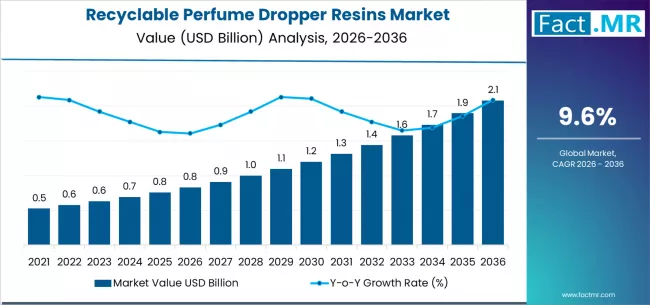
The global market for recyclable perfume dropper resins is emerging as a critical solution to a longstanding sustainability bottleneck in luxury packaging, projected to expand from USD 0.83 billion in 2026 to USD 2.08 billion by 2036, advancing at a notable 9.6% CAGR.
Summary of Recyclable Perfume Dropper Resins Market
Market Snapshot
Global recyclable perfume dropper resins market revenue stood at USD 0.83 billion in 2026 and is forecast to reach USD 2.08 billion by 2036.
At aCAGRof 9.6% from 2026 to 2036, this market adds USD 1.25 billion in absolute opportunity, growing ~2.51x in value.
Growth is driven by the urgent need to deconstruct the complex, multi-material assembly of traditional perfume dispensers into mono-material or easily separable, fully recyclable systems.
Market innovation is intensely focused on developinghigh-purity,odorlessresins meeting exacting fragrance compatibility standards, alongside designing all-resin mechanisms thatmaintainpremium aesthetics and recyclability.
Demand and Growth Drivers
Tightening global regulatory landscape around packaging waste, particularly extended producer responsibility schemes, makes brands financially responsible for end-of-life packaging outcomes.
Consumer demand for sustainable luxury is potent, with purchasers increasingly valuing brands thatdemonstratetangible circularity, especially in the premium fragrance sector.
Push for mono-material packaging to simplify recycling streams directly targets the complex assembly of perfume droppers, creating a clear mandate for material innovation.
Development of all-resin, mono-material dropper assemblies designed for easy consumer disassembly and snap-fit assemblieseliminatingglue are key emerging trends.
Integration ofQRcodes on packaging to instruct consumers on proper recycling steps for new dropper systems is broadening market reach and compliance.
Product and Segment View
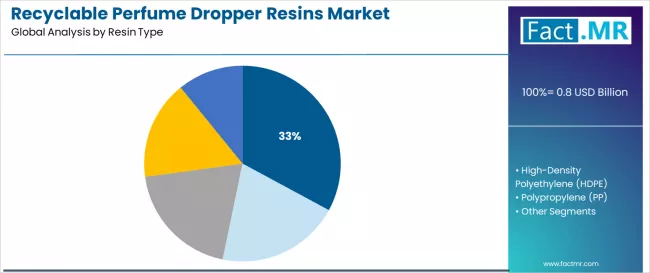
Polyethylene terephthalate (PET) leads the resin type segment with 33% market share in 2026,favoredfor clarity, chemical resistance, and established recycling infrastructure globally.
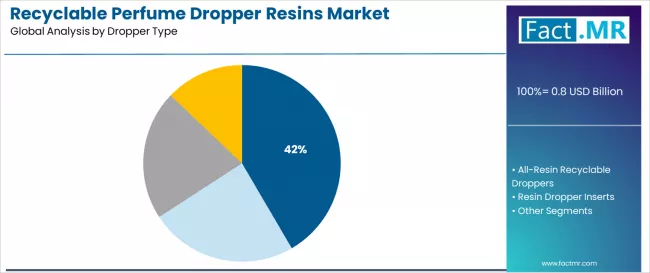
Glass dropper bottles with recyclable resin caps dominate the dropper type segment with 42% share in 2026,representingthe most scalable first step toward circularity for established perfume houses.
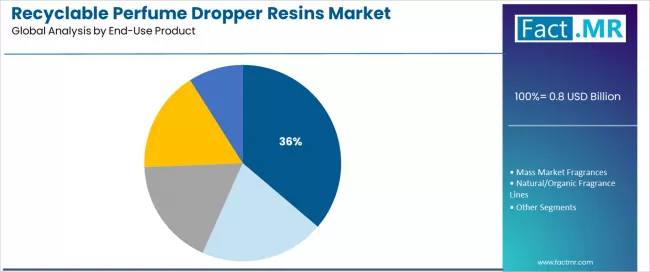
Premium perfume is the leading end-use product segment with 36% share in 2026, where luxury brands face intense pressure to adopt sustainable practices without compromising sensory experience.
Additionalresin types include High-Density Polyethylene, Polypropylene, and Bio-Based/Sustainable Resins; other dropper types include All-Resin Recyclable Droppers and Resin Dropper Inserts.
Geography and Competitive Outlook
Key growth regions include North America, Latin America, Western Europe, Eastern Europe, East Asia, South Asia & Pacific, and Middle East & Africa.
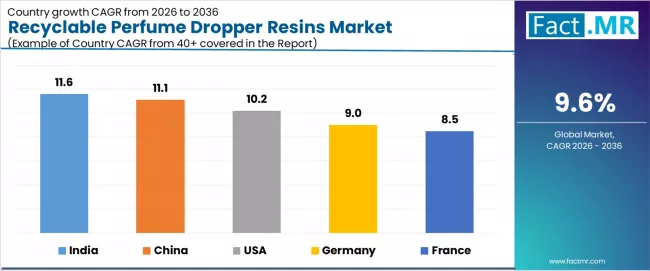
India leads country-level growth at 11.6%CAGR, driven by rapidly expanding middle class with growing premium fragrance appetite alongside new national packaging waste rules.
China (11.1%CAGR) stems from its position as the world's primary packaging manufacturing hub and its own booming domestic luxury consumption.
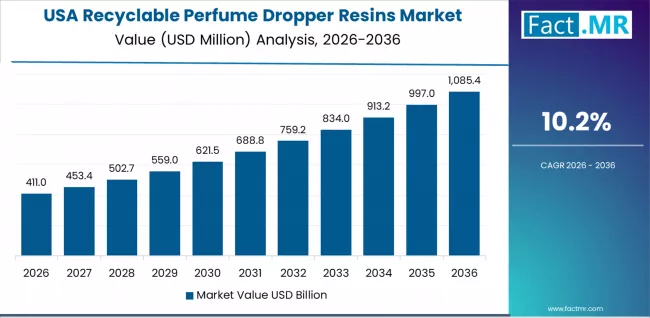
USA (10.2%CAGR) driven by extensive corporate sustainability targets from major fragrance houses and a culture of brand-led packaging innovation.
Germany (9.0%CAGR) a direct consequence of strict packaging law and advanced engineering capabilities prioritizing designs engineered for disassembly and high-quality material recovery.
France (8.5%CAGR) deeply intertwined with its status as the historic heart of global perfumery, demanding recyclable solutions of the utmost quality and aesthetic refinement.
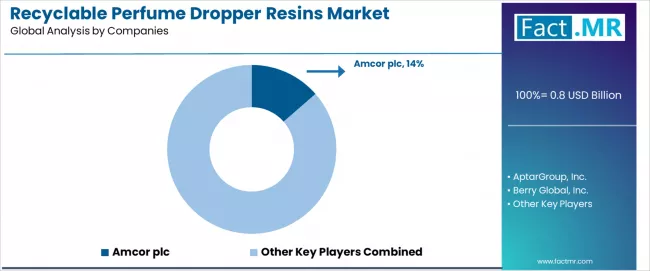
Key companies active in this market include Amcor plc, AptarGroup, Inc., Berry Global, Inc.,Albéa(GroupePochet), andHCTGroup.
Recyclable Perfume Dropper Resins Market — At a Glance
Attribute
Details
Market Value 2026
USD 0.83 Billion
Market Value 2036
USD 2.08 Billion
Absolute Dollar Opportunity 2026-2036
USD 1.25 Billion
Total Growth 2026-2036
150.60%
CAGR2026-2036
9.6%
Growth Multiple
~2.51x
Key Demand Theme
Deconstruction of complex multi-material perfume dropper assemblies into mono-material, recyclable resin systems meeting luxury fragrance compatibility and premium aesthetic standards
Leading Segment by Resin Type (2026)
Polyethylene Terephthalate (PET)
Resin Type Segment Share (2026)
33%
Leading Segment by Dropper Type (2026)
Glass Dropper Bottles with Recyclable Resin Caps
Dropper Type Segment Share (2026)
42%
Leading Segment by End-Use Product (2026)
Premium Perfume
End-Use Product Segment Share (2026)
36%
Key Growth Regions
North America, Latin America, Western Europe, Eastern Europe, East Asia, South Asia & Pacific, Middle East & Africa
CountryCAGRs
India 11.6%, China 11.1%, USA 10.2%, Germany 9.0%, France 8.5%
North America, Latin America, Western Europe, Eastern Europe, East Asia, South Asia & Pacific, Middle East & Africa
Source: Fact.MR analysis. Updated Apr 10, 2026
This growth is driven by the urgent need to deconstruct the complex, multi-material assembly of traditional perfume dispensers, often combining glass, metal springs, and multiple plastics, into a mono-material or easily separable, fully recyclable system. Polyethylene terephthalate leads resin types with a 33% share, favored for its clarity, chemical resistance, and established recycling infrastructure. The dominant format is glass dropper bottles with recyclable resin caps (42%), representing a pragmatic first step toward circularity. Premium perfumes are the primary end-use (36%), where luxury brands are leveraging sustainable innovation to enhance brand value and meet stringent ESG goals. Market innovation is intensely focused on developing high-purity, odorless resins that meet the exacting compatibility standards for fine fragrances, alongside designing clever cap-and-dropper mechanisms that maintain premium aesthetics and functionality while ensuring material purity for recycling streams.
North America, Latin America, Western Europe, Eastern Europe, East Asia, South Asia & Pacific, MEA
Source: Fact.MR analysis. Updated Apr 10, 2026
Segmental Analysis
By Resin Type, Which Material Offers Clarity and Recyclability?
Recyclable Perfume Dropper Resins Market Analysis By Resin Type | Source: Fact.MR
Polyethylene terephthalate holds a leading 33% market share, primarily due to its excellent clarity, which allows for the premium visual appeal required for fragrance caps and inserts. Its strong barrier properties help protect fragrance integrity, and its status as one of the most widely recycled plastics globally provides a clear end-of-life pathway.
Advanced PET grades engineered for high precision molding and enhanced chemical resistance to perfume alcohols are becoming the standard for brands seeking a balance of luxury and sustainability.
By Dropper Type, Which Format is the Current Industry Workhorse?
Recyclable Perfume Dropper Resins Market Analysis By Dropper Type | Source: Fact.MR
Glass dropper bottles with recyclable resin caps constitute the dominant segment with a 42% share. This format addresses the most immediate recyclability issue, the traditional metal-and-plastic assembly, by replacing it with a single-material plastic cap and dropper mechanism.
It allows brands to retain the heavy, premium feel of glass for the primary container while making a significant, visible step toward circularity. This hybrid approach is often the first and most scalable move for established perfume houses.
By End-Use Product, Which Segment Demands the Highest Performance Standards?
Recyclable Perfume Dropper Resins Market Analysis By End Use Product | Source: Fact.MR
Premium perfume is the leading end-use segment, accounting for 36% of the market. Luxury and niche fragrance brands face intense consumer and investor pressure to adopt sustainable practices without compromising the exquisite sensory experience of their products.
The resins used must be absolutely inert, preventing any interaction with the fragrance, and must be capable of being molded into complex, finely detailed components that meet the highest aesthetic standards, justifying their investment in advanced recyclable material solutions.
What are the Drivers, Restraints, and Key Trends of the Recyclable Perfume Dropper Resins Market?
The primary market driver is the tightening global regulatory landscape around packaging waste, particularly extended producer responsibility schemes that make brands financially responsible for the end-of-life of their packaging.
Consumer demand for sustainable luxury is equally potent, with purchasers increasingly valuing brands that demonstrate tangible circularity. The push for mono-material packaging to simplify recycling streams directly targets the complex assembly of perfume droppers, creating a clear mandate for innovation.
A significant market restraint is the technical difficulty of creating a resin dropper mechanism that replicates the precise, smooth functionality and feel of traditional designs that often rely on metal springs and ball bearings.
The risk of fragrance interaction or migration with new resin formulations requires extensive and costly stability testing. Furthermore, the current lack of specialized collection and sorting infrastructure for these small, complex items could undermine their recyclability in practice, leading to skepticism.
Key trends include the development of all-resin, mono-material dropper assemblies designed for easy disassembly by consumers. There is significant investment in bio-based and biodegradable resins for components that may not be captured in recycling.
Smart design trends focus on snap-fit assemblies that eliminate glue and facilitate separation. Brands are also beginning to integrate QR codes on packaging to instruct consumers on the proper recycling steps for these new dropper systems.
Analysis of the Recyclable Perfume Dropper Resins Market by Key Countries
Recyclable Perfume Dropper Resins Market Cagr Analysis By Country | Source: Fact.MR
Country
CAGR (2026-2036)
India
11.6%
China
11.1%
USA
10.2%
Germany
9.0%
France
8.5%
Source: Fact.MR analysis. Updated Apr 10, 2026
How is India's Growing Affluent Consumer Base and Regulatory Shift Driving Demand?
India's leading CAGR of 11.6% is propelled by a rapidly expanding middle class with growing appetite for premium fragrances, alongside new national packaging waste rules. Domestic and international brands are adapting packaging for this price-sensitive yet increasingly eco-conscious market.
Demand is for cost-effective recyclable resin solutions that can be manufactured locally, often using HDPE and PP, which align with India's existing plastic waste management and recycling flows.
What is the Impact of China's Dual Role as Manufacturing Center and Luxury Market?
China's 11.1% growth stems from its position as the world's primary packaging manufacturing hub and its own booming domestic luxury consumption. Chinese packaging suppliers are innovating rapidly to provide global brands with compliant, recyclable dropper solutions.
The scale of production enables fast iteration on mono-material designs. Simultaneously, Chinese perfume brands are emerging, often launching with sustainable positioning from the start, which fuels early adoption of these advanced resin systems.
Why does the USA's Corporate Sustainability Push and Brand Innovation Sustain Growth?
Recyclable Perfume Dropper Resins Market Country Value Analysis | Source: Fact.MR
Extensive corporate sustainability targets drive the USA’s 10.2% growth from major fragrance houses and retailers, coupled with a culture of brand-led innovation. American consumers are responsive to clear sustainability stories.
The market demands high-performance, drop-in recyclable solutions that require minimal changes to existing filling lines and brand aesthetics. There is also strong activity in the natural fragrance segment, where sustainable packaging is a core brand mandate.
How is Germany's Engineering Prowess and Green Legislation Shaping the Market?
Germany's 9.0% CAGR is a direct consequence of its strict packaging law and advanced engineering capabilities. The market prioritizes designs that are not only recyclable but are engineered for disassembly and high-quality material recovery.
German suppliers focus on precision-molded resin components with exceptional chemical resistance and longevity, supporting the country's reputation for quality and its circular economy ambitions.
What Role does France's Heritage in Perfumery and Luxury Play?
France's 8.5% growth is deeply intertwined with its status as the historic heart of the global perfume industry. French luxury houses are under particular scrutiny to lead on sustainability without diluting brand heritage.
This drives demand for recyclable resin solutions of the utmost quality and aesthetic refinement. Innovation here is closely tied to preserving the luxurious user experience, the click of the cap and the smooth action of the dropper, while seamlessly integrating recycled or bio-based content.
Competitive Landscape of the Recyclable Perfume Dropper Resins Market
Recyclable Perfume Dropper Resins Market Analysis By Company | Source: Fact.MR
Global packaging leaders with strong positions in beauty and luxury, competing on material science, design IP, and closed-loop service models, define the competitive landscape. Competition is intensifying around proprietary mono-material dropper designs, partnerships with resin producers to develop custom sustainable grades, and the ability to provide full lifecycle analysis for brands. Success depends on deep collaboration with fragrance houses to co-develop solutions and secure long-term contracts as brands redesign entire packaging lines for circularity.
Key Players in the Recyclable Perfume Dropper Resins Market
Chemical compatibility and migration testing with diverse fragrance compounds; lifecycle assessment comparing multi-material vs. mono-material dropper assemblies; consumer interaction and disassembly studies; recycling infrastructure compatibility and sortability testing; economic modeling of closed-loop take-back programs for perfume packaging.
Source: Fact.MR analysis. Updated Apr 10, 2026
Market by Segments
Resin Type :
Polyethylene Terephthalate
High-Density Polyethylene
Polypropylene
Bio-Based/Sustainable Resins
Others
Dropper Type :
Glass Dropper Bottles with Recyclable Resin Caps
All-Resin Recyclable Droppers
Resin Dropper Inserts
Others
End-Use Product :
Premium Perfume
Mass Market Fragrances
Natural/Organic Fragrance Lines
Travel & Sample Sizes
Others
Region :
North America
USA
Canada
Latin America
Brazil
Mexico
Argentina
Rest of Latin America
Western Europe
Germany
UK
France
Spain
Italy
BENELUX
Rest of Western Europe
Eastern Europe
Russia
Poland
Czech Republic
Rest of Eastern Europe
East Asia
China
Japan
South Korea
Rest of East Asia
South Asia & Pacific
India
ASEAN
Australia
Rest of South Asia & Pacific
MEA
Saudi Arabia
UAE
Turkiye
Rest of MEA
References
Boz, Z., Korhonen, V., & Koelsch Sand, C. (2023). Consumer considerations for the implementation of sustainable packaging: A review. Journal of Cleaner Production, 252, 119889.
Deshwal, G. K., & Panjagari, N. R. (2023). Review on role of packaging in luxury product preservation and sustainability. Packaging Technology and Science, 36(5), 301-315.
Huang, J., & Liang, J. (2024). Sustainable packaging design for the cosmetics and fragrance industry. International Journal of Sustainable Design, 5(2), 112-128.
Magnier, L., & Crie, D. (2023). Communicating packaging eco-friendliness in the luxury sector. Journal of Business Research, 144, 890-902.
Molina-Besch, K., & Wikström, F. (2024). The environmental impact of luxury packaging: A focus on perfumery. Packaging Technology and Science, 37(3), 155-170.
Pauer, E., & Wohner, B. (2024). Assessing the recyclability of multi-material packaging: The case of perfume dispensers. Waste Management, 174, 450-459.
Ribeiro, I., & Peças, P. (2023). Life cycle assessment of packaging systems for perfume products. The International Journal of Life Cycle Assessment, 28(4), 411-426.
Svanes, E., & Oestergaard, S. (2024). Sustainable packaging design for circular economy: A framework. Journal of Industrial Ecology, 28(2), 345-360.
Williams, H., & Wikström, F. (2023). The influence of packaging attributes on consumer recycling behavior. Waste Management, 145, 44-51.
Wyrwa, J., & Barska, A. (2024). Innovations in sustainable packaging for the luxury cosmetics market. Sustainability, 16(6), 2501.
Questions Answered
Frequently Asked Questions
How big is the recyclable perfume dropper resins market in 2026?
The global recyclable perfume dropper resins market is estimated to be valued at USD 0.8 billion in 2026.
What will be the size of recyclable perfume dropper resins market in 2036?
The market size for the recyclable perfume dropper resins market is projected to reach USD 2.1 billion by 2036.
How much will be the recyclable perfume dropper resins market growth between 2026 and 2036?
The recyclable perfume dropper resins market is expected to grow at a 9.6% CAGR between 2026 and 2036.
What are the key product types in the recyclable perfume dropper resins market?
The key product types in recyclable perfume dropper resins market are polyethylene terephthalate (pet), high‑density polyethylene (hdpe), polypropylene (pp), bio‑based/sustainable resins and others.
Which dropper type segment to contribute significant share in the recyclable perfume dropper resins market in 2026?
In terms of dropper type, glass dropper bottles with recyclable resin caps segment to command 41.6% share in the recyclable perfume dropper resins market in 2026.