Compressed Air Lubricator Market Size, Share, Growth and Forecast (2026 - 2036)

The Compressed Air Lubricator Market is segmented by Product Type, Lubricator Type , Operation / Type , Lubrication, Flow Capacity, Pressure Range, Installation Type, Distribution Channel, End-Use Industry, and Region, with forecasts covering the period from 2026 to 2036.

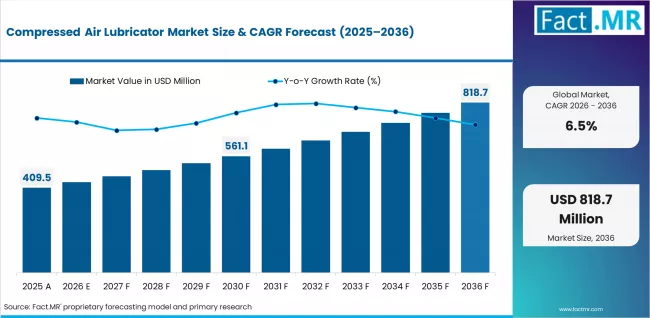
According to Fact.MR estimates, the compressed air lubricator market was valued at USD 409.5 million in 2025 and is projected to reach USD 436.1 million in 2026, further growing to USD 818.7 million by 2036, at a CAGR of 6.5%. Industrial applications will remain dominant, accounting for around 43.1% share by 2036, while process industries will be the fastest-growing segment, reaching approximately 21.1% share, driven by demand in food, beverage, and pharmaceutical sectors. Growth is supported by increasing automation and rising adoption of integrated FRL systems and automatic lubricators, along with a shift toward more efficient lubrication technologies.

Compressed Air Lubricator Market Overview, Growth Outlook, and Forecast By Fact.MR

The Compressed Air Lubricator Market was valued at USD 409.5 million in 2025 and is expected to grow at a CAGR of 6.5% to reach USD 818.7 million by 2036. Expanding at a CAGR of 6.5% during 2026–2036, the market is projected to grow approximately 1.9x, creating an absolute opportunity of around USD 382.6 million in 2036 compared to 2026
Compressed Air Lubricator Market Market Value Analysis

Summary of the Compressed Air Lubricator

  • Market Snapshot
    • In 2025, the size of the global Compressed Air Lubricator Market was about USD 409.5 million.
    • The market is expected to grow from USD 436.1 million in 2026 to an estimated USD 818.7 million by 2036.
    • The market is projected to expand at a CAGR of 6.5% during the forecast period.
    • The market is expected to generate an absolute dollar opportunity of around USD 382.6 million from 2026 to 2036.
    • Industrial applications hold a dominant position in 2026 by end-use industry, driven by strong demand from manufacturing, metal & machinery, and chemical sectors.
    • Key growth markets during the forecast period are India at 8.5% CAGR, Japan at 8.4% CAGR, and China at 8.1% CAGR, supported by rapid industrialization, increasing automation adoption, and expansion of pneumatic systems across manufacturing and process industries.
    • Key growth markets during the forecast period are India at 8.5% CAGR, Japan at 8.4% CAGR, and China at 8.1% CAGR, supported by rapid industrialization, increasing automation adoption, and expansion of pneumatic systems across manufacturing and process industries.
  • Demand and Growth Drivers
    • Growing penetration of industrial automation and pneumatic systems in the end-use industries is expected to drive the need for compressed air lubricators to enhance the smooth operation and life of the equipment.
    • Growing demand for maintenance efficiency and minimized wear and tear on equipment is driving the utilization of lubricants, especially for high-speed pneumatic tools and automated production lines.
    • Increasing demand for integrated FRL (filter–regulator–lubricator) packages is contributing to the market growth as the industry trends lean toward compact, minimal cleaning, air preparation units.
    • Growth of process industries such as food & beverage and pharmaceuticals is fostering the demand for regulated and effective lubrication solutions.
    • Industrialization is progressing rapidly in the developing world, particularly the Asia-Pacific where heavy concentration of the global population lies, adoption of pneumatic systems is being accelerated and consequently the oil lubricator market is getting boosted.
    • Emerging technologies including automatic lubricators, micro-fog lubrication systems and minimum lubrication systems which enhance the productivity and reduce the oil consumption are driving the market.
    • While, increasing popularity of oil-free compressed air systems for use in clean sensitive industry is a restraint for the traditional lubricator sales.
  • Product and Segment View
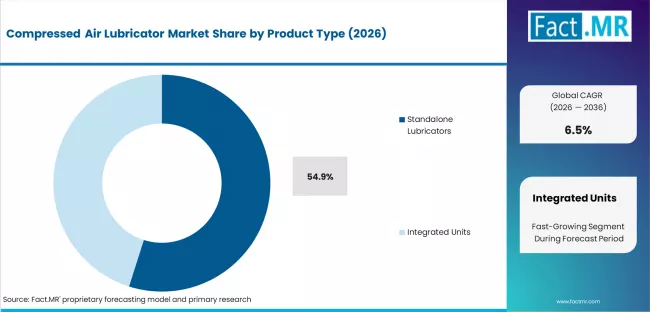
    • Standalone Lubricators lead the product type segment with a 54.9% share, driven by their widespread use in existing pneumatic systems and standalone applications across industries.
    • Integrated Units follow with a 45.1% share, supported by increasing adoption of compact and efficient FRL systems in modern industrial setups.
    • Automatic Lubricators dominate the operation segment with a 61.2% share, driven by rising automation and demand for consistent, low-maintenance lubrication systems.
    • Manual Lubricators account for a 38.8% share, supported by continued use in small-scale and cost-sensitive applications.
    • Oil-mist Lubrication leads the lubrication method segment with a 44.2% share, owing to its widespread adoption in conventional pneumatic systems.
    • Micro-fog Lubrication follows with a 27.8% share, benefiting from higher efficiency and reduced oil consumption in advanced applications.
    • Industrial Applications lead the end-use industry segment with a 45.8% share, driven by strong demand from manufacturing, metal & machinery, and chemical industries.
    • Automotive Sector follows with a 20.3% share, supported by usage in assembly lines and workshop operations.
  • Geography and Competitive Outlook
    • Asia Pacific is the most dynamic region in the compressed air lubricator market, with India, China, and Japan leading the growth, owing to rapid industrialization, growing manufacturing sector, and rising usage of automation and pneumatic systems.
    • North America and Western Europe are considered developed markets, with high penetration of sophisticated pneumatic systems, strong aftermarket demand, and a shifting towards energy-efficient and consolidated air preparation products.
    • SMC Corporation, Festo, Parker Hannifin, IMI plc (Norgren), Airtac International Group, Camozzi Group, CKD Corporation, Metal Work S.p.A., Emerson Electric Co., and Bosch Rexroth are some of the leading companies in the market.
  • Analyst Opinion
    • Shambhu Nath Jha, Principal Consultant at Fact.MR, says the compressed air lubricator market is set to grow steadily, driven by increasing industrial automation, expansion of manufacturing activities, and rising adoption of pneumatic systems. “Growing demand for efficient and low-maintenance air preparation systems is accelerating the adoption of integrated FRL units and automatic lubricators. Advancements in lubrication technologies such as micro-fog and minimal lubrication systems are enhancing efficiency and reducing oil consumption.

Compressed Air Lubricator Market — At a Glance

Attribute Details
Market Value 2025 USD 409.5 Million
Market Value 2026 USD 436.1 Million
Market Value 2036 USD 818.7 Million
Absolute Dollar Opportunity USD 382.6 Million
Total Growth 87.70%
CAGR 6.50%
Growth Multiple 1.9x
Key Demand Theme Rising industrial automation, increasing adoption of pneumatic systems, demand for efficient lubrication, and growth in manufacturing and process industries
Leading End User Industrial Applications
End User Share 45.80%
Leading Product Type Standalone Lubricators
Product Share 54.90%
Leading Operation Type Automatic Lubricators
Operation Share 61.20%
Leading Lubrication Method Oil-mist Lubrication
Method Share 44.20%
Leading Flow Capacity Medium Flow (500–3000 L/min)
Flow Share 43.50%
Leading Pressure Range Medium Pressure (5–10 bar)
Pressure Share 55.10%
Leading Installation Type Point-of-Use Lubricators
Installation Share 61.80%
Leading Application Pneumatic Tools
Key Growth Regions Asia-Pacific, North America, Europe
Key Companies SMC Corporation, Festo, Parker Hannifin, IMI plc (Norgren), Airtac International Group, Camozzi Group, CKD Corporation, Metal Work S.p.A., Emerson Electric Co., Bosch Rexroth
Segmentation by Product Type Standalone Lubricators, Integrated Units (FRL Units, Modular Air Preparation Assemblies)
Segmentation by Lubricator Type Inline Lubricators, Modular Lubricators, Micro-fog Lubricators
Segmentation by Operation / Type Automatic Lubricators, Manual Lubricators
Segmentation by Lubrication Method Oil-mist Lubrication, Micro-fog Lubrication, Drop Feed Lubricators, Dry / Minimal Lubrication Systems
Segmentation by Flow Capacity Low Flow (≤ 500 L/min), Medium Flow (500–3000 L/min), High Flow (> 3000 L/min)
Segmentation by Pressure Range Low Pressure (< 5 bar), Medium Pressure (5–10 bar), High Pressure (> 10 bar)
Segmentation by Installation Type Point-of-Use Lubricators, Centralized Lubrication Systems
Segmentation by Distribution Channel Direct Sales, OEMs, Distributors / Wholesalers, Online Sales
Segmentation by End-User Industry Industrial Applications, Automotive Sector, Process Industries, Other Applications
Segmentation by Region North America, Latin America, East Asia, South Asia & Pacific, Western Europe, Eastern Europe, Middle East & Africa

Key Growth Drivers, Constraints, and Opportunities
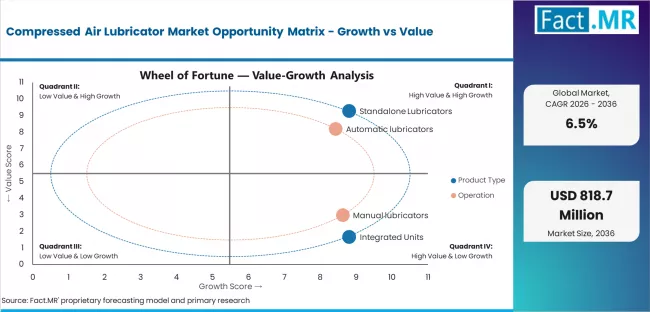
Compressed Air Lubricator Market Opportunity Matrix Growth Vs Value

Key Factors Driving Growth

  • The growing adoption of industrial automation and pneumatic systems in manufacturing is creating a high need for dependable lubrication that can provide operational efficiency and equipment life.
  • Expansion of the manufacturing, automotive and process (food, pharmaceuticals, chemicals) industries is generating steady compressed air lubricators demand.
  • Growing preference for integrated FRL units and smaller air preparation modules are positively impacting market growth by increasing system efficiency and reducing maintenance.
  • Innovations in lubrication technologies such as micron-fog, minimal lubrication, and automatic lubricators are improving performance, and oil consumption is decreasing.
  • The pneumatic systems and associated components are witnessing gaining pace of adoption due to the rapid industrialization in developing countries especially India and China.
Growth Driver Demand Impact Time Horizon Key Impact Area Fact.MR Insight
Rising industrial automation and adoption of pneumatic systems High Short–Mid Term Adoption acceleration Increasing use of pneumatic tools, cylinders, and automation lines is driving strong demand for reliable lubrication systems to ensure performance and durability.
Expansion of manufacturing and process industries (food, pharma, chemicals) High Short–Mid Term Industry demand growth Growth in regulated and high-precision industries is boosting demand for efficient and controlled lubrication solutions in pneumatic systems.
Increasing adoption of integrated FRL systems and compact air preparation units Medium-High Mid Term Product integration & system efficiency Industries are shifting toward integrated solutions for improved efficiency, reduced maintenance, and space optimization in compressed air systems.
Advancements in lubrication technologies (micro-fog, minimal lubrication, automatic systems) Medium-High Mid–Long Term Product innovation & efficiency Continuous innovation is enhancing lubrication precision, reducing oil consumption, and improving system performance across applications.
Growth of industrialization in emerging markets (Asia-Pacific) Medium Short–Mid Term Regional expansion & infrastructure development Rapid industrial growth in countries like India and China is increasing adoption of pneumatic systems, supporting lubricator demand.

Key Market Constraints

  • Increasing use of oil-free compressed air in sensitive industries is diminishing the demand for lubricators.
  • Oil contamination risk restricts application in food, pharmaceutical and electronics application.
  • The result is an increase in the complexity of operations with lubricated air systems due to the extra maintenance and filtration demands.
  • The need for external lubrication systems is reduced by the availability of pre-lubricated and self-lubricating parts.

Key Opportunity Areas

  • Increasing demand for automatic and smart lubricators integrated with industrial automation systems.
  • Growth in aftermarket and replacement demand for existing pneumatic systems, especially in developing regions.
  • Development of low-oil and precision lubrication technologies to meet efficiency and environmental requirements.
  • Expansion of industrial infrastructure and manufacturing capacity in emerging markets creating new demand opportunities.

Segment-wise Analysis of the Compressed Air Lubricator Market

  • Standalone Lubricators lead the product type segment with a 54.9% share, driven by their widespread use in legacy systems and cost-effective standalone applications.
  • Automatic Lubricators dominate the operation segment with a 61.2% share, supported by increasing automation and demand for consistent, low-maintenance lubrication.
  • Industrial Applications hold the largest share at 45.8%, fueled by strong demand from manufacturing, metal & machinery, and chemical industries.

The global analysis has been provided by product type, operation, lubrication, flow capacity, pressure range, installation, distribution channel, end-user, and country.

Which Product Type Segment Leads the Compressed Air Lubricator Market?
Compressed Air Lubricator Market Analysis By Product Type

Standalone Lubricators lead the market, holding a 54.9% share in 2026. This dominance is driven by their widespread use in legacy pneumatic systems and cost-effective deployment across industrial applications where flexibility and ease of installation are critical.

Which Operation Type Accounts for the Highest Share in the Market?
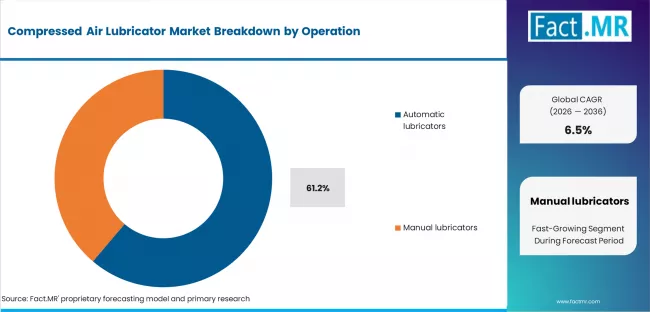
Compressed Air Lubricator Market Analysis By Operation

Automatic Lubricators dominate the segment with a 61.2% share in 2026, supported by increasing automation and the need for consistent, low-maintenance lubrication in high-cycle industrial operations.

Which Lubrication Method Holds the Largest Share in the Market?
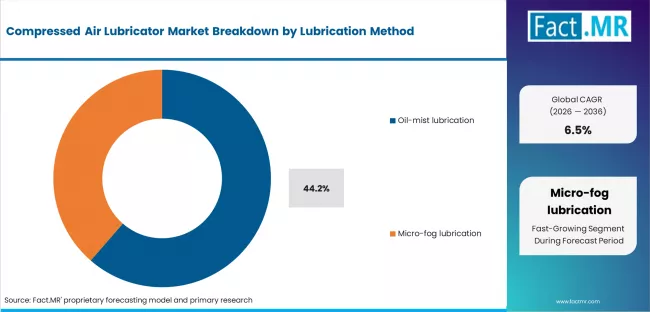
Compressed Air Lubricator Market Analysis By Lubrication Method

Oil-mist Lubrication leads with a 44.2% share in 2026, owing to its extensive use in conventional pneumatic systems across manufacturing and automotive industries.

Which Flow Capacity Segment Commands the Highest Share?
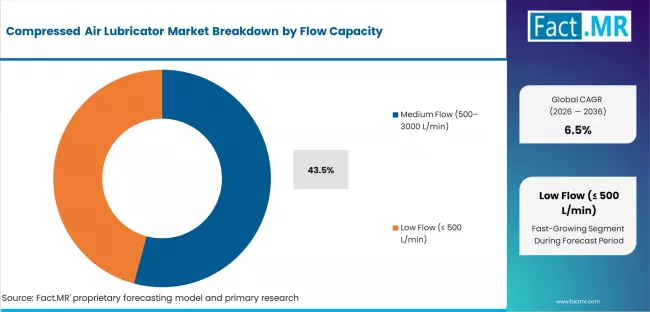
Compressed Air Lubricator Market Analysis By Flow Capacity

Medium Flow (500–3000 L/min) holds the largest share at 43.5% in 2026, as it meets the requirements of a broad range of standard industrial applications.

Which Pressure Range Segment Leads the Market?
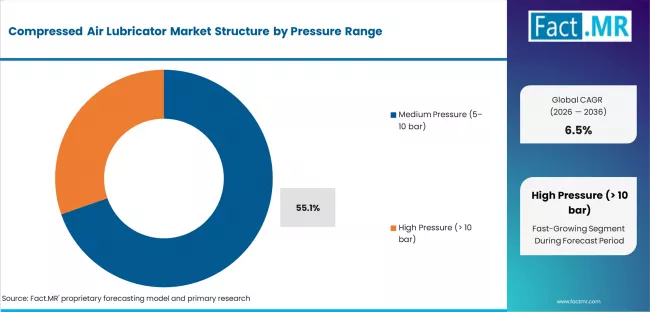
Compressed Air Lubricator Market Analysis By Pressure Range

Medium Pressure (5–10 bar) dominates with a 55.1% share in 2026, reflecting its role as the standard operating range for most pneumatic systems.

Which Installation Type Holds the Largest Share?
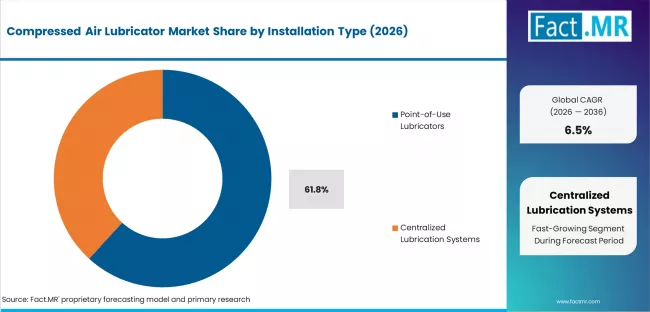
Compressed Air Lubricator Market Analysis By Installation Type

Point-of-Use Lubricators lead with a 61.8% share in 2026, driven by their flexibility and widespread use across individual machines and decentralized systems.

Which End-Use Industry Segment Leads the Market?
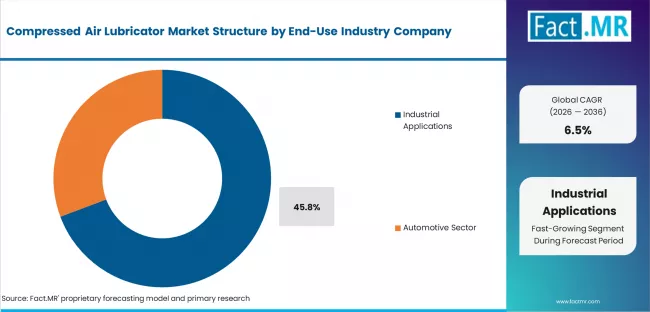
Compressed Air Lubricator Market Analysis By End Use Industry

Industrial Applications dominate the market with a 45.8% share in 2026, supported by strong demand from manufacturing, metal & machinery, and chemical industries where pneumatic systems are widely used.

Regional Outlook Across Key Markets

  • India would lead the growth with a rate of ~8.5 % to be the fastest growing market owing to rapid industrialization, growth of manufacturing industries and growing use of automation. SMEs, automotive workshops and process industries have a notable contribution towards rise in demand from pneumatic systems and lubricators.
  • The US, being a lucrative market, is anticipated to hold a significant share, with a growth rate of ~5.7% owing to high demand from advanced manufacturing, automation, and remanufacture of pneumatic parts. Efficient and integrated FRL systems stability in the market is expected to be more supported by the movement of.
  • Europe is growing steadily, Germany is expected to account for 4.4%, due to the market maturity and popularity of efficient oil free systems. Italy is anticipated to register a growth of 7.1%, owing to the strong presence of industrial machinery and manufacturing industry.

Top Country Growth Comparison Compressed Air Lubricator Market Cagr (2026 2036)

CAGR Table

Country CAGR (%)
India 8.5%
Japan 8.4%
China 8.1%
Italy 7.1%
United States 5.7%
South Korea 5.5%
Germany 4.4%

Source: Fact.MR (FMR) analysis, based on proprietary forecasting model and primary research.
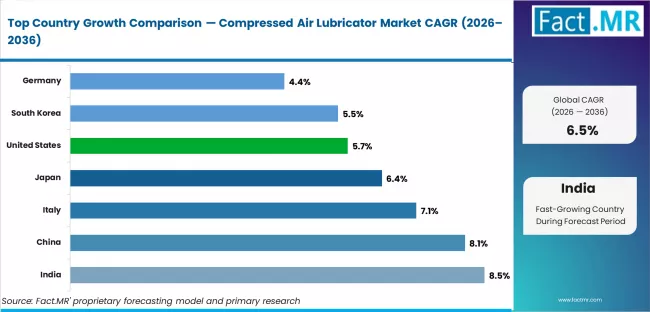
Compressed Air Lubricator Market Cagr Analysis By Country

North America – The Mature Industrial & Automation Hub

North America is mature market being influenced by high-tech manufacturing, automation and robust after market demand. The region is targeted towards efficiency enhancements, system modifications / upgrades and turnkey solutions including integrated air preparation. Usage of oil-free technology in regulated industries is impacting market trends.

  • U.S.: Demand is projected to grow at 5.7% CAGR, supported by industrial automation, replacement demand, and expansion in manufacturing sectors.
  • Canada: Expected to witness steady growth, driven by industrial activities and increasing adoption of efficient pneumatic systems.

Europe – The Efficiency & Precision Engineering Market
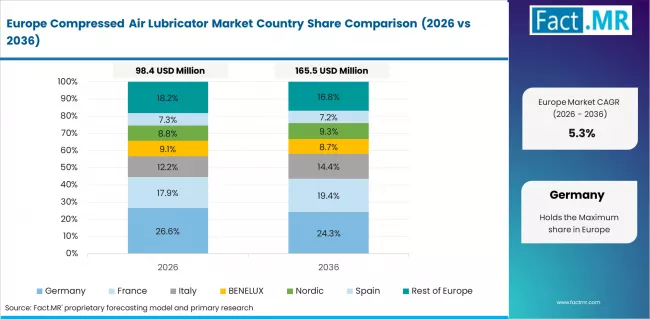
Compressed Air Lubricator Market Europe Country Market Share Analysis, 2026 & 2036

Europe is characterized by stringent industrial standards, energy efficiency focus, and high adoption of advanced pneumatic systems. The region is gradually shifting toward oil-free and precision lubrication technologies.

  • Germany: Expected to grow at 4.4% CAGR, reflecting market maturity and adoption of high-efficiency systems.
  • Italy: Projected to grow at 7.1% CAGR, supported by strong machinery manufacturing and industrial base.

Asia-Pacific – The Industrial Growth Engine
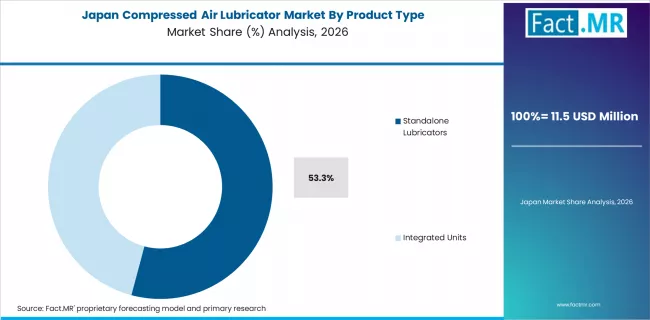
Compressed Air Lubricator Market Japan Market Share Analysis By Product Type

The region of Asia-Pacific has witnessed the highest growth due to the fast-paced industrialization, growing manufacturing sector, and rising adoption of automation. growing infrastructure and SMEs investment are driving the market for pneumatic systems.

  • China: Expected to grow at 8.1% CAGR, supported by large-scale manufacturing and industrial expansion.
  • Japan: Growth at 8.4% CAGR, driven by automation, robotics, and precision manufacturing.
  • India: Leading growth at 8.5% CAGR, fueled by industrial expansion, SMEs, and increasing adoption of pneumatic tools.

Latin America – The Emerging Industrial Market

Latin America is a emerging market, where growth is fueled by industrial growth, development of automotive industry, and growth in use of pneumatic systems.

  • Brazil: Expected to witness steady growth, supported by manufacturing and infrastructure development.

Middle East & Africa – The Infrastructure Development Zone

The Middle East & Africa is an emerging region where demand is driven by industrial diversification, infrastructure projects, and oil & gas sector activities. Adoption of pneumatic systems is increasing gradually.

  • Saudi Arabia (KSA): Demand is expected to grow steadily, supported by industrial expansion and infrastructure investments.

Fact.MR’s analysis of the Compressed Air Lubricator Market indicates strong regional momentum, with Asia-Pacific emerging as the fastest-growing region, while North America and Europe remain mature markets focused on efficiency, automation, and system optimization, shaping the global demand for pneumatic lubrication solutions.

Competitive Benchmarking and Company Positioning

Leading Companies Shaping the Compressed Air Lubricator Market
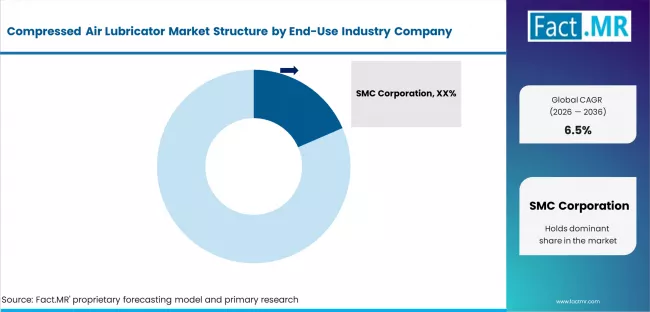
Compressed Air Lubricator Market Analysis By Company

The market is consolidated by top 5 players such as SMC, Festo, IMI, Parker Hannifin, and Emerson. They together hold 50 – 55% of the total market share. The competitive nature of the market is a result of the reliability of the products, integration with FRL system, automation compatibility and TCO.

The world leaders have strong brand, distribution and OEM relationship to provide native end-to-end solutions in Pneumatic systems, which is key point in industrial Application. With industry trends pointing towards greater automation, more efficient air systems and a general shift to oil-free technology, the market is getting even more competitive. End-users are now adopting multi vendor sourcing strategies for flexibility and cost effectiveness, and prefer those vendors who can deliver effective, scalable, and low maintenance solutions.

Recent Industry Developments

  • SMC Corporation Launches In-line Air Filter ZFD Series (2025)
    • SMC Corporation introduced the In-line Air Filter (ZFD Series) to enhance compressed air quality and system reliability. The product is designed to remove contaminants from compressed air streams, supporting efficient operation of pneumatic systems. This development strengthens SMC’s air preparation portfolio, which includes FRL systems where lubricators play a critical role in ensuring equipment longevity and performance.
  • Festo Launches AX Motion Insights Electric for AI-Based Monitoring (2025)
    • Festo launched AX Motion Insights Electric, an AI-based monitoring solution designed to enable predictive maintenance and improve performance of motion systems. The platform enhances system reliability through data-driven insights and condition monitoring. While focused on electric drive systems, the solution reflects the broader industry shift toward intelligent automation and system optimization, indirectly influencing pneumatic system efficiency and maintenance strategies.
  • SMC Corporation Launches Air Saving Impact Blow Valve IBV Series (2025)
    • SMC Corporation introduced the Air Saving Impact Blow Valve (IBV Series) to significantly reduce compressed air consumption while maintaining performance. The solution improves energy efficiency in pneumatic applications by optimizing air usage, which directly impacts lubrication requirements and overall system efficiency. This innovation supports the trend toward energy-efficient air preparation systems, including integrated FRL units.
  • Bosch Rexroth Completes HydraForce Acquisition to Expand Fluid Power Portfolio (2024)
    • Bosch Rexroth completed the acquisition of HydraForce, a specialist in compact hydraulic solutions, to strengthen its global fluid power capabilities. The acquisition enhances Bosch Rexroth’s portfolio across hydraulic and fluid control technologies, supporting broader industrial automation and motion control applications. While primarily focused on hydraulics, the expansion contributes to the overall fluid power ecosystem, which includes pneumatic systems and air preparation components such as lubricators.

Leading Companies Shaping the Compressed Air Lubricator Market

  • SMC Corporation
  • Festo
  • Parker Hannifin
  • IMI plc (Norgren)
  • Airtac International Group
  • Camozzi Group
  • CKD Corporation
  • Metal Work S.p.A.
  • Emerson Electric Co.
  • Bosch Rexroth

Sources and Research References

  • [1] SMC Corporation, “New Products: In-line Air Filter ZFD Series,” 2025.
  • [2] Festo SE & Co. KG, “Festo launches AX Motion Insights Electric for AI monitoring,” 2025.
  • [3] SMC Corporation, “New Products: Air Saving Impact Blow Valve IBV Series,” 2025.
  • [4] Bosch Rexroth AG, “Bosch Rexroth completes HydraForce acquisition to enhance global hydraulics offering,” 2024.

Compressed Air Lubricator Market Definition

The market is devices used air tools or pneumatic systems to inject oil mist in the compressed air and so on, providing smooth operation, reduced friction and longer life of tool and equipment. These are the stand-alone lubricators as well as combined FRL (Filter-regulator-lubricator) units with different flow rates, pressure drops, and modes of lubrication such as oil-mist, micro-fog and Minimum Quantity Lubrication (MQL). These may be utilized as point-of-use or centralized systems in any sector. Compressed air lubricators are also extensively used for manufacturing, automotive, process industries and automation applications to deliver high efficient, reliability and maintenance effciency in today’s industrial pneumatic operation.

Compressed Air Lubricator Market Inclusions

The report closely analyses the market at global, regional and country levels to cover the market size, share, key market players, market dynamics, the demand drivers, as well as macro and microeconomic influencers in the market. It is categorized by product type, operation type, lubrication type, flow rate, pressure rating, installation, distribution channel, end-user industry, and region. This report covers such pricing trends, growth opportunities, and demand for the manufacturing, automotive, process industry and automation sectors. Trends in integrated FRL systems, automatic lubricators, micro-fog and minimal lubrication technologies, energy-efficient solutions, and the influence of oil-free compressed air systems on the market are also analyzed.

Compressed Air Lubricator Market Exclusions

The market does not hold air compressors, filters, regulators, dryers and other air preparation element unless there is an integration with the lubricator system i.e. in FRL units. Excluded are oil-free compressed air systems where lubrication is not necessary. The scope does not include pneumatic end-use equipment (such as cylinders, valves and tools) that are consumers of lubricated air but are not providers of lubricated air. Lubricants and oils (without the dispensing systems) are out of scope of this report. Besides that, the installation, maintenance, and after-sales services not referring to the lubricator hardware is not to be covered. The centralized system made of compressor and fluid lubrication system that is separate from the rest are out of the reach of this market.

Compressed Air Lubricator Market Research Methodology

  • Primary Research
    • In-depth interviews were conducted with pneumatic component manufacturers, air treatment system providers, distributors, OEMs, and end users across industries such as manufacturing, automotive, food & beverage, and pharmaceuticals. These interactions provided insights on demand trends, adoption of lubricators, pricing structures, and the shift toward integrated FRL systems and advanced lubrication technologies.
  • Desk Research
    • Secondary research included analysis of company annual reports, investor presentations, product catalogs, industry databases, trade journals, and publications related to pneumatic systems, industrial automation, and compressed air technologies to validate market size, trends, and competitive landscape.
  • Market-Sizing and Forecasting
    • Market estimates were derived using a combination of bottom-up analysis (company revenues, product adoption, installed base of pneumatic systems) and top-down analysis (growth in industrial automation, manufacturing output, and compressed air system usage).
  • Data Validation and Update Cycle
    • All data points were validated through triangulation with industry experts and continuously refined based on technological advancements, industrial growth trends, and evolving adoption of oil-free and energy-efficient systems.

Scope of Analysis

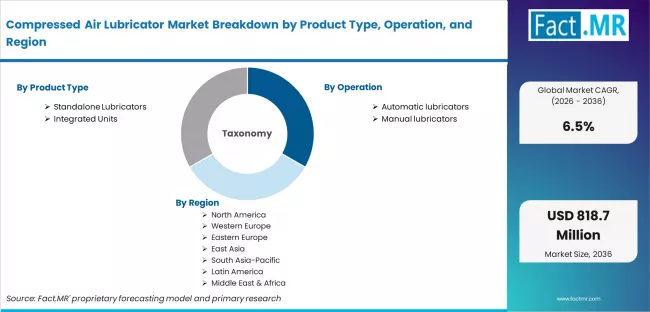
Compressed Air Lubricator Market Breakdown By Product Type, Operation, And Region


Parameter
Details
Quantitative Units USD 409.5 Million (2025) to USD 818.7 Million (2036), at a CAGR of 6.5%
Market Definition The Compressed Air Lubricator Market covers devices used in pneumatic systems to introduce controlled oil mist into compressed air, ensuring reduced friction, improved efficiency, and extended equipment life. It includes standalone lubricators and integrated FRL (Filter–Regulator–Lubricator) units, operating across various flow capacities, pressure ranges, and lubrication methods. These systems are deployed in industrial automation, manufacturing, automotive, and process industries, focusing on performance optimization, reliability, and maintenance efficiency.
Regions Covered North America, Eastern Europe, Western Europe, East Asia, South Asia-Pacific, Latin America, Middle East & Africa
Countries Covered USA, Canada, Germany, Italy, UK, China, Japan, India, South Korea, Brazil, Saudi Arabia, and 15+ countries
Key Companies SMC Corporation, Festo, Parker Hannifin, IMI plc (Norgren), Emerson Electric Co., Airtac International Group, Camozzi Group, CKD Corporation, Metal Work S.p.A., Bosch Rexroth
Forecast Period 2026 to 2036
Approach Hybrid demand-side and top-down methodology based on growth in industrial automation, pneumatic system adoption, manufacturing expansion, and process industry demand, validated through primary interviews with pneumatic component manufacturers, OEMs, distributors, and end users across key regions.

Analysis by Product Type, Lubricator Type, Operation, Lubrication Method, Flow Capacity, Pressure Range, Installation Type, Distribution Channel, Application, End-User Industry, and Region

  • Compressed Air Lubricator Market by Product Type

    • Standalone Lubricators
      • Inline Lubricators
      • Modular Lubricators
      • Micro-fog Lubricators
    • Integrated Units
      • Filter–Regulator–Lubricator (FRL) Units
      • Modular Air Preparation Assemblies
  • Compressed Air Lubricator Market by Operation / Type

    • Automatic Lubricators
    • Manual Lubricators
  • Compressed Air Lubricator Market by Lubrication Method

    • Oil-mist Lubrication
    • Micro-fog Lubrication
    • Drop Feed Lubricators
    • Dry / Minimal Lubrication Systems
  • Compressed Air Lubricator Market by Flow Capacity

    • Low Flow (≤ 500 L/min)
    • Medium Flow (500–3000 L/min)
    • High Flow (> 3000 L/min)
  • Compressed Air Lubricator Market by Pressure Range

    • Low Pressure (< 5 bar)
    • Medium Pressure (5–10 bar)
    • High Pressure (> 10 bar)
  • Compressed Air Lubricator Market by Installation Type

    • Point-of-Use Lubricators
    • Centralized Lubrication Systems
  • Compressed Air Lubricator Market by Distribution Channel

    • Direct Sales
    • OEMs
    • Distributors / Wholesalers
    • Online Sales
  • Compressed Air Lubricator Market by Application

    • Pneumatic Tools
    • Actuation Systems
    • Automation & Assembly Lines
    • Process Equipment
  • Compressed Air Lubricator Market by End-User Industry

    • Industrial Applications
      • General Manufacturing
      • Metal & Machinery
      • Chemical Industry
      • Oil & Gas
    • Automotive Sector
      • Assembly Lines
      • Workshops & Garages
    • Process Industries
      • Food & Beverage
      • Pharmaceuticals
    • Other Applications
      • Electronics
      • Packaging
      • Energy & Power
  • Compressed Air Lubricator Market by Region

    • North America
      • USA
      • Canada
      • Mexico
    • Latin America
      • Brazil
      • Chile
      • Rest of LATAM
    • East Asia
      • China
      • Japan
      • South Korea
      • Taiwan
    • South Asia & Pacific
      • India
      • Singapore
      • Australia
      • ASEAN
    • Western Europe
      • Germany
      • France
      • U.K.
      • Italy
      • Spain
      • BENELUX
      • Nordic
      • Rest of Western Europe
    • Eastern Europe
      • Poland
      • Hungary
      • Czech Republic
      • Balkan & Baltics
      • Rest of Eastern Europe
    • Middle East and Africa
      • Kingdom of Saudi Arabia
      • United Arab Emirates
      • South Africa
      • Rest of Middle East and Africa

- Frequently Asked Questions -

How large is the demand for compressed air lubricators in the global market in 2025?

Demand for the Compressed Air Lubricator Market is estimated to be valued at USD 409.5 million in 2025, driven by increasing adoption of pneumatic systems across manufacturing, automotive, and process industries.

What will be the market size by 2036?

The market is projected to reach USD 818.7 million by 2036, supported by growth in industrial automation and expanding manufacturing activities.

What is the expected demand growth between 2025 and 2036?

Demand is expected to grow at a CAGR of 6.5%, driven by rising need for efficient air preparation systems and increasing automation

Which product type segment is expected to dominate the market?

Standalone lubricators are expected to dominate, accounting for 54.9% share in 2026, due to their widespread use and cost-effectiveness

Who are the key companies operating in the market?

Key players include SMC Corporation, Festo, Parker Hannifin, IMI plc (Norgren), Emerson Electric Co., Airtac International Group, Camozzi Group, CKD Corporation, Metal Work S.p.A., and Bosch Rexroth.

Table of Content

  • Compressed Air Lubricator Market - Executive Summary
    • Market Overview
      • Market Definition and Introduction
      • Market Taxonomy/ Research Scope
    • Global Compressed Air Lubricator Market Demand Analysis 2021-2025 and Forecast, 2026–2036
      • Historical Market Volume Analysis, 2021-2025
      • Current and Future Market Volume Forecast, 2026–2036
      • Y-o-Y Growth Trend Analysis
    • Global Compressed Air Lubricator Market - Pricing Analysis
      • Product Category and Country-Level Pricing Analysis
      • Global Average Pricing Analysis Benchmark
      • Factors Influencing Pricing
      • Cost Structure Analysis: Elementary Deep Dive
      • Competitive Pricing Strategies
      • Price Trends and Forecasts
        • Historical price trends
        • Future price forecasts
    • Global Compressed Air Lubricator Market Demand Analysis 2021-2025 and Forecast, 2026–2036
      • Historical Market Value Analysis, 2021-2025
      • Current and Future Market Value Forecast, 2026–2036
        • Y-o-Y Growth Trend Analysis
        • Absolute $ Opportunity Analysis
    • Market Background and Foundation Data
      • Global Industrial Pneumatics Market Outlook (2025)
      • Penetration of Compressed Air Lubricators
      • Consumer Perception Analysis
      • Recent Developments by Market Players
      • Production Analysis
        • By Region
        • By Key Companies
      • Trade Scenario (2025)
        • Imports & Exports
        • By Region
      • Raw Material Sourcing
        • Key materials: Aluminum, brass, stainless steel, engineering plastics
        • Sourcing concentrated in China, Southeast Asia, and Europe
        • Key Importing Countries
        • Key Exporting Countries
      • Investment Trends
        • Increasing investments in industrial automation and manufacturing infrastructure
        • Growth in Asia-Pacific industrial clusters
        • Focus on energy-efficient and compact pneumatic systems
      • Compressed Air Lubricator Market Opportunity Assessment
        • Total Available Market (US$ Mn)
        • Serviceable Addressable Market (US$ Mn)
        • Serviceable Obtainable Market (US$ Mn)
      • Porter’s Five Forces and PESTEL Analysis
      • Investment Feasibility Analysis
      • Macro-Economic Factors
      • Forecast Factors - Relevance & Impact
      • Industry Value and Supply Chain Analysis
        • List of Key Channel Partners
        • Profit Margin & Operating Margin at Each Node of Supply Chain.
        • Notes on Value Added at Each Node in the Value Chain
        • Factors Influencing Value Chain
      • Market Dynamics
        • Drivers
        • Restraints
        • Opportunity Analysis
      • Key Regulations & Certifications
    • Global Compressed Air Lubricator Market Analysis 2021-2025 and Forecast 2026–2036, By Product Type
      • Introduction / Key Findings
      • Market Size & Volume Analysis by Market Taxonomy, 2021–2036
        • Standalone Lubricators
          • Inline lubricators
          • Modular lubricators
          • Micro-fog lubricators
          • Oil-fog lubricators
        • Integrated Units
          • Filter-Regulator-Lubricator (FRL) units
          • Modular air preparation assemblies
      • Market Attractiveness Analysis by Product Type
    • Global Compressed Air Lubricator Market Analysis 2021-2025 and Forecast 2026–2036, By Operation / Type
      • Introduction / Key Findings
      • Market Size & Volume Analysis by Market Taxonomy, 2021–2036
        • Automatic lubricators
        • Manual lubricators
      • Market Attractiveness Analysis by Operation / Type
    • Global Compressed Air Lubricator Market Analysis 2021-2025 and Forecast 2026–2036, By Lubrication Method
      • Introduction / Key Findings
      • Market Size & Volume Analysis by Market Taxonomy, 2021–2036
        • Oil-mist lubrication
        • Micro-fog lubrication
        • Drop Feed Lubricators
        • Dry / Minimal Lubrication Systems
      • Market Attractiveness Analysis by Lubrication Method
    • Global Compressed Air Lubricator Market Analysis 2021-2025 and Forecast 2026–2036, By Flow Capacity
      • Introduction / Key Findings
      • Market Size & Volume Analysis by Market Taxonomy, 2021–2036
        • Low Flow (≤ 500 L/min)
        • Medium Flow (500–3000 L/min)
        • High Flow (> 3000 L/min)
      • Market Attractiveness Analysis by Flow Capacity
    • Global Compressed Air Lubricator Market Analysis 2021-2025 and Forecast 2026–2036, By Pressure Range
      • Introduction / Key Findings
      • Market Size & Volume Analysis by Market Taxonomy, 2021–2036
        • Low Pressure (< 5 bar)
        • Medium Pressure (5–10 bar)
        • High Pressure (> 10 bar)
      • Market Attractiveness Analysis by Pressure Range
    • Global Compressed Air Lubricator Market Analysis 2021-2025 and Forecast 2026–2036, By Installation Type
      • Introduction / Key Findings
      • Market Size & Volume Analysis by Market Taxonomy, 2021–2036
        • Point-of-Use Lubricators
        • Centralized Lubrication Systems
      • Market Attractiveness Analysis by Installation Type
    • Global Compressed Air Lubricator Market Analysis 2021-2025 and Forecast 2026–2036, By Distribution Channel
      • Introduction / Key Findings
      • Market Size & Volume Analysis by Market Taxonomy, 2021–2036
        • Direct sales
        • OEMs
        • Distributors / wholesalers
        • Online sales
      • Market Attractiveness Analysis by Distribution Channel
    • Global Compressed Air Lubricator Market Analysis 2021-2025 and Forecast 2026–2036, By Application
      • Introduction / Key Findings
      • Market Size & Volume Analysis by Market Taxonomy, 2021–2036
        • Pneumatic Tools
        • Actuation Systems
        • Automation & Assembly Lines
        • Process Equipment
      • Market Attractiveness Analysis by Application
    • Global Compressed Air Lubricator Market Analysis 2021-2025 and Forecast 2026–2036, By End-Use Industry
      • Introduction / Key Findings
      • Market Size & Volume Analysis by Market Taxonomy, 2021–2036
        • Industrial Applications
          • General manufacturing
          • Metal & machinery
          • Chemical industry
          • Oil & gas
        • Automotive Sector
          • Assembly lines
          • Workshops & garages
        • Process Industries
          • Food & beverage
          • Pharmaceuticals
        • Other Applications
          • Electronics
          • Packaging
          • Energy & power
      • Market Attractiveness Analysis by End-Use Industry
    • Global Compressed Air Lubricator Market Analysis and Forecast, by Region
      • Introduction / Key Findings
      • Market Size & Volume Analysis by Market Taxonomy, 2021–2036
        • North America
        • Latin America
        • Western Europe
        • Eastern Europe
        • East Asia
        • South Asia & Pacific
        • Middle East & Africa
      • Market Attractiveness Analysis by Region
    • North America Compressed Air Lubricator Market Analysis and Forecast
      • Market Size & Volume Analysis by Market Taxonomy, 2021–2036
        • By Country
          • United States
          • Canada
          • Mexico
        • By Taxonomy
      • Market Attractiveness Analysis by Country & Taxonomy
    • Latin America Compressed Air Lubricator Market Analysis and Forecast
      • Market Size & Volume Analysis by Market Taxonomy, 2021–2036
        • By Country
          • Brazil
          • Chile
          • Rest of LATAM
        • By Taxonomy
      • Market Attractiveness Analysis by Country & Taxonomy
    • Western Europe Compressed Air Lubricator Market Analysis and Forecast
      • Market Size & Volume Analysis by Market Taxonomy, 2021–2036
        • By Country
          • Germany
          • Italy
          • France
          • United Kingdom
          • Spain
          • BENELUX
          • Nordics
          • Rest of Western Europe
        • By Taxonomy
      • Market Attractiveness Analysis by Country & Taxonomy
    • Eastern Europe Compressed Air Lubricator Market Analysis and Forecast
      • Market Size & Volume Analysis by Market Taxonomy, 2021–2036
        • By Country
          • Russia
          • Hungary
          • Poland
          • Balkan & Baltics
          • Rest of Eastern Europe
        • By Taxonomy
      • Market Attractiveness Analysis by Country & Taxonomy
    • East Asia Compressed Air Lubricator Market Analysis and Forecast
      • Market Size & Volume Analysis by Market Taxonomy, 2021–2036
        • By Country
          • China
          • Japan
          • South Korea
        • By Taxonomy
      • Market Attractiveness Analysis by Country & Taxonomy
    • South Asia & Pacific Compressed Air Lubricator Market Analysis and Forecast
      • Market Size & Volume Analysis by Market Taxonomy, 2021–2036
        • By Country
          • India
          • ASEAN
          • Australia & New Zealand
          • Rest of South Asia & Pacific
        • By Taxonomy
      • Market Attractiveness Analysis by Country & Taxonomy
    • Middle East & Africa Compressed Air Lubricator Market Analysis and Forecast
      • Market Size & Volume Analysis by Market Taxonomy, 2021–2036
        • By Country
          • Kingdom of Saudi Arabia
          • Other GCC Countries
          • Türkiye
          • South Africa
          • Other African Union
        • By Taxonomy
      • Market Attractiveness Analysis by Country & Taxonomy
    • Country-level Compressed Air Lubricator Market Analysis and Forecast
      • Introduction
        • Market Value Proportion Analysis, By Key Countries
        • Global Vs. Country Growth Comparison
      • United States Compressed Air Lubricator Market Analysis
        • Market Size & Volume Analysis by Market Taxonomy, 2021–2036
          • By Product Type
          • By Operation / Type
          • By Lubrication Method
          • By Flow Capacity
          • By Pressure Range
          • By Installation Type
          • By Distribution Channel
          • By Application
          • By End-Use Industry
    • *Same Analysis will be provide for each of the countries mentioned below
      • Canada Compressed Air Lubricator Market Analysis
      • Mexico Compressed Air Lubricator Market Analysis
      • Brazil Compressed Air Lubricator Market Analysis
      • Chile Compressed Air Lubricator Market Analysis
      • Germany Compressed Air Lubricator Market Analysis
      • France Compressed Air Lubricator Market Analysis
      • Italy Compressed Air Lubricator Market Analysis
      • Spain Compressed Air Lubricator Market Analysis
      • United Kingdom Compressed Air Lubricator Market Analysis
      • BENELUX Compressed Air Lubricator Market Analysis
      • Nordics Compressed Air Lubricator Market Analysis
      • Poland Compressed Air Lubricator Market Analysis
      • Russia Compressed Air Lubricator Market Analysis
      • Hungary Compressed Air Lubricator Market Analysis
      • Balkan & Baltics Compressed Air Lubricator Market Analysis
      • China Compressed Air Lubricator Market Analysis
      • Japan Compressed Air Lubricator Market Analysis
      • South Korea Compressed Air Lubricator Market Analysis
      • India Compressed Air Lubricator Market Analysis
      • ASEAN Compressed Air Lubricator Market Analysis
      • ANZ Compressed Air Lubricator Market Analysis
      • KSA Compressed Air Lubricator Market Analysis
      • Other GCC Countries Compressed Air Lubricator Market Analysis
      • South Africa Compressed Air Lubricator Market Analysis
      • Türkiye Compressed Air Lubricator Market Analysis
    • Compressed Air Lubricator Market Structure Analysis
      • Market Analysis by Tier of Companies
      • Market Share Analysis of Top Players
      • Market Space for New Brands and Dollar Opportunity
      • Market Presence Analysis
        • Regional Footprint of Players
        • Product Footprint by Players
        • Application Footprint by Players
    • Compressed Air Lubricator Competition Analysis
      • Competition Dashboard
      • Pricing Analysis by Competition
      • Competition Benchmarking
      • Competition Deep Dive
        • SMC Corporation
          • Overview
          • Product Portfolio
          • Sales Footprint
          • Key Developments
          • SWOT Analysis
          • Strategy Overview
          • Key Financials
        • Festo
        • Parker Hannifin
        • IMI plc (Norgren)
        • Airtac International Group
        • Camozzi Group
        • CKD Corporation
        • Metal Work S.p.A.
        • Emerson Electric Co.
        • Bosch Rexroth
        • Other Prominent Players
    • Primary Insights
    • Assumption & Acronyms Used
    • Research Methodology & Data Sources

List Of Table

  • Table 1: Global market Value (Units) Forecast by Region, 2021 to 2036
  • Table 2: Global market Volume (Cubic Meters) Forecast by Region, 2021 to 2036
  • Table 3: Global market Value (Units) Forecast by Product Type, 2021 to 2036
  • Table 4: Global market Volume (Cubic Meters) Forecast by Product Type, 2021 to 2036
  • Table 5: Global market Value (Units) Forecast by Operation / Type, 2021 to 2036
  • Table 6: Global market Volume (Cubic Meters) Forecast by Operation / Type, 2021 to 2036
  • Table 7: Global market Value (Units) Forecast by Lubrication Method, 2021 to 2036
  • Table 8: Global market Volume (Cubic Meters) Forecast by Lubrication Method, 2021 to 2036
  • Table 9: Global market Value (Units) Forecast by Flow Capacity, 2021 to 2036
  • Table 10: Global market Volume (Cubic Meters) Forecast by Flow Capacity, 2021 to 2036
  • Table 11: Global market Value (Units) Forecast by Pressure Range, 2021 to 2036
  • Table 12: Global market Volume (Cubic Meters) Forecast by Pressure Range, 2021 to 2036
  • Table 13: Global market Value (Units) Forecast by Distribution Channel, 2021 to 2036
  • Table 14: Global market Volume (Cubic Meters) Forecast by Distribution Channel, 2021 to 2036
  • Table 15: Global market Value (Units) Forecast by End-Use Industry, 2021 to 2036
  • Table 16: Global market Volume (Cubic Meters) Forecast by End-Use Industry, 2021 to 2036
  • Table 17: North America market Value (Units) Forecast by Country, 2021 to 2036
  • Table 18: North America market Volume (Cubic Meters) Forecast by Country, 2021 to 2036
  • Table 19: North America market Value (Units) Forecast by Product Type, 2021 to 2036
  • Table 20: North America market Volume (Cubic Meters) Forecast by Product Type, 2021 to 2036
  • Table 21: North America market Value (Units) Forecast by Operation / Type, 2021 to 2036
  • Table 22: North America market Volume (Cubic Meters) Forecast by Operation / Type, 2021 to 2036
  • Table 23: North America market Value (Units) Forecast by Lubrication Method, 2021 to 2036
  • Table 24: North America market Volume (Cubic Meters) Forecast by Lubrication Method, 2021 to 2036
  • Table 25: North America market Value (Units) Forecast by Flow Capacity, 2021 to 2036
  • Table 26: North America market Volume (Cubic Meters) Forecast by Flow Capacity, 2021 to 2036
  • Table 27: North America market Value (Units) Forecast by Pressure Range, 2021 to 2036
  • Table 28: North America market Volume (Cubic Meters) Forecast by Pressure Range, 2021 to 2036
  • Table 29: North America market Value (Units) Forecast by Distribution Channel, 2021 to 2036
  • Table 30: North America market Volume (Cubic Meters) Forecast by Distribution Channel, 2021 to 2036
  • Table 31: North America market Value (Units) Forecast by End-Use Industry, 2021 to 2036
  • Table 32: North America market Volume (Cubic Meters) Forecast by End-Use Industry, 2021 to 2036
  • Table 33: Latin America market Value (Units) Forecast by Country, 2021 to 2036
  • Table 34: Latin America market Volume (Cubic Meters) Forecast by Country, 2021 to 2036
  • Table 35: Latin America market Value (Units) Forecast by Product Type, 2021 to 2036
  • Table 36: Latin America market Volume (Cubic Meters) Forecast by Product Type, 2021 to 2036
  • Table 37: Latin America market Value (Units) Forecast by Operation / Type, 2021 to 2036
  • Table 38: Latin America market Volume (Cubic Meters) Forecast by Operation / Type, 2021 to 2036
  • Table 39: Latin America market Value (Units) Forecast by Lubrication Method, 2021 to 2036
  • Table 40: Latin America market Volume (Cubic Meters) Forecast by Lubrication Method, 2021 to 2036
  • Table 41: Latin America market Value (Units) Forecast by Flow Capacity, 2021 to 2036
  • Table 42: Latin America market Volume (Cubic Meters) Forecast by Flow Capacity, 2021 to 2036
  • Table 43: Latin America market Value (Units) Forecast by Pressure Range, 2021 to 2036
  • Table 44: Latin America market Volume (Cubic Meters) Forecast by Pressure Range, 2021 to 2036
  • Table 45: Latin America market Value (Units) Forecast by Distribution Channel, 2021 to 2036
  • Table 46: Latin America market Volume (Cubic Meters) Forecast by Distribution Channel, 2021 to 2036
  • Table 47: Latin America market Value (Units) Forecast by End-Use Industry, 2021 to 2036
  • Table 48: Latin America market Volume (Cubic Meters) Forecast by End-Use Industry, 2021 to 2036
  • Table 49: Western Europe market Value (Units) Forecast by Country, 2021 to 2036
  • Table 50: Western Europe market Volume (Cubic Meters) Forecast by Country, 2021 to 2036
  • Table 51: Western Europe market Value (Units) Forecast by Product Type, 2021 to 2036
  • Table 52: Western Europe market Volume (Cubic Meters) Forecast by Product Type, 2021 to 2036
  • Table 53: Western Europe market Value (Units) Forecast by Operation / Type, 2021 to 2036
  • Table 54: Western Europe market Volume (Cubic Meters) Forecast by Operation / Type, 2021 to 2036
  • Table 55: Western Europe market Value (Units) Forecast by Lubrication Method, 2021 to 2036
  • Table 56: Western Europe market Volume (Cubic Meters) Forecast by Lubrication Method, 2021 to 2036
  • Table 57: Western Europe market Value (Units) Forecast by Flow Capacity, 2021 to 2036
  • Table 58: Western Europe market Volume (Cubic Meters) Forecast by Flow Capacity, 2021 to 2036
  • Table 59: Western Europe market Value (Units) Forecast by Pressure Range, 2021 to 2036
  • Table 60: Western Europe market Volume (Cubic Meters) Forecast by Pressure Range, 2021 to 2036
  • Table 61: Western Europe market Value (Units) Forecast by Distribution Channel, 2021 to 2036
  • Table 62: Western Europe market Volume (Cubic Meters) Forecast by Distribution Channel, 2021 to 2036
  • Table 63: Western Europe market Value (Units) Forecast by End-Use Industry, 2021 to 2036
  • Table 64: Western Europe market Volume (Cubic Meters) Forecast by End-Use Industry, 2021 to 2036
  • Table 65: Eastern Europe market Value (Units) Forecast by Country, 2021 to 2036
  • Table 66: Eastern Europe market Volume (Cubic Meters) Forecast by Country, 2021 to 2036
  • Table 67: Eastern Europe market Value (Units) Forecast by Product Type, 2021 to 2036
  • Table 68: Eastern Europe market Volume (Cubic Meters) Forecast by Product Type, 2021 to 2036
  • Table 69: Eastern Europe market Value (Units) Forecast by Operation / Type, 2021 to 2036
  • Table 70: Eastern Europe market Volume (Cubic Meters) Forecast by Operation / Type, 2021 to 2036
  • Table 71: Eastern Europe market Value (Units) Forecast by Lubrication Method, 2021 to 2036
  • Table 72: Eastern Europe market Volume (Cubic Meters) Forecast by Lubrication Method, 2021 to 2036
  • Table 73: Eastern Europe market Value (Units) Forecast by Flow Capacity, 2021 to 2036
  • Table 74: Eastern Europe market Volume (Cubic Meters) Forecast by Flow Capacity, 2021 to 2036
  • Table 75: Eastern Europe market Value (Units) Forecast by Pressure Range, 2021 to 2036
  • Table 76: Eastern Europe market Volume (Cubic Meters) Forecast by Pressure Range, 2021 to 2036
  • Table 77: Eastern Europe market Value (Units) Forecast by Distribution Channel, 2021 to 2036
  • Table 78: Eastern Europe market Volume (Cubic Meters) Forecast by Distribution Channel, 2021 to 2036
  • Table 79: Eastern Europe market Value (Units) Forecast by End-Use Industry, 2021 to 2036
  • Table 80: Eastern Europe market Volume (Cubic Meters) Forecast by End-Use Industry, 2021 to 2036
  • Table 81: East Asia market Value (Units) Forecast by Country, 2021 to 2036
  • Table 82: East Asia market Volume (Cubic Meters) Forecast by Country, 2021 to 2036
  • Table 83: East Asia market Value (Units) Forecast by Product Type, 2021 to 2036
  • Table 84: East Asia market Volume (Cubic Meters) Forecast by Product Type, 2021 to 2036
  • Table 85: East Asia market Value (Units) Forecast by Operation / Type, 2021 to 2036
  • Table 86: East Asia market Volume (Cubic Meters) Forecast by Operation / Type, 2021 to 2036
  • Table 87: East Asia market Value (Units) Forecast by Lubrication Method, 2021 to 2036
  • Table 88: East Asia market Volume (Cubic Meters) Forecast by Lubrication Method, 2021 to 2036
  • Table 89: East Asia market Value (Units) Forecast by Flow Capacity, 2021 to 2036
  • Table 90: East Asia market Volume (Cubic Meters) Forecast by Flow Capacity, 2021 to 2036
  • Table 91: East Asia market Value (Units) Forecast by Pressure Range, 2021 to 2036
  • Table 92: East Asia market Volume (Cubic Meters) Forecast by Pressure Range, 2021 to 2036
  • Table 93: East Asia market Value (Units) Forecast by Distribution Channel, 2021 to 2036
  • Table 94: East Asia market Volume (Cubic Meters) Forecast by Distribution Channel, 2021 to 2036
  • Table 95: East Asia market Value (Units) Forecast by End-Use Industry, 2021 to 2036
  • Table 96: East Asia market Volume (Cubic Meters) Forecast by End-Use Industry, 2021 to 2036
  • Table 97: South Asia and Pacific market Value (Units) Forecast by Country, 2021 to 2036
  • Table 98: South Asia and Pacific market Volume (Cubic Meters) Forecast by Country, 2021 to 2036
  • Table 99: South Asia and Pacific market Value (Units) Forecast by Product Type, 2021 to 2036
  • Table 100: South Asia and Pacific market Volume (Cubic Meters) Forecast by Product Type, 2021 to 2036
  • Table 101: South Asia and Pacific market Value (Units) Forecast by Operation / Type, 2021 to 2036
  • Table 102: South Asia and Pacific market Volume (Cubic Meters) Forecast by Operation / Type, 2021 to 2036
  • Table 103: South Asia and Pacific market Value (Units) Forecast by Lubrication Method, 2021 to 2036
  • Table 104: South Asia and Pacific market Volume (Cubic Meters) Forecast by Lubrication Method, 2021 to 2036
  • Table 105: South Asia and Pacific market Value (Units) Forecast by Flow Capacity, 2021 to 2036
  • Table 106: South Asia and Pacific market Volume (Cubic Meters) Forecast by Flow Capacity, 2021 to 2036
  • Table 107: South Asia and Pacific market Value (Units) Forecast by Pressure Range, 2021 to 2036
  • Table 108: South Asia and Pacific market Volume (Cubic Meters) Forecast by Pressure Range, 2021 to 2036
  • Table 109: South Asia and Pacific market Value (Units) Forecast by Distribution Channel, 2021 to 2036
  • Table 110: South Asia and Pacific market Volume (Cubic Meters) Forecast by Distribution Channel, 2021 to 2036
  • Table 111: South Asia and Pacific market Value (Units) Forecast by End-Use Industry, 2021 to 2036
  • Table 112: South Asia and Pacific market Volume (Cubic Meters) Forecast by End-Use Industry, 2021 to 2036
  • Table 113: Middle East & Africa market Value (Units) Forecast by Country, 2021 to 2036
  • Table 114: Middle East & Africa market Volume (Cubic Meters) Forecast by Country, 2021 to 2036
  • Table 115: Middle East & Africa market Value (Units) Forecast by Product Type, 2021 to 2036
  • Table 116: Middle East & Africa market Volume (Cubic Meters) Forecast by Product Type, 2021 to 2036
  • Table 117: Middle East & Africa market Value (Units) Forecast by Operation / Type, 2021 to 2036
  • Table 118: Middle East & Africa market Volume (Cubic Meters) Forecast by Operation / Type, 2021 to 2036
  • Table 119: Middle East & Africa market Value (Units) Forecast by Lubrication Method, 2021 to 2036
  • Table 120: Middle East & Africa market Volume (Cubic Meters) Forecast by Lubrication Method, 2021 to 2036
  • Table 121: Middle East & Africa market Value (Units) Forecast by Flow Capacity, 2021 to 2036
  • Table 122: Middle East & Africa market Volume (Cubic Meters) Forecast by Flow Capacity, 2021 to 2036
  • Table 123: Middle East & Africa market Value (Units) Forecast by Pressure Range, 2021 to 2036
  • Table 124: Middle East & Africa market Volume (Cubic Meters) Forecast by Pressure Range, 2021 to 2036
  • Table 125: Middle East & Africa market Value (Units) Forecast by Distribution Channel, 2021 to 2036
  • Table 126: Middle East & Africa market Volume (Cubic Meters) Forecast by Distribution Channel, 2021 to 2036
  • Table 127: Middle East & Africa market Value (Units) Forecast by End-Use Industry, 2021 to 2036
  • Table 128: Middle East & Africa market Volume (Cubic Meters) Forecast by End-Use Industry, 2021 to 2036

List Of Figures

  • Figure 1: Global market Volume (Cubic Meters) Forecast 2021 to 2036
  • Figure 2: Global market Pricing Analysis
  • Figure 3: Global market Value (Units) Forecast 2021 to 2036
  • Figure 4: Global market Value Share and BPS Analysis by Product Type, 2026 and 2036
  • Figure 5: Global market Y-o-Y Growth Comparison by Product Type, 2026 to 2036
  • Figure 6: Global market Attractiveness Analysis by Product Type
  • Figure 7: Global market Value Share and BPS Analysis by Operation / Type, 2026 and 2036
  • Figure 8: Global market Y-o-Y Growth Comparison by Operation / Type, 2026 to 2036
  • Figure 9: Global market Attractiveness Analysis by Operation / Type
  • Figure 10: Global market Value Share and BPS Analysis by Lubrication Method, 2026 and 2036
  • Figure 11: Global market Y-o-Y Growth Comparison by Lubrication Method, 2026 to 2036
  • Figure 12: Global market Attractiveness Analysis by Lubrication Method
  • Figure 13: Global market Value Share and BPS Analysis by Flow Capacity, 2026 and 2036
  • Figure 14: Global market Y-o-Y Growth Comparison by Flow Capacity, 2026 to 2036
  • Figure 15: Global market Attractiveness Analysis by Flow Capacity
  • Figure 16: Global market Value Share and BPS Analysis by Pressure Range, 2026 and 2036
  • Figure 17: Global market Y-o-Y Growth Comparison by Pressure Range, 2026 to 2036
  • Figure 18: Global market Attractiveness Analysis by Pressure Range
  • Figure 19: Global market Value Share and BPS Analysis by Distribution Channel, 2026 and 2036
  • Figure 20: Global market Y-o-Y Growth Comparison by Distribution Channel, 2026 to 2036
  • Figure 21: Global market Attractiveness Analysis by Distribution Channel
  • Figure 22: Global market Value Share and BPS Analysis by End-Use Industry, 2026 and 2036
  • Figure 23: Global market Y-o-Y Growth Comparison by End-Use Industry, 2026 to 2036
  • Figure 24: Global market Attractiveness Analysis by End-Use Industry
  • Figure 25: Global market Value (Units) Share and BPS Analysis by Region, 2026 and 2036
  • Figure 26: Global market Y-o-Y Growth Comparison by Region, 2026 to 2036
  • Figure 27: Global market Attractiveness Analysis by Region
  • Figure 28: North America market Incremental $ Opportunity, 2026 to 2036
  • Figure 29: Latin America market Incremental $ Opportunity, 2026 to 2036
  • Figure 30: Western Europe market Incremental $ Opportunity, 2026 to 2036
  • Figure 31: Eastern Europe market Incremental $ Opportunity, 2026 to 2036
  • Figure 32: East Asia market Incremental $ Opportunity, 2026 to 2036
  • Figure 33: South Asia and Pacific market Incremental $ Opportunity, 2026 to 2036
  • Figure 34: Middle East & Africa market Incremental $ Opportunity, 2026 to 2036
  • Figure 35: North America market Value Share and BPS Analysis by Country, 2026 and 2036
  • Figure 36: North America market Value Share and BPS Analysis by Product Type, 2026 and 2036
  • Figure 37: North America market Y-o-Y Growth Comparison by Product Type, 2026 to 2036
  • Figure 38: North America market Attractiveness Analysis by Product Type
  • Figure 39: North America market Value Share and BPS Analysis by Operation / Type, 2026 and 2036
  • Figure 40: North America market Y-o-Y Growth Comparison by Operation / Type, 2026 to 2036
  • Figure 41: North America market Attractiveness Analysis by Operation / Type
  • Figure 42: North America market Value Share and BPS Analysis by Lubrication Method, 2026 and 2036
  • Figure 43: North America market Y-o-Y Growth Comparison by Lubrication Method, 2026 to 2036
  • Figure 44: North America market Attractiveness Analysis by Lubrication Method
  • Figure 45: North America market Value Share and BPS Analysis by Flow Capacity, 2026 and 2036
  • Figure 46: North America market Y-o-Y Growth Comparison by Flow Capacity, 2026 to 2036
  • Figure 47: North America market Attractiveness Analysis by Flow Capacity
  • Figure 48: North America market Value Share and BPS Analysis by Pressure Range, 2026 and 2036
  • Figure 49: North America market Y-o-Y Growth Comparison by Pressure Range, 2026 to 2036
  • Figure 50: North America market Attractiveness Analysis by Pressure Range
  • Figure 51: North America market Value Share and BPS Analysis by Distribution Channel, 2026 and 2036
  • Figure 52: North America market Y-o-Y Growth Comparison by Distribution Channel, 2026 to 2036
  • Figure 53: North America market Attractiveness Analysis by Distribution Channel
  • Figure 54: North America market Value Share and BPS Analysis by End-Use Industry, 2026 and 2036
  • Figure 55: North America market Y-o-Y Growth Comparison by End-Use Industry, 2026 to 2036
  • Figure 56: North America market Attractiveness Analysis by End-Use Industry
  • Figure 57: Latin America market Value Share and BPS Analysis by Country, 2026 and 2036
  • Figure 58: Latin America market Value Share and BPS Analysis by Product Type, 2026 and 2036
  • Figure 59: Latin America market Y-o-Y Growth Comparison by Product Type, 2026 to 2036
  • Figure 60: Latin America market Attractiveness Analysis by Product Type
  • Figure 61: Latin America market Value Share and BPS Analysis by Operation / Type, 2026 and 2036
  • Figure 62: Latin America market Y-o-Y Growth Comparison by Operation / Type, 2026 to 2036
  • Figure 63: Latin America market Attractiveness Analysis by Operation / Type
  • Figure 64: Latin America market Value Share and BPS Analysis by Lubrication Method, 2026 and 2036
  • Figure 65: Latin America market Y-o-Y Growth Comparison by Lubrication Method, 2026 to 2036
  • Figure 66: Latin America market Attractiveness Analysis by Lubrication Method
  • Figure 67: Latin America market Value Share and BPS Analysis by Flow Capacity, 2026 and 2036
  • Figure 68: Latin America market Y-o-Y Growth Comparison by Flow Capacity, 2026 to 2036
  • Figure 69: Latin America market Attractiveness Analysis by Flow Capacity
  • Figure 70: Latin America market Value Share and BPS Analysis by Pressure Range, 2026 and 2036
  • Figure 71: Latin America market Y-o-Y Growth Comparison by Pressure Range, 2026 to 2036
  • Figure 72: Latin America market Attractiveness Analysis by Pressure Range
  • Figure 73: Latin America market Value Share and BPS Analysis by Distribution Channel, 2026 and 2036
  • Figure 74: Latin America market Y-o-Y Growth Comparison by Distribution Channel, 2026 to 2036
  • Figure 75: Latin America market Attractiveness Analysis by Distribution Channel
  • Figure 76: Latin America market Value Share and BPS Analysis by End-Use Industry, 2026 and 2036
  • Figure 77: Latin America market Y-o-Y Growth Comparison by End-Use Industry, 2026 to 2036
  • Figure 78: Latin America market Attractiveness Analysis by End-Use Industry
  • Figure 79: Western Europe market Value Share and BPS Analysis by Country, 2026 and 2036
  • Figure 80: Western Europe market Value Share and BPS Analysis by Product Type, 2026 and 2036
  • Figure 81: Western Europe market Y-o-Y Growth Comparison by Product Type, 2026 to 2036
  • Figure 82: Western Europe market Attractiveness Analysis by Product Type
  • Figure 83: Western Europe market Value Share and BPS Analysis by Operation / Type, 2026 and 2036
  • Figure 84: Western Europe market Y-o-Y Growth Comparison by Operation / Type, 2026 to 2036
  • Figure 85: Western Europe market Attractiveness Analysis by Operation / Type
  • Figure 86: Western Europe market Value Share and BPS Analysis by Lubrication Method, 2026 and 2036
  • Figure 87: Western Europe market Y-o-Y Growth Comparison by Lubrication Method, 2026 to 2036
  • Figure 88: Western Europe market Attractiveness Analysis by Lubrication Method
  • Figure 89: Western Europe market Value Share and BPS Analysis by Flow Capacity, 2026 and 2036
  • Figure 90: Western Europe market Y-o-Y Growth Comparison by Flow Capacity, 2026 to 2036
  • Figure 91: Western Europe market Attractiveness Analysis by Flow Capacity
  • Figure 92: Western Europe market Value Share and BPS Analysis by Pressure Range, 2026 and 2036
  • Figure 93: Western Europe market Y-o-Y Growth Comparison by Pressure Range, 2026 to 2036
  • Figure 94: Western Europe market Attractiveness Analysis by Pressure Range
  • Figure 95: Western Europe market Value Share and BPS Analysis by Distribution Channel, 2026 and 2036
  • Figure 96: Western Europe market Y-o-Y Growth Comparison by Distribution Channel, 2026 to 2036
  • Figure 97: Western Europe market Attractiveness Analysis by Distribution Channel
  • Figure 98: Western Europe market Value Share and BPS Analysis by End-Use Industry, 2026 and 2036
  • Figure 99: Western Europe market Y-o-Y Growth Comparison by End-Use Industry, 2026 to 2036
  • Figure 100: Western Europe market Attractiveness Analysis by End-Use Industry
  • Figure 101: Eastern Europe market Value Share and BPS Analysis by Country, 2026 and 2036
  • Figure 102: Eastern Europe market Value Share and BPS Analysis by Product Type, 2026 and 2036
  • Figure 103: Eastern Europe market Y-o-Y Growth Comparison by Product Type, 2026 to 2036
  • Figure 104: Eastern Europe market Attractiveness Analysis by Product Type
  • Figure 105: Eastern Europe market Value Share and BPS Analysis by Operation / Type, 2026 and 2036
  • Figure 106: Eastern Europe market Y-o-Y Growth Comparison by Operation / Type, 2026 to 2036
  • Figure 107: Eastern Europe market Attractiveness Analysis by Operation / Type
  • Figure 108: Eastern Europe market Value Share and BPS Analysis by Lubrication Method, 2026 and 2036
  • Figure 109: Eastern Europe market Y-o-Y Growth Comparison by Lubrication Method, 2026 to 2036
  • Figure 110: Eastern Europe market Attractiveness Analysis by Lubrication Method
  • Figure 111: Eastern Europe market Value Share and BPS Analysis by Flow Capacity, 2026 and 2036
  • Figure 112: Eastern Europe market Y-o-Y Growth Comparison by Flow Capacity, 2026 to 2036
  • Figure 113: Eastern Europe market Attractiveness Analysis by Flow Capacity
  • Figure 114: Eastern Europe market Value Share and BPS Analysis by Pressure Range, 2026 and 2036
  • Figure 115: Eastern Europe market Y-o-Y Growth Comparison by Pressure Range, 2026 to 2036
  • Figure 116: Eastern Europe market Attractiveness Analysis by Pressure Range
  • Figure 117: Eastern Europe market Value Share and BPS Analysis by Distribution Channel, 2026 and 2036
  • Figure 118: Eastern Europe market Y-o-Y Growth Comparison by Distribution Channel, 2026 to 2036
  • Figure 119: Eastern Europe market Attractiveness Analysis by Distribution Channel
  • Figure 120: Eastern Europe market Value Share and BPS Analysis by End-Use Industry, 2026 and 2036
  • Figure 121: Eastern Europe market Y-o-Y Growth Comparison by End-Use Industry, 2026 to 2036
  • Figure 122: Eastern Europe market Attractiveness Analysis by End-Use Industry
  • Figure 123: East Asia market Value Share and BPS Analysis by Country, 2026 and 2036
  • Figure 124: East Asia market Value Share and BPS Analysis by Product Type, 2026 and 2036
  • Figure 125: East Asia market Y-o-Y Growth Comparison by Product Type, 2026 to 2036
  • Figure 126: East Asia market Attractiveness Analysis by Product Type
  • Figure 127: East Asia market Value Share and BPS Analysis by Operation / Type, 2026 and 2036
  • Figure 128: East Asia market Y-o-Y Growth Comparison by Operation / Type, 2026 to 2036
  • Figure 129: East Asia market Attractiveness Analysis by Operation / Type
  • Figure 130: East Asia market Value Share and BPS Analysis by Lubrication Method, 2026 and 2036
  • Figure 131: East Asia market Y-o-Y Growth Comparison by Lubrication Method, 2026 to 2036
  • Figure 132: East Asia market Attractiveness Analysis by Lubrication Method
  • Figure 133: East Asia market Value Share and BPS Analysis by Flow Capacity, 2026 and 2036
  • Figure 134: East Asia market Y-o-Y Growth Comparison by Flow Capacity, 2026 to 2036
  • Figure 135: East Asia market Attractiveness Analysis by Flow Capacity
  • Figure 136: East Asia market Value Share and BPS Analysis by Pressure Range, 2026 and 2036
  • Figure 137: East Asia market Y-o-Y Growth Comparison by Pressure Range, 2026 to 2036
  • Figure 138: East Asia market Attractiveness Analysis by Pressure Range
  • Figure 139: East Asia market Value Share and BPS Analysis by Distribution Channel, 2026 and 2036
  • Figure 140: East Asia market Y-o-Y Growth Comparison by Distribution Channel, 2026 to 2036
  • Figure 141: East Asia market Attractiveness Analysis by Distribution Channel
  • Figure 142: East Asia market Value Share and BPS Analysis by End-Use Industry, 2026 and 2036
  • Figure 143: East Asia market Y-o-Y Growth Comparison by End-Use Industry, 2026 to 2036
  • Figure 144: East Asia market Attractiveness Analysis by End-Use Industry
  • Figure 145: South Asia and Pacific market Value Share and BPS Analysis by Country, 2026 and 2036
  • Figure 146: South Asia and Pacific market Value Share and BPS Analysis by Product Type, 2026 and 2036
  • Figure 147: South Asia and Pacific market Y-o-Y Growth Comparison by Product Type, 2026 to 2036
  • Figure 148: South Asia and Pacific market Attractiveness Analysis by Product Type
  • Figure 149: South Asia and Pacific market Value Share and BPS Analysis by Operation / Type, 2026 and 2036
  • Figure 150: South Asia and Pacific market Y-o-Y Growth Comparison by Operation / Type, 2026 to 2036
  • Figure 151: South Asia and Pacific market Attractiveness Analysis by Operation / Type
  • Figure 152: South Asia and Pacific market Value Share and BPS Analysis by Lubrication Method, 2026 and 2036
  • Figure 153: South Asia and Pacific market Y-o-Y Growth Comparison by Lubrication Method, 2026 to 2036
  • Figure 154: South Asia and Pacific market Attractiveness Analysis by Lubrication Method
  • Figure 155: South Asia and Pacific market Value Share and BPS Analysis by Flow Capacity, 2026 and 2036
  • Figure 156: South Asia and Pacific market Y-o-Y Growth Comparison by Flow Capacity, 2026 to 2036
  • Figure 157: South Asia and Pacific market Attractiveness Analysis by Flow Capacity
  • Figure 158: South Asia and Pacific market Value Share and BPS Analysis by Pressure Range, 2026 and 2036
  • Figure 159: South Asia and Pacific market Y-o-Y Growth Comparison by Pressure Range, 2026 to 2036
  • Figure 160: South Asia and Pacific market Attractiveness Analysis by Pressure Range
  • Figure 161: South Asia and Pacific market Value Share and BPS Analysis by Distribution Channel, 2026 and 2036
  • Figure 162: South Asia and Pacific market Y-o-Y Growth Comparison by Distribution Channel, 2026 to 2036
  • Figure 163: South Asia and Pacific market Attractiveness Analysis by Distribution Channel
  • Figure 164: South Asia and Pacific market Value Share and BPS Analysis by End-Use Industry, 2026 and 2036
  • Figure 165: South Asia and Pacific market Y-o-Y Growth Comparison by End-Use Industry, 2026 to 2036
  • Figure 166: South Asia and Pacific market Attractiveness Analysis by End-Use Industry
  • Figure 167: Middle East & Africa market Value Share and BPS Analysis by Country, 2026 and 2036
  • Figure 168: Middle East & Africa market Value Share and BPS Analysis by Product Type, 2026 and 2036
  • Figure 169: Middle East & Africa market Y-o-Y Growth Comparison by Product Type, 2026 to 2036
  • Figure 170: Middle East & Africa market Attractiveness Analysis by Product Type
  • Figure 171: Middle East & Africa market Value Share and BPS Analysis by Operation / Type, 2026 and 2036
  • Figure 172: Middle East & Africa market Y-o-Y Growth Comparison by Operation / Type, 2026 to 2036
  • Figure 173: Middle East & Africa market Attractiveness Analysis by Operation / Type
  • Figure 174: Middle East & Africa market Value Share and BPS Analysis by Lubrication Method, 2026 and 2036
  • Figure 175: Middle East & Africa market Y-o-Y Growth Comparison by Lubrication Method, 2026 to 2036
  • Figure 176: Middle East & Africa market Attractiveness Analysis by Lubrication Method
  • Figure 177: Middle East & Africa market Value Share and BPS Analysis by Flow Capacity, 2026 and 2036
  • Figure 178: Middle East & Africa market Y-o-Y Growth Comparison by Flow Capacity, 2026 to 2036
  • Figure 179: Middle East & Africa market Attractiveness Analysis by Flow Capacity
  • Figure 180: Middle East & Africa market Value Share and BPS Analysis by Pressure Range, 2026 and 2036
  • Figure 181: Middle East & Africa market Y-o-Y Growth Comparison by Pressure Range, 2026 to 2036
  • Figure 182: Middle East & Africa market Attractiveness Analysis by Pressure Range
  • Figure 183: Middle East & Africa market Value Share and BPS Analysis by Distribution Channel, 2026 and 2036
  • Figure 184: Middle East & Africa market Y-o-Y Growth Comparison by Distribution Channel, 2026 to 2036
  • Figure 185: Middle East & Africa market Attractiveness Analysis by Distribution Channel
  • Figure 186: Middle East & Africa market Value Share and BPS Analysis by End-Use Industry, 2026 and 2036
  • Figure 187: Middle East & Africa market Y-o-Y Growth Comparison by End-Use Industry, 2026 to 2036
  • Figure 188: Middle East & Africa market Attractiveness Analysis by End-Use Industry
  • Figure 189: Global market – Tier Structure Analysis
  • Figure 190: Global market – Company Share Analysis

Compressed Air Lubricator Market