- Market Value (2025): USD 207.6 Mn
- Estimated Value (2026): USD 219.6 Mn
- Forecast Value (2036): USD 386.7 Mn
- CAGR (2026-2036): 5.8%
What is the Residual Chlorine Meters Market forecast to be worth by 2036?
USD 219.6 million in 2026 to USD 386.7 million by 2036 at a 5.8% CAGR.
- As per Fact.MR analysis, the residual chlorine meters market was valued at USD 207.6 million in 2025
- Demand is projected to increase from USD 219.6 million in 2026 to USD 386.7 million by 2036.
- The forecast represents a 5.8% CAGR from 2026 to 2036, supported by the need to monitor disinfection levels in municipal water systems and industrial water processes.
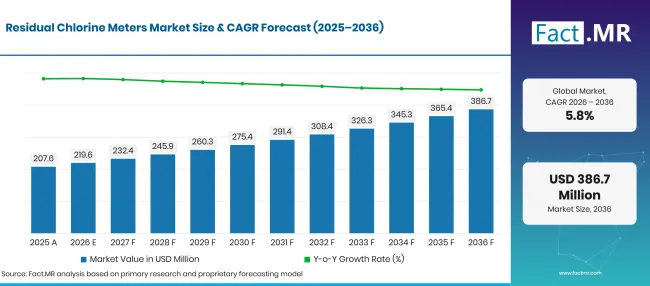
Residual Chlorine Meters Market Forecast Global | Source: Fact.MR
| Year | Basis | Market Value (USD million) |
|---|---|---|
| 2025 | Actual | 207.6 |
| 2026 | Estimate | 219.6 |
| 2036 | Forecast | 386.7 |
| CAGR 2026 to 2036 | Forecast period | 5.8% |
Source: Fact.MR analysis. Updated Nov 3, 2026
What are the defining numbers behind Residual Chlorine Meters Market growth?
USD 167.1 million absolute opportunity between 2026 and 2036.
- Demand Drivers in the Market
- Drinking water operators need to verify disinfectant levels throughout treatment and distribution. The World Health Organization's drinking-water guidance addresses residual disinfectant monitoring as part of water safety management. Residual chlorine measurement helps operators assess whether disinfection is being maintained through the supply system [1].
- Municipal and industrial water facilities increasingly use continuous instruments to monitor chlorine levels and respond to process changes. Hach offers CL17sc colorimetric and CL10sc amperometric chlorine analyzers for continuous measurement of free or total chlorine [2].
- Food and beverage operators require water quality checks in production and cleaning processes. Yokogawa identifies food and beverage water measurement among the applications for its FC800D chlorine analyzer, while Hanna offers portable free and total chlorine photometers for field and laboratory testing [3][4].
- Key Segments Analyzed
- By Product Type: Portable Residual Chlorine Meters are projected to account for 42.3% of the market in 2026, supported by their suitability for field testing and routine water quality checks.
- By Application: Water Treatment is set to hold 38.9% share in 2026, reflecting the need to monitor disinfectant residuals in treated water.
- By End-User: Municipal users are estimated to capture for 44.6% of the market in 2026, driven by monitoring requirements across public water supply systems.
- By Distribution Channel: Offline sales are projected to represent 72.4% of the market in 2026, reflecting the role of technical distributors, instrument suppliers and service support.
- Analyst Opinion at Fact.MR
- Shambhu Nath Jha, Principal Consultant at Fact.MR, states, “Residual chlorine measurement remains an important part of water quality control. Buyers are likely to compare portable testing convenience with the reliability of continuous monitoring, while giving weight to calibration support and measurement consistency.”
- Strategic Implications
- Instrument manufacturers should offer clear guidance on free and total chlorine measurement and the appropriate testing method for each water system.
- Suppliers need to strengthen calibration, reagent and maintenance support to help customers maintain measurement reliability.
- Municipal water operators can select portable or online instruments according to sampling frequency and process-control needs.
- Distributors must maintain access to replacement reagents, sensors and service support to reduce instrument downtime.
Germany is set to record a 6.7% CAGR through 2036. Brazil is projected to post 6.1%, followed by the USA at 5.5%. The UK is estimated to advance at 4.9%, while Japan is forecast to register 4.4%.
How does the Residual Chlorine Meters Market break down by segment?
Fact.MR finds that Portable Residual Chlorine Meters lead Product Type at 42.3%; Water Treatment leads Application at 38.9%; Municipal leads End-User at 44.6%; and Offline Leads Distribution Channel at 72.4%.
Which Product Type dominates?
Portable Residual Chlorine Meters are set to hold 42.3% share in 2026.
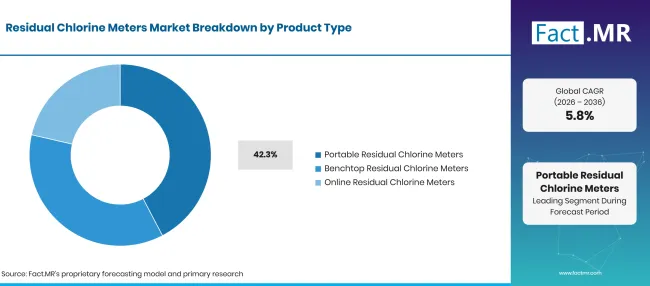
Residual Chlorine Meters Market Breakdown Product Type | Source: Fact.MR
| Product Type | Share (2026) |
|---|---|
| Portable Residual Chlorine Meters (Leading segment) | 42.3% |
| Other segments combined | 57.7%* |
| Total | 100.0% |
Source: Fact.MR analysis. Updated Nov 3, 2026
Portable meters are used for field sampling, routine inspections and spot checks at water treatment facilities. Their compact design allows operators to test samples at different points without installing permanent monitoring equipment. Benchtop meters are suited to laboratory and controlled testing environments, while online residual chlorine meters provide continuous measurement for process monitoring and automated control.
What leads the Application segment?
Water Treatment is set to represent 38.9% share in 2026.
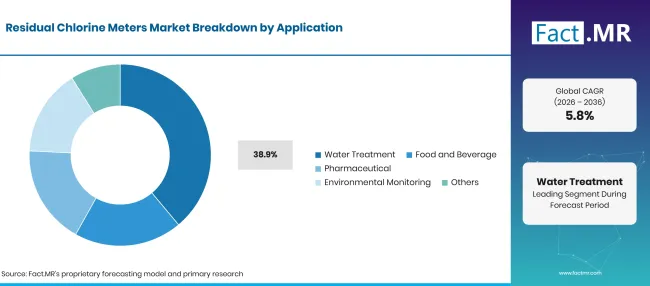
Residual Chlorine Meters Market Breakdown Application | Source: Fact.MR
| Application | Share (2026) |
|---|---|
| Water Treatment (Leading segment) | 38.9% |
| Other segments combined | 61.1%* |
| Total | 100.0% |
Source: Fact.MR analysis. Updated Nov 3, 2026
Water treatment facilities use residual chlorine meters to check disinfectant levels after treatment and at selected distribution points. Measurement helps operators assess whether adequate chlorine remains in the water. Industrial applications include process water and cooling systems, while commercial and residential applications include building water systems and other settings where chlorine levels need to be checked. Environmental monitoring covers selected water quality testing requirements.
Which End-User accounts for the largest share?
Municipal users are likely to capture for 44.6% share in 2026.
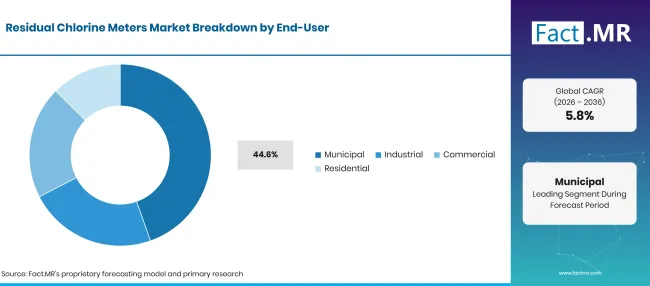
Residual Chlorine Meters Market Breakdown End User | Source: Fact.MR
| End-User | Share (2026) |
|---|---|
| Municipal (Leading segment) | 44.6% |
| Other segments combined | 55.4%* |
| Total | 100.0% |
Source: Fact.MR analysis. Updated Nov 3, 2026
Municipal water utilities use residual chlorine meters to monitor disinfection across treatment plants and distribution networks. Portable instruments support sampling at different locations, while online analyzers provide continuous readings at critical process points. Industrial and commercial users apply chlorine monitoring according to their water treatment requirements. Residential use is generally associated with local water systems and point-of-use testing.
How does Distribution Channel shape demand?
Offline distribution is projected to account for 72.4% share in 2026.
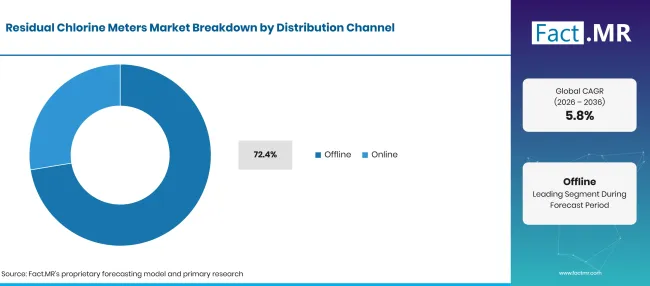
Residual Chlorine Meters Market Breakdown Distribution Channel 1 | Source: Fact.MR
| Distribution Channel | Share (2026) |
|---|---|
| Offline (Leading segment) | 72.4% |
| Other segments combined | 27.6%* |
| Total | 100.0% |
Source: Fact.MR analysis. Updated Nov 3, 2026
Offline distribution remains important because residual chlorine meters require product selection based on measurement range, method, calibration and operating conditions. Instrument distributors can provide installation support, operator training, calibration services and access to reagents or replacement sensors. Online channels support product discovery and repeat purchases, particularly for standard portable instruments and consumables.
What is accelerating Residual Chlorine Meters Market adoption, and what is holding it back?
Water safety monitoring and demand for process control support adoption, while instrument maintenance, calibration requirements and operating costs can constrain purchasing.
Drivers Impact Analysis
| DRIVER | (~) % IMPACT ON CAGR | GEOGRAPHIC RELEVANCE | IMPACT TIMELINE |
|---|---|---|---|
| Municipal drinking water quality monitoring | +0.9% | Global | Short term (≤ 2 years) |
| Continuous chlorine monitoring in treatment plants | +0.8% | Europe, Americas, Asia | Medium term (2–4 years) |
| Industrial water process monitoring | +0.7% | Global | Medium term (2–4 years) |
| Food and beverage water quality checks | +0.5% | Global | Short term (≤ 2 years) |
| Expansion of portable field testing | +0.4% | Global | Medium term (2–4 years) |
Source: Fact.MR analysis. Updated Nov 3, 2026
Opportunity Impact Analysis
| OPPORTUNITY | (~) % IMPACT ON CAGR | GEOGRAPHIC RELEVANCE | IMPACT TIMELINE |
|---|---|---|---|
| Digital and connected chlorine monitoring | +0.8% | Global | Medium term (2–4 years) |
| Portable instruments for distributed sampling | +0.7% | Asia, Americas | Short term (≤ 2 years) |
| Automated monitoring in municipal facilities | +0.6% | Europe, Asia | Long term (≥ 4 years) |
| Integrated chlorine and water quality systems | +0.5% | Global | Medium term (2–4 years) |
Source: Fact.MR analysis. Updated Nov 3, 2026
Restraints Impact Analysis
| RESTRAINT | (~) % IMPACT ON CAGR | GEOGRAPHIC RELEVANCE | IMPACT TIMELINE |
|---|---|---|---|
| Calibration and reagent replacement costs | -0.7% | Global | Short term (≤ 2 years) |
| Sensor maintenance and measurement drift | -0.6% | Global | Medium term (2–4 years) |
| Limited technical support in remote locations | -0.5% | Emerging markets | Medium term (2–4 years) |
| Budget constraints among smaller water operators | -0.4% | Global | Short term (≤ 2 years) |
Source: Fact.MR analysis. Updated Nov 3, 2026
Which countries are scaling the Residual Chlorine Meters Market through 2036?
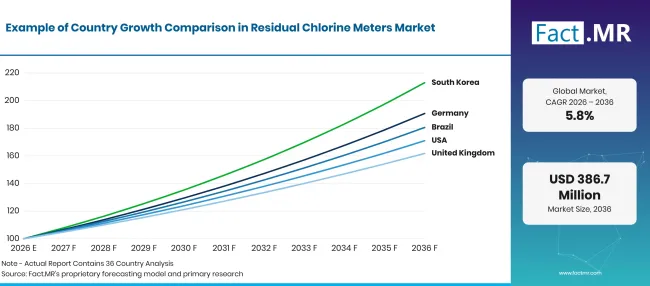
Residual Chlorine Meters Market Growth Index | Source: Fact.MR
| Country | CAGR (2026–2036) |
|---|---|
| Germany | 6.7% |
| Brazil | 6.1% |
| USA | 5.5% |
| UK | 4.9% |
| Japan | 4.4% |
Source: Fact.MR analysis. Updated Nov 3, 2026
What supports Germany adoption?
6.7% CAGR, supported by water quality monitoring across municipal utilities and industrial facilities.
Germany's municipal water systems and process industries require reliable measurement of disinfectant residuals. Portable instruments support routine sampling, while online analyzers help monitor treatment processes continuously. Instrument suppliers need to provide calibration support and clear measurement procedures for operators.
How is Brazil developing residual chlorine meter adoption?
6.1% CAGR, shaped by municipal water treatment requirements and the need for consistent water quality checks.
Brazil's water and sanitation operators require instruments for checking disinfection performance at treatment plants and across distribution systems. Portable meters can support field sampling, while online systems help larger facilities maintain process oversight. Local service networks and access to consumables can influence equipment selection.
What supports United States adoption?
5.5% CAGR, driven by drinking water monitoring requirements and industrial process control.
US water utilities use residual chlorine measurement to monitor disinfectant levels in treated drinking water. Hach markets portable chlorine instruments and continuous analyzers, including the DR series and CL17sc, for water testing and process applications [2] [5]. Selection depends on whether operators require spot measurements or continuous readings.
How is the United Kingdom building adoption?
4.9% CAGR, led by drinking water quality management and industrial water monitoring.
UK water operators and industrial facilities require reliable measurement to support disinfection control. Portable photometers can support routine sample testing, while fixed analyzers are relevant for continuous process monitoring. Hanna Instruments lists free and total chlorine portable photometers and chlorine analyzers within its water testing portfolio [4].
What supports Japan adoption?
4.4% CAGR, backed by established water treatment infrastructure and industrial monitoring requirements.
Japan's water utilities and industrial facilities use chlorine measurement systems to monitor disinfection and process conditions. Yokogawa supplies FC800D and RC800D chlorine analyzer systems for free and residual chlorine measurement, including applications in water purification and selected industrial settings [3]. These systems support continuous measurement and process monitoring.
Who leads the Residual Chlorine Meters Market?
Fact.MR identifies Hach, Hanna Instruments, Yokogawa Electric Corporation and Halogen Systems as companies with active, product-specific residual chlorine measurement portfolios.
Hach offers portable chlorine testing instruments and online analyzers. Its product portfolio includes the DR900 portable colorimeter, CL17sc colorimetric analyzer and CL10sc amperometric chlorine sensor. These products cover field testing and continuous free or total chlorine monitoring.
Hanna Instruments offers portable free and total chlorine photometers, including the HI97711 and HI93102 product ranges. Its PCA300 family provides chlorine, pH, ORP and temperature analysis. The company also lists the HI701 Free Chlorine Checker for routine portable testing [6].
Yokogawa supplies the FC800D non-reagent chlorine analyzer and RC800D reagent-based residual chlorine analyzer. Its product documentation identifies water purification, drinking water and selected food and beverage applications.
Halogen Systems offers the MP-5F free chlorine sensor and MP-TOTAL total chlorine analyzer. Its portfolio uses amperometric measurement and includes systems designed for municipal water, commercial buildings and industrial facilities [7].
Which companies are the key providers?
Key companies with active, product-specific residual chlorine meter or analyzer portfolios include:
- Hach
- Hanna Instruments
- Yokogawa Electric Corporation
- Halogen Systems
What is the report’s scope and coverage?
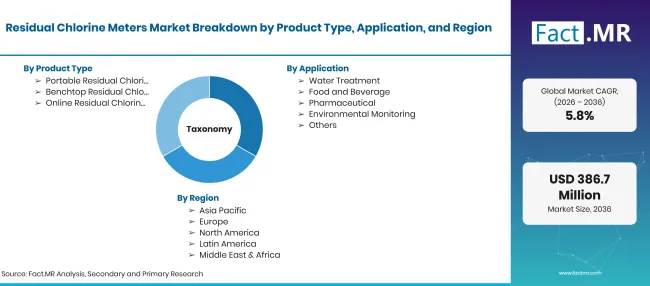
Residual Chlorine Meters Market Taxonomy | Source: Fact.MR
| Attribute | Details |
|---|---|
| Quantitative Units | USD million |
| Market Definition | The residual chlorine meters market comprises instruments designed to measure free or total residual chlorine concentrations in water. |
| Product Type | Portable Residual Chlorine Meters; Benchtop Residual Chlorine Meters; Online Residual Chlorine Meters |
| Application | Water Treatment; Food and Beverage; Pharmaceutical; Industrial; Commercial; Environmental Monitoring; Others |
| End-User | Municipal; Industrial; Commercial; Residential |
| Distribution Channel | Offline; Online |
| Regions Covered | North America; Latin America; Western Europe; Eastern Europe; East Asia; South Asia & Pacific; Middle East & Africa |
| Countries Covered | Germany; Brazil; USA; UK; Japan |
| Companies Profiled | Hach; Hanna Instruments; Yokogawa Electric Corporation; Halogen Systems |
| Forecast Period | 2026 to 2036 |
| Approach | Market segmentation and scenario-based analysis supported by instrument portfolios and water quality monitoring references |
Source: Fact.MR analysis. Updated Nov 3, 2026
Bibliography
- [1] World Health Organization. (2026, June 17). Guidelines for drinking-water quality: Fourth edition incorporating the first, second and third addenda
- [2] Hach. (n.d.). Chlorine analyzers
- [3] Yokogawa Electric Corporation. (n.d.). Chlorine analyzers
- [4] Hanna Instruments. (n.d.). Water testing instruments
- [5] Hach. (n.d.). Chlorine analyzers, test kits and reagents
- [6] Hanna Instruments India. (n.d.). Free Chlorine Checker® HC - HI701
- [7] Halogen Systems. (n.d.). Chlorine analyzers & sensors
This Report Answers
- The report describes how residual chlorine meters are used for water quality measurement across the specified applications.
- Product analysis compares portable, benchtop and online residual chlorine instruments.
- End-user analysis examines demand from municipal, industrial, commercial and residential users.
- Country analysis discusses Germany, Brazil, USA, UK and Japan alongside their respective market growth estimates.
- The competitive overview profiles companies with active residual chlorine measurement products.
What does the Spinal Orthotics Market cover?
The market covers instruments used to measure free or total residual chlorine in water. These include portable photometers, benchtop analyzers and online monitoring systems. Instruments use methods such as DPD colorimetry and amperometric sensing. Buyers select systems according to measurement range, accuracy, sampling frequency, maintenance requirements and whether the application requires spot testing or continuous monitoring.
What is included in the scope?
Included products comprise portable residual chlorine meters, benchtop chlorine measurement instruments and online chlorine analyzers. The scope covers instruments used in municipal water treatment, food and beverage production, pharmaceutical operations, industrial processes, commercial buildings and environmental monitoring. Both offline and online sales channels are included.
What is excluded from the scope?
The analysis excludes chlorine dosing pumps, disinfection chemicals and water treatment equipment that does not directly measure residual chlorine. General-purpose pH, conductivity and turbidity meters are excluded unless they form part of an integrated instrument that includes residual chlorine measurement. Laboratory testing services and water treatment plant construction are also outside the instrument market boundary.
How Was the Analysis Built?
The analysis draws on 120+ sources, 35+ company portfolios, 25+ countries, and more than 20 industry interviews.
- Primary Research: Primary research includes discussions with instrument manufacturers, water treatment operators, municipal utilities, industrial users, distributors and subject-matter experts. These conversations examine measurement requirements, purchasing priorities, calibration practices, maintenance needs and competitive positioning.
- Desk Research: Desk research covers company product portfolios, technical data sheets, government water quality publications, drinking water guidelines, industry studies, standards and other authoritative sources. Every source used in the analysis is documented in the bibliography.
- Market Sizing and Forecasting: Market estimates combine historical performance, demand indicators, pricing and volume trends, segment shares, company participation, country-level growth, adoption patterns and barriers to market expansion.
- Data Validation and Update Cycle: Findings are validated by comparing primary interviews with product specifications, company activity, regulatory developments and water infrastructure investment. Regular updates review product launches, measurement technologies, distribution networks and changes in commercial adoption.
Segmentation
How is the market segmented?
-
By Product Type
- Portable Residual Chlorine Meters
- Benchtop Residual Chlorine Meters
- Online Residual Chlorine Meters
-
By Application
- Water Treatment
- Food and Beverage
- Pharmaceutical
- Industrial
- Commercial
- Environmental Monitoring
- Others
-
By End-User
- Municipal
- Industrial
- Commercial
- Residential
-
By Distribution Channel
- Offline
- Online
-
By Region
- North America
- Latin America
- Western Europe
- Eastern Europe
- East Asia
- South Asia & Pacific
- Middle East & Africa
Frequently Asked Questions
How big is the Residual Chlorine Meters Market in 2026?
What is the CAGR from 2026 to 2036?
Which Product Type has the largest share?
Which Application leads?
Which End-User accounts for the largest share?
Which Distribution Channel leads?
Which companies are covered?
Who worked on this report


Preview the report firsthand - request a free sample
Free SampleGet the brochure for pricing and purchase details
Download PDF