- Market Value (2025): USD 23.4 Bn
- Estimated Value (2026): USD 24.7 Bn
- Forecast Value (2036): USD 42.6 Bn
- CAGR (2026-2036): 5.6%
What is the Rigid PU Foam Market forecast to be worth by 2036?
USD 24.7 billion in 2026 to USD 42.6 billion by 2036 at a 5.6% CAGR.
- As per the Fact.MR analysis, the rigid PU foam market was valued at USD 23.4 billion in 2025.
- Demand is projected to rise from USD 24.7 billion in 2026 to USD 42.6 billion by 2036.
- The rigid PU foam market is projected to increase from USD 24.7 billion in 2026 to USD 42.6 billion by 2036, registering a CAGR of 5.6%.
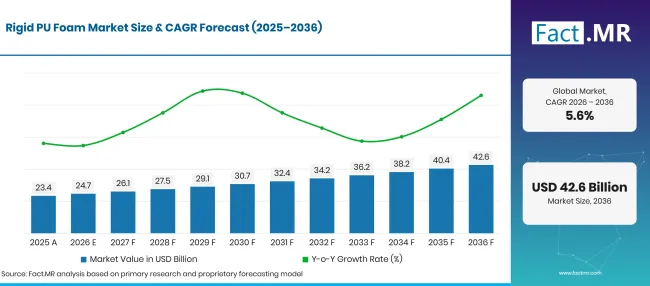
Rigid Pu Foam Market Forecast Global | Source: Fact.MR
| Year | Basis | Market Value (USD billion) |
|---|---|---|
| 2025 | Actual | 23.4 |
| 2026 | Estimate | 24.7 |
| 2036 | Forecast | 42.6 |
| CAGR 2026 to 2036 | Forecast period | 5.6% |
Source: Fact.MR analysis. Updated Oct 27, 2026
What are the defining numbers behind Rigid PU Foam Market growth?
USD 17.9 billion absolute opportunity between 2026 and 2036.
- Demand Drivers in the Market
- Building energy efficiency is supporting the market growth. The European Commission reported in June 2026 that buildings account for around 40% of EU energy consumption and 36% of energy-related greenhouse gas emissions. Policies aimed at improving building performance support demand for insulation materials, including rigid PU foam where product specifications and installation requirements are suitable [1].
- Insulation performance and compliance requirements influence material selection in building applications. On October 19, 2026, the European Commission reported that 31 of 97 tested insulation samples failed thermal-resistance requirements. The assessment covered six insulation material categories, highlighting the importance of verified thermal performance and accurate product documentation [2]
- Appliance and industrial insulation drives the growth of the rigid PU foam market by increasing demand for energy-efficient refrigeration and thermal insulation systems. Rigid PU foam is used in refrigeration equipment and other applications requiring thermal insulation. Manufacturers select formulations according to insulation performance, processing requirements and end-product design [3].
- Construction and renovation increase the demand for rigid PU foam in building envelopes and roofing systems to improve thermal insulation and energy efficiency. Spray foam and rigid foam components can support insulation in roofs, walls and other building-envelope areas. Adoption depends on local building codes and on appropriate fire-performance and installation practices [4].
- Key Segments Analyzed
- By Product Type: Spray Foam is projected to account for 48.7% of the market in 2026, supported by its ability to seal irregular gaps and provide continuous thermal insulation.
- By Application: Building and Construction holds 42.3% share in 2026, driven by demand for energy-efficient insulation across roofs and walls in new and renovated buildings.
- By End-User: Residential represents 38.5% of the end-user category in 2026, supported by demand for improved home insulation that reduces heat transfer and energy consumption.
- Analyst Opinion at Fact.MR
- Shambhu Nath Jha, Principal Consultant at Fact.MR, states, “Rigid PU foam demand is closely tied to insulation requirements across buildings and appliances. Manufacturers that deliver consistent thermal performance and reliable product documentation will be better positioned as customers place greater emphasis on energy efficiency and compliance.”
- Strategic Implications
- Manufacturers need to document thermal performance and fire-related characteristics for the intended application.
- Building-material suppliers must align product specifications with local construction codes and installation practices.
- Appliance manufacturers can evaluate insulation performance alongside processing needs and product design constraints.
- Distributors play a key role in providing clear technical guidance on installation, handling and application suitability.
- Producers should prioritize lower-impact raw materials and manufacturing options without compromising required foam performance.
Germany is set to record a 7.1% CAGR through 2036. Brazil is projected to grow at 6.5%, followed by the USA at 5.9%. The UK is estimated to advance at 5.3%, while Japan is forecast to register 4.7%.
How does the Rigid PU Foam Market break down by segment?
Fact.MR identifies Spray Foam as the leading Product Type at 48.7%. Building and Construction leads Application at 42.3%, while Residential accounts for 38.5% of End-User demand.
Which Product Type dominates?
Spray Foam is set to hold a 48.7% share in 2026.
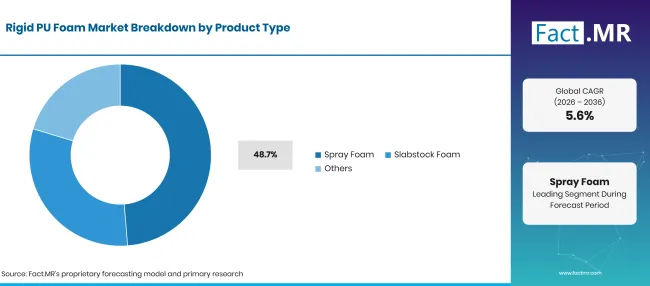
Rigid Pu Foam Market Breakdown Product Type | Source: Fact.MR
| Product Type | Share (2026) |
| Spray Foam (Leading segment) | 48.7% |
| Other segments combined | 51.3%* |
| Total | 100.0% |
Source: Fact.MR analysis. Updated Oct 27, 2026
Spray foam is used to insulate building-envelope areas and seal gaps around building components. Its ability to form a continuous layer makes it suitable for selected roof, wall and floor applications. Slabstock foam serves other rigid foam requirements and is processed according to the intended product design. Adoption depends on installation quality and compliance with applicable building and fire-safety requirements.
What leads the Application segment?
Building and Construction is set to represent a 42.3% share in 2026.
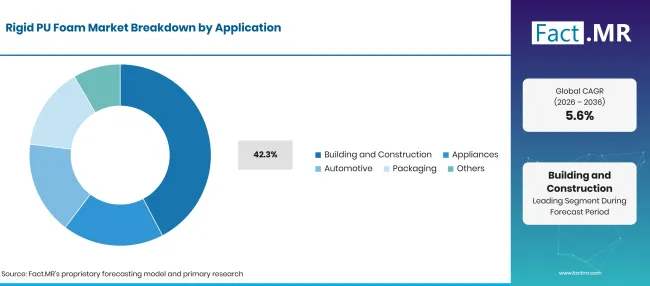
Rigid Pu Foam Market Breakdown Application | Source: Fact.MR
| Application | Share (2026) |
| Building and Construction (Leading segment) | 42.3% |
| Other segments combined | 57.7%* |
| Total | 100.0% |
Source: Fact.MR analysis. Updated Oct 27, 2026
Construction applications include wall and roof insulation as well as insulated panels and other building-envelope systems. Rigid PU foam can reduce heat transfer where the product is appropriately specified and installed. Appliances and automotive applications have different requirements for component geometry, production methods and thermal performance.
Which End-User segment leads?
Residential is projected to account for a 38.5% share in 2026.
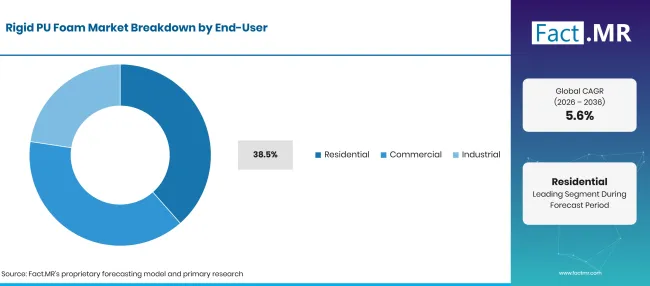
Rigid Pu Foam Market Breakdown End User | Source: Fact.MR
| End-User | Share (2026) |
| Residential (Leading segment) | 38.5% |
| Other segments combined | 61.5%* |
| Total | 100.0% |
Source: Fact.MR analysis. Updated Oct 27, 2026
Residential demand is supported by insulation needs in new homes and renovation projects. Commercial and industrial buyers evaluate insulation performance alongside durability and installation requirements. Appliance manufacturers use rigid PU foam in applications such as domestic and commercial refrigeration. These end-user categories have different product specifications and purchasing cycle.
What is accelerating Rigid PU Foam Market adoption, and what is holding it back?
Demand for insulation and temperature-controlled equipment supports adoption. However, material costs, compliance requirements and the need for correct installation can constrain uptake.
Drivers Impact Analysis
| Driver | (~) % IMPACT ON CAGR | Geographic relevance | Impact timeline |
|---|---|---|---|
| Building energy-efficiency upgrades | +1.0% | Europe, North America | Medium term (2–4 years) |
| Residential and commercial construction | +0.8% | Global | Medium term (2–4 years) |
| Insulation demand from appliances | +0.6% | Global | Short to medium term |
| Industrial insulation requirements | +0.4% | Global | Long term (4+ years) |
| Improved foam processing technology | +0.3% | Global | Medium term (2–4 years) |
Source: Fact.MR analysis. Updated Oct 27, 2026
Opportunity Impact Analysis
| Opportunity | (~) % IMPACT ON CAGR | Geographic relevance | Impact timeline |
|---|---|---|---|
| Energy-efficient building renovation | +0.8% | Europe, North America | Medium term (2–4 years) |
| High-performance insulated panels | +0.6% | Global | Medium term (2–4 years) |
| Refrigeration and cold-chain equipment | +0.5% | Asia, Americas | Long term (4+ years) |
| Lower-impact blowing-agent systems | +0.4% | Global | Medium to long term |
| Product-specific technical support | +0.3% | Global | Short term (≤2 years) |
Source: Fact.MR analysis. Updated Oct 27, 2026
Restraints Impact Analysis
| Restraint | (~) % IMPACT ON CAGR | Geographic relevance | Impact timeline |
|---|---|---|---|
| Raw-material price volatility | -0.8% | Global | Short term (≤2 years) |
| Fire-safety and building-code requirements | -0.6% | Global | Medium term (2–4 years) |
| Installation quality and workforce availability | -0.5% | Global | Short to medium term |
| Competition from alternative insulation materials | -0.4% | Global | Medium term (2–4 years) |
| Recycling and end-of-life management challenges | -0.3% | Global | Long term (4+ years) |
Source: Fact.MR analysis. Updated Oct 27, 2026
Which countries are scaling the Rigid PU Foam Market through 2036?
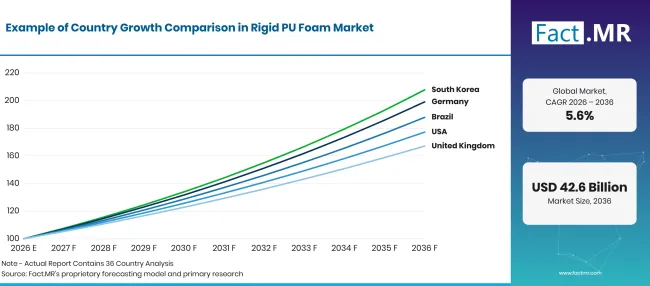
Rigid Pu Foam Market Growth Index | Source: Fact.MR
| Country | CAGR (2026–2036) |
|---|---|
| Germany | 7.1% |
| Brazil | 6.5% |
| USA | 5.9% |
| UK | 5.3% |
| Japan | 4.7% |
Source: Fact.MR analysis. Updated Oct 27, 2026
What supports Germany adoption?
7.1% CAGR, supported by building renovation and demand for energy-efficient insulation.
Germany's renovation activity and energy-performance requirements support demand for insulation materials used in roofs walls and floors. Rigid polyurethane (PU) foam offers thermal insulation properties that suit building-envelope applications. Product selection depends on thermal performance and compliance with applicable building regulations and fire-safety requirements.
How is Brazil developing rigid PU foam adoption?
6.5% CAGR, driven by construction activity and demand for thermal insulation.
Brazil's construction sector creates opportunities for rigid PU foam in buildings and industrial facilities. Adoption depends on local climate conditions and building design as well as the cost of installing insulation systems. Manufacturers can support market development through application-specific products and technical guidance for construction and industrial users.
What supports United States adoption?
5.9% CAGR, led by building energy-efficiency improvements and appliance insulation demand.
The U.S. market uses rigid PU foam in residential and commercial buildings as well as refrigeration equipment and appliances because its low thermal conductivity and closed-cell structure provide high thermal resistance with relatively little material thickness. In building envelopes, rigid PU insulation reduces conductive heat transfer through roofs and walls, while properly designed joints and continuous insulation help limit thermal bridging.
How is the United Kingdom building adoption?
5.3% CAGR, backed by building renovation and efforts to improve energy performance.
The UK market benefits from demand for rigid PU foam in roof wall and floor insulation because its low thermal conductivity enables high thermal resistance at relatively low thickness. This is particularly relevant in retrofit projects where cavity depth and available installation space are limited. Closed-cell foam structures also provide effective insulation and can help reduce heat transfer through building envelopes when installed as part of a correctly designed system. Adoption depends on declared thermal conductivity and system-level U-value calculations alongside moisture management and condensation risk assessments. Compliance with UK building regulations and fire-safety requirements remains essential when specifying foam insulation for residential and commercial buildings.
What supports Japan adoption?
4.7% CAGR, shaped by building insulation and demand for energy-efficient appliances.
Japan's rigid PU foam market serves construction applications and appliance manufacturing. Producers evaluate foam systems based on thermal performance and durability alongside compatibility with manufacturing processes. Demand will depend on construction activity and appliance production as manufacturers seek insulation materials that meet application-specific performance requirements.
Who leads the Rigid PU Foam Market?
Fact.MR finds that BASF SE, Covestro AG, Huntsman Corporation, Dow Inc. and Recticel NV/SA are profiled across the rigid polyurethane foam value chain.
BASF and Covestro supply polyurethane foam systems and materials for insulation applications. Huntsman and Dow participate in the market through rigid foam formulations and polyurethane system solutions for construction and refrigeration. Recticel manufactures rigid PU and polyisocyanurate insulation boards for building applications. Product portfolios differ by formulation and finished-product category, so comparisons should account for whether suppliers offer chemical inputs, formulated foam systems or finished insulation boards.
Commercial competition depends on thermal conductivity, dimensional stability, processing efficiency and fire-performance requirements. Construction and appliance manufacturers also evaluate insulation thickness and system compatibility to meet application-specific energy-efficiency and safety standards.
Which companies are the key providers?
Key companies profiled include BASF SE; Covestro AG; Huntsman Corporation; Dow Inc.; and Recticel NV/SA.
- BASF SE,
- Covestro AG
- Huntsman Corporation
- Dow Inc.
- Recticel NV/SA
Bibliography
- 1] European Climate, Infrastructure and Environment Executive Agency. (2026, June 2). New EPBD rules enter into force to improve the energy performance of buildings. European Commission. Official source
- [2] European Commission, Directorate-General for Internal Market, Industry, Entrepreneurship and SMEs. (2026, October 19). EU tests put thermal insulating materials under the spotlight. Official source
- [3] BASF. (n.d.). Polyiso and rigid foam insulation. BASF source
- [4] Covestro. (n.d.). Insulation & protection: Safe, sustainable PU foams for high-performance insulation. Covestro source
This Report Answers
- The report examines how rigid PU foam is used in building insulation and selected appliance and industrial applications.
- Segment analysis compares the specified product categories and their respective 2026 market shares.
- Country analysis evaluates Germany, Brazil, the USA, the UK and Japan alongside relevant construction and energy-efficiency indicators.
- The competitive overview profiles BASF SE, Covestro AG, Huntsman Corporation, Dow Inc. and Recticel NV/SA.
- Application analysis distinguishes building insulation from appliance and other specified end-use applications.
What does the Rigid PU Foam Market cover?
The market covers rigid polyurethane foam products and systems used for thermal insulation in buildings and selected appliances and industrial applications. Product coverage follows the specified categories including spray foam and slabstock foam. Application coverage reflects the defined construction and non-construction uses. Purchasing decisions depend on thermal conductivity and insulation thickness alongside processing requirements and applicable safety standards.
What is included in the scope?
Included products comprise rigid PU foam materials and formulated systems sold for the applications defined in the market segmentation.
The value boundary covers specified construction and building insulation uses alongside appliance automotive packaging and industrial applications where included.
The analysis also covers residential commercial and industrial end-user demand and the five identified country markets.
What is excluded from the scope?
The analysis excludes flexible polyurethane foam used primarily for cushioning and upholstery.
Finished construction projects and installation services are outside the product revenue boundary. Polyurethane materials that do not meet the defined rigid foam classification are excluded. Raw materials sold for unrelated applications and insulation products made from other chemistries are also excluded unless explicitly counted within the market-sizing methodology.
How was the analysis built?
The analysis considers market forecasts, industry developments, company activities, technical requirements and relevant government statistics to assess market conditions and growth opportunities.
- Primary Research: Primary research includes discussions with manufacturers, service providers, technology developers, distributors, end users, and subject-matter experts. These conversations examine purchasing priorities, product adoption, operational challenges, approval requirements, competitive positioning, and the factors that influence wider market acceptance.
- Desk Research: Desk research covers government statistics, regulatory publications, company filings, trade data, technical studies, industry associations, standards, public policy, and other authoritative sources. Every source used in the analysis is documented in the bibliography.
- Market Sizing and Forecasting: Market estimates combine historical performance, demand indicators, pricing and volume trends, segment shares, company participation, country-level growth, adoption patterns, investment activity, and barriers to market expansion.
- Data Validation and Update Cycle: Findings are validated by comparing primary interviews with public data, company activity, regulatory changes, trade patterns, and industry developments. Regular updates review new product launches, capacity changes, partnerships, approvals, and shifts in commercial adoption.
Segmentation
What is the report’s scope and coverage?
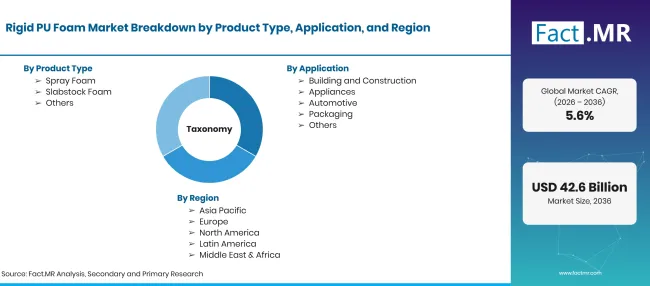
Factmr Rigid Pu Foam Market Taxonomy | Source: Fact.MR
| Attribute | Details |
|---|---|
| Quantitative units | USD billion |
| Market definition | Rigid polyurethane foam products and systems used in insulation and other rigid foam applications |
| Product Type | Spray Foam; Slabstock Foam; Others |
| Application | Building and Construction; Appliances; Automotive; Packaging; Others |
| End-User | Residential; Commercial; Industrial; Others |
| Countries covered | Germany; Brazil; USA; UK; Japan |
| Companies profiled | BASF SE, Covestro AG, Huntsman Corporation, Dow Inc. and Recticel NV/SA |
| Forecast period | 2026–2036 |
| Approach | Market segmentation and forecast analysis supported by official energy-efficiency information and company product documentation |
Source: Fact.MR analysis. Updated Oct 27, 2026
How is the market segmented?
-
By Product Type
- Spray Foam
- Slabstock Foam
- Others
-
By Application
- Building and Construction
- Appliances
- Automotive
- Packaging
- Others
-
By End-User
- Residential
- Commercial
- Industrial
- Others
-
By Region
- North America
- Latin America
- Western Europe
- Eastern Europe
- East Asia
- South Asia & Pacific
- Middle East & Africa
Frequently Asked Questions
How big is the Rigid PU Foam Market in 2026?
What is the CAGR from 2026 to 2036?
Which Product Type has the largest share?
Which Application leads the market?
Which companies are covered?
Who worked on this report


Preview the report firsthand - request a free sample
Free SampleGet the brochure for pricing and purchase details
Download PDF