
- Market Value (2025): USD 1.55 Bn
- Estimated Value (2026): USD 1.71 Bn
- Forecast Value (2036): USD 4.86 Bn
- CAGR (2026-2036): 11.0%
Tunable Lasers Market Forecast and Outlook 2026 to 2036
The tunable laser market is anticipated to expand from USD 1.71 billion in 2026 to USD 4.86 billion by 2036, registering a CAGR of 11.0% over the ten-year period. Demand is supported by the increasing use of wavelength-adjustable laser systems in fiber-optic communications, photonic component testing and precision optical measurements.
Interest in tunable lasers reflects how optical networks, spectroscopy, sensing and test equipment need light sources that can change wavelength on demand. Suppliers are offering semiconductor, external-cavity and solid-state tunable lasers across near-infrared, visible and mid-infrared ranges with mechanical, current and thermal tuning.
Key Takeaways from Tunable Lasers Market
- Sales of tunable lasers stood at USD 1.55 billion in 2025
- Tunable Lasers Market Value (2026): USD 1.71 billion
- Tunable Lasers Market Forecast Value (2036): USD 4.86 billion
- Tunable Lasers Market Forecast CAGR (2026-2036): 11.0%
- Leading Laser Type: Semiconductor tunable lasers (ITLA, DBR, DFB arrays) (40.4%)
- Key Market Participants: Lumentum, Coherent, MKS Instruments (Spectra-Physics), Santec, TOPTICA Photonics
- Key Growth Countries: China, South Korea, United States, France, United Kingdom
In September 2025, Lumentum introduced an ultrawideband nano-iTLA laser assembly offering more than 12.4 THz of tunability across the extended C- and L-bands. The product targets data-center interconnects, metropolitan networks and long-haul optical communications. Network equipment manufacturers require wavelength-adjustable lasers to transmit information across multiple optical channels and support increasing bandwidth requirements. Lumentum's development extends the operating range available within a compact laser assembly, allowing optical system designers to address wider transmission bands.
Tunable Lasers Market
| Metric | Value |
|---|---|
| Estimated Value in (2026) | USD 1.71 billion |
| Forecast Value in (2036) | USD 4.86 billion |
| Forecast CAGR (2026 to 2036) | 11.0% |
Source: Fact.MR analysis.
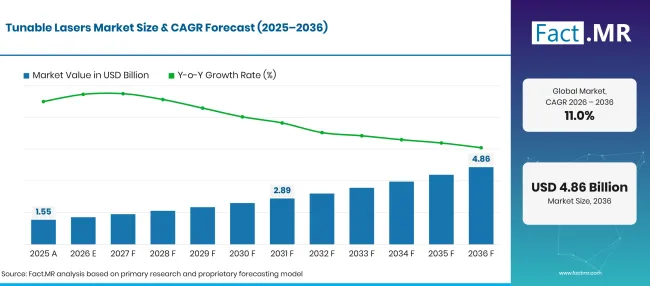
Tunable Lasers Market Forecast Global 3 | Source: Fact.MR
Category
| Category | Segments |
|---|---|
| Laser Type | Semiconductor tunable lasers (ITLA, DBR, DFB arrays), External-cavity diode lasers, Solid-state and optical parametric lasers, Fiber lasers, Quantum cascade lasers |
| Wavelength Range | Near-infrared, Visible, Mid- and far-infrared, Ultraviolet |
| Application | Optical communications, Spectroscopy and gas sensing, Test and measurement, Biomedical imaging and life sciences, Defence and lidar |
| Tuning Mechanism | Mechanical grating and MEMS tuning, Current injection tuning, Thermal tuning, Electro-optic and acousto-optic tuning |
| Region | China; South Korea; United States; France; United Kingdom |
Source: Fact.MR analysis. Updated Nov 25, 2026
Segmental Analysis
What explains the leading laser type share of semiconductor tunable lasers (ITLA, DBR, DFB arrays) in the Tunable Lasers Market?
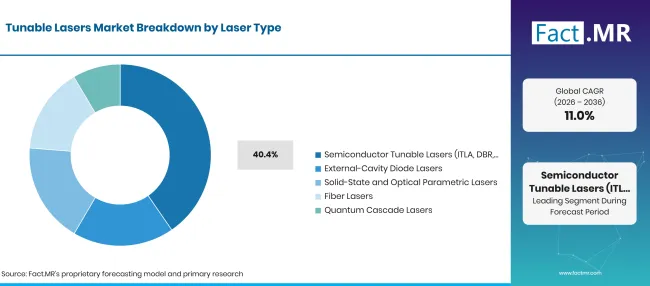
Tunable Lasers Market Breakdown Laser Type | Source: Fact.MR
Semiconductor tunable lasers secure a 40.4% revenue share in 2026, with sales of approximately USD 690.8 million. Their compact size and adjustable wavelengths suit coherent optical transceivers used in telecommunications and data centers. Coherent offers DBR-based tunable laser assemblies with narrow linewidth and stable frequency control, supporting high-capacity optical transmission systems.
What explains the leading wavelength range share of near-infrared in the Tunable Lasers Market?
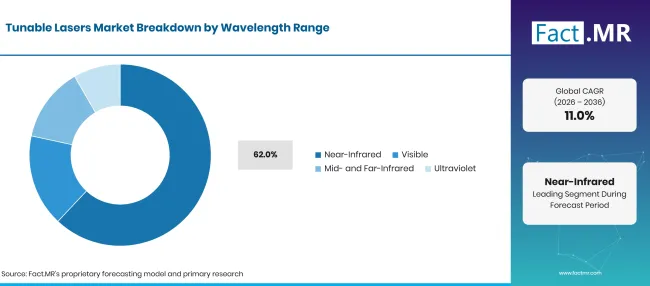
Tunable Lasers Market Breakdown Wavelength Range | Source: Fact.MR
Near-infrared tunable lasers generate approximately USD 1.06 billion in 2026, representing 62.0% of market revenue. This wavelength range covers optical communication bands used for transmitting data through fiber networks. Lumentum's ultrawideband nano-iTLA provides tunability across extended C- and L-bands, illustrating the importance of near-infrared sources in modern optical networking equipment.
What explains the leading application share of optical communications in the Tunable Lasers Market?
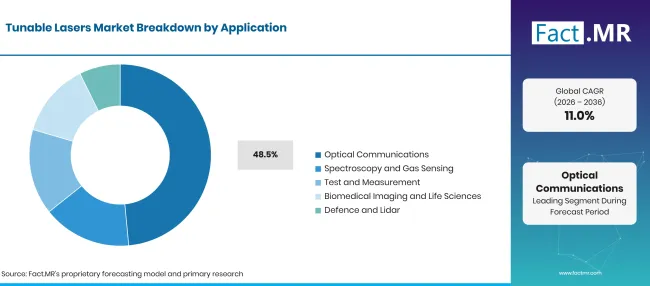
Tunable Lasers Market Breakdown Application 1 | Source: Fact.MR
Optical communications contribute 48.5% of tunable laser revenue in 2026, approximately USD 829.3 million. Coherent transmission systems use wavelength-adjustable laser sources to support different optical channels across fiber networks. Lumentum introduced an ultrawideband nano-iTLA in September 2025 for data-center interconnects, metropolitan networks and long-haul transmission, addressing increasing bandwidth requirements in optical infrastructure.
What explains the leading tuning mechanism share of mechanical grating and MEMS tuning in the Tunable Lasers Market?
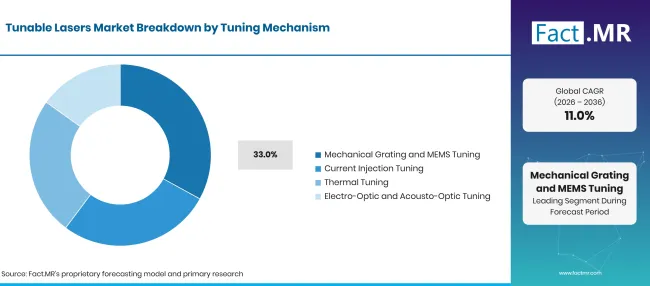
Tunable Lasers Market Breakdown Tuning Mechanism | Source: Fact.MR
The mechanical grating and MEMS tuning segment holds 33.0% of revenue in 2026, approximately USD 564.3 million. Grating-based external-cavity lasers allow precise wavelength adjustment, making them suitable for spectroscopy and photonic component testing. Santec offers tunable laser systems with wide tuning ranges and narrow linewidths, while MEMS-based designs support compact wavelength-sweeping applications.
Tunable Lasers Market- Drivers, Restraints and Trends
Drivers
Optical network upgrades and growing AI data center traffic are increasing the need for tunable laser sources in coherent transmission systems. Gas sensing, lidar and photonic testing also require adjustable wavelengths, encouraging manufacturers to develop compact lasers with accurate frequency control.
Restraints
High manufacturing costs for lasers offering wide wavelength coverage and narrow linewidths influence purchasing decisions among equipment manufacturers. Fluctuating telecommunications investment and pricing pressure from optical transceiver suppliers further affect sales, particularly for specialized laser assemblies requiring precise calibration and reliability testing.
Trend
Coherent Optics in Data Centers: In September 2025, Lumentum introduced an ultrawideband nano-iTLA offering more than 12.4 THz of tunability across extended C- and L-bands. Its compact design supports coherent optical transmission in AI data centers, metropolitan networks and long-haul communication infrastructure.
Trend
Gas Sensing and Spectroscopy: Near-infrared and mid-infrared tunable lasers are finding applications in gas detection, materials analysis and scientific spectroscopy. Coherent supplies wavelength-adjustable laser technologies for optical measurement applications, where precise wavelength selection helps researchers and equipment operators examine material properties and detect specific optical responses.
Tunable Lasers Market Analysis by Key Country
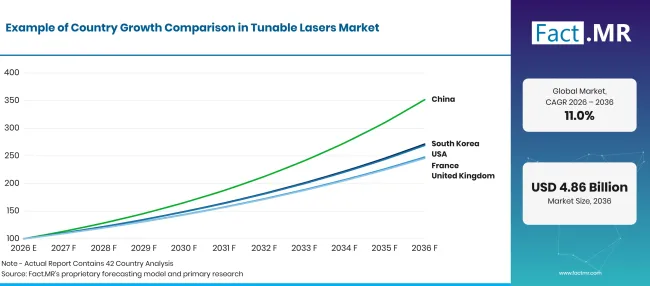
Tunable Lasers Market Growth Index | Source: Fact.MR
| Country | CAGR (2026-2036) |
|---|---|
| China | 13.4% |
| South Korea | 10.5% |
| United States | 10.4% |
| France | 9.5% |
| United Kingdom | 9.4% |
Source: Fact.MR analysis.
Why is China the fastest-growing market for tunable lasers?
Sales of tunable lasers in China are forecast to increase at a 13.4% CAGR over the next decade, the highest among the five countries.
Expansion of optical communication networks and domestic photonics manufacturing supports purchases of wavelength-adjustable laser sources. China's Ministry of Industry and Information Technology reported 5.102 million 5G base stations by June 2026. Telecommunications equipment manufacturers require tunable lasers for coherent optical transmission and network testing.
What is driving tunable lasers demand in South Korea?
Demand for tunable lasers in South Korea is anticipated to grow at a 10.5% CAGR over the forecast period, slightly below the global rate of 11.0%.
Semiconductor fabrication, optical communications and display manufacturing support purchases of precision laser instruments. South Korea's Ministry of Trade, Industry and Resources reported ICT exports worth USD 264.3 billion in 2025, reflecting substantial electronics manufacturing activity. Photonics suppliers serve equipment manufacturers requiring stable wavelengths for component testing, optical measurement and research applications.
What is shaping tunable lasers demand in the United States?
Sales of tunable lasers in the United States are projected to expand at a 10.4% CAGR by 2036, compared with the global rate of 11.0%. AI data center investments, optical component manufacturing and scientific research support purchases of advanced laser systems.
In August 2026, the National Science Foundation announced USD 1.5 billion for foundational research across scientific and technological fields. Coherent optical transmission requires wavelength-stable laser sources, while research laboratories use tunable systems for spectroscopy, photonic testing and precision optical measurements.
How is demand for tunable lasers developing in France?
Demand for tunable lasers in France is estimated to rise at a 9.5% CAGR over the ten-year outlook, below the global average of 11.0%.
Telecommunications infrastructure, photonics laboratories and quantum technology development create opportunities for wavelength-adjustable laser systems. In May 2026, the French government announced an additional EUR 1 billion commitment to its national quantum strategy for 2026–2030. Research programmes involving optical components and atom manipulation require precise laser control.
Why is growth slower for tunable lasers in the United Kingdom?
Sales of tunable lasers in the United Kingdom are forecast to advance at a 9.4% CAGR by 2036, the lowest among the five countries.
Photonics research, telecommunications equipment and precision measurement applications support purchases of wavelength-adjustable sources. The UK Council for Science and Technology reported in 2026 that the country's photonics industry generated GBP 18.5 billion in turnover during 2024. Research institutions and optical equipment manufacturers require tunable lasers for spectroscopy, component characterization and communication testing.
Competitive Landscape for Tunable Lasers Market
Laser suppliers address distinct requirements across optical communications, scientific research and precision measurement. Lumentum and Coherent develop compact tunable assemblies for coherent transmission, while MKS Instruments' Spectra-Physics portfolio serves laboratory applications requiring narrow linewidths and wavelength flexibility. Santec specializes in tunable sources for optical component testing, whereas TOPTICA Photonics focuses on precision laser systems.
Recent developments show growing attention to optical bandwidth and manufacturing capacity. In March 2026, Coherent announced expanded nano-iTLA production, while Lumentum showcased lasers offering more than 12.4 THz of tunability in 2025. Suppliers compete on wavelength coverage, output stability and integration with optical equipment.
Recent Developments
- In January 2026, Santec launched its TSL-570 Type U tunable laser for advanced optical testing. The device provides more than 300 mW output power, helping manufacturers test silicon photonics and optical communication components.
- In October 2025, TOPTICA Photonics launched TeraScan ultra, a tunable terahertz measurement system. The equipment provides precise frequency control and supports research in wireless communication, semiconductor inspection, and high-resolution spectroscopy across different applications.
Key Players in Tunable Lasers Market
Key companies operating in the market include Lumentum, Coherent, MKS Instruments (Spectra-Physics), Santec, and TOPTICA Photonics.
- Lumentum
- Coherent
- MKS Instruments (Spectra-Physics)
- Santec
- TOPTICA Photonics
Bibliography
- Coherent Corp. (2026, March 12). Coherent advances scale-across networks with significant enhancements to its multi-rail transport platform.
- Council for Science and Technology. (2026). Photonics: Capturing the opportunities for growth and global leadership.
- Lumentum Holdings Inc. (2025, September 29). Lumentum showcases new products and technologies at ECOC 2025 for AI and data center networks.
- Ministry of Economy, Finance and Industrial and Digital Sovereignty, France. (2026, May 26). Souveraineté technologique : la France investit 1 milliard d’euros supplémentaire dans la stratégie nationale quantique et 550 M€ dans les semi-conducteurs.
- Ministry of Industry and Information Technology of the People’s Republic of China. (2026). Economic operation of the communications industry in the first half of 2026. tjca.miit.
- MKS Inc. (2026, July). MKS launches European Laser Applications Lab to help accelerate development time.
- Santec Holdings Corporation. (2026, January 15). Santec unveils ultra high-power TSL-570 Type U tunable laser to address optical loss challenges in AI-driven CPO architectures.
- Santec LIS Corporation. (2026, March 16). Santec sets a new standard in tunable lasers with the TSL-580.
- TOPTICA Photonics AG. (2026, March 18). Lasers that power analytics. Gräfelfing, TOPTICA Photonics SE
- U.S. National Science Foundation. (2026, August 17). NSF announces $1.5B for foundational research to drive scientific breakthroughs for American technological leadership.
- U.S. National Science Foundation. (2026, August 25). Eight NSF research institutes to propel U.S. quantum science with $290M investment.
- TOPTICA Photonics. (2025, October 9). TOPTICA launches TeraScan ultra.
Segmentation
Scope of Report
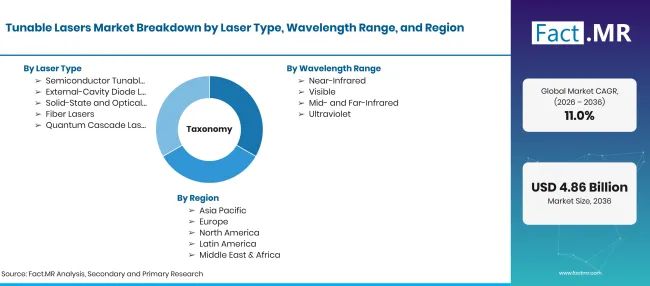
Tunable Lasers Market Taxonomy | Source: Fact.MR
| Items | Values |
|---|---|
| Quantitative Units (2026) | USD 1.71 Billion |
| Laser Type | Semiconductor tunable lasers (ITLA, DBR, DFB arrays), External-cavity diode lasers, Solid-state and optical parametric lasers, Fiber lasers, Quantum cascade lasers |
| Wavelength Range | Near-infrared, Visible, Mid- and far-infrared, Ultraviolet |
| Application | Optical communications, Spectroscopy and gas sensing, Test and measurement, Biomedical imaging and life sciences, Defence and lidar |
| Tuning Mechanism | Mechanical grating and MEMS tuning, Current injection tuning, Thermal tuning, Electro-optic and acousto-optic tuning |
| Regions Covered | North America, Latin America, Europe, Asia Pacific, Middle East & Africa |
| Countries Covered | China, South Korea, United States, France, United Kingdom, and other countries |
| Key Companies Profiled | Lumentum, Coherent, MKS Instruments (Spectra-Physics), Santec, TOPTICA Photonics |
| Additional Attributes | Dollar revenue in the Tunable Lasers Market is segmented by laser type, wavelength range, application and tuning mechanism and region. |
Source: Fact.MR analysis. Updated Nov 25, 2026
Tunable Lasers Market by Segments
-
Laser Type
- Semiconductor tunable lasers (ITLA, DBR, DFB arrays)
- External-cavity diode lasers
- Solid-state and optical parametric lasers
- Fiber lasers
- Quantum cascade lasers
-
Wavelength Range
- Near-infrared
- Visible
- Mid- and far-infrared
- Ultraviolet
-
Application
- Optical communications
- Spectroscopy and gas sensing
- Test and measurement
- Biomedical imaging and life sciences
- Defence and lidar
-
Tuning Mechanism
- Mechanical grating and MEMS tuning
- Current injection tuning
- Thermal tuning
- Electro-optic and acousto-optic tuning
-
Region:
- North America
- United States
- Canada
- Mexico
- Europe
- Germany
- United Kingdom
- France
- Italy
- Spain
- Rest of Europe
- Asia Pacific
- China
- India
- Japan
- South Korea
- Australia and New Zealand
- Rest of Asia Pacific
- Latin America
- Brazil
- Argentina
- Rest of Latin America
- Middle East & Africa
- GCC Countries
- South Africa
- Rest of Middle East & Africa
- North America
Table of Contents
Key Takeaways
- Market Size and CAGR
- Top Growth Driver
- Fastest Growing Segment
- Leading Region
- Key Companies
- Emerging Opportunities

