
- Market Value (2025): USD 35.1 Bn
- Estimated Value (2026): USD 37.4 Bn
- Forecast Value (2036): USD 70.8 Bn
- CAGR (2026-2036): 6.6%
Sensor Module for Mobile Devices Market Forecast and Outlook 2026 to 2036
The sensor module for mobile devices market is projected to grow from USD 37.4 billion in 2026 to USD 13.9 billion by 2036, registering a CAGR of 6.2% over the ten-year period. Growing integration of motion-sensing and environmental monitoring technologies in smartphones, tablets and wearable devices is supporting demand for compact, energy-efficient sensor modules.
Interest in sensor modules for mobile devices reflects how smartphones, wearables and handheld devices add motion, biometric, proximity, light and environmental sensing for new features. Suppliers are offering inertial, fingerprint, proximity and ambient light modules, mostly MEMS-based, in single and combined packages.
Key Takeaways from Sensor Module for Mobile Devices Market
- Sales of sensor modules for mobile devices stood at USD 7.2 billion in 2025
- Sensor Module for Mobile Devices Market Value (2026): USD 37.4 billion
- Sensor Module for Mobile Devices Market Forecast Value (2036): USD 13.9 billion
- Sensor Module for Mobile Devices Market Forecast CAGR (2026-2036): 6.2%
- Leading Sensor Type: Motion and inertial modules (28.6%)
- Key Market Participants: STMicroelectronics, Bosch Sensortec, TDK, Goodix
- Key Growth Countries: India, Vietnam, China, United States, Taiwan
In October 2025, STMicroelectronics published an updated datasheet for its LSM6DSV320X inertial measurement unit, featuring two accelerometers and a gyroscope within a compact 2.5 mm × 3 mm package. The device combines motion tracking, high-impact detection and embedded sensor processing for personal electronics and connected devices. Smartphone and wearable manufacturers increasingly require compact sensor modules that support activity recognition, gesture detection and orientation tracking while conserving board space. STMicroelectronics' development illustrates how semiconductor suppliers are integrating multiple sensing functions into miniature packages.
Sensor Module for Mobile Devices Market
| Metric | Value |
|---|---|
| Estimated Value in (2026) | USD 37.4 billion |
| Forecast Value in (2036) | USD 13.9 billion |
| Forecast CAGR (2026 to 2036) | 6.2% |
Source: Fact.MR analysis.
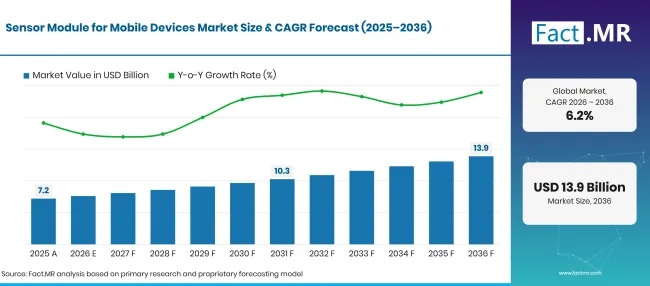
Sensor Module For Mobile Devices Market Forecast Global 3 | Source: Fact.MR
Category
| Category | Segments |
|---|---|
| Sensor Type | Motion and inertial modules, Fingerprint and biometric modules, Proximity and ambient light modules, MEMS microphone modules, Time-of-flight and 3D sensing modules |
| Device | Smartphones, Wearables and hearables, Handheld gaming and other mobile devices, Tablets |
| Technology | MEMS, Optical, Capacitive, Ultrasonic, Hall-effect and magnetoresistive |
| Integration Level | Multi-sensor combination modules, Single-sensor modules, Sensor-hub integrated modules, System-in-package sensor modules |
| Region | India; Vietnam; China; United States; Taiwan |
Source: Fact.MR analysis. Updated Nov 25, 2026
Segmental Analysis
What explains the leading sensor type share of motion and inertial modules in the Sensor Module for Mobile Devices Market?
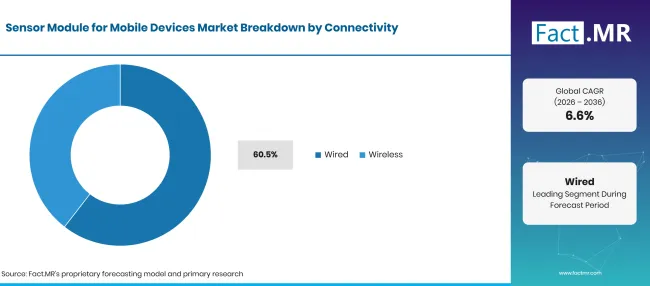
Factmr Sensor Module For Mobile Devices Market Breakdown Connectivity | Source: Fact.MR
Motion and inertial modules hold a 60.5% revenue share in 2026, with sales of approximately USD 2.17 billion. Smartphones, wearables and gaming devices use these sensors for orientation tracking, step counting and gesture recognition. STMicroelectronics offers the LSM6DSV320X, combining two accelerometers and a gyroscope to support motion measurement and activity tracking in compact electronic devices.
What explains the leading device share of smartphones in the Sensor Module for Mobile Devices Market?
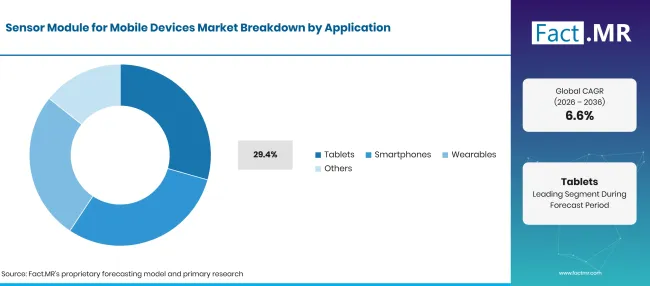
Factmr Sensor Module For Mobile Devices Market Breakdown Application 1 | Source: Fact.MR
Smartphones generate approximately USD 5.47 billion in sensor module revenue in 2026, securing a 29.4% market share. Multiple sensing functions support screen rotation, camera stabilization, biometric authentication and proximity detection within a single handset. Manufacturers integrate different sensor technologies to accommodate these features, while wearables and hearables provide additional opportunities for compact, low-power modules.
What explains the leading technology share of MEMS in the Sensor Module for Mobile Devices Market?
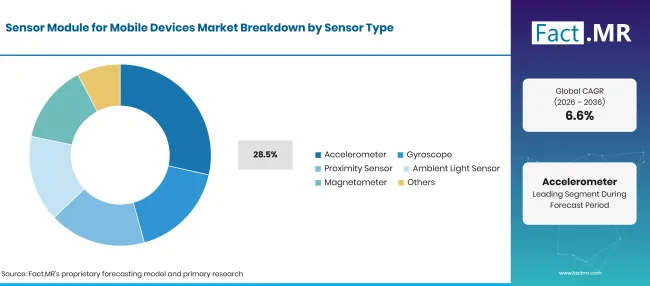
Sensor Module For Mobile Devices Market Breakdown Sensor Type | Source: Fact.MR
The MEMS segment contributes 28.5% of revenue in 2026, approximately USD 4.10 billion. Miniature mechanical structures allow accelerometers, gyroscopes and microphones to operate within compact electronic devices. Bosch Sensortec supplies MEMS components designed for smartphones and wearables, where low power consumption and limited installation space influence component selection. Optical and capacitive technologies address other sensing functions.
What explains the leading integration level share of multi-sensor combination modules in the Sensor Module for Mobile Devices Market?
Multi-sensor combination modules lead integration-level revenue with a 68.2% share, worth approximately USD 2.89 billion in 2026. Combining sensing functions within one package helps mobile device manufacturers manage limited circuit board space. STMicroelectronics' LSM6DSV320X integrates two accelerometers and a gyroscope within a 2.5 mm × 3 mm footprint, supporting different motion measurement requirements.
Sensor Module for Mobile Devices Market- Drivers, Restraints and Trends
Drivers
Smartphone and wearable manufacturers are incorporating biometric authentication, motion tracking and health monitoring functions into compact devices. These applications require miniature sensors with low power consumption and reliable performance. Growing interest in gesture recognition and activity monitoring also supports sensor integration.
Restraints
Slower smartphone shipment growth and intense component pricing pressure affect sensor module manufacturers. Large handset brands purchase components in substantial volumes, giving them greater influence over supplier pricing. Strict requirements for power consumption, dimensions and performance also increase development costs.
Trend
Health and Fitness Sensing: Wearable devices increasingly incorporate sensors for heart rate, activity tracking and physiological monitoring. STMicroelectronics offers biosensing technology that combines electrical signal detection with motion sensing. Such developments allow manufacturers to introduce additional wellness features while managing battery consumption and device dimensions.
Trend
Sensor Fusion and On-Device Processing: In January 2025, TDK introduced PositionSense, combining a six-axis inertial measurement unit, three-axis magnetometer and sensor-fusion software. The solution supports orientation tracking and navigation in smartphones, wearables and augmented reality devices, demonstrating the integration of sensing and processing functions.
Sensor Module for Mobile Devices Market Analysis by Key Country
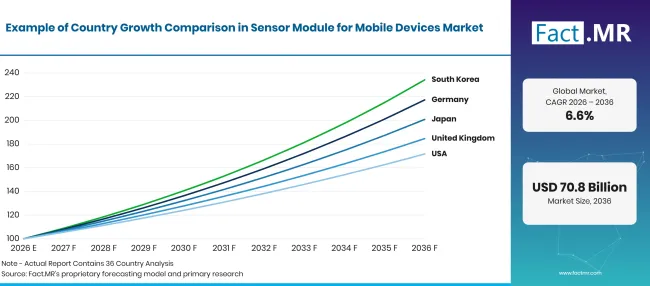
Sensor Module For Mobile Devices Market Growth Index | Source: Fact.MR
| Country | CAGR (2026-2036) |
|---|---|
| India | 9.3% |
| Vietnam | 7.9% |
| China | 5.7% |
| United States | 4.4% |
| Taiwan | 3.9% |
Source: Fact.MR analysis.
Why is India the fastest-growing market for sensor modules for mobile devices?
Sales of sensor modules for mobile devices in India are forecast to increase at a 9.3% CAGR over the next decade, the highest among the five countries.
Expanding smartphone manufacturing and government incentives for electronics production support component purchases. India's Ministry of Electronics and Information Technology reported mobile phone production worth approximately INR 6.27 lakh crore in FY 2025–2026. Local assembly operations create opportunities for motion sensors, fingerprint modules and proximity detectors, while domestic component manufacturing initiatives encourage greater participation in the mobile electronics supply chain.
What is shaping sensor modules for mobile devices demand in Vietnam?
Demand for sensor modules for mobile devices in Vietnam is anticipated to rise at a 7.9% CAGR during the forecast period, exceeding the global rate of 6.2%.
Electronics assembly operations serving international smartphone brands support purchases of compact sensing components. Vietnam's National Statistics Office reported electronics, computers and component exports worth USD 107.7 billion in 2025, an increase of 48.4% from 2024. Manufacturing activities involving smartphones and portable electronics provide opportunities for suppliers of motion, proximity and biometric sensors used in device assembly.
How is demand for sensor modules for mobile devices developing in China?
Sales of sensor modules for mobile devices in China are estimated to expand at a 5.7% CAGR over the ten-year outlook, compared with the global rate of 6.2%.
Established smartphone production facilities and domestic semiconductor manufacturers support purchases of MEMS and optical sensing components. China's Ministry of Industry and Information Technology recorded smartphone production of 1.27 billion units in 2025. Handset manufacturers require accelerometers, gyroscopes and proximity sensors for everyday device functions, while growing interest in wearable electronics creates additional opportunities for compact, energy-efficient modules.
What is driving sensor modules for mobile devices demand in the United States?
Demand for sensor modules for mobile devices in the United States is projected to grow at a 4.4% CAGR, below the global average of 6.2%.
Premium smartphones, wearable electronics and advanced device features influence purchases of motion, biometric and environmental sensors. The Semiconductor Industry Association reported that US-headquartered semiconductor companies generated USD 425 billion in sales during 2025. Domestic chip design expertise supports the development of specialized sensing technologies, while smartphone manufacturers continue specifying compact modules with improved accuracy, lower power consumption and software compatibility.
Why is growth slower for sensor modules for mobile devices in Taiwan?
Sales of sensor modules for mobile devices in Taiwan are forecast to increase at a 3.9% CAGR by 2036, the slowest among the five countries.
Semiconductor fabrication, component packaging and electronics manufacturing support the supply of sensors for international device brands. Taiwan's Ministry of Economic Affairs reported semiconductor industry output worth NT$6.83 trillion in 2025. Its industrial development plans also include pilot production lines for sensor chips and semiconductor packaging.
Competitive Landscape for Sensor Module for Mobile Devices Market
Mobile device manufacturers select sensor suppliers based on component size, power efficiency, measurement accuracy and compatibility with device software. STMicroelectronics and Bosch Sensortec specialize in MEMS motion sensing, offering compact accelerometers and gyroscopes for smartphones and wearables. TDK competes through inertial sensors and integrated motion-tracking solutions, while Goodix focuses on fingerprint authentication.
Recent developments illustrate different approaches to sensor integration. STMicroelectronics introduced its LSM6DSV320X inertial sensor in 2025, combining two accelerometers and a gyroscope within a miniature package. TDK's PositionSense integrates motion and magnetic sensing with sensor-fusion software, while Goodix expanded ultrasonic fingerprint applications in smartphones.
Recent Developments
- In May 2025, STMicroelectronics introduced the LSM6DSV320X inertial measurement unit, integrating dual accelerometers and embedded AI.
- In January 2026, Bosch Sensortec introduced its BMI5 motion sensor platform at CES, featuring three inertial sensor variants.
Key Players in Sensor Module for Mobile Devices Market
STMicroelectronics, Bosch Sensortec, TDK, and Goodix.
- STMicroelectronics
- Bosch Sensortec
- TDK
- Goodix
Bibliography
- Bosch Sensortec. (2026, January). From immersive XR to advanced robotics and wearables: Bosch Sensortec launches BMI5 motion sensor platform.
- Bosch Sensortec. (2026, January). Precision sensing for the always-on era: Bosch Sensortec launches BMI423 IMU.
- Goodix Technology. (2025). 2025 Interim Report Summary. goodix.com
- Knowles Corporation. (2025, October 20). Knowles Corporation unveils MM60 MEMS microphone at EUHA, setting new standard for AI-optimized hearing aids.
- Ministry of Industry and Information Technology of the People’s Republic of China. (2026, January 30). 2025 electronic information manufacturing industry performance.
- National Statistics Office of Vietnam. (2026, January). Results of merchandise import and export activities in 2025: Record breakthrough and strong shift toward high technology.
- Semiconductor Industry Association. (2026). 2026 State of the Industry Report: Historic growth amid intensifying global competition.
- STMicroelectronics. (2025, May 13). STMicroelectronics combines activity tracking and high-impact sensing in miniature AI-enabled sensor for personal electronics and IoT.
- STMicroelectronics. (2025, October). LSM6DSV320X: 6-axis IMU with dual accelerometer up to 320 g and embedded AI for activity tracking and high-impact sensing (Rev. 3).
- TDK Corporation. (2025, January 7). New TDK 9-axis PositionSense™ solution helps ensure consumer tech users are “never lost”.
Segmentation
Scope of Report
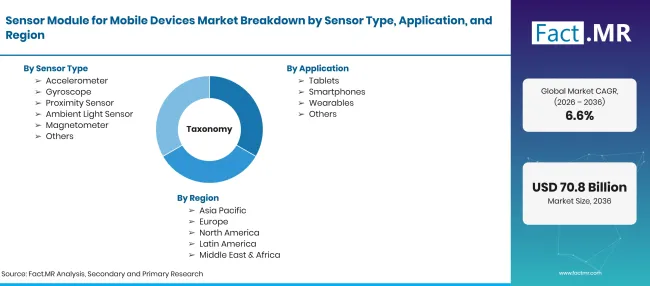
Sensor Module For Mobile Devices Market Taxonomy | Source: Fact.MR
| Items | Values |
|---|---|
| Quantitative Units (2026) | USD 7.60 Billion |
| Sensor Type | Motion and inertial modules, Fingerprint and biometric modules, Proximity and ambient light modules, MEMS microphone modules, Time-of-flight and 3D sensing modules |
| Device | Smartphones, Wearables and hearables, Handheld gaming and other mobile devices, Tablets |
| Technology | MEMS, Optical, Capacitive, Ultrasonic, Hall-effect and magnetoresistive |
| Integration Level | Multi-sensor combination modules, Single-sensor modules, Sensor-hub integrated modules, System-in-package sensor modules |
| Regions Covered | North America, Latin America, Europe, Asia Pacific, Middle East & Africa |
| Countries Covered | India, Vietnam, China, United States, Taiwan, and other countries |
| Key Companies Profiled | STMicroelectronics, Bosch Sensortec, TDK, Goodix |
| Additional Attributes | Dollar revenue in the Sensor Module for Mobile Devices Market is segmented by sensor type, device, technology and integration level and region. |
Source: Fact.MR analysis. Updated Nov 25, 2026
Sensor Module for Mobile Devices Market by Segments
-
Sensor Type
- Motion and inertial modules
- Fingerprint and biometric modules
- Proximity and ambient light modules
- MEMS microphone modules
- Time-of-flight and 3D sensing modules
-
Device
- Smartphones
- Wearables and hearables
- Handheld gaming and other mobile devices
- Tablets
-
Technology
- MEMS
- Optical
- Capacitive
- Ultrasonic
- Hall-effect and magnetoresistive
-
Integration Level
- Multi-sensor combination modules
- Single-sensor modules
- Sensor-hub integrated modules
- System-in-package sensor modules
-
Region:
- North America
- United States
- Canada
- Mexico
- Europe
- Germany
- United Kingdom
- France
- Italy
- Spain
- Rest of Europe
- Asia Pacific
- China
- India
- Japan
- South Korea
- Australia and New Zealand
- Vietnam
- Taiwan
- Rest of Asia Pacific
- Latin America
- Brazil
- Argentina
- Rest of Latin America
- Middle East & Africa
- GCC Countries
- South Africa
- Rest of Middle East & Africa
- North America
Table of Contents
Key Takeaways
- Market Size and CAGR
- Top Growth Driver
- Fastest Growing Segment
- Leading Region
- Key Companies
- Emerging Opportunities

