Salinity-Tolerance Enhancing Foliar Shield Market

Salinity-Tolerance Enhancing Foliar Shield Market Size and Share Forecast Outlook 2026 to 2036

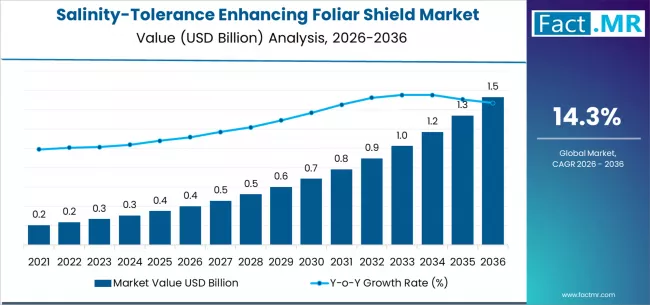
Salinity-tolerance enhancing foliar shield market is projected to grow from USD 0.4 billion in 2026 to USD 1.5 billion by 2036, at a CAGR of 14.3%. Osmoprotectant–Polymer Barrier Blends will dominate with a 35.0% market share, while cereals & grains will lead the crop type segment with a 34.0% share.

Salinity-Tolerance Enhancing Foliar Shield Market Forecast and Outlook 2026 to 2036

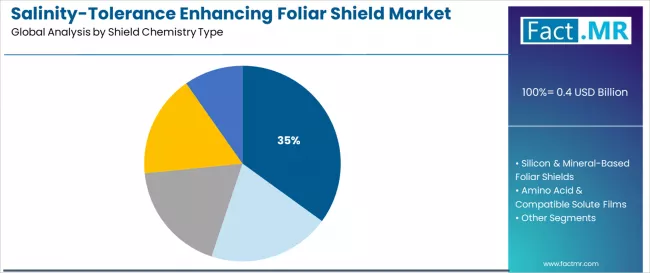
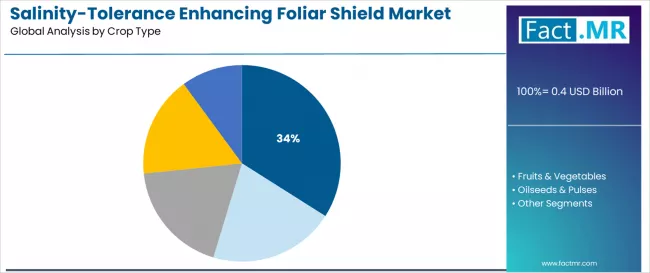
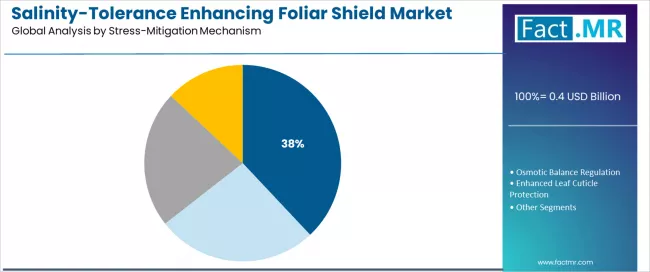
The global salinity-tolerance enhancing foliar shield market is projected to reach USD 1.53 billion by 2036. The market is valued at USD 0.40 billion in 2026 and is set to rise at a CAGR of 14.3% during the assessment period. By shield chemistry type, osmoprotectant-polymer barrier blends hold a leading 35% share. The cereals & grains crop type segment represents a dominant 34% share, while the ion toxicity shielding stress-mitigation mechanism accounts for 38% market share.

Key Takeaways from the Salinity-Tolerance Enhancing Foliar Shield Market

  • Market Value for 2026: USD 0.40 Billion
  • Market Value for 2036: USD 1.53 Billion
  • Forecast CAGR (2026-2036): 14.3%
  • Leading Shield Chemistry Type Share (2026): Osmoprotectant-Polymer Barrier Blends (35%)
  • Leading Crop Type Share (2026): Cereals & Grains (34%)
  • Leading Stress-Mitigation Mechanism Share (2026): Ion Toxicity Shielding (38%)
  • Key Players in the Market: Valagro (Biostimulant Solutions), Tradecorp International, Biolchim S.p.A., Haifa Group (Specialty Foliar Nutrition), Atlantica Agricola
Salinity Tolerance Enhancing Foliar Shield Market Market Value Analysis

A central trend is the convergence of biostimulant science and film-forming technology to create multifunctional protective sprays. Research focuses on enhancing the durability of these shields under high-evaporation conditions and improving their ability to regulate stomatal aperture. Integration of these products into irrigation management and soil amendment programs is becoming a holistic strategy for managing saline growing environments.

Regulatory frameworks are generally supportive, particularly in regions where salinity is recognized as a major agricultural threat. Policies promoting sustainable water use and soil conservation indirectly support adoption. Product registration often follows pathways for biostimulants or adjuvants, which can be more streamlined than for conventional agrochemicals, facilitating market entry for novel formulations.

Salinity-Tolerance Enhancing Foliar Shield Market

Metric Value
Market Value (2026) USD 0.40 Billion
Market Forecast Value (2036) USD 1.53 Billion
Forecast CAGR (2026-2036) 14.3%

Category

Category Segments
Shield Chemistry Type Osmoprotectant–Polymer Barrier Blends, Silicon & Mineral-Based Foliar Shields, Amino Acid & Compatible Solute Films, Bio-Extract & Algal-Derived Coatings, Others
Crop Type Cereals & Grains, Fruits & Vegetables, Oilseeds & Pulses, Plantation & Salt-Tolerant Crops, Others
Stress-Mitigation Mechanism Ion Toxicity Shielding, Osmotic Balance Regulation, Enhanced Leaf Cuticle Protection, Stomatal Stress Moderation, Others
Region North America, Latin America, Western Europe, Eastern Europe, East Asia, South Asia & Pacific, MEA

Segmental Analysis

By Shield Chemistry, Which Formulation Provides Dual-Mode Action?
Salinity Tolerance Enhancing Foliar Shield Market Analysis By Shield Chemistry Type

Osmoprotectant-polymer barrier blends lead the segment with a 35% share. This dominance is due to their dual function: the polymer forms a physical film that reduces sodium ion penetration and water loss, while the integrated osmoprotectants like betaines or proline are absorbed to help maintain cellular turgor and enzyme function inside the leaf. This combined inside-out and outside-in defense offers superior protection under sustained saline stress.

By Crop Type, Where is the Economic Imperative for Yield Protection Greatest?
Salinity Tolerance Enhancing Foliar Shield Market Analysis By Crop Type

Cereals and grains command a 34% share. Staple crops like wheat, barley, and rice are often grown on marginal or irrigated land where salinity is a pervasive yield limiter. Even modest percentage yield losses represent massive economic impacts at a global scale. Foliar shields offer a practical, in-season intervention to protect photosynthetic capacity and grain fill in these essential commodity crops, driving significant demand.

By Stress-Mitigation Mechanism, What is the Primary Physiological Defense?
Salinity Tolerance Enhancing Foliar Shield Market Analysis By Stress Mitigation Mechanism

Ion toxicity shielding is the leading mechanism at 38%. The direct injury from sodium and chloride ions accumulating in leaf tissues is a primary cause of necrosis and reduced photosynthesis. Shields that specifically block or reduce foliar uptake of these toxic ions address the most immediate damaging effect of salinity, providing a clear and measurable preservation of leaf area and function.

What are the Drivers, Restraints, and Key Trends of the Salinity-Tolerance Enhancing Foliar Shield Market?

Market expansion is driven by the increasing extent of secondary salinity due to irrigation practices and climate change effects. The shrinking availability of high-quality freshwater for agriculture forces greater use of brackish water, escalating the need for crop protection. The high value of horticultural and vegetable production in saline-affected areas justifies investment in yield-preserving technologies.

A key restraint is the temporary nature of the protection, requiring repeated applications during critical growth stages, which increases cost and labor. Performance can be washed off by rain or overhead irrigation, limiting use in some systems. Scientifically quantifying the exact yield benefit under variable field conditions remains a challenge for demonstrating consistent return on investment.

Significant trends include the integration of nutrient components like potassium or calcium into shield formulations to directly antagonize sodium uptake. Development of UV-stable polymers extends shield longevity. Products are being tailored for specific irrigation methods, such as formulations compatible with fertigation systems in protected agriculture.

Analysis of the Salinity-Tolerance Enhancing Foliar Shield Market by Key Countries
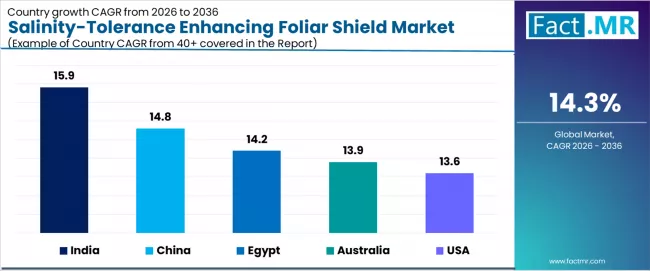
Salinity Tolerance Enhancing Foliar Shield Market Cagr Analysis By Country

Country CAGR (2026-2036)
India 15.90%
China 14.80%
Egypt 14.20%
Australia 13.90%
USA 13.60%

Why does India's Irrigation-Dependent Agriculture Drive Market Leadership?

India leads with a 15.90% CAGR, directly linked to widespread irrigation-induced salinity in its major wheat and rice bowls like the Indo-Gangetic Plain. The need to maintain productivity on declining quality soils is paramount for food security. Smallholder and large-scale farmers alike are adopting foliar shields as a vital tool to mitigate yield loss from brackish irrigation water, especially during dry seasons when freshwater is scarce.

How is China's Coastal and Interior Salinization Influencing Adoption?

China's 14.80% growth is driven by salinity challenges in two key areas: coastal regions with seawater intrusion and interior basins with poor drainage. The government's focus on maximizing crop production on all arable land supports technologies that reclaim marginal areas. Foliar shields are used extensively in greenhouse vegetable production and on field crops like cotton in Xinjiang, where they help maintain yields under saline irrigation.

What Factors make Egypt a Critical Market for Salinity Solutions?

Egypt's 14.20% growth stems from its nearly complete reliance on Nile irrigation in a hyper-arid climate, leading to severe secondary salinization. High-value export crops like citrus, grapes, and vegetables must meet strict quality standards, making salinity-induced blemishes or size reduction unacceptable. Egyptian growers use foliar shields as a routine practice to protect both yield and premium marketability.

How does Australia's Dryland Salinity Problem Shape Product Development?

Australia's 13.90% growth is tied to its ancient, widespread dryland salinity resulting from altered water tables. While landscape-scale solutions are long-term, foliar shields offer an immediate tactical tool for protecting cereal and legume crops in affected zones. Australian products often emphasize robust film-forming properties to withstand harsh, dry conditions and provide protection between limited rainfall events.

What drives Specific Demand in the USA's Diverse Agricultural Regions?
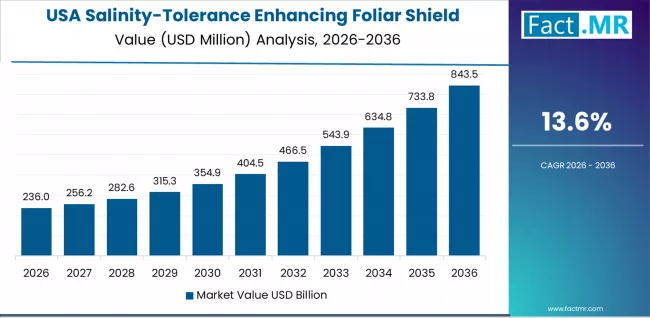
Salinity Tolerance Enhancing Foliar Shield Market Country Value Analysis

The USA's 13.60% growth is concentrated in regions with specific salinity issues: the Central Valley of California (irrigation salinity), the Rio Grande Valley, and certain Northern Plains soils. Use is often targeted at high-value permanent crops like almonds and grapes, or in conjunction with the cultivation of salt-tolerant crops like barley, where shields are used to push yield boundaries in challenging soils.

Competitive Landscape of the Salinity-Tolerance Enhancing Foliar Shield Market
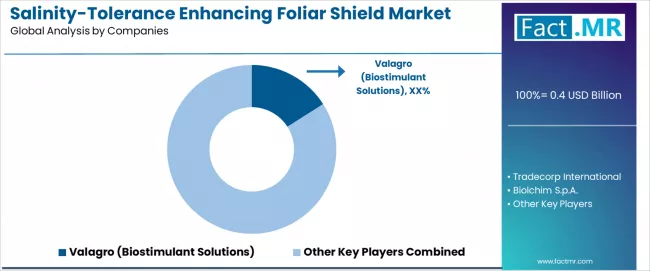
Salinity Tolerance Enhancing Foliar Shield Market Analysis By Company

The market is highly specialized, dominated by global and regional biostimulant and specialty nutrition companies. Leaders like Valagro, Tradecorp International, and Biolchim S.p.A. compete based on advanced R&D in plant physiology and organic chemistry, offering sophisticated blends of compatible solutes, polymers, and nutrients. Their strength lies in technical data showing physiological responses and yield outcomes under saline stress.

Companies like Haifa Group and Atlantica Agricola compete by integrating shield technology with their core expertise in foliar nutrition, creating synergistic products. Competition centers on proving product efficacy through independent trials in key saline regions, building strong relationships with distributors and agronomists serving affected areas, and providing clear application protocols for different crops and salinity levels.

Key Players in the Salinity-Tolerance Enhancing Foliar Shield Market

  • Valagro (Biostimulant Solutions)
  • Tradecorp International
  • Biolchim S.p.A.
  • Haifa Group (Specialty Foliar Nutrition)
  • Atlantica Agricola

Scope of Report

Items Values
Quantitative Units USD Billion
Shield Chemistry Type Osmoprotectant–Polymer Barrier Blends, Silicon & Mineral-Based Foliar Shields, Amino Acid & Compatible Solute Films, Bio-Extract & Algal-Derived Coatings, Others
Crop Type Cereals & Grains, Fruits & Vegetables, Oilseeds & Pulses, Plantation & Salt-Tolerant Crops, Others
Stress-Mitigation Mechanism Ion Toxicity Shielding, Osmotic Balance Regulation, Enhanced Leaf Cuticle Protection, Stomatal Stress Moderation, Others
Key Countries India, China, Egypt, Australia, USA
Key Companies Valagro (Biostimulant Solutions), Tradecorp International, Biolchim S.p.A., Haifa Group (Specialty Foliar Nutrition), Atlantica Agricola
Additional Analysis Analysis of leaf ion concentration studies, interaction with soil-applied salinity amendments, application timing relative to stress onset, and cost-benefit analysis for high-value versus broad-acre crops.

Salinity-Tolerance Enhancing Foliar Shield Market by Segments

  • Shield Chemistry Type :

    • Osmoprotectant–Polymer Barrier Blends
    • Silicon & Mineral-Based Foliar Shields
    • Amino Acid & Compatible Solute Films
    • Bio-Extract & Algal-Derived Coatings
    • Others
  • Crop Type :

    • Cereals & Grains
    • Fruits & Vegetables
    • Oilseeds & Pulses
    • Plantation & Salt-Tolerant Crops
    • Others
  • Stress-Mitigation Mechanism :

    • Ion Toxicity Shielding
    • Osmotic Balance Regulation
    • Enhanced Leaf Cuticle Protection
    • Stomatal Stress Moderation
    • Others
  • Region :

    • North America

      • USA
      • Canada
    • Latin America

      • Brazil
      • Mexico
      • Argentina
      • Rest of Latin America
    • Western Europe

      • Germany
      • UK
      • France
      • Spain
      • Italy
      • BENELUX
      • Rest of Western Europe
    • Eastern Europe

      • Czech Republic
      • Poland
      • Russia
      • Rest of Eastern Europe
    • East Asia

      • China
      • Japan
      • South Korea
      • Rest of East Asia
    • South Asia & Pacific

      • India
      • Indonesia
      • Australia
      • Rest of South Asia & Pacific
    • MEA

      • Egypt
      • GCC Countries
      • Saudi Arabia
      • Rest of MEA

Table of Content

  1. Executive Summary
    • Global Market Outlook
    • Demand to side Trends
    • Supply to side Trends
    • Technology Roadmap Analysis
    • Analysis and Recommendations
  2. Market Overview
    • Market Coverage / Taxonomy
    • Market Definition / Scope / Limitations
  3. Market Background
    • Market Dynamics
      • Drivers
      • Restraints
      • Opportunity
      • Trends
    • Scenario Forecast
      • Demand in Optimistic Scenario
      • Demand in Likely Scenario
      • Demand in Conservative Scenario
    • Opportunity Map Analysis
    • Product Life Cycle Analysis
    • Supply Chain Analysis
    • Investment Feasibility Matrix
    • Value Chain Analysis
    • PESTLE and Porter’s Analysis
    • Regulatory Landscape
    • Regional Parent Market Outlook
    • Production and Consumption Statistics
    • Import and Export Statistics
  4. Global Market Analysis 2021 to 2025 and Forecast, 2026 to 2036
    • Historical Market Size Value (USD Million) Analysis, 2021 to 2025
    • Current and Future Market Size Value (USD Million) Projections, 2026 to 2036
      • Y to o to Y Growth Trend Analysis
      • Absolute $ Opportunity Analysis
  5. Global Market Pricing Analysis 2021 to 2025 and Forecast 2026 to 2036
  6. Global Market Analysis 2021 to 2025 and Forecast 2026 to 2036, By Shield Chemistry Type
    • Introduction / Key Findings
    • Historical Market Size Value (USD Million) Analysis By Shield Chemistry Type, 2021 to 2025
    • Current and Future Market Size Value (USD Million) Analysis and Forecast By Shield Chemistry Type, 2026 to 2036
      • Osmoprotectant–Polymer Barrier Blends
      • Silicon & Mineral-Based Foliar Shields
      • Amino Acid & Compatible Solute Films
      • Bio-Extract & Algal-Derived Coatings
      • Others
    • Y to o to Y Growth Trend Analysis By Shield Chemistry Type, 2021 to 2025
    • Absolute $ Opportunity Analysis By Shield Chemistry Type, 2026 to 2036
  7. Global Market Analysis 2021 to 2025 and Forecast 2026 to 2036, By Crop Type
    • Introduction / Key Findings
    • Historical Market Size Value (USD Million) Analysis By Crop Type, 2021 to 2025
    • Current and Future Market Size Value (USD Million) Analysis and Forecast By Crop Type, 2026 to 2036
      • Cereals & Grains
      • Fruits & Vegetables
      • Oilseeds & Pulses
      • Plantation & Salt-Tolerant Crops
      • Others
    • Y to o to Y Growth Trend Analysis By Crop Type, 2021 to 2025
    • Absolute $ Opportunity Analysis By Crop Type, 2026 to 2036
  8. Global Market Analysis 2021 to 2025 and Forecast 2026 to 2036, By Stress-Mitigation Mechanism
    • Introduction / Key Findings
    • Historical Market Size Value (USD Million) Analysis By Stress-Mitigation Mechanism, 2021 to 2025
    • Current and Future Market Size Value (USD Million) Analysis and Forecast By Stress-Mitigation Mechanism, 2026 to 2036
      • Ion Toxicity Shielding
      • Osmotic Balance Regulation
      • Enhanced Leaf Cuticle Protection
      • Stomatal Stress Moderation
    • Y to o to Y Growth Trend Analysis By Stress-Mitigation Mechanism, 2021 to 2025
    • Absolute $ Opportunity Analysis By Stress-Mitigation Mechanism, 2026 to 2036
  9. Global Market Analysis 2021 to 2025 and Forecast 2026 to 2036, By Region
    • Introduction
    • Historical Market Size Value (USD Million) Analysis By Region, 2021 to 2025
    • Current Market Size Value (USD Million) Analysis and Forecast By Region, 2026 to 2036
      • North America
      • Latin America
      • Western Europe
      • Eastern Europe
      • East Asia
      • South Asia and Pacific
      • Middle East & Africa
    • Market Attractiveness Analysis By Region
  10. North America Market Analysis 2021 to 2025 and Forecast 2026 to 2036, By Country
    • Historical Market Size Value (USD Million) Trend Analysis By Market Taxonomy, 2021 to 2025
    • Market Size Value (USD Million) Forecast By Market Taxonomy, 2026 to 2036
      • By Country
        • USA
        • Canada
        • Mexico
      • By Shield Chemistry Type
      • By Crop Type
      • By Stress-Mitigation Mechanism
    • Market Attractiveness Analysis
      • By Country
      • By Shield Chemistry Type
      • By Crop Type
      • By Stress-Mitigation Mechanism
    • Key Takeaways
  11. Latin America Market Analysis 2021 to 2025 and Forecast 2026 to 2036, By Country
    • Historical Market Size Value (USD Million) Trend Analysis By Market Taxonomy, 2021 to 2025
    • Market Size Value (USD Million) Forecast By Market Taxonomy, 2026 to 2036
      • By Country
        • Brazil
        • Chile
        • Rest of Latin America
      • By Shield Chemistry Type
      • By Crop Type
      • By Stress-Mitigation Mechanism
    • Market Attractiveness Analysis
      • By Country
      • By Shield Chemistry Type
      • By Crop Type
      • By Stress-Mitigation Mechanism
    • Key Takeaways
  12. Western Europe Market Analysis 2021 to 2025 and Forecast 2026 to 2036, By Country
    • Historical Market Size Value (USD Million) Trend Analysis By Market Taxonomy, 2021 to 2025
    • Market Size Value (USD Million) Forecast By Market Taxonomy, 2026 to 2036
      • By Country
        • Germany
        • UK
        • Italy
        • Spain
        • France
        • Nordic
        • BENELUX
        • Rest of Western Europe
      • By Shield Chemistry Type
      • By Crop Type
      • By Stress-Mitigation Mechanism
    • Market Attractiveness Analysis
      • By Country
      • By Shield Chemistry Type
      • By Crop Type
      • By Stress-Mitigation Mechanism
    • Key Takeaways
  13. Eastern Europe Market Analysis 2021 to 2025 and Forecast 2026 to 2036, By Country
    • Historical Market Size Value (USD Million) Trend Analysis By Market Taxonomy, 2021 to 2025
    • Market Size Value (USD Million) Forecast By Market Taxonomy, 2026 to 2036
      • By Country
        • Russia
        • Poland
        • Hungary
        • Balkan & Baltic
        • Rest of Eastern Europe
      • By Shield Chemistry Type
      • By Crop Type
      • By Stress-Mitigation Mechanism
    • Market Attractiveness Analysis
      • By Country
      • By Shield Chemistry Type
      • By Crop Type
      • By Stress-Mitigation Mechanism
    • Key Takeaways
  14. East Asia Market Analysis 2021 to 2025 and Forecast 2026 to 2036, By Country
    • Historical Market Size Value (USD Million) Trend Analysis By Market Taxonomy, 2021 to 2025
    • Market Size Value (USD Million) Forecast By Market Taxonomy, 2026 to 2036
      • By Country
        • China
        • Japan
        • South Korea
      • By Shield Chemistry Type
      • By Crop Type
      • By Stress-Mitigation Mechanism
    • Market Attractiveness Analysis
      • By Country
      • By Shield Chemistry Type
      • By Crop Type
      • By Stress-Mitigation Mechanism
    • Key Takeaways
  15. South Asia and Pacific Market Analysis 2021 to 2025 and Forecast 2026 to 2036, By Country
    • Historical Market Size Value (USD Million) Trend Analysis By Market Taxonomy, 2021 to 2025
    • Market Size Value (USD Million) Forecast By Market Taxonomy, 2026 to 2036
      • By Country
        • India
        • ASEAN
        • Australia & New Zealand
        • Rest of South Asia and Pacific
      • By Shield Chemistry Type
      • By Crop Type
      • By Stress-Mitigation Mechanism
    • Market Attractiveness Analysis
      • By Country
      • By Shield Chemistry Type
      • By Crop Type
      • By Stress-Mitigation Mechanism
    • Key Takeaways
  16. Middle East & Africa Market Analysis 2021 to 2025 and Forecast 2026 to 2036, By Country
    • Historical Market Size Value (USD Million) Trend Analysis By Market Taxonomy, 2021 to 2025
    • Market Size Value (USD Million) Forecast By Market Taxonomy, 2026 to 2036
      • By Country
        • Kingdom of Saudi Arabia
        • Other GCC Countries
        • Turkiye
        • South Africa
        • Other African Union
        • Rest of Middle East & Africa
      • By Shield Chemistry Type
      • By Crop Type
      • By Stress-Mitigation Mechanism
    • Market Attractiveness Analysis
      • By Country
      • By Shield Chemistry Type
      • By Crop Type
      • By Stress-Mitigation Mechanism
    • Key Takeaways
  17. Key Countries Market Analysis
    • USA
      • Pricing Analysis
      • Market Share Analysis, 2025
        • By Shield Chemistry Type
        • By Crop Type
        • By Stress-Mitigation Mechanism
    • Canada
      • Pricing Analysis
      • Market Share Analysis, 2025
        • By Shield Chemistry Type
        • By Crop Type
        • By Stress-Mitigation Mechanism
    • Mexico
      • Pricing Analysis
      • Market Share Analysis, 2025
        • By Shield Chemistry Type
        • By Crop Type
        • By Stress-Mitigation Mechanism
    • Brazil
      • Pricing Analysis
      • Market Share Analysis, 2025
        • By Shield Chemistry Type
        • By Crop Type
        • By Stress-Mitigation Mechanism
    • Chile
      • Pricing Analysis
      • Market Share Analysis, 2025
        • By Shield Chemistry Type
        • By Crop Type
        • By Stress-Mitigation Mechanism
    • Germany
      • Pricing Analysis
      • Market Share Analysis, 2025
        • By Shield Chemistry Type
        • By Crop Type
        • By Stress-Mitigation Mechanism
    • UK
      • Pricing Analysis
      • Market Share Analysis, 2025
        • By Shield Chemistry Type
        • By Crop Type
        • By Stress-Mitigation Mechanism
    • Italy
      • Pricing Analysis
      • Market Share Analysis, 2025
        • By Shield Chemistry Type
        • By Crop Type
        • By Stress-Mitigation Mechanism
    • Spain
      • Pricing Analysis
      • Market Share Analysis, 2025
        • By Shield Chemistry Type
        • By Crop Type
        • By Stress-Mitigation Mechanism
    • France
      • Pricing Analysis
      • Market Share Analysis, 2025
        • By Shield Chemistry Type
        • By Crop Type
        • By Stress-Mitigation Mechanism
    • India
      • Pricing Analysis
      • Market Share Analysis, 2025
        • By Shield Chemistry Type
        • By Crop Type
        • By Stress-Mitigation Mechanism
    • ASEAN
      • Pricing Analysis
      • Market Share Analysis, 2025
        • By Shield Chemistry Type
        • By Crop Type
        • By Stress-Mitigation Mechanism
    • Australia & New Zealand
      • Pricing Analysis
      • Market Share Analysis, 2025
        • By Shield Chemistry Type
        • By Crop Type
        • By Stress-Mitigation Mechanism
    • China
      • Pricing Analysis
      • Market Share Analysis, 2025
        • By Shield Chemistry Type
        • By Crop Type
        • By Stress-Mitigation Mechanism
    • Japan
      • Pricing Analysis
      • Market Share Analysis, 2025
        • By Shield Chemistry Type
        • By Crop Type
        • By Stress-Mitigation Mechanism
    • South Korea
      • Pricing Analysis
      • Market Share Analysis, 2025
        • By Shield Chemistry Type
        • By Crop Type
        • By Stress-Mitigation Mechanism
    • Russia
      • Pricing Analysis
      • Market Share Analysis, 2025
        • By Shield Chemistry Type
        • By Crop Type
        • By Stress-Mitigation Mechanism
    • Poland
      • Pricing Analysis
      • Market Share Analysis, 2025
        • By Shield Chemistry Type
        • By Crop Type
        • By Stress-Mitigation Mechanism
    • Hungary
      • Pricing Analysis
      • Market Share Analysis, 2025
        • By Shield Chemistry Type
        • By Crop Type
        • By Stress-Mitigation Mechanism
    • Kingdom of Saudi Arabia
      • Pricing Analysis
      • Market Share Analysis, 2025
        • By Shield Chemistry Type
        • By Crop Type
        • By Stress-Mitigation Mechanism
    • Turkiye
      • Pricing Analysis
      • Market Share Analysis, 2025
        • By Shield Chemistry Type
        • By Crop Type
        • By Stress-Mitigation Mechanism
    • South Africa
      • Pricing Analysis
      • Market Share Analysis, 2025
        • By Shield Chemistry Type
        • By Crop Type
        • By Stress-Mitigation Mechanism
  18. Market Structure Analysis
    • Competition Dashboard
    • Competition Benchmarking
    • Market Share Analysis of Top Players
      • By Regional
      • By Shield Chemistry Type
      • By Crop Type
      • By Stress-Mitigation Mechanism
  19. Competition Analysis
    • Competition Deep Dive
      • Valagro (Biostimulant Solutions)
        • Overview
        • Product Portfolio
        • Profitability by Market Segments (Product/Age /Sales Channel/Region)
        • Sales Footprint
        • Strategy Overview
          • Marketing Strategy
          • Product Strategy
          • Channel Strategy
      • Tradecorp International
      • Biolchim S.p.A.
      • Haifa Group (Specialty Foliar Nutrition)
      • Atlantica Agricola
      • Others
  20. Assumptions & Acronyms Used
  21. Research Methodology

List Of Table

  • Table 1: Global Market Value (USD Million) Forecast by Region, 2021 to 2036
  • Table 2: Global Market Value (USD Million) Forecast by Shield Chemistry Type, 2021 to 2036
  • Table 3: Global Market Value (USD Million) Forecast by Crop Type, 2021 to 2036
  • Table 4: Global Market Value (USD Million) Forecast by Stress-Mitigation Mechanism, 2021 to 2036
  • Table 5: North America Market Value (USD Million) Forecast by Country, 2021 to 2036
  • Table 6: North America Market Value (USD Million) Forecast by Shield Chemistry Type, 2021 to 2036
  • Table 7: North America Market Value (USD Million) Forecast by Crop Type, 2021 to 2036
  • Table 8: North America Market Value (USD Million) Forecast by Stress-Mitigation Mechanism, 2021 to 2036
  • Table 9: Latin America Market Value (USD Million) Forecast by Country, 2021 to 2036
  • Table 10: Latin America Market Value (USD Million) Forecast by Shield Chemistry Type, 2021 to 2036
  • Table 11: Latin America Market Value (USD Million) Forecast by Crop Type, 2021 to 2036
  • Table 12: Latin America Market Value (USD Million) Forecast by Stress-Mitigation Mechanism, 2021 to 2036
  • Table 13: Western Europe Market Value (USD Million) Forecast by Country, 2021 to 2036
  • Table 14: Western Europe Market Value (USD Million) Forecast by Shield Chemistry Type, 2021 to 2036
  • Table 15: Western Europe Market Value (USD Million) Forecast by Crop Type, 2021 to 2036
  • Table 16: Western Europe Market Value (USD Million) Forecast by Stress-Mitigation Mechanism, 2021 to 2036
  • Table 17: Eastern Europe Market Value (USD Million) Forecast by Country, 2021 to 2036
  • Table 18: Eastern Europe Market Value (USD Million) Forecast by Shield Chemistry Type, 2021 to 2036
  • Table 19: Eastern Europe Market Value (USD Million) Forecast by Crop Type, 2021 to 2036
  • Table 20: Eastern Europe Market Value (USD Million) Forecast by Stress-Mitigation Mechanism, 2021 to 2036
  • Table 21: East Asia Market Value (USD Million) Forecast by Country, 2021 to 2036
  • Table 22: East Asia Market Value (USD Million) Forecast by Shield Chemistry Type, 2021 to 2036
  • Table 23: East Asia Market Value (USD Million) Forecast by Crop Type, 2021 to 2036
  • Table 24: East Asia Market Value (USD Million) Forecast by Stress-Mitigation Mechanism, 2021 to 2036
  • Table 25: South Asia and Pacific Market Value (USD Million) Forecast by Country, 2021 to 2036
  • Table 26: South Asia and Pacific Market Value (USD Million) Forecast by Shield Chemistry Type, 2021 to 2036
  • Table 27: South Asia and Pacific Market Value (USD Million) Forecast by Crop Type, 2021 to 2036
  • Table 28: South Asia and Pacific Market Value (USD Million) Forecast by Stress-Mitigation Mechanism, 2021 to 2036
  • Table 29: Middle East & Africa Market Value (USD Million) Forecast by Country, 2021 to 2036
  • Table 30: Middle East & Africa Market Value (USD Million) Forecast by Shield Chemistry Type, 2021 to 2036
  • Table 31: Middle East & Africa Market Value (USD Million) Forecast by Crop Type, 2021 to 2036
  • Table 32: Middle East & Africa Market Value (USD Million) Forecast by Stress-Mitigation Mechanism, 2021 to 2036

List Of Figures

  • Figure 1: Global Market Pricing Analysis
  • Figure 2: Global Market Value (USD Million) Forecast 2021 to 2036
  • Figure 3: Global Market Value Share and BPS Analysis by Shield Chemistry Type, 2026 and 2036
  • Figure 4: Global Market Y to o to Y Growth Comparison by Shield Chemistry Type, 2026 to 2036
  • Figure 5: Global Market Attractiveness Analysis by Shield Chemistry Type
  • Figure 6: Global Market Value Share and BPS Analysis by Crop Type, 2026 and 2036
  • Figure 7: Global Market Y to o to Y Growth Comparison by Crop Type, 2026 to 2036
  • Figure 8: Global Market Attractiveness Analysis by Crop Type
  • Figure 9: Global Market Value Share and BPS Analysis by Stress-Mitigation Mechanism, 2026 and 2036
  • Figure 10: Global Market Y to o to Y Growth Comparison by Stress-Mitigation Mechanism, 2026 to 2036
  • Figure 11: Global Market Attractiveness Analysis by Stress-Mitigation Mechanism
  • Figure 12: Global Market Value (USD Million) Share and BPS Analysis by Region, 2026 and 2036
  • Figure 13: Global Market Y to o to Y Growth Comparison by Region, 2026 to 2036
  • Figure 14: Global Market Attractiveness Analysis by Region
  • Figure 15: North America Market Incremental Dollar Opportunity, 2026 to 2036
  • Figure 16: Latin America Market Incremental Dollar Opportunity, 2026 to 2036
  • Figure 17: Western Europe Market Incremental Dollar Opportunity, 2026 to 2036
  • Figure 18: Eastern Europe Market Incremental Dollar Opportunity, 2026 to 2036
  • Figure 19: East Asia Market Incremental Dollar Opportunity, 2026 to 2036
  • Figure 20: South Asia and Pacific Market Incremental Dollar Opportunity, 2026 to 2036
  • Figure 21: Middle East & Africa Market Incremental Dollar Opportunity, 2026 to 2036
  • Figure 22: North America Market Value Share and BPS Analysis by Country, 2026 and 2036
  • Figure 23: North America Market Value Share and BPS Analysis by Shield Chemistry Type, 2026 and 2036
  • Figure 24: North America Market Y to o to Y Growth Comparison by Shield Chemistry Type, 2026 to 2036
  • Figure 25: North America Market Attractiveness Analysis by Shield Chemistry Type
  • Figure 26: North America Market Value Share and BPS Analysis by Crop Type, 2026 and 2036
  • Figure 27: North America Market Y to o to Y Growth Comparison by Crop Type, 2026 to 2036
  • Figure 28: North America Market Attractiveness Analysis by Crop Type
  • Figure 29: North America Market Value Share and BPS Analysis by Stress-Mitigation Mechanism, 2026 and 2036
  • Figure 30: North America Market Y to o to Y Growth Comparison by Stress-Mitigation Mechanism, 2026 to 2036
  • Figure 31: North America Market Attractiveness Analysis by Stress-Mitigation Mechanism
  • Figure 32: Latin America Market Value Share and BPS Analysis by Country, 2026 and 2036
  • Figure 33: Latin America Market Value Share and BPS Analysis by Shield Chemistry Type, 2026 and 2036
  • Figure 34: Latin America Market Y to o to Y Growth Comparison by Shield Chemistry Type, 2026 to 2036
  • Figure 35: Latin America Market Attractiveness Analysis by Shield Chemistry Type
  • Figure 36: Latin America Market Value Share and BPS Analysis by Crop Type, 2026 and 2036
  • Figure 37: Latin America Market Y to o to Y Growth Comparison by Crop Type, 2026 to 2036
  • Figure 38: Latin America Market Attractiveness Analysis by Crop Type
  • Figure 39: Latin America Market Value Share and BPS Analysis by Stress-Mitigation Mechanism, 2026 and 2036
  • Figure 40: Latin America Market Y to o to Y Growth Comparison by Stress-Mitigation Mechanism, 2026 to 2036
  • Figure 41: Latin America Market Attractiveness Analysis by Stress-Mitigation Mechanism
  • Figure 42: Western Europe Market Value Share and BPS Analysis by Country, 2026 and 2036
  • Figure 43: Western Europe Market Value Share and BPS Analysis by Shield Chemistry Type, 2026 and 2036
  • Figure 44: Western Europe Market Y to o to Y Growth Comparison by Shield Chemistry Type, 2026 to 2036
  • Figure 45: Western Europe Market Attractiveness Analysis by Shield Chemistry Type
  • Figure 46: Western Europe Market Value Share and BPS Analysis by Crop Type, 2026 and 2036
  • Figure 47: Western Europe Market Y to o to Y Growth Comparison by Crop Type, 2026 to 2036
  • Figure 48: Western Europe Market Attractiveness Analysis by Crop Type
  • Figure 49: Western Europe Market Value Share and BPS Analysis by Stress-Mitigation Mechanism, 2026 and 2036
  • Figure 50: Western Europe Market Y to o to Y Growth Comparison by Stress-Mitigation Mechanism, 2026 to 2036
  • Figure 51: Western Europe Market Attractiveness Analysis by Stress-Mitigation Mechanism
  • Figure 52: Eastern Europe Market Value Share and BPS Analysis by Country, 2026 and 2036
  • Figure 53: Eastern Europe Market Value Share and BPS Analysis by Shield Chemistry Type, 2026 and 2036
  • Figure 54: Eastern Europe Market Y to o to Y Growth Comparison by Shield Chemistry Type, 2026 to 2036
  • Figure 55: Eastern Europe Market Attractiveness Analysis by Shield Chemistry Type
  • Figure 56: Eastern Europe Market Value Share and BPS Analysis by Crop Type, 2026 and 2036
  • Figure 57: Eastern Europe Market Y to o to Y Growth Comparison by Crop Type, 2026 to 2036
  • Figure 58: Eastern Europe Market Attractiveness Analysis by Crop Type
  • Figure 59: Eastern Europe Market Value Share and BPS Analysis by Stress-Mitigation Mechanism, 2026 and 2036
  • Figure 60: Eastern Europe Market Y to o to Y Growth Comparison by Stress-Mitigation Mechanism, 2026 to 2036
  • Figure 61: Eastern Europe Market Attractiveness Analysis by Stress-Mitigation Mechanism
  • Figure 62: East Asia Market Value Share and BPS Analysis by Country, 2026 and 2036
  • Figure 63: East Asia Market Value Share and BPS Analysis by Shield Chemistry Type, 2026 and 2036
  • Figure 64: East Asia Market Y to o to Y Growth Comparison by Shield Chemistry Type, 2026 to 2036
  • Figure 65: East Asia Market Attractiveness Analysis by Shield Chemistry Type
  • Figure 66: East Asia Market Value Share and BPS Analysis by Crop Type, 2026 and 2036
  • Figure 67: East Asia Market Y to o to Y Growth Comparison by Crop Type, 2026 to 2036
  • Figure 68: East Asia Market Attractiveness Analysis by Crop Type
  • Figure 69: East Asia Market Value Share and BPS Analysis by Stress-Mitigation Mechanism, 2026 and 2036
  • Figure 70: East Asia Market Y to o to Y Growth Comparison by Stress-Mitigation Mechanism, 2026 to 2036
  • Figure 71: East Asia Market Attractiveness Analysis by Stress-Mitigation Mechanism
  • Figure 72: South Asia and Pacific Market Value Share and BPS Analysis by Country, 2026 and 2036
  • Figure 73: South Asia and Pacific Market Value Share and BPS Analysis by Shield Chemistry Type, 2026 and 2036
  • Figure 74: South Asia and Pacific Market Y to o to Y Growth Comparison by Shield Chemistry Type, 2026 to 2036
  • Figure 75: South Asia and Pacific Market Attractiveness Analysis by Shield Chemistry Type
  • Figure 76: South Asia and Pacific Market Value Share and BPS Analysis by Crop Type, 2026 and 2036
  • Figure 77: South Asia and Pacific Market Y to o to Y Growth Comparison by Crop Type, 2026 to 2036
  • Figure 78: South Asia and Pacific Market Attractiveness Analysis by Crop Type
  • Figure 79: South Asia and Pacific Market Value Share and BPS Analysis by Stress-Mitigation Mechanism, 2026 and 2036
  • Figure 80: South Asia and Pacific Market Y to o to Y Growth Comparison by Stress-Mitigation Mechanism, 2026 to 2036
  • Figure 81: South Asia and Pacific Market Attractiveness Analysis by Stress-Mitigation Mechanism
  • Figure 82: Middle East & Africa Market Value Share and BPS Analysis by Country, 2026 and 2036
  • Figure 83: Middle East & Africa Market Value Share and BPS Analysis by Shield Chemistry Type, 2026 and 2036
  • Figure 84: Middle East & Africa Market Y to o to Y Growth Comparison by Shield Chemistry Type, 2026 to 2036
  • Figure 85: Middle East & Africa Market Attractiveness Analysis by Shield Chemistry Type
  • Figure 86: Middle East & Africa Market Value Share and BPS Analysis by Crop Type, 2026 and 2036
  • Figure 87: Middle East & Africa Market Y to o to Y Growth Comparison by Crop Type, 2026 to 2036
  • Figure 88: Middle East & Africa Market Attractiveness Analysis by Crop Type
  • Figure 89: Middle East & Africa Market Value Share and BPS Analysis by Stress-Mitigation Mechanism, 2026 and 2036
  • Figure 90: Middle East & Africa Market Y to o to Y Growth Comparison by Stress-Mitigation Mechanism, 2026 to 2036
  • Figure 91: Middle East & Africa Market Attractiveness Analysis by Stress-Mitigation Mechanism
  • Figure 92: Global Market - Tier Structure Analysis
  • Figure 93: Global Market - Company Share Analysis

- FAQs -

How big is the salinity-tolerance enhancing foliar shield market in 2026?

The global salinity-tolerance enhancing foliar shield market is estimated to be valued at USD 0.4 billion in 2026.

What will be the size of salinity-tolerance enhancing foliar shield market in 2036?

The market size for the salinity-tolerance enhancing foliar shield market is projected to reach USD 1.5 billion by 2036.

How much will be the salinity-tolerance enhancing foliar shield market growth between 2026 and 2036?

The salinity-tolerance enhancing foliar shield market is expected to grow at a 14.3% CAGR between 2026 and 2036.

What are the key product types in the salinity-tolerance enhancing foliar shield market?

The key product types in salinity-tolerance enhancing foliar shield market are osmoprotectant–polymer barrier blends, silicon & mineral-based foliar shields, amino acid & compatible solute films, bio-extract & algal-derived coatings and others.

Which crop type segment to contribute significant share in the salinity-tolerance enhancing foliar shield market in 2026?

In terms of crop type, cereals & grains segment to command 34.0% share in the salinity-tolerance enhancing foliar shield market in 2026.

Salinity-Tolerance Enhancing Foliar Shield Market