- Market Value (2025): USD 1.5 Bn
- Estimated Value (2026): USD 1.6 Bn
- Forecast Value (2036): USD 3.9 Bn
- CAGR (2026-2036): 9.1%
What is the Sclerotium Gum Texturizers Market forecast to be worth by 2036?
USD 1.6 billion in 2026 to USD 3.9 billion by 2036 at a 9.1% CAGR.
- The Sclerotium Gum Texturizers Market reached USD 1.5 billion in 2025.
- Demand is projected to increase from USD 1.6 billion in 2026 to USD 3.9 billion by 2036.
- The market is forecast to record 9.1% CAGR from 2026 to 2036 as personal care formulators and topical brands qualify biofermented gums for stable texture.
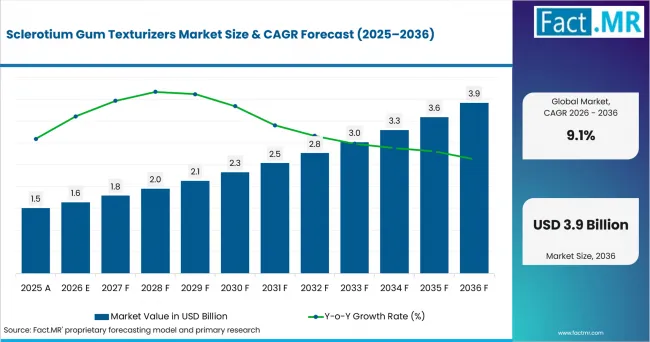
Sclerotium Gum Texturizers Market Value Analysis | Source: Fact.MR
What are the defining numbers behind Sclerotium Gum Texturizers Market growth?
An absolute opportunity of USD 2.3 billion is expected between 2026 and 2036.
- Demand Drivers in the Market
- Personal care formulators need cold-process rheology control where gel creams, cleansers and sunscreens must hold actives evenly through storage.
- Cargill describes sclerotium gum as a cold-soluble thickener and stabilizer made by aerobic fermentation of sugar with Sclerotium rolfsii.
- Clariant identifies Siligel SF as a natural gelling agent that stabilizes and increases emulsion viscosity, supports particle suspension, and is positioned for skin and hair applications.
- Food and beverage developers need traceable hydrocolloid choices for suspension and mouthfeel where low dosage must stabilize water-based systems.
- Key Segments Analyzed
- By Grade: Cosmetic and personal care is expected to hold 48.00% share in 2026, supported by its fit in creams, cleansers, sunscreens and color cosmetics.
- By Formulation Function: Suspension and yield value is projected to account for 31.00% share in 2026 because brands use sclerotium gum to hold pigments and actives evenly.
- By Application: Skin care is anticipated to capture 34.00% share in 2026 owing to demand for smooth gel creams, lotions and serum textures.
- By Product Type: Standard powder is estimated to represent 51.00% share in 2026, led by broad availability and easier storage across formulation laboratories.
- Analyst Opinion at Fact.MR
- Shambhu Nath Jha, Principal Consultant at Fact.MR, states, “Sclerotium gum is drawing attention because it solves a narrow formulation problem: stable suspension with a soft skin feel. Adoption is expected to widen as brands reduce reliance on synthetic acrylate texture builders. Suppliers that combine fermentation control, low-bioburden quality and application testing are better placed to win repeat projects.”
- Strategic Implications
- Ingredient suppliers should document viscosity behavior across salt, pH and temperature ranges used in skin care and rinse-off systems.
- The U.S. Bureau of Labor Statistics reported that the Producer Price Index for final demand increased 4.7% over the 12 months ended July 2026.
- Brand owners should align natural-origin and biodegradability language with ISO-based documentation and regional cosmetic ingredient rules.
- Distributors should support sample packs that help laboratories compare sclerotium gum against carbomer and xanthan systems during early trials.
The USA is expected to record 10.3% CAGR through 2036 due to personal care retail scale. Germany is projected to post 9.1% CAGR as specialty ingredient users balance performance with documentation. France is forecast to advance at 8.6% CAGR, supported by perfumery and beauty retail. Japan is anticipated to reach 8.2% CAGR through pharmacy and topical formulation demand. The UK is estimated to post 7.1% CAGR through cosmetics retail recovery and manufacturing depth.
How does the Sclerotium Gum Texturizers Market break down by segment?
Cosmetic and personal care grade leads at 48.00%; standard powder leads product type at 51.00%.
Which Grade dominates?
Cosmetic and personal care holds 48.0% share in 2026.
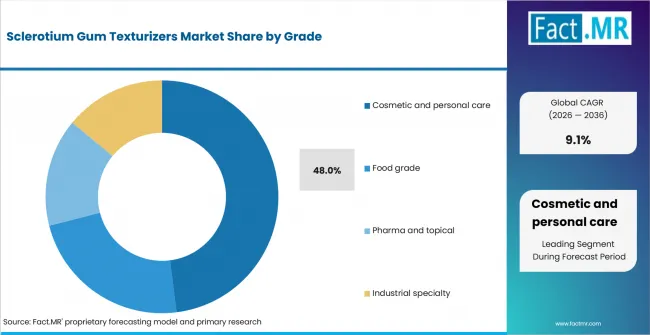
Sclerotium Gum Texturizers Market Analysis By Grade | Source: Fact.MR
Cosmetic and personal care grade leads because sclerotium gum improves texture and stability in products used on skin and hair. Cargill describes Actigum CS 11 QD as an INCI Sclerotium Gum texturizer for skin care, sun care, cleansers, hair care and color cosmetics.
The grade fits natural-origin reformulation. Cargill states that scleroglucan is obtained by sugar biofermentation and provides suspension in low-viscosity formulas where xanthan gum alone can feel stringy.
What leads Formulation Function?
Suspension and yield value accounts for 31.0% share in 2026.
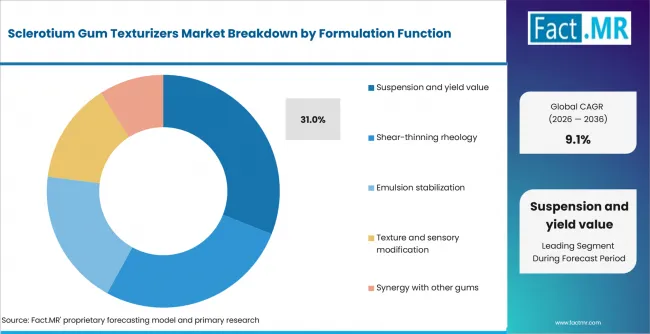
Sclerotium Gum Texturizers Market Analysis By Formulation Function | Source: Fact.MR
Suspension and yield value lead because many personal care formats need pigments or actives to stay evenly dispersed. Sclerotium gum builds that structure while keeping the product pourable or spreadable.
Health Canada lists sclerotium gum as an emulsion stabilizer, skin-conditioning agent and aqueous viscosity-increasing agent. These functions match the suspension role assigned to the formulation-function segment.
How does Application shape demand?
Skin care captures 34.0% share in 2026.
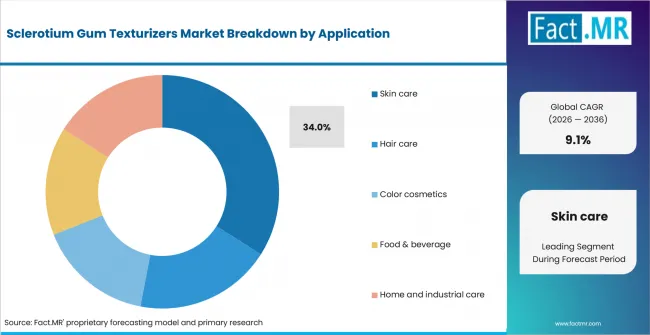
Sclerotium Gum Texturizers Market Analysis By Application | Source: Fact.MR
Skin care leads because moisturizers and gel creams rely on sensory cues consumers notice quickly. The U.S. Census Bureau reported seasonally adjusted U.S. retail e-commerce sales of USD 340.2 billion in Q2 2026.
INSEE reported a preliminary sales-volume index of 154.14 for specialist perfumery and beauty-product retail stores in May 2026 (2021=100). The index provides a current indicator of French beauty-retail activity.
What supports Standard powder within Product Type?
Standard powder represents 51.0% share in 2026.
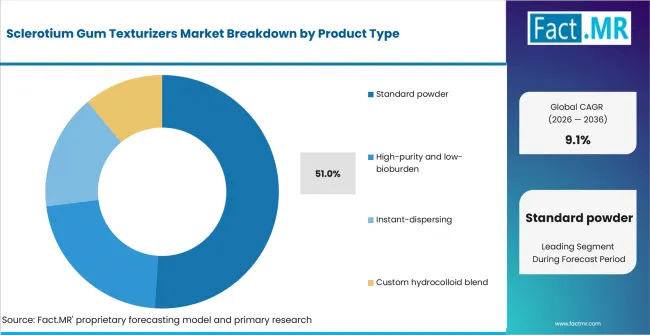
Sclerotium Gum Texturizers Market Analysis By Product Type | Source: Fact.MR
Standard powder leads because it fits how laboratories and contract manufacturers handle hydrocolloids. Powder formats are easier to store, blend and dose during bench trials.
High-purity and instant-dispersing grades are expected to gain share where topical product teams need faster hydration or stricter microbiological control. Standard powder remains the base format for broad commercial use.
What is accelerating Sclerotium Gum Texturizers Market adoption, and what is holding it back?
Demand is expected to rise through natural-origin texture control and suspension needs. Adoption is constrained by qualification work and substitution from other gums.
Drivers Impact Analysis
| DRIVER | (~) % IMPACT ON CAGR | GEOGRAPHIC RELEVANCE | IMPACT TIMELINE |
|---|---|---|---|
| Natural-origin personal care reformulation | +1.4% | North America, Europe, East Asia | Medium term (2-4 years) |
| Suspension and yield value in low-viscosity systems | +1.1% | Global | Short term (<= 2 years) |
| Skin care texture and sensory differentiation | +0.9% | USA, France, Japan | Medium term (2-4 years) |
| Hydrocolloid blending with xanthan, lecithin and starch systems | +0.7% | Europe, North America | Long term (>= 4 years) |
- Natural-origin personal care reformulation: Brands are expected to replace some synthetic texture builders where a biofermented polymer gives adequate viscosity and feel.
- Suspension and yield value: Low-viscosity formulas need structure that holds particles evenly while still pouring, pumping or spreading smoothly.
- Skin care sensory differentiation: Gel creams and serums depend on glide, cushion and after-feel, making texturizer choice visible to consumers.
Opportunity Impact Analysis
| OPPORTUNITY | (~) % IMPACT ON CAGR | GEOGRAPHIC RELEVANCE | IMPACT TIMELINE |
|---|---|---|---|
| Instant-dispersing grades for faster batching | +0.8% | Global | Medium term (2-4 years) |
| Low-bioburden grades for topical and pharma-adjacent use | +0.6% | USA, Japan, Europe | Long term (>= 4 years) |
| Custom gum blends for sensory and suspension targets | +0.5% | North America, Europe | Short term (<= 2 years) |
- Instant-dispersing grades: Faster hydration reduces batch delays and helps small laboratories move from bench trials to pilot batches with fewer process changes.
- Low-bioburden grades: Topical and pharma-adjacent formulators value microbial control when the texturizer is used in sensitive leave-on applications.
- Custom gum blends: Pre-balanced blends give brands a shorter route to suspension, viscosity and sensory targets than single-gum testing.
Restraints Impact Analysis
| RESTRAINT | (~) % IMPACT ON CAGR | GEOGRAPHIC RELEVANCE | IMPACT TIMELINE |
|---|---|---|---|
| Qualification time against carbomer and xanthan systems | -0.6% | Global | Short term (<= 2 years) |
| Cost sensitivity in mass personal care formulas | -0.4% | USA, Europe, Japan | Medium term (2-4 years) |
| Documentation gaps for food or topical claims | -0.3% | Global | Long term (>= 4 years) |
- Qualification time: Formulators must repeat stability, preservative and pack tests when a rheology system changes.
- Cost sensitivity: Mass personal care formulas often compare sclerotium gum with lower-cost xanthan, cellulose derivatives and acrylate thickeners.
- Documentation depth: Food, topical and cosmetic applications require a clear technical file before a specialty gum moves into commercial batches.
Which countries are scaling the Sclerotium Gum Texturizers Market through 2036?
- The country comparison spans 3.22 percentage points across the forecast period.
- The USA remains 1.18 percentage points above Germany through personal care retail scale and active formulation testing.
- Germany remains 0.45 percentage point above France as specialty cosmetic ingredient users balance texture performance with documentation.
- France remains 0.46 percentage point above Japan through perfumery, beauty retail and export-oriented cosmetics activity.
- Japan remains 1.13 percentage points above the UK as topical and pharma-adjacent buyers place weight on quality files.
- The UK closes the displayed range through cosmetics retail recovery and domestic manufacturing depth.
Comparable CAGRs can create different entry conditions due to retail-channel scale, formulation habits, ingredient documentation and local testing expectations. Full report coverage includes North America, Latin America, Western Europe, Eastern Europe, East Asia, South Asia and Pacific, Middle East and Africa.
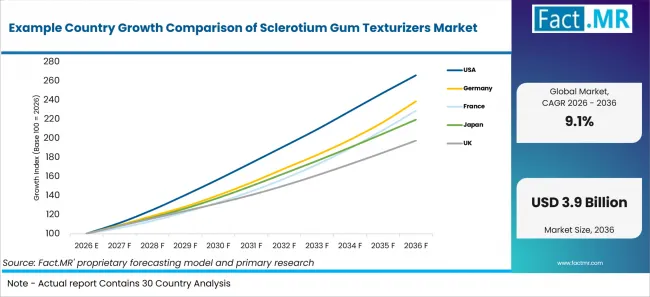
Example Country Growth Comparison Of Sclerotium Gum Texturizers Market | Source: Fact.MR
| Country | CAGR (2026-2036) |
|---|---|
| United States | 10.3% |
| Germany | 9.1% |
| France | 8.6% |
| Japan | 8.2% |
| United Kingdom | 7.1% |
What supports USA adoption?
10.3% CAGR, supported by personal care retail scale and clean-label formulation demand.
Advance U.S. health and personal care store sales were USD 40.505 billion in July 2026 on a seasonally adjusted basis, according to the U.S. Census Bureau series available through FRED. Sclerotium gum gains relevance where brands want a biofermented thickener that can stabilize water-rich systems and improve sensory feel.
What supports Germany adoption?
9.1% CAGR, led by specialty cosmetic formulation and structured retail channels.
Eurostat reported a seasonally adjusted retail trade volume index of 101.5 for Germany in May 2026 (2021=100). The index provides a current measure of domestic retail activity. Clariant’s Siligel portfolio strengthens local market relevance because the company documents sclerotium gum in natural gelling systems used for skin care and hair care.
How is France scaling demand?
8.6% CAGR, backed by beauty retail and export-oriented cosmetics activity.
French customs data reported EUR 6.442 billion in seasonally and working-day-adjusted exports of chemicals, perfumes and cosmetics in June 2026. Sclerotium gum is expected to benefit where formulators need a natural-origin thickener that supports both emulsion stability and a soft application profile.
How does Japan perform?
8.2% CAGR, shaped by premium personal care and pharmaceutical-grade documentation needs.
Japan’s Ministry of Health, Labour and Welfare reported JPY 823.4 billion in direct overseas shipments of pharmaceuticals in 2024. The agency notes that the survey is designed to describe domestic production and shipment activity and should not be used to measure trade flows. High-purity and low-bioburden sclerotium gum grades fit Japanese buyer preference for controlled quality files and stable sensory performance.
What supports UK adoption?
7.1% CAGR, driven by cosmetics retail recovery and manufacturing demand.
The UK Office for National Statistics reported that retail sales volumes rose 1.6% in Q1 2026, while other non-food stores rose 4.7%; cosmetics and toiletries stores increased across all three months of the quarter. These movements provide context on UK beauty-retail activity.
Who leads the Sclerotium Gum Texturizers Market?
Cargill is a direct participant through its Beauty portfolio of scleroglucan-based texturizers for rheology, suspension and stabilization. Actigum™ CS 11 QD uses the INCI name Sclerotium Gum, while Actigum™ VSX 20 combines Sclerotium Gum and Xanthan Gum and is documented to deliver high yield value and strong suspending performance.
Clariant participates through Siligel™ and Siligel™ SF, natural gelling systems containing Sclerotium Gum that stabilize emulsions, suspend particles and support skin- and hair-care formulations. BASF participates through Tinocare® GL Green, whose documented composition includes Sclerotium Gum. Sisterna, whose parent company is DKS Co. Ltd., offers EZ Base containing Sclerotium Gum and Xanthan Gum. Croda participates through Amigum™, an INCI Sclerotium Gum gelling and stabilizing ingredient; Croda acquired Alban Muller’s worldwide business activities in 2021.
Competition centers on formulation performance, sensory characteristics, product documentation and technical application support. Supplier guidance comparing sclerotium gum with xanthan gum and synthetic rheology modifiers can help formulators evaluate suitable stabilization and texturizing systems.
Which companies are the key providers?
Key companies include Cargill; BASF; Clariant; Sisterna (part of DKS Co. Ltd.); and Croda.
- Cargill
- BASF
- Clariant
- Sisterna (part of DKS Co. Ltd.)
- Croda
Bibliography
- U.S. Bureau of Labor Statistics. (2026, August 13). Producer Price Indexes—July 2026.
- Clariant. (2026, July 22). Siligel™ SF.
- Clariant. (2026, July 7). Siligel™.
- Eurostat. (2026, July 6). Volume of retail trade up by 0.2% in the euro area and by 0.5% in the EU.
- Health Canada. (2026, February 5). Chemical substance - Sclerotium gum.
- Institut national de la statistique et des études économiques. (2026, July 22). Indice de volume des ventes - Commerce de détail de parfumerie et de produits de beauté en magasin spécialisé (NAF rév. 2, niv. classe poste 47.75) : Série mensuelle CVS-CJO - France - Base 100 en 2021 – Identifiant 010770109.
- Office for National Statistics. (2026, April 24). Retail sales, Great Britain: March 2026.
- Office for National Statistics. (2026, July 24). UK manufacturers' sales by product: 2025.
- U.S. Census Bureau. (2026, August 14). Advance monthly sales for retail and food services.
- U.S. Census Bureau. (2026, August 18). Quarterly retail e-commerce sales.
This Report Answers
- The report explains where sclerotium gum texturizers are used across grade and formulation function, including links to adjacent gum hydrocolloid systems.
- Segment analysis identifies the 2026 share positions across grade, formulation function, application and product type, with context from natural texture gums.
- Country analysis examines the listed markets and the retail, export and manufacturing signals supporting their projected growth through 2036.
- Competitive analysis reviews current providers across biofermented gum, natural gelling systems and related natural rheology modifiers.
- Application analysis assesses how suspension, shear-thinning behavior and sensory quality influence formulation decisions in skin care and food-adjacent uses.
What does the Sclerotium Gum Texturizers Market cover?
The Sclerotium Gum Texturizers Market covers biofermented polysaccharide ingredients whose primary role is to modify viscosity, suspension, emulsion stability and sensory behavior. It includes single-ingredient sclerotium gum, scleroglucan products and blended systems used where formulators need high yield value.
The assessment covers cosmetic and personal care grade, food grade, pharma and topical grade, and industrial specialty use. It connects sclerotium gum to broader texture modifier categories where viscosity control and mouthfeel are central to product performance.
What is included in the scope?
The scope includes sclerotium gum powders, scleroglucan texturizers, natural gelling systems containing sclerotium gum and custom hydrocolloid blends where sclerotium gum is a functional component. It covers ingredients used for thickening, suspension, emulsion stabilization and sensory modification.
It includes cosmetic and personal care, food and beverage, topical, home care and selected specialty uses. Product-type coverage includes standard powder, high-purity and low-bioburden grades, instant-dispersing formats and custom hydrocolloid blends.
What is excluded from the scope?
The scope excludes finished cosmetics, finished foods, finished pharmaceuticals and general hydrocolloid systems that lack a sclerotium gum or scleroglucan component. It also excludes unrelated microbial polysaccharides sold only for drilling or construction applications.
Standalone xanthan gum, carbomer, cellulose derivatives and starch products are outside the scope when they are sold separately from a sclerotium gum system. Finished-brand revenue is excluded from the ingredient market sizing.
How Was the Analysis Built?
The analysis draws on 120+ sources, 35+ company portfolios, 25+ countries, and more than 20 industry interviews.
- Primary Research: Primary research includes discussions with manufacturers, service providers, technology developers, distributors, end users, and subject-matter experts. These conversations examine purchasing priorities, product adoption, operational challenges, approval requirements, competitive positioning, and the factors that influence wider market acceptance.
- Desk Research: Desk research covers government statistics, regulatory publications, company filings, trade data, technical studies, industry associations, standards, public policy, and other authoritative sources. Every source used in the analysis is documented in the bibliography.
- Market Sizing and Forecasting: Market estimates combine historical performance, demand indicators, pricing and volume trends, segment shares, company participation, country-level growth, adoption patterns, investment activity, and barriers to market expansion.
- Data Validation and Update Cycle: Findings are validated by comparing primary interviews with public data, company activity, regulatory changes, trade patterns, and industry developments. Regular updates review new product launches, capacity changes, partnerships, approvals, and shifts in commercial adoption.
What is the report’s scope and coverage?
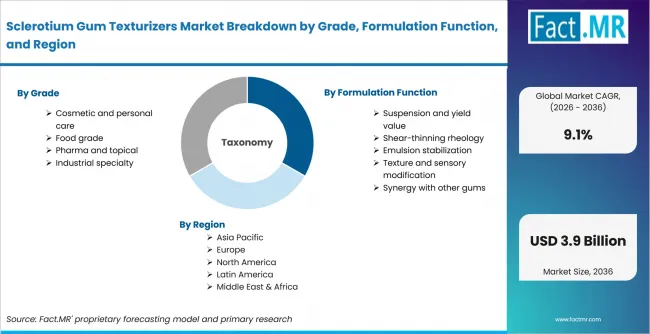
Sclerotium Gum Texturizers Market Breakdown By Grade, Formulation Function, And Region | Source: Fact.MR
| Attribute | Details |
|---|---|
| Quantitative Units | USD billion |
| Market Definition | Biofermented sclerotium gum and scleroglucan-based texturizers used to thicken, suspend, stabilize and improve sensory behavior in personal care, topical, food and specialty formulations. |
| Grade | Cosmetic and personal care; Food grade; Pharma and topical; Industrial specialty |
| Formulation Function | Suspension and yield value; Shear-thinning rheology; Emulsion stabilization; Texture and sensory modification; Synergy with other gums |
| Application | Skin care; Hair care; Color cosmetics; Food and beverage; Home and industrial care |
| Product Type | Standard powder; High-purity and low-bioburden; Instant-dispersing; Custom hydrocolloid blend |
| Regions Covered | North America; Latin America; Western Europe; Eastern Europe; East Asia; South Asia and Pacific; Middle East and Africa |
| Countries Covered | United States; Germany; France; Japan; United Kingdom |
| Key Companies Profiled | Cargill; BASF; Clariant; Sisterna (part of DKS Co. Ltd.); Croda |
| Forecast Period | 2026 to 2036 |
| Approach | Hybrid top-down and bottom-up approach using ingredient-use intensity, application mix, product form, country-level demand indicators and provider portfolio review. |
How is the market segmented?
-
By Grade
- Cosmetic and personal care
- Food grade
- Pharma and topical
- Industrial specialty
-
By Formulation Function
- Suspension and yield value
- Shear-thinning rheology
- Emulsion stabilization
- Texture and sensory modification
- Synergy with other gums
-
By Application
- Skin care
- Hair care
- Color cosmetics
- Food and beverage
- Home and industrial care
-
By Product Type
- Standard powder
- High-purity and low-bioburden
- Instant-dispersing
- Custom hydrocolloid blend
-
By Region
- North America
- Latin America
- Western Europe
- Eastern Europe
- East Asia
- South Asia and Pacific
- Middle East and Africa