- Base Value(2025): 18.7 Bn
- Estimated Value(2025): 18.7 Bn
- Forecast Value (2035): 31.2 Bn
- CAGR (2025 - 2035): 5.3%
Seafood Packaging Market Forecast and Outlook 2025 to 2035
The global seafood packaging market is set to grow from USD 18.7 billion in 2025 to USD 31.2 billion by 2035, adding USD 12.5 billion in new revenue and advancing at a CAGR of 5.3%. Growth is driven by escalating demand for fresh seafood preservation solutions, expanding cold chain infrastructure across regulated markets, and accelerating food safety compliance requirements among seafood processing organizations seeking quality maintenance capabilities.
Seafood packaging technologies are increasingly recognized as essential tools for seafood distribution practitioners, offering precise freshness retention capabilities, contamination prevention assurance, and comprehensive shelf-life extension characteristics compared to traditional packaging approaches.
Quick Stats for Seafood Packaging Market
- Seafood Packaging Market Value (2025): USD 18.7 billion
- Seafood Packaging Market Forecast Value (2035): USD 31.2 billion
- Seafood Packaging Market Forecast CAGR: 5.3%
- Leading Material in Seafood Packaging Market: Plastic (50.0%)
- Key Growth Regions in Seafood Packaging Market: Asia Pacific, North America, and Europe
- Top Players in Seafood Packaging Market: DS Smith, AptarGroup, Sealed Air, Amcor, ProAmpac
Seafood Packaging Market Market Value Analysis | Source: Fact.MR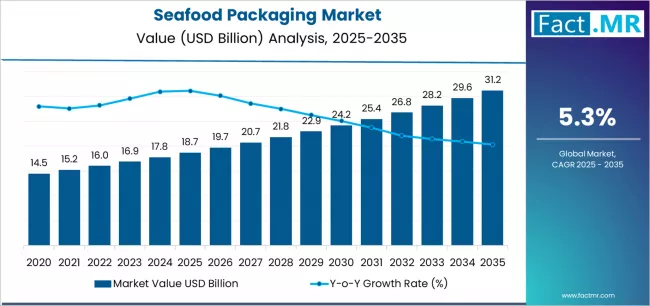
Plastic formulations dominate the market with 50.0% share, favored in seafood processing and distribution environments for their established barrier properties, providing moisture resistance mechanisms, oxygen protection capabilities, and cost-effectiveness across diverse product applications and packaging demographics.
Modified Atmosphere Packaging remains fundamental in seafood preservation protocols where extended shelf-life requirements and quality maintenance operations match operational requirements and freshness confidence standards. Fish is advancing among seafood categories as specialized processing facility networks expand and consumption infrastructure increases accessibility in market-convenient locations with diverse species structures.
Geographic concentration demonstrates dynamic growth patterns with China and India leading expansion, supported by rising seafood production capacity, food safety consciousness expansion among consumer populations, and packaging innovation establishment programs in processing centers.
USA, Germany, Japan, Brazil, and Thailand demonstrate robust development through established seafood supply chain ecosystems, regulatory framework maturity for food contact materials, and standardized acceptance of advanced packaging procedures. Competitive advantage is consolidating around barrier performance profiles, sustainability documentation, automation compatibility, and integrated preservation portfolios rather than standalone material formulations alone.
The first half of the decade will witness the market climbing from USD 18.7 billion to approximately USD 24.1 billion, adding USD 5.4 billion in value, which constitutes 43.2% of the total forecast growth period. This phase will be characterized by the continued dominance of plastic packaging methodologies in seafood distribution settings, combined with accelerating adoption of vacuum skin packaging technologies in retail applications where visual presentation and extended freshness create favorable consumer outcomes.
The latter half will witness sustained expansion from USD 24.1 billion to USD 31.2 billion, representing an addition of USD 7.1 billion or 56.8% of the decade's growth, defined by broadening acceptance of sustainable packaging materials and integration of smart packaging platforms across mainstream seafood processing facilities.
Where revenue comes from - Now Vs Next (industry-level view)
| Period | Primary Revenue Buckets | Share | Notes |
|---|---|---|---|
| Today | Plastic | 50.0% | Material dominance |
| Modified Atmosphere Packaging | 44.0% | Preservation technology | |
| Fish | 54.0% | Primary seafood type | |
| Fresh & Frozen | 69.0% | Leading application | |
| Paper & Paperboard | 28.0% | Sustainable alternative | |
| Future (3-5 yrs) | Biodegradable Materials | 35-41% | Sustainability advancement |
| Smart Packaging | 32-38% | Traceability integration | |
| Active Packaging | 28-34% | Freshness indicators | |
| Recyclable Solutions | 38-44% | Circular economy | |
| E-commerce Packaging | 30-36% | Online retail growth | |
| Plant-based Films | 25-31% | Bio-based alternatives | |
| RFID Integration | 22-28% | Supply chain visibility |
Source: Fact.MR analysis. Updated Dec 12, 2025
Seafood Packaging Market Key Takeaways
At-a-Glance Metrics
| Metric | Value |
|---|---|
| Market Value (2025) → | USD 18.7 billion |
| Market Forecast (2035) ↑ | USD 31.2 billion |
| Growth Rate ★ | 5.3% CAGR |
| Leading Material → | Plastic |
| Primary Technology → | Modified Atmosphere Packaging |
Source: Fact.MR analysis. Updated Dec 12, 2025
The market demonstrates exceptional fundamentals with Plastic capturing a commanding 50.0% share through superior barrier performance characteristics, established cost-effectiveness advantages, and proven moisture protection profiles across seafood packaging applications. Modified Atmosphere Packaging drives primary technology demand at 44.0% share, supported by established shelf-life extension infrastructure and quality preservation requirements that maintain freshness compliance across diverse seafood segments.
Geographic concentration remains anchored in Asia Pacific and North America with emerging market leadership through seafood production expansion and packaging infrastructure development, while developed markets show accelerated adoption rates driven by sustainability requirement demographics and food safety regulatory procedure preferences.
Imperatives for Stakeholders in Seafood Packaging Market
Design for sustainability and freshness, not just containment
- Offer complete packaging solutions: advanced barrier materials + MAP technology integration + anti-microbial systems + freshness indicators + recycling programs.
- Preconfigured packaging packages: fresh fish specifications, frozen seafood configurations, processed product programs, and combination preservation protocols for diverse application requirements.
Regulatory readiness for food contact applications
- Comprehensive migration testing documentation, food safety compliance systems, and material infrastructure (FDA approval, EU regulations, traceability protocols).
Affordability-by-design approach
- Cost-optimized material portfolios, flexible pricing models, processor partnership programs, and transparent total packaging cost documentation.
Processor training-focused market penetration
- Established packaging technology workshops + comprehensive certification programs (MAP operation, seal integrity, quality control); direct processor engagement for relationship development and packaging confidence building.
Segmental Analysis
Primary Classification: The market segments by material into Plastic, Paper & Paperboard, Metal, and Others, representing the evolution from basic containment toward sophisticated preservation with sustainable capabilities, comprehensive barrier characteristics, and integrated freshness features.
Secondary Classification: The packaging technology segmentation divides the market into modified atmosphere packaging (44.0%), vacuum skin packaging, and other technologies, reflecting distinct preservation objectives for extended shelf-life optimization and quality maintenance versus presentation enhancement implementation and cost-effective packaging.
Tertiary Classification: The seafood segmentation shows fish commanding 54.0% position, followed by mollusca, crustaceans, and others, demonstrating varied preservation sensitivity levels and handling requirement concentrations.
The segmentation structure reveals seafood packaging evolution from basic containment technology toward comprehensive freshness preservation platforms with enhanced barrier characteristics and multi-dimensional food safety compliance capabilities, while material diversity spans from conventional plastics to sustainable alternatives requiring specialized processing infrastructure.
Why are Plastic Seafood Packaging Materials Dominant?
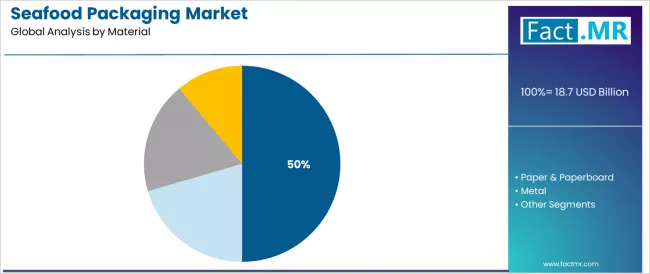
Seafood Packaging Market Analysis By Material | Source: Fact.MR
Market Position: Plastic commands the leading position in the seafood packaging market with a 50.0% share through superior barrier performance characteristics, including established moisture resistance presence, extensive oxygen protection capabilities, and standardized processing pathways that enable manufacturers to achieve predictable preservation outcomes across varied seafood categories and diverse packaging demographics.
Value Drivers: The segment benefits from performance advantages through multi-layer film technology, transparent product visibility without barrier compromise, and established manufacturing frameworks without requiring extensive equipment modifications. Advanced plastic technology enables thermoforming optimization, flexible film customization, and rigid container variation, where seal integrity and moisture barrier represent critical freshness requirements. Thermoformed trays hold significant share within the plastic segment, appealing to processors seeking visual presentation capabilities for retail distribution.
Competitive Advantages: Plastic solutions differentiate through proven cost-effectiveness profiles, processing efficiency advantages, and integration with established packaging protocols that enhance operational confidence while maintaining compliant food safety outcomes for diverse seafood applications.
Key market characteristics:
- Advanced barrier properties with oxygen transmission control and moisture protection for extended shelf-life
- Superior processing efficiency, enabling high-speed packaging lines and automated sealing for production applications
- Comprehensive format versatility, including film options and rigid containers for packaging optimization
Why does Paper & Paperboard Represent a Growing Sustainable Segment?
Paper & paperboard maintains specialized market position at 28.0% through renewable material capabilities and recyclable characteristics. These materials appeal to processors and retailers seeking environmental responsibility with fiber-based solutions, offering biodegradable disposal and consumer preference alignment through sustainable packaging systems. Market adoption is driven by fresh seafood applications, emphasizing complete moisture management evaluation and barrier coating progression through innovative treatment mechanisms.
Which Packaging Technology Occupies the Dominant Position?
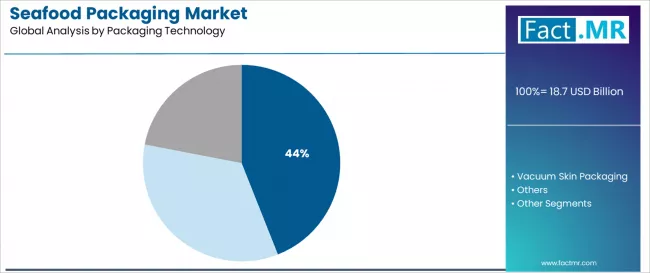
Seafood Packaging Market Analysis By Packaging Technology | Source: Fact.MR
Market Context: Modified atmosphere packaging demonstrates technology leadership in the seafood packaging market with a 44.0% share due to widespread shelf-life extension requirements and established focus on gas composition control, microbial growth inhibition, and quality preservation that maximizes freshness while maintaining consistent safety standards.
Appeal Factors: Processors and distributors prioritize MAP applications for extended distribution windows, retail display maintenance, and integration with established cold chain workflows that enables coordinated preservation experiences across multiple seafood categories. The segment benefits from substantial food safety standardization and shelf-life documentation that emphasizes gas-based preservation approaches for freshness maintenance across diverse seafood demographics. CO2-enriched atmospheres capture significant adoption within the MAP segment, demonstrating processor preference for bacterial growth inhibition formats.
Growth Drivers: E-commerce seafood expansion incorporates MAP as essential preservation protocols for direct-to-consumer delivery, while premium seafood retail growth increases packaging sophistication that meets quality requirements and ensures freshness maintenance capabilities.
What Drives Vacuum Skin Packaging Adoption in Retail Applications?
Vacuum skin packaging captures substantial technology share at 30.0% through comprehensive requirements in presentation frameworks, second-skin sealing capabilities, and integrated product visibility protocols. These systems demand sophisticated film materials capable of achieving tight conformity while providing drip prevention and visual appeal, appealing to processors and retailers seeking evidence-based differentiation advantages beyond conventional MAP approaches.
Which Seafood Category Accounts for the Bulk of all Packaging Applications?
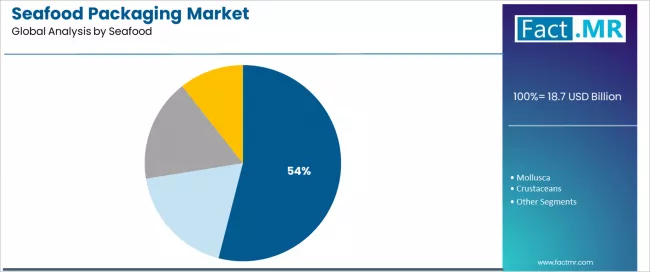
Seafood Packaging Market Analysis By Seafood | Source: Fact.MR
Market Context: Fish establishes market leadership in the seafood packaging sector with a 54.0% share due to comprehensive consumption volume requirements and sustained focus on species diversity, global trade intensity, and preservation sensitivity that maximizes quality maintenance while maintaining appropriate food safety oversight standards.
Appeal Factors: Processors and distributors prioritize fish packaging for high-volume production runs, diverse species handling, and integration with established supply chain infrastructure that enables coordinated preservation experiences across multiple fish categories. The sector benefits from substantial global trade infrastructure maturity and cold chain guideline campaigns that emphasize specialized packaging delivery for critical quality preservation applications.
Growth Drivers: Salmon farming expansion incorporates advanced packaging as standard preservation protocols for premium products, while tuna processing growth increases packaging complexity that meets export requirements and ensures quality retention capabilities.
Application dynamics include:
- Strong growth in portion-controlled packaging requiring individual serving formats and convenience positioning arrangements
- Increasing adoption in value-added products for marinated fish and meal kit integration positioning
- Rising integration with sustainable fisheries for eco-labeling and certification traceability
How ae Mollusca Applications Advancing Specialized Handling Requirements?
Mollusca applications capture a 20.0% share through established bivalve frameworks, complex shell protection capabilities, and integrated moisture retention protocols. The segment demonstrates specialized packaging expertise across diverse shellfish populations, with advanced breathable film applications and live product handling infrastructure gaining traction in premium seafood programs while quality system frameworks drive continued freshness compliance requiring careful balance between oxygen availability and shelf-life extension assurance.
What are the Drivers, Restraints, and Key Trends of the Seafood Packaging Market?
| Category | Factor | Impact | Why It Matters |
|---|---|---|---|
| Driver | Rising seafood consumption & global trade growth (protein demand, aquaculture expansion) | ★★★★★ | Preservation requirements enable packaging demand for seafood distribution; increasing consumption drives packaging adoption across retail markets and diverse distribution segments. |
| Driver | Growth in cold chain infrastructure and quality standards (temperature control, traceability systems) | ★★★★★ | Drives demand for reliable preservation systems and standardized barrier protocols; manufacturers providing consistent freshness outcomes gain competitive advantage in processor-focused packaging segments. |
| Driver | Food safety regulations and traceability requirements (HACCP standards, FDA guidelines) | ★★★★☆ | Processors demand validated packaging solutions and documented compliance systems; regulatory framework visibility expanding addressable segments beyond traditional seafood demographics and export clientele. |
| Restraint | High material costs & sustainability pressures (plastic concerns, recycling infrastructure) | ★★★★☆ | Cost-conscious processors face budget limitations and environmental constraints, restricting material adoption and affecting sustainable packaging penetration in price-sensitive markets and developing regions. |
| Restraint | Technical complexity & equipment investment requirements (MAP machinery, sealing technology) | ★★★☆☆ | Processors face capability concerns and capital limitations; increases implementation barriers and affects adoption penetration in smaller seafood facilities and artisanal processing operations. |
| Trend | Sustainable packaging materials & circular economy (biodegradable films, recyclable solutions) | ★★★★★ | Growing consumer demand for environmental responsibility and waste reduction preferences beyond traditional plastic packaging; advanced materials become core differentiation strategy for progressive brand positioning. |
| Trend | Smart packaging & freshness indicators (time-temperature indicators, QR codes) | ★★★★☆ | Seafood packaging evolving beyond passive barrier toward interactive monitoring protocols; technology positioning drives enhanced consumer confidence and supply chain transparency in sophisticated retail environments. |
Source: Fact.MR analysis. Updated Dec 12, 2025
Analysis of the Seafood Packaging Market by Key Countries
The seafood packaging market demonstrates robust regional growth dynamics with emerging leaders including China (6.3% CAGR) and India (6.1% CAGR) driving expansion through seafood production programs and packaging infrastructure development. Strong performers encompass the USA (5.5% CAGR), Germany (5.2% CAGR), and Japan (5.0% CAGR), benefiting from established cold chain infrastructure and quality assurance demographics. Developed markets feature Brazil (4.8% CAGR) and Thailand (4.5% CAGR), where export orientation normalization and processing expertise support consistent growth patterns.
Regional synthesis reveals Asian markets leading adoption through comprehensive production capacity positioning and aquaculture investment expansion, while Western countries demonstrate measured growth potential supported by sustainability preferences and traceability regulatory influence. Global markets show solid development driven by food safety culture integration and advanced packaging technology.
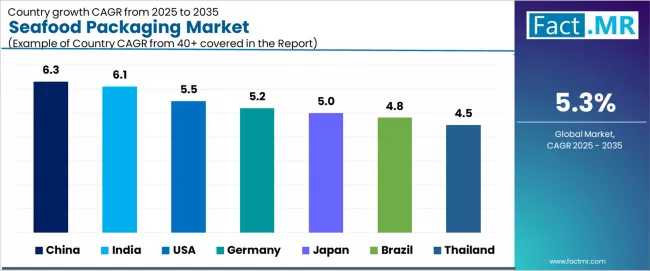
Seafood Packaging Market Cagr Analysis By Country | Source: Fact.MR
| Region/Country | 2025 to 2035 Growth | How to win | What to watch out |
|---|---|---|---|
| China | 6.3% | Focus on high-volume production portfolios | Export competition; regulatory evolution |
| India | 6.1% | Lead with cost-effective solutions | Infrastructure gaps; quality standardization |
| USA | 5.5% | Provide compliance-ready technologies | Sustainability pressures; regulatory complexity |
| Germany | 5.2% | Maintain eco-friendly positioning | Import dependency; premium pricing |
| Japan | 5.0% | Push smart packaging innovation | Market maturity; population decline |
| Brazil | 4.8% | Offer export-oriented solutions | Economic volatility; currency fluctuations |
| Thailand | 4.5% | Deliver sustainable export packaging | Labor costs; competitive intensity |
Source: Fact.MR analysis. Updated Dec 12, 2025
China Drives Largest Production Scale
China establishes largest seafood production scale through progressive aquaculture expansion and comprehensive processing infrastructure development, positioning seafood packaging technologies as essential preservation solutions in coastal processing centers and emerging inland aquaculture facilities.
The country's 6.3% growth rate reflects rising seafood production levels supporting packaging investments and growing export quality mandates that encourage the deployment of advanced preservation solutions in diverse processing settings. Growth concentrates in major coastal provinces, including Shandong, Fujian, and Guangdong, where processing facilities showcase increasing capacity for international packaging standard adoption that appeal to export-focused processors demanding validated freshness retention and food safety outcomes.
Chinese seafood processors are developing standardized packaging protocols that combine imported film technology with domestic manufacturing capacity, including MAP system expansion and automation growth. Distribution channels through packaging converters and equipment suppliers expand market access, while technician certification initiatives support adoption across diverse seafood types and processing specialization levels.
India Emerges as Aquaculture Growth Leader
In Andhra Pradesh, Kerala, and Tamil Nadu regions, seafood processing facilities and aquaculture farms are adopting advanced packaging technologies as essential preservation tools for shrimp export operations, driven by increasing quality alignment with international standards and elevation of food safety expectations that emphasize the importance of validated barrier protection.
The market holds a 6.1% growth rate, supported by government aquaculture promotion and export infrastructure investment that promote packaging adoption for foreign market applications. Indian processors are favoring cost-effective packaging platforms that provide comprehensive barrier capabilities and regulatory compliance evidence, particularly appealing in export clusters where freshness maintenance and microbial control represent critical competitive factors.
Market expansion benefits from substantial shrimp farming investment and cold chain development that enable widespread adoption of evidence-based packaging methodologies for diverse seafood applications. Industry adoption follows patterns established in pharmaceutical cold chain excellence, where quality system advantages and traceability documentation drive buyer confidence and export certification achievement.
USA Shows Food Safety Regulatory Leadership
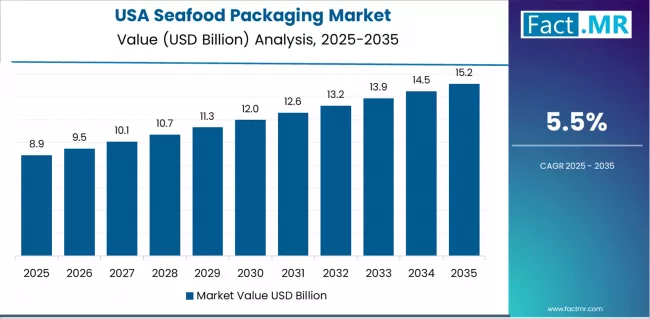
Seafood Packaging Market Country Value Analysis | Source: Fact.MR
USA establishes food safety regulatory leadership through comprehensive HACCP framework and established FDA compliance ecosystem, integrating seafood packaging solutions across processing plants, distribution centers, and retail chains. The country's 5.5% growth rate reflects established regulatory framework maturity and sophisticated consumer expectation levels that support widespread deployment of validated packaging solutions in commercial and retail applications.
Growth concentrates in established seafood regions, including Alaska, New England, and Gulf Coast, where processors showcase advanced packaging adoption that appeals to quality-focused organizations seeking predictable food safety outcomes and comprehensive traceability documentation.
American seafood providers leverage established supplier relationships and comprehensive quality system frameworks, including allergen labeling readiness and tamper-evidence programs that create consumer confidence and regulatory assurance. The market benefits from substantial e-commerce seafood development and meal kit expansion that encourage premium packaging purchases while supporting continuous innovation investments and material validation funding.
Germany Shows Import Quality Leadership
Germany's sophisticated import market demonstrates established seafood packaging integration with documented sustainability emphasis in material selection and recyclability protocol execution through specialized retailers and established foodservice organizations.
The country leverages stringent packaging regulations and environmental excellence approaches to maintain a 5.2% growth rate. Premium retail regions, including Hamburg, Berlin, and Bavaria, showcase eco-friendly priorities where seafood packaging integrates with established sustainability cultures and thorough waste management practices to optimize environmental impact and ensure appropriate food quality assessment.
German retailers prioritize recyclable material requirements and comprehensive environmental documentation in packaging selection, creating demand for sustainable solutions with extensive green characteristics, including biodegradable films, compostable trays, and comprehensive lifecycle analysis. The market benefits from established organic seafood specialty segments and environmental consumer consciousness that provide differentiation opportunities and compliance with strict German packaging regulations.
Japan Demonstrates Smart Packaging Innovation
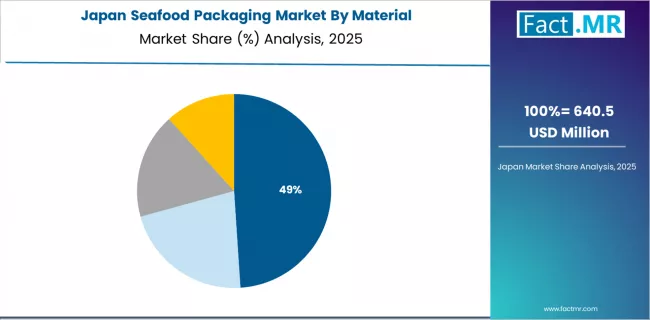
Seafood Packaging Market Japan Market Share Analysis By Material | Source: Fact.MR
Japan's advanced consumer market demonstrates sophisticated seafood packaging integration with documented technology focus in innovation methodology and quality monitoring execution through specialized retailers and established convenience store networks.
The country maintains a 5.0% growth rate, leveraging advanced sensor technology and consumer convenience approaches. Premium retail centers, including Tokyo, Osaka, and Fukuoka, showcase innovation priorities where seafood packaging integrates with established quality cultures and meticulous freshness systems to optimize product monitoring and ensure appropriate consumption guidance.
Japanese retailers prioritize freshness indication and comprehensive quality monitoring in packaging implementation, creating demand for smart solutions with extensive technology characteristics, including time-temperature indicators, freshness sensors, and comprehensive QR code traceability. The market benefits from established sushi consumption segments and ready-to-eat seafood demographics that provide differentiation opportunities and compliance with Japanese food safety standards.
Brazil Shows Export Growth Leadership
Brazil's developing seafood market demonstrates progressive packaging adoption with documented export emphasis in frozen product handling and international market compliance through specialized processors and established export facilities. The country maintains a 4.8% growth rate, leveraging abundant fishery resources with global market access and quality-focused export cultures.
Major processing regions, including Santa Catarina, Pará, and Bahia, showcase export-driven approaches where seafood packaging integrates with established cold storage cultures and comprehensive certification systems to optimize international acceptance and maintain buyer quality requirements under stringent importer standards.
Brazilian exporters prioritize international standard alignment and comprehensive certification documentation in packaging program implementation, creating demand for compliant solutions with extensive approval characteristics, including EU regulation compliance, USDA acceptance, and comprehensive audit trail systems. The market benefits from established shrimp export clusters and fish farming development that provide positioning opportunities and maintain alignment with international buyer regulatory expectations.
Thailand Shows Export-oriented Processing Excellence
Thailand's mature seafood market demonstrates established packaging integration with documented export focus in processing methodology and sustainability protocol optimization through comprehensive processors and established canning facilities. The country maintains a 4.5% growth rate, leveraging seafood processing heritage with global distribution networks and quality-focused export operations.
Key processing regions, including Samut Sakhon, Songkhla, and Chonburi, showcase export excellence approaches where seafood packaging integrates with established processing cultures and comprehensive sustainability systems to optimize eco-friendly positioning and maintain market differentiation under evolving consumer requirements.
Thai processors prioritize sustainable material adoption and comprehensive eco-certification in packaging development, creating demand for environmentally-friendly solutions with extensive green characteristics, including recyclable materials, reduced plastic usage, and comprehensive carbon footprint documentation. The market benefits from established tuna canning sectors and frozen seafood export leadership that provide quality positioning opportunities and maintain alignment with international sustainability expectations.
Europe Market Split by Country
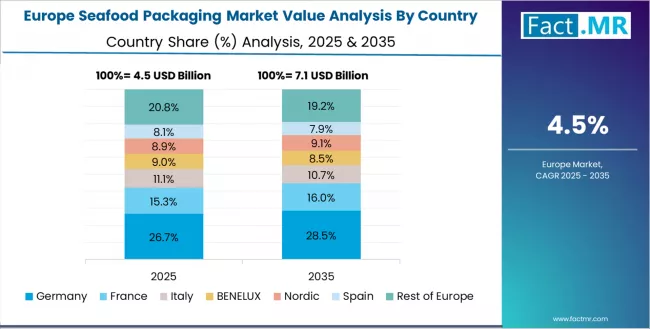
Seafood Packaging Market Europe Country Market Share Analysis, 2025 & 2035 | Source: Fact.MR
The European seafood packaging market is projected to grow from USD 4.2 billion in 2025 to USD 6.8 billion by 2035, registering a CAGR of 4.9% over the forecast period. Germany is expected to maintain its leadership position with a 26.8% market share in 2025, declining slightly to 25.4% by 2035, supported by its advanced import infrastructure and major retail chains including major fish market hubs.
France follows with a 18.9% share in 2025, projected to reach 19.2% by 2035, driven by comprehensive seafood consumption traditions and Paris retail concentration. The United Kingdom holds a 17.3% share in 2025, expected to decrease to 16.8% by 2035 due to post-Brexit supply chain adjustments.
Italy commands a 14.2% share, while Spain accounts for 11.6% in 2025. The Rest of Europe region is anticipated to gain momentum, expanding its collective share from 11.2% to 12.4% by 2035, attributed to increasing sustainable packaging adoption in Nordic countries and emerging Eastern European seafood processing facilities implementing quality assurance programs.
Competitive Landscape of the Seafood Packaging Market
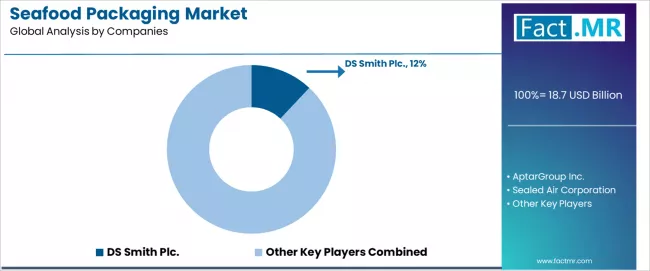
Seafood Packaging Market Analysis By Company | Source: Fact.MR
The seafood packaging market exhibits a moderately consolidated competitive structure with approximately 70-90 active players operating across global packaging converter networks and regional material supplier portfolios. DS Smith Plc. maintains market leadership at a 12.0% share, reflecting strong packaging portfolio positioning across diverse seafood segments with sophisticated sustainability strategies.
This competitive landscape demonstrates the maturation of seafood packaging technology, where established players leverage brand recognition advantages, extensive processor relationship programs, and technical expertise to maintain dominant positions, while emerging sustainable material developers and regional converters create niche opportunities through innovative material offerings and competitive pricing strategies.
Market leadership is maintained through several critical competitive advantages extending beyond manufacturing capabilities and material portfolios. Global converter networks enable leading players to navigate diverse food safety requirements and access varied seafood segments including fresh fish, frozen products, and processed seafood.
Technical expertise and processor training program availability represent crucial differentiators in seafood packaging categories, where decades of barrier technology experience, MAP system knowledge, and regulatory compliance frameworks create purchasing preference among quality-focused processors.
Manufacturing efficiency in film extrusion facilities, thermoforming operations, and supply chain material sourcing separate major converters from smaller competitors, while comprehensive performance documentation addressing migration testing, shelf-life validation, and sustainability credentials strengthen market position and processor confidence.
The market demonstrates emerging differentiation opportunities in biodegradable material categories and smart packaging technologies, where traditional plastic packaging methodologies face competition from innovation-focused entrants offering sustainability advantages. Significant competitive advantages persist in established plastic film categories through comprehensive performance portfolios and processor relationship depth.
Premium positioning strategies with recyclable material integration and compostable solution capabilities command margin premiums through superior environmental credentials and circular economy alignment. Specialized packaging portfolios combining multiple formats with application-specific designs create comprehensive positioning that justifies higher price points beyond commodity packaging competition.
Integrated solution offerings emphasizing complementary equipment compatibility, unified technical support platforms, and cross-format service programs generate processor loyalty and material preferences beyond transactional packaging purchases.
| Stakeholder | What they actually control | Typical strengths | Typical blind spots |
|---|---|---|---|
| Global packaging corporations | Comprehensive material portfolios; global converter networks; sustainability programs | Brand recognition; processor relationships; technical expertise; innovation resources | Pricing flexibility; regional customization; niche applications; startup agility |
| Specialized seafood packagers | Application expertise; format innovation; processor partnerships | Product differentiation; seafood knowledge; technical support; processor loyalty | Manufacturing scale; geographic coverage; material sourcing; cost competitiveness |
| Regional converters | Local production; cost optimization; market proximity; cultural understanding | Affordability positioning; delivery speed; local expertise; flexibility | Technology development; sustainability credentials; brand recognition; innovation capabilities |
| Material suppliers | Raw material control; polymer expertise; film technology; additive systems | Technical innovation; material science; cost efficiency; supply security | Market access; processor relationships; format expertise; application knowledge |
| Equipment manufacturers | Packaging machinery; automation systems; MAP equipment; sealing technology | Process innovation; productivity optimization; technical support; training programs | Material development; processor relationships; market trends; format innovation |
Source: Fact.MR analysis. Updated Dec 12, 2025
Key Players in the Seafood Packaging Market
- DS Smith Plc.
- AptarGroup Inc.
- Sealed Air Corporation
- Amcor plc
- ProAmpac Holdings LLC
- Frontier Packaging Inc.
- ULMA Packaging S. Coop
- Printpack Inc.
- North Coast Seafoods Corporation
- Trivium Packaging B.V.
Segmentation
Scope of the Report
| Items | Values |
|---|---|
| Quantitative Units (2025) | USD 18.7 billion |
| Material | Plastic, Paper & Paperboard, Metal, Others |
| Packaging Technology | Modified Atmosphere Packaging (MAP), Vacuum Skin Packaging, Others |
| Seafood | Fish, Mollusca, Crustaceans, Others |
| Packaging Format | Trays, Bags & Pouches, Cans, Boxes, Shrink Films, Others |
| Application | Fresh & Frozen, Processed |
| Regions Covered | North America, Europe, Asia Pacific, Latin America, Middle East & Africa |
| Countries Covered | China, India, USA, Germany, Japan, Brazil, Thailand, and 15+ additional countries |
| Key Companies Profiled | DS Smith, AptarGroup, Sealed Air, Amcor, ProAmpac, Frontier Packaging, ULMA Packaging |
| Additional Attributes | Dollar sales by material and seafood categories, regional adoption trends across Asia Pacific, North America, and Europe, competitive landscape with established packaging corporations and specialized seafood packagers, processor preferences for MAP methodologies and food safety compliance, integration with cold chain facilities and retail distribution networks, innovations in sustainable materials and smart packaging platforms, and development of sophisticated barrier systems with enhanced freshness profiles and comprehensive traceability documentation frameworks. |
Source: Fact.MR analysis. Updated Dec 12, 2025
Seafood Packaging Market by Segments
-
Material :
- Plastic
- Paper & Paperboard
- Metal
- Others
-
Packaging Technology :
- Modified Atmosphere Packaging (MAP)
- Vacuum Skin Packaging
- Others
-
Seafood :
- Fish
- Mollusca
- Crustaceans
- Others
-
Packaging Format :
- Trays
- Bags & Pouches
- Cans
- Boxes
- Shrink Films
- Others
-
Application :
- Fresh & Frozen
- Processed
-
Region :
- North America
- USA
- Canada
- Mexico
- Europe
- Germany
- France
- UK
- Italy
- Spain
- Rest of Europe
- Asia Pacific
- China
- India
- Japan
- South Korea
- ASEAN
- Australia & New Zealand
- Rest of Asia Pacific
- Latin America
- Brazil
- Rest of Latin America
- Middle East & Africa
- GCC Countries
- South Africa
- Rest of Middle East & Africa
- North America
Frequently Asked Questions
How big is the seafood packaging market in 2025?
What will be the size of seafood packaging market in 2035?
How much will be the seafood packaging market growth between 2025 and 2035?
What are the key product types in the seafood packaging market?
Which packaging technology segment to contribute significant share in the seafood packaging market in 2025?
Who worked on this report


Preview the report firsthand - request a free sample
Free SampleGet the brochure for pricing and purchase details
Download PDF