- Market Value (2025): USD 82.6 Mn
- Estimated Value (2026): USD 88.0 Mn
- Forecast Value (2036): USD 164.5 Mn
- CAGR (2026-2036): 6.5%
What is the Semiconductor Micro Components Market forecast to be worth by 2036?
USD 87.96 billion in 2026 to USD 164.49 billion by 2036, at a 6.5% CAGR.
- Fact.MR places the semiconductor micro components market at USD 82.6 billion in 2025, providing the base for the current expansion cycle.
- Revenue is expected to move from USD 88.0 billion in 2026 to USD 164.5 billion by 2036 as more processing shifts into vehicles, connected equipment, and distributed computing nodes.
- This translates into a 6.5% CAGR between 2026 and 2036. Growth is being carried by higher silicon content per system rather than unit shipments alone, particularly in edge servers, software-defined vehicles, and accelerator-rich data centers.
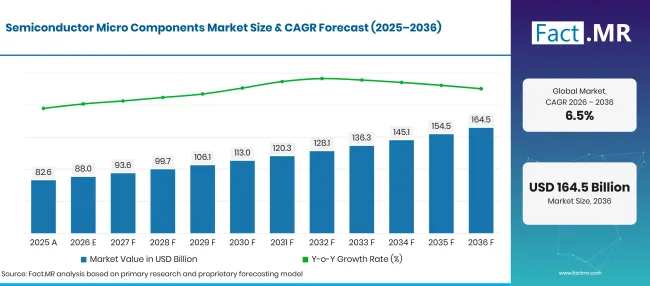
Factmr Semiconductor Micro Components Market Forecast Global | Source: Fact.MR
| Year |
Market Value (USD billion) | |
|---|---|---|
| 2025 | Actual | 82.6 |
| 2026 | Estimate | 88.0 |
| 2036 | Forecast | 164.5 |
| CAGR 2026 to 2036 | Forecast period | 6.5% |
Source: Fact.MR analysis. Updated Oct 19, 2026
What are the defining numbers behind Semiconductor Micro Components Market growth?
The forecast adds USD 76.53 billion in annual market value between 2026 and 2036. Microprocessors and silicon logic remain the manufacturing core, while application-specific controllers and signal-processing devices widen the addressable revenue pool.
- Demand Drivers in the Market
- Hyperscale data infrastructure operators increasingly source high-density microprocessors to accelerate parallel compute workloads and algorithmic modeling across distributed networks. The Semiconductor Industry Association reported that worldwide semiconductor industry sales reached USD 630.5 billion in 2024, expanding 19.1% year over year as digital infrastructure investments surged [1]. Cloud operators favor micro component platforms that deliver elevated floating-point performance per watt to contain datacenter thermal budgets.
- Automotive original equipment manufacturers integrate specialized microcontrollers and digital signal processors to coordinate powertrain electrification and advanced driver assistance suites. Modern vehicle electrical architectures demand silicon platforms with hardware-level functional safety compliance and extended operational durability under extreme thermal cycles. Component suppliers align wafer fabrication schedules with automotive tier-one production calendars to avoid assembly line disruptions.
- Consumer electronics device architects specify ultra-low-power micro components to extend battery longevity in connected portables and personal compute terminals. Designers prioritize multi-core system-on-chip arrangements that unify central processing, graphics rendering, and machine perception on compact die footprints. Packaging specialists deploy wafer-level chip scale techniques to minimize parasitics and conserve printed circuit board surface area.
- Telecommunication hardware vendors incorporate ruggedized micro components into next-generation base stations and optical transport switches to support high-throughput transmission. Network infrastructure demands integrated micro circuits capable of processing packet streams with minimal jitter while enduring harsh outdoor cabinet conditions. Rigorous environmental screening ensures uninterrupted service continuity across metropolitan cell sites.
- Key Segments Analyzed
- Component mix will remain processor-led, but the reason is structural: enterprise servers and industrial control platforms need high-throughput instruction handling, while microcontrollers absorb the much larger unit volumes created by embedded functions. This combination keeps microprocessors ahead in value even as controllers proliferate across vehicles and appliances.
- Consumer electronics is expected to contribute 32.5% of 2026 demand because compact devices require increasingly dense processing, connectivity, and power-management functions. Automotive electronics is the faster-shifting opportunity, as centralized compute and domain control replace multiple stand-alone electronic control units.
- Silicon retains an 81.4% share in 2026 because its fabrication ecosystem, design libraries, and packaging infrastructure are difficult to displace at scale. Gallium arsenide and silicon carbide remain selective rather than universal alternatives, gaining where radio-frequency behavior, voltage tolerance, or thermal performance outweighs cost.
- Integrated device manufacturers lead with a 58.2% share in 2026 because ownership of design, fabrication, and qualification shortens control loops for high-value programs. Fabless suppliers remain influential in fast-cycle digital designs, but depend on foundry capacity and advanced packaging availability.
- Analyst Opinion at Fact.MR
- Shambhu Nath Jha, Lead Consultant at Fact.MR, states, “Semiconductor micro component consumption is experiencing a transformative structural shift as workloads move from centralized server rooms toward edge compute nodes. System architects are transitioning from monolithic dies toward modular multi-chiplet topologies interconnected through high-density packaging fabrics. Foundries that successfully scale advanced packaging solutions and deliver verified power-performance improvements will capture substantial design wins across consumer electronics, telecom networks, and automotive platforms.”
- Strategic Implications
- Semiconductor fabricators are investing heavily in advanced multi-die packaging, utilizing 2.5D and 3D silicon interposers to circumvent conventional physical reticle boundaries. The National Institute of Standards and Technology and U.S. Department of Commerce allocated USD 1.4 billion in CHIPS program awards to scale advanced packaging substrates and pilot facilities [2].
- Foundry operators and research consortia are deploying digital twin modeling across wafer fabrication lines to optimize tool scheduling and defect reduction during complex lithographic sequences. NIST awarded the Semiconductor Research Corporation USD 285 million to establish national digital twin research institutes aimed at compressing physical prototype development cycles [3].
- Tier-one device manufacturers are expanding long-term foundry capacity reservations to secure critical wafer allocations before next-generation platform launches. Proactive multi-year capacity planning safeguards component availability against unexpected regional supply shocks and packaging material bottlenecks.
- Semiconductor engineering centers are constructing collaborative test environments to validate emerging chiplet interconnect standards across multi-vendor silicon modules. NIST confirmed the selection of the Arizona State University Research Park as the site for the third CHIPS for America R&D flagship facility to accelerate prototyping transitions [4].
Japan is projected to advance at an 8.4% CAGR, while the United Kingdom rises at 8.0%, fueled by specialized micro component design and regional automotive electronics assembly. Brazil registers 6.6% growth, backed by local consumer hardware integration and regional telecom modernization. The United States records a 5.9% CAGR, sustained by enterprise cloud infrastructure expansions and domestic wafer fabrication investments. Germany grows at 4.9%, supported by industrial automation controls and precision automotive electronics manufacturing.
What is accelerating Semiconductor Micro Components Market adoption, and what is holding it back?
Proliferation of AI-enabled edge hardware, vehicular electrification, and continuous enterprise cloud migration drives strong component demand. Elevated wafer fabrication capital expenditures, lithography tooling constraints, and geopolitical trade restrictions impede frictionless market scaling.
Drivers Impact Analysis
| DRIVER | (~) % IMPACT ON CAGR | GEOGRAPHIC RELEVANCE | IMPACT TIMELINE |
|---|---|---|---|
| Cloud datacenter parallel compute scaling | +1.2% | North America, East Asia | Short term (<= 2 years) |
| Automotive zonal controller electrification | +1.0% | Europe, East Asia, USA | Medium term (2–4 years) |
| Edge AI integration in mobile portables | +0.9% | Global | Medium term (2–4 years) |
| Multi-chiplet heterogeneous packaging adoption | +0.7% | USA, East Asia | Medium term (2–4 years) |
| 5G advanced network station upgrades | +0.5% | Global | Long term (>= 4 years) |
Source: Fact.MR analysis. Updated Oct 19, 2026
Opportunity Impact Analysis
| OPPORTUNITY | (~) % IMPACT ON CAGR | GEOGRAPHIC RELEVANCE | IMPACT TIMELINE |
|---|---|---|---|
| Dedicated neural processing accelerator dies | +1.1% | Global | Short term (<= 2 years) |
| Silicon photonics co-packaged optics integration | +0.8% | USA, Europe | Medium term (2–4 years) |
| Wide-bandgap hybrid power-logic modules | +0.6% | Europe, Japan | Medium term (2–4 years) |
| Open standard RISC-V embedded architectures | +0.5% | Asia Pacific, Global | Long term (>= 4 years) |
Source: Fact.MR analysis. Updated Oct 19, 2026
Restraints Impact Analysis
| RESTRAINT | (~) % IMPACT ON CAGR | GEOGRAPHIC RELEVANCE | IMPACT TIMELINE |
|---|---|---|---|
| Extreme sub-nanometer fab tooling costs | -0.9% | Global | Short term (<= 2 years) |
| Advanced packaging substrate supply tightness | -0.7% | East Asia, North America | Medium term (2–4 years) |
| Global semiconductor supply export regulations | -0.6% | USA, Europe, Asia | Medium term (2–4 years) |
| Thermal management limits in compact chassis | -0.4% | Global | Long term (>= 4 years) |
Source: Fact.MR analysis. Updated Oct 19, 2026
Which countries are scaling the Semiconductor Micro Components Market through 2036?
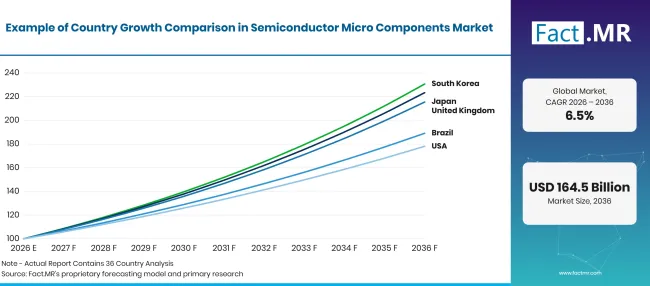
Factmr Semiconductor Micro Components Market Growth Index | Source: Fact.MR
| Country | CAGR (2026–2036) |
|---|---|
| Japan | 8.4% |
| United Kingdom | 8.0% |
| Brazil | 6.6% |
| United States | 5.9% |
| Germany | 4.9% |
Source: Fact.MR analysis. Updated Oct 19, 2026
Why is Japan accelerating semiconductor micro component deployment?
8.4% CAGR, driven by industrial automation upgrades, automotive electronic control centralization, and domestic semiconductor manufacturing initiatives.
Japanese precision machinery manufacturers and automotive tier-one suppliers are actively integrating advanced microcontrollers and image signal processors into industrial robotics and next-generation vehicle platforms. The government and private consortia are investing heavily in advanced semiconductor foundries and research labs to secure domestic component supply chains for automotive and automation applications. Component distributors report rising orders for power-efficient micro components tailored for factory automation lines and smart robotics.
How is the United Kingdom expanding semiconductor micro component adoption?
8.0% CAGR, supported by semiconductor intellectual property design clusters, telecommunications infrastructure investments, and aerospace electronics development.
British fabless design houses and technical research centers lead innovation in processor architecture, low-power core configurations, and embedded security hardware. Systems integrators across the UK aerospace, defense, and telecommunications sectors require high-reliability micro components certified for continuous operation under severe environmental stress. Expanding investments in national wireless communications networks and satellite ground equipment drive procurement of specialized digital signal processing units.
What factors support growth in Brazil?
6.6% CAGR, propelled by consumer electronics assembly in free trade zones and expanding telecommunication infrastructure.
Brazilian electronics contract manufacturers located in Manaus and southeastern industrial belts consume large quantities of microprocessors and microcontrollers for consumer white goods, televisions, and smartphones. Mobile network operators are expanding cellular infrastructure to widen high-speed data coverage, generating steady demand for baseband micro components. Local automotive assembly plants are also incorporating more electronic control units into passenger vehicles to satisfy regional safety mandates.
What is sustaining steady sales in the United States?
5.9% CAGR, underpinned by hyperscale cloud investments, aerospace electronics procurement, and domestic wafer fabrication expansion.
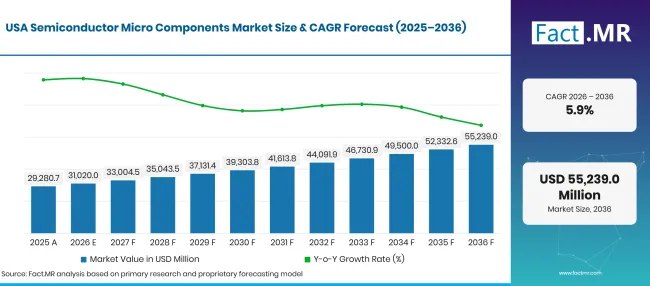
Factmr Semiconductor Micro Components Market Forecast Usa | Source: Fact.MR
United States cloud service providers and enterprise server operators represent the world's most lucrative customer segment for advanced server microprocessors and accelerator dies. Intel Corporation reported full-year 2024 revenue of USD 53.1 billion while investing substantially in next-generation wafer fabrication and packaging lines to support high-density logic architectures [5]. Defense contractors and aerospace manufacturers continuously procure radiation-tolerant and high-reliability micro components for mission-critical avionic systems.
Why is Germany maintaining industrial demand for micro components?
4.9% CAGR, steered by automotive electronic architecture upgrades and Industry 4.0 factory automation programs.
German automotive original equipment manufacturers and industrial machinery builders require certified micro components that comply with stringent functional safety and electromagnetic compatibility standards. Industrial plants across Bavaria and Baden-Württemberg integrate embedded microcontrollers into automated drive units, sensor gateways, and factory monitoring nodes. Engineering teams emphasize predictable multi-year component lifecycles and transparent supply chain documentation to ensure uninterrupted industrial equipment manufacturing.
Who leads the Semiconductor Micro Components Market?
Intel Corporation and Samsung Electronics maintain dominant positions across commercial computing and memory-integrated micro component production, leveraging advanced lithography lines and multi-billion-dollar R&D programs. Taiwan Semiconductor Manufacturing Company (TSMC) serves as the primary foundry partner for global fabless logic innovators, fabricating leading-edge processor dies using state-of-the-art extreme ultraviolet lithography. Qualcomm Incorporated and Broadcom Inc. lead the supply of high-performance mobile system-on-chips, wireless communication processors, and routing silicon.
Texas Instruments Incorporated provides an extensive portfolio of analog-integrated microcontrollers and digital signal processors serving industrial and automotive applications. NVIDIA Corporation and Advanced Micro Devices (AMD) dominate parallel processing architectures, high-performance graphics engines, and specialized datacenter microprocessors. Micron Technology and SK Hynix deliver tightly integrated high-bandwidth memory architectures that interface directly with advanced micro component logic stacks. Comprehensive Fact.MR reviews of the semiconductor packaging market, the embedded processor market, and the industrial semiconductor market detail how strategic packaging alliances dictate market positioning.
Which companies are the key providers?
Key companies include Intel Corporation; Samsung Electronics; TSMC; Qualcomm; Broadcom; Texas Instruments; NVIDIA; AMD; Micron Technology; and SK Hynix.
- Intel Corporation
- Samsung Electronics
- TSMC
- Qualcomm
- Broadcom
- Texas Instruments
- NVIDIA
- AMD
- Micron Technology
- SK Hynix
Bibliography
- [1] Semiconductor Industry Association. (2025, February 7). Global semiconductor sales increase 19.1% in 2024; double-digit growth projected in 2025.
- [2] National Institute of Standards and Technology. (2025, January 16). U.S. Department of Commerce announces $1.4 billion in final awards to support next generation of U.S. semiconductor advanced packaging.
- [3] National Institute of Standards and Technology. (2025, January 14). Biden-Harris administration awards Semiconductor Research Corporation Manufacturing Consortium Corporation $285M for new CHIPS Manufacturing USA institute for digital twins.
- [4] National Institute of Standards and Technology. (2025, January 10). Biden-Harris administration announces Arizona State University Research Park as planned site for third CHIPS for America R&D flagship facility.
- [5] Intel Corporation. (2025, January 30). Intel reports fourth-quarter and full-year 2024 financial results.
This Report Answers
- The report evaluates technology adoption across microprocessors, microcontrollers, and digital signal processors.
- Application assessments detail why consumer electronics and automotive electronics absorb the largest share of micro component production.
- Country-level analysis investigates the factors enabling Japan and the United Kingdom to achieve faster growth rates.
- Material comparisons examine why silicon maintains long-term structural dominance over compound semiconductors in logic fabrication.
- Competitive profiling benchmarks manufacturing capacity, chiplet packaging roadmaps, and foundry partnerships across top semiconductor vendors.
What does the Semiconductor Micro Components Market cover?
The market encompasses monolithic and chiplet-based integrated circuits designed to execute program logic, process real-time signals, and control peripheral electronic functions. It tracks logic devices installed in personal computers, cloud servers, automotive electronic control units, mobile phones, and industrial machinery. The analysis incorporates related Fact.MR semiconductor research on computing hardware and microelectronic devices.
What is included in the scope?
The scope covers merchant and captive shipments of microprocessors, microcontrollers, and digital signal processors sold as packaged components or multi-chip modules. Revenues reflect finished semiconductor component sales recognized by device manufacturers and foundries. Advanced packaging structures including 2.5D interposers and fan-out wafer-level packages are evaluated within component revenue boundaries.
What is excluded from the scope?
The scope excludes discrete semiconductor components such as individual diodes, transistors, and passive resistors or capacitors. Commodity memory modules (DRAM and NAND flash) sold as standalone storage units are excluded from micro component totals. Silicon wafer manufacturing equipment, electronic design automation software licensing fees, and raw unprocessed silicon ingots are outside the report boundary.
How Was the Analysis Built?
The analysis draws on 120+ sources, 35+ company portfolios, 25+ countries, and more than 20 industry interviews.
- Primary Research: Primary research includes discussions with manufacturers, service providers, technology developers, distributors, end users, and subject-matter experts. These conversations examine purchasing priorities, product adoption, operational challenges, approval requirements, competitive positioning, and the factors that influence wider market acceptance.
- Desk Research: Desk research covers government statistics, regulatory publications, company filings, trade data, technical studies, industry associations, standards, public policy, and other authoritative sources. Every source used in the analysis is documented in the bibliography.
- Market Sizing and Forecasting: Market estimates combine historical performance, demand indicators, pricing and volume trends, segment shares, company participation, country-level growth, adoption patterns, investment activity, and barriers to market expansion.
- Data Validation and Update Cycle: Findings are validated by comparing primary interviews with public data, company activity, regulatory changes, trade patterns, and industry developments. Regular updates review new product launches, capacity changes, partnerships, approvals, and shifts in commercial adoption.
Segmentation
What is the report’s scope and coverage?
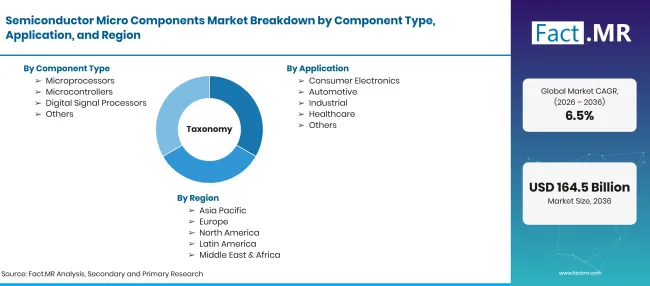
Factmr Semiconductor Micro Components Market Taxonomy | Source: Fact.MR
| Attribute | Details |
|---|---|
| Quantitative Units | USD billion in 2026 to USD billion by 2036 at 6.5% CAGR |
| Market Definition | Integrated semiconductor logic circuits including microprocessors, microcontrollers, and digital signal processors engineered for computation and control. |
| Component Type | Microprocessors; Microcontrollers; Digital Signal Processors; Others |
| Application | Consumer Electronics; Automotive; Industrial; Healthcare; Others |
| Material | Silicon; Gallium Arsenide; Silicon Carbide; Others |
| End-User | IT and Telecommunications; BFSI; Healthcare; Automotive; Others |
| Regions Covered | North America; Latin America; Western Europe; Eastern Europe; East Asia; South Asia & Pacific; Middle East & Africa |
| Countries Covered | Japan; United Kingdom; Brazil; United States; Germany |
| Companies Profiled | Intel Corporation; Samsung Electronics; TSMC; Qualcomm; Broadcom; Texas Instruments; NVIDIA; AMD; Micron Technology; SK Hynix |
| Forecast Period | 2026 to 2036 |
| Approach | Analysis of wafer foundry shipment data, packaging capacity indices, trade statistics, and primary discussions with fabless designers and OEMs |
Source: Fact.MR analysis. Updated Oct 19, 2026
How is the market segmented?
-
By Component Type
- Microprocessors
- Microcontrollers
- Digital Signal Processors
- Others
-
By Application
- Consumer Electronics
- Automotive
- Industrial
- Healthcare
- Others
-
By Material
- Silicon
- Gallium Arsenide
- Silicon Carbide
- Others
-
By End-User
- IT and Telecommunications
- BFSI
- Healthcare
- Automotive
- Others
-
By Region
- North America
- Latin America
- Western Europe
- Eastern Europe
- East Asia
- South Asia & Pacific
- Middle East & Africa
Frequently Asked Questions
How big is the semiconductor micro components market in 2026?
What is the CAGR from 2026 to 2036?
Which component type leads?
Which material leads?
Which companies participate in semiconductor micro components?
Who worked on this report


Preview the report firsthand - request a free sample
Free SampleGet the brochure for pricing and purchase details
Download PDF