- Base Value(2026): 2.0 Bn
- Forecast Value (2036): 3.4 Bn
- CAGR (2036): 5.4%
Senior-Specific Texture-Modified Food Market Forecast By Fact.MR
The senior-specific texture-modified food market reached USD 1.9 billion in 2025. Fact MR estimates the market will expand to USD 2.0 billion in 2026 and attain USD 3.4 billion by 2036. The market is forecast to register a CAGR of 5.4% across the assessment period.
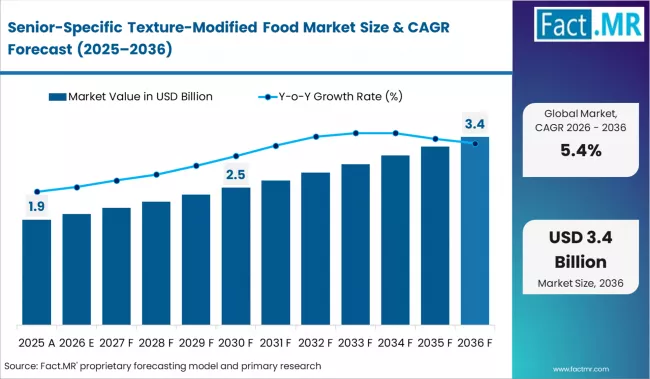
Senior Specific Texture Modified Food Market Market Value Analysis | Source: Fact.MR
Summary of the Senior-Specific Texture-Modified Food Market
- Market Definition
- The market includes food and beverage products processed to achieve modified textures such as pureed, minced, soft solid, or thickened consistency to support safe chewing and swallowing among elderly individuals. These formulations are commonly applied in clinical nutrition programs, assisted living facilities, rehabilitation centers, and home care environments where reduced oral function, dysphagia risk, or chewing limitations require controlled food structure. Texture modification processes ensure consistency stability, particle size control, and viscosity management aligned with therapeutic diet standards.
- Demand Drivers
- Increasing aging population requiring clinically appropriate food formats supporting safe swallowing conditions
- Expansion of institutional meal programs across hospitals and long-term care facilities requiring standardized texture classification systems
- Rising incorporation of high protein formulations supporting muscle maintenance and metabolic requirements among elderly populations
- Growing adoption of standardized dysphagia diet frameworks supporting consistent texture specification across clinical nutrition environments
- Key Segments Analyzed
- Nutrition Type: High protein formulations account for approximately 31% share supported by dietary protocols addressing muscle preservation needs
- Distribution Channel: Hospitals represent nearly 34% share due to structured therapeutic diet planning frameworks
- Product Type: Pureed foods, minced foods, and thickened beverages demonstrate stable demand across clinical nutrition programs
- Geography: Europe demonstrates consistent adoption supported by established elderly care dietary standards
- Analyst Opinion at Fact MR
- Shambhu Nath Jha, Principal Consultant, Fact MR, opines, "In this updated edition of the Senior-Specific Texture-Modified Food Market report, industry participants will observe stable demand linked to demographic aging and structured clinical nutrition programs. Texture-modified foods support safe swallowing conditions while maintaining nutrient density aligned with geriatric dietary requirements. Companies that strengthen formulation stability and compliance with standardized texture classification frameworks are expected to maintain competitive positioning through 2036."
- Strategic Implications Executive Takeaways
- Strengthen formulation capabilities supporting consistent viscosity and particle size control aligned with dysphagia dietary classifications
- Improve protein fortification methods enabling nutrient density optimization across modified texture meal formats
- Expand collaboration with healthcare institutions supporting standardized procurement of clinically compliant texture-modified foods
- Monitor clinical nutrition guidelines influencing texture classification requirements and labeling frameworks
- Methodology
- Primary interviews conducted with clinical nutrition specialists, healthcare foodservice providers, dietitians, and medical nutrition manufacturers
- Desk research based on clinical nutrition publications, geriatric dietary standards, healthcare regulatory frameworks, and product formulation studies
- Market sizing derived using a hybrid approach combining top down geriatric nutrition demand evaluation with bottom up product adoption assessment
- Data validation performed through cross verification with healthcare nutrition datasets and internal peer review aligned with Fact MR standards
Senior-Specific Texture-Modified Food Market
| Metric | Details |
|---|---|
| Industry Size (2026E) | USD 2.0 billion |
| Industry Value (2036F) | USD 3.4 billion |
| CAGR (2026 to 2036) | 5.4% |
Source: Fact.MR analysis. Updated Mar 27, 2026
A CAGR of 5.4% indicates stable, incremental expansion, reflecting predictable demand linked to demographic aging and institutional meal provision across healthcare and assisted living settings. Growth stability is supported by clinical nutrition guidelines and standardized texture classification frameworks, while moderate variability may arise from reimbursement policy adjustments, budget constraints in care facilities, and formulation costs associated with protein fortification and texture consistency control.
The United Kingdom leads with a projected CAGR of 6.2%, supported by increasing demand for dysphagia-friendly food formulations across elderly care facilities. Germany follows with a CAGR of 5.9%, driven by stable use of modified texture nutrition products within clinical nutrition programs. The United States records a CAGR of 5.5%, reflecting steady demand for easy-to-consume meal formats across assisted living environments. France shows a CAGR of 5.3%, supported by gradual adoption of standardized texture-modified diets across geriatric healthcare settings. Japan records the slowest growth at 5.1%, reflecting a mature market where demand is largely tied to replacement consumption cycles within established elderly nutrition product categories. Mature markets generate a significant share of replacement demand as formulation refinement remains focused on consistency control, nutrient density, and swallowing safety across clinical nutrition applications.
Segmental Analysis
Senior-Specific Texture-Modified Food Market Analysis by Distribution Channel
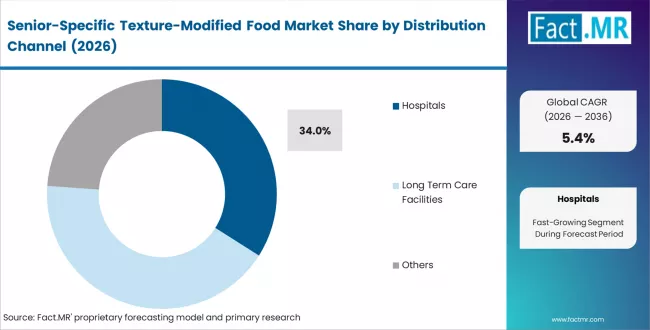
Senior Specific Texture Modified Food Market Analysis By Distribution Channel | Source: Fact.MR
- Market Overview: Based on Fact MR assessment, hospitals are projected to account for 34% share of the senior-specific texture-modified food market in 2026. Clinical nutrition protocols incorporate texture-modified meals across inpatient dietary programs supporting individuals experiencing dysphagia and chewing limitations. Healthcare foodservice departments utilize standardized meal texture classifications including pureed, minced, and soft diets aligned with swallowing safety frameworks defined within medical nutrition therapy practices. Procurement of texture-adjusted meals is structured through hospital catering systems requiring controlled viscosity, particle size consistency, and nutrient stability across therapeutic diet planning environments.
- Demand Drivers:
- Clinical Nutrition Protocol Requirements: Hospitals implement structured meal texture classification systems supporting safe swallowing conditions across geriatric patient populations requiring modified consistency diets.
- Patient Safety Compliance: Controlled food texture parameters support reduction of aspiration risk across clinical feeding environments requiring medically supervised nutrition delivery.
- Institutional Procurement Structure: Hospital foodservice operations require standardized nutrition formulations compatible with large scale batch preparation and regulated dietary planning frameworks.
Senior-Specific Texture-Modified Food Market Analysis by Nutrition Type
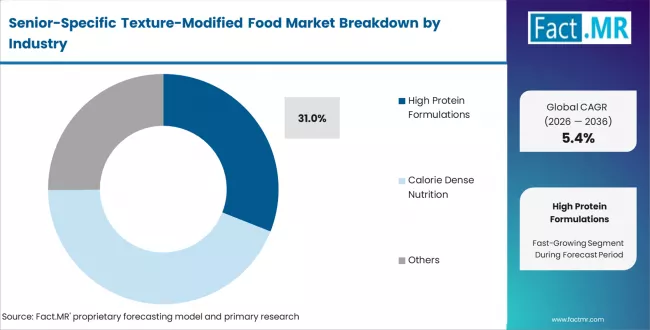
Senior Specific Texture Modified Food Market Analysis By Nutrition Type | Source: Fact.MR
- Market Overview: High protein formulations are estimated to hold 31% share of the senior-specific texture-modified food market in 2026, supported by dietary management protocols addressing muscle maintenance and recovery requirements across aging populations. Protein enriched purees, fortified soups, and soft texture meals are formulated to deliver essential amino acids while maintaining safe swallowing characteristics. Nutritional composition is structured to support muscle mass retention and metabolic function across clinical and home based elderly nutrition programs requiring controlled macronutrient intake profiles.
- Demand Drivers:
- Protein Intake Requirements: High protein formulations support dietary intake associated with muscle preservation needs observed across geriatric nutrition planning frameworks.
- Digestibility Characteristics: Modified texture protein meals enable nutrient absorption across individuals experiencing chewing and swallowing limitations affecting conventional solid food consumption.
- Medical Nutrition Specification: Healthcare nutrition providers incorporate protein fortified texture-modified foods aligned with dietary recommendations addressing age related metabolic requirements.
Key Dynamics
Senior-Specific Texture-Modified Food Market Drivers, Restraints, and Opportunities
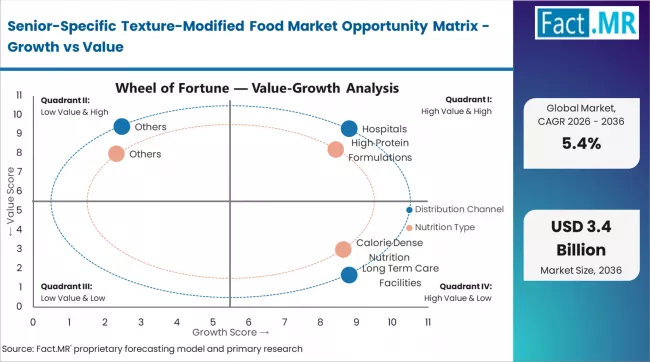
Senior Specific Texture Modified Food Market Opportunity Matrix Growth Vs Value | Source: Fact.MR
FMR analysts observe that the senior-specific texture-modified food market developed from clinical nutrition practices addressing swallowing difficulties associated with Dysphagia and age-related oral health conditions. Early institutional adoption occurred in hospitals and long-term care facilities where pureed and soft foods were prepared manually to support safe consumption. The current market valuation reflects increased availability of standardized texture-modified meals designed to maintain nutritional intake while reducing choking risk. Demand persists because aging populations require adapted food formats that support safe swallowing without compromising caloric and micronutrient intake.
A structural shift is occurring as traditional pureed meals prepared in institutional kitchens transition toward commercially produced texture-modified packaged foods. Conventional meal preparation methods remain widely used in smaller care facilities where in-house preparation remains cost efficient. Manufacturers increasingly produce molded purees, soft solid foods, and thickened nutritional products designed to meet standardized texture classifications. These products require specialized processing techniques and controlled moisture structures that increase production costs relative to conventional ready meals. Even with moderate volume growth, higher pricing associated with clinically suitable texture-modified foods supports gradual market value expansion.
- Clinical Nutrition Adaptation: Food producers develop soft, minced, and pureed food formats that align with swallowing safety requirements in elderly populations.
- Dietary Standardization Framework: Standards such as International Dysphagia Diet Standardisation Initiative (IDDSI) influence classification of texture levels and product labeling.
- Europe Geriatric Nutrition Demand: Germany, Italy, and the United Kingdom maintain established long-term care systems that support adoption of texture-modified packaged foods.
Regional Analysis
The senior-specific texture-modified food market is assessed across North America, Europe, Asia Pacific, Latin America, and Middle East & Africa, segmented by country-level demand for dysphagia-friendly foods, clinical nutrition products, and elderly care dietary solutions. Regional demand reflects aging population trends, healthcare nutrition standards, and institutional meal provision systems. The full report offers market attractiveness analysis.
.webp "Top Country Growth Comparison Senior Specific Texture Modified Food Market Cagr (2026 2036)")
Top Country Growth Comparison Senior Specific Texture Modified Food Market Cagr (2026 2036) | Source: Fact.MR
| Country | CAGR (2026-2036) |
|---|---|
| United Kingdom | 6.2% |
| Germany | 5.9% |
| United States | 5.5% |
| France | 5.3% |
| Japan | 5.1% |
Source: Fact.MR analysis. Updated Mar 27, 2026
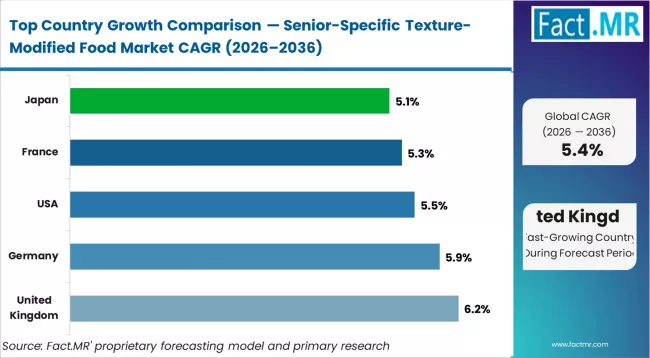
Senior Specific Texture Modified Food Market Cagr Analysis By Country | Source: Fact.MR
Source: Fact MR analysis, based on proprietary forecasting model and primary research
Europe
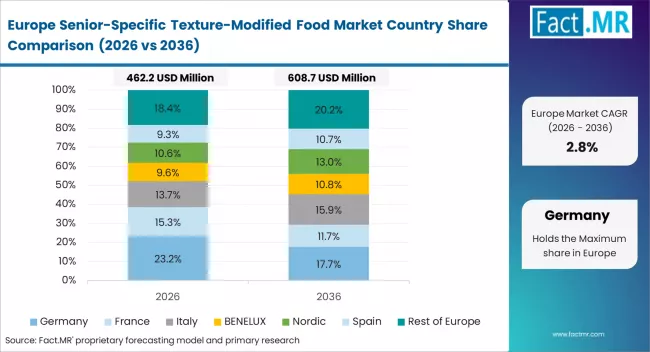
Senior Specific Texture Modified Food Market Europe Country Market Share Analysis, 2026 & 2036 | Source: Fact.MR
Europe functions as the clinical nutrition regulatory laboratory for texture-modified dietary standards, supported by structured elderly care nutrition frameworks and medical nutrition product adoption. Danone S.A. strengthens medical nutrition product portfolio. Nestlé Health Science expands dysphagia nutrition formulations. Fresenius Kabi AG supports clinical nutrition product development.
- United Kingdom: Demand for senior-specific texture-modified food in United Kingdom is projected to rise at 6.2% CAGR through 2036. The NHS Nutrition and Hydration Guidelines update (NHS England, October 2021) supports dysphagia dietary standards. Nestlé Health Science expanded texture-modified nutritional products (March 2023), supporting institutional adoption.
- Germany: Demand for senior-specific texture-modified food in Germany is projected to rise at 5.9% CAGR through 2036. The German Nutrition Society clinical nutrition recommendations (updated 2022) support texture-modified dietary solutions. Fresenius Kabi AG expanded medical nutrition product offerings (February 2023), supporting demand.
- France: Demand for senior-specific texture-modified food in France is projected to rise at 5.3% CAGR through 2036. The National Health Nutrition Programme update (French Ministry of Health, January 2022) supports elderly nutrition standards. Danone S.A. expanded clinical nutrition product lines (January 2023), supporting market growth.
North America
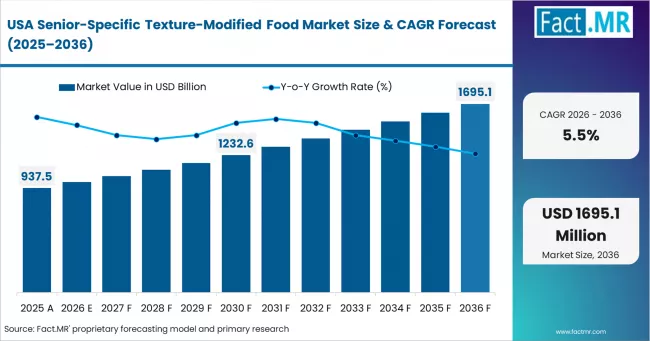
Senior Specific Texture Modified Food Market Country Value Analysis | Source: Fact.MR
North America functions as the clinical dietary formulation and healthcare nutrition integration hub, supported by structured medical nutrition guidelines and institutional meal programs. Abbott Laboratories strengthens medical nutrition product offerings. Hormel Foods Corporation expands texture-modified meal solutions. Campbell Soup Company supports easy-to-consume meal product formats.
- United States: Demand for senior-specific texture-modified food in United States is projected to rise at 5.5% CAGR through 2036. The Older Americans Act Nutrition Programs update (Administration for Community Living, revised 2022) supports elderly nutrition services. Abbott Laboratories expanded dysphagia-focused nutrition product offerings (April 2023), supporting adoption.
Asia Pacific
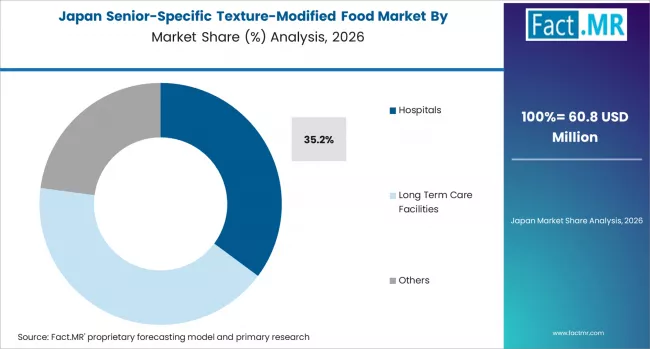
Senior Specific Texture Modified Food Market Japan Market Share Analysis By Distribution Channel | Source: Fact.MR
Asia Pacific serves as the aging population nutrition and healthcare dietary support market, supported by demographic aging trends and structured elderly care services. Meiji Holdings Co., Ltd. strengthens medical nutrition product offerings. Morinaga Milk Industry Co., Ltd. expands elderly nutrition formulations. Otsuka Holdings Co., Ltd. supports clinical dietary product development.
- Japan: Demand for senior-specific texture-modified food in Japan is projected to rise at 5.1% CAGR through 2036. The Japanese Long-Term Care Insurance nutrition standards update (Ministry of Health, Labour and Welfare, March 2022) supports elderly dietary solutions. Meiji Holdings Co., Ltd. expanded texture-modified nutrition products (May 2023), supporting market demand.
Fact MR's analysis of senior-specific texture-modified food market in global regions consists of country-wise assessment that includes United Kingdom, Germany, United States, France, and Japan. Readers can find clinical nutrition trends, elderly care dietary developments, regulatory frameworks, and competitive positioning across key markets.
Competitive Landscape
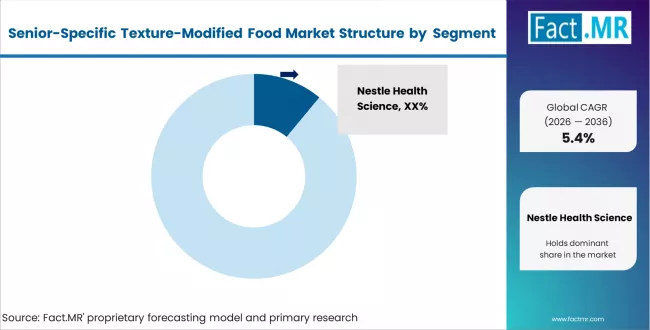
Senior Specific Texture Modified Food Market Analysis By Company | Source: Fact.MR
Competitive Structure and Buyer Dynamics in the Senior-Specific Texture-Modified Food Market
The competitive structure of the Senior-Specific Texture-Modified Food Market is moderately concentrated, with clinical nutrition companies and specialized medical food manufacturers controlling a significant share of supply. Companies such as Nestle Health Science, Danone Nutricia, Abbott Nutrition, and Fresenius Kabi maintain strong positions through established medical nutrition portfolios and global healthcare distribution networks. These firms provide texture modified foods and thickened beverages designed to support individuals with swallowing difficulties and clinical dietary requirements. Additional participants including Hormel Health Labs, Kent Precision Foods Group, Medtrition Inc., SimplyThick LLC, Flavor Creations Pty Ltd, and ThickenUp Clear contribute through specialized thickening agents and modified consistency food solutions. Competition is primarily influenced by product safety, nutritional balance, formulation stability, and compliance with clinical dietary standards.
Several companies maintain structural advantages through clinical research capabilities and established relationships with healthcare providers and long term care institutions. Firms such as Nestle Health Science, Danone Nutricia, Abbott Nutrition, and Fresenius Kabi benefit from strong expertise in medical nutrition and regulatory compliance. Hormel Health Labs and Kent Precision Foods Group maintain advantages through specialized product development focused on dysphagia management. Healthcare institutions and care providers often evaluate multiple suppliers to ensure consistent product availability and compatibility with dietary protocols. Procurement decisions assess nutritional consistency, safety standards, and ease of preparation. This purchasing behavior moderates supplier pricing leverage, while companies with clinically validated formulations and established healthcare distribution networks retain moderate negotiating influence.
Key Players of the Senior-Specific Texture-Modified Food Market
- Nestle Health Science
- Danone Nutricia
- Hormel Health Labs
- Fresenius Kabi
- Abbott Nutrition
- Kent Precision Foods Group
- SimplyThick LLC
- Medtrition Inc.
- Flavor Creations Pty Ltd
- ThickenUp Clear
Bibliographies
- [1] Cichero, J. A. Y., Lam, P., Steele, C. M., Hanson, B., Chen, J., Dantas, R. O., et al. (2017). Development of international terminology and definitions for texture-modified foods and thickened fluids used in dysphagia management: The IDDSI framework. Dysphagia, 32(2), 293-314.
- [2] Keller, H. H., Chambers, L., Niezgoda, H., and Duizer, L. (2012). Issues associated with the use of modified texture foods. Journal of Nutrition, Health and Aging, 16(3), 195-200.
- [3] Wright, L., Cotter, D., and Hickson, M. (2005). The effectiveness of food and/or fluid modifications on dysphagia management. Journal of Human Nutrition and Dietetics, 18(6), 427-443.
- [4] Steele, C. M., Greenwood, C., Ens, I., Robertson, C., and Seidman-Carlson, R. (1997). Mealtime difficulties in a home for the aged: Not just dysphagia. Dysphagia, 12(1), 43-50.
- [5] Volkert, D., Beck, A. M., Cederholm, T., Cereda, E., Cruz-Jentoft, A., Goisser, S., et al. (2019). ESPEN guideline on clinical nutrition and hydration in geriatrics. Clinical Nutrition, 38(1), 10-47.
This Report Addresses
- Market size estimation and revenue forecasts for the Senior-Specific Texture-Modified Food Market from 2026 to 2036, supported by geriatric clinical nutrition demand trends and institutional meal provision benchmarks across healthcare systems.
- Growth opportunity mapping across pureed foods, minced and moist foods, soft solid foods, thickened beverages, texture-modified meat products, and texture-modified bakery products aligned with dysphagia-friendly dietary requirements.
- Segment and regional revenue forecasts covering nutrition types, distribution channels, and major healthcare markets including United Kingdom, Germany, United States, France, and Japan.
- Competition strategy assessment of leading companies such as Nestlé Health Science, Danone Nutricia, Abbott Nutrition, Fresenius Kabi, and Hormel Health Labs, including clinical formulation capability benchmarking and healthcare distribution positioning analysis.
- Regulatory impact analysis covering International Dysphagia Diet Standardisation Initiative (IDDSI) framework, clinical nutrition guidelines, and national healthcare dietary compliance standards influencing product formulation and classification.
- Market report delivery in PDF, Excel, PPT, and interactive dashboard formats designed for clinical nutrition planning, institutional procurement assessment, and therapeutic diet portfolio evaluation.
- Supply chain vulnerability assessments examining protein fortification cost variability, texture stability requirements, reimbursement policy sensitivity, and institutional budget constraints influencing adoption of standardized texture-modified nutrition solutions.
Senior-Specific Texture-Modified Food Market Definition
Senior-Specific Texture-Modified Food Market Definition Paragraph
The Senior-Specific Texture-Modified Food Market includes food products processed to achieve softer, pureed, minced, or thickened textures to support safe chewing and swallowing among older adults with reduced oral or swallowing function across healthcare, home care, and assisted living settings.
Senior-Specific Texture-Modified Food Market Inclusions
The report includes global and regional market size estimates, forecast analysis, and segmentation by texture type, product category, nutritional formulation, application setting, end user, pricing structure, and distribution channels.
Senior-Specific Texture-Modified Food Market Exclusions
The scope excludes standard unmodified foods, general functional foods not designed for swallowing support, medical nutrition formulas without texture modification, and feeding equipment such as thickening tools or assistive dining devices.
Senior-Specific Texture-Modified Food Market Research Methodology
- Primary Research: Interviews were conducted with clinical nutrition specialists, food manufacturers, caregivers, healthcare providers, and senior care facility operators.
- Desk Research: Public data sources included clinical nutrition publications, regulatory guidelines, company product documentation, and healthcare dietary standards.
- Market-Sizing and Forecasting: A hybrid approach combining top-down evaluation of geriatric nutrition demand and bottom-up analysis of texture-modified product adoption was applied.
- Data Validation and Update Cycle: Findings were verified through expert consultation, cross dataset comparison, and periodic review of healthcare nutrition guidelines and product availability.
Segmentation
Report Scope
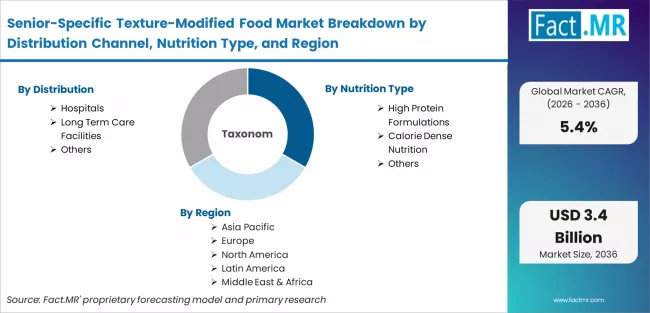
Senior Specific Texture Modified Food Market Breakdown By Distribution Channel, Nutrition Type, And Region | Source: Fact.MR
| Metric | Value |
|---|---|
| Quantitative Units | USD 2.0 billion (2026) to USD 3.4 billion (2036), at a CAGR of 5.4% |
| Market Definition | The senior-specific texture-modified food market includes nutritionally formulated food and beverage products designed with altered textures to support safe swallowing and ease of consumption among elderly populations experiencing dysphagia or reduced chewing ability. |
| Product Type Segmentation | Pureed foods, Minced and moist foods, Soft solid foods, Thickened beverages, Texture-modified meat products, Texture-modified bakery products |
| Nutrition Type Segmentation | High protein formulations, Calorie dense nutrition, Fiber enriched formulations, Low sodium therapeutic diets, Fortified vitamin and mineral blends |
| Distribution Channel Segmentation | Hospitals, Long term care facilities, Home care settings, Retail pharmacies, Online medical nutrition platforms |
| Regions Covered | North America, Latin America, Europe, East Asia, South Asia, Oceania, Middle East and Africa |
| Countries Covered | United States, Canada, Mexico, Brazil, Argentina, Germany, France, United Kingdom, Italy, Spain, China, Japan, South Korea, India, Australia, New Zealand, United Arab Emirates, and 40+ countries |
| Key Companies Profiled | Nestle Health Science, Danone Nutricia, Hormel Health Labs, Fresenius Kabi, Abbott Nutrition, Kent Precision Foods Group, SimplyThick LLC, Medtrition Inc., Flavor Creations Pty Ltd, ThickenUp Clear |
| Forecast Period | 2026 to 2036 |
| Approach | Hybrid top-down and bottom-up market estimation based on clinical nutrition demand trends, geriatric population dietary requirements, dysphagia management product usage patterns, healthcare facility procurement data, and validation through primary interviews with medical nutrition manufacturers, dietitians, and healthcare distribution providers. |
Source: Fact.MR analysis. Updated Mar 27, 2026
Senior Specific Texture Modified Food Market Key Segments
-
Product Type :
- Pureed Foods
- Minced and Moist Foods
- Soft Solid Foods
- Thickened Beverages
- Texture Modified Meat Products
- Texture Modified Bakery Products
-
Nutrition Type :
- High Protein Formulations
- Calorie Dense Nutrition
- Fiber Enriched Formulations
- Low Sodium Therapeutic Diets
- Fortified Vitamin and Mineral Blends
-
Distribution Channel :
- Hospitals
- Long Term Care Facilities
- Home Care Settings
- Retail Pharmacies
- Online Medical Nutrition Platforms
-
Region :
- North America
- USA
- Canada
- Mexico
- Europe
- Germany
- UK
- France
- Italy
- Spain
- Nordic Countries
- BENELUX
- Rest of Europe
- Asia Pacific
- China
- Japan
- South Korea
- India
- Australia
- Rest of Asia Pacific
- Latin America
- Brazil
- Argentina
- Rest of Latin America
- Middle East and Africa
- Kingdom of Saudi Arabia
- United Arab Emirates
- South Africa
- Rest of Middle East and Africa
- Other Regions
- Oceania
- Central Asia
- Other Markets
- North America
Frequently Asked Questions
How large is the demand for Senior-Specific Texture-Modified Food in the global market in 2026?
What will be the market size of Senior-Specific Texture-Modified Food in the global market by 2036?
What is the expected demand growth for Senior-Specific Texture-Modified Food in the global market between 2026 and 2036?
Which company is identified as a leading manufacturer in the Senior-Specific Texture-Modified Food market?
Which distribution channel is projected to dominate Senior-Specific Texture-Modified Food sales by 2026?
Why are hospitals an important distribution channel for texture-modified food products?
What is driving demand for Senior-Specific Texture-Modified Food products in the United Kingdom?
What is the growth outlook for the Senior-Specific Texture-Modified Food market in the United Kingdom?
Why is Germany an important market for texture-modified nutrition products?
What is the growth outlook for the Senior-Specific Texture-Modified Food market in Germany?
How is demand for Senior-Specific Texture-Modified Food evolving in the United States?
What is the growth outlook for the Senior-Specific Texture-Modified Food market in the United States?
What is the growth outlook for the Senior-Specific Texture-Modified Food market in France?
How is Japan positioned in the Senior-Specific Texture-Modified Food market?
What is the growth outlook for the Senior-Specific Texture-Modified Food market in Japan?
What are senior-specific texture-modified food products and what are they mainly used for?
What does the Senior-Specific Texture-Modified Food market include in this report?
What applications are included in the scope of the Senior-Specific Texture-Modified Food market?
What is excluded from the scope of the Senior-Specific Texture-Modified Food market report?
What does market forecast mean in the Senior-Specific Texture-Modified Food market report?
How is the Senior-Specific Texture-Modified Food market forecast developed in this report?
What does primary validation indicate in the Senior-Specific Texture-Modified Food market analysis?
Who worked on this report


Preview the report firsthand - request a free sample
Free SampleGet the brochure for pricing and purchase details
Download PDF