- Market Value (2025): USD 11.1 Bn
- Estimated Value (2026): USD 11.8 Bn
- Forecast Value (2036): USD 22.5 Bn
- CAGR (2026-2036): 6.6%
What is the Display Driver and Touch IC Market forecast to be worth by 2036?
USD 11.8 billion in 2026 to USD 22.5 billion by 2036, at the CAGR of 6.6%.
- As per Fact.MR analysis, the Display Driver and Touch IC Market reached USD 11.1 billion in 2025.
- Revenue is projected to climb from USD 11.8 billion in 2026 to USD 22.5 billion by 2036 as demand for display-driving and touch-control functions expands across electronic devices.
- The display driver and touch IC market is forecast to record 6.6% CAGR from 2026 to 2036.
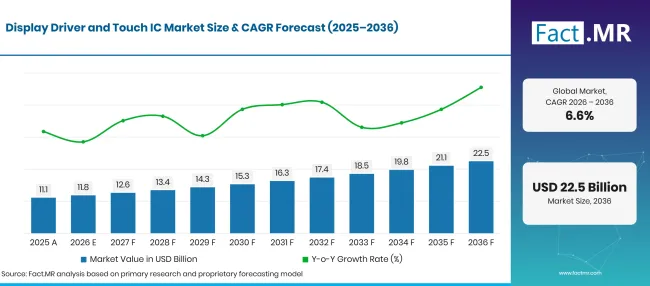
Display Driver And Touch Ic Market Forecast Global | Source: Fact.MR
| Year | Basis | Market Value (USD billion) |
|---|---|---|
| 2025 | Actual | 11.1 |
| 2026 | Estimate | 11.8 |
| 2036 | Forecast | 22.5 |
| CAGR 2026 to 2036 | Forecast period | 6.6% |
Source: Fact.MR analysis. Updated Oct 23, 2026
What are the defining numbers behind Display Driver and Touch IC Market growth?
USD 10.7 billion absolute opportunity between 2026 and 2036
- Demand Drivers in the Market
- Increasing demand for advanced display performance is supporting the development of display driver ICs for mobile phones, tablets, televisions, laptops and automotive screens. Higher resolution, refresh-rate requirements and image-quality management require drivers tailored to specific panel architectures. LX Semicon's product portfolio includes LCD and OLED display drivers for mobile and larger-panel applications [1].
- Growing integration of touch and display functions is creating opportunities for Touch and Display Driver Integration (TDDI) solutions. These combine display-driving and touch-sensing functions to reduce component count and support thinner display modules. LX Semicon identifies TDDI among its mobile display solutions.
- Expansion of OLED displays into computing devices is creating demand for touch controllers that can maintain accurate touch sensing while minimizing interference from display signals. On February 4, 2026, Himax Technologies announced that its HX85200-series on-cell OLED touch controller, designed for high-end OLED laptop PCs, would begin mass production in the first quarter of 2026, with tablet applications also targeted [2]. [2]
- Increasing use of digital displays in vehicles is creating opportunities for display drivers and touch ICs designed for automotive applications. Center information displays and other in-vehicle screens require products suited to application-specific performance and reliability needs. LX Semicon lists display driver ICs and touch ICs among its automotive display products [3].
- Demand fluctuations and supply-chain constraints can affect supplier revenue and production planning. Omdia reported in February 2026 that the global display driver IC market was expected to decline by 1% year over year in 2025 before stabilizing in 2026, reflecting weaker demand in selected panel categories and pressure from memory shortages [4].
- Key Segments Analyzed
- By Product Type: Display Driver IC is projected to account for 62.5%, assuming the two categories are mutually exclusive and exhaustive.
- By Application: Smartphones lead with 35.8% in 2026 within the defined market segmentation.
- By Technology: The estimated 33.1% LED share requires classification as LED driver functionality or a distinct display technology before comparisons with LCD and OLED categories.
- By End-User: Consumer Electronics represent 64.8% in 2026 driven by demand for smartphones and other display-enabled devices.
- Analyst Opinion at Fact.MR
- Shambhu Nath Jha, Principal Consultant at Fact.MR, states, “The display driver and touch IC market is being shaped by the need for better display performance, thinner modules and responsive touch interfaces across consumer and automotive electronics. Suppliers developing integrated touch and display solutions, OLED-compatible controllers and application-specific products can address changing device requirements. However, pricing pressure, changes in device demand and semiconductor supply constraints remain important considerations for market participants.”
- Strategic Implications
- Semiconductor suppliers should prioritize integrated touch and display solutions to address customer demand for thinner modules and reduced component counts.
- Product developers are expanding OLED-compatible driver and touch-controller portfolios for smartphones, tablets and laptops.
- Suppliers need to strengthen automotive product development to serve digital cockpit displays and other in-vehicle screen applications.
- Companies differentiate their offerings through power efficiency, display quality, touch responsiveness and panel-specific optimization.
- Market participants must monitor foundry availability, device inventory cycles and changes in display-panel demand when planning production and product launches.
Germany leads the country growth outlook at 8.3% CAGR, followed by Brazil at 7.6%. The United States follows at 6.8%, while the United Kingdom is projected to grow at 6.1% and Japan at 5.4% over 2026–2036.
How does the Display Driver and Touch IC Market break down by segment?”
Fact.MR finds that Display Driver IC will account for 62.5% of Product Type, while Consumer Electronics will lead End-User at 64.8%.
Which Product Type leads?
Display Driver IC will represent 62.5% in 2026.
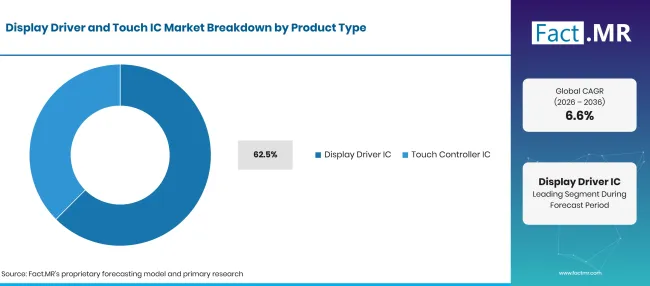
Display Driver And Touch Ic Market Breakdown Product Type | Source: Fact.MR
| Product Type | Share |
|---|---|
| Display Driver IC (Leading segment) | 62.5% |
| Other segments combined | 37.5%* |
| Total | 100.0% |
Source: Fact.MR analysis. Updated Oct 23, 2026
Display Driver ICs convert image data into electrical signals that control display pixels. Their requirements vary by panel technology, resolution, refresh rate and power consumption. Touch Controller ICs detect finger or stylus interactions and relay position information to a device's application processor. Integrated TDDI solutions combine both functions in a single solution, helping reduce component count and support thinner displays.
What supports Smartphones within Application?
Smartphones will make up 35.8% share in 2026.
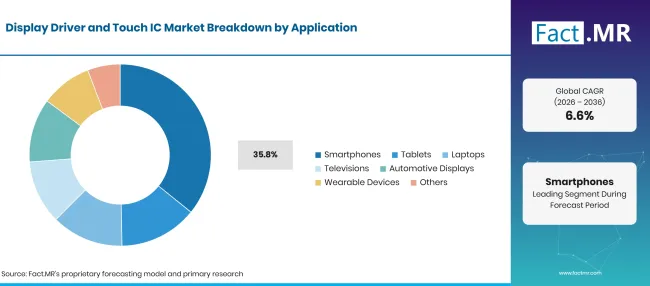
Display Driver And Touch Ic Market Breakdown Application | Source: Fact.MR
| Application | Share |
|---|---|
| Smartphones (Leading segment) | 35.8% |
| Other segments combined | 64.2%* |
| Total | 100.0% |
Source: Fact.MR analysis. Updated Oct 23, 2026
Smartphones require display drivers to control panel operation and touch controllers to detect user interactions. Higher-resolution panels, foldable designs and OLED adoption can increase the need for specialized driver and touch-control solutions. Tablets and laptops offer opportunities for larger touch surfaces, while televisions require drivers designed for large-panel display architectures. Automotive displays and wearables add further requirements related to reliability, compact design and power management.
What supports LED within Technology?
LED will represent 33.1% share in 2026.
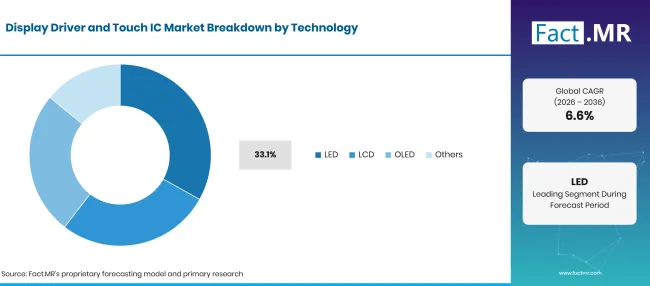
Display Driver And Touch Ic Market Breakdown Technology | Source: Fact.MR
| Technology | Share |
|---|---|
| LED | 33.1% |
| Other segments combined | 66.9%* |
| Total | 100.0% |
Source: Fact.MR analysis. Updated Oct 23, 2026
Display-related ICs vary according to the technology they control. LED driver ICs regulate electrical current and brightness in LED-based applications. LCD display drivers supply signals required to operate liquid-crystal panels, while OLED display drivers manage the operation of self-emissive pixels and may incorporate image-quality compensation functions.
What supports Consumer Electronics within End-User?
Consumer Electronics will account for 64.8% share in 2026.
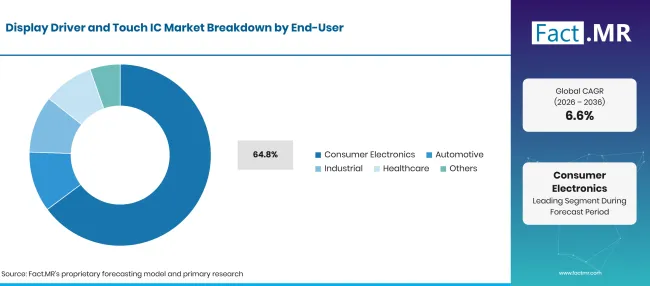
Display Driver And Touch Ic Market Breakdown End User | Source: Fact.MR
| End-User | Share |
|---|---|
| Consumer Electronics (Leading segment) | 64.8% |
| Other end-users combined | 35.2%* |
| Total | 100.0% |
Source: Fact.MR analysis. Updated Oct 23, 2026
Consumer electronics represents a broad demand base because display drivers and touch controllers are used across smartphones, tablets, laptops, televisions and wearable devices. Automotive applications create additional demand for display and touch solutions in center information displays and other digital interfaces. Industrial and healthcare equipment also use touch-enabled displays, where reliability and product-specific requirements influence component selection.
What is accelerating Display Driver and Touch IC Market adoption, and what is holding it back?
Demand for advanced displays, integrated touch functionality and OLED-compatible ICs is creating growth opportunities across consumer electronics and automotive applications. However, semiconductor demand cycles, pricing pressure, manufacturing constraints and changes in device shipments can limit growth. Omdia's February 2026 outlook highlighted weakness in selected display driver IC categories in 2025, illustrating that demand can vary considerably by panel type and application [4].
Drivers Impact Analysis
| DRIVER | (~) % IMPACT ON CAGR | GEOGRAPHIC RELEVANCE | IMPACT TIMELINE |
|---|---|---|---|
| Demand for high-resolution displays in smartphones and consumer electronics | +1.0% | Asia, Global | Medium term (2–4 years) |
| Integration of touch functionality with display-driver technologies | +0.9% | Global | Short term (≤ 2 years) |
| Adoption of OLED and advanced display panels | +0.7% | Asia, Europe | Medium term (2–4 years) |
| Growth in automotive displays and digital cockpits | +0.5% | Global | Medium term (2–4 years) |
| Demand for lower-power display control in portable devices | +0.4% | Global | Long term (≥ 4 years) |
Source: Fact.MR analysis. Updated Oct 23, 2026
Opportunity Impact Analysis
| OPPORTUNITY | (~) % IMPACT ON CAGR | GEOGRAPHIC RELEVANCE | IMPACT TIMELINE |
|---|---|---|---|
| Development of integrated display-driver and touch-controller ICs | +0.8% | Global | Medium term (2–4 years) |
| Expansion of OLED and flexible-display applications | +0.6% | Asia, Global | Medium term (2–4 years) |
| Increasing use of displays in electric vehicles and advanced dashboards | +0.5% | Americas, Europe, Asia | Long term (≥ 4 years) |
| Development of energy-efficient ICs for mobile and wearable devices | +0.4% | Global | Short term (≤ 2 years) |
Source: Fact.MR analysis. Updated Oct 23, 2026
Restraints Impact Analysis
| RESTRAINT | (~) % IMPACT ON CAGR | GEOGRAPHIC RELEVANCE | IMPACT TIMELINE |
|---|---|---|---|
| Price pressure from consumer-electronics manufacturers | -0.8% | Global | Short term (≤ 2 years) |
| High research, development and semiconductor fabrication costs | -0.6% | Global | Medium term (2–4 years) |
| Design complexity across display technologies and device platforms | -0.5% | Global | Short term (≤ 2 years) |
| Dependence on semiconductor supply chains and display-panel production cycles | -0.4% | Asia, Global | Medium term (2–4 years) |
Source: Fact.MR analysis. Updated Oct 23, 2026
Which countries are scaling the Display Driver and Touch IC Market through 2036?
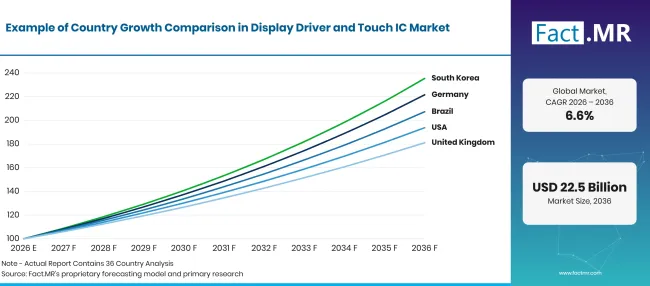
Display Driver And Touch Ic Market Growth Index | Source: Fact.MR
| Country | CAGR (2026–2036) |
|---|---|
| Germany | 8.3% |
| Brazil | 7.6% |
| USA | 6.8% |
| UK | 6.1% |
| Japan | 5.4% |
Source: Fact.MR analysis. Updated Oct 23, 2026
What supports Brazil’s adoption?
7.6% CAGR, driven by rising demand for display-enabled consumer electronics and advanced touch interfaces.
Brazil's display driver and touch IC market may benefit from demand for smartphones, tablets, laptops and other consumer electronics incorporating display and touch functionality. Demand depends on device sales, product mix, replacement cycles and the cost of imported electronic components.
How is Japan developing demand?
5.4% CAGR, shaped by rising demand for advanced display technologies and integrated touch functionality across consumer electronics and automotive displays.
Japan's market opportunities include consumer electronics, automotive displays and industrial equipment. Demand for display drivers and touch controllers depends on the adoption of new display architectures, component specifications and manufacturing activity across these applications.
What is supporting Germany’s adoption?
8.3% CAGR, backed by growing adoption of high-resolution displays and integrated touch technologies across consumer electronics and automotive applications.
Germany's market opportunities are linked to automotive electronics, industrial displays and consumer devices. Automotive center information displays and other digital interfaces require display driver and touch IC solutions suited to their technical and reliability requirements. LX Semicon identifies display driver ICs and touch ICs among the products used in automotive center information displays.
How does the United Kingdom perform?
6.1% CAGR, supported by increasing demand for advanced display panels and touch-enabled devices across consumer electronics and automotive applications.
The UK's display driver and touch IC demand is associated with consumer electronics, computing devices, automotive applications and industrial equipment. Market development depends on device adoption, sourcing arrangements and the use of advanced display and touch functionality across different applications.
What supports adoption in the United States?
6.8% CAGR, driven by rising adoption of high-resolution displays and integrated touch solutions across smartphones, automotive displays and other electronic devices.
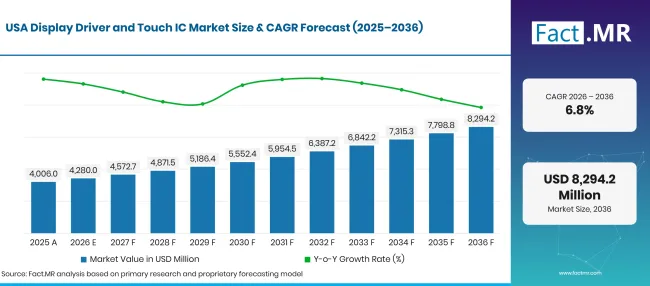
Display Driver And Touch Ic Market Forecast Usa | Source: Fact.MR
The United States offers demand opportunities across smartphones, laptops, tablets, automotive displays and other electronic equipment. Suppliers compete on performance, integration, power efficiency and their ability to meet device manufacturers' specifications.
Who leads the Display Driver and Touch IC Market?
Competition includes semiconductor suppliers specializing in display driver ICs, touch controllers and integrated touch-and-display solutions. Samsung Electronics, Synaptics, Novatek Microelectronics, Himax Technologies, Raydium Semiconductor, FocalTech Systems and LX Semicon are the companies identified in the competitive landscape.
Samsung Electronics participates in the semiconductor and display ecosystem, while Synaptics develops touch and integrated display technologies. Novatek Microelectronics and Raydium Semiconductor participate in display-related IC markets. Himax Technologies supplies display drivers and touch controllers, including OLED touch products for computing devices. FocalTech Systems focuses on touch-controller and display-related IC solutions, while LX Semicon offers display drivers, touch ICs and integrated solutions for mobile, IT, television and automotive applications [5].
Competitive positioning depends on product design wins, display-panel compatibility, performance, customer relationships, cost and the ability to support different applications.
Which companies are the key providers?
Key companies in the Display Driver and Touch IC Market include Samsung Electronics Co., Ltd., Synaptics Incorporated, Novatek Microelectronics Corp., Himax Technologies Inc., Raydium Semiconductor Corporation, FocalTech Systems Co., Ltd. and LX Semicon Co., Ltd.
- Samsung Electronics Co., Ltd.
- Synaptics Incorporated
- Novatek Microelectronics Corp.
- Himax Technologies Inc.
- Raydium Semiconductor Corporation
- FocalTech Systems Co., Ltd.
- LX Semicon Co., Ltd.
Bibliography
- [1] LX Semicon Co., Ltd. (n.d.). Display Driver IC.
- [2] Himax Technologies, Inc. (2026, February 4). Himax industry-leading OLED touch IC enters mass production for IT applications, elevating the integrated display and touch experience.
- [3] LX Semicon Co., Ltd. (n.d.). Automotive.
- [4] Omdia. (2026, February 19). Omdia: Global DDIC market set to decline 1% YoY in 2025 before stabilizing in 2026.
- [5] LX Semicon Co., Ltd. (n.d.). Touch IC.
This Report Answers
- Display Driver and Touch IC Market revenue is assessed by product type, application, technology and end-user, including display driver ICs, touch controller ICs, smartphones, automotive displays and consumer electronics.
- For each segment, the leading category is identified using the shares, alongside the product and application factors influencing demand.
- Demand drivers, opportunities and restraints are assessed in relation to display technology adoption, touch integration, device demand and semiconductor supply conditions.
- Country comparisons cover Germany, Brazil, the USA, the UK and Japan
- Company profiles cover major suppliers of display drivers, touch controllers and integrated display-and-touch solutions.
- Recent product announcements and portfolio developments are used to illustrate technology and application trends through the forecast period.
What does the Display Driver and Touch IC Market cover?
The Display Driver and Touch IC Market covers semiconductor components used to operate display panels and detect touch input in electronic devices. Display Driver ICs manage the signals required to display images, while Touch Controller ICs detect finger or stylus interactions and transmit the corresponding information to a device processor.
The market includes applications across smartphones, tablets, laptops, televisions, automotive displays, wearable devices and other electronic equipment. It also includes relevant integrated touch-and-display solutions, where the two functions are combined to reduce component count and support thinner display modules.
Market demand is influenced by display-panel technology, device shipments, resolution requirements, power efficiency, integration trends and the adoption of touch-enabled interfaces.
What is included in the scope?
The market includes display driver ICs and touch controller ICs used in consumer electronics, automotive systems, industrial equipment, healthcare devices and other display-enabled applications.
Relevant technologies include LCD and OLED display drivers, LED driver ICs and touch-control solutions. Integrated Touch and Display Driver Integration products are included where they meet the market definition and are counted consistently to avoid double counting.
The assessment also considers company product portfolios, display technology developments, application trends and the country growth estimates.
What is excluded from the scope?
Display panels, complete smartphones, televisions, laptops and other finished devices are excluded from the semiconductor market valuation. General-purpose processors and other ICs are excluded unless they directly fall within the defined display driver or touch IC categories.
Display manufacturing equipment, semiconductor fabrication equipment, standalone software and general electronic components are also excluded. Integrated products should not be counted separately under both display driver and touch controller categories unless the underlying market methodology explicitly allows this.
How Was the Analysis Built?
The analysis draws on 120+ sources, 35+ company portfolios, 25+ countries, and more than 20 industry interviews.
- Primary Research: Primary research includes discussions with manufacturers, service providers, technology developers, distributors, end users, and subject-matter experts. These conversations examine purchasing priorities, product adoption, operational challenges, approval requirements, competitive positioning, and the factors that influence wider market acceptance.
- Desk Research: Desk research covers government statistics, regulatory publications, company filings, trade data, technical studies, industry associations, standards, public policy, and other authoritative sources. Every source used in the analysis is documented in the bibliography.
- Market Sizing and Forecasting: Market estimates combine historical performance, demand indicators, pricing and volume trends, segment shares, company participation, country-level growth, adoption patterns, investment activity, and barriers to market expansion.
- Data Validation and Update Cycle: Findings are validated by comparing primary interviews with public data, company activity, regulatory changes, trade patterns, and industry developments. Regular updates review new product launches, capacity changes, partnerships, approvals, and shifts in commercial adoption.
Segmentation
What is the report’s scope and coverage?
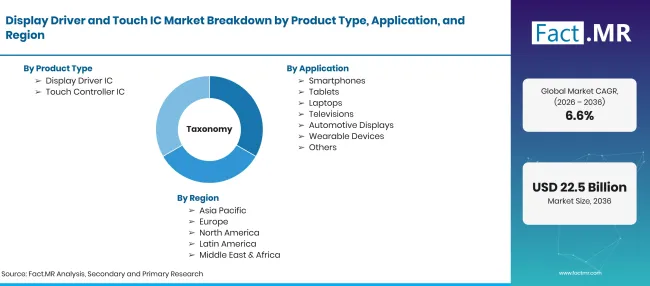
Display Driver And Touch Ic Market Taxonomy | Source: Fact.MR
| Attribute | Details |
|---|---|
| Quantitative Units | USD billion in 2026 to USD billion by 2036, at CAGR |
| Market Definition | The Display Driver and Touch IC Market covers integrated circuits used to control display-panel operation and detect touch interactions in electronic devices. The scope includes display driver ICs, touch controller ICs and relevant integrated touch-and-display solutions. |
| Product Type | Display Driver IC; Touch Controller IC |
| Application | Smartphones; Tablets; Laptops; Televisions; Automotive Displays; Wearable Devices; Others |
| Technology | LED; LCD; OLED; Others |
| End-User | Consumer Electronics; Automotive; Industrial; Healthcare; Others |
| Regions Covered | North America; Latin America; Western Europe; Eastern Europe; East Asia; South Asia & Pacific; Middle East & Africa |
| Countries Covered | Germany; Brazil; United States; United Kingdom; Japan |
| Companies Profiled | Samsung Electronics; Synaptics; Novatek Microelectronics; Himax Technologies; Raydium Semiconductor; FocalTech Systems; LX Semicon |
| Forecast Period | 2026 to 2036 |
| Approach | Market assessment using market estimates, segment shares, company product portfolios, public industry announcements and relevant display-semiconductor developments. |
Source: Fact.MR analysis. Updated Oct 23, 2026
How is the market segmented?
-
By Product Type
- Display Driver IC
- Touch Controller IC
-
By Application
- Smartphones
- Tablets
- Laptops
- Televisions
- Automotive Displays
- Wearable Devices
- Others
-
By Technology
- LED
- LCD
- OLED
- Others
-
By End-User
- Consumer Electronics
- Automotive
- Industrial
- Healthcare
- Others
-
By Region
- North America
- Latin America
- Western Europe
- Eastern Europe
- East Asia
- South Asia & Pacific
- Middle East & Africa
Frequently Asked Questions
How big is the Display Driver and Touch IC Market in 2026?
What is the CAGR of the Display Driver and Touch IC Market from 2026 to 2036?
Which product type leads the Display Driver and Touch IC Market?
Which application leads the Display Driver and Touch IC Market?
Who are the leading companies in the Display Driver and Touch IC Market?
Who worked on this report


Preview the report firsthand - request a free sample
Free SampleGet the brochure for pricing and purchase details
Download PDF