- Market Value (2025): USD 1.85 Bn
- Estimated Value (2026): USD 1.95 Bn
- Forecast Value (2036): USD 3.27 Bn
- CAGR (2026-2036): 5.3%
What is the High Power Microwave Tubes Market forecast to be worth by 2036?
USD 1.95 Billion in 2026 to USD 3.27 Billion by 2036, at a 5.3% CAGR.
- As per Fact.MR analysis, the high power microwave tubes market reached USD 1.85 Billion in 2025.
- Demand will increase from USD 1.95 Billion in 2026 to USD 3.27 Billion in 2036.
- The market is forecast to record a 5.3% CAGR during 2026 to 2036 driven by expanding particle accelerator infrastructure, modernizing clinical linear accelerators (LINACs) for cancer radiation therapy, military investments in high-power counter-unmanned aerial system (C-UAS) microwave weapons, and rising adoption of industrial microwave heating for carbon fiber processing and chemical synthesis.
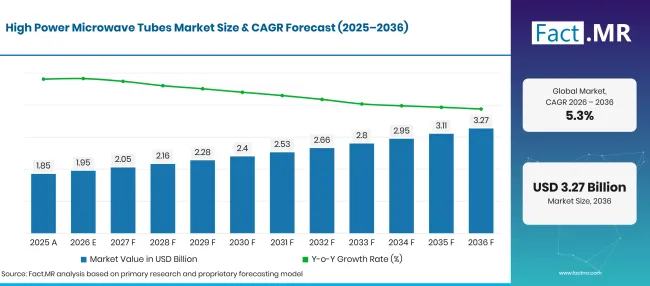
High Power Microwave Tubes Market Forecast Global | Source: Fact.MR
| Year | Basis | Market Value (USD Billion) |
|---|---|---|
| 2025 | Actual | 1.85 |
| 2026 | Estimate | 1.95 |
| 2036 | Forecast | 3.27 |
| CAGR 2026 to 2036 | Forecast period | 5.3% |
Source: Fact.MR analysis. Updated Oct 24, 2026
What are the defining numbers behind High Power Microwave Tubes Market growth?
USD 1.3 Billion absolute chance between 2026 and 2036, with klystrons, communications applications, and defense end-users generating the largest market share expansion.
- Demand Drivers in the Market
- The FDA classifies medical linear accelerators as Class II medical charged-particle radiation therapy systems and lists 12 recognized consensus standards, including a February 2025 standard for image-guided radiotherapy equipment used with electron accelerators [1]. This regulatory framework keeps functional performance, dosimetry, treatment planning, and image-guidance requirements central to equipment qualification and lifecycle support.
- The FCC regulates RF devices capable of emitting energy from 9 kHz to 3,000 GHz and generally requires applicable equipment-authorization testing before regulated products can be marketed, imported, or used in the United States [2]. Industrial microwave-heating equipment therefore remains subject to documented RF-emissions measurement and compliance procedures.
- CERN reported in 2025 that RF cavities can account for 50% to 60% of total energy consumption in proposed electron-positron colliders; conventional klystrons have historically operated near 60% efficiency, while CERN’s high-efficiency program is targeting more than 80% [3]. These gains strengthen the case for continued investment in advanced high-power klystron designs for future accelerator infrastructure.
- A 2025 U.S. Government Accountability Office review identified dedicated Army development timelines for both high-energy-laser and high-power-microwave air-and-missile-defense systems, alongside formal counter-small-UAS acquisition programs [4]. The documented programs show that directed-energy counter-drone capability has moved beyond laboratory research into structured development and fielding pathways.
- Key Segments Analyzed
- By Product Type: Klystrons holds 34.8% share in 2026, preferred across particle accelerators, deep-space radar transmitters, and clinical radiotherapy for its unmatched high-gain narrow-band amplification and multi-megawatt pulsed output.
- By Application: Communication accounts for 32.4% share in 2026, underpinned by high-power satellite uplink earth stations, deep-space communications tracking networks, and tropospheric scatter military communication links.
- By End-User: Defense accounts for 45.2% share in 2026, driven by long-range early warning radar, naval combat management, airborne fire-control radar, and high-power microwave electronic attack pods.
- Analyst Opinion at Fact.MR
- Shambhu Nath Jha, Lead Consultant at Fact.MR, states, “High-power microwave tubes remain indispensable workhorses of modern high-energy science, clinical oncology, and electronic defense. While solid-state power amplifiers have successfully displaced vacuum tubes at lower frequencies and modest power levels, tubes remain completely unchallenged when generating gigawatt peak pulsed powers or multi-megawatt continuous radiation. Microwave tube manufacturers who master multi-beam electron optics, depressed collector energy recovery, and automated ceramic-metal braze inspection will establish lasting competitive moats across government physics laboratories and defense radar programs.”
- Strategic Implications
- RF vacuum engineering teams are prioritizing efficiency because CERN reported in 2025 that klystrons amplify high-frequency radio waves by up to a factor of one million and that its High-Efficiency Klystron program is working beyond 80% efficiency, compared with the historical level of about 60% [5]. Higher conversion efficiency directly reduces the electrical demand of accelerator RF systems.
- Microwave tube fabricators are modernizing high-temperature hydrogen braze furnaces and vacuum bakeout stations with automated mass spectrometry leak detection. Sourcing executives negotiate forward procurement agreements for ultra-pure OFHC copper, high-emissivity dispenser cathodes, and beryllia ceramic output windows, insulating assembly operations from specialized raw material supply disruptions.
- Industrial thermal equipment integrators are designing modular continuous-wave magnetron power blocks delivering 75 kW to 100 kW at 915 MHz for continuous industrial chemical synthesis and biomass pyrolysis. Developing standardized plug-and-play microwave generators accelerates industrial electrification, allowing chemical manufacturers to replace fossil-fired steam boilers with high-efficiency volumetric microwave heating.
- Defense contractors are developing ruggedized solid-state-driver-to-vacuum-tube hybrid transmitter chains for mobile radar installations. Combining wideband solid-state preamplifiers with high-power traveling wave tubes or crossed-field amplifiers optimizes instantaneous radar frequency agility while preserving multi-kilowatt pulsed transmit power.
Germany is projected to record an industry-leading 6.9% CAGR, propelled by world-class particle accelerator facilities (such as DESY), high-power industrial microwave engineering, and defense radar production. The United Kingdom advances at a 6.5% CAGR, supported by the Diamond Light Source synchrotron upgrades, aerospace defense manufacturing, and cancer radiotherapy clinical installations. Japan records a 5.6% CAGR, anchored by the KEK particle physics complex, radiotherapy LINAC manufacturing, and precision klystron export leadership. The United States registers a 4.2% CAGR, maintaining the largest overall commercial valuation driven by national laboratory upgrades, defense radar procurement, and medical device manufacturing. Brazil expands at a 3.8% CAGR, underpinned by the Sirius synchrotron light source operations, expanding oncology radiotherapy clinics, and industrial food processing.
How does the High Power Microwave Tubes Market break down by segment?
Klystrons 34.8%; Defense 45.2%; Communication 32.4% in 2026.
Which Product Type dominates?
Klystrons holds 34.8% share in 2026.
| Product Type | Share (2026) |
|---|---|
| Klystrons (Leading segment) | 34.8% |
| Other segments combined (Magnetrons, TWTs, Others) | 65.2%* |
| Total | 100.0% |
Source: Fact.MR analysis. Updated Oct 24, 2026
Klystrons represent the single largest product category by market value, commanding 34.8% of global expenditures. Sourcing directors across scientific research institutions and medical device companies prioritize klystrons due to their ability to provide linear, high-gain amplification exceeding 50 dB and peak pulsed powers ranging from hundreds of kilowatts to over 50 megawatts. Particle accelerators (such as synchrotrons and linear colliders) require highly stable RF phase coherence across hundreds of klystrons to accelerate subatomic particles to relativistic velocities. Magnetrons follow closely, dominating high-volume commercial markets including medical oncology radiotherapy LINACs, industrial microwave heating, and commercial maritime navigation radar due to their compact size and cost-effective crossed-field generation. Traveling wave tubes and specialized crossed-field amplifiers (CFAs) account for the remaining share, favored in wideband electronic defense systems. Processing plants deploy high-efficiency magnetrons within high-power microwave heating generators for continuous materials processing. Armed forces deploy high-power pulsed tubes inside high-power electronic countermeasures suites. Ground stations utilize high-power klystrons inside high-power klystron transmitters to communicate with interplanetary spacecraft. Design engineers also evaluate complementary wide-bandgap semiconductor devices for low-power driver stages.
Who represents the primary End-User?
Defense accounts for 45.2% share in 2026.
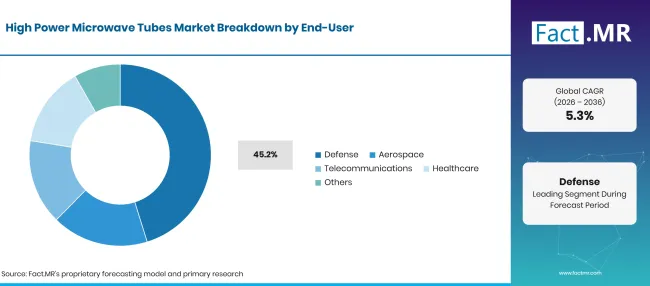
High Power Microwave Tubes Market Breakdown End User | Source: Fact.MR
| End-User | Share (2026) |
|---|---|
| Defense (Leading segment) | 45.2% |
| Other segments combined (Aerospace, Telecom, Healthcare, Others) | 54.8%* |
| Total | 100.0% |
Source: Fact.MR analysis. Updated Oct 24, 2026
Defense represents the dominant end-user segment, contributing 45.2% of total industry revenue. Armed forces across North America, Europe, and Asia deploy high-power microwave tubes across long-range early warning air defense radar, naval Aegis phased-array radar, ballistic missile defense, and directed-energy counter-drone weapons. The extreme electromagnetic power density of microwave tubes provides military radar systems with multi-hundred-kilometer detection ranges capable of tracking stealth aircraft and hypersonic threats through heavy electronic jamming. The aerospace sector follows, utilizing tubes in satellite communications uplinks and deep-space planetary tracking stations. Healthcare institutions generate steady, recurring demand through cancer radiotherapy centers operating medical LINACs, while industrial processors and telecommunications carriers account for the remainder. Systems integrators deploy high-power tubes inside pulsed microwave power sources for radar test facilities. Quality control labs utilize microwave frequency synthesis instrumentation to measure spectral purity. High-power diagnostic teams use thermal diagnostic imaging sensors to detect collector hotspots. Deep-space telemetry networks install high-power klystrons to maintain deep space communication uplinks across interplanetary distances. High-voltage power engineers utilize pulsed cathode current transformers to monitor modulator pulse shapes. Vacuum specialists specify beryllia ceramic output windows to handle multi-megawatt RF throughput without dielectric breakdown.
What leads the Application segment?
Communication accounts for 32.4% share in 2026.
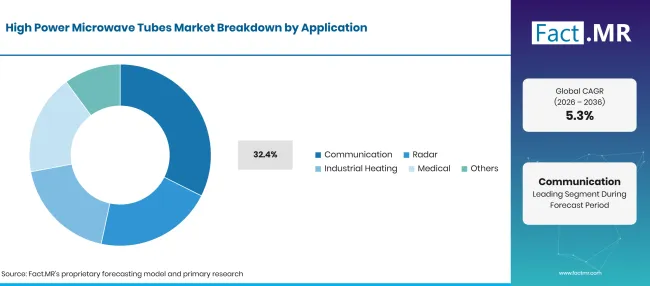
High Power Microwave Tubes Market Breakdown Application | Source: Fact.MR
| Application | Share (2026) |
|---|---|
| Communication (Leading segment) | 32.4% |
| Other segments combined (Radar, Industrial Heating, Medical, Others) | 67.6%* |
| Total | 100.0% |
Source: Fact.MR analysis. Updated Oct 24, 2026
Communication applications represent the largest individual application domain, commanding nearly one-third of total industry value. Commercial satellite ground stations, military satellite telecommunications gateways, and deep-space network uplinks rely on high-power microwave tubes to overcome severe free-space path loss and atmospheric attenuation when transmitting high-bandwidth signals to orbital satellites and distant planetary probes. Radar follows as a vital secondary application, accounting for major revenue across airborne, shipborne, and ground-based surveillance. Industrial microwave heating and medical oncology radiation therapy comprise the remaining consumption base, sustained by expanding factory electrification and global cancer hospital expansions.
What is accelerating High Power Microwave Tubes Market adoption, and what is holding it back?
Synchrotron and particle physics research facility expansions, cancer radiotherapy LINAC upgrades, and military directed-energy counter-drone weapon programs accelerate market expansion. Solid-state gallium nitride power amplifier encroachment at lower power levels, lengthy tube fabrication cycles, and high capital investment requirements restrict frictionless market growth.
Drivers Impact Analysis
| DRIVER | (~) % IMPACT ON CAGR | GEOGRAPHIC RELEVANCE | IMPACT TIMELINE |
|---|---|---|---|
| Global investments in advanced fourth-generation synchrotron light sources and particle colliders | +1.6% | Europe, North America, East Asia | Short term (<= 2 years) |
| Expanding installation of cancer radiation therapy linear accelerators across emerging markets | +1.4% | Global | Short term (<= 2 years) |
| Military procurement of high-power microwave directed-energy counter-drone defense systems | +1.2% | North America, Europe | Medium term (2–4 years) |
| Industrial factory adoption of microwave heating for carbon composite curing and chemical synthesis | +0.9% | Western Europe, East Asia | Medium term (2–4 years) |
| Modernization of long-range ballistic missile defense and airspace surveillance radar suites | +0.7% | North America, Europe | Long term (>= 4 years) |
Source: Fact.MR analysis. Updated Oct 24, 2026
Opportunity Impact Analysis
| OPPORTUNITY | (~) % IMPACT ON CAGR | GEOGRAPHIC RELEVANCE | IMPACT TIMELINE |
|---|---|---|---|
| Multi-beam klystron (MBK) designs boosting electrical conversion efficiency above 65.0% | +1.5% | Europe, USA, Japan | Short term (<= 2 years) |
| Compact, high-power continuous-wave magnetrons engineered for industrial plasma torches | +1.2% | Western Europe, USA | Medium term (2–4 years) |
| Automated robotic cathode brazing and precision vacuum assembly lines reducing scrap rates | +1.0% | Global | Medium term (2–4 years) |
| Refurbishment and re-gunning services for high-value scientific and military klystrons | +0.8% | North America, Europe | Long term (>= 4 years) |
Source: Fact.MR analysis. Updated Oct 24, 2026
Restraints Impact Analysis
| RESTRAINT | (~) % IMPACT ON CAGR | GEOGRAPHIC RELEVANCE | IMPACT TIMELINE |
|---|---|---|---|
| Ongoing performance improvements and market penetration of solid-state GaN RF amplifiers below 20 kW | -1.5% | Global | Short term (<= 2 years) |
| Extreme complexity of precision ceramic-to-metal brazing resulting in lengthy production lead times | -1.1% | North America, Europe | Short term (<= 2 years) |
| High procurement and maintenance costs for specialized high-voltage pulse modulator subsystems | -0.8% | Global | Medium term (2–4 years) |
| Stringent export control licensing requirements for military-grade high-power microwave hardware | -0.6% | USA, Western Europe | Long term (>= 4 years) |
Source: Fact.MR analysis. Updated Oct 24, 2026
Which countries are scaling the High Power Microwave Tubes Market through 2036?
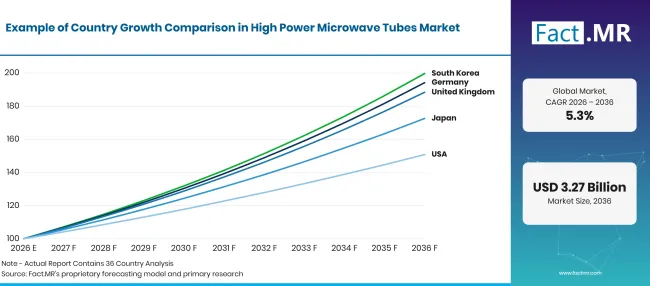
High Power Microwave Tubes Market Growth Index | Source: Fact.MR
| Country | CAGR (2026–2036) |
|---|---|
| Germany | 6.9% |
| Brazil | 3.8% |
| USA | 4.2% |
| UK | 6.5% |
| Japan | 5.6% |
Source: Fact.MR analysis. Updated Oct 24, 2026
What sustains engineering leadership in Germany?
6.9% CAGR, propelled by world-class particle accelerator facilities, high-power industrial microwave engineering, and defense radar production.
Germany’s accelerator-tube demand is anchored by the European XFEL at DESY. Its high-power RF system comprises 27 stations, each built around a modulator, klystron, waveguide distribution, interlocks, and supporting supplies; DESY states that three limited-life klystrons are expected to be tested and replaced each year [6]. The same facility operates nearly 800 superconducting cavities, creating recurring requirements for RF-source maintenance, spares, and precision controls.
What opportunities are unfolding across Brazil?
3.8% CAGR, backed by the Sirius synchrotron light source operations, expanding oncology radiotherapy clinics, and industrial food processing.
Brazil’s Sirius synchrotron is expanding its operating capability through superconducting RF infrastructure. CNPEM reported that a new superconducting radiofrequency cavity would raise storage-ring current from a 100 mA limit toward 350 mA, enabling a 3.5-fold increase in synchrotron-light flux at experimental stations [7]. This measurable capacity expansion supports sustained demand for high-power RF equipment, cryogenic integration, controls, and specialist maintenance.
Why does the United States maintain substantial commercial market valuation?
4.2% CAGR, propelled by national laboratory upgrades, defense radar procurement, and medical device manufacturing.
The United States maintains a broad accelerator and light-source base through the Department of Energy’s Office of Science, which operates 28 national user facilities used by tens of thousands of researchers each year [8]. The portfolio includes particle accelerators and large X-ray light sources, sustaining recurring requirements for high-power RF generation, cavity systems, controls, component replacement, and facility upgrades.
How is the United Kingdom advancing particle physics and cancer therapy?
6.5% CAGR, supported by the Diamond Light Source synchrotron upgrades, aerospace defense manufacturing, and cancer radiotherapy clinical installations.
The United Kingdom’s accelerator ecosystem includes Diamond Light Source, ISIS, the Accelerator Science and Technology Centre, the Cockcroft Institute, and the John Adams Institute. A 2026 STFC international review, commissioned in April 2025, assessed these organizations as the core of the national accelerator science and technology landscape [9]. Their continuing programs support demand for RF sources, superconducting systems, diagnostics, and specialist vacuum-electronics expertise.
Why does Japan maintain elite technological and manufacturing prowess?
5.6% CAGR, anchored by the KEK particle physics complex, radiotherapy LINAC manufacturing, and precision klystron export leadership.
Japan’s SuperKEKB facility continues to operate a high-power RF network at substantial beam currents. KEK’s 2025 review reported 1.632 A in the positron ring and 1.259 A in the electron ring, with total beam powers of approximately 3.2 MW and 3.4 MW and RF voltages of 9.3 MV and 14.2 MV, respectively [10]. The documented configuration includes ARES and superconducting cavities powered through multiple klystron-to-cavity arrangements, reinforcing sustained demand for high-voltage RF equipment and maintenance.
Who leads the High Power Microwave Tubes Market?
Thales Group commands the leading global market share at 12.3% in 2026, manufacturing an unrivaled portfolio of high-power klystrons, continuous-wave magnetrons, traveling wave tubes, and gyrotrons through its Thales Electron Devices division, supplying global scientific particle accelerators and military defense programs. L3Harris Technologies stands as the foremost American titan in military and scientific microwave tubes, operating specialized electron device plants that manufacture multi-megawatt klystrons and high-power radar transmitters for national defense and aerospace agencies. TMD Technologies Ltd. and Communications and Power Industries (CPI) represent premier transatlantic vacuum electronics leaders, providing comprehensive lines of high-power klystrons, radar transmitter modules, and medical radiotherapy tubes.
Teledyne e2v delivers elite British microwave engineering excellence, dominating the global supply of compact, high-reliability magnetrons utilized in medical cancer radiotherapy LINACs and marine navigation radars. NEC Corporation, Mitsubishi Electric Corporation, and Toshiba Electron Tubes & Devices Co., Ltd. (Canon Electron Tubes & Devices) provide world-class Japanese manufacturing capabilities, producing ultra-high-power pulsed klystrons for international particle colliders and commercial broadcast transmitters. Richardson Electronics, Ltd. operates as a leading global manufacturer and distributor of replacement microwave tubes, industrial heating magnetrons, and power grid tubes. Qorvo Inc. delivers specialized high-frequency RF components and hybrid microwave power modules bridging vacuum and solid-state architectures.
Which companies are the key providers?
Key companies include Thales Group; L3Harris Technologies; TMD Technologies; CPI; Teledyne e2v; NEC Corporation; Mitsubishi Electric; Toshiba Electron Tubes; Richardson Electronics; and Qorvo Inc.
- Thales Group
- L3Harris Technologies
- TMD Technologies
- CPI
- Teledyne e2v
- NEC Corporation
- Mitsubishi Electric
- Toshiba Electron Tubes
- Richardson Electronics
- Qorvo Inc
Bibliography
- [1] U.S. Food and Drug Administration. (2025). Device classification: Medical linear accelerator (Product Code IYE). AccessGUDID/CDRH Product Classification Database.
- [2] Federal Communications Commission. (2026). Equipment authorization—RF device. Office of Engineering and Technology.
- [3] European Organization for Nuclear Research. (2025, June 10). Powering future accelerators. CERN.
- [4] U.S. Government Accountability Office. (2025, June 17). Army modernization: Air and missile defense efforts would benefit from applying leading practices (GAO-25-107491).
- [5] European Organization for Nuclear Research. (2025, June 10). Powering future accelerators. CERN.
- [6] Deutsches Elektronen-Synchrotron. (2026). OPs-2xx: RF systems—Operation of the European XFEL accelerator. DESY.
- [7] Brazilian Center for Research in Energy and Materials. (2025). Sirius receives superconducting radiofrequency cavity. CNPEM.
- [8] U.S. Department of Energy, Office of Science. (2026). Office of Science user facilities.
- [9] Science and Technology Facilities Council. (2026). STFC accelerator international review: Report. UK Research and Innovation.
- [10] Abe, T. (2025, January 15). Reports on the SuperKEKB RF system. High Energy Accelerator Research Organization.
This Report Answers
- How does the global high power microwave tubes market expand from USD 2.0 Billion in 2026 to USD 3.3 Billion by 2036?
- What technological advancements in multi-beam klystrons (MBKs) elevate electrical conversion efficiency above 65.0%?
- Why do klystrons command 34.8% of total industry revenue in 2026?
- How are cancer radiotherapy centers managing scheduled replacement cycles for medical linear accelerator magnetrons and klystrons?
- What factors support Germany achieving an industry-leading 6.9% CAGR across European scientific and industrial sectors?
- How are military defense agencies deploying high-power microwave tubes in directed-energy counter-drone defense weapons?
- What role do beryllia ceramic output windows play in preventing dielectric breakdown under multi-megawatt pulsed RF operation?
What does the High Power Microwave Tubes Market cover?
The market covers commercial shipments of high-power vacuum electron tubes that generate or amplify multi-kilowatt and multi-megawatt radio-frequency energy. It includes klystrons, magnetrons, traveling wave tubes, and other qualified high-power tube architectures used in communication, radar, industrial heating, medical, and related systems.
Demand is tracked across defense, aerospace, telecommunications, healthcare, and other end users in the seven regions included in the forecast.
What is included in the scope?
New high-power klystrons, magnetrons, traveling wave tubes, crossed-field amplifiers, and other vacuum electron devices sold for communication, radar, industrial heating, medical equipment, scientific infrastructure, and qualified defense uses are included.
Commercial tube shipments are counted whether sold directly to equipment operators or supplied through system integrators as part of a transmitter, accelerator RF station, industrial generator, or medical linear accelerator subsystem.
What is excluded from the scope?
Low-power receiving tubes, consumer microwave-oven replacement magnetrons, solid-state RF power amplifiers, passive microwave components, and complete end systems are excluded. Modulators, power supplies, waveguides, antennas, cooling systems, and controls are not counted unless their value is inseparable from the invoiced tube assembly.
Repair-only work, refurbishment services, resale of used tubes, internal prototypes, and laboratory devices without a commercial shipment are outside the market revenue boundary.
How Was the Analysis Built?
The analysis draws on 120+ sources, 35+ company portfolios, 25+ countries, and more than 20 industry interviews.
- Primary Research: Primary research includes discussions with manufacturers, service providers, technology developers, distributors, end users, and subject-matter experts. These conversations examine purchasing priorities, product adoption, operational challenges, approval requirements, competitive positioning, and the factors that influence wider market acceptance.
- Desk Research: Desk research covers government statistics, regulatory publications, company filings, trade data, technical studies, industry associations, standards, public policy, and other authoritative sources. Every source used in the analysis is documented in the bibliography.
- Market Sizing and Forecasting: Market estimates combine historical performance, demand indicators, pricing and volume trends, segment shares, company participation, country-level growth, adoption patterns, investment activity, and barriers to market expansion.
- Data Validation and Update Cycle: Findings are validated by comparing primary interviews with public data, company activity, regulatory changes, trade patterns, and industry developments. Regular updates review new product launches, capacity changes, partnerships, approvals, and shifts in commercial adoption.
Segmentation
What is the report's scope and coverage?
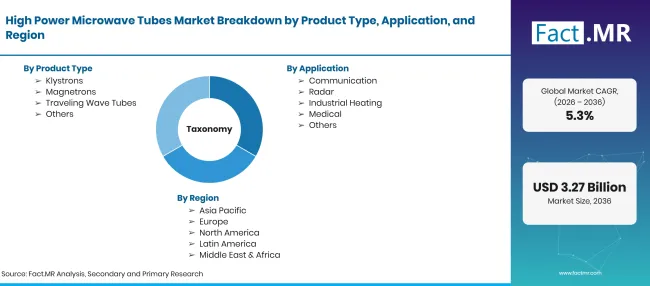
Factmr High Power Microwave Tubes Market Taxonomy | Source: Fact.MR
| Attribute | Details |
|---|---|
| Quantitative Units | USD Billion in 2026 to USD 3.3 Billion by 2036 at a 5.3% CAGR |
| Market Definition | Commercial manufacturing and shipment of high-power vacuum electron tubes, including klystrons, magnetrons, traveling wave tubes, and crossed-field amplifiers delivering multi-kilowatt and multi-megawatt RF power. |
| Product Type | Klystrons; Magnetrons; Traveling Wave Tubes; Others |
| Application | Communication; Radar; Industrial Heating; Medical; Others |
| End-User | Defense; Aerospace; Telecommunications; Healthcare; Others |
| Regions Covered | North America; Latin America; Western Europe; Eastern Europe; East Asia; South Asia & Pacific; Middle East & Africa |
| Countries Covered | Germany; Brazil; USA; UK; Japan |
| Companies Profiled | Thales Group; L3Harris Technologies; TMD Technologies; CPI; Teledyne e2v; NEC Corporation; Mitsubishi Electric; Toshiba Electron Tubes; Richardson Electronics; Qorvo Inc |
| Forecast Period | 2026 to 2036 |
| Approach | Primary interviews with particle accelerator RF directors, medical LINAC maintenance physicists, and defense radar procurement officers combined with national scientific funding audits. |
Source: Fact.MR analysis. Updated Oct 24, 2026
How is the market segmented?
-
By Product Type
- Klystrons
- Magnetrons
- Traveling Wave Tubes
- Others
-
By Application
- Communication
- Radar
- Industrial Heating
- Medical
- Others
-
By End-User
- Defense
- Aerospace
- Telecommunications
- Healthcare
- Others
-
By Region
- North America
- Latin America
- Western Europe
- Eastern Europe
- East Asia
- South Asia & Pacific
- Middle East & Africa
Frequently Asked Questions
What is the projected value of the High Power Microwave Tubes Market by 2036?
Which product type represents the largest revenue share in the market?
What is the primary end-user driving high-power microwave tube demand?
Which country is projected to record the highest growth rate during the forecast period?
Who are the leading manufacturers in the global market?
Who worked on this report


Preview the report firsthand - request a free sample
Free SampleGet the brochure for pricing and purchase details
Download PDF