- Base Value(2025): 0.5 Bn
- Forecast Value (2035): 1.1 Bn
- CAGR (2035): 8.9%
Sim Racing Gear Market Outlook 2025 to 2035
The global sim racing gear market is expected to reach USD 1.1 Billion by 2035, up from USD 0.5 Billion in 2025. During the forecast period 2025 to 2035, the industry is projected to expand at a CAGR of 8.7%.
The market of sim racing gears is pushed by the popularity of motorsports and esports, with users requiring virtual environments that make it possible to experience the race at home. The demand of high-performance racing simulators, advanced force feedback steering wheels, pedals and VR immersion increases the market growth. Sim racing is used by gamers and professional drivers to train, improve their skills as well as have fun. The development of technologies and the increasing internet connection as well as moving towards virtual competitive racing continue to drive the growth of the market.
Quick Stats for Sim Racing Gear Market
- Industry Value (2025): USD 0.5 billion
- Projected Value (2035): USD 1.1 billion
- Forecast CAGR (2025 to 2035): 8.7%
- Leading Segment (2025): Steering Wheels (30.3% Market Share)
- Fastest Growing Country (2025-2035): India (9.9% CAGR)
- Top Key Players: Fanatec (Endor AG), Logitech, Thrustmaster, MOZA Racing, Simucube, Next Level Racing, Sim-Lab, Cube Controls, Heusinkveld Engineering, and Playseat
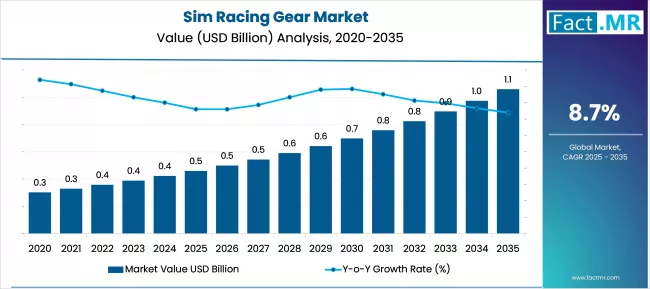
Sim Racing Gear Market Market Value Analysis | Source: Fact.MR
What are the drivers of the Sim Racing Gear Market?
Sim racing gear market is growing because the manufacturers are concentrating on augmenting accuracy, realism, and training of the drivers through innovative technologies. Product development is encouraged by the popularity of esports and motorsports, growth in investment in high-performance racing simulators, and demand of professional-quality force feedback steering wheels, pedals, and motion platforms.
Among the important technological solutions are direct drive systems, immersive VR system integration, and real-time telemetry with performance analysis. The introduction is also assisted by the increasing fitness consciousness, competitive online races, and fitness training at home. The incorporation of the IoT to allow uninterrupted data capture and functional designs enhances usability, increasing the demand of the market across the world.
What are the regional trends of the Sim Racing Gear Market?
The sim racing gear market presents various regional trends that are inspired by the development of infrastructure, use of technology, and the popularity of motorsports. North America is the leader, with the high demand of advanced racing wheels, pedals, motion platforms, and VR integration by professional and amateur sim racers, backed by well-developed esports ecosystems.
Western Europe is oriented towards ergonomic, ecologically sound, and high-performance sim racing products, according to high safety requirements.
In Asia-Pacific, such nations as China, Japan, and India are fast moving to the use of sim racing equipment because of the increasing number of esports players, the growth of gaming communities, and the emergence of sim racing facilities.
Latin America demonstrates moderate growth with the rising interest in motorsport, whereas the Middle East and Africa rely on professional training facilities and the new sim racing events.
What are the challenges and restraining factors of the Sim Racing Gear Market?
Sim racing gear market has a number of challenges that can inhibit its growth. Low barrier of entry enables low quality racing wheels, pedals and accessories to be sold by small players, which influences the level of trust and credibility to the market.
The direct drive simulations and motion platforms are expensive and restrict the purchase of high-end sim racing equipment by amateur gamers and amateur users. The availability of high-speed internet, specialized training facilities and technical skills are unequal in developing regions, limiting usage.
User experience is complicated by frequent software updates, compatibility problems with devices and a lack of interoperability between brands. Moreover, the discontinuous supply chains, the inappropriate technical assistance, and absence of standardized safety and quality standards do not allow to achieve a steady market growth.
Country-Wise Insights
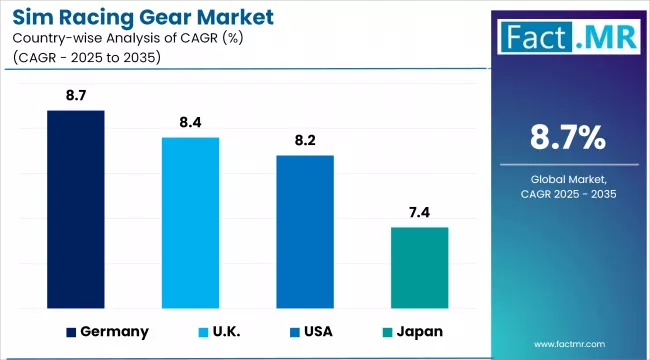
Sim Racing Gear Market Cagr Analysis By Country | Source: Fact.MR
United States leads with strong esports, motorsport culture, high adoption
The sim racing gear market is dominated by the United States because of its high number of motorsport fans, presence of massive esports culture and the consumer purchasing power is high. Professional and amateur sim racers are eager to use professional racing wheels and pedals, motion platforms, and VR systems in order to train their skills and experience immersion.
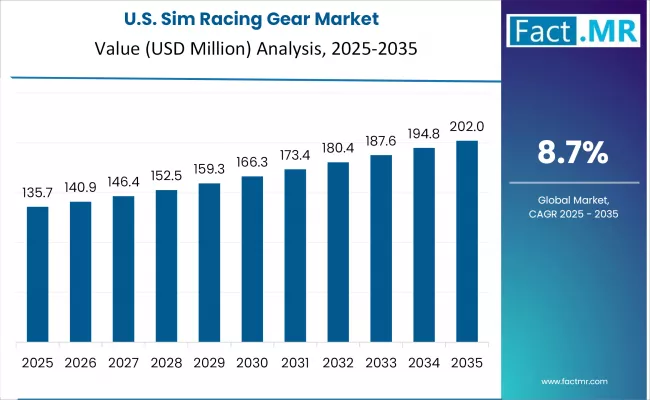
Sim Racing Gear Market Country Value Analysis | Source: Fact.MR
Modern internet network facilitates competitive online racing. Sim racing events, esports tournaments, and home-based simulators are extremely popular, which makes them adopt them. Large brands and technology sellers increase channels of distribution and present new solutions. The U.S. is the most popular market in the world due to the growing need to have realistic driving simulation, quality analysis, and ergonomics.
Germany excels in engineering, motorsport heritage, high-quality sim gear
Germany has an important niche in the sim racing gear market due to its heavy motorsport background and engineering quality. There are famous racing events held in the country as well as a large group of professional and amateur sim racers. Advanced pedal sets, high-performance force feedback steering systems, direct drive wheels, and high-performance steering systems are popular among customers who want to be realistically simulated.
German manufacturers are concentrated on the production of high quality, durable goods which are in compliance with the strict safety and environmental demands. Due to the fact that the country is technologically ornamented, and esports along with online racing leagues is becoming increasingly popular, the market expands, also appealing to amateur and professional fans of sim racing.
United Kingdom driven by motorsport legacy, competitive sim racing
The U.K. has been an important market within the sim racing gear sector and this has been facilitated by its rich history of motorsport and the emerging esports ecosystem. The United Kingdom is highly adopting of advanced sim racing setups and peripherals with iconic racing circuits such as Silverstone, and sim racing communities of activities. Professional and amateur sim racers invest in high-fidelity motion platforms, direct drive wheel and immersive VR, to improve training and entertainment.
Infrastructure and competitive racing are putting greater investment into the infrastructure of esports and the government and private sectors. Besides, the increasing popularity of the virtual experience and performance-based training among the consumers also boosts the market growth that enhances the presence of the UK in the global market.
Category-Wise Analysis
Steering wheels deliver realistic force feedback for immersive racing
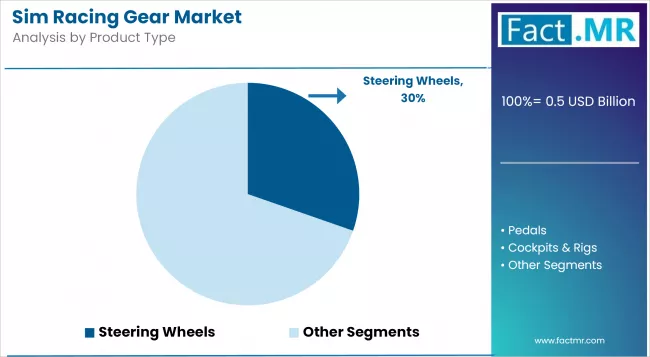
Sim Racing Gear Market Analysis By Product Type | Source: Fact.MR
The most important part in the Business of sim racing gear is the steering wheels, as they are equipped with realistic driving experience by the means of high-quality force feedback. These include budget products up to direct drive systems towards professional sim racers. These wheels provide accuracy and control, ergonomics and simulation platforms.
The major brands are aimed at improving durability, responsiveness as well as realism in order to simulate the real racing conditions. The segment has the advantage of increasing demand by esports players, amateur race car owners, and professional training facilities. On-going technology advancement like built-in displays and adjustable controls also increase the adoption hence steering wheels play a central role in market development.
Budget sim gear attracts casual gamers, price-conscious consumers
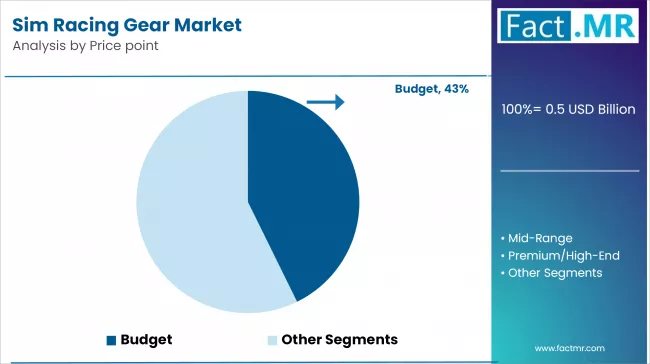
Sim Racing Gear Market Analysis By Price Point | Source: Fact.MR
The low-end market aims at amateur gamers and hobby sim racers who do not have to spend much. It has low-cost steering wheels, pedals, and low-end cockpits aimed at the entry-level user. Although they may have less advanced features than premium products, the low-price items perform well and are easy to use and are attractive to hobbyists and budget consumers.
The market segment is expanding because of increasing numbers of consumers indulging in sim racing to be entertained or to have basic training. Accessibility is offered by being available on online retail outlets and games stores. As the esports and home gaming trends are gaining more users, the low-end segment is growing, lying between the casual gamers and professional sim racers.
Gaming & Esports drive demand for high-performance simulation equipment
Gaming / Esports is a huge growth factor in the Sim Racing Gear Market. The popularity of competitive sim racing and online tourism has greatly contributed to the rise in the demand of the high performance peripheral devices such as steering wheels, pedals and motion platform. Esports athletes and professional sim racers need accurate, fast equipment that will allow them to have real-time data analysis and gameplay.
Manufacturers come up with new solutions, and they incorporate VR systems, force feedback and collection of telemetry data to improve the performance of the users. Adoption is further spurred by sponsorships, competitive leagues and streaming culture. The segment is being driven by the increasing awareness of motorsports esports, the growth of internet infrastructure and the growing trends of digital entertainment around the world.
Competitive Analysis
Key players in the sim racing gear market include Fanatec (Endor AG), Logitech, Thrustmaster, MOZA Racing, Simucube, Next Level Racing, Sim-Lab, Cube Controls, Heusinkveld Engineering and Playseat
The Sim Racing Gear Market is a very competitive market that is motivated by the technological innovation, accuracy, and user experience. Fanatec, Logitech, Thrustmaster, Simucube, and Next Level Racing are major players based on the high-performance force feedback steering wheel, motion platform and sophisticated pedals. The accurate immersion and the driving realism are provided by the powerful R&D investments that facilitate the real-time telemetry, realistic force feedback, and ergonomic designs.
The important strategies are the collaboration with esports leagues, gaming platforms, and training centers, the broadening of distribution avenues. Firms can use product customization, updates of programs and higher after sales services as a differentiation strategy. To remain competitive, the major brands are active in terms of innovation, both by upgrading hardware quality, adding VR applications, and streamlining all user-friendly interfaces of amateur and professional sim racers.
Recent Development
- In September 2025, Thrustmaster has released T248R racing wheel, which is compatible with PS5, PS4, and PC. At a price of $349.99, it has three adjustable levels of force feedback, which are termed as BOOST, and a customizable LCD display showing real time racing information. The pedal set integrated in the T-3PM includes the Hall effect technology to increase its durability and precision.
- In May 2025, Moza Racing presents a model of the Lamborghini Revuelto steering wheel, which will provide the fans with the opportunity to feel a racing design. This system with the R16 Direct Drive Wheelbase by Moza and mBooster active pedals gives the ability to sim race on a high-performance basis. The pricing information is still to be observed.
Fact.MR has provided detailed information about the price points of key manufacturers of Sim Racing Gear Market positioned across regions, sales growth, production capacity, and speculative technological expansion, in the recently published report.
Methodology and Industry Tracking Approach
The Fact.MR 2025 survey of the Sim Racing Gear Market was completed among 7,000 respondents and 20 major countries were fitted, with no less than 200 respondents per country. End-users were represented by about 70% of the users, such as professional sim racers, esports athletes, race teams, training facilities and gaming enthusiasts and the other was the industry experts including hardware suppliers, software developers, and performance analysts. The data used on the adoption of devices, the force feedback systems, motion platform, price, and market potential were gathered between September 2024 and August 2025. More than 150 secondary sources and analytical techniques were used to provide precise market projections and segmentation (regression analysis, trend extrapolation, and scenario modeling).
With Fact.MR monitoring consumer behavior, product efficacy, industry trends, and market opportunities since 2018, this report is becoming an authoritative source of information that stakeholders can rely on.
Segmentation
Segmentation of Sim Racing Gear Market
-
By Product Type :
- Steering Wheels
- Pedals
- Cockpits & Rigs
- Shifters & Handbrakes
- Motion Platforms
- Seat Frames & Accessories
-
By Price Point :
- Budget
- Mid-Range
- Premium/High-End
-
By Application :
- Professional Training
- Gaming & Esports
-
By Sales Channel :
- E-commerce platforms
- Specialty stores
- Electronics retailers
- Gaming shops
-
By End-User :
- Professional Racers
- Enthusiasts
- Casual Gamers
-
By Region :
- North America
- Latin America
- Western Europe
- Eastern Europe
- East Asia
- South Asia & Pacific
- Middle East & Africa
Frequently Asked Questions
What was the global Sim Racing Gear Market Size Reported by Fact.MR for 2025?
Who are the major players operating in the Sim Racing Gear Market?
What is the estimated valuation of the Sim Racing Gear Market in 2035?
What value CAGR did the Sim Racing Gear Market Exhibit Over the Last Five Years?
Who worked on this report


Preview the report firsthand - request a free sample
Free SampleGet the brochure for pricing and purchase details
Download PDF