- Base Value(2025): 3.30 Bn
- Estimated Value(2026): 3.55 Bn
- Forecast Value (2036): 7.46 Bn
- CAGR (2026 - 2036): 7.70%
Skin Care Supplements Market Size, Market Forecast and Outlook By Fact.MR
- The skin care supplements market was valued at USD 3.30 billion in 2025, projected to reach USD 3.55 billion in 2026, and is forecast to expand to USD 7.46 billion by 2036 at a 7.7% CAGR.
- Consumer investment in ingestible beauty products is transitioning from niche supplementation into a mainstream personal care routine across global markets.
- Clinical evidence linking specific oral collagen peptide dosages to measurable skin elasticity improvement has shifted purchasing behaviour from impulse trial toward repeat subscription models, particularly among women aged 25 to 45 seeking anti-aging and hydration outcomes supported by published dermatological research.
Summary of Skin Care Supplements Market
- Market Overview
- The market is valued at USD 3.30 billion in 2025 and is projected to reach USD 7.46 billion by 2036.
- The industry is expected to grow at a 7.7% CAGR from 2026 to 2036, creating an incremental opportunity of USD 3.91 billion.
- The market operates as a clinically driven nutraceutical sub-category where ingredient bioavailability documentation, published skin efficacy data, and multi-channel distribution across e-commerce, pharmacy, and specialty retail define competitive positioning.
- Demand and Growth Drivers
- Published clinical evidence linking oral collagen peptide supplementation to measurable skin elasticity and hydration improvement is converting consumer trial into sustained repeat purchase behaviour.
- Premiumization of the global nutraceutical category enables higher price acceptance for formulations supported by specific bioavailability claims and dermatologist endorsement.
- Social media dermatologist content creation and influencer-led education are expanding consumer awareness of ingestible beauty products beyond the traditional supplement buyer demographic.
- Among key countries, India leads at 9.1% CAGR, followed by Kuwait at 8.5%, China at 8.4%, Saudi Arabia at 8.1%, Japan at 8.0%, the USA at 7.6%, and Germany at 6.9%.
- Product and Segment View
- Skin care supplements are ingestible products containing collagen peptides, vitamins, hyaluronic acid, herbal extracts, or mineral complexes formulated to support skin elasticity, hydration, clarity, and brightness from within.
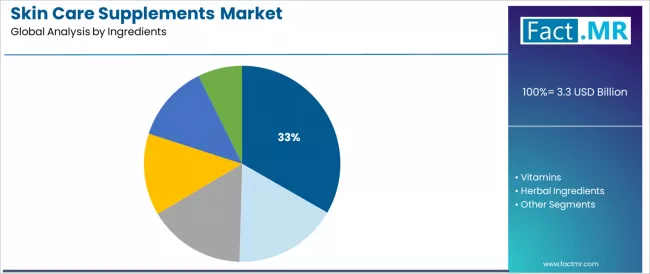
- Collagen holds 33.3% of the Ingredients segment in 2026, reflecting established clinical evidence for oral collagen peptide efficacy in improving skin hydration and reducing wrinkle depth.
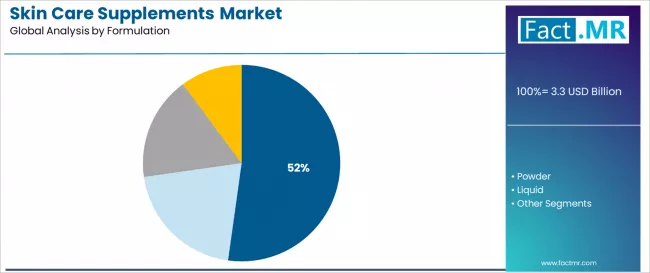
- Tablets & Capsules command 52.2% of the Formulation segment in 2026, preferred for dosage precision, shelf stability, and portability.
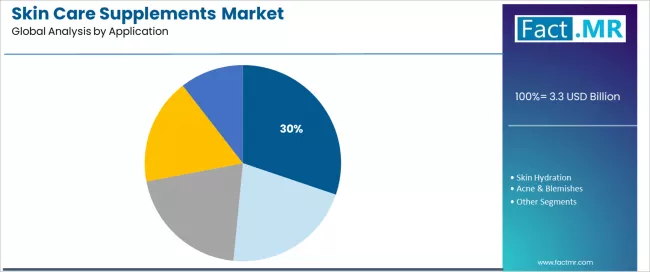
- Skin Aging accounts for 30.2% of the Application segment in 2026, representing the largest demand pool among consumers seeking measurable anti-wrinkle and elasticity outcomes.
- Scope includes collagen, vitamin, herbal, hyaluronic acid, and mineral-based oral supplements for skin health in tablet, capsule, powder, and liquid formats. Topical skincare products, prescription dermatological treatments, and general multivitamins without specific skin health claims are excluded.
- Geography and Competitive Outlook
- India, Kuwait, China, and Saudi Arabia are the fastest-growing markets, driven by rising beauty spending, social media-influenced supplement adoption, and expanding premium retail and e-commerce infrastructure.
- Japan and the USA represent mature but steady demand bases with established collagen supplement consumption patterns and clinical validation frameworks.
- Competition is shaped by clinical ingredient portfolios, published bioavailability data, and multi-channel distribution reach, with Amway Corporation, HUM Nutrition Inc., Nestle S.A., Meiji Holdings Co. Ltd., Unilever plc. (Murad LLC), and Vitabiotics Ltd. among the principal participants.
- Analyst Opinion at Fact.MR
- Shambhu Nath Jha, Principal Consultant for Consumer Products, opines: 'In my analysis, I have observed that the skin care supplements market is entering a clinical credibility bifurcation. Brands with peer-reviewed clinical trial data for specific collagen peptide molecular weights and dosage protocols are pulling ahead of competitors relying on generic ingredient labelling without published absorption or efficacy documentation. The procurement decision for pharmacy and specialty retail buyers increasingly hinges on whether a brand can present third-party validated bioavailability certificates at the product listing stage.'
- Strategic Implications / Executive Takeaways
- Brand managers must invest in randomized, placebo-controlled clinical trials for specific collagen peptide dosages to generate peer-reviewed efficacy data that supports premium retail shelf positioning and pharmacy channel listing.
- E-commerce directors should develop subscription-based supplement routine bundles aligned with consumer skin concern profiles identified through online diagnostic questionnaires to increase customer lifetime value.
- Formulation teams need to expand beyond single-ingredient collagen products into multi-ingredient synergistic formulations combining collagen with hyaluronic acid, vitamin C, and biotin for comprehensive skin health positioning.
Skin Care Supplements Market Key Takeaways
| Metric | Details |
|---|---|
| Industry Size (2026) | USD 3.55 billion |
| Industry Value (2036) | USD 7.46 billion |
| CAGR (2026 to 2036) | 7.7% |
Source: Fact.MR analysis. Updated Apr 2, 2026
Source: Future Market Insights, 2026
Between 2026 and 2036, the market is set to register an absolute dollar opportunity of USD 3.91 billion. This expansion reflects the premiumization of the nutraceutical category, where consumers accept higher price points for clinically validated formulations with specific bioavailability claims. The competitive entry of established pharmaceutical and FMCG companies into the skin supplement space is compressing margins for early-stage direct-to-consumer brands that lack clinical trial differentiation.
India leads with a 9.1% CAGR, driven by rapid adoption of collagen and vitamin-based supplements among urban consumers influenced by social media dermatologist endorsements. Kuwait follows at 8.5%, supported by high per-capita beauty spending and premium supplement retail infrastructure. China registers 8.4%, reflecting the maturation of the oral beauty category in tier-1 city e-commerce channels. Saudi Arabia advances at 8.1%, anchored by growing female consumer spending on wellness products. Japan tracks at 8.0%, maintaining its position as a mature collagen supplement market. The USA registers 7.6%, while Germany follows at 6.9%.
Imperatives for Stakeholders in Skin Care Supplements Market
Design for efficacy and bioavailability, not just ingredient inclusion
- Offer complete beauty wellness solutions: clinically-proven ingredients + bioavailability enhancement support + beauty benefit documentation + formulation optimization systems + consumer education platforms.
- Preconfigured supplement packages: anti-aging specifications, hydration optimization configurations, skin brightening programs, and combination beauty protocols for diverse consumer requirements.
Clinical readiness for beauty claim validation
- Comprehensive efficacy documentation, clinical trial systems, and quality infrastructure (bioavailability testing, stability assurance, ingredient traceability protocols).
Affordability-by-design approach
- Cost-optimized formulation portfolios, flexible subscription models, consumer loyalty programs, and transparent ingredient value documentation.
Consumer education-focused market penetration
- Established beauty science workshops + comprehensive awareness programs (ingredient benefits, consumption timing, result optimization); direct consumer engagement for brand relationship development and product confidence building.
Segmental Analysis
The market segments by ingredient into collagen, vitamins, herbal ingredients, hyaluronic acid, minerals, and other ingredients, representing the evolution from basic nutritional supplementation toward sophisticated beauty-from-within solutions with targeted skin benefits capabilities, comprehensive bioactive properties, and integrated wellness characteristics.
The formulation segmentation divides the market into tablets & capsules (52.2%), powder, liquid, and other formulations, reflecting distinct delivery objectives for convenience and dosage precision versus mixing flexibility implementation and rapid absorption validation. The application segmentation shows skin aging's commanding 30.2% position, followed by skin hydration, acne & blemishes, skin brightening, and other applications, demonstrating varied beauty concern levels and treatment approach concentrations.
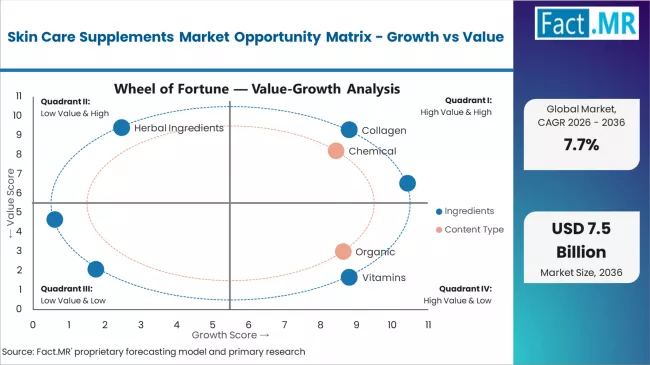
The content type segmentation reveals chemical content’s leading position, followed by organic content with fastest growth, demonstrating natural ingredient preference evolution and clean label positioning. The gender segmentation shows female's dominant position, followed by male with fastest growth, while distribution channel segmentation reveals offline's current leadership with online showing fastest expansion.
By Ingredient, Which Segment Accounts for the Dominant Share in the Market?
Skin Care Supplements Market Analysis By Ingredients | Source: Fact.MR
Collagen commands the leading position in the skin care supplements market with a 33.3% market share through superior anti-aging characteristics, including established clinical research, extensive consumer awareness documentation, and proven efficacy pathways that enable consumers to achieve visible skin improvement outcomes across varied age categories and diverse skin condition demographics.
The segment benefits from structural protein advantages through triple helix peptide composition, skin elasticity enhancement without topical application limitations, and proven wrinkle reduction documentation without requiring invasive procedures. Advanced collagen technology enables hydrolyzed peptide optimization, marine source variation, and bioavailability enhancement customization, where absorption precision and amino acid delivery represent critical beauty supplement requirements.
Type I collagen peptides hold significant share within the ingredient segment, appealing to anti-aging consumers seeking dermal support capabilities for youthful skin maintenance applications. Collagen products differentiate through proven clinical efficacy profiles, consumer familiarity advantages, and integration with established beauty-from-within protocols that enhance skin appearance confidence while maintaining safe consumption outcomes for diverse anti-aging applications.
Key market characteristics:
- Advanced bioavailability properties with hydrolyzed peptides and optimal molecular weight for efficient absorption
- Superior efficacy attributes, enabling visible wrinkle reduction and skin elasticity improvement for beauty operations
- Comprehensive scientific validation, including clinical studies and consumer trial evidence for credibility establishment
Which Formulation Category Occupies the Leading Position in the Market?
Skin Care Supplements Market Analysis By Formulation | Source: Fact.MR
Tablets & capsules demonstrate formulation leadership in the skin care supplements market with a 52.2% share due to widespread convenience requirements and established focus on precise dosage delivery, easy consumption protocols, and shelf-stable characteristics that maximize consumer compliance while maintaining appropriate ingredient protection properties.
Consumers and brands prioritize tablet/capsule formats for portability advantages, no-preparation convenience, and integration with established supplement consumption workflows that enables coordinated daily routine experiences across multiple wellness categories. The segment benefits from substantial manufacturing infrastructure maturity and consumer habit documentation that emphasizes solid dosage form delivery for consistent beauty supplement applications across diverse demographic populations.
Veggie capsule formulations capture significant share within the formulation segment, demonstrating consumer preference for plant-based delivery formats. Busy lifestyle expansion incorporates convenient supplement formats as essential wellness components for beauty routines, while travel-friendly packaging development increases on-the-go consumption with portability credentials for comprehensive lifestyle integration outcomes.
By Application, Which Segment Accounts for the Largest Market Share?
Skin Care Supplements Market Analysis By Application | Source: Fact.MR
Skin aging establishes market leadership in the skin care supplements sector with a 30.2% share due to comprehensive anti-aging requirements and sustained focus on wrinkle reduction, elasticity improvement, and collagen preservation that maximizes youthful appearance while maintaining appropriate wellness standards.
Consumers and beauty practitioners prioritize anti-aging applications for established demographic needs, visible result expectations, and integration with established skincare regimens that enables coordinated beauty experiences across multiple product categories. The segment benefits from substantial aging population demographics and beauty consciousness campaigns that emphasize supplement-based aging defense delivery for critical appearance maintenance applications.
Population aging expansion incorporates skin supplements as standard beauty protocols for mature consumers, while preventive beauty adoption increases younger demographic usage that meets early intervention requirements and ensures long-term skin health preservation capabilities.
Application dynamics include:
- Strong growth in collagen-focused formulations requiring validated anti-aging specifications and consistent efficacy documentation arrangements
- Increasing adoption in combination supplements for comprehensive skin support and multi-benefit positioning
- Rising integration with topical skincare regimens for inside-out beauty approach and holistic wellness enhancement
What are the Drivers, Restraints, and Key Trends of the Skin Care Supplements Market?
Skin Care Supplements Market Opportunity Matrix Growth Vs Value | Source: Fact.MR
| Category | Factor | Impact | Why It Matters |
|---|---|---|---|
| Driver | Rising beauty consciousness & anti-aging awareness (aging demographics, appearance focus) | ★★★★★ | Consumer beauty requirements enable supplement adoption for skin health management; increasing age-conscious demographics drive ingestible beauty consumption across global markets and diverse wellness segments. |
| Driver | Growth in wellness culture and holistic beauty approaches (inside-out beauty, preventive care) | ★★★★★ | Drives demand for systemic beauty solutions and scientifically-backed formulations; brands providing clinically-proven efficacy outcomes gain competitive advantage in evidence-focused beauty segments. |
| Driver | Social media influence and beauty standard evolution (influencer marketing, visual platforms) | ★★★★☆ | Consumers demand innovative beauty solutions and validated supplement systems; digital visibility expanding addressable segments beyond traditional skincare demographics and pharmacy supplement clientele. |
| Restraint | High product costs & premium pricing (ingredient expenses, formulation complexity) | ★★★★☆ | Price-conscious consumers face affordability limitations and value perception concerns, restricting premium supplement adoption and affecting market penetration in cost-sensitive demographics and emerging market populations. |
| Restraint | Regulatory variations & claim substantiation requirements (efficacy evidence, labeling restrictions) | ★★★☆☆ | Brands face compliance concerns and marketing limitations; increases regulatory barriers and affects market penetration in strictly-regulated jurisdictions and international expansion operations. |
| Trend | Organic ingredient development & clean label preferences (natural sourcing, chemical-free formulations) | ★★★★★ | Growing health consciousness preference for natural approaches and ingredient transparency beyond traditional synthetic formulations; organic innovations become core differentiation strategy for premium brand positioning. |
| Trend | Personalized supplement innovation & customized formulations (skin type-specific, DNA-based) | ★★★★☆ | Beauty supplementation evolving beyond one-size-fits-all toward tailored wellness protocols; personalization positioning drives enhanced consumer satisfaction and efficacy optimization in sophisticated beauty markets. |
Source: Fact.MR analysis. Updated Apr 2, 2026
Analysis of the Skin Care Supplements Market by Key Countries
The skin care supplements market demonstrates robust regional growth dynamics with emerging leaders including India (9.1% CAGR) and Kuwait (8.5% CAGR) driving expansion through beauty consciousness programs and premium wellness infrastructure development. Strong performers encompass China (8.4% CAGR), Saudi Arabia (8.1% CAGR), and Japan (8.0% CAGR), benefiting from established beauty culture infrastructure and supplement consumption demographics. Developed markets feature USA (7.6% CAGR) and Germany (6.9% CAGR), where wellness trend normalization and consumer expertise support consistent growth patterns.
Regional synthesis reveals Asian markets leading adoption through comprehensive beauty ritual positioning and nutraceutical investment expansion, while Middle Eastern countries demonstrate measured growth potential supported by premium product preferences and disposable income influence. North American markets show solid development driven by anti-aging culture integration and advanced supplement infrastructure.
.webp "Top Country Growth Comparison Skin Care Supplements Market Cagr (2026 2036)")
Top Country Growth Comparison Skin Care Supplements Market Cagr (2026 2036) | Source: Fact.MR
| Region/Country | 2025 to 2035 Growth | How to win | What to watch out |
|---|---|---|---|
| India | 9.1% | Focus on affordable innovation portfolios | Distribution challenges; consumer education needs |
| Kuwait | 8.5% | Lead with premium positioning | Market size; dependency on imports |
| China | 8.4% | Provide localized formulations | Regulatory complexity; competition intensity |
| Saudi Arabia | 8.1% | Offer luxury product strategies | Conservative segments; price sensitivity |
| Japan | 8.0% | Maintain quality excellence focus | Market maturity; aging demographics |
| USA | 7.6% | Deliver clinical validation solutions | Market saturation; regulatory scrutiny |
| Germany | 6.9% | Push clean label programs | Skepticism; stringent regulations |
Source: Fact.MR analysis. Updated Apr 2, 2026
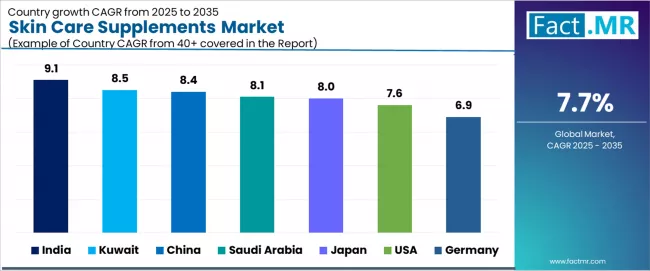
Skin Care Supplements Market Cagr Analysis By Country | Source: Fact.MR
India Drives Fastest Market Growth
India establishes fastest market growth through progressive beauty consciousness expansion and comprehensive nutraceutical retail infrastructure development, positioning skin care supplements as essential wellness products in urban pharmacy chains and emerging e-commerce platforms.
The country's 9.1% growth rate reflects rising middle-class income levels supporting premium beauty spending and growing supplement awareness segments that encourage the deployment of affordable beauty supplement products in diverse consumption settings.
Growth concentrates in major metropolitan areas, including Mumbai, Delhi, and Bangalore, where modern retail channels showcase increasing capacity for international brand adoption that appeals to beauty-conscious consumers demanding validated skin improvement and wellness benefit outcomes.
Indian consumers are developing sophisticated beauty supplement preferences that combine traditional Ayurvedic ingredients with modern collagen formulations, including domestic brand expansion and international product entry growth. Distribution channels through pharmacy chains and digital commerce platforms expand market access, while beauty influencer initiatives support adoption across diverse age groups and income specialization levels.
Kuwait Emerges as Premium Consumption Leader
In Kuwait City and major urban centers, premium retail outlets and luxury beauty stores are adopting skin care supplement portfolios as essential wellness products for affluent consumer operations, driven by high disposable income demographics and elevation of beauty standard expectations that emphasize the importance of premium quality supplementation.
The market holds an 8.5% growth rate, supported by retail infrastructure sophistication and luxury product preference investment that promote supplement adoption for premium beauty-focused applications. Kuwaiti consumers are favoring imported brand platforms that provide comprehensive quality positioning and prestige packaging evidence, particularly appealing in luxury retail settings where brand heritage and international recognition represent critical purchase factors.
Market expansion benefits from substantial affluent population presence and premium retail channel establishment that enable widespread adoption of high-end beauty supplement methodologies for diverse wellness applications. Industry adoption follows patterns established in luxury beauty excellence, where brand prestige advantages and premium positioning documentation drive consumer confidence and repeat purchase achievement.
China Shows Beauty Innovation Leadership
China establishes beauty innovation leadership through comprehensive supplement manufacturing infrastructure and established beauty consciousness ecosystem, integrating skin care supplements across e-commerce platforms, specialty beauty stores, and pharmacy networks.
The country's 8.4% growth rate reflects established beauty ritual maturity and sophisticated wellness lifestyle levels that support widespread deployment of innovative supplement products in urban and online applications. Growth concentrates in established metropolitan regions, including Shanghai, Beijing, and Guangzhou, where consumers showcase advanced beauty supplement adoption that appeals to image-conscious individuals seeking predictable skin outcomes and comprehensive ingredient documentation.
Chinese consumers leverage established digital commerce relationships and comprehensive product variety frameworks, including livestream shopping integration and KOL recommendation platforms that create consumption confidence and beauty trend assurance. The market benefits from substantial young professional demographics and social media beauty culture that encourage premium product purchases while supporting continuous innovation investments and ingredient technology validation funding.
Saudi Arabia Shows Premium Wellness Integration
Saudi Arabia's progressive consumer market demonstrates established skin care supplement adoption with documented premium emphasis in product selection and wellness protocol execution through luxury retail chains and specialized beauty boutiques. The country maintains an 8.1% growth rate, leveraging rising beauty consciousness and expanding modern retail infrastructure in urban centers.
Major consumption markets, including Riyadh, Jeddah, and Dammam regions, showcase quality-driven beauty priorities where skin care supplements integrate with established luxury beauty cultures and comprehensive retail accessibility to optimize consumer wellness outcomes and maintain premium product access under evolving beauty retail requirements.
Saudi consumers prioritize brand reputation strategies and comprehensive quality integration in supplement selection, creating demand for internationally recognized products with premium positioning characteristics, including clinical validation, imported ingredient sourcing, and luxury packaging presentation. The market benefits from established high-income demographics and growing female workforce participation that provide premium positioning opportunities and maintain alignment with Saudi beauty consumption patterns.
Japan Shows Clinical Quality Integration
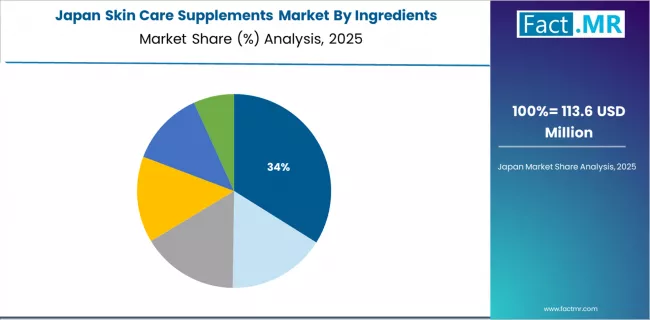
Skin Care Supplements Market Japan Market Share Analysis By Ingredients | Source: Fact.MR
Japan's mature beauty market demonstrates sophisticated skin care supplement integration with documented efficacy emphasis in ingredient selection and formulation protocol precision through specialized beauty supplement retailers and convenience store networks. The country leverages rigorous quality standards and beauty science approaches to maintain an 8.0% growth rate.
Premium consumption markets, including Tokyo, Osaka, and Nagoya, showcase evidence-driven supplement priorities where skin care products integrate with established beauty-from-within cultures and thorough clinical testing practices to optimize skin health confidence and ensure appropriate beauty benefit assessment.
Japanese consumers prioritize comprehensive clinical documentation requirements and systematic quality verification in supplement selection, creating demand for scientifically-validated products with extensive research characteristics, including clinical trial evidence, ingredient purity certification, and efficacy substantiation data. The market benefits from established beauty supplement tradition and aging population beauty consciousness that provide premium positioning opportunities and compliance with strict Japanese supplement quality regulations.
USA shows Anti-Aging Culture Integration
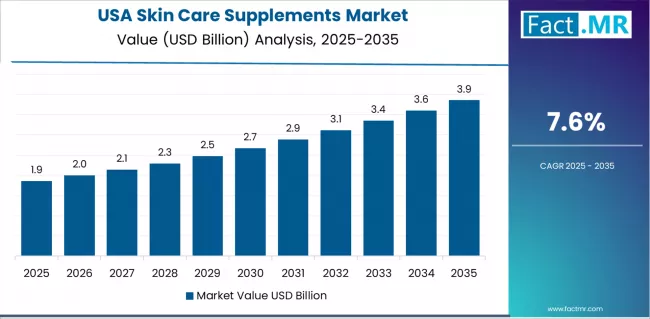
Skin Care Supplements Market Country Value Analysis | Source: Fact.MR
USA's mature wellness market demonstrates established skin care supplement adoption with documented convenience emphasis in product accessibility and consumption protocol execution through mass retail channels and specialized supplement stores. The country maintains a 7.6% growth rate, leveraging established anti-aging culture and comprehensive beauty supplement awareness in consumer populations.
Major consumption markets, including California, New York, and Florida regions, showcase wellness-driven beauty priorities where skin care supplements integrate with established holistic health cultures and comprehensive product education to optimize appearance outcomes and maintain convenient supplement access under evolving beauty wellness requirements.
American consumers prioritize clinical validation strategies and comprehensive benefit integration in supplement selection, creating demand for evidence-based products with transparency characteristics, including ingredient disclosure, third-party testing, and efficacy claim substantiation. The market benefits from established dietary supplement infrastructure and influencer marketing culture that provide brand positioning opportunities and maintain alignment with FDA dietary supplement regulations.
Germany demonstrates Clean Label Preferences
Germany's advanced consumer market demonstrates progressive skin care supplement adoption with documented natural standards in formulation methodology and ingredient protocol execution through specialized health food stores and organic retail channels. The country maintains a 6.9% growth rate, leveraging established organic product preference and comprehensive ingredient skepticism frameworks in supplement consumption.
Major retail centers, including Berlin and Munich regions, showcase quality-driven supplement priorities where skin care products integrate with established clean label standards and meticulous ingredient verification practices to optimize consumer trust and maintain formulation transparency under comprehensive consumer protection supervision.
German consumers prioritize comprehensive ingredient transparency documentation and natural sourcing assurance in supplement program selection, creating demand for organic-certified products with extensive clean characteristics, including synthetic-free formulation, sustainable sourcing verification, and comprehensive testing documentation. The market benefits from established organic retail reputation and environmentally-conscious demographics that provide premium positioning opportunities and comply with strict German supplement quality standards.
Competitive Landscape of the Skin Care Supplements Market
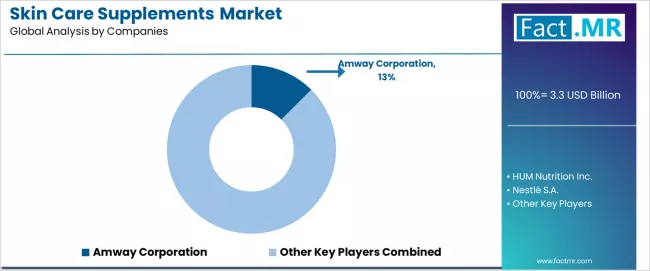
Skin Care Supplements Market Analysis By Company | Source: Fact.MR
The skin care supplements market exhibits a moderately fragmented competitive structure with approximately 50-80 active players operating across global beauty supplement networks and regional wellness distribution portfolios. Amway Corporation maintains market leadership at a 12.5% share, reflecting strong brand portfolio positioning across diverse supplement categories with sophisticated global distribution strategies.
This competitive landscape demonstrates the maturation of beauty supplement technology, where established players leverage brand recognition advantages, extensive clinical research documentation, and consumer relationship programs to maintain strong positions, while emerging clean beauty brands and specialized collagen companies create niche opportunities through innovative ingredient offerings and targeted demographic strategies.
Market leadership is maintained through several critical competitive advantages extending beyond formulation capabilities and product portfolios. Global distribution networks enable leading players to navigate diverse retail requirements and access varied consumer segments including mass market retailers, specialty beauty stores, and e-commerce platforms.
Marketing infrastructure and influencer partnership program availability represent crucial differentiators in beauty supplement categories, where decades of consumer engagement expertise, clinical validation protocols, and beauty science communication frameworks create purchasing preference among appearance-focused consumers.
Manufacturing efficiency in supplement production facilities, supply chain ingredient sourcing management, and quality control systems separate major brands from smaller competitors, while comprehensive clinical documentation addressing efficacy studies, consumer satisfaction data, and before-after evidence strengthen market position and consumer confidence.
The market demonstrates emerging differentiation opportunities in organic supplement categories and personalized formulation technologies, where traditional chemical-based methodologies face competition from clean beauty-focused entrants offering natural advantages.
Significant competitive advantages persist in established collagen supplement categories through comprehensive clinical evidence portfolios and consumer awareness depth. Premium positioning strategies with clinically-proven ingredients and bioavailability enhancement capabilities command margin premiums through superior efficacy demonstration and scientific credibility integration.
Specialized product portfolios combining multiple beauty benefits with targeted skin applications create comprehensive positioning that justifies higher price points beyond commodity supplement competition. Integrated beauty wellness offerings emphasizing complementary product compatibility, unified brand messaging, and cross-category beauty programs generate consumer loyalty and portfolio preferences beyond transactional supplement purchases.
| Stakeholder | What they actually control | Typical strengths | Typical blind spots |
|---|---|---|---|
| Global wellness corporations | Comprehensive brand portfolios; distribution networks; marketing budgets | Brand recognition; clinical research; consumer trust; scale economies | Innovation speed; niche targeting; clean beauty positioning; millennial appeal |
| Specialized beauty supplement companies | Innovation expertise; formulation technology; beauty positioning | Product differentiation; clinical validation; consumer engagement; brand authenticity | Distribution infrastructure; price competitiveness; global reach; mass market appeal |
| Clean beauty brands | Natural positioning; transparency; sustainability credentials | Consumer loyalty; premium positioning; ingredient innovation; mission alignment | Clinical validation; scale economics; distribution access; mainstream penetration |
| Regional manufacturers | Local production; market understanding; pricing flexibility | Affordability positioning; cultural alignment; distribution proximity; agility | International expansion; clinical research; brand recognition; innovation resources |
| Retailers (private label) | Shelf space control; consumer data; margin optimization | Value positioning; convenience; volume leverage; loyalty integration | Clinical validation; brand building; innovation leadership; premium positioning |
Source: Fact.MR analysis. Updated Apr 2, 2026
Key Players in the Skin Care Supplements Market
- Amway Corporation
- HUM Nutrition Inc.
- Nestlé S.A.
- Meiji Holdings Co. Ltd.
- Plix- The Plant Fix (Vegicle Health & Nutrition Pvt. Ltd.)
- Unilever plc. (Murad LLC)
- Johnson & Johnson Services Inc. (Neutrogena Corporation)
- Perricone MD Ltd.
- TCH Health LLC (Reserveage Nutrition)
- Vitabiotics Ltd.
Scope of the Report
| Metric | Value |
|---|---|
| Quantitative Units | USD 3.55 billion to USD 7.46 billion, at a CAGR of 7.70% |
| Market Definition | Skin care supplements encompass orally ingested nutraceutical products containing collagen, vitamins, hyaluronic acid, herbal extracts, and minerals formulated to improve skin elasticity, hydration, clarity, and brightness, distributed through e-commerce, pharmacy, supermarket, and specialty retail channels globally. |
| Ingredients Segmentation | Collagen, Vitamins, Herbal Ingredients, Hyaluronic Acid, Minerals, Others |
| Content Type Segmentation | Chemical, Organic |
| Formulation Segmentation | Tablets & Capsules, Powder, Liquid, Others |
| Application Segmentation | Skin Aging, Skin Hydration, Acne & Blemishes, Skin Brightening, Others |
| Gender Segmentation | Female, Male |
| Regions Covered | India, Kuwait, China, Saudi Arabia, Japan, USA, Germany |
| Key Companies Profiled | Amway Corporation, HUM Nutrition Inc., Nestle S.A., Meiji Holdings Co. Ltd., Plix- The Plant Fix (Vegicle Health & Nutrition Pvt. Ltd.), Unilever plc. (Murad LLC), Johnson & Johnson Services Inc. (Neutrogena Corporation), Perricone MD Ltd., TCH Health LLC (Reserveage Nutrition), Vitabiotics Ltd. |
| Forecast Period | 2026 to 2036 |
| Approach | Forecasting models apply a bottom-up methodology starting with country-level beauty supplement retail audit data and ingredient-category sales metrics, cross-validated against nutraceutical industry association reports and e-commerce transaction volumes. |
Source: Fact.MR analysis. Updated Apr 2, 2026
Skin Care Supplements Market by Segments
-
By Ingredients :
- Collagen
- Vitamins
- Herbal Ingredients
- Hyaluronic Acid
- Minerals
- Others
-
By Content Type :
- Chemical
- Organic
-
By Formulation :
- Tablets & Capsules
- Powder
- Liquid
- Others
-
By Application :
- Skin Aging
- Skin Hydration
- Acne & Blemishes
- Skin Brightening
- Others
-
By Gender:
- Female
- Male
-
By Distribution Channel :
- Online
- E-commerce
- Company Website
- Offline
- Pharmacies
- Supermarkets
- Others
- Online
-
By Region :
- North America
- USA
- Canada
- Mexico
- Europe
- Germany
- UK
- France
- Italy
- Spain
- Rest of Europe
- Asia Pacific
- China
- India
- Japan
- South Korea
- ASEAN
- Australia & New Zealand
- Rest of Asia Pacific
- Middle East & Africa
- Saudi Arabia
- Kuwait
- GCC Countries
- South Africa
- Rest of Middle East & Africa
- Latin America
- Brazil
- Rest of Latin America
- North America
Bibliography
- Council for Responsible Nutrition. (2025). Dietary supplement consumer survey: Global usage and trends report. CRN.
- European Food Safety Authority. (2024). Scientific opinion on collagen peptide health claims. EFSA.
- U.S. Food and Drug Administration. (2024). Dietary supplement labelling guidance for industry. FDA.
- Japan Health and Nutrition Food Association. (2025). Functional food and supplement market annual report. JHNFA.
- World Health Organization. (2024). Global nutrition monitoring framework: Micronutrient supplement usage data. WHO.
- This bibliography is provided for reader reference. The full Fact.MR report contains the complete reference list with primary research documentation.
This Report Addresses
- Market sizing and quantitative forecast metrics detailing skin care supplement expenditure across global consumer segments through 2036.
- Segmentation analysis mapping adoption velocity across collagen, vitamin, herbal, hyaluronic acid, and mineral ingredient categories and evaluating formulation format preferences.
- Country-level deployment intelligence comparing beauty supplement retail infrastructure, e-commerce penetration, and regulatory frameworks across India, Kuwait, China, Saudi Arabia, Japan, USA, and Germany.
- Competitive posture evaluation tracking clinical ingredient portfolios, published bioavailability data, and multi-channel distribution strategies among leading supplement brands.
- Gender-specific demand assessment analyzing purchasing behaviour differences and product formulation preferences between female and male consumer segments.
- Regulatory compliance assessment identifying dietary supplement registration, labelling, and health claim requirements across covered country markets.
- Custom data delivery formats encompassing interactive dashboards, raw Excel datasets, and comprehensive PDF narrative reports.
Skin Care Supplements Market Definition
Skin care supplements are orally ingested nutraceutical products containing bioactive ingredients such as collagen peptides, vitamins, hyaluronic acid, herbal extracts, and mineral complexes formulated to support skin health, elasticity, hydration, and appearance. Product formats include tablets, capsules, powders, and liquid formulations. The market covers manufacture, distribution, and retail sale of these products globally.
Skin Care Supplements Market Inclusions
Market scope includes collagen, vitamin, herbal ingredient, hyaluronic acid, and mineral-based oral supplements marketed for skin health benefits. Formulation coverage spans tablets and capsules, powder, liquid, and other delivery formats. Application coverage includes skin aging, skin hydration, acne and blemishes, skin brightening, and others. Gender segmentation covers female and male consumers. Country coverage spans India, Kuwait, China, Saudi Arabia, Japan, USA, and Germany. Forecast covers 2026 to 2036 with base year 2025.
Skin Care Supplements Market Exclusions
Topical skincare creams, serums, and lotions are excluded. Prescription dermatological treatments, general multivitamins without declared skin health claims, and injectable cosmetic fillers fall outside the scope.
Skin Care Supplements Market Research Methodology
- Primary Research: Analysts engaged with nutraceutical brand directors, pharmacy chain category managers, and dermatological research consultants to map consumer adoption triggers, clinical evidence requirements, and channel expansion strategies.
- Desk Research: Data collection phases aggregated national dietary supplement regulation filings, nutraceutical industry association market reports, and e-commerce platform beauty supplement sales metrics across covered countries.
- Market-Sizing and Forecasting: Baseline values derive from a bottom-up aggregation of skin care supplement retail and e-commerce sales volumes by ingredient category and formulation type, applying country-specific beauty spending growth indices to project adoption velocity.
- Data Validation and Update Cycle: Projections are tested against publicly reported nutraceutical market data from national supplement industry associations and retail audit figures from trade publications.
Frequently Asked Questions
How large is the skin care supplements market in 2026?
What will be the market size by 2036?
What is the expected demand growth between 2026 and 2036?
Which Ingredient leads the market in 2026?
Which Formulation type commands the largest share?
Which country is the fastest-growing market?
Which Application segment is the largest?
What is excluded from the scope?
Who worked on this report


Preview the report firsthand - request a free sample
Free SampleGet the brochure for pricing and purchase details
Download PDF