- Market Value (2025): USD 2.5 Bn
- Estimated Value (2026): USD 2.7 Bn
- Forecast Value (2036): USD 7.0 Bn
- CAGR (2026-2036): 10.0%
What is the Skin Tightening Market forecast to be worth by 2036?
USD 2.7 billion in 2026 to USD 7.0 billion by 2036, at 10.0% CAGR.
- The Skin Tightening Market was valued at USD 2.5 billion in 2025.
- Demand is projected to increase from USD 2.7 billion in 2026 to USD 7.0 billion by 2036.
- The market is forecast to record 10.0% CAGR from 2026 to 2036 as dermatology clinics and medspa centers invest in device based systems.
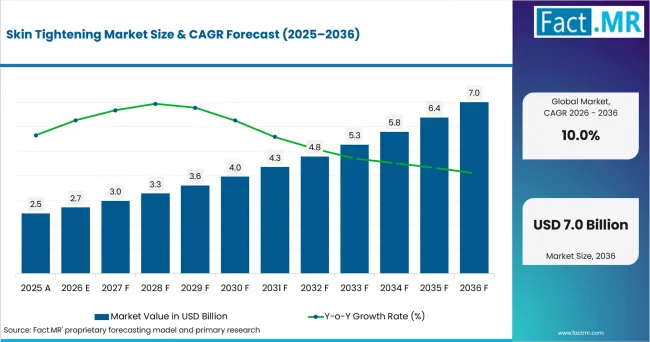
Skin Tightening Market Value Analysis | Source: Fact.MR
What are the defining numbers behind Skin Tightening Market growth?
USD 4.3 billion absolute opportunity by 2036, led by energy based devices, facial procedures and dermatology clinics.
- Demand Drivers in the Market
- Dermatology clinics need predictable systems that can treat facial laxity, jawline contouring and neck rejuvenation during scheduled outpatient visits.
- Medspa centers value device based treatment systems because repeat sessions support package based patient programs and smoother calendar planning.
- ISAPS reported in June 2025 that aesthetic procedures reached close to 38 million in 2024, including 20.5 million non-surgical procedures.
- Equipment distributors and direct sales teams compete on training, service coverage and device uptime because clinic schedules depend on reliable systems.
- Key Segments Analyzed
- By Product: Energy Based Skin Tightening Devices is expected to hold 68.40% share in 2026 because they cover RF, ultrasound and laser systems used in professional tightening.
- By Application: Facial Skin Tightening is expected to hold 74.10% share in 2026 as facial laxity, jawline contouring and cheek lifting remain the most common clinic entry points.
- By End Use: Dermatology Clinics is expected to hold 62.80% share in 2026 given that clinical oversight and repeat patient flow favor provider owned device programs.
- By Technology: Energy Based Aesthetic Technology is expected to hold 51.60% share in 2026 since thermal and focused energy platforms define the core treatment pathway.
- By Formulation: Device Based Treatment Systems is expected to hold 77.20% share in 2026 while capital equipment carries the treatment value more directly than topical add-ons.
- By Distribution Channel: Direct Aesthetic Device Sales is expected to hold 44.90% share in 2026 owing to manufacturers and authorized teams stay close to providers during training and service setup.
- Analyst Opinion at Fact.MR
- Shambhu Nath Jha, Principal Consultant at Fact.MR, states, "Skin tightening is becoming a clinic workflow decision and a device choice. Providers are expected to judge platforms by treatment depth, patient selection, staff training and service response. Suppliers that combine clear indications, clinical education and dependable after-sales support are better placed to win repeat equipment orders."
- Strategic Implications
- Manufacturers should document treatment indications, energy delivery limits and training protocols so clinics can match devices to patient needs.
- Dermatology clinics should link device selection with appointment capacity, patient screening and post-treatment follow-up.
- Distributors should build technician coverage before expanding city reach because downtime directly affects clinic revenue.
- Medspa operators should separate facial tightening, body tightening and maintenance packages so patients understand the care plan.
Germany leads at 11.5% CAGR through specialist dermatology demand and an ageing patient base. Brazil follows at 10.5% as private aesthetic clinics expand low-downtime facial tightening services. The USA reaches 9.5% through a large provider base and stable minimally invasive treatment demand. The UK records 8.5% through trained clinic settings and provider qualification, while Japan reaches 7.5% through ageing demographics and clinic interest in facial tightening.
How does the Skin Tightening Market break down by segment?
Energy based skin tightening devices lead at 68.40%; device based treatment systems lead at 77.20%.
Which Product leads?
Energy Based Skin Tightening Devices hold 68.40% share in 2026.
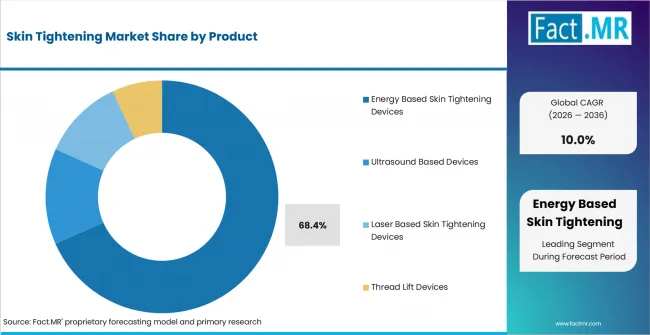
Skin Tightening Market Analysis By Product | Source: Fact.MR
Energy based devices lead because RF, microneedle RF, ultrasound and laser systems stay closest to the treatment result. The same technology boundary overlaps with energy based aesthetic devices, where professional platforms use light, electrical, acoustic or thermal energy in clinic settings.
What leads the Application segment?
Facial Skin Tightening holds 74.10% share in 2026.
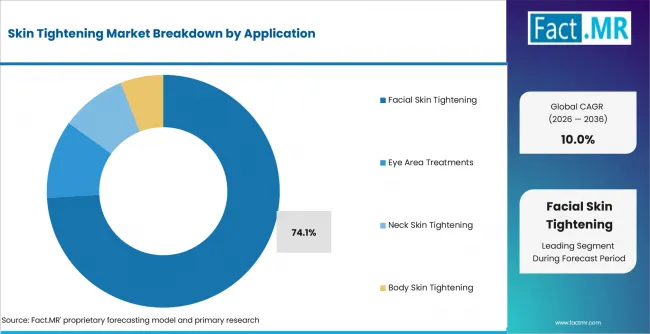
Skin Tightening Market Analysis By Application | Source: Fact.MR
Facial treatment leads because early laxity is most visible around the jawline, cheeks and eye area. ASPS reported in June 2025 that minimally invasive treatments rose 1.5% in 2024. Providers therefore keep facial tightening on the menu as an accessible step before surgery or more intensive procedures.
How does End Use shape demand?
Dermatology Clinics hold 62.80% share in 2026.
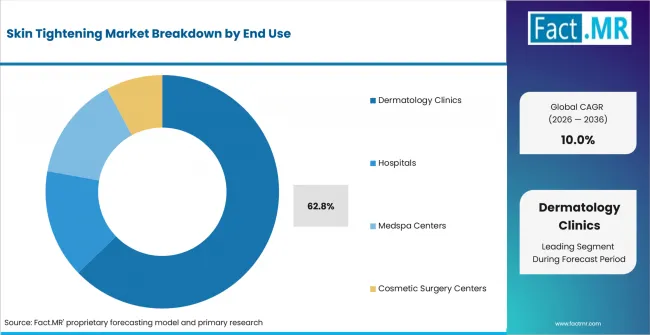
Skin Tightening Market Analysis By End Use | Source: Fact.MR
Dermatology clinics lead because energy based treatments require patient screening, trained operation and realistic expectations. These settings can pair device treatments with skin assessment and follow-up visits. Related equipment demand is tracked in dermatology devices, where clinical use and equipment support shape buying behavior.
What supports Energy Based Aesthetic Technology?
Energy Based Aesthetic Technology holds 51.60% share in 2026.
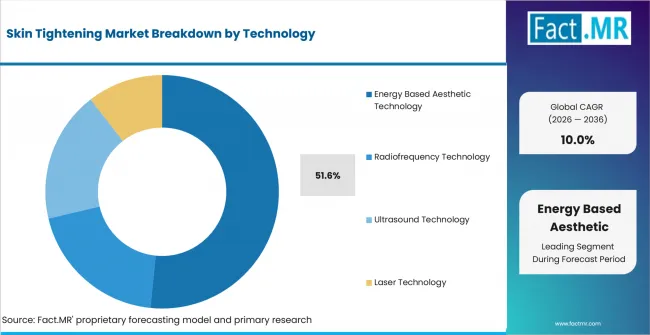
Skin Tightening Market Analysis By Technology | Source: Fact.MR
Thermal energy systems, multi-frequency RF and focused ultrasound technology support controlled tightening without open surgery. Aesthetic laser and energy device category shows how professional RF, ultrasound and laser platforms sit next to skin rejuvenation and body contouring use cases.
Which Formulation leads?
Device Based Treatment Systems hold 77.20% share in 2026.
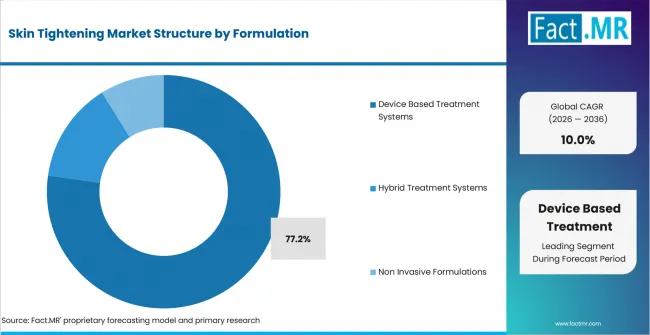
Skin Tightening Market Analysis By Formulation | Source: Fact.MR
Device based treatment systems lead because the equipment determines treatment depth, session duration and provider workflow. Related interest in non-surgical skin tightening devices also reflects the shift toward hardware guided aesthetic programs in clinic settings.
How does Distribution Channel affect sales?
Direct Aesthetic Device Sales hold 44.90% share in 2026.
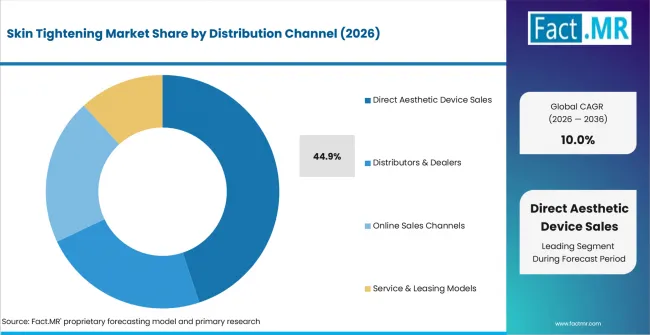
Skin Tightening Market Analysis By Distribution Channel | Source: Fact.MR
Direct sales lead because manufacturers need to explain indications, training and service terms before a clinic commits to an energy platform. Dealers remain relevant where local maintenance and financing are required. Online channels support smaller equipment, but clinic grade systems depend on demonstrations and ongoing technical support.
What is accelerating Skin Tightening Market adoption, and what is holding it back?
Adoption is supported by non-surgical procedure demand and aging demographics; barriers center on safety, regulation and capital cost.
| DRIVER | DIRECTIONAL IMPACT | GEOGRAPHIC RELEVANCE | IMPACT TIMELINE |
|---|---|---|---|
| Low-downtime facial tightening programs | Positive | Global | Short term |
| Aging population and visible skin laxity concerns | Positive | Germany, Japan, USA, UK | Medium term |
| Clinic interest in RF and ultrasound platforms | Positive | North America, Western Europe, East Asia | Medium term |
| Direct training and service support from device makers | Positive | Global | Long term |
Source: Fact.MR analysis. Updated Sep 1, 2026
- Low-downtime facial tightening programs give clinics a repeatable service for patients before surgical lifting becomes the preferred treatment route.
- Aging population growth raises the patient pool for facial and neck laxity evaluation in mature aesthetic markets.
- Clinic interest in RF and ultrasound platforms helps providers position tightening as a scheduled outpatient treatment.
| OPPORTUNITY | DIRECTIONAL IMPACT | GEOGRAPHIC RELEVANCE | IMPACT TIMELINE |
|---|---|---|---|
| Combination energy and body-area programs | Positive | USA, Brazil, Japan | Medium term |
| Training-led direct sales models | Positive | Global | Short term |
| Service and leasing models for medspa chains | Positive | North America, Europe | Long term |
Source: Fact.MR analysis. Updated Sep 1, 2026
- Combination energy and body-area programs create a route to facial, neck, arm and abdominal tightening packages.
- Training-led direct sales models help manufacturers reduce misuse risk and support provider confidence.
- Service and leasing models lower entry barriers for clinics seeking equipment access without a large upfront purchase.
| RESTRAINT | DIRECTIONAL IMPACT | GEOGRAPHIC RELEVANCE | IMPACT TIMELINE |
|---|---|---|---|
| RF microneedling safety concerns | Constraining | USA, Europe | Short term |
| Medical device regulatory documentation | Constraining | Brazil, Japan, Germany, UK | Medium term |
| High equipment cost and maintenance needs | Constraining | Global | Medium term |
Source: Fact.MR analysis. Updated Sep 1, 2026
- RF microneedling safety concerns require clear patient screening and operator training.
- Medical device documentation raises the effort needed to launch or import clinic grade systems in regulated markets.
- High equipment cost and maintenance needs can delay adoption where clinics lack enough treatment volume.
Which countries are scaling the Skin Tightening Market through 2036?
- The country comparison spans 4.0 percentage points and forms three practical growth bands across the forecast period.
- Germany remains 1.0 percentage point above Brazil through specialist dermatology demand and an older patient base.
- Brazil remains 1.0 percentage point above the USA as private aesthetic providers widen low-downtime treatment menus.
- The USA remains 1.0 percentage point above the UK through a large provider base and stable minimally invasive treatment demand.
- The UK remains 1.0 percentage point above Japan as provider qualification and clinic governance shape adoption.
- Japan closes the displayed range through aging demographics and clinic interest in facial tightening.
Comparable CAGRs can create different entry conditions due to clinic density, treatment affordability, device regulation and provider training depth. Full report coverage includes North America, Latin America, Western Europe, Eastern Europe, East Asia, South Asia and Pacific, Middle East and Africa.
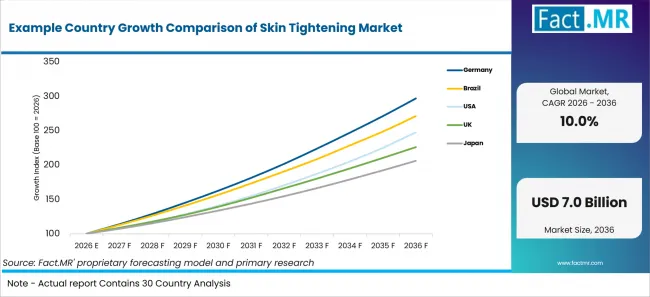
Example Country Growth Comparison Of Skin Tightening Market | Source: Fact.MR
| Country | CAGR (2026-2036) |
|---|---|
| Germany | 11.5% |
| Brazil | 10.5% |
| USA | 9.5% |
| UK | 8.5% |
| Japan | 7.5% |
Source: Fact.MR analysis. Updated Sep 1, 2026
What supports Germany adoption?
11.5% CAGR, supported by specialist dermatology demand and demographic context.
Destatis reported in May 2026 that Germany had 19.0 million residents aged 65 and older in 2024. Dermatology clinics evaluate RF and ultrasound systems for facial and neck tightening, with direct sales supporting training, maintenance and treatment protocols.
How is Brazil scaling demand?
10.5% CAGR, supported by private aesthetic clinic expansion and facial treatment interest.
IBGE reported in December 2025 that Brazil's population aged 60 and older increased from 22.0 million in 2012 to 34.1 million in 2024. Private clinics expand low-downtime facial tightening, with distributor support covering service, installation and staff training.
What supports USA adoption?
9.5% CAGR, supported by a large provider base and stable minimally invasive treatment demand.
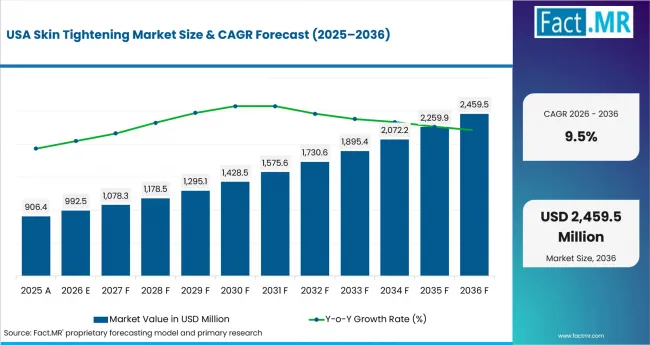
Skin Tightening Market Country Value Analysis | Source: Fact.MR
The U.S. Census Bureau reported in June 2025 that the U.S. population aged 65 and older rose 3.1% to 61.2 million in 2024. Dermatology and medspa providers expand facial tightening, supported by manufacturer-led training for RF and ultrasound systems.
What supports the United Kingdom's growth?
8.5% CAGR, supported by trained clinic settings and provider qualification.
ONS reported in July 2026 that people aged 65 and over accounted for 19.1% of England's population in mid-2025. Trained clinic settings, provider qualification and equipment support shape adoption.
How does Japan perform?
7.5% CAGR, supported by aging demographics and clinic interest in facial tightening.
Japan's Statistics Bureau reported that people aged 65 and older totaled 36.243 million in 2024 and represented 29.3% of the population. Clinics use ultrasound and RF systems for facial laxity in appointment-based care, with authorized local representation supporting device-market access.
Who leads the Skin Tightening Market?
Competition centers on energy delivery, treatment indications, clinical training and after-sales service. Merz Aesthetics participates through Ultherapy PRIME, while Alma Lasers supports energy-based aesthetic treatment offerings through Alma Harmony, whose global debut the company announced in a release datelined March 26, 2025. Cynosure Lutronic participates through XERF structural skin tightening and a broader portfolio of RF-based aesthetic systems for professional providers.
Candela Medical serves professional-provider demand through RF-based aesthetic systems, while Sofwave Medical serves professional providers through ultrasound-based skin-tightening technology.
Which companies are the key providers?
Key providers include Merz Aesthetics, Alma Lasers, Cynosure Lutronic, Candela Medical and Sofwave Medical Ltd.
- Merz Aesthetics
- Alma Lasers
- Cynosure Lutronic
- Candela Medical
- Sofwave Medical Ltd.
Bibliography
- International Society of Aesthetic Plastic Surgery. (2025). 2025 ISAPS international survey on aesthetic/cosmetic procedures performed in 2024.
- American Society of Plastic Surgeons. (2025, June 25). Interest in aesthetic health remained consistent despite economic uncertainty in 2024, according to new report from American Society of Plastic Surgeons.
- U.S. Food and Drug Administration. (2025, October 15). Potential risks with certain uses of radiofrequency (RF) microneedling: FDA safety communication.
- Merz Aesthetics. (2025, January 23). Merz Aesthetics launches Ultherapy PRIME® in the EMEA region at the 2025 IMCAS World Congress.
- Alma Lasers. (2025, April 10). Alma introduces Alma Harmony, a state-of-the-art aesthetic platform for next-level in-office treatments.
- Cynosure Lutronic. (2025, September 29). A new era of structural skin tightening: Meet the XERF™ RF system.
- U.S. Census Bureau. (2025, June 26). Older adults outnumber children in 11 states and nearly half of U.S. counties.
- Statistisches Bundesamt (Destatis). (2026, May 18). Ältere Menschen: Die Bevölkerungsgruppe der älteren Menschen ab 65 Jahren.
- Instituto Brasileiro de Geografia e Estatística. (2025, December 3). IBGE shows that one out of every four older adults were employed in 2024.
- Office for National Statistics. (2026, July 29). Population estimates for England and Wales: Mid-2025.
- Statistics Bureau of Japan. (2025, April 14). Current population estimates as of October 1, 2024.
This Report Answers
- The report explains where skin tightening devices are used across product, application, end use and technology.
- Segment analysis identifies the leading subsegments and the provider reasons behind their 2026 shares.
- Country analysis reviews Germany, Brazil, the USA, the UK and Japan using official demographic or regulatory evidence.
- Competitive analysis reviews active providers tied to ultrasound, RF, laser and professional aesthetic equipment.
- Application analysis assesses how facial, neck and body tightening influence clinic purchasing and service decisions.
What does the Skin Tightening Market cover?
The Skin Tightening Market covers energy based systems, thread systems and related treatment models used by professional providers. It sits close to skin rejuvenation devices, where equipment is used to improve texture and appearance in professional care pathways.
The assessment includes facial, eye area, neck and body applications. It also considers non-invasive aesthetic treatment when low-downtime tightening is part of the broader procedure mix.
What is included in the scope?
The scope includes RF devices, microneedle RF systems, focused ultrasound platforms, laser based tightening systems and thread lift devices used in clinical or medspa settings. Adjacent ultrasonic skin care devices are considered when they align with professional tightening applications.
Distribution coverage includes manufacturer direct sales, dealers, online channels for smaller systems and service or leasing models. Broader aesthetic medicine services are used only where they clarify the professional treatment setting.
What is excluded from the scope?
The scope excludes general cosmetics, skin creams and devices used only for cleansing or massage. Broad non-medical grade aesthetic devices are excluded when they lack a defined tightening function or professional treatment pathway.
Surgical facelifts, general plastic surgery, injectables sold without an energy or thread tightening procedure and unrelated wellness devices are outside the scope. Wider medical aesthetic devices coverage is used only as adjacent context.
How Was the Analysis Built?
The analysis draws on 120+ sources, 35+ company portfolios, 25+ countries, and more than 20 industry interviews.
- Primary Research: Primary research includes discussions with manufacturers, service providers, technology developers, distributors, end users, and subject-matter experts. These conversations examine purchasing priorities, product adoption, operational challenges, approval requirements, competitive positioning, and the factors that influence wider market acceptance.
- Desk Research: Desk research covers government statistics, regulatory publications, company filings, trade data, technical studies, industry associations, standards, public policy, and other authoritative sources. Every source used in the analysis is documented in the bibliography.
- Market Sizing and Forecasting: Market estimates combine historical performance, demand indicators, pricing and volume trends, segment shares, company participation, country-level growth, adoption patterns, investment activity, and barriers to market expansion.
- Data Validation and Update Cycle: Findings are validated by comparing primary interviews with public data, company activity, regulatory changes, trade patterns, and industry developments. Regular updates review new product launches, capacity changes, partnerships, approvals, and shifts in commercial adoption.
Segmentation
What is the report's scope and coverage?
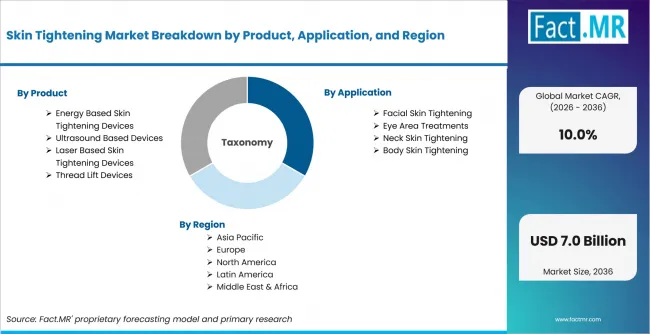
Skin Tightening Market Breakdown By Product, Application, And Region | Source: Fact.MR
| Attribute | Details |
|---|---|
| Quantitative Units | USD billion |
| Market Definition | Non-surgical and minimally invasive products, technologies and treatment systems used to tighten lax skin across facial and body applications. |
| Product | Energy Based Skin Tightening Devices; Ultrasound Based Devices; Laser Based Skin Tightening Devices; Thread Lift Devices |
| Application | Facial Skin Tightening; Eye Area Treatments; Neck Skin Tightening; Body Skin Tightening |
| End Use | Dermatology Clinics; Hospitals; Medspa Centers; Cosmetic Surgery Centers |
| Technology | Energy Based Aesthetic Technology; Radiofrequency Technology; Ultrasound Technology; Laser Technology |
| Formulation | Device Based Treatment Systems; Hybrid Treatment Systems; Non Invasive Formulations |
| Distribution Channel | Direct Aesthetic Device Sales; Distributors and Dealers; Online Sales Channels; Service and Leasing Models |
| Regions Covered | North America; Latin America; Western Europe; Eastern Europe; East Asia; South Asia and Pacific; Middle East and Africa |
| Countries Covered | Germany; Brazil; USA; UK; Japan |
| Key Companies Profiled | Merz Aesthetics; Alma Lasers; Cynosure Lutronic; Candela Medical; Sofwave Medical Ltd. |
| Forecast Period | 2026 to 2036 |
| Approach | Hybrid top-down and bottom-up approach using clinic treatment demand, device segmentation, country growth, company activity and regulatory review. |
Source: Fact.MR analysis. Updated Sep 1, 2026
How is the market segmented?
-
By Product
- Energy Based Skin Tightening Devices
- Ultrasound Based Devices
- Laser Based Skin Tightening Devices
- Thread Lift Devices
-
By Application
- Facial Skin Tightening
- Eye Area Treatments
- Neck Skin Tightening
- Body Skin Tightening
-
By End Use
- Dermatology Clinics
- Hospitals
- Medspa Centers
- Cosmetic Surgery Centers
-
By Technology
- Energy Based Aesthetic Technology
- Radiofrequency Technology
- Ultrasound Technology
- Laser Technology
-
By Formulation
- Device Based Treatment Systems
- Hybrid Treatment Systems
- Non Invasive Formulations
- By Distribution Channel
- Direct Aesthetic Device Sales
- Online Sales Channels
- Service and Leasing Models
-
By Region
- North America
- Latin America
- Western Europe
- Eastern Europe
- East Asia
- South Asia and Pacific
- Middle East and Africa
Frequently Asked Questions
How big is the Skin Tightening Market in 2026?
What is the CAGR of the Skin Tightening Market from 2026 to 2036?
Which product leads the Skin Tightening Market?
Which application leads the Skin Tightening Market?
Who are the key providers in the Skin Tightening Market?
Who worked on this report


Preview the report firsthand - request a free sample
Free SampleGet the brochure for pricing and purchase details
Download PDF