Small Turbojet Engines Market Size, Share, Growth and Forecast (2026 - 2036)

The Small Turbojet Engines Market is segmented by Engine Type, by Thrust Output, by Platform Type, by End User, by Fuel Type, by Application, and Region. Forecast for 2026 to 2036.

Small Turbojet Engines Market Forecast and Outlook by Fact.MR

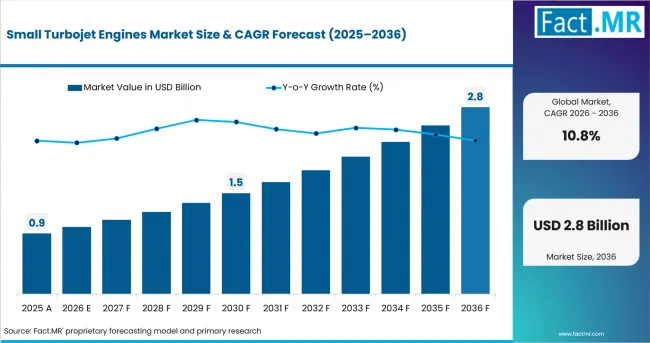
  • In 2025, the Small Turbojet Engines Market was valued at approximately USD 0.9 billion.
  • Based on Fact.MR's analysis, demand for small turbojet engines is estimated to reach USD 1.0 billion in 2026 and USD 2.8 billion by 2036.
  • Fact.MR projects a CAGR of 10.8% during the forecast period.
Small Turbojet Engines Market Value Analysis

Summary of the Small Turbojet Engines Market

  • Market Snapshot
    • Global small turbojet engines market was valued at approximately USD 0.9 billion in 2025 and is estimated to reach USD 1.0 billion in 2026, further expanding to USD 2.8 billion by 2036.
    • At a CAGR of 10.8% from 2026 to 2036, the market is projected to expand nearly 2.8x in value, creating an absolute dollar opportunity of approximately USD 1.8 billion.
    • Growth is being driven by increasing demand for high-speed missiles, target drones, loitering munitions, and advanced unmanned aerial systems requiring compact, lightweight, and high-thrust propulsion solutions.
    • Small turbojet engines are increasingly adopted in defense applications where speed, reliability, compact size, and operational efficiency are critical mission requirements.
    • Rising investments in indigenous missile programs, next-generation UAV development, additive manufacturing, and advanced turbine materials are reinforcing market expansion globally.
  • Demand and Growth Drivers
    • Increasing deployment of missile systems and high-speed unmanned platforms globally.
    • Rising defense modernization programs and investments in indigenous propulsion technologies.
    • Growing demand for compact engines capable of delivering high thrust-to-weight ratios.
    • Expanding utilization of target drones and expendable aerial systems for military training and testing.
    • Need for propulsion solutions that provide:
      • Higher speed and mission endurance for tactical and strategic platforms.
      • Lightweight engine architecture suitable for compact aerospace systems.
      • Improved fuel efficiency and operational reliability under demanding conditions.
      • Enhanced performance in long-range surveillance, strike, and reconnaissance missions.
  • Product and Segment View
    • Missile propulsion applications represent the leading application segment with an estimated 40% market share in 2026, driven by increasing procurement of cruise missiles, target missiles, and loitering munitions worldwide.
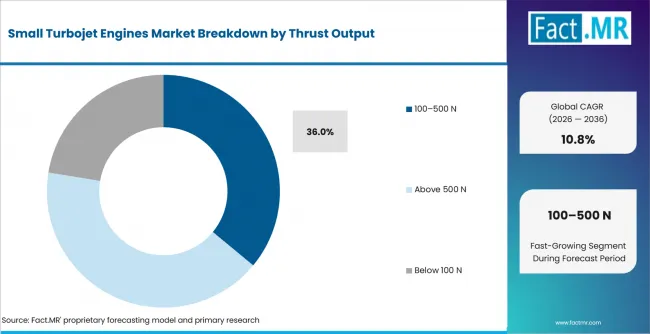
    • Engines generating 100–500 N thrust account for approximately 36% of the market in 2026, supported by widespread deployment in target drones, small UAVs, and tactical missile systems.
    • Micro turbojet engines hold nearly 38% market share in 2026 due to their compact size, lower weight, ease of integration, and growing use in unmanned platforms and research programs.
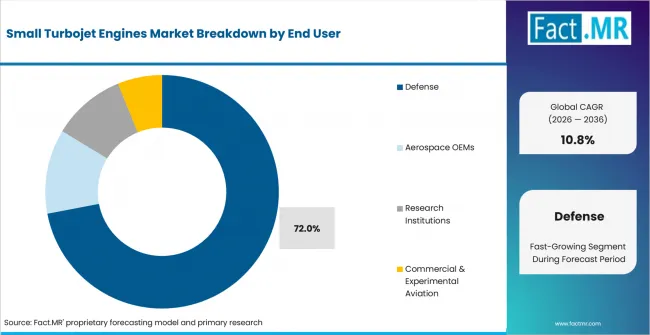
    • Defense end users represent the dominant segment with approximately 72% market share in 2026, owing to rising investments in missile modernization, drone programs, and strategic defense capabilities.
  • Geography and Competitive Outlook
    • The market is geographically segmented into North America, Latin America, Western Europe, Eastern Europe, East Asia, South Asia & Pacific, and the Middle East & Africa.
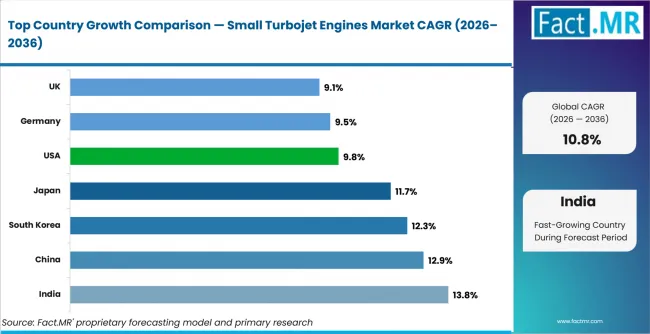
    • Key growth markets and CAGR: India 13.8%, China 12.9%, South Korea 12.3%, Japan 11.7%, U.S. 9.8%, Germany 9.5%, and U.K. 9.1%.
    • Market expansion is closely tied to:
      • Rising investments in indigenous missile and unmanned system development programs.
      • Increasing procurement of tactical missiles, target drones, and loitering munitions.
      • Growing integration of advanced materials, digital engine controls, and additive manufacturing technologies in compact propulsion systems.
    • Key companies active in this market include Williams International, PBS Group, JetCat, Kratos Defense & Security Solutions, Safran, Honeywell Aerospace, Turbotech, JetCat USA, GE Aerospace, RTX Corporation.
  • Analyst Opinion
    • Shambhu Nath Jha, Principal Consultant at Fact.MR, opines, “CXOs and defense procurement leaders will increasingly view small turbojet engines as a strategic enabler of next-generation aerospace and defense capabilities. Competitive advantage in this market will not be determined solely by thrust performance, but by the ability to deliver compact, fuel-efficient, reliable, and cost-effective propulsion systems that support evolving requirements across missiles, loitering munitions, target drones, and high-speed unmanned platforms."

Small Turbojet Engines Market - At a Glance

Attribute Details
Market Value 2025 USD 0.9 billion
Market Value 2026 USD 1.0 billion
Market Value 2036 USD 2.8 billion
Absolute Dollar Opportunity (2026–2036) USD 1.8 billion
Total Growth (2026–2036) 180.0%
CAGR (2026–2036) 10.8%
Growth Multiple ~2.8x
Key Demand Theme Rising deployment of compact high-speed propulsion systems for missiles, target drones, loitering munitions, and advanced unmanned aerial platforms
Leading Engine Type (2026) Micro Turbojet Engines
Engine Type Share (2026) 38%
Leading Thrust Range (2026) 100–500 N
Thrust Range Share (2026) 36%
Leading End User (2026) Defence
End User Share (2026) 72%
Leading Application (2026) Missile Propulsion
Application Share (2026) 40%
Key Growth Regions North America, Latin America, Western Europe, Eastern Europe, East Asia, South Asia & Pacific, Middle East & Africa
Country CAGRs India 13.8%, China 12.9%, South Korea 12.3%, Japan 11.7%, U.S. 9.8%, Germany 9.5%, U.K. 9.1%
Top Companies Williams International, PBS Group, JetCat, Kratos Defense & Security Solutions, RTX Corporation, Safran, Honeywell Aerospace, GE Aerospace, Northrop Grumman
Segmentation by Engine Type Micro Turbojet Engines, Single-Spool Turbojet Engines, Dual-Spool Turbojet Engines, Other
Segmentation by Thrust Output Below 100 N, 100–500 N, Above 500 N, Other
Segmentation by Platform Type Missiles, Target Drones, Unmanned Aerial Vehicles (UAVs), Experimental Aircraft, Other
Segmentation by End User Defense, Aerospace OEMs, Research Institutions, Commercial Applications, Other
Segmentation by Application Missile Propulsion, Target Drones, Loitering Munitions, High-Speed UAVs, Experimental & Research Applications, Other
Segmentation by Region North America, Latin America, Western Europe, Eastern Europe, East Asia, South Asia & Pacific, Middle East & Africa

Market growth between 2026 and 2036 will generate an absolute dollar opportunity of approximately USD 1.8 billion. This growth phase is expected to be driven by increasing procurement of advanced missile systems, expanding deployment of high-speed unmanned aerial vehicles, rising defense modernization programs, and continuous investments in compact propulsion technologies. Advancements in fuel efficiency, additive manufacturing, digital engine controls, and lightweight high-temperature materials are expected to enhance engine performance and operational reliability. However, market expansion may be moderated by stringent export regulations, high development and testing costs, supply chain constraints for aerospace-grade materials, and rigorous certification requirements associated with defense and aviation applications.

Drivers, Restraints, and Opportunities
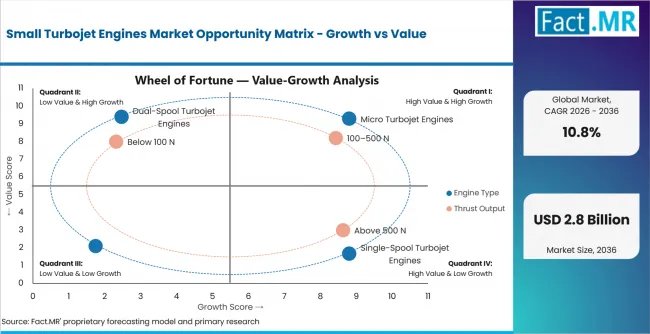
Small Turbojet Engines Market Opportunity Matrix Growth Vs Value

Small Turbojet Engines Market is entering a phase of sustained growth as defense organizations increasingly prioritize compact, high-performance propulsion systems for missiles, loitering munitions, target drones, and next-generation unmanned aerial platforms. Demand is being supported by growing investments in indigenous missile development programs, military modernization initiatives, and the need for propulsion technologies that deliver higher speed, operational flexibility, and mission effectiveness.

As per Fact.MR insights, the market is witnessing a gradual transition from conventional propulsion technologies and imported engine platforms toward domestically developed, lightweight, and digitally controlled turbojet engines. Defense agencies are increasingly emphasizing propulsion self-sufficiency, reduced platform weight, improved fuel efficiency, and enhanced mission endurance. Simultaneously, advances in additive manufacturing, turbine materials, and miniaturized engine control systems are improving performance while reducing production complexity.

The development and certification of small turbojet engines require significant investments in testing infrastructure, high-temperature materials, precision manufacturing, and regulatory compliance. Despite these challenges, increasing procurement of missiles, target drones, and expendable aerial systems will continue to support demand. As geopolitical tensions rise and nations focus on strengthening indigenous defense capabilities, compact turbojet propulsion systems are expected to capture a larger share of military aerospace investments.

  • Growing Demand for High-Speed Defense Platforms: Modern armed forces are increasingly deploying cruise missiles, loitering munitions, target drones, and high-speed UAVs that require compact propulsion systems capable of delivering sustained thrust and superior operational performance. The growing emphasis on precision strike capabilities, rapid response missions, and extended operational range is driving demand for advanced small turbojet engines. Continuous improvements in thrust-to-weight ratios, fuel efficiency, and engine reliability are further accelerating adoption across defense programs worldwide.
  • Defense Modernization and Indigenous Propulsion Programs: Governments across major defense economies are increasing investments in indigenous missile and UAV development initiatives to reduce dependence on imported propulsion technologies. National defense modernization programs are encouraging aerospace manufacturers to develop next-generation small turbojet engines with improved efficiency, reduced lifecycle costs, and enhanced mission capabilities. These initiatives are creating long-term procurement opportunities for engine manufacturers while strengthening domestic aerospace ecosystems.
  • Regional Procurement Shift: North America remains the largest market due to extensive missile procurement programs, advanced aerospace manufacturing capabilities, and substantial defense spending. Meanwhile, East Asia and South Asia & Pacific are emerging as high-growth regions, supported by expanding missile inventories, indigenous defense manufacturing initiatives, increasing geopolitical tensions, and growing investments in unmanned combat and reconnaissance systems. Countries such as China, India, South Korea, and Japan are expected to play a pivotal role in future market expansion.

Small Turbojet Engines Market Segmentation Analysis

Which Engine Type is the Most Popular Across the Industry?
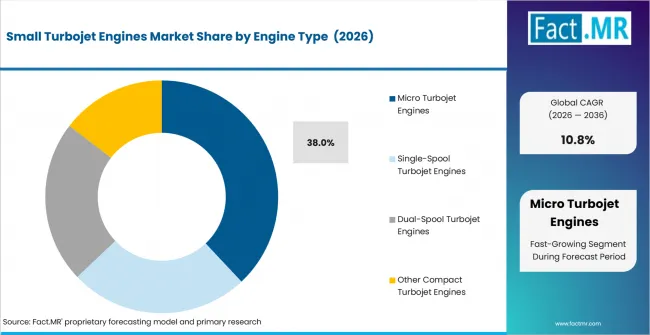
Small Turbojet Engines Market Analysis By Engine Type

Based on Fact.MR's Small Turbojet Engines Market report, consumption of Micro Turbojet Engines is estimated to hold approximately 38% market share in 2026. Their leadership position is attributed to their compact size, lightweight construction, ease of integration, and suitability for a wide range of aerospace and defense platforms. These engines address critical military requirements for high-speed propulsion in missiles, loitering munitions, target drones, and unmanned aerial systems where space constraints, performance reliability, and operational efficiency are essential. Their growing adoption is further supported by advancements in miniaturized turbine technology, digital engine controls, and cost-effective manufacturing processes.

Which thrust range is most used across applications?
Small Turbojet Engines Market Analysis By Thrust Output

According to the study, consumption of 100–500 N thrust output engines is estimated to hold 36% share in 2026. This segment dominates due to its optimal balance between performance, fuel efficiency, platform compatibility, and operational cost. Engines within this thrust category are widely utilized in target drones, tactical missiles, loitering munitions, and compact unmanned aerial systems where sufficient thrust is required to achieve high-speed flight while maintaining manageable weight and fuel consumption. These engines effectively address defense requirements for reliable propulsion in mission-critical platforms without the complexity and expense associated with higher-thrust propulsion systems.

Why are Micro Turbojet Engines more demanded than others?

As per industry analysis, consumption of Micro Turbojet Engines is estimated to hold 38% share in 2026. The segment leads due to its compact architecture, lightweight construction, ease of integration, and suitability for a broad range of aerospace and defense applications. Micro turbojet engines address growing military demand for propulsion systems capable of powering target drones, loitering munitions, experimental aircraft, and high-speed UAVs while minimizing space and weight constraints. Continuous advancements in turbine miniaturization, digital engine controls, and additive manufacturing technologies further support adoption across both defense and research applications.

What is Missile Propulsion and why do small turbojet engines matter in these applications?

The consumption of Missile Propulsion is estimated to hold 40% share in 2026. The segment dominates because small turbojet engines play a critical role in enabling sustained high-speed flight, extended operational range, and improved mission flexibility for modern missile systems. Unlike purely rocket-powered systems, turbojet-powered missiles can maintain efficient cruise flight over longer distances while carrying larger payloads. Their ability to provide reliable propulsion, enhanced maneuverability, and lower operational costs makes them essential for tactical strike, precision engagement, and long-range defense missions.

Which end-user segment drives the highest demand?
Small Turbojet Engines Market Analysis By End User

Based on Fact.MR's Small Turbojet Engines Market report, consumption by the Defense Sector is estimated to hold 72% share in 2026. This segment dominates due to increasing procurement of missiles, target drones, loitering munitions, and advanced unmanned systems by military organizations worldwide. Defense agencies require compact propulsion solutions capable of delivering high performance, operational reliability, and mission effectiveness across a wide variety of combat and training applications. Growing defense modernization initiatives and indigenous propulsion development programs continue to strengthen demand from this segment.

Regional Analysis

The market is geographically segmented into North America, Latin America, Western Europe, Eastern Europe, East Asia, South Asia & Pacific, and the Middle East & Africa. The report evaluates regional market sizes, growth prospects, defense procurement trends, propulsion technology developments, and adoption patterns across these key regions. The full report also provides a detailed market attractiveness analysis to identify high-growth opportunities across regional markets.

Top Country Growth Comparison Small Turbojet Engines Market Cagr (2026 2036)

Country CAGR
U.S. 9.8%
China 12.9%
Germany 9.5%
U.K. 9.1%
Japan 11.7%
S. Korea 12.3%
India 13.8%

Source: Fact.MR analysis, based on proprietary forecasting model and primary research
Small Turbojet Engines Market Cagr Analysis By Country

North America Small Turbojet Engines Market
Small Turbojet Engines Market Country Value Analysis

North America serves as the global center for advanced aerospace propulsion development, supported by extensive defense budgets, mature aerospace manufacturing ecosystems, and continuous investments in missile modernization and unmanned systems. The region benefits from the presence of leading propulsion developers, aerospace OEMs, defense contractors, and government research agencies focused on advancing compact turbine technologies.

Key regional participants include Williams International, recognized for compact propulsion solutions used in missile and aerospace applications; Honeywell Aerospace, a major supplier of advanced aerospace technologies; and GE Aerospace, which continues to invest in next-generation propulsion systems and advanced manufacturing capabilities.

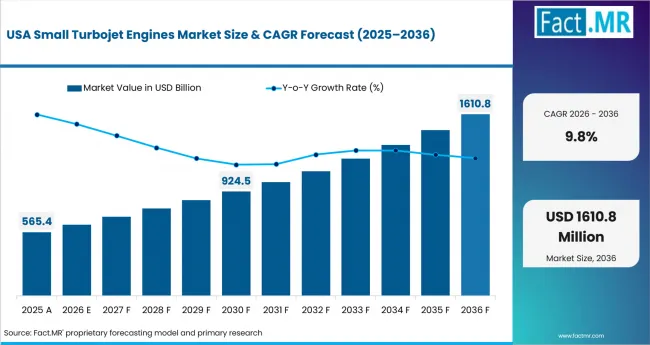
  • United States: Demand for small turbojet engines in the United States is projected to rise at a 9.8% CAGR through 2036. Growth is driven by continued investments from defense agencies in missile modernization programs, next-generation loitering munitions, target drone development, and advanced unmanned aerial systems. The presence of leading propulsion manufacturers, substantial defense procurement budgets, and strong government support for indigenous propulsion technologies are expected to sustain market expansion. However, stringent certification requirements, export regulations, and high development costs may influence commercialization timelines.
  • Canada: Market growth in Canada is supported by increasing investments in aerospace innovation, defense technology development, and participation in North American defense supply chains. The country's strong aerospace manufacturing base, research capabilities, and growing focus on unmanned systems are expected to create opportunities for propulsion technology providers. While defense procurement volumes remain lower than those of the United States, continued modernization initiatives and collaboration with allied defense programs are likely to support gradual market expansion.

Europe Small Turbojet Engines Market
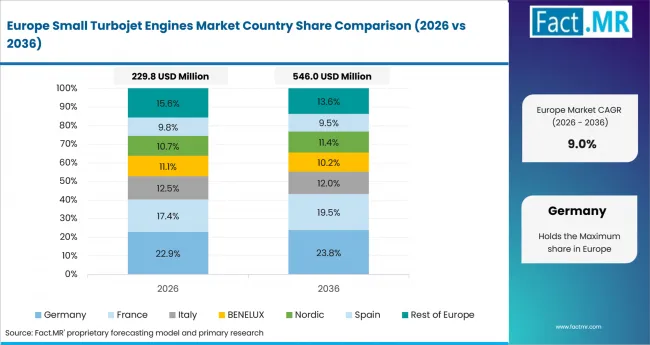
Small Turbojet Engines Market Europe Country Market Share Analysis, 2026 & 2036

Europe serves as a major aerospace propulsion innovation and defense technology hub for the Small Turbojet Engines Market, supported by strong indigenous engine development capabilities, expanding missile modernization programs, and increasing investments in sovereign defense technologies. The region benefits from a mature aerospace manufacturing ecosystem and close collaboration between defense agencies, propulsion developers, and research institutions.

Key regional players include Safran, which leverages extensive expertise in aerospace propulsion and defense technologies, recognized for advanced turbine engineering capabilities, and PBS Group, which specializes in compact turbine engines for UAV and defense applications.

  • Germany: Demand for small turbojet engines in Germany is projected to rise at 9.5% CAGR through 2036. Growth is supported by the country's accelerated defense modernization initiatives, increasing investments in missile technologies, and emphasis on strengthening indigenous aerospace capabilities. German defense manufacturers and research organizations continue to invest in propulsion technologies that support advanced unmanned systems, tactical missiles, and next-generation aerospace platforms. The country's commitment to NATO readiness and strategic defense autonomy is expected to further stimulate demand.
  • United Kingdom: Demand for small turbojet engines in the United Kingdom is projected to rise at 9.1% CAGR through 2036. Market expansion is driven by ongoing investments in missile modernization, sovereign defense capabilities, and advanced aerospace technologies. The UK's strong defense-industrial base, combined with increasing focus on unmanned systems and precision-guided weapons, is creating opportunities for compact propulsion technologies. Continued investments in domestic aerospace innovation are expected to strengthen long-term market growth.
  • France: Demand for small turbojet engines in France is projected to rise at 10.2% CAGR through 2036. Growth is supported by sustained investments in missile systems, defense aviation programs, and sovereign propulsion technologies. The presence of major aerospace and defense manufacturers, coupled with government initiatives aimed at strengthening domestic defense production capabilities, is expected to accelerate adoption of advanced small turbojet propulsion systems across military applications.
  • Russia: Market growth is influenced by continued investments in indigenous missile technologies, unmanned systems, and domestic aerospace manufacturing capabilities. The country's focus on reducing dependence on foreign technology suppliers and expanding local propulsion production capabilities is expected to support demand for compact turbojet engines utilized in missile and UAV platforms.

Asia-Pacific Small Turbojet Engines Market
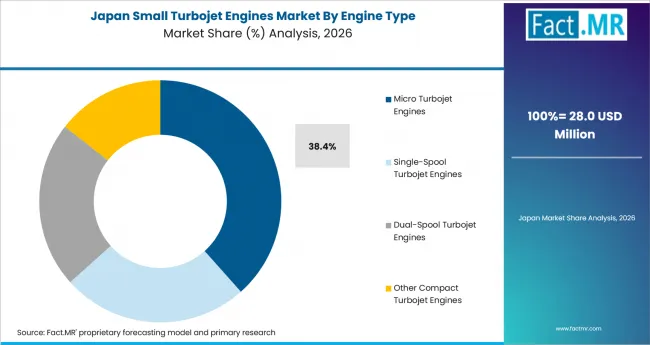
Small Turbojet Engines Market Japan Market Share Analysis By Engine Type

Asia-Pacific serves as the fastest-growing regional market for small turbojet engines, driven by increasing missile procurement programs, expanding indigenous defense manufacturing capabilities, and rising investments in advanced aerospace technologies. The region's growing focus on military modernization and self-reliance in defense propulsion systems continues to create substantial growth opportunities.

Key regional participants include Aviation Industry Corporation of China (AVIC), a leading aerospace manufacturer with extensive defense propulsion capabilities, which maintains a strong position in missile development and advanced propulsion technologies.

  • China: Demand for small turbojet engines in China is projected to rise at 12.9% CAGR through 2036. Growth is driven by increasing investments in missile modernization programs, indigenous propulsion technologies, and advanced unmanned combat systems. State-supported aerospace organizations continue to expand manufacturing capabilities and strengthen domestic supply chains for strategic propulsion technologies, supporting widespread adoption across military applications.
  • Japan: Demand for small turbojet engines in Japan is projected to rise at 11.7% CAGR through 2036. Market growth is supported by increasing defense spending, modernization of missile capabilities, and investments in advanced aerospace technologies. The country's focus on strengthening national security and expanding indigenous defense capabilities is expected to generate sustained demand for compact propulsion systems.
  • South Korea: Demand for small turbojet engines in South Korea is projected to rise at 12.3% CAGR through 2036. Growth is supported by government initiatives focused on indigenous missile development, unmanned systems, and defense innovation programs. Domestic aerospace manufacturers continue investing in advanced propulsion technologies to support future defense requirements and strengthen export competitiveness.
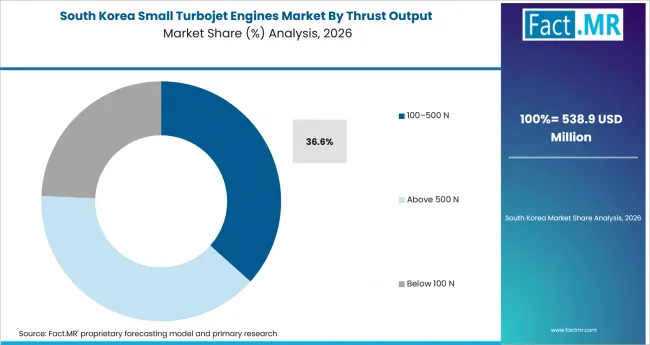
Small Turbojet Engines Market South Korea Market Share Analysis By Thrust Output

  • India: Demand for small turbojet engines in India is projected to rise at 13.8% CAGR through 2036. Growth is driven by increasing emphasis on indigenous missile and UAV programs under defense self-reliance initiatives, expanding procurement of domestically developed military technologies, and rising investments in aerospace propulsion R&D. The development of indigenous cruise missiles, loitering munitions, and unmanned combat platforms is expected to significantly accelerate adoption of compact turbojet engines. Growing collaboration between defense agencies, research institutions, and private aerospace companies further supports long-term market expansion.

Fact.MR's analysis of the Small Turbojet Engines Market consists of a comprehensive regional and country-wise assessment across North America, Latin America, Western Europe, Eastern Europe, East Asia, South Asia & Pacific, and the Middle East & Africa. The study includes detailed evaluations of key countries such as the United States, Canada, Germany, the United Kingdom, France, Russia, China, Japan, South Korea, India, Australia, and other emerging markets. Readers can find in-depth insights on regional market share, missile modernization initiatives, aerospace propulsion developments, defense procurement activities, unmanned system adoption trends, competitive dynamics, and future growth opportunities across the global market.

Competitive Benchmarking and Company Positioning
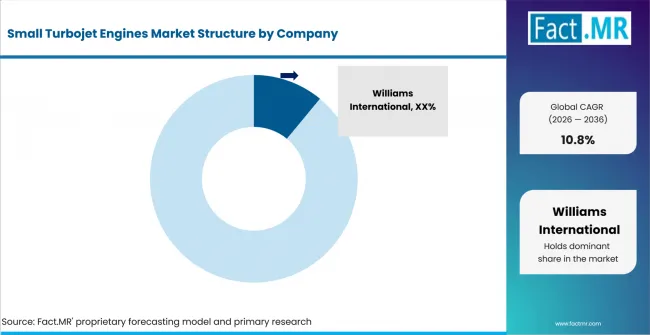
Small Turbojet Engines Market Analysis By Company

The Small Turbojet Engines Market exhibits a moderately concentrated competitive structure. Competition is primarily driven by propulsion efficiency, thrust-to-weight ratio, engine reliability, fuel consumption, miniaturization capabilities, and compliance with stringent defense and aerospace performance requirements.

Large aerospace and defense companies such as Safran, Honeywell Aerospace, GE Aerospace, and RTX Corporation possess significant structural advantages due to extensive R&D capabilities, advanced manufacturing infrastructure, established defense relationships, and broad aerospace technology portfolios.

Specialized manufacturers such as Williams International, JetCat, and PBS Group maintain competitive positions through expertise in compact turbine technologies, rapid product innovation, and customized propulsion solutions for missile systems, target drones, and unmanned aerial platforms.

Buyer power remains moderate to high, as the primary customers are defense ministries, military organizations, missile manufacturers, and aerospace OEMs that operate under strict procurement and qualification requirements. Procurement decisions are typically influenced by performance validation, indigenous sourcing policies, long-term support capabilities, and lifecycle cost considerations. As a result, engine manufacturers must continuously demonstrate improvements in reliability, efficiency, durability, and cost-effectiveness to secure long-term contracts and maintain competitive positioning.

Leading Companies Shaping the Market

  • Williams International
  • PBS Group
  • JetCat
  • Honeywell Aerospace
  • GE Aerospace
  • RTX Corporation
  • Safran
  • Kratos Defense & Security Solutions
  • Aviation Industry Corporation of China (AVIC)

Recent Developments

  • In September 2025, PBS Aerospace opened a new U.S. manufacturing facility in Georgia to produce small turbojet engines for drones, interceptors, and cruise missiles. The expansion supports plans to increase production capacity significantly. [1]
  • In June 2025, PBS Group unveiled its most powerful turbojet engine designed for UAVs, guided missiles, and target systems. The engine features advanced digital engine controls and enhanced performance capabilities. [2]
  • In September 2025, RTX Pratt & Whitney and PBS Group entered an agreement to develop a next-generation auxiliary power unit for military and commercial aerospace platforms. [3]
  • In May 2025, Williams International announced plans to invest more than USD 1 billion in a new gas turbine engine manufacturing facility in Florida. The expansion supports production capacity growth and rising demand from aerospace and defense customers. [4]

Sources and Research Reference

  • [1] PBS Aerospace. (2025, September 4). PBS Aerospace celebrates grand opening of U.S. headquarters in Roswell. PBS Aerospace.
  • [2] PBS Group. (2025). PBS TJ200. PBS Group.
  • [3] RTX. (2025, September 18). RTX’s Pratt & Whitney and PBS Group to develop next-generation auxiliary power unit. RTX.
  • [4] SelectFlorida. (2025, May 29). State of Florida and Williams International announce billion dollar investment in Northwest Florida. SelectFlorida.

Small Turbojet Engines Market Definition

The Small Turbojet Engines Market comprises compact air-breathing jet propulsion systems designed to generate thrust for missiles, target drones, unmanned aerial vehicles (UAVs), loitering munitions, experimental aircraft, and specialized aerospace applications. These engines are characterized by their lightweight design, high thrust-to-weight ratio, compact footprint, and ability to deliver sustained high-speed performance.

Small turbojet engines are widely utilized in defense and aerospace sectors where speed, operational reliability, compact integration, and mission endurance are critical requirements. Key end users include defense organizations, aerospace manufacturers, research institutions, missile developers, and UAV system integrators seeking efficient propulsion solutions for advanced aerial platforms.

Small Turbojet Engines Market Inclusion

The report provides a comprehensive analysis of the global Small Turbojet Engines Market, including historical analysis and forecasts for the period 2026–2036. The study evaluates market size and growth opportunities across regions while segmenting the market based on engine type, thrust output, platform type, application, end user, and geography.

The report further examines technological advancements in turbine design, additive manufacturing, digital engine control systems, lightweight materials, defense procurement trends, supply chain developments, pricing dynamics, regulatory considerations, and competitive positioning. It also assesses adoption trends across missile programs, UAV platforms, target drones, and emerging aerospace applications to provide a forward-looking market outlook.

Small Turbojet Engines Market Exclusion

The scope of the market excludes turbofan, turboprop, turboshaft, and piston-based aircraft propulsion systems utilized in conventional commercial and military aviation applications.

Additionally, the study does not include rocket propulsion systems, hybrid rocket engines, large aircraft gas turbines, industrial gas turbines, ground-based power generation turbines, or propulsion systems designed exclusively for manned commercial aircraft. General aviation engines that do not employ turbojet technology are also outside the scope of this analysis.

Small Turbojet Engines Market Research Methodology

  • Primary Research
    • Primary interviews were conducted with propulsion system manufacturers, aerospace OEMs, defense procurement officials, missile developers, UAV platform manufacturers, research institutions, industry consultants, and senior executives to evaluate technology trends, procurement patterns, and future market opportunities.
  • Desk Research
    • Secondary research involved the analysis of defense budgets, aerospace industry publications, government procurement databases, missile modernization programs, company annual reports, investor presentations, patent filings, technical journals, regulatory documents, and credible aerospace and defense databases.
  • Market-Sizing and Forecasting
    • Market estimates were developed using a hybrid methodology combining bottom-up analysis of engine manufacturers, defense contracts, missile production volumes, and UAV deployments with top-down assessment of defense propulsion spending and aerospace investment trends. Forecasts were derived using adoption modeling, procurement pipelines, and anticipated technological advancements.
  • Data Validation and Update Cycle
    • All market estimates were validated through triangulation of primary research findings, secondary data sources, company-level developments, defense procurement records, and historical market trends. The database is continuously monitored and updated to incorporate changes in defense spending, propulsion technology advancements, new product launches, strategic partnerships, and evolving geopolitical requirements influencing demand for small turbojet engines.

Report Scope

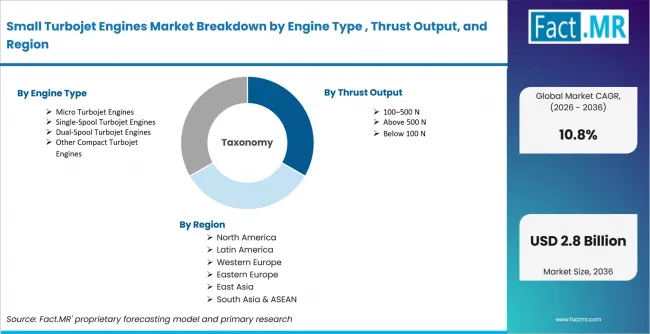
Small Turbojet Engines Market Breakdown By Engine Type , Thrust Output, And Region

Parameter Details
Quantitative Units USD 1.0 billion in 2026 to USD 2.8 billion by 2036 at 10.8% CAGR
Market Definition The Small Turbojet Engines Market comprises compact air-breathing jet propulsion systems designed for missiles, target drones, loitering munitions, UAVs, experimental aircraft, and specialized aerospace applications.
Segments Covered Engine Type, Thrust Output, Platform Type, End User, Application, and Region
Regions Covered North America, Latin America, Western Europe, Eastern Europe, East Asia, South Asia & Pacific, Middle East & Africa
Countries Covered U.S., China, Germany, Japan, India, U.K., France, Brazil, and 30 others
Key Companies Williams International, PBS Group, JetCat, Honeywell Aerospace, GE Aerospace, Safran, RTX Corporation, Kratos Defense & Security Solutions, and others
Forecast Period 2026 – 2036
Approach Hybrid market approach combining bottom-up analysis of engine manufacturers, aerospace production volumes, missile procurement programs, and UAV deployments, with top-down assessment of defense modernization spending, aerospace propulsion investments, and indigenous engine development initiatives.

Small Turbojet Engines Market Taxonomy

  • Small Turbojet Engines Market Segment by Engine Type

    • Micro Turbojet Engines
    • Single-Spool Turbojet Engines
    • Dual-Spool Turbojet Engines
    • Other Compact Turbojet Engines
  • Small Turbojet Engines Market Segment by Thrust Output

    • Below 100 N
    • 100–500 N
    • Above 500 N
  • Small Turbojet Engines Market Segment by Platform Type

    • Missiles
    • Target Drones
    • Unmanned Aerial Vehicles (UAVs)
    • Loitering Munitions
    • Experimental Aircraft
  • Small Turbojet Engines Market Segment by End User

    • Defense
    • Aerospace OEMs
    • Research Institutions
    • Commercial & Experimental Aviation
  • Small Turbojet Engines Market Segment by Application

    • Missile Propulsion
    • Target Drone Propulsion
    • High-Speed UAV Propulsion
    • Loitering Munitions
    • Aerospace Research & Testing
  • Small Turbojet Engines Market Segment by Region

    • North America
      • USA
      • Canada
      • Mexico
    • Latin America
      • Brazil
      • Chile
      • Rest of LATAM
    • East Asia
      • China
      • Japan
      • South Korea
    • South Asia-Pacific
      • India
      • ASEAN Countries
      • ANZ
      • Rest of SAP
    • Western Europe
      • Germany
      • Italy
      • France
      • U.K.
      • Spain
      • BENELUX
      • Nordic
      • Rest of W. Europe
    • Eastern Europe
      • Russia
      • Hungary
      • Poland
      • Balkan & Baltics
      • Rest of E. Europe
    • Middle East and Africa
      • Kingdom of Saudi Arabia
      • United Arab Emirates
      • South Africa
      • Turkiye
      • Rest of Middle East and Africa

- Frequently Asked Questions -

How large is the Small Turbojet Engines market in 2026?

The global Small Turbojet Engines Market is estimated to be valued at USD 1.0 billion in 2026.

What will be the market size by 2036?

The market is projected to reach USD 2.8 billion by 2036.

What is the expected growth rate between 2026 and 2036?

The market is expected to grow at a CAGR of 10.8%, driven by rising missile procurement programs, increasing deployment of high-speed UAVs, expanding loitering munitions programs, and growing investments in indigenous propulsion technologies.

Which Engine Type is expected to dominate the market?

Micro Turbojet Engines are expected to lead the market, accounting for approximately 38% of total market share in 2026, owing to their compact size, lightweight design, and suitability for missiles, target drones, and UAV applications.

Which thrust output segment leads the market?

100–500 N thrust engines are projected to dominate, accounting for approximately 36% of market share in 2026, as they provide an effective balance between performance, fuel efficiency, and platform compatibility.

Which country is expected to show the highest growth rate?

India is projected to register the highest CAGR at 13.8%, supported by indigenous missile development programs, increasing defense modernization spending, and growing investments in domestic aerospace propulsion technologies.

Table of Content

  1. Executive Summary
    • Global Market Outlook
    • Demand-side Trends
    • Supply-side Trends
    • Technology Roadmap Analysis
    • Analysis and Recommendations
  2. Market Overview
    • Market Coverage / Taxonomy
    • Market Definition / Scope / Limitations
  3. Market Background
    • Market Dynamics
      • Drivers
      • Restraints
      • Opportunity
      • Trends
    • Scenario Forecast
      • Demand in Optimistic Scenario
      • Demand in Likely Scenario
      • Demand in Conservative Scenario
    • Opportunity Map Analysis
    • Product Life Cycle Analysis
    • Supply Chain Analysis
    • Investment Feasibility Matrix
    • Value Chain Analysis
    • PESTLE and Porter’s Analysis
    • Regulatory Landscape
    • Regional Parent Market Outlook
    • Production and Consumption Statistics
    • Import and Export Statistics
  4. Global Small Turbojet Engines Market Analysis 2020-2024 and Forecast, 2025-2035
    • Historical Market Size Value (USD Bn) & Volume (Units) Analysis, 2020-2024
    • Current and Future Market Size Value (USD Bn) & Volume (Units) Projections, 2025-2035
      • Y-o-Y Growth Trend Analysis
      • Absolute $ Opportunity Analysis
  5. Global Small Turbojet Engines Market Pricing Analysis 2020-2024 and Forecast 2025-2035
  6. Global Small Turbojet Engines Market Analysis 2020-2024 and Forecast 2025-2035, By Engine Type
    • Introduction / Key Findings
    • Historical Market Size Value (USD Bn) & Volume (Units) Analysis By Engine Type, 2020-2024
    • Current and Future Market Size Value (USD Bn) & Volume (Units) Analysis and Forecast By Engine Type, 2025-2035
      • Micro Turbojet Engines
      • Single-Spool Turbojet Engines
      • Dual-Spool Turbojet Engines
      • Other Compact Turbojet Engines
    • Y-o-Y Growth Trend Analysis By Engine Type, 2020-2024
    • Absolute $ Opportunity Analysis By Engine Type, 2025-2035
  7. Global Small Turbojet Engines Market Analysis 2020-2024 and Forecast 2025-2035, By Thrust Output
    • Introduction / Key Findings
    • Historical Market Size Value (USD Bn) & Volume (Units) Analysis By Thrust Output, 2020-2024
    • Current and Future Market Size Value (USD Bn) & Volume (Units) Analysis and Forecast By Thrust Output, 2025-2035
      • Below 100 N
      • 100–500 N
      • Above 500 N
    • Y-o-Y Growth Trend Analysis By Thrust Output, 2020-2024
    • Absolute $ Opportunity Analysis By Thrust Output, 2025-2035
  8. Global Small Turbojet Engines Market Analysis 2020-2024 and Forecast 2025-2035, By Platform Type
    • Introduction / Key Findings
    • Historical Market Size Value (USD Bn) & Volume (Units) Analysis By Platform Type, 2020-2024
    • Current and Future Market Size Value (USD Bn) & Volume (Units) Analysis and Forecast By Platform Type, 2025-2035
      • Missiles
      • Target Drones
      • Unmanned Aerial Vehicles (UAVs)
      • Loitering Munitions
      • Experimental Aircraft
    • Y-o-Y Growth Trend Analysis By Platform Type, 2020-2024
    • Absolute $ Opportunity Analysis By Platform Type, 2025-2035
  9. Global Small Turbojet Engines Market Analysis 2020-2024 and Forecast 2025-2035, By End User
    • Introduction / Key Findings
    • Historical Market Size Value (USD Bn) & Volume (Units) Analysis By End User, 2020-2024
    • Current and Future Market Size Value (USD Bn) & Volume (Units) Analysis and Forecast By End User, 2025-2035
      • Defense
      • Aerospace OEMs
      • Research Institutions
      • Commercial & Experimental Aviation
    • Y-o-Y Growth Trend Analysis By End User, 2020-2024
    • Absolute $ Opportunity Analysis By End User, 2025-2035
  10. Global Small Turbojet Engines Market Analysis 2020-2024 and Forecast 2025-2035, By Application
    • Introduction / Key Findings
    • Historical Market Size Value (USD Bn) & Volume (Units) Analysis By Application, 2020-2024
    • Current and Future Market Size Value (USD Bn) & Volume (Units) Analysis and Forecast By Application, 2025-2035
      • Missile Propulsion
      • Target Drone Propulsion
      • High-Speed UAV Propulsion
      • Loitering Munitions
      • Aerospace Research & Testing
    • Y-o-Y Growth Trend Analysis By Application, 2020-2024
    • Absolute $ Opportunity Analysis By Application, 2025-2035
  11. Global Small Turbojet Engines Market Analysis 2020-2024 and Forecast 2025-2035, By Region
    • Introduction
    • Historical Market Size Value (USD Bn) & Volume (Units) Analysis By Region, 2020-2024
    • Current Market Size Value (USD Bn) & Volume (Units) Analysis and Forecast By Region, 2025-2035
      • North America
      • Latin America
      • Western Europe
      • Eastern Europe
      • East Asia
      • South Asia and Pacific
      • Middle East & Africa
    • Market Attractiveness Analysis By Region
  12. North America Small Turbojet Engines Market Analysis 2020-2024 and Forecast 2025-2035, By Country
    • Historical Market Size Value (USD Bn) & Volume (Units) Trend Analysis By Market Taxonomy, 2020-2024
    • Market Size Value (USD Bn) & Volume (Units) Forecast By Market Taxonomy, 2025-2035
      • By Country
        • U.S.
        • Canada
        • Mexico
      • By Engine Type
      • By Thrust Output
      • By Platform Type
      • By End User
      • By Application
    • Market Attractiveness Analysis
      • By Country
      • By Engine Type
      • By Thrust Output
      • By Platform Type
      • By End User
      • By Application
    • Key Takeaways
  13. Latin America Small Turbojet Engines Market Analysis 2020-2024 and Forecast 2025-2035, By Country
    • Historical Market Size Value (USD Bn) & Volume (Units) Trend Analysis By Market Taxonomy, 2020-2024
    • Market Size Value (USD Bn) & Volume (Units) Forecast By Market Taxonomy, 2025-2035
      • By Country
        • Brazil
        • Chile
        • Rest of Latin America
      • By Engine Type
      • By Thrust Output
      • By Platform Type
      • By End User
      • By Application
    • Market Attractiveness Analysis
      • By Country
      • By Engine Type
      • By Thrust Output
      • By Platform Type
      • By End User
      • By Application
    • Key Takeaways
  14. Western Europe Small Turbojet Engines Market Analysis 2020-2024 and Forecast 2025-2035, By Country
    • Historical Market Size Value (USD Bn) & Volume (Units) Trend Analysis By Market Taxonomy, 2020-2024
    • Market Size Value (USD Bn) & Volume (Units) Forecast By Market Taxonomy, 2025-2035
      • By Country
        • Germany
        • U.K.
        • Italy
        • Spain
        • France
        • Nordic
        • BENELUX
        • Rest of Western Europe
      • By Engine Type
      • By Thrust Output
      • By Platform Type
      • By End User
      • By Application
    • Market Attractiveness Analysis
      • By Country
      • By Engine Type
      • By Thrust Output
      • By Platform Type
      • By End User
      • By Application
    • Key Takeaways
  15. Eastern Europe Small Turbojet Engines Market Analysis 2020-2024 and Forecast 2025-2035, By Country
    • Historical Market Size Value (USD Bn) & Volume (Units) Trend Analysis By Market Taxonomy, 2020-2024
    • Market Size Value (USD Bn) & Volume (Units) Forecast By Market Taxonomy, 2025-2035
      • By Country
        • Russia
        • Poland
        • Hungary
        • Balkan & Baltic
        • Rest of Eastern Europe
      • By Engine Type
      • By Thrust Output
      • By Platform Type
      • By End User
      • By Application
    • Market Attractiveness Analysis
      • By Country
      • By Engine Type
      • By Thrust Output
      • By Platform Type
      • By End User
      • By Application
    • Key Takeaways
  16. East Asia Small Turbojet Engines Market Analysis 2020-2024 and Forecast 2025-2035, By Country
    • Historical Market Size Value (USD Bn) & Volume (Units) Trend Analysis By Market Taxonomy, 2020-2024
    • Market Size Value (USD Bn) & Volume (Units) Forecast By Market Taxonomy, 2025-2035
      • By Country
        • China
        • Japan
        • South Korea
      • By Engine Type
      • By Thrust Output
      • By Platform Type
      • By End User
      • By Application
    • Market Attractiveness Analysis
      • By Country
      • By Engine Type
      • By Thrust Output
      • By Platform Type
      • By End User
      • By Application
    • Key Takeaways
  17. South Asia and Pacific Small Turbojet Engines Market Analysis 2020-2024 and Forecast 2025-2035, By Country
    • Historical Market Size Value (USD Bn) & Volume (Units) Trend Analysis By Market Taxonomy, 2020-2024
    • Market Size Value (USD Bn) & Volume (Units) Forecast By Market Taxonomy, 2025-2035
      • By Country
        • India
        • ASEAN
        • Australia & New Zealand
        • Rest of South Asia and Pacific
      • By Engine Type
      • By Thrust Output
      • By Platform Type
      • By End User
      • By Application
    • Market Attractiveness Analysis
      • By Country
      • By Engine Type
      • By Thrust Output
      • By Platform Type
      • By End User
      • By Application
    • Key Takeaways
  18. Middle East & Africa Small Turbojet Engines Market Analysis 2020-2024 and Forecast 2025-2035, By Country
    • Historical Market Size Value (USD Bn) & Volume (Units) Trend Analysis By Market Taxonomy, 2020-2024
    • Market Size Value (USD Bn) & Volume (Units) Forecast By Market Taxonomy, 2025-2035
      • By Country
        • Kingdom of Saudi Arabia
        • Other GCC Countries
        • Turkiye
        • South Africa
        • Other African Union
        • Rest of Middle East & Africa
      • By Engine Type
      • By Thrust Output
      • By Platform Type
      • By End User
      • By Application
    • Market Attractiveness Analysis
      • By Country
      • By Engine Type
      • By Thrust Output
      • By Platform Type
      • By End User
      • By Application
    • Key Takeaways
  19. Key Countries Small Turbojet Engines Market Analysis
    • U.S.
      • Pricing Analysis
      • Market Share Analysis, 2024
        • By Engine Type
        • By Thrust Output
        • By Platform Type
        • By End User
        • By Application
    • Canada
      • Pricing Analysis
      • Market Share Analysis, 2024
        • By Engine Type
        • By Thrust Output
        • By Platform Type
        • By End User
        • By Application
    • Mexico
      • Pricing Analysis
      • Market Share Analysis, 2024
        • By Engine Type
        • By Thrust Output
        • By Platform Type
        • By End User
        • By Application
    • Brazil
      • Pricing Analysis
      • Market Share Analysis, 2024
        • By Engine Type
        • By Thrust Output
        • By Platform Type
        • By End User
        • By Application
    • Chile
      • Pricing Analysis
      • Market Share Analysis, 2024
        • By Engine Type
        • By Thrust Output
        • By Platform Type
        • By End User
        • By Application
    • Germany
      • Pricing Analysis
      • Market Share Analysis, 2024
        • By Engine Type
        • By Thrust Output
        • By Platform Type
        • By End User
        • By Application
    • U.K.
      • Pricing Analysis
      • Market Share Analysis, 2024
        • By Engine Type
        • By Thrust Output
        • By Platform Type
        • By End User
        • By Application
    • Italy
      • Pricing Analysis
      • Market Share Analysis, 2024
        • By Engine Type
        • By Thrust Output
        • By Platform Type
        • By End User
        • By Application
    • Spain
      • Pricing Analysis
      • Market Share Analysis, 2024
        • By Engine Type
        • By Thrust Output
        • By Platform Type
        • By End User
        • By Application
    • France
      • Pricing Analysis
      • Market Share Analysis, 2024
        • By Engine Type
        • By Thrust Output
        • By Platform Type
        • By End User
        • By Application
    • India
      • Pricing Analysis
      • Market Share Analysis, 2024
        • By Engine Type
        • By Thrust Output
        • By Platform Type
        • By End User
        • By Application
    • ASEAN
      • Pricing Analysis
      • Market Share Analysis, 2024
        • By Engine Type
        • By Thrust Output
        • By Platform Type
        • By End User
        • By Application
    • Australia & New Zealand
      • Pricing Analysis
      • Market Share Analysis, 2024
        • By Engine Type
        • By Thrust Output
        • By Platform Type
        • By End User
        • By Application
    • China
      • Pricing Analysis
      • Market Share Analysis, 2024
        • By Engine Type
        • By Thrust Output
        • By Platform Type
        • By End User
        • By Application
    • Japan
      • Pricing Analysis
      • Market Share Analysis, 2024
        • By Engine Type
        • By Thrust Output
        • By Platform Type
        • By End User
        • By Application
    • South Korea
      • Pricing Analysis
      • Market Share Analysis, 2024
        • By Engine Type
        • By Thrust Output
        • By Platform Type
        • By End User
        • By Application
    • Russia
      • Pricing Analysis
      • Market Share Analysis, 2024
        • By Engine Type
        • By Thrust Output
        • By Platform Type
        • By End User
        • By Application
    • Poland
      • Pricing Analysis
      • Market Share Analysis, 2024
        • By Engine Type
        • By Thrust Output
        • By Platform Type
        • By End User
        • By Application
    • Hungary
      • Pricing Analysis
      • Market Share Analysis, 2024
        • By Engine Type
        • By Thrust Output
        • By Platform Type
        • By End User
        • By Application
    • Kingdom of Saudi Arabia
      • Pricing Analysis
      • Market Share Analysis, 2024
        • By Engine Type
        • By Thrust Output
        • By Platform Type
        • By End User
        • By Application
    • Turkiye
      • Pricing Analysis
      • Market Share Analysis, 2024
        • By Engine Type
        • By Thrust Output
        • By Platform Type
        • By End User
        • By Application
    • South Africa
      • Pricing Analysis
      • Market Share Analysis, 2024
        • By Engine Type
        • By Thrust Output
        • By Platform Type
        • By End User
        • By Application
  20. Market Structure Analysis
    • Competition Dashboard
    • Competition Benchmarking
    • Market Share Analysis of Top Players
      • By Regional
      • By Engine Type
      • By Thrust Output
      • By Platform Type
      • By End User
      • By Application
  21. Competition Analysis
    • Competition Deep Dive
      • Williams International
        • Overview
        • Product Portfolio
        • Profitability by Market Segments (Product/Age /Sales Channel/Region)
        • Sales Footprint
        • Strategy Overview
      • PBS Group
      • JetCat
      • Honeywell Aerospace
      • GE Aerospace
      • RTX Corporation
      • Safran
    • Assumptions & Acronyms Used
    • Research Methodology

List Of Table

  • Table 1: Global Market Value (USD Bn) Forecast by Region, 2020 to 2035
  • Table 2: Global Market Volume (Units) Forecast by Region, 2020 to 2035
  • Table 3: Global Market Value (USD Bn) Forecast by Engine Type, 2020 to 2035
  • Table 4: Global Market Volume (Units) Forecast by Engine Type, 2020 to 2035
  • Table 5: Global Market Value (USD Bn) Forecast by Thrust Output, 2020 to 2035
  • Table 6: Global Market Volume (Units) Forecast by Thrust Output, 2020 to 2035
  • Table 7: Global Market Value (USD Bn) Forecast by Platform Type, 2020 to 2035
  • Table 8: Global Market Volume (Units) Forecast by Platform Type, 2020 to 2035
  • Table 9: Global Market Value (USD Bn) Forecast by End User, 2020 to 2035
  • Table 10: Global Market Volume (Units) Forecast by End User, 2020 to 2035
  • Table 11: Global Market Value (USD Bn) Forecast by Application, 2020 to 2035
  • Table 12: Global Market Volume (Units) Forecast by Application, 2020 to 2035
  • Table 13: North America Market Value (USD Bn) Forecast by Country, 2020 to 2035
  • Table 14: North America Market Volume (Units) Forecast by Country, 2020 to 2035
  • Table 15: North America Market Value (USD Bn) Forecast by Engine Type, 2020 to 2035
  • Table 16: North America Market Volume (Units) Forecast by Engine Type, 2020 to 2035
  • Table 17: North America Market Value (USD Bn) Forecast by Thrust Output, 2020 to 2035
  • Table 18: North America Market Volume (Units) Forecast by Thrust Output, 2020 to 2035
  • Table 19: North America Market Value (USD Bn) Forecast by Platform Type, 2020 to 2035
  • Table 20: North America Market Volume (Units) Forecast by Platform Type, 2020 to 2035
  • Table 21: North America Market Value (USD Bn) Forecast by End User, 2020 to 2035
  • Table 22: North America Market Volume (Units) Forecast by End User, 2020 to 2035
  • Table 23: North America Market Value (USD Bn) Forecast by Application, 2020 to 2035
  • Table 24: North America Market Volume (Units) Forecast by Application, 2020 to 2035
  • Table 25: Latin America Market Value (USD Bn) Forecast by Country, 2020 to 2035
  • Table 26: Latin America Market Volume (Units) Forecast by Country, 2020 to 2035
  • Table 27: Latin America Market Value (USD Bn) Forecast by Engine Type, 2020 to 2035
  • Table 28: Latin America Market Volume (Units) Forecast by Engine Type, 2020 to 2035
  • Table 29: Latin America Market Value (USD Bn) Forecast by Thrust Output, 2020 to 2035
  • Table 30: Latin America Market Volume (Units) Forecast by Thrust Output, 2020 to 2035
  • Table 31: Latin America Market Value (USD Bn) Forecast by Platform Type, 2020 to 2035
  • Table 32: Latin America Market Volume (Units) Forecast by Platform Type, 2020 to 2035
  • Table 33: Latin America Market Value (USD Bn) Forecast by End User, 2020 to 2035
  • Table 34: Latin America Market Volume (Units) Forecast by End User, 2020 to 2035
  • Table 35: Latin America Market Value (USD Bn) Forecast by Application, 2020 to 2035
  • Table 36: Latin America Market Volume (Units) Forecast by Application, 2020 to 2035
  • Table 37: Western Europe Market Value (USD Bn) Forecast by Country, 2020 to 2035
  • Table 38: Western Europe Market Volume (Units) Forecast by Country, 2020 to 2035
  • Table 39: Western Europe Market Value (USD Bn) Forecast by Engine Type, 2020 to 2035
  • Table 40: Western Europe Market Volume (Units) Forecast by Engine Type, 2020 to 2035
  • Table 41: Western Europe Market Value (USD Bn) Forecast by Thrust Output, 2020 to 2035
  • Table 42: Western Europe Market Volume (Units) Forecast by Thrust Output, 2020 to 2035
  • Table 43: Western Europe Market Value (USD Bn) Forecast by Platform Type, 2020 to 2035
  • Table 44: Western Europe Market Volume (Units) Forecast by Platform Type, 2020 to 2035
  • Table 45: Western Europe Market Value (USD Bn) Forecast by End User, 2020 to 2035
  • Table 46: Western Europe Market Volume (Units) Forecast by End User, 2020 to 2035
  • Table 47: Western Europe Market Value (USD Bn) Forecast by Application, 2020 to 2035
  • Table 48: Western Europe Market Volume (Units) Forecast by Application, 2020 to 2035
  • Table 49: Eastern Europe Market Value (USD Bn) Forecast by Country, 2020 to 2035
  • Table 50: Eastern Europe Market Volume (Units) Forecast by Country, 2020 to 2035
  • Table 51: Eastern Europe Market Value (USD Bn) Forecast by Engine Type, 2020 to 2035
  • Table 52: Eastern Europe Market Volume (Units) Forecast by Engine Type, 2020 to 2035
  • Table 53: Eastern Europe Market Value (USD Bn) Forecast by Thrust Output, 2020 to 2035
  • Table 54: Eastern Europe Market Volume (Units) Forecast by Thrust Output, 2020 to 2035
  • Table 55: Eastern Europe Market Value (USD Bn) Forecast by Platform Type, 2020 to 2035
  • Table 56: Eastern Europe Market Volume (Units) Forecast by Platform Type, 2020 to 2035
  • Table 57: Eastern Europe Market Value (USD Bn) Forecast by End User, 2020 to 2035
  • Table 58: Eastern Europe Market Volume (Units) Forecast by End User, 2020 to 2035
  • Table 59: Eastern Europe Market Value (USD Bn) Forecast by Application, 2020 to 2035
  • Table 60: Eastern Europe Market Volume (Units) Forecast by Application, 2020 to 2035
  • Table 61: East Asia Market Value (USD Bn) Forecast by Country, 2020 to 2035
  • Table 62: East Asia Market Volume (Units) Forecast by Country, 2020 to 2035
  • Table 63: East Asia Market Value (USD Bn) Forecast by Engine Type, 2020 to 2035
  • Table 64: East Asia Market Volume (Units) Forecast by Engine Type, 2020 to 2035
  • Table 65: East Asia Market Value (USD Bn) Forecast by Thrust Output, 2020 to 2035
  • Table 66: East Asia Market Volume (Units) Forecast by Thrust Output, 2020 to 2035
  • Table 67: East Asia Market Value (USD Bn) Forecast by Platform Type, 2020 to 2035
  • Table 68: East Asia Market Volume (Units) Forecast by Platform Type, 2020 to 2035
  • Table 69: East Asia Market Value (USD Bn) Forecast by End User, 2020 to 2035
  • Table 70: East Asia Market Volume (Units) Forecast by End User, 2020 to 2035
  • Table 71: East Asia Market Value (USD Bn) Forecast by Application, 2020 to 2035
  • Table 72: East Asia Market Volume (Units) Forecast by Application, 2020 to 2035
  • Table 73: South Asia and Pacific Market Value (USD Bn) Forecast by Country, 2020 to 2035
  • Table 74: South Asia and Pacific Market Volume (Units) Forecast by Country, 2020 to 2035
  • Table 75: South Asia and Pacific Market Value (USD Bn) Forecast by Engine Type, 2020 to 2035
  • Table 76: South Asia and Pacific Market Volume (Units) Forecast by Engine Type, 2020 to 2035
  • Table 77: South Asia and Pacific Market Value (USD Bn) Forecast by Thrust Output, 2020 to 2035
  • Table 78: South Asia and Pacific Market Volume (Units) Forecast by Thrust Output, 2020 to 2035
  • Table 79: South Asia and Pacific Market Value (USD Bn) Forecast by Platform Type, 2020 to 2035
  • Table 80: South Asia and Pacific Market Volume (Units) Forecast by Platform Type, 2020 to 2035
  • Table 81: South Asia and Pacific Market Value (USD Bn) Forecast by End User, 2020 to 2035
  • Table 82: South Asia and Pacific Market Volume (Units) Forecast by End User, 2020 to 2035
  • Table 83: South Asia and Pacific Market Value (USD Bn) Forecast by Application, 2020 to 2035
  • Table 84: South Asia and Pacific Market Volume (Units) Forecast by Application, 2020 to 2035
  • Table 85: Middle East & Africa Market Value (USD Bn) Forecast by Country, 2020 to 2035
  • Table 86: Middle East & Africa Market Volume (Units) Forecast by Country, 2020 to 2035
  • Table 87: Middle East & Africa Market Value (USD Bn) Forecast by Engine Type, 2020 to 2035
  • Table 88: Middle East & Africa Market Volume (Units) Forecast by Engine Type, 2020 to 2035
  • Table 89: Middle East & Africa Market Value (USD Bn) Forecast by Thrust Output, 2020 to 2035
  • Table 90: Middle East & Africa Market Volume (Units) Forecast by Thrust Output, 2020 to 2035
  • Table 91: Middle East & Africa Market Value (USD Bn) Forecast by Platform Type, 2020 to 2035
  • Table 92: Middle East & Africa Market Volume (Units) Forecast by Platform Type, 2020 to 2035
  • Table 93: Middle East & Africa Market Value (USD Bn) Forecast by End User, 2020 to 2035
  • Table 94: Middle East & Africa Market Volume (Units) Forecast by End User, 2020 to 2035
  • Table 95: Middle East & Africa Market Value (USD Bn) Forecast by Application, 2020 to 2035
  • Table 96: Middle East & Africa Market Volume (Units) Forecast by Application, 2020 to 2035

List Of Figures

  • Figure 1: Global Market Volume (Units) Forecast 2020–2035
  • Figure 2: Global Market Pricing Analysis
  • Figure 3: Global Market Value (USD Bn) Forecast 2020–2035
  • Figure 4: Global Market Value Share and BPS Analysis by Engine Type, 2025 and 2035
  • Figure 5: Global Market Y-o-Y Growth Comparison by Engine Type, 2025 to 2035
  • Figure 6: Global Market Attractiveness Analysis by Engine Type
  • Figure 7: Global Market Value Share and BPS Analysis by Thrust Output, 2025 and 2035
  • Figure 8: Global Market Y-o-Y Growth Comparison by Thrust Output, 2025 to 2035
  • Figure 9: Global Market Attractiveness Analysis by Thrust Output
  • Figure 10: Global Market Value Share and BPS Analysis by Platform Type, 2025 and 2035
  • Figure 11: Global Market Y-o-Y Growth Comparison by Platform Type, 2025 to 2035
  • Figure 12: Global Market Attractiveness Analysis by Platform Type
  • Figure 13: Global Market Value Share and BPS Analysis by End User, 2025 and 2035
  • Figure 14: Global Market Y-o-Y Growth Comparison by End User, 2025 to 2035
  • Figure 15: Global Market Attractiveness Analysis by End User
  • Figure 16: Global Market Value Share and BPS Analysis by Application, 2025 and 2035
  • Figure 17: Global Market Y-o-Y Growth Comparison by Application, 2025 to 2035
  • Figure 18: Global Market Attractiveness Analysis by Application
  • Figure 19: Global Market Value (USD Bn) Share and BPS Analysis by Region, 2025 and 2035
  • Figure 20: Global Market Y-o-Y Growth Comparison by Region, 2025 to 2035
  • Figure 21: Global Market Attractiveness Analysis by Region
  • Figure 22: North America Market Incremental $ Opportunity, 2025 to 2035
  • Figure 23: Latin America Market Incremental $ Opportunity, 2025 to 2035
  • Figure 24: Western Europe Market Incremental $ Opportunity, 2025 to 2035
  • Figure 25: Eastern Europe Market Incremental $ Opportunity, 2025 to 2035
  • Figure 26: East Asia Market Incremental $ Opportunity, 2025 to 2035
  • Figure 27: South Asia and Pacific Market Incremental $ Opportunity, 2025 to 2035
  • Figure 28: Middle East & Africa Market Incremental $ Opportunity, 2025 to 2035
  • Figure 29: North America Market Value Share and BPS Analysis by Country, 2025 and 2035
  • Figure 30: North America Market Value Share and BPS Analysis by Engine Type, 2025 and 2035
  • Figure 31: North America Market Y-o-Y Growth Comparison by Engine Type, 2025 to 2035
  • Figure 32: North America Market Attractiveness Analysis by Engine Type
  • Figure 33: North America Market Value Share and BPS Analysis by Thrust Output, 2025 and 2035
  • Figure 34: North America Market Y-o-Y Growth Comparison by Thrust Output, 2025 to 2035
  • Figure 35: North America Market Attractiveness Analysis by Thrust Output
  • Figure 36: North America Market Value Share and BPS Analysis by Platform Type, 2025 and 2035
  • Figure 37: North America Market Y-o-Y Growth Comparison by Platform Type, 2025 to 2035
  • Figure 38: North America Market Attractiveness Analysis by Platform Type
  • Figure 39: North America Market Value Share and BPS Analysis by End User, 2025 and 2035
  • Figure 40: North America Market Y-o-Y Growth Comparison by End User, 2025 to 2035
  • Figure 41: North America Market Attractiveness Analysis by End User
  • Figure 42: North America Market Value Share and BPS Analysis by Application, 2025 and 2035
  • Figure 43: North America Market Y-o-Y Growth Comparison by Application, 2025 to 2035
  • Figure 44: North America Market Attractiveness Analysis by Application
  • Figure 45: Latin America Market Value Share and BPS Analysis by Country, 2025 and 2035
  • Figure 46: Latin America Market Value Share and BPS Analysis by Engine Type, 2025 and 2035
  • Figure 47: Latin America Market Y-o-Y Growth Comparison by Engine Type, 2025 to 2035
  • Figure 48: Latin America Market Attractiveness Analysis by Engine Type
  • Figure 49: Latin America Market Value Share and BPS Analysis by Thrust Output, 2025 and 2035
  • Figure 50: Latin America Market Y-o-Y Growth Comparison by Thrust Output, 2025 to 2035
  • Figure 51: Latin America Market Attractiveness Analysis by Thrust Output
  • Figure 52: Latin America Market Value Share and BPS Analysis by Platform Type, 2025 and 2035
  • Figure 53: Latin America Market Y-o-Y Growth Comparison by Platform Type, 2025 to 2035
  • Figure 54: Latin America Market Attractiveness Analysis by Platform Type
  • Figure 55: Latin America Market Value Share and BPS Analysis by End User, 2025 and 2035
  • Figure 56: Latin America Market Y-o-Y Growth Comparison by End User, 2025 to 2035
  • Figure 57: Latin America Market Attractiveness Analysis by End User
  • Figure 58: Latin America Market Value Share and BPS Analysis by Application, 2025 and 2035
  • Figure 59: Latin America Market Y-o-Y Growth Comparison by Application, 2025 to 2035
  • Figure 60: Latin America Market Attractiveness Analysis by Application
  • Figure 61: Western Europe Market Value Share and BPS Analysis by Country, 2025 and 2035
  • Figure 62: Western Europe Market Value Share and BPS Analysis by Engine Type, 2025 and 2035
  • Figure 63: Western Europe Market Y-o-Y Growth Comparison by Engine Type, 2025 to 2035
  • Figure 64: Western Europe Market Attractiveness Analysis by Engine Type
  • Figure 65: Western Europe Market Value Share and BPS Analysis by Thrust Output, 2025 and 2035
  • Figure 66: Western Europe Market Y-o-Y Growth Comparison by Thrust Output, 2025 to 2035
  • Figure 67: Western Europe Market Attractiveness Analysis by Thrust Output
  • Figure 68: Western Europe Market Value Share and BPS Analysis by Platform Type, 2025 and 2035
  • Figure 69: Western Europe Market Y-o-Y Growth Comparison by Platform Type, 2025 to 2035
  • Figure 70: Western Europe Market Attractiveness Analysis by Platform Type
  • Figure 71: Western Europe Market Value Share and BPS Analysis by End User, 2025 and 2035
  • Figure 72: Western Europe Market Y-o-Y Growth Comparison by End User, 2025 to 2035
  • Figure 73: Western Europe Market Attractiveness Analysis by End User
  • Figure 74: Western Europe Market Value Share and BPS Analysis by Application, 2025 and 2035
  • Figure 75: Western Europe Market Y-o-Y Growth Comparison by Application, 2025 to 2035
  • Figure 76: Western Europe Market Attractiveness Analysis by Application
  • Figure 77: Eastern Europe Market Value Share and BPS Analysis by Country, 2025 and 2035
  • Figure 78: Eastern Europe Market Value Share and BPS Analysis by Engine Type, 2025 and 2035
  • Figure 79: Eastern Europe Market Y-o-Y Growth Comparison by Engine Type, 2025 to 2035
  • Figure 80: Eastern Europe Market Attractiveness Analysis by Engine Type
  • Figure 81: Eastern Europe Market Value Share and BPS Analysis by Thrust Output, 2025 and 2035
  • Figure 82: Eastern Europe Market Y-o-Y Growth Comparison by Thrust Output, 2025 to 2035
  • Figure 83: Eastern Europe Market Attractiveness Analysis by Thrust Output
  • Figure 84: Eastern Europe Market Value Share and BPS Analysis by Platform Type, 2025 and 2035
  • Figure 85: Eastern Europe Market Y-o-Y Growth Comparison by Platform Type, 2025 to 2035
  • Figure 86: Eastern Europe Market Attractiveness Analysis by Platform Type
  • Figure 87: Eastern Europe Market Value Share and BPS Analysis by End User, 2025 and 2035
  • Figure 88: Eastern Europe Market Y-o-Y Growth Comparison by End User, 2025 to 2035
  • Figure 89: Eastern Europe Market Attractiveness Analysis by End User
  • Figure 90: Eastern Europe Market Value Share and BPS Analysis by Application, 2025 and 2035
  • Figure 91: Eastern Europe Market Y-o-Y Growth Comparison by Application, 2025 to 2035
  • Figure 92: Eastern Europe Market Attractiveness Analysis by Application
  • Figure 93: East Asia Market Value Share and BPS Analysis by Country, 2025 and 2035
  • Figure 94: East Asia Market Value Share and BPS Analysis by Engine Type, 2025 and 2035
  • Figure 95: East Asia Market Y-o-Y Growth Comparison by Engine Type, 2025 to 2035
  • Figure 96: East Asia Market Attractiveness Analysis by Engine Type
  • Figure 97: East Asia Market Value Share and BPS Analysis by Thrust Output, 2025 and 2035
  • Figure 98: East Asia Market Y-o-Y Growth Comparison by Thrust Output, 2025 to 2035
  • Figure 99: East Asia Market Attractiveness Analysis by Thrust Output
  • Figure 100: East Asia Market Value Share and BPS Analysis by Platform Type, 2025 and 2035
  • Figure 101: East Asia Market Y-o-Y Growth Comparison by Platform Type, 2025 to 2035
  • Figure 102: East Asia Market Attractiveness Analysis by Platform Type
  • Figure 103: East Asia Market Value Share and BPS Analysis by End User, 2025 and 2035
  • Figure 104: East Asia Market Y-o-Y Growth Comparison by End User, 2025 to 2035
  • Figure 105: East Asia Market Attractiveness Analysis by End User
  • Figure 106: East Asia Market Value Share and BPS Analysis by Application, 2025 and 2035
  • Figure 107: East Asia Market Y-o-Y Growth Comparison by Application, 2025 to 2035
  • Figure 108: East Asia Market Attractiveness Analysis by Application
  • Figure 109: South Asia and Pacific Market Value Share and BPS Analysis by Country, 2025 and 2035
  • Figure 110: South Asia and Pacific Market Value Share and BPS Analysis by Engine Type, 2025 and 2035
  • Figure 111: South Asia and Pacific Market Y-o-Y Growth Comparison by Engine Type, 2025 to 2035
  • Figure 112: South Asia and Pacific Market Attractiveness Analysis by Engine Type
  • Figure 113: South Asia and Pacific Market Value Share and BPS Analysis by Thrust Output, 2025 and 2035
  • Figure 114: South Asia and Pacific Market Y-o-Y Growth Comparison by Thrust Output, 2025 to 2035
  • Figure 115: South Asia and Pacific Market Attractiveness Analysis by Thrust Output
  • Figure 116: South Asia and Pacific Market Value Share and BPS Analysis by Platform Type, 2025 and 2035
  • Figure 117: South Asia and Pacific Market Y-o-Y Growth Comparison by Platform Type, 2025 to 2035
  • Figure 118: South Asia and Pacific Market Attractiveness Analysis by Platform Type
  • Figure 119: South Asia and Pacific Market Value Share and BPS Analysis by End User, 2025 and 2035
  • Figure 120: South Asia and Pacific Market Y-o-Y Growth Comparison by End User, 2025 to 2035
  • Figure 121: South Asia and Pacific Market Attractiveness Analysis by End User
  • Figure 122: South Asia and Pacific Market Value Share and BPS Analysis by Application, 2025 and 2035
  • Figure 123: South Asia and Pacific Market Y-o-Y Growth Comparison by Application, 2025 to 2035
  • Figure 124: South Asia and Pacific Market Attractiveness Analysis by Application
  • Figure 125: Middle East & Africa Market Value Share and BPS Analysis by Country, 2025 and 2035
  • Figure 126: Middle East & Africa Market Value Share and BPS Analysis by Engine Type, 2025 and 2035
  • Figure 127: Middle East & Africa Market Y-o-Y Growth Comparison by Engine Type, 2025 to 2035
  • Figure 128: Middle East & Africa Market Attractiveness Analysis by Engine Type
  • Figure 129: Middle East & Africa Market Value Share and BPS Analysis by Thrust Output, 2025 and 2035
  • Figure 130: Middle East & Africa Market Y-o-Y Growth Comparison by Thrust Output, 2025 to 2035
  • Figure 131: Middle East & Africa Market Attractiveness Analysis by Thrust Output
  • Figure 132: Middle East & Africa Market Value Share and BPS Analysis by Platform Type, 2025 and 2035
  • Figure 133: Middle East & Africa Market Y-o-Y Growth Comparison by Platform Type, 2025 to 2035
  • Figure 134: Middle East & Africa Market Attractiveness Analysis by Platform Type
  • Figure 135: Middle East & Africa Market Value Share and BPS Analysis by End User, 2025 and 2035
  • Figure 136: Middle East & Africa Market Y-o-Y Growth Comparison by End User, 2025 to 2035
  • Figure 137: Middle East & Africa Market Attractiveness Analysis by End User
  • Figure 138: Middle East & Africa Market Value Share and BPS Analysis by Application, 2025 and 2035
  • Figure 139: Middle East & Africa Market Y-o-Y Growth Comparison by Application, 2025 to 2035
  • Figure 140: Middle East & Africa Market Attractiveness Analysis by Application
  • Figure 141: Global Market – Tier Structure Analysis
  • Figure 142: Global Market – Company Share Analysis

Small Turbojet Engines Market

Buy Report Now