- Market Value (2025): USD 1.24 Bn
- Estimated Value (2026): USD 1.34 Bn
- Forecast Value (2036): USD 2.92 Bn
- CAGR (2026-2036): 8.1%
What is the Smart Hospital Beds Market forecast to be worth by 2036?
USD 1.34 billion in 2026 to USD 2.92 billion by 2036, at a CAGR of 8.1%.
- As per Fact.MR analysis, the smart hospital beds market was valued at USD 1.24 billion in 2025
- Demand will grow from USD 1.34 billion in 2026 to USD 2.92 billion by 2036.
- The forecast records a 8.1% CAGR from 2026 to 2036, supported by hospital investment in connected patient-care infrastructure and beds with integrated safety features.
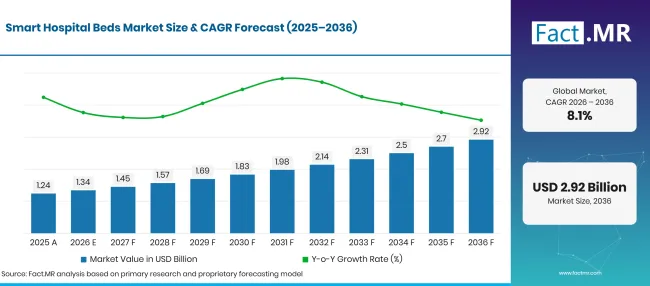
Smart Hospital Beds Market Forecast Global | Source: Fact.MR
| Year | Basis | Market Value (USD billion) |
|---|---|---|
| 2025 | Actual | 1.24 |
| 2026 | Estimate | 1.34 |
| 2036 | Forecast | 2.92 |
| CAGR 2026 to 2036 | Forecast period | 8.1% |
Source: Fact.MR analysis. Updated Nov 5, 2026
What are the defining numbers behind Smart Hospital Beds Market growth?
USD 1.6 billion absolute opportunity between 2026 and 2036.
- Demand Drivers in the Market
- Rising focus on patient safety and fall prevention has driven the market growth. Hospitals need beds that help reduce patient falls and support continuous observation, particularly among elderly patients and those with limited mobility. The U.S. federal government has identified inpatient falls as a major patient-safety concern and introduced a hospital harm measure for falls with injury beginning with the 2026 reporting period. CMS finalized the Hospital Harm – Falls with Injury electronic clinical quality measure for inclusion beginning with the calendar year 2026 reporting period, affecting the FY2028 payment determination. [10][11]
- Growing demand for advanced beds in intensive care units supports the growth of the market. Intensive care units require beds with advanced positioning, lateral rotation and patient-mobility functions to support the care of critically ill patients.
- Hospital digitalization and connected-care infrastructure has increased the demand for the smart hospital beds. Healthcare digitalization is encouraging hospitals to adopt connected equipment that can exchange information with nurse-call systems and central monitoring platforms.
- Key Segments Analyzed
- By Product Type: Fully Automatic beds will account for 45.2% of the market in 2026, reflecting demand for powered adjustment and integrated patient-care functions.
- By Technology: Wireless technology is projected to hold 58.3% share in 2026, supported by demand for flexible connectivity and remote access to bed-related information.
- By Application: Intensive Care will capture 62.1% share in 2026, reflecting the need for advanced positioning, patient mobility and monitoring features in critical-care settings.
- By End User: Hospitals lead with 55.0% share in 2026, driven by the scale of inpatient care and the need to equip multiple wards with connected patient beds.
- Analyst Opinion at Fact.MR
- Shambhu Nath Jha, Principal Consultant at Fact.MR, states, “Smart hospital beds are becoming an important part of connected patient-care environments. Hospitals need solutions that combine patient safety, caregiver convenience and reliable data connectivity. Manufacturers should focus on practical integration with hospital workflows while ensuring that advanced features remain easy for clinical teams to use.”
- Strategic Implications
- Manufacturers should develop beds with reliable patient-position monitoring, bed-exit alerts and nurse-call connectivity to address hospital safety requirements.
- Hospitals need to evaluate compatibility with existing nurse-call systems, central monitoring platforms and hospital information infrastructure before purchasing connected beds.
- Suppliers should offer flexible configurations for intensive care and general wards, as patient acuity and clinical requirements vary across hospital departments.
- Technology providers can strengthen their position through wireless connectivity, secure data transmission and integration with hospital digital systems.
- Bed manufacturers should provide maintenance support, staff training and clear operating procedures to improve adoption and reduce equipment downtime.
Germany is set to record a 9.5% CAGR through 2036. Brazil is projected to post 8.3%, followed by the USA at 10.5%. The UK is forecast to advance at 7.4%, while Japan is expected to register 10.0%.
How does the Smart Hospital Beds Market break down by segment?
Fact.MR finds that Fully Automatic beds lead Product Type with 45.2%; Wireless technology leads Technology with 58.3%; Intensive Care leads Application with 62.1%; and Hospitals lead End User with 55.0%.
Which Product Type dominates?
Fully Automatic beds are set to hold 45.2% share in 2026.
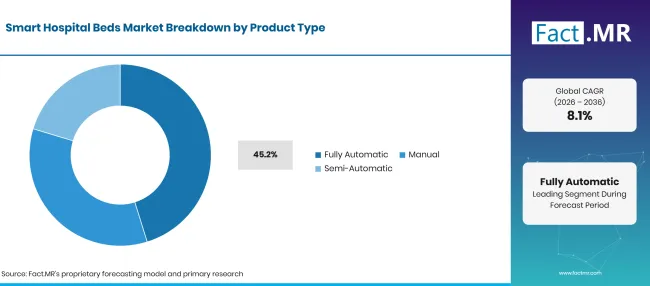
Smart Hospital Beds Market Breakdown Product Type | Source: Fact.MR
| Product Type | Share (2026) |
|---|---|
| Fully Automatic (Leading segment) | 45.2% |
| Other segments combined | 54.8%* |
| Total | 100.0% |
Source: Fact.MR analysis. Updated Nov 5, 2026
Fully automatic hospital beds account for the leading product-type share because hospitals require powered adjustment functions that help caregivers position patients and manage routine bed operations. These beds can support changes in bed height and backrest or leg positioning through electric controls. Semi-automatic beds provide powered adjustment for selected functions, while manual beds rely more heavily on caregiver-operated mechanisms. Purchasing decisions depend on patient acuity, clinical workflow and the level of automation required.
Which Technology leads the market?
Wireless technology is projected to account for 58.3% share in 2026.
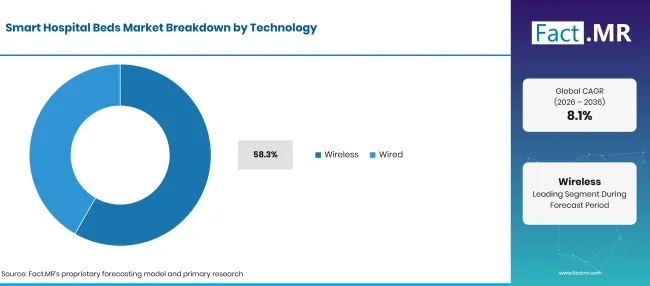
Smart Hospital Beds Market Breakdown Technology | Source: Fact.MR
| Technology | Share (2026) |
|---|---|
| Wireless (Leading segment) | 58.3% |
| Other segments combined | 41.7%* |
| Total | 100.0% |
Source: Fact.MR analysis. Updated Nov 5, 2026
Wireless technology leads because connected beds can transmit alerts and selected patient or bed-status information to compatible monitoring systems and mobile devices. Wireless connectivity can support bed-exit notifications, patient movement alerts and communication with nurse-call infrastructure. Wired systems remain relevant where hospitals prefer fixed connections, established infrastructure or specific reliability and network-control arrangements. Adoption depends on network coverage, cybersecurity requirements and compatibility with hospital systems.
Which Application leads the market?
Intensive Care is set to represent 62.1% share in 2026.
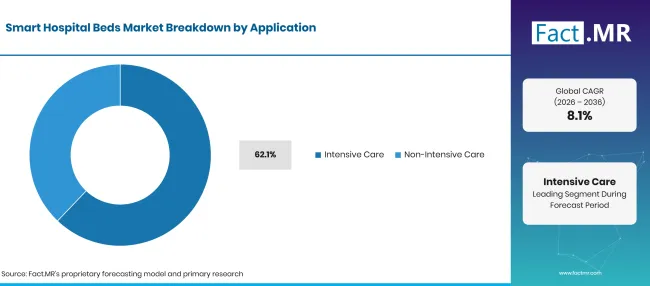
Smart Hospital Beds Market Breakdown Application | Source: Fact.MR
| Application | Share (2026) |
|---|---|
| Intensive Care (Leading segment) | 62.1% |
| Other segments combined | 37.9%* |
| Total | 100.0% |
Source: Fact.MR analysis. Updated Nov 5, 2026
Intensive care units require beds with advanced functions for patients who need continuous clinical attention and assisted positioning. Features such as lateral tilt, adjustable positioning, patient-mobility support and integrated monitoring can help clinical teams manage complex care requirements. Non-intensive care applications include medical-surgical wards and other inpatient settings where powered adjustment, fall prevention and patient comfort remain important. The selection of bed functions varies according to patient condition and the clinical protocols followed by each facility.
Which End User dominates demand?
Hospitals are projected to lead with 55.0% share in 2026.
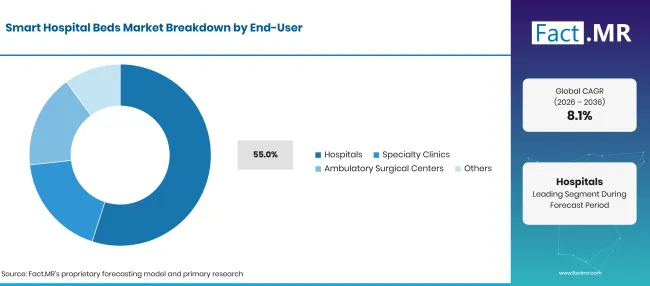
Smart Hospital Beds Market Breakdown End User | Source: Fact.MR
| End User | Share (2026) |
|---|---|
| Hospitals (Leading segment) | 55.0% |
| Other segments combined | 45.0%* |
| Total | 100.0% |
Source: Fact.MR analysis. Updated Nov 5, 2026
Hospitals account for the largest end-user share because they operate intensive care units, general wards and other inpatient departments that require beds across different levels of patient acuity. Large hospital facilities may also need connected bed systems that integrate with nurse-call infrastructure and centralized monitoring platforms. Specialty clinics and ambulatory surgical centers have more focused requirements, while other healthcare facilities purchase beds according to their patient-care capacity and service mix.
What is accelerating Smart Hospital Beds Market adoption, and what is holding it back?
Demand for connected patient monitoring and advanced intensive care functions supports adoption, while high equipment costs and integration requirements can limit wider deployment.
Drivers Impact Analysis
| Driver | (~) % Impact on CAGR | Geographic Relevance | Impact Timeline |
|---|---|---|---|
| Hospital investment in connected patient-care infrastructure | +1.0% | North America, Europe, Asia | Medium term (2–4 years) |
| Demand for patient fall-prevention and movement alerts | +0.9% | Global | Short term (≤ 2 years) |
| Expansion and modernization of intensive care facilities | +0.7% | Global | Medium term (2–4 years) |
| Integration with nurse-call and hospital monitoring systems | +0.5% | North America, Europe | Medium term (2–4 years) |
| Adoption of automated patient-positioning functions | +0.4% | Global | Long term (≥ 4 years) |
Source: Fact.MR analysis. Updated Nov 5, 2026
Opportunity Impact Analysis
| Opportunity | (~) % Impact on CAGR | Geographic Relevance | Impact Timeline |
|---|---|---|---|
| Wireless bed monitoring and alert systems | +0.8% | Global | Medium term (2–4 years) |
| Connected beds for intensive care units | +0.6% | North America, Europe, Asia | Medium term (2–4 years) |
| Integration with hospital information systems | +0.5% | North America, Europe | Long term (≥ 4 years) |
| Advanced patient mobility and repositioning features | +0.4% | Global | Short term (≤ 2 years) |
Source: Fact.MR analysis. Updated Nov 5, 2026
Restraints Impact Analysis
| Restraint | (~) % Impact on CAGR | Geographic Relevance | Impact Timeline |
|---|---|---|---|
| High initial cost of connected hospital beds | -0.8% | Global | Short term (≤ 2 years) |
| Integration with existing hospital infrastructure | -0.6% | Global | Medium term (2–4 years) |
| Cybersecurity and data privacy requirements | -0.5% | North America, Europe | Medium term (2–4 years) |
| Maintenance, training and replacement costs | -0.4% | Emerging markets | Long term (≥ 4 years) |
Source: Fact.MR analysis. Updated Nov 5, 2026
Which countries are scaling the Smart Hospital Beds Market through 2036?
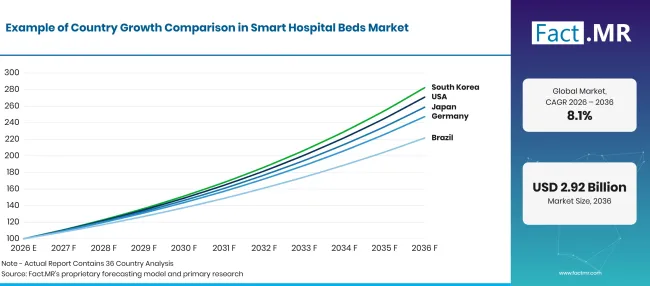
Smart Hospital Beds Market Growth Index | Source: Fact.MR
| Country | CAGR (2026–2036) |
|---|---|
| Germany | 9.5% |
| Brazil | 8.3% |
| USA | 10.5% |
| UK | 7.4% |
| Japan | 10.0% |
Source: Fact.MR analysis. Updated Nov 5, 2026
What supports Germany adoption?
9.5% CAGR, supported by an established hospital network and demand for advanced inpatient-care equipment.
Germany's hospital infrastructure creates demand for beds that support patient positioning, monitoring and caregiver workflows. Destatis reported 1,841 hospitals and 472,851 available beds in 2024, including approximately 26,000 intensive care beds. Hospitals seeking to improve patient safety and operational efficiency can consider connected beds with integrated alerts and advanced positioning functions. [1]
How is Brazil developing smart hospital beds adoption?
8.3% CAGR, driven by hospital infrastructure requirements and opportunities to modernize inpatient-care equipment.
Brazil's hospital network includes public and private facilities with different investment capacities and equipment requirements. The Fiocruz CNES dashboard reported 9,157 hospitals in December 2025. This broad provider base creates opportunities for suppliers offering beds across different levels of automation and connectivity. Manufacturers need to consider acquisition costs, local service coverage and compatibility with hospital infrastructure when targeting the market. [2]
What supports United States adoption?
10.5% CAGR, led by a large hospital base and demand for connected patient-care equipment.
The United States has a substantial installed base of hospital facilities and staffed beds. Demand is likely to be shaped by integration with existing nurse-call systems and the ability to demonstrate operational value.
How is the United Kingdom building adoption?
7.4% CAGR, shaped by hospital modernization and the need to improve patient safety and care workflows.
The UK's hospital providers require beds that support patient handling, safe positioning and efficient ward operations. Smart features such as bed-exit alerts and wireless communication can help clinical teams respond to patient movement and coordinate care. Suppliers need to demonstrate compatibility with existing hospital systems while addressing purchasing budgets, maintenance requirements and staff training.
What supports Japan adoption?
10.0% CAGR, backed by an extensive hospital bed base and demand for patient monitoring solutions.
Japan's hospital network has substantial inpatient capacity and a strong need for equipment that supports patient care and monitoring. The Ministry of Health, Labour and Welfare's 2025 medical facilities statistics reported 1,450,322 hospital beds. This installed base provides opportunities for powered beds, patient sensors and connected monitoring solutions, although purchasing decisions will depend on hospital budgets and the requirements of individual care settings. [3]
Who leads the Smart Hospital Beds Market?
Fact.MR profiles Baxter International Inc., Stryker Corporation, Arjo AB, Paramount Bed Co., Ltd. and LINET Group SE across the smart hospital beds and connected patient-care equipment value chain.
Baxter International offers Hillrom smart bed platforms, including the Centrella Smart+ Bed and Progressa+ ICU Bed. The Centrella platform supports wireless connectivity and optional contact-free heart-rate and respiration-rate monitoring, while Progressa+ is designed for critical-care applications. [12] [13] [4]
Stryker Corporation offers the ProCuity bed series and InTouch critical-care bed. Its ProCuity range includes cable-less nurse-call functionality and connected features designed to support patient safety and hospital workflows. The company also offers ICU and medical-surgical beds for different levels of care. [5] [10]
Arjo AB supplies medical beds for intensive and critical care as well as general hospital settings. Its Citadel patient care system is designed for high-dependency patients and combines a bed frame with therapeutic support surfaces. Arjo's portfolio also includes bariatric care and advanced patient-positioning solutions. [6]
Paramount Bed Co., Ltd. offers ICU beds, electric beds and related patient-care equipment. Its portfolio includes the ALiUS and Qualitas Gamma DS ICU beds [9]. The company also offers sensor-based products such as Nemuri SCAN, which measures sleep state, heart rate and respiratory rate and can make information accessible remotely. [7]
LINET Group SE supplies hospital beds across acute care and intensive care settings. Its portfolio includes Multicare X, Multicare and Eleganza intensive-care beds. Its Smart Care solutions support digital patient monitoring and clinical workflows, positioning the company across connected hospital-care environments. [8]
Which companies are the key providers?
Key companies include Baxter International Inc.; Stryker Corporation; Arjo AB; Paramount Bed Co., Ltd.; and LINET Group SE.
- Baxter International Inc.
- Stryker Corporation
- Arjo AB
- Paramount Bed Co., Ltd.
- LINET Group SE
Bibliography
- [1] Statistisches Bundesamt (Destatis). (2025, November 27). Krankenhäuser 2024 nach Trägern und Bundesländern. DestatisOfficial source
- [2] Fundação Oswaldo Cruz. (2025, December). Cadastro Nacional de Estabelecimentos de Saúde. tabnet.fiocruz.brOfficial source
- [3] Ministry of Health, Labour and Welfare, Japan. (2026, September 29).2025 [Overview of the 2025 Survey of Medical Institutions and Hospital Report].Official source
- [4] Baxter International Inc. (2026, January 13). Baxter introduces the Dynamo Series, a new smart stretcher to help address common challenges in hospital settings. Baxter Investor RelationsOfficial source
- [5] Stryker Corporation. (2026, March 9). Stryker launches SmartHospital Platform. StrykerOfficial source
- [6] Arjo AB. (2026, March 31). Annual and Sustainability Report 2025. ArjoOfficial source
- [7] Paramount Bed Co., Ltd. (2025, June 4). Paramount Bed launches ICU bed with motorized drive for patient transport.| PARAMOUNT BED -Official source
- [8] LINET Group SE. (2026, June 22). LINET and Life Care Technology sign agreement on hospital bed production in Egypt. LinetOfficial source
- [9] Paramount Bed Co., Ltd. (2025, June 23). Paramount Bed to showcase at Japan Health 2025| PARAMOUNT BED -Official source
- [10] Centers for Medicare & Medicaid Services. (2024, August 1). FY 2025 Hospital Inpatient Prospective Payment System (IPPS) and Long-Term Care Hospital Prospective Payment System (LTCH PPS) Final Rule – CMS-1808-F. Centers for Medicare & Medicaid Services
- https://www.cms.gov/newsroom/fact-sheets/fy-2025-hospital-inpatient-prospective-payment-system-ipps-long-term-care-hospital-prospective-0Centers for Medicare & Medicaid ServicesOfficial source
- [11] Press Information Bureau, Government of India. (2026, September 22). Progressing towards universal health coverage. Press Information Bureau
- Official source
- [12] Baxter Healthcare Corporation. (n.d.). Centrella Smart+ Bed: Instructions for use. Hillrom. https://www.hillrom.com/content/dam/hillrom-aem/us/en/marketing/products/centrella-smart-bed/documents/193587_17.pdf
- [13] Baxter. (n.d.). Progressa+ ICU Bed. https://pro.baxter.com/products/beds-patient-mobility/smart-beds-surfaces/progressa-smart-bed
This Report Answers
- The report examines demand for fully automatic, manual and semi-automatic smart hospital beds.
- Product-type analysis compares different levels of bed automation and powered adjustment.
- Technology analysis evaluates wireless and wired connectivity across hospital bed systems.
- Application analysis covers intensive care and non-intensive care settings.
- End-user analysis compares hospitals, specialty clinics, ambulatory surgical centers and other healthcare facilities.
- Country analysis covers Germany, Brazil, USA, UK and Japan.
- The competitive overview profiles five companies participating in hospital beds and connected patient-care technologies.
What does the Smart Hospital Beds Market cover?
The market covers hospital beds equipped with smart features that support patient safety, positioning, monitoring and caregiver workflows. It includes beds with powered adjustment, patient movement alerts, wireless connectivity and integration with compatible hospital communication systems. Coverage spans intensive care and non-intensive care applications across hospitals and other healthcare facilities.
What is included in the scope?
The analysis includes fully automatic, manual and semi-automatic hospital beds marketed with smart or connected patient-care functions.
It covers wired and wireless technologies used for bed-related monitoring and communication. Included applications span intensive care and non-intensive care settings. Revenue coverage should be restricted to hospital beds and directly attributable smart-bed features and systems.
What is excluded from the scope?
The analysis excludes conventional hospital beds without smart or connected functionality.
Standalone patient monitors, nurse-call systems, hospital information systems and general medical furniture are excluded unless sold as integrated components of a smart hospital bed. General-purpose mattresses, stretchers, operating tables and home-care beds are also outside the defined market unless specifically included in a smart hospital bed solution.
How Was the Analysis Built?
The analysis draws on 120+ sources, 35+ company portfolios, 25+ countries and more than 20 industry interviews.
- Primary Research: Primary research includes discussions with hospital bed manufacturers, healthcare technology providers, hospital service teams, intensive care specialists, distributors and subject-matter experts. These conversations examine purchasing priorities, bed functionality, connectivity requirements, maintenance challenges and factors influencing technology adoption.
- Desk Research: Desk research covers government hospital statistics, healthcare infrastructure publications, company filings, product catalogues, technical documentation, medical equipment regulations and industry associations. Every source used in the analysis is documented in the bibliography.
- Market Sizing and Forecasting: Market estimates combine historical performance, hospital infrastructure, bed replacement requirements, equipment pricing, segment shares, company participation, country-level growth, connected-care adoption and barriers to market expansion.
- Data Validation and Update Cycle: Findings are validated by comparing primary interviews with public data, company product portfolios, new product introductions, technology improvements, hospital investment and changes in healthcare infrastructure. Regular updates review connected-bed capabilities, patient monitoring features and integration with hospital systems.
Segmentation
What is the report's scope and coverage?
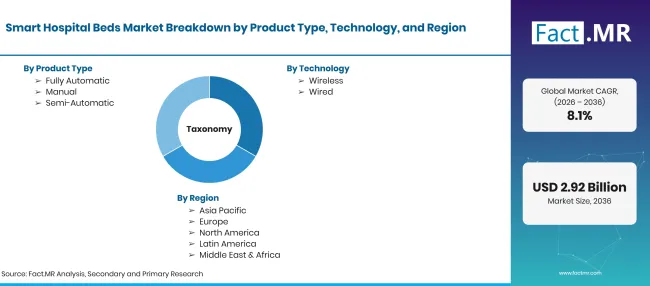
Smart Hospital Beds Market Taxonomy | Source: Fact.MR
| Attribute | Details |
|---|---|
| Quantitative Units | USD billion |
| Market Definition | The smart hospital beds market comprises hospital beds equipped with powered adjustment, connected monitoring, patient-safety and digital communication features. These beds support patient positioning, mobility, fall prevention and caregiver workflows across intensive care and general hospital settings. |
| Product Type | Fully Automatic; Manual; Semi-Automatic |
| Technology | Wireless; Wired |
| Application | Intensive Care; Non-Intensive Care |
| End User | Hospitals; Specialty Clinics; Ambulatory Surgical Centers; Others |
| Regions Covered | North America; Latin America; Western Europe; Eastern Europe; East Asia; South Asia & Pacific; Middle East & Africa |
| Countries Covered | Germany; Brazil; USA; UK; Japan |
| Companies Profiled | Baxter International Inc.; Stryker Corporation; Arjo AB; Paramount Bed Co., Ltd.; LINET Group SE |
| Forecast Period | 2026 to 2036 |
| Approach | Market segmentation and scenario-based analysis supported by hospital infrastructure statistics, company product portfolios and healthcare technology adoption trends |
Source: Fact.MR analysis. Updated Nov 5, 2026
How is the market segmented?
-
By Product Type
- Fully Automatic
- Manual
- Semi-Automatic
-
By Technology
- Wireless
- Wired
-
By Application
- Intensive Care
- Non-Intensive Care
-
By End User
- Hospitals
- Specialty Clinics
- Ambulatory Surgical Centers
- Others
-
By Region
- North America
- Latin America
- Western Europe
- Eastern Europe
- East Asia
- South Asia & Pacific
- Middle East & Africa
Frequently Asked Questions
How big is the smart hospital beds market in 2026?
What is the CAGR from 2026 to 2036?
Which product type has the largest share?
Which technology leads the market?
Which application leads the market?
Which end user dominates the market?
Which companies are covered?
Who worked on this report


Preview the report firsthand - request a free sample
Free SampleGet the brochure for pricing and purchase details
Download PDF