- Market Value (2025): USD 4.8 Bn
- Estimated Value (2026): USD 5.15 Bn
- Forecast Value (2036): USD 10.3 Bn
- CAGR (2026-2036): 7.2%
What is the Hospital and Nursing Home Probiotics Market forecast to be worth by 2036?
USD 5.15 billion in 2026 to USD 10.3 billion by 2036 at a 7.2% CAGR.
- According to Fact.MR analysis, the hospital and nursing home probiotics market reached USD 4.8 billion in 2025.
- Revenue is projected to reach USD 10.3 billion by 2036 as institutional use and clinically guided purchasing broaden.
- A 7.2% CAGR is forecast for 2026 to 2036, reflecting demand for traceable probiotic products in patient and resident care.
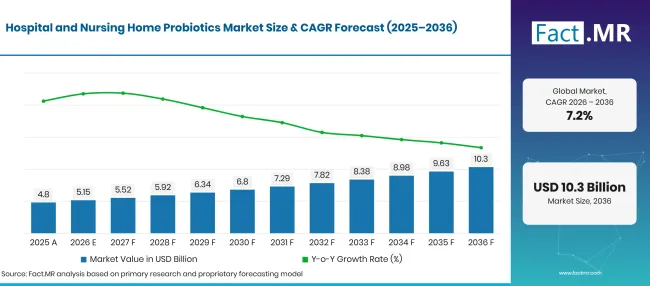
Hospital And Nursing Home Probiotics Market Forecast Global | Source: Fact.MR
| Year | Basis | Market Value (USD billion) |
|---|---|---|
| 2025 | Actual | 4.8 |
| 2026 | Estimate | 5.15 |
| 2036 | Forecast | 10.3 |
| CAGR 2026 to 2036 | Forecast period | 7.2% |
Source: Fact.MR analysis. Updated Nov 5, 2026
What are the defining numbers behind Hospital and Nursing Home Probiotics Market growth?
USD 5.1 billion in additional value by 2036, with digestive health and hospital use shaping the outlook.
- Demand Drivers in the Market
- Hospital clinicians may consider probiotics during antibiotic treatment when evidence supports a particular strain and patient group. A 2025 meta-analysis of 15 trials involving 7,427 adults found a lower pooled risk of antibiotic-associated diarrhea among participants given probiotics [1].
- Hospital pharmacists compare probiotic products by named strain, batch documentation and storage requirements. Reliable labeling helps them distinguish one tested formulation from another when deciding whether it fits a local care protocol.
- Nursing-home teams consider whether a preparation can be administered consistently during routine care. A clearly stated dose and storage process can make the product easier for staff to manage, while clinical eligibility still needs individual review.
- Suppliers serving institutional customers need to maintain product identity and viable-organism specifications across deliveries. Consistent packs and usable shelf-life information can make repeat orders easier for hospital and care-home purchasing teams.
- Key Segments Analyzed
- By Product Type: Lactobacillus is projected to account for 42.3% in 2026, reflecting its broad use in researched probiotic preparations.
- By Application: Digestive Health is estimated to represent 64.5% in 2026 as digestive symptoms attract the closest clinical review.
- By Form: Capsules are anticipated to hold 45.2% in 2026, supported by measured doses and established medication-round procedures.
- By End-User: Hospitals are forecast to account for 58.3% in 2026, where clinical assessment precedes product use.
- By Sales Channel: Pharmacies are projected to hold 61.4% in 2026, supported by controlled supply and pharmacist involvement.
- Analyst Opinion at Fact.MR
- Shambhu Nath Jha, Principal Consultant at Fact.MR, states, “The commercial case for institutional probiotics depends on evidence for the specific strain and patient population. A product backed by a useful clinical trial still requires screening for vulnerable patients and clear treatment protocols. Suppliers with consistent documentation and dependable small-unit packaging are positioned to earn repeat hospital and care-home orders.”
- Strategic Implications
- Probiotic suppliers can make strain identity, viable-count specifications, storage conditions and supporting clinical evidence easy for hospital pharmacies to review before adding a product to institutional use.
- Hospitals need indication-specific protocols that distinguish evidence for a named strain from broader probiotic claims, particularly when treating vulnerable patients.
- Nursing homes benefit from measured-dose formats, clear administration instructions and packaging that fits routine medicine rounds without adding unnecessary handling complexity.
- Distributors can support repeat institutional orders through consistent batch documentation, dependable shelf-life information and stable access to the same formulation across deliveries.
Germany is projected to advance at 8.3% CAGR through 2036 as long-term care services assess digestive-support options. Brazil follows at 7.6%, while the USA is forecast at 6.8%. The UK is anticipated to record 6.1%, and Japan is estimated at 5.4%.
How does the Hospital and Nursing Home Probiotics Market break down by segment?
Lactobacillus 42.3%; Digestive Health 64.5%; Capsules 45.2%; Hospitals 58.3%; Pharmacies 61.4%.
Which Product Type dominates?
Lactobacillus accounts for 42.3% of 2026 value.
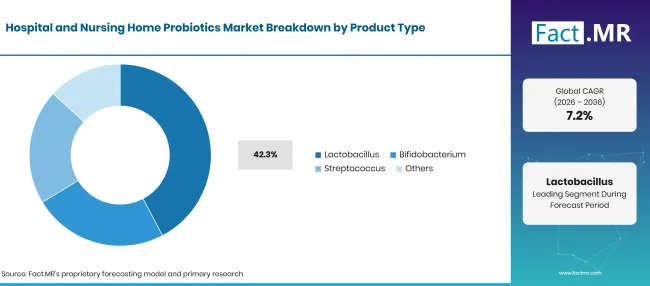
Hospital And Nursing Home Probiotics Market Breakdown Product Type | Source: Fact.MR
| Product Type | Share (2026) |
|---|---|
| Lactobacillus (Leading segment) | 42.3% |
| Other segments combined | 57.7% |
| Total | 100.0% |
Source: Fact.MR analysis. Updated Nov 5, 2026
Lactobacillus leads product type because several strains have been studied for digestive indications. Bifidobacterium products occupy a different part of the microbiome portfolio and require their own clinical evidence. Streptococcus-based formulations have specific strain identities and application limits. The word probiotic does not establish equal effects across these groups. A 2025 randomized trial examined Lactobacillus acidophilus LA85 for antibiotic-associated diarrhea and illustrates why a named strain is more informative than a broad genus label [2].
What leads the Application segment?
Digestive Health leads with 64.5% of 2026 value.
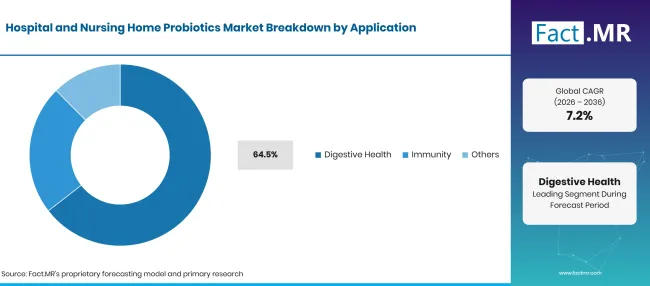
Hospital And Nursing Home Probiotics Market Breakdown Application | Source: Fact.MR
| Application | Share (2026) |
|---|---|
| Digestive Health (Leading segment) | 64.5% |
| Other segments combined | 35.5% |
| Total | 100.0% |
Source: Fact.MR analysis. Updated Nov 5, 2026
Digestive health is the main application because hospital and care-home teams regularly manage bowel symptoms alongside other treatments. A multicenter randomized trial published in October 2024 examined a combination of Lactobacillus species, Bifidobacterium species, Bacillus coagulans and Saccharomyces boulardii for preventing antibiotic-associated diarrhea in adults [3].
How does Form shape purchasing?
Capsules capture 45.2% of 2026 value.
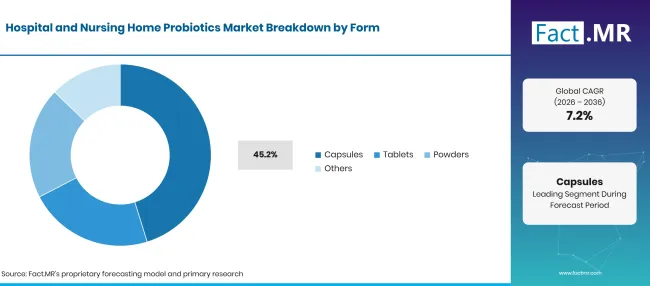
Hospital And Nursing Home Probiotics Market Breakdown Form | Source: Fact.MR
| Form | Share (2026) |
|---|---|
| Capsules (Leading segment) | 45.2% |
| Other segments combined | 54.8% |
| Total | 100.0% |
Source: Fact.MR analysis. Updated Nov 5, 2026
Capsules offer a defined amount per unit and fit routine dispensing arrangements. Tablets provide another measured format, although product composition and manufacturing conditions can affect survival of live organisms. Powders allow different preparation methods but introduce handling and mixing considerations. Hospitals weigh these details against staff time and patient needs.
Which End-User leads?
Hospitals represent 58.3% of 2026 value.
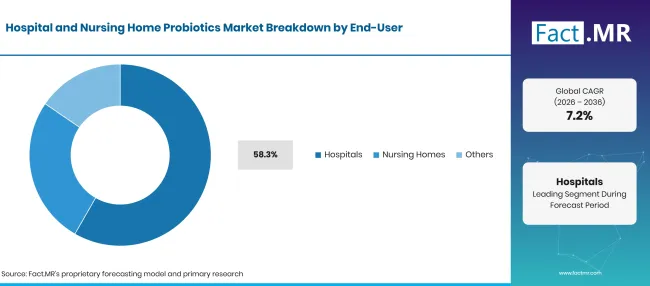
Hospital And Nursing Home Probiotics Market Breakdown End User | Source: Fact.MR
| End-User | Share (2026) |
|---|---|
| Hospitals (Leading segment) | 58.3% |
| Other segments combined | 41.7% |
| Total | 100.0% |
Source: Fact.MR analysis. Updated Nov 5, 2026
Hospitals lead end-user demand because clinical departments can assess a product against treatment needs and individual risk. Nursing homes operate on longer resident-care cycles and generally rely on routine administration by nursing staff. That changes the purchasing balance toward simple labeling and dependable supply.
Which Sales Channel leads?
Pharmacies hold 61.4% of 2026 value.
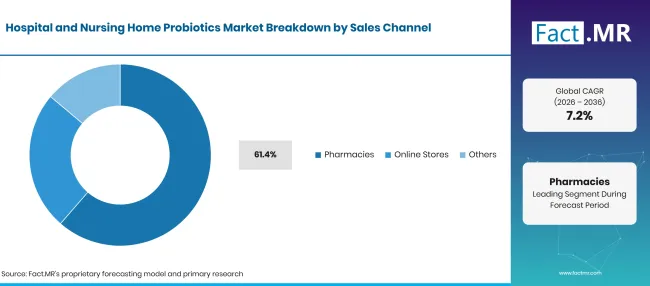
Hospital And Nursing Home Probiotics Market Breakdown Sales Channel | Source: Fact.MR
| Sales Channel | Share (2026) |
|---|---|
| Pharmacies (Leading segment) | 61.4% |
| Other segments combined | 38.6% |
| Total | 100.0% |
Source: Fact.MR analysis. Updated Nov 5, 2026
Pharmacies lead the sales-channel split because they manage prescription-related questions and provide a controlled route for probiotic products used in care. Online stores offer repeat ordering, but individual listings still need reliable strain and dosage information. Other channels include direct institutional distribution and specialized supply agreements. Pharmacy teams are particularly concerned with storage conditions and changes in product composition.
What is accelerating Hospital and Nursing Home Probiotics Market adoption, and what is holding it back?
Clinical research on specific digestive conditions supports selective interest in probiotics, while patient safety, strain-level evidence and storage stability shape how care institutions decide whether a product is appropriate.
Drivers Impact Analysis
| Driver | (~) % IMPACT ON CAGR | Geographic Relevance | Impact Timeline |
|---|---|---|---|
| Digestive-care evidence | +1.3 pp | Global | Medium term |
| Defined capsule dosing | +1.0 pp | North America, Europe | Short term |
| Care-home resident needs | +0.8 pp | Europe, East Asia | Long term |
| Pharmacy distribution | +0.6 pp | Global | Short term |
| Supplier quality records | +0.4 pp | Global | Medium term |
Source: Fact.MR analysis. Updated Nov 5, 2026
Opportunity Impact Analysis
| Opportunity | (~) % IMPACT ON CAGR | Geographic Relevance | Impact Timeline |
|---|---|---|---|
| Strain-specific care protocols | +0.7 pp | Hospitals and long-term care | Medium term |
| Small-unit institutional packs | +0.5 pp | North America, Europe | Short term |
| Resident-friendly preparations | +0.4 pp | Western Europe, East Asia | Medium term |
| Verified stability information | +0.3 pp | Global | Long term |
Source: Fact.MR analysis. Updated Nov 5, 2026
Restraints Impact Analysis
| Restraint | (~) % IMPACT ON CAGR | Geographic Relevance | Impact Timeline |
|---|---|---|---|
| Safety review in vulnerable patients | −0.8 pp | Global | Short term |
| Inconsistent strain-level evidence | −0.6 pp | Global | Medium term |
| Handling and storage requirements | −0.5 pp | Global | Short term |
| Budget and formulary restrictions | −0.4 pp | Europe, North America | Medium term |
Source: Fact.MR analysis. Updated Nov 5, 2026
Which countries are scaling the Hospital and Nursing Home Probiotics Market through 2036?
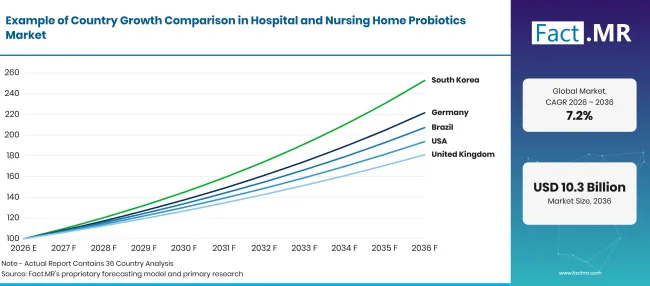
Hospital And Nursing Home Probiotics Market Growth Index | Source: Fact.MR
| Country | CAGR (2026 to 2036) |
|---|---|
| Germany | 8.3% |
| Brazil | 7.6% |
| USA | 6.8% |
| UK | 6.1% |
| Japan | 5.4% |
Source: Fact.MR analysis. Updated Nov 5, 2026
Why is Germany emerging as the fastest-growing institutional probiotics market?
8.3% CAGR, shaped by institutional long-term care needs.
Germany’s institutional probiotic outlook reflects the organization of long-term care and the way hospitals assess digestive-support products. In May 2025, Destatis described approximately 800,000 people receiving full residential nursing care in 2023 [4]. Another Destatis release reported almost 432,000 recipients of assistance for nursing care during 2024 [5]. The same May 2025 Destatis release reported that 86% of people needing long-term care were supported at home in 2023, which shapes the institutional customer base.
How is Brazil’s aging population widening the institutional probiotics opportunity?
7.6% CAGR, linked to a growing older population and pharmacy access.
Brazil’s outlook is closely linked to older-adult care and the use of pharmacies as a product access point. In December 2025, IBGE reported that the population aged 60 years and older had reached 34.1 million in 2024 [6]. IBGE also reported in December 2025 that 24.4% of older Brazilians were employed in 2024 [7], pointing to different household income and care-payment situations.
What gives the USA a strong base for institutional probiotic use?
6.8% CAGR, supported by established residential care infrastructure.
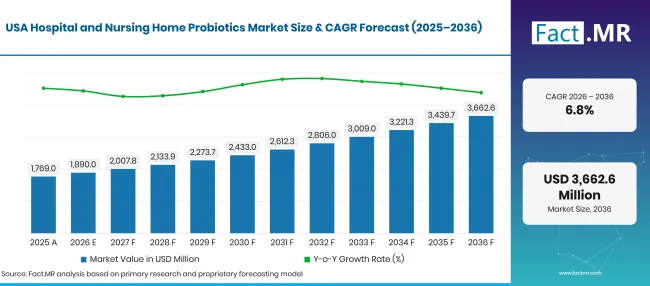
Hospital And Nursing Home Probiotics Market Forecast Usa | Source: Fact.MR
The United States combines a sizable residential-care network with established hospital pharmacy review procedures. The National Center for Health Statistics reported an estimated 31,416 residential care communities in its 2025 study. Its research also estimated 1,001,118 current residents, indicating the scale of routine care delivery. The CDC study estimated 1,297,134 residential care beds [8], although capacity does not establish the number of patients receiving probiotic products.
How are formal care services influencing probiotic demand in the UK?
6.1% CAGR, reflecting formal care pathways and pharmacy review.
The United Kingdom’s institutional probiotic outlook depends on established adult social-care services and clinical oversight of product use. The Department of Health and Social Care reported 1.60 million filled adult social-care posts in England during 2024–25 [9]. A February 2026 government factsheet recorded 50,000 international recruits into care-worker and senior care-worker roles in 2024–25 [10]. The Department of Health and Social Care reported a 24.7% turnover rate in the independent adult social-care sector for 2024–25.
Why does Japan remain a distinct market for probiotics in older-adult care?
5.4% CAGR, influenced by aging-related nutritional product development.
Japan’s institutional market is influenced by an established culture of fermented products and the distinct clinical needs of older adults. Japan’s Statistics Bureau reported in September 2025 that people aged 65 and older accounted for 29.4% of the population [12]. Probi and Nomura Dairy introduced an LP299V-containing fermented carrot drink in May 2025 [11], showing commercial interest in identified probiotic strains outside the hospital channel. Nursing-home staff can assess dose formats that fit supervised daily schedules.
Who leads the Hospital and Nursing Home Probiotics Market?
The supplier base spans branded probiotic manufacturers and ingredient specialists. BioGaia AB, Probi AB and Lallemand Health Solutions emphasize identified strains and clinical research.
Yakult Honsha Co., Ltd. works mainly through fermented drinks and other consumer-facing formats. Danone S.A. and Nestlé Health Science have broader nutrition portfolios. Their participation in probiotic products does not mean every item is intended for an institutional hospital formulary.
Novonesis supplies microbial and bioscience technologies used by health-product manufacturers, while International Flavors & Fragrances Inc. offers health-related ingredients. Archer Daniels Midland Company and Kerry Group plc operate ingredient businesses that can support probiotic product supply. Competition in the hospital and nursing-home setting depends on the evidence available for individual products, quality records and channel access.
Which companies are the key providers?
Key companies include Danone S.A.; Novonesis; Nestlé Health Science; Yakult Honsha Co., Ltd.; Probi AB; BioGaia AB; Lallemand Health Solutions; International Flavors & Fragrances Inc.; Archer Daniels Midland Company; Kerry Group plc.
- Danone S.A.
- Novonesis
- Nestlé Health Science
- Yakult Honsha Co., Ltd.
- Probi AB
- BioGaia AB
- Lallemand Health Solutions
- International Flavors & Fragrances Inc.
- Archer Daniels Midland Company
- Kerry Group plc
Bibliography
- [1] Wanyama, H., Akhtar, T. S., & Abbas, S. (2025, March 16). Probiotic use reduces the incidence of antibiotic-associated diarrhea among adult patients: A meta-analysis. Przegląd Gastroenterologiczny, 20(1), 5–16. https://doi.org/10.5114/pg.2025.148486 PubMed
- [2] Zhu, J., Sun, Y., Dong, Y., Zhao, Y., Gai, Z., & Fang, S. (2025, June 20). Efficacy and safety of Lactobacillus acidophilus LA85 in preventing antibiotic-associated diarrhea: A randomized, placebo-controlled study. Food Science & Nutrition, 13(6), e70490. https://doi.org/10.1002/fsn3.70490 PubMed Central (PMC)
- [3] Hodzhev, V., Dzhambazov, K., Sapundziev, N., Encheva, M., Todorov, S., Youroukova, V., Benchev, R., Nikolov, R., Bogov, B., Momekov, G., & Hadjiev, V. (2024, October 21). High-dose probiotic mix of Lactobacillus spp., Bifidobacterium spp., Bacillus coagulans, and Saccharomyces boulardii to prevent antibiotic-associated diarrhea in adults: A multicenter, randomized, double-blind, placebo-controlled trial (SPAADA). Open Forum Infectious Diseases, 11(11), ofae615. https://doi.org/10.1093/ofid/ofae615 PubMed
- [4] Statistisches Bundesamt (Destatis). (2025, May 15). Gesundheitsausgaben in Pflegeeinrichtungen im Jahr 2023 um 6,3 % gestiegen.
- https://www.destatis.de/DE/Presse/Pressemitteilungen/2025/05/PD25_N025_236.html Destatis
- [5] Statistisches Bundesamt (Destatis). (2025). Knapp 432.000 Personen erhielten im Laufe des Jahres 2024 Hilfe zur Pflege.
- https://www.destatis.de/DE/Themen/Gesellschaft-Umwelt/Soziales/Sozialhilfe/empfaenger-hilfe-pflege.html Destatis
- [6] Instituto Brasileiro de Geografia e Estatística. (2025, December 3). IBGE mostra que um a cada quatro idosos trabalhava em 2024.
- https://agenciadenoticias.ibge.gov.br/busca-avancada.html?contem=idosos&start=0 agenciadenoticias.ibge.gov.br
- [7] Instituto Brasileiro de Geografia e Estatística. (2025, December 3). Síntese de indicadores sociais: Nível de ocupação de pessoas com 60 anos ou mais de idade.
- https://agenciadenoticias.ibge.gov.br/media/com_mediaibge/arquivos/71016b2eb0a5feb8f7685271b1233db7.pdf
- [8] National Center for Health Statistics. (2026, June). 2025 National Post-acute and Long-term Care Study: Adult Day Services Center and Residential Care Community Survey Design and Methodology.
- https://www.cdc.gov/nchs/data/npals/2025/2025-NPALS-survey-methodology-documentation.pdf CDC
- [9] Department of Health and Social Care. (2025, December 11). DHSC annual report and accounts: 2024 to 2025.
- https://www.gov.uk/government/publications/dhsc-annual-report-and-accounts-2024-to-2025 GOV.UK
- [10] Department of Health and Social Care. (2026, February). Factsheet: Social Care Negotiating Bodies and Fair Pay Agreements.
- https://assets.publishing.service.gov.uk/media/69a6c0503b5b78231d1a9ae6/factsheet-social-care-negotiating-bodies-and-fair-pay-agreements-feb-2026.pdf GOV.UK
- [11] Probi AB. (2025, May 7). Nomura Dairy and Probi introduce probiotic-enhanced carrot juice to Japan.
- https://www.probi.com/press-releases/2025/05/nomura-dairy-and-probi-introduce-probiotic-enhanced-carrot-juice-to-japan/ probi.com
- [12] Statistics Bureau of Japan. (2025, September 14). Statistical Topics No. 146: Older persons in Japan on Respect for the Aged Day.
- https://www.stat.go.jp/data/topics/topi1460.html Statistics Bureau
This Report Answers
- Why digestive health attracts closer review than broader immune-support claims in hospitals.
- How hospitals and nursing homes differ in purchasing routines and product-handling needs.
- How evidence boundaries and patient risk affect the commercial outlook in five countries.
What does the Hospital and Nursing Home Probiotics Market cover?
The report covers preparations considered for hospital and nursing-home use. It evaluates product type, application, form, end-user and sales channel. A product remains within the scope when it is presented for an institutional care setting, subject to clinical suitability and the local supply route.
What is included in the scope?
Included products cover specified Lactobacillus and Bifidobacterium preparations alongside other named strains.
Capsules and tablets are included when supplied through pharmacies or institutional channels. Powders are considered where their labels describe suitable preparation and administration methods.
What is excluded from the scope?
Ordinary yogurt and fermented drinks sold only for everyday food consumption are outside the institutional revenue boundary.
Live-culture products without a defined strain or suitable use information are not treated as interchangeable clinical probiotic preparations. Standalone antibiotics and unrelated medicines are excluded.
How Was the Analysis Built?
The analysis draws on 120+ sources, 35+ company portfolios, 25+ countries, and more than 20 industry interviews.
- Primary Research: Primary research includes discussions with manufacturers, service providers, technology developers, distributors, end users, and subject-matter experts. These conversations examine purchasing priorities, product adoption, operational challenges, approval requirements, competitive positioning, and the factors that influence wider market acceptance.
- Desk Research: Desk research covers government statistics, regulatory publications, company filings, trade data, technical studies, industry associations, standards, public policy, and other authoritative sources. Every source used in the analysis is documented in the bibliography.
- Market Sizing and Forecasting: Market estimates combine historical performance, demand indicators, pricing and volume trends, segment shares, company participation, country-level growth, adoption patterns, investment activity, and barriers to market expansion.
- Data Validation and Update Cycle: Findings are validated by comparing primary interviews with public data, company activity, regulatory changes, trade patterns, and industry developments. Regular updates review new product launches, capacity changes, partnerships, approvals, and shifts in commercial adoption.
Segmentation
What is the report’s scope and coverage?
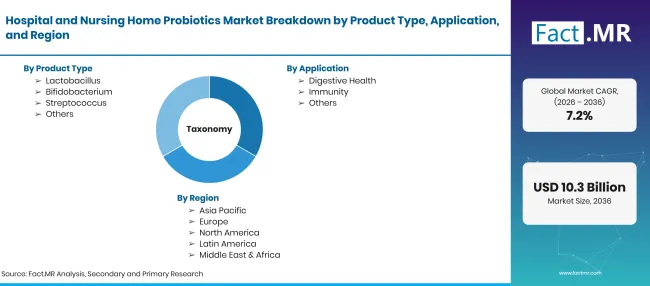
Hospital And Nursing Home Probiotics Market Taxonomy | Source: Fact.MR
| Attribute | Details |
|---|---|
| Quantitative Units | USD billion |
| Market Definition | Probiotic preparations considered for use or supply in hospital and nursing-home settings, including products evaluated by strain identity, application, dosage form and institutional suitability. |
| Product Type | Lactobacillus; Bifidobacterium; Streptococcus; Others |
| Application | Digestive Health; Immunity; Others |
| Form | Capsules; Tablets; Powders; Others |
| End-User | Hospitals; Nursing Homes; Others |
| Sales Channel | Pharmacies; Online Stores; Others |
| Regions Covered | North America; Latin America; Western Europe; Eastern Europe; East Asia; South Asia and Pacific; Middle East and Africa |
| Countries Covered | Germany; Brazil; United States; United Kingdom; Japan |
| Companies Profiled | Danone S.A.; Novonesis; Nestlé Health Science; Yakult Honsha Co., Ltd.; Probi AB; BioGaia AB; Lallemand Health Solutions; International Flavors & Fragrances Inc.; Archer Daniels Midland Company; Kerry Group plc |
| Forecast Period | 2026 to 2036 |
| Approach | Hybrid market assessment using clinical evidence, institutional purchasing patterns, strain-level product analysis, dosage-form and channel review, country demand indicators, company portfolios and validation across public data and industry inputs. |
Source: Fact.MR analysis. Updated Nov 5, 2026
How is the market segmented?
-
By Product Type
- Lactobacillus
- Bifidobacterium
- Streptococcus
- Others
-
By Application
- Digestive Health
- Immunity
- Others
-
By Form
- Capsules
- Tablets
- Powders
- Others
-
By End-User
- Hospitals
- Nursing Homes
- Others
-
By Sales Channel
- Pharmacies
- Online Stores
- Others
-
By Region
- North America
- Latin America
- Western Europe
- Eastern Europe
- East Asia
- South Asia and Pacific
- Middle East and Africa
Frequently Asked Questions
How large is the hospital and nursing home probiotics market in 2026?
What CAGR is forecast for 2026 to 2036?
Which probiotic product type leads?
Which application accounts for the main share?
Who are the main companies in the hospital and nursing home probiotics market?
Who worked on this report


Preview the report firsthand - request a free sample
Free SampleGet the brochure for pricing and purchase details
Download PDF