- Market Value (2025): USD 780.7 Mn
- Estimated Value (2026): USD 890 Mn
- Forecast Value (2036): USD 3299 Mn
- CAGR (2026-2036): 14.0%
What is the Smart CNC Sensors Market forecast to be worth by 2036?
USD 890 million in 2026 to USD 3299 million by 2036, at 14.0% CAGR.
- The Smart CNC Sensors Market reached USD 780.7 million in 2025.
- Demand is projected to rise from USD 890 million in 2026 to USD 3299 million by 2036.
- The market is forecast to record a 14.0% CAGR from 2026 to 2036 as machining centers and maintenance teams attach sensors to CNC assets.
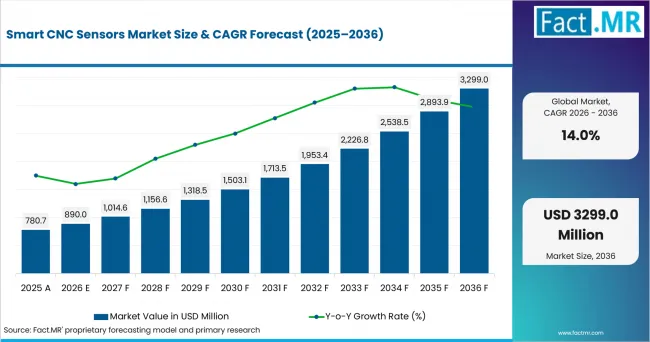
Smart Cnc Sensors Market Value Analysis | Source: Fact.MR
What are the defining numbers behind Smart CNC Sensors Market growth?
USD 2,409 million absolute opportunity by 2036, led by vibration-acoustic sensors, embedded OEM installation and machining centers.
- Demand Drivers in the Market
- CNC maintenance teams need early spindle-health warnings before bearing wear becomes visible in finished parts.
- Machine builders need embedded sensor packages that reduce wiring changes during commissioning.
- Production engineers need tool-wear signals that reduce scrap risk in precision parts.
- Plant managers need simple threshold alerts while predictive models are trained on local cutting conditions.
- Key Segments Analyzed
- By Sensor Type: Vibration-acoustic is expected to hold 46.0% share in 2026 due to its direct fit with spindle, bearing and chatter monitoring.
- By Target: Spindle health is projected to account for 32.0% share in 2026 because spindle failure creates high downtime and repair exposure.
- By Installation: Embedded OEM is anticipated to represent 39.0% share in 2026, supported by factory-qualified wiring and controller integration.
- By Machine: Machining centers are estimated to capture 34.0% share in 2026 owing to their broad use across milling, drilling and finishing work.
- By Analytics: Threshold alerts are forecast to hold 36.0% share in 2026 since many workshops need clear alarms before model-heavy analytics.
- Analyst Opinion at Fact.MR
- Shambhu Nath Jha, Principal Consultant at Fact.MR, states, “Smart CNC sensor adoption is tied to proof on the shop floor, beyond sensor count alone. Buyers are expected to favor systems that connect signal quality with tool life, spindle protection and part-quality checks. The stronger providers combine rugged sensing hardware, controller-level integration and service teams that understand machining cycles.”
- Strategic Implications
- Sensor vendors should publish machine-specific mounting guidance so maintenance teams capture repeatable vibration and force signals.
- CNC OEMs should offer sensor-ready spindle and coolant packages for customers that want condition data at installation.
- Retrofit integrators should standardize IO-Link and wired gateway kits to reduce commissioning time on older machines.
- Analytics providers should keep alarm setup simple because many smaller shops still rely on threshold-based maintenance decisions.
The USA is forecast to record 16.8% CAGR through 2036, supported by machine-tool order flow and active machinery use. Germany is projected to post 16.2% CAGR due to embedded OEM packages and industrial AI policy. Japan is expected to reach 14.6% CAGR through precision machining demand. South Korea is anticipated to record 12.9% CAGR as equipment investment supports monitoring projects. The UK is forecast to post 12.3% CAGR as manufacturing output supports retrofit testing.
How does the Smart CNC Sensors Market break down by segment?
Vibration-acoustic leads Sensor Type at 46.0%; Embedded OEM leads Installation at 39.0%.
Which Sensor Type dominates?
Vibration-acoustic holds 46.0% share in 2026.
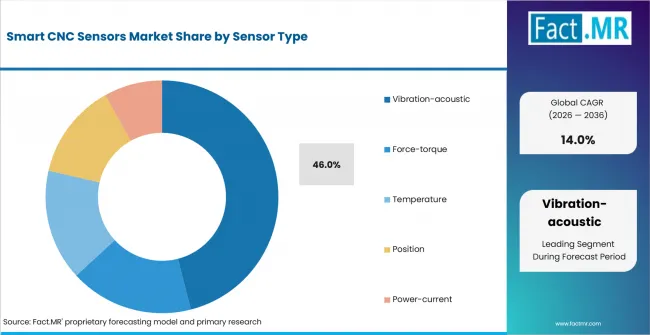
Smart Cnc Sensors Market Analysis By Sensor Type | Source: Fact.MR
Vibration-acoustic sensors are expected to lead because they translate spindle movement and cutting sound into early machine-health warnings. Maintenance teams use these signals around chatter, imbalance and bearing wear before those conditions affect tool life or the machined surface.
What leads the Target segment?
Spindle health accounts for 32.0% share in 2026.
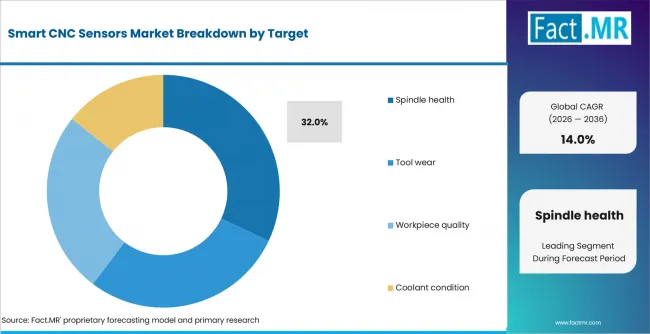
Smart Cnc Sensors Market Analysis By Target | Source: Fact.MR
Spindle health is projected to lead because spindle damage can stop a high-value CNC cell. Renishaw plc’s August 2025 NC4+ Blue launch linked on-machine tool measurement and non-contact tool setting with detection of tool features and defects as small as 5 µm. Tool setters and spindle sensors both serve the same maintenance problem by catching cutting issues before scrap or downtime expands.
How does Installation shape demand?
Embedded OEM holds 39.0% share in 2026.
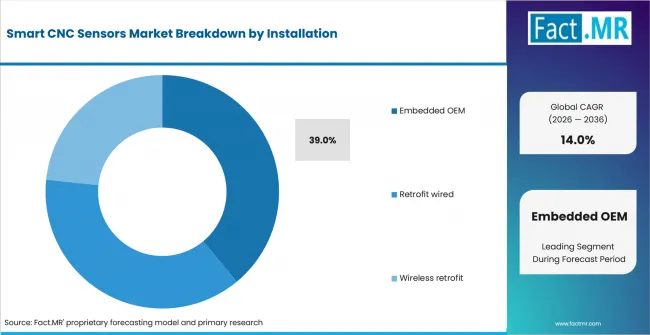
Smart Cnc Sensors Market Analysis By Installation | Source: Fact.MR
Embedded OEM installation is anticipated to lead because it reduces wiring uncertainty before machine delivery. Kistler Group introduced a Telemetric Measurement System in September 2025 for wireless process and tool monitoring on dynamic machine structures. Factory and semi-factory integration helps machine builders turn sensor data into a normal commissioning feature.
What supports Machining Centers within Machine?
Machining centers lead with 34.0% share in 2026.
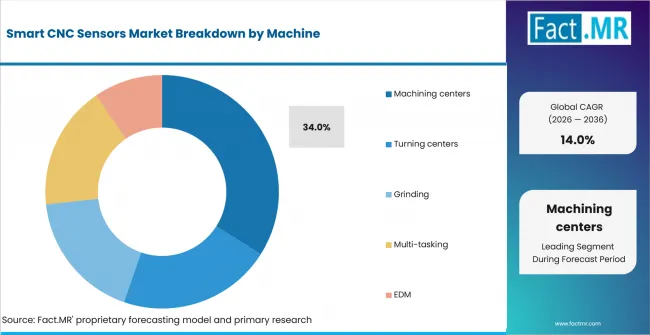
Smart Cnc Sensors Market Analysis By Machine | Source: Fact.MR
Machining centers are forecast to lead because one platform handles milling, drilling and finishing work. Sensor attachment gives maintenance teams a common view of spindle, tool and workpiece signals across high-use cells. Multi-machine plants therefore prioritize sensors on machining centers before expanding to turning or EDM assets.
What supports Threshold Alerts within Analytics?
Threshold alerts hold 36.0% share in 2026.
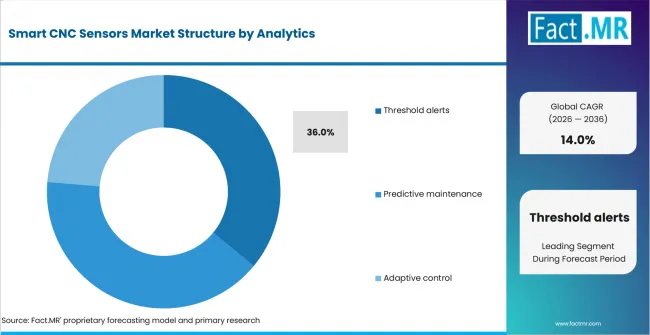
Smart Cnc Sensors Market Analysis By Analytics | Source: Fact.MR
Threshold alerts are expected to lead because plant teams need clear actions before predictive models earn trust. Simple alarms let operators stop a job, check a tool or inspect coolant flow without interpreting a full analytics dashboard. Clear limits keep setup practical for shops that start with spindle and tool-wear monitoring.
What is accelerating Smart CNC Sensors Market adoption, and what is holding it back?
Spindle-health monitoring drives it; retrofit complexity restrains it.
Drivers Impact Analysis
| Driver | (~) % Impact on CAGR | Geographic Relevance | Impact Timeline |
|---|---|---|---|
| Spindle-health protection | +2.1% | Global | Short term |
| CNC capital spending and utilization | +1.7% | USA, Germany, Japan | Medium term |
| Embedded OEM sensor packages | +1.3% | Europe, East Asia | Medium term |
| Tool-wear and scrap reduction | +1.1% | Global | Short term |
| Industrial digital programs | +0.9% | UK, South Korea | Long term |
Source: Fact.MR analysis. Updated Aug 25, 2026
- Spindle-health protection: Spindles carry high repair cost and production risk. Vibration-acoustic sensors give maintenance teams a warning before tool marks or bearing damage become visible in finished parts.
- CNC capital spending and utilization: Machine-tool order flow is expected to raise the number of assets that require monitoring.
- Tool-wear and scrap reduction: Force, acoustic and current signals help engineers replace tools based on cutting evidence. This lowers the risk of producing defective batches before manual inspection catches the issue.
- Industrial digital programs: Public support for automation and manufacturing AI is expected to help smaller firms test sensor-led maintenance. Adoption is anticipated to widen where advisory programs reduce the perceived risk of first projects. For CNC sensors, practical funding is expected to favor pilots that prove lower downtime on a small group of machines before expanding across a cell.
Opportunity Impact Analysis
| Opportunity | (~) % Impact on CAGR | Geographic Relevance | Impact Timeline |
|---|---|---|---|
| Retrofit kits for installed CNC fleets | +1.2% | Global | Short term |
| Wireless monitoring on moving structures | +0.9% | Japan, Europe | Medium term |
| Coolant and power-current monitoring | +0.7% | North America, East Asia | Medium term |
| Controller-linked analytics services | +0.6% | Global | Long term |
Source: Fact.MR analysis. Updated Aug 25, 2026
- Retrofit kits for installed CNC fleets: Many workshops operate mixed machine brands and ages. Standard sensor kits let integrators expand monitoring without replacing the machine.
- Wireless monitoring on moving structures: Turrets and rotating elements are hard to wire cleanly. Wireless telemetry expands the addressable base where signal quality is proven.
- Coolant and power-current monitoring: Some failures begin outside the spindle. Monitoring fluid condition and motor load gives plant teams a wider view of process risk.
- Controller-linked analytics services: Sensor data gains more value when it appears inside the CNC workflow. Service providers are projected to gain where alarms trigger clear maintenance actions.
Restraints Impact Analysis
| Restraint | (~) % Impact on CAGR | Geographic Relevance | Impact Timeline |
|---|---|---|---|
| Retrofit downtime and wiring work | -0.7% | Global | Short term |
| Signal noise and false alarms | -0.5% | Global | Medium term |
| Skills gaps in maintenance teams | -0.4% | USA, UK | Medium term |
| Price sensitivity in small shops | -0.3% | Global | Long term |
Source: Fact.MR analysis. Updated Aug 25, 2026
- Retrofit downtime and wiring work: Older CNC fleets often need custom mounting, cable routing and controller checks. Production managers delay projects when installation threatens scheduled work.
- Signal noise and false alarms: Cutting conditions vary by material, tool and fixture. Poor threshold setup reduces operator trust and slows wider sensor rollout. Calibration routines are expected to become part of the purchase decision when shops run mixed materials and short batches.
- Skills gaps in maintenance teams: Sensor projects need staff who understand both machining and data. Suppliers need setup tools that fit shop-floor skills and translate alarms into clear maintenance actions. Training depth is expected to shape repeat orders after the first retrofit project.
- Price sensitivity in small shops: Smaller workshops often buy sensors only when downtime savings are clear. Suppliers therefore need packages that show payback without long consulting projects. Service packs that document one avoided stoppage are expected to shorten approval cycles for small owners.
Which countries are scaling the Smart CNC Sensors Market through 2036?
- The country comparison spans 4.5 percentage points and forms three practical growth bands across the forecast period.
- The USA remains 0.6 percentage point above Germany through machine-tool order flow and active machinery use.
- Germany remains 1.6 percentage points above Japan because its machine-tool production base supports embedded OEM sensor packages.
- Japan remains 1.7 percentage points above South Korea as precision machining workloads support spindle and tool monitoring.
- South Korea remains 0.6 percentage point above the UK with machinery investment and manufacturing AI programs.
- The UK closes the displayed range through digital-adoption support for smaller manufacturers and advanced manufacturing supply chains.
Comparable CAGRs create different entry conditions due to machine-tool order cycles, automation policy, retrofit budgets and maintenance skills. Full report coverage includes North America, Latin America, Western Europe, Eastern Europe, East Asia, South Asia & Pacific, Middle East & Africa.
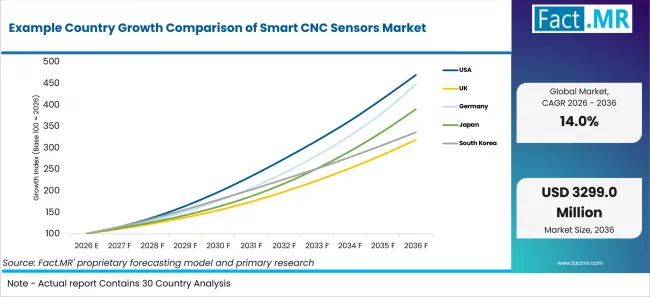
Example Country Growth Comparison Of Smart Cnc Sensors Market | Source: Fact.MR
| Country | CAGR |
|---|---|
| USA | 16.8% |
| Germany | 16.2% |
| Japan | 14.6% |
| South Korea | 12.9% |
| UK | 12.3% |
Source: Fact.MR analysis. Updated Aug 25, 2026
What supports USA adoption?
16.8% CAGR, supported by machine-tool order flow and active machinery use.
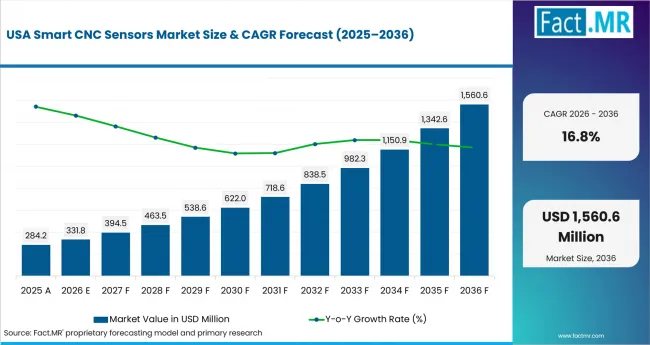
Smart Cnc Sensors Market Country Value Analysis | Source: Fact.MR
U.S. workshops attach sensors where active machine use makes spindle stops costly and easy to measure. The USA is forecast to record 16.8% CAGR through 2036, and Federal Reserve G.17 data released on July 17, 2026 showed U.S. machinery output rose 0.8% in June 2026 and was 4.4% above its June 2025 level. That demand pattern favors vibration-acoustic and tool-monitoring packages on CNC assets that run across mixed jobs.
What supports Germany adoption?
16.2% CAGR, led by machine-tool production scale and industrial AI policy.
German CNC sensor uptake is tied to machine-tool builders that package measurement, spindle and process controls with machining cells. Germany is projected to record 16.2% CAGR through 2036, and VDW’s February 25, 2026 key-figures release reported German machine-tool production of EUR 12.155 billion in 2025 when installation, repair and maintenance were excluded for comparability. In July 2026, Plattform Industrie 4.0 was reoriented toward Industrial AI, with digital infrastructure, data, AI foundation models and AI applications forming the core framework.
How is Japan scaling demand?
14.6% CAGR, shaped by precision machining and domestic machinery orders.
Japan’s precision machining base favors sensors that detect small tool changes before workpiece quality drifts. Japan is expected to post 14.6% CAGR through 2036, and the Cabinet Office reported in July 2026 that machinery orders received by 280 manufacturers rose 9.5% in May 2026. Wireless retrofit packages remain useful on turrets and compact machines where cable routing is hard.
How is South Korea developing demand?
12.9% CAGR, driven by machinery investment and manufacturing AI programs.
South Korea’s manufacturing programs give sensor vendors a route into high-throughput CNC cells that track uptime and quality. South Korea is anticipated to advance at 12.9% CAGR through 2036, and the Ministry of Data and Statistics reported in July 2026 that the Equipment Investment Index increased 21.7% year over year in June 2026. Local plants are expected to favor sensor packages that turn machine signals into faster maintenance decisions.
What supports the UK outlook?
12.3% CAGR, backed by manufacturing output and retrofit testing.
UK adoption is centered on workshops that use retrofit sensors before larger factory upgrades. The UK is forecast to record 12.3% CAGR through 2036, and ONS reported in August 2026 that manufacturing output grew 1.0% in the three months to June 2026 compared with the previous three months. CNC sensor pilots therefore fit shops that retain installed machines while testing simple maintenance alerts.
Who leads the Smart CNC Sensors Market?
Renishaw plc and Marposs S.p.A. are profiled for CNC measurement and process-monitoring systems, while Kistler Group, ifm electronic GmbH, Balluff GmbH and Schaeffler AG are profiled for relevant process or machine-condition sensing capabilities.
Renishaw plc is active through in-machine tool setting and measurement systems used on CNC machine tools. Marposs S.p.A. is profiled for process monitoring systems that connect sensors with machining signals. Kistler Group supports the field through force and telemetric measurement used around turrets, tools and rotating structures.
ifm electronic GmbH and Balluff GmbH strengthen the industrial sensor layer through IO-Link, vibration and machine-monitoring products. Schaeffler AG expanded its OPTIME portfolio in January 2026 with FAG OPTIME E-CM for electrical condition monitoring of three-phase motors. Competition is expected to center on easy commissioning, clear alarm behavior and links to maintenance software.
Which companies are the key providers?
Key companies include Renishaw plc, Marposs S.p.A., Kistler Group, ifm electronic GmbH, Balluff GmbH, Schaeffler AG.
- Renishaw plc
- Marposs S.p.A.
- Kistler Group
- ifm electronic GmbH
- Balluff GmbH
- Schaeffler AG
Bibliography
- Chidzik, C. (2026, February 9). Manufacturing technology orders set record in December 2025. AMT – The Association For Manufacturing Technology.
- Board of Governors of the Federal Reserve System. (2026, July 17). Industrial production and capacity utilization—G.17.
- Cabinet Office, Economic and Social Research Institute. (2026, July 15). Machinery orders in May, 2026.
- Kistler Group. (2025, September). New telemetric measurement system with wireless signal transmission for process monitoring.
- Ministry of Data and Statistics. (2026, July 31). Monthly industrial statistics, June 2026.
- Office for National Statistics. (2026, August 13). GDP monthly estimate, UK: June 2026.
- Renishaw plc. (2025, August). Renishaw sets new benchmark with third-generation NC4+ Blue laser tool setters at EMO Hannover 2025.
- Schaeffler AG. (2026, January 27). Schaeffler expands OPTIME portfolio: FAG OPTIME E-CM monitors electrically driven units.
- VDW – German Machine Tool Builders’ Association. (2026, February 25). Key figures of the German machine tool industry: Year 2025.
- Federal Ministry for Economic Affairs and Energy, & Federal Ministry of Research, Technology and Space. (2026, July 3). Bundesregierung, Wirtschaft und Forschung richten Plattform Industrie 4.0 auf industrielle KI (Künstliche Intelligenz) aus.
This Report Answers
- The report explains sensor type, target, installation route, machine type and analytics level.
- Segment analysis identifies vibration-acoustic sensors and embedded OEM installation as 2026 share anchors.
- Country analysis examines the USA, Germany, Japan, South Korea and the UK.
- Competitive analysis reviews Renishaw plc, Marposs S.p.A., Kistler Group, ifm electronic GmbH, Balluff GmbH and Schaeffler AG.
- Application analysis assesses spindle health, tool wear, workpiece quality and coolant condition.
- Technology assessment covers threshold alerts, predictive maintenance and adaptive control.
- Primary interviews, provider checks and official source review support the forecast.
What does the Smart CNC Sensors Market cover?
Vibration-acoustic, force-torque, temperature and power-current sensors used for CNC monitoring.
The Smart CNC Sensors Market covers sensor devices and signal interfaces used on CNC machine tools. These products measure machine condition, cutting load, temperature, position and current behavior during machining.
The assessment is narrower than general industrial sensors because each device must support CNC operation or machining maintenance. Broader factory sensors are excluded unless they monitor a CNC machine directly.
What is included in the scope?
Smart CNC sensor systems used on CNC machine tools and machining cells.
The scope includes embedded OEM sensors, wired retrofit kits and wireless retrofit systems used on machining centers, turning centers, grinding equipment, multi-tasking machines and EDM equipment. It covers vibration-acoustic, force-torque, temperature, position and power-current sensors for spindle health, tool wear, workpiece quality and coolant condition.
What is excluded from the scope?
General factory sensors and standalone machine tools are outside the scope.
The scope excludes non-CNC factory sensors, safety-only devices, stand-alone gauges and generic plant monitoring products when they lack a CNC machine signal. Broader current sensor platforms are outside the scope when they track facility power alone. General machine tools are included only when supplied with sensor hardware or monitoring interfaces.
How Was the Analysis Built?
The analysis draws on 120+ sources, 35+ company portfolios, 25+ countries, and more than 20 industry interviews.
- Primary Research: Primary research includes discussions with manufacturers, service providers, technology developers, distributors, end users, procurement teams, and subject-matter experts. These conversations examine purchasing priorities, product adoption, operational challenges, approval requirements, competitive positioning, and the factors that influence wider market acceptance.
- Desk Research: Desk research covers government statistics, regulatory publications, company filings, trade data, technical studies, industry associations, standards, public policy, and other authoritative sources. Every source used in the analysis is documented in the bibliography.
- Market Sizing and Forecasting: Market estimates combine historical performance, demand indicators, pricing and volume trends, segment shares, company participation, country-level growth, adoption patterns, investment activity, and barriers to market expansion.
- Data Validation and Update Cycle: Findings are validated by comparing primary interviews with public data, company activity, regulatory changes, trade patterns, and industry developments. Regular updates review new product launches, capacity changes, partnerships, approvals, procurement trends, and shifts in commercial adoption.
Segmentation
What is the report’s scope and coverage?
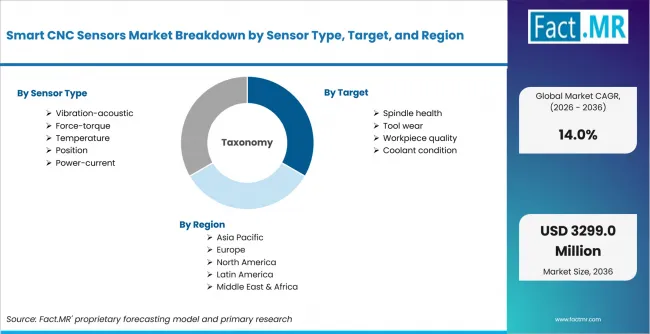
Smart Cnc Sensors Market Breakdown By Sensor Type, Target, And Region | Source: Fact.MR
| Attribute | Details |
|---|---|
| Quantitative Units | USD million |
| Market Definition | Sensor systems and related signal devices used on CNC machine tools to monitor machine condition, tool wear, workpiece quality, coolant state and process behavior. |
| Sensor Type | Vibration-acoustic; Force-torque; Temperature; Position; Power-current |
| Target | Spindle health; Tool wear; Workpiece quality; Coolant condition |
| Installation | Embedded OEM; Retrofit wired; Wireless retrofit |
| Machine | Machining centers; Turning centers; Grinding; Multi-tasking; EDM |
| Analytics | Threshold alerts; Predictive maintenance; Adaptive control |
| Regions Covered | North America; Latin America; Western Europe; Eastern Europe; East Asia; South Asia & Pacific; Middle East & Africa |
| Countries Covered | USA; Germany; Japan; South Korea; UK |
| Key Companies Profiled | Renishaw plc, Marposs S.p.A., Kistler Group, ifm electronic GmbH, Balluff GmbH, Schaeffler AG |
| Forecast Period | 2026 to 2036 |
| Approach | Hybrid top-down and bottom-up approach using CNC installed base, machine-tool orders, sensor attachment rates, retrofit mix, country adoption and provider portfolio review. |
Source: Fact.MR analysis. Updated Aug 25, 2026
How is the market segmented?
-
By Sensor Type:
- Vibration-acoustic
- Force-torque
- Temperature
- Position
- Power-current
-
By Target:
- Spindle health
- Tool wear
- Workpiece quality
- Coolant condition
-
By Installation:
- Embedded OEM
- Retrofit wired
- Wireless retrofit
-
By Machine:
- Machining centers
- Turning centers
- Grinding
- Multi-tasking
- EDM
-
By Analytics:
- Threshold alerts
- Predictive maintenance
- Adaptive control
-
By Region:
- North America
- Latin America
- Western Europe
- Eastern Europe
- East Asia
- South Asia & Pacific
- Middle East & Africa
Frequently Asked Questions
How big is the smart CNC sensors market in 2026?
What is the CAGR of the smart CNC sensors market from 2026 to 2036?
Which sensor type leads the smart CNC sensors market?
Which target leads the smart CNC sensors market?
Who are the leading companies in the smart CNC sensors market?
Who worked on this report


Preview the report firsthand - request a free sample
Free SampleGet the brochure for pricing and purchase details
Download PDF