- Market Value (2025): USD 259.3 Mn
- Estimated Value (2026): USD 350.0 Mn
- Forecast Value (2036): USD 7037.0 Mn
- CAGR (2026-2036): 35.0%
What is the Solid Electrolyte Powders Market forecast to be worth by 2036?
USD 350.0 million in 2026 to USD 7,037.0 million by 2036 at a 35.0% CAGR.
- The solid electrolyte powders market reached USD 259.3 million in 2025.
- Demand is projected to increase from USD 350.0 million in 2026 to USD 7037.0 million by 2036.
- The market is forecast to record 35.0% CAGR from 2026 to 2036 as EV traction cells and pilot lines require dry ion-conducting powders.
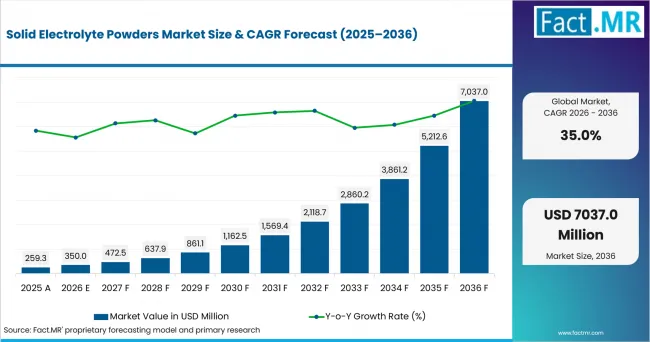
Solid Electrolyte Powders Market Value Analysis | Source: Fact.MR
What are the defining numbers behind Solid Electrolyte Powders Market growth?
An absolute opportunity of USD 6,687.0 million is expected between 2026 and 2036.
- Demand Drivers in the Market
- Cell developers need stable powder interfaces as the International Energy Agency reported in May 2026 that EV battery deployment reached 1.2 TWh in 2025.
- Automotive qualification teams need safer electrolyte routes where the International Energy Agency reported in May 2026 that electric car sales exceeded 20 million in 2025.
- Battery material producers need domestic process capacity. The U.S. Department of Energy’s March 13, 2026 funding opportunity offered up to USD 500 million to expand U.S. critical-mineral and materials processing and derivative battery manufacturing and recycling.
- Powder distributors need downstream validation signals. Samsung SDI signed an all-solid-state battery validation agreement with BMW and Solid Power in October 2025.
- Key Segments Analyzed
- By Chemistry: Sulfide is expected to hold 41.0% share in 2026 because high ionic conductivity keeps it close to EV fast-charge testing.
- By Conductivity: Below 1 mS/cm is projected to account for 48.0% share in 2026 since early screening still includes oxide and hybrid powders.
- By Particle Size: Sub-micron is anticipated to capture 47.0% share in 2026 due to its fit with thin separator and cathode-contact layers.
- By Application: EV traction is estimated to represent 35.0% share in 2026 owing to automaker interest in non-flammable electrolyte systems.
- Analyst Opinion at Fact.MR
- Shambhu Nath Jha, Principal Consultant at Fact.MR, states, “The commercial bottleneck has moved beyond conductivity alone. Powder suppliers are expected to compete on lot purity, moisture control and proof that particle behavior transfers into larger cells. Suppliers that combine sulfide know-how with handling support and shipment-ready quality records have the clearer qualification path.”
- Strategic Implications
- Powder producers should publish lot-to-lot conductivity, particle-size distribution and moisture limits so cell developers shorten screening work.
- Battery developers should qualify sulfide and oxide routes separately because conductivity targets and plant handling controls create different scale-up paths.
- Equipment integrators should align dry-room transfer systems with electrolyte chemistry. Powder movement, milling and storage affect cell-test yield before pack qualification begins.
- Automotive procurement teams should connect powder approval to pouch-cell cycling and abuse-test evidence alongside coin-cell conductivity data.
The UK is forecast to post 41.7% CAGR through 2036, supported by public battery funding and zero-emission vehicle registrations. Japan is anticipated to reach 38.6% CAGR due to all-solid-state battery commercialization plans. The USA is projected to record 37.6% CAGR through federal battery-material funding. Germany is expected to post 36.7% CAGR as electric-drive registration volumes keep testing demand active. South Korea is forecast to reach 34.8% CAGR as next-generation battery strategy supports pilot-line work.
How does the Solid Electrolyte Powders Market break down by segment?
Sulfide leads Chemistry at 41.0%; sub-micron leads Particle Size at 47.0%.
Which Chemistry dominates?
Sulfide is expected to hold 41.0% share in 2026.
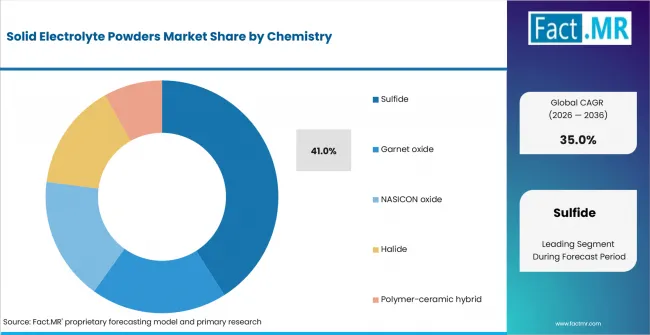
Solid Electrolyte Powders Market Analysis By Chemistry | Source: Fact.MR
Sulfide powders are expected to hold 41.0% share in 2026 because they offer a practical route to high ion movement in solid-state cells. Garnet oxide and NASICON oxide remain relevant for projects where air stability reduces plant burden. Halide and polymer-ceramic hybrid powders remain smaller but useful for targeted cell designs. NEI Corporation’s battery-materials page, updated May 21, 2026, lists sulfide-, oxide-, phosphate-, polymer-, and halide-based solid electrolytes, demonstrating the range of electrolyte chemistries available for solid-state battery development.
What leads the Conductivity segment?
Below 1 mS/cm is projected to account for 48.0% share in 2026.
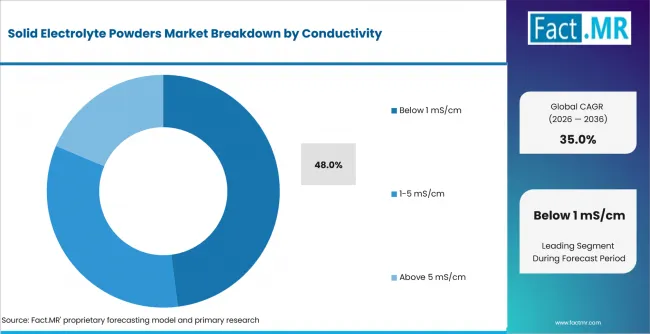
Solid Electrolyte Powders Market Analysis By Conductivity | Source: Fact.MR
Below 1 mS/cm powders are projected to account for 48.0% share in 2026 since many early programs still screen safer oxide and hybrid options. The 1-5 mS/cm range supports more demanding sulfide trials. Above 5 mS/cm remains a premium target for programs that can manage moisture and interface risk. Conductivity therefore functions as a qualification filter, with handling and repeatability shaping buyer selection alongside laboratory performance.
How does Particle Size shape demand?
Sub-micron is anticipated to lead with 47.0% share in 2026.
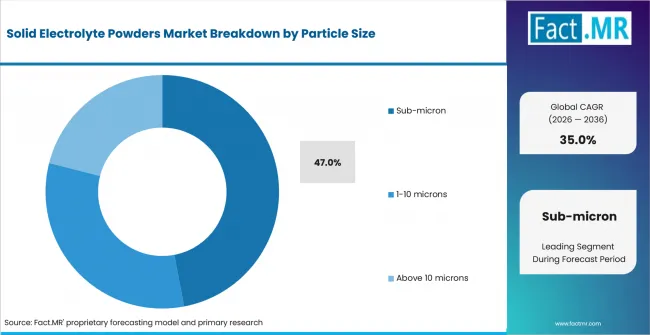
Solid Electrolyte Powders Market Analysis By Particle Size | Source: Fact.MR
Sub-micron powders are anticipated to lead with 47.0% share in 2026 due to their fit with thin separators and compact cathode composites. One-to-ten micron powders remain practical for handling and flow. Above 10 microns stays relevant where thicker layers or lower-cost test builds are acceptable. Particle-size control is central to this market because uneven particles can weaken contact between the cathode and solid electrolyte during cycling.
What supports EV traction within Application?
EV traction is estimated to represent 35.0% share in 2026.
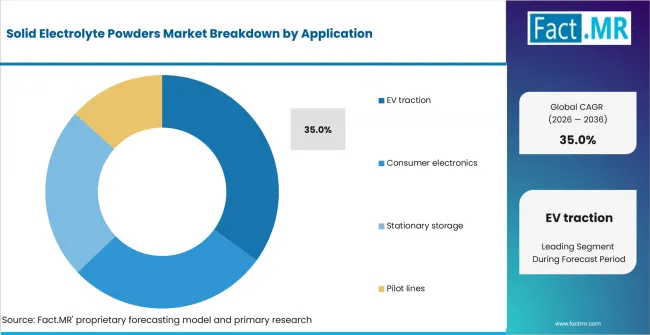
Solid Electrolyte Powders Market Analysis By Application | Source: Fact.MR
EV traction is estimated to represent 35.0% share in 2026 owing to automaker pressure for safer and denser pack designs. Consumer electronics can absorb premium powders in smaller cells. Stationary storage remains a later application because cost and cycle-life proof carry more weight than energy density alone. The International Energy Agency reported in May 2026 that battery-electric cars accounted for 65% of global electric car sales in 2025.
What is accelerating Solid Electrolyte Powders Market adoption, and what is holding it back?
EV traction demand drives it; moisture-sensitive processing restrains it.
Drivers Impact Analysis
| DRIVER | (~) % IMPACT ON CAGR | GEOGRAPHIC RELEVANCE | IMPACT TIMELINE |
|---|---|---|---|
| EV traction qualification | +4.1% | North America; Western Europe; East Asia | Short term (<= 2 years) |
| Public battery-material funding | +3.4% | USA; UK; Japan; South Korea | Medium term (2-4 years) |
| Sulfide conductivity advantage | +2.7% | Japan; USA; South Korea | Medium term (2-4 years) |
| Sub-micron interface control | +1.9% | Global | Long term (>= 4 years) |
- EV traction qualification: Automakers are testing solid-state cells to improve safety and pack density.
- Public battery-material funding: Government programs are increasing pilot capacity for battery materials.
- Sulfide conductivity advantage: Sulfide powders are selected where developers need faster lithium-ion movement.
- Sub-micron interface control: Smaller particles help active materials contact the solid electrolyte with fewer voids.
Opportunity Impact Analysis
| OPPORTUNITY | (~) % IMPACT ON CAGR | GEOGRAPHIC RELEVANCE | IMPACT TIMELINE |
|---|---|---|---|
| Commercial nano sulfide supply | +2.6% | USA; Japan; South Korea | Short term (<= 2 years) |
| Automaker-linked pilots | +2.2% | Japan; USA; Germany | Medium term (2-4 years) |
| Hybrid powder screening | +1.5% | Global | Long term (>= 4 years) |
- Commercial nano sulfide supply: Purchasable sulfide powders create a route outside custom synthesis.
- Automaker-linked pilots: Large pilot facilities help close the gap between laboratory samples and multi-kilogram cell trials.
- Hybrid powder screening: Polymer-ceramic powders give developers a handling route when sulfide moisture control is difficult. These grades are anticipated to win early design work where acceptable conductivity can be paired with safer storage and lower process burden.
Restraints Impact Analysis
| RESTRAINT | (~) % IMPACT ON CAGR | GEOGRAPHIC RELEVANCE | IMPACT TIMELINE |
|---|---|---|---|
| Moisture-sensitive handling | -1.4% | Global | Short term (<= 2 years) |
| Automotive qualification cycles | -1.1% | North America; Europe; East Asia | Medium term (2-4 years) |
| Critical mineral supply exposure | -0.8% | USA; Europe; East Asia | Long term (>= 4 years) |
- Moisture-sensitive handling: Sulfide powders require dry processing because side reactions can damage performance.
- Automotive qualification cycles: Solid-state cells require long validation before vehicle purchase orders scale.
- Critical mineral supply exposure: Upstream material concentration affects specialty powder availability.
Which countries are scaling the Solid Electrolyte Powders Market through 2036?
- The country comparison spans 6.9 percentage points between the UK and South Korea across the forecast period.
- The UK remains 3.1 percentage points above Japan as public battery programs and EV registrations support early materials demand.
- Japan remains 1.0 percentage point above the USA due to all-solid-state battery targets and sulfide electrolyte scale-up.
- The USA remains 0.9 percentage point above Germany due to federal battery-material programs and domestic commercialization work.
- Germany remains 1.9 percentage points above South Korea as electric-drive registrations sustain automotive battery validation.
- South Korea closes the displayed range through battery strategy, material-security funding and pilot-line activity.
Comparable CAGRs create different entry conditions due to pilot-line depth, qualification needs, powder-handling readiness and battery policy. Full report coverage includes North America, Latin America, Western Europe, Eastern Europe, East Asia, South Asia & Pacific, Middle East & Africa.
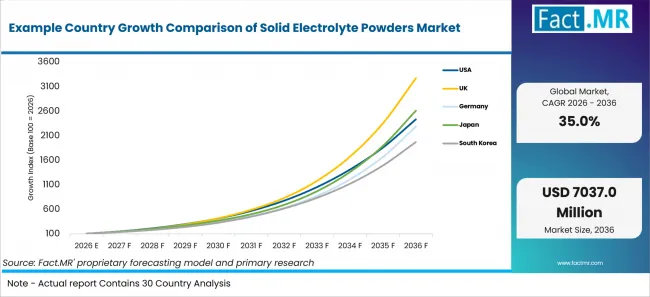
Example Country Growth Comparison Of Solid Electrolyte Powders Market | Source: Fact.MR
| Country | CAGR |
|---|---|
| UK | 41.7% |
| Japan | 38.6% |
| USA | 37.6% |
| Germany | 36.7% |
| South Korea | 34.8% |
What supports UK adoption?
41.7% CAGR, supported by EV registrations and battery innovation funding.
UK cell developers evaluate powder reliability before approving solid-state battery materials for pilot cells. The country is forecast to post 41.7% CAGR through 2036. The Department for Transport reported in April 2026 that 473,226 zero-emission cars were first registered in 2025, and Innovate UK opened a Battery Innovation Programme round in October 2025 with up to GBP 20 million for feasibility studies.
How is Japan scaling demand?
38.6% CAGR, driven by all-solid-state battery commercialization targets.
Japan’s battery policy gives electrolyte suppliers a clear timing signal for all-solid-state work. Japan is anticipated to reach 38.6% CAGR through 2036. METI’s June 2026 Battery and Power Industry Strategy targets a domestic manufacturing base of 150 GWh per year over the period from 2030 to the mid-2030s, while Idemitsu states that two small-scale solid-electrolyte verification facilities are operating and that it made the final investment decision for a large pilot facility in fiscal 2025, with construction targeted for completion in 2027.
What supports USA adoption?
37.6% CAGR, supported by federal battery-material funding and laboratory licensing.
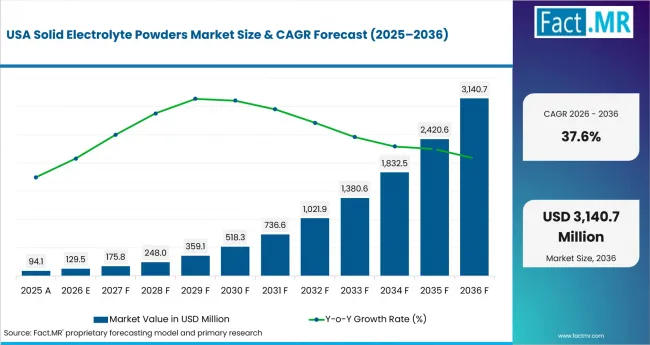
Solid Electrolyte Powders Market Country Value Analysis | Source: Fact.MR
U.S. materials teams are using federal funding and national-lab licensing to shorten the route from powder discovery to customer testing. The USA is projected to record 37.6% CAGR through 2036. The U.S. Department of Energy announced up to USD 500 million in March 2026 to expand U.S. critical mineral and materials processing and derivative battery manufacturing and recycling, while PNNL reported in May 2025 that Ampcera Inc. and PNNL had entered into an exclusive option agreement covering PNNL-developed solid-state electrolyte technology.
What is supporting Germany’s adoption?
36.7% CAGR, backed by electric-drive registration growth and automotive validation work.
Germany’s vehicle base gives powder suppliers a demanding route into European cell validation. Germany is expected to post 36.7% CAGR through 2036. VDA reported in February 2026 that around 64,500 electric passenger cars were newly registered in Germany in January 2026, while the February 2026 revision of VDA 19.1 reinforces standardized inspection and documentation of particulate contamination for automotive components, including applications in quality assurance and supplier management.
How does South Korea perform?
34.8% CAGR, led by next-generation battery strategy and supply-chain funding.
South Korea’s battery makers continue to link solid-state development with domestic material-security planning. South Korea is forecast to reach 34.8% CAGR through 2036. The IEA policy database, updated in May 2026, states that Korea’s Battery Industry Innovation Strategy supports more than KRW 50 trillion in domestic private investment by 2030, while MOTIR announced in October 2025 that the government would establish a KRW 250 billion Critical Minerals and Energy Supply Chain Stabilization Fund.
Who leads the Solid Electrolyte Powders Market?
Ampcera Inc., Idemitsu Kosan Co., Ltd., NEI Corporation, Solid Power, Inc., Mitsui Mining & Smelting Co., Ltd. are profiled for relevant solid-electrolyte or specialty-material supply.
Ampcera Inc. is active in sulfide solid electrolyte powders and has linked its commercialization route with PNNL licensing work. Idemitsu Kosan Co., Ltd. is building sulfide-based solid electrolyte capacity around automotive solid-state battery programs. These companies sit closest to the market boundary because they connect powder materials with cell-development needs.
NEI Corporation, Solid Power, Inc., and Mitsui Mining & Smelting Co., Ltd. support the market through research materials, custom powders and specialty chemical supply. Competition is expected to turn on consistent ionic conductivity, particle-size control, moisture management and evidence from larger cell formats. Suppliers with reliable documentation are positioned to move from sample supply into repeat qualification programs.
Which companies are the key providers?
Key companies include Ampcera Inc., NEI Corporation, Solid Power, Inc., Mitsui Mining & Smelting Co., Ltd., Idemitsu Kosan Co., Ltd.
- Ampcera Inc.
- NEI Corporation
- Solid Power, Inc.
- Mitsui Mining & Smelting Co., Ltd.
- Idemitsu Kosan Co., Ltd.
Bibliography
- Ampcera Inc. (2025, May 12). Ampcera launches breakthrough nano sulfide solid electrolytes and begins global shipments to solid-state battery makers.
- Department for Transport. (2026, April 29). Vehicle licensing statistics, United Kingdom: 2025. GOV.UK.
- Idemitsu Kosan Co., Ltd. (2026, January 29). Final investment decision and construction start for large pilot facility for solid electrolytes (all-solid-state battery material).
- International Energy Agency. (2026, May 20). Global EV Outlook 2026: Electric vehicle batteries.
- International Energy Agency. (2026, May 20). Global EV Outlook 2026: Trends in electric cars.
- Innovate UK. (2025, October 20). Battery innovation feasibility studies round one. UK Research and Innovation.
- Ministry of Economy, Trade and Industry. (2026, June 2). “Battery Industry Strategy” revised as the “Battery and Power Industry Strategy”.
- Ministry of Trade, Industry and Resources. (2025, October 31). Korea to strengthen supply chain stability for rare earth elements and critical minerals.
- NEI Corporation. (2026, May 20). Solid electrolyte materials.
- U.S. Department of Energy. (2026, March 13). Energy Department announces $500 million to strengthen domestic critical materials processing and manufacturing.
- U.S. Geological Survey. (2026, February 6). Mineral commodity summaries 2026.
This Report Answers
- The report explains where solid electrolyte powders are used across chemistry and conductivity classes. It also covers particle size and application.
- Segment analysis identifies sulfide, below 1 mS/cm, sub-micron and EV traction as the 2026 share positions.
- Country analysis examines the UK, Japan, USA, Germany and South Korea.
- Competitive analysis reviews Ampcera Inc., NEI Corporation, Solid Power, Inc., Mitsui Mining & Smelting Co., Ltd., and Idemitsu Kosan Co., Ltd..
- Application analysis assesses EV traction, consumer electronics, stationary storage and pilot-line cells.
- Technology assessment reviews sulfide, garnet oxide, NASICON oxide, halide and polymer-ceramic hybrid powders.
- Source review combines official statistics, public policy, provider checks and company developments from 2025 onward.
What does the Solid Electrolyte Powders Market cover?
Sulfide, garnet oxide, NASICON oxide, halide and hybrid powders used for ion-conducting solid-state battery layers.
The Solid Electrolyte Powders Market covers powdered ion-conducting materials used inside all-solid-state cells. It includes powders used for separator layers, cathode-interface layers and composite electrodes where lithium-ion movement occurs through a solid material.
The assessment differs from broader solid-state battery materials coverage because it focuses on powders instead of complete cells, packs or finished electrode assemblies. Liquid electrolyte formulations are outside the boundary unless used as comparison chemistry during cell qualification.
What is included in the scope?
Solid electrolyte powders used in EV traction, consumer electronics, stationary storage and pilot-line cells.
The scope includes sulfide, garnet oxide, NASICON oxide, halide and polymer-ceramic hybrid powders used by cell developers and material producers. Adjacent solid-state battery materials analysis is relevant where powders are part of a wider cell-material stack. Battery chemicals coverage is included only where electrolyte powder sourcing affects battery-grade input decisions. Lithium-ion battery cathode research is adjacent when dry powder mixing changes cathode-interface design. Precursor-free cathodes are reviewed only where solid electrolyte powder integration is part of the cathode route.
What is excluded from the scope?
Finished battery cells and liquid electrolyte systems are outside the scope.
The scope excludes finished lithium-ion cells, assembled packs, battery management systems and raw mining inputs. Liquid electrolyte salts, separator films and active cathode materials remain outside coverage unless sold as part of a documented solid-state powder qualification package.
How Was the Analysis Built?
The analysis draws on 120+ sources, 35+ company portfolios, 25+ countries, and more than 20 industry interviews.
- Primary Research: Primary research includes discussions with manufacturers, service providers, technology developers, distributors, end users, procurement teams, and subject-matter experts. These conversations examine purchasing priorities, product adoption, operational challenges, approval requirements, competitive positioning, and the factors that influence wider market acceptance.
- Desk Research: Desk research covers government statistics, regulatory publications, company filings, trade data, technical studies, industry associations, standards, public policy, and other authoritative sources. Every source used in the analysis is documented in the bibliography.
- Market Sizing and Forecasting: Market estimates combine historical performance, demand indicators, pricing and volume trends, segment shares, company participation, country-level growth, adoption patterns, investment activity, and barriers to market expansion.
- Data Validation and Update Cycle: Findings are validated by comparing primary interviews with public data, company activity, regulatory changes, trade patterns, and industry developments. Regular updates review new product launches, capacity changes, partnerships, approvals, procurement trends, and shifts in commercial adoption.
What is the report’s scope and coverage?
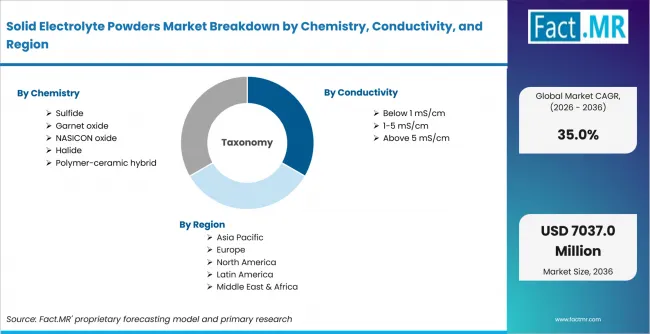
Solid Electrolyte Powders Market Breakdown By Chemistry, Conductivity, And Region | Source: Fact.MR
| Attribute | Details |
|---|---|
| Quantitative Units | USD million in 2026 to USD million by 2036 at a CAGR |
| Market Definition | Powdered ion-conducting solid electrolyte materials used in solid-state battery separator, cathode-interface and composite-electrode layers. |
| Chemistry | Sulfide; Garnet oxide; NASICON oxide; Halide; Polymer-ceramic hybrid |
| Conductivity | Below 1 mS/cm; 1-5 mS/cm; Above 5 mS/cm |
| Particle Size | Sub-micron; 1-10 microns; Above 10 microns |
| Application | EV traction; Consumer electronics; Stationary storage; Pilot lines |
| Regions Covered | North America; Latin America; Western Europe; Eastern Europe; East Asia; South Asia & Pacific; Middle East & Africa |
| Countries Covered | USA; UK; Germany; Japan; South Korea |
| Key Companies Profiled | Ampcera Inc.; NEI Corporation; Solid Power, Inc.; Mitsui Mining & Smelting Co., Ltd.; Idemitsu Kosan Co., Ltd. |
| Forecast Period | 2026 to 2036 |
| Approach | Hybrid top-down and bottom-up approach using powder chemistry, conductivity class, particle-size needs, application mix, country adoption and provider portfolio review. |
How is the market segmented?
-
By Chemistry
- Sulfide
- Garnet oxide
- NASICON oxide
- Halide
- Polymer-ceramic hybrid
-
By Conductivity
- Below 1 mS/cm
- 1-5 mS/cm
- Above 5 mS/cm
-
By Particle Size
- Sub-micron
- 1-10 microns
- Above 10 microns
-
By Application
- EV traction
- Consumer electronics
- Stationary storage
- Pilot lines
-
By Region
- North America
- Latin America
- Western Europe
- Eastern Europe
- East Asia
- South Asia & Pacific
- Middle East & Africa