- Market Value (2025): USD 525.9 Mn
- Estimated Value (2026): USD 560.0 Mn
- Forecast Value (2036): USD 1050.0 Mn
- CAGR (2026-2036): 6.5%
What is the Sorbent Media Cartridges Market forecast to be worth by 2036?
USD 560.0 million in 2026 to USD 1,050.0 million by 2036, at 6.5% CAGR.
- The market was approximately USD 525.9 million in 2025, supported by a large installed base across municipal, industrial, commercial, food, healthcare, and laboratory systems.
- Revenue is forecast to advance from USD 560.0 million in 2026 to USD 1,050.0 million by 2036 as contaminant-specific media and recurring replacement programs widen the addressable base.
- The projected 6.5% CAGR from 2026 to 2036 reflects PFAS treatment demand, decentralized water polishing, and greater use of condition-based cartridge management.
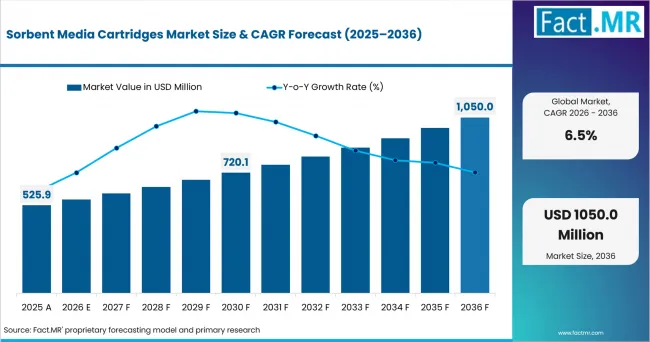
Sorbent Media Cartridges Market Value Analysis | Source: Fact.MR
What are the defining numbers behind Sorbent Media Cartridges Market growth?
USD 490.0 million absolute opportunity by 2036, led by Activated carbon and Chlorine/organics within their respective segments.
- Demand Drivers in the Market
- Activated carbon cartridges remain a practical choice for chlorine, organic compounds, taste, odor, and selected dissolved contaminants in compact systems.
- PFAS treatment planning is expanding interest in specialized carbon and ion-exchange media that can be changed without replacing a full treatment train.
- Industrial water users value cartridges when a small, high-purity stream does not justify a large regenerable vessel.
- Recurring replacement creates predictable service demand when suppliers can link change-out frequency to measured capacity and feed-water conditions.
- Key Segments Analyzed
- By Media Chemistry: Activated Carbon is expected to hold 27.0% share in 2026, supported by its porous structure and broad adsorption performance across water-quality, taste, and odor-control applications.
- By Target Contaminant: Chlorine/Organics are projected to account for 28.0% share in 2026 due to their wide treatment need across municipal, commercial, food-processing, and industrial water systems.
- By Cartridge Format: Drop-in Cartridges are anticipated to capture 34.0% share in 2026 because they simplify media replacement across standardized housings and distributed treatment points.
- By End User: Municipal Water Utilities are estimated to represent 26.0% share in 2026 through their use of cartridges in polishing systems, public buildings, smaller treatment points, and distributed water networks.
- By Replacement Cycle: Semi-annual Replacement is forecast to account for 24.0% share in 2026 as a six-month schedule helps limit contaminant breakthrough without creating the labour burden of quarterly servicing.
- Analyst Opinion at Fact.MR
- Fact.MR analyst view: "The cartridge housing is the easy part; commercial performance is determined by the match between media chemistry, competing ions, contact time, and the buyer's tolerance for breakthrough. Suppliers that make those limits visible will earn more trust than those selling a universal change-out calendar."
- Strategic Implications
- Water utilities should qualify sorbent media against the full contaminant profile rather than a target compound in isolation.
- Cartridge manufacturers can build recurring value through batch traceability, condition indicators, and reliable take-back or disposal guidance.
- Industrial users need to compare disposable cartridges with regenerable vessels using labor, downtime, residuals, and quality risk as well as media price.
- Distributors should stock compatible housings and multiple media chemistries because emergency replacement demand can be more time-sensitive than the initial installation.
U.S. Environmental Protection Agency treatment guidance identifies granular activated carbon and ion exchange among the established technologies used for PFAS removal. For cartridge suppliers, that attention raises the value of contaminant-specific capacity data and a clear plan for the media after exhaustion.
United States 7.0% CAGR. Germany 7.1% CAGR. India 6.7% CAGR. Japan 6.4% CAGR. South Korea 6.0% CAGR. Brazil 5.6% CAGR.
How does the Sorbent Media Cartridges Market break down by segment?
The leading shares are Drop-in Cartridge at 34.0% by Cartridge Format and Chlorine/Organics at 28.0% by Target Contaminant.
Why does activated carbon remain the largest media chemistry?
Activated Carbon holds 27.0% share in 2026.
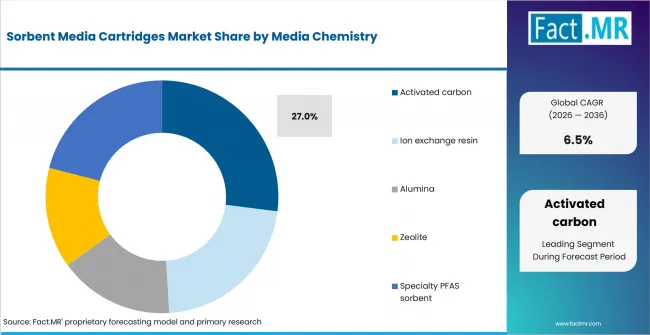
Sorbent Media Cartridges Market Analysis By Media Chemistry | Source: Fact.MR
Activated carbon leads demand because it is familiar, widely available, and adaptable to several cartridge sizes. Ion exchange resin follows and is selected when ionic contaminants or high-purity requirements call for more specific chemical capture. Specialty PFAS sorbent already holds a meaningful position, indicating that selective performance is becoming a large commercial category rather than a niche formulation.
Which contaminant group creates the largest cartridge requirement?
Chlorine/Organics account for 28.0% share in 2026.
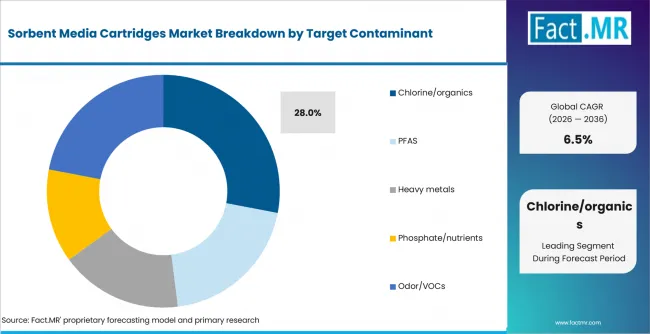
Sorbent Media Cartridges Market Analysis By Target Contaminant | Source: Fact.MR
Chlorine and organics lead target demand, drawing on the broad installed base of carbon treatment. Odor and VOC applications follow and often require careful media selection where moisture or competing compounds shorten life. PFAS also holds a substantial share whose economics depend on the specific compounds, influent matrix, and acceptable breakthrough level.
Why do drop-in cartridges lead the format mix?
Drop-in Cartridges represent 34.0% share in 2026.
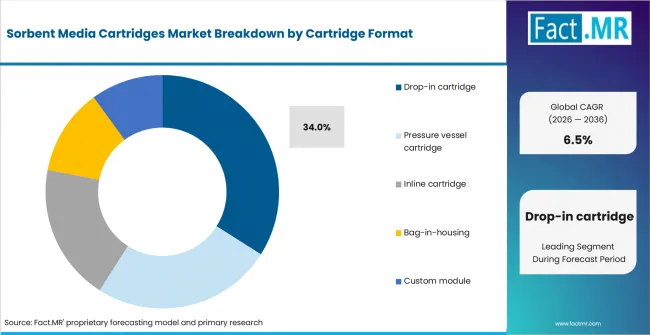
Sorbent Media Cartridges Market Analysis By Cartridge Format | Source: Fact.MR
Drop-in cartridges lead demand because technicians can replace a self-contained element without emptying loose media. Pressure-vessel cartridges follow and support higher-flow or more demanding duty where sealing and hydraulic distribution matter. Inline cartridges round out the mix, favored for compact equipment and point applications that prioritize quick plumbing integration.
Why is end-user demand split between utilities and residential or commercial systems?
Municipal Water Utilities capture 26.0% share in 2026.
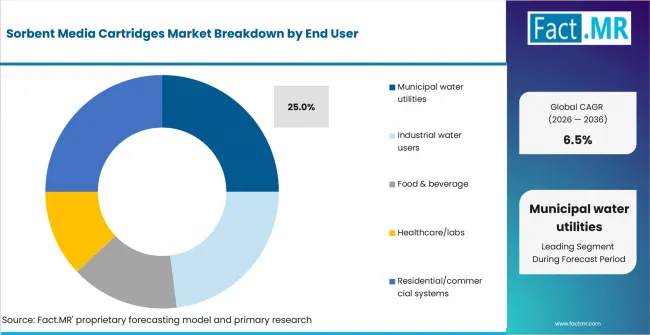
Sorbent Media Cartridges Market Analysis By End User | Source: Fact.MR
Municipal water utilities and residential or commercial systems lead end-user demand in roughly equal measure, but their procurement needs differ sharply. Industrial water users follow and often specify cartridges around a process limit or protection of downstream equipment. Food and beverage places additional emphasis on materials, hygiene, taste, and consistent replacement supply.
Why is semi-annual replacement the leading cycle?
Semi-annual Replacement holds 24.0% share in 2026.
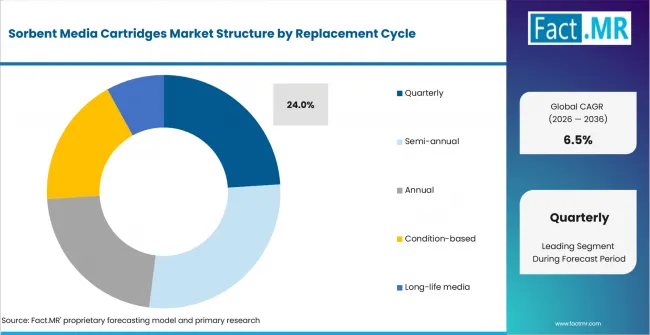
Sorbent Media Cartridges Market Analysis By Replacement Cycle | Source: Fact.MR
Semi-annual replacement leads, giving operators a practical scheduled-maintenance rhythm. Quarterly changes follow where loading is high, quality risk is low-tolerance, or cartridges are deliberately kept small. Annual replacement also holds a solid share, while condition-based service can expand as monitoring becomes affordable and reliable.
What is accelerating Sorbent Media Cartridges Market adoption, and what is holding it back?
The strongest accelerator is the ability to add targeted sorption within an existing housing or compact treatment loop. The main restraint is uncertain service life, since breakthrough can change materially with flow, water chemistry, competing contaminants, and media batch quality.
Drivers Impact Analysis
| DRIVER | (~) % IMPACT ON CAGR | GEOGRAPHIC RELEVANCE | IMPACT TIMELINE |
|---|---|---|---|
| PFAS treatment investment | +1.0% | United States and Europe | Medium term (2-4 years) |
| Decentralized water polishing | +0.8% | Rapidly industrializing markets | Short term (<= 2 years) |
| Industrial purity requirements | +0.7% | Germany and Japan | Medium term (2-4 years) |
| Recurring replacement revenue | +0.6% | Global | Short term (<= 2 years) |
| Condition-based maintenance | +0.5% | Advanced utility and industrial sites | Long term (>= 4 years) |
Source: Fact.MR analysis. Updated Jul 22, 2026
- PFAS treatment investment: Utilities and building owners are evaluating carbon, ion exchange, and other media for PFAS control. Cartridge formats benefit in smaller flows, pilots, and polishing steps where rapid media replacement is desirable.
- Decentralized water polishing: Commercial buildings, laboratories, and smaller facilities need compact treatment close to the use point. Drop-in and inline cartridges allow deployment without constructing a central media system.
- Industrial purity requirements: Electronics, healthcare, and specialty manufacturing use cartridges to protect final polishing and sensitive equipment. Demand favors traceable resin and carbon media with consistent pressure drop and capacity.
Opportunity Impact Analysis
| OPPORTUNITY | (~) % IMPACT ON CAGR | GEOGRAPHIC RELEVANCE | IMPACT TIMELINE |
|---|---|---|---|
| Selective PFAS formulations | +0.5% | North America and Europe | Medium term (2-4 years) |
| Cartridge take-back services | +0.5% | Regulated industrial markets | Long term (>= 4 years) |
| Multi-media staged housings | +0.4% | Global | Short term (<= 2 years) |
| Verified compatibility platforms | +0.3% | Commercial and laboratory channels | Medium term (2-4 years) |
Source: Fact.MR analysis. Updated Jul 22, 2026
- Selective PFAS formulations: Specialty media can differentiate on capacity across the relevant PFAS mixture and competing natural organic matter. Commercial claims need transparent test conditions and realistic end-of-life criteria.
- Cartridge take-back services: A managed return program can reduce the burden of storing and arranging disposition for spent media. Suppliers must preserve chain-of-custody and align the program with contaminant-specific waste requirements.
- Multi-media staged housings: Sequential carbon, resin, alumina, or specialty cartridges can divide contaminant load and protect the most expensive medium. The design needs sampling points so operators know which stage is exhausted.
Restraints Impact Analysis
| RESTRAINT | (~) % IMPACT ON CAGR | GEOGRAPHIC RELEVANCE | IMPACT TIMELINE |
|---|---|---|---|
| Variable breakthrough | -0.5% | Global | Short term (<= 2 years) |
| Spent-media liability | -0.4% | PFAS and heavy-metal applications | Medium term (2-4 years) |
| Housing pressure loss | -0.3% | High-flow systems | Short term (<= 2 years) |
| Low-quality substitutes | -0.2% | Price-sensitive channels | Long term (>= 4 years) |
Source: Fact.MR analysis. Updated Jul 22, 2026
- Variable breakthrough: Media can exhaust sooner than expected when competing substances occupy active sites. A nominal capacity figure is not enough unless feed chemistry and flow conditions are defined.
- Spent-media liability: The cartridge concentrates contaminants and transfers them into a solid residual. Handling and disposition can weaken the economics of an otherwise simple treatment step.
- Housing pressure loss: Dense media and fine particles can raise pressure drop as the cartridge loads. Pumping energy, bypass risk, and flow reduction limit how much sorbent can be packed into a compact element.
Which country markets carry sorbent cartridge growth?
United States 7.0% CAGR. Germany 7.1% CAGR. Japan 6.4% CAGR. South Korea 6.0% CAGR. Brazil 5.6% CAGR.
Regional analysis covers country chapters on United States, China, Germany, India, Japan, South Korea, and Brazil. Analysis on more than 30 countries is included in the full report.How is the United States market likely to develop?
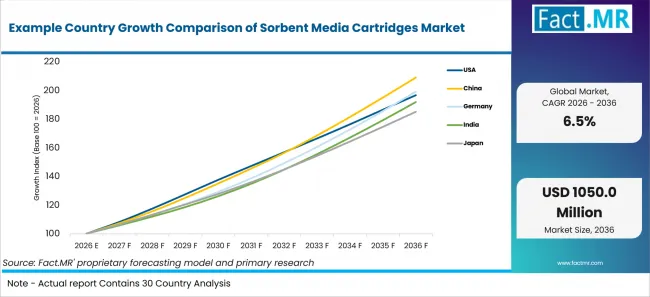
Example Country Growth Comparison Of Sorbent Media Cartridges Market | Source: Fact.MR
| COUNTRY | CAGR |
|---|---|
| United States | 7.0% |
| Germany | 7.1% |
| India | 6.7% |
| South Korea | 6.0% |
| Brazil | 5.6% |
Source: Fact.MR analysis. Updated Jul 22, 2026
How is the United States market likely to develop?
A 7.0% CAGR is projected for United States during 2026-2036.
The United States market reflects a mix of chemical-control requirements and a large industrial base. Before changing a treatment material or cartridge program, customers often look for clear application data, stable specifications, and complete compliance records. In the sorbent media cartridges market, attention usually centres on contaminant breakthrough, service life, replacement timing, and verified treatment performance. Companies therefore gain more from showing local operating evidence than from making broad demand claims.
How is the Germany market likely to develop?
A 7.1% CAGR is projected for Germany during 2026-2036.
Germany’s market is influenced by strict substance-control rules and a technically advanced manufacturing sector. REACH restriction duties make substance control a procurement issue, while manufacturing statistics reflect a technically demanding production base. Buyers put weight on traceability, change control, and evidence that a material will behave consistently in qualified processes. For sorbent media cartridges, buyers focus on contaminant breakthrough, service life, replacement planning, and documented treatment performance. That makes country-specific operating evidence more useful than a broad demand statement: suppliers need to match the offer to local qualification, channel, and service requirements.
How is the India market likely to develop?
A 6.7% CAGR is projected for India during 2026-2036.
India combines expanding industrial activity with growing attention to environmental compliance. Demand favours companies that offer dependable treatment performance, competitive pricing, local technical help, and steady product availability across varied distribution channels. For sorbent media cartridges, customers compare contaminant removal, cartridge life, replacement planning, and proof of treatment efficiency. Local service reach and practical operating support are likely to carry greater weight than broad market positioning.
How is the Japan market likely to develop?
A 6.4% CAGR is projected for Japan during 2026-2036.
Japan operates within a carefully controlled product and chemical-management environment. Cartridge changes often require detailed records, repeatable performance, and technical support that limits disruption in established systems. Users of sorbent media cartridges place particular emphasis on breakthrough behaviour, service intervals, replacement planning, and documented filtration results. Market success therefore depends on precise technical evidence and close alignment with local approval and service expectations.
How is the South Korea market likely to develop?
A 6.0% CAGR is projected for South Korea during 2026-2036.
South Korea’s export-led industrial structure places strong emphasis on consistency, regulatory alignment, and rapid production support. Customers often examine whether a cartridge system fits short product cycles without causing rework, delays, or repeat qualification. In this market, sorbent media cartridge selection depends on breakthrough control, operating life, replacement schedules, and proven treatment performance. Companies with responsive technical service and dependable product quality are better placed to meet local requirements.
How is the Brazil market likely to develop?
A 5.6% CAGR is projected for Brazil during 2026-2036.
Brazil's outlook is shaped by country-specific operating conditions. mineral-resource governance and industrial statistics frame a market where regional supply conditions matter. Procurement teams focus on distributor coverage, import exposure, plant-level performance, and documentation that can travel across varied industrial locations. For sorbent media cartridges, buyers focus on contaminant breakthrough, service life, replacement planning, and documented treatment performance. That makes country-specific operating evidence more useful than a broad demand statement: suppliers need to match the offer to local qualification, channel, and service requirements.
Who leads the Sorbent Media Cartridges Market?
3M, Pentair, Pure Aqua, and Culligan compete through media chemistry, cartridge platforms, water-treatment integration, and replacement reach.
3M leads the company group, followed by Pentair. Broad water-treatment access helps these companies position cartridges within a larger process rather than as isolated consumables.
Pure Aqua and Culligan are also active in the space. Regional cartridge specialists can still gain ground through custom media loading, shorter replenishment lead times, and support for smaller industrial or commercial systems.
Which companies are the key providers?
The company set includes 3M, Pentair, Pure Aqua, and Culligan.
- 3M
- Pentair
- Pure Aqua
- Culligan
Bibliography
- Calgon Carbon Corporation. (2025, December 9). Calgon Carbon announces issuance of new patents for advanced activated carbon sorbent technology to remove PFAS from water.
- National Sanitation Foundation. (2025, December 16). NSF/ANSI 42, 53 and 401: Filtration systems standards.
- U.S. Environmental Protection Agency. (2025, October 3). PFAS treatment in drinking water and wastewater: State of the science.
- U.S. Environmental Protection Agency. (2025, November 18). Identifying drinking-water filters certified to reduce PFAS.
- U.S. Geological Survey. (2025, January 15). U.S. Geological Survey integrated water availability assessment—2010–20. U.S. Department of the Interior.
This Report Addresses
- The report establishes the 2025 baseline and forecasts market revenue through 2036.
- It reviews United States, China, Germany, India, Japan, South Korea, and Brazil, within coverage that reaches more than 30 countries.
- It assesses 3M, Pentair, Pure Aqua, and Culligan.
- It evaluates activated carbon, ion exchange, alumina, zeolite, and specialty PFAS sorbents.
- It examines municipal, industrial, food, healthcare, laboratory, commercial, and residential demand.
- It links forecast evidence to PFAS investment, decentralized treatment, installed housings, and replacement practice.
What does the Sorbent Media Cartridges Market cover?
The study tracks sorbent cartridge revenue from initial system placement through recurring media exhaustion and replacement.
Revenue is recognized for the media-bearing element and any inseparable cartridge hardware. New and replacement cartridges are modeled separately using format, chemistry, end user, and service interval.
Country demand reflects water-quality investment, industrial mix, decentralized system penetration, regulation, and distribution access. Specialty and standard media are priced according to their realized market mix rather than treated as interchangeable elements.
What is included in the scope?
Included elements must remove a dissolved or gaseous contaminant principally through adsorption, ion exchange, or related sorption.
Carbon block, granular carbon, resin-filled, alumina, zeolite, mixed-media, and contaminant-selective cartridges are included. Modules may serve point-of-use, point-of-entry, laboratory, industrial, municipal, food, or healthcare systems.
Quarterly, semi-annual, annual, condition-based, and long-life replacement patterns are all captured. Cartridge take-back or monitoring is included only when billed as part of the covered consumable program.
What is excluded from the scope?
Mechanical filtration and loose-media treatment outside a cartridge format are not counted.
Sediment-only cartridges, membrane elements, ultraviolet lamps, chemical dosing, granular media delivered for open beds, and full treatment vessels are excluded. Installation labor and waste disposal are outside scope unless inseparable from a supplier-managed cartridge contract.
How Was the Analysis Built?
The analysis draws on 120+ sources, 35+ company portfolios, 25+ countries, and more than 20 industry interviews.
- Primary Research: Primary research includes discussions with manufacturers, service providers, technology developers, distributors, end users, procurement teams, and subject-matter experts. These conversations examine purchasing priorities, product adoption, operational challenges, approval requirements, competitive positioning, and the factors that influence wider market acceptance.
- Desk Research: Desk research covers government statistics, regulatory publications, company filings, trade data, technical studies, industry associations, standards, public policy, and other authoritative sources. Every source used in the analysis is documented in the bibliography.
- Market Sizing and Forecasting: Market estimates combine historical performance, demand indicators, pricing and volume trends, segment shares, company participation, country-level growth, adoption patterns, investment activity, and barriers to market expansion.
- Data Validation and Update Cycle: Findings are validated by comparing primary interviews with public data, company activity, regulatory changes, trade patterns, and industry developments. Regular updates review new product launches, capacity changes, partnerships, approvals, procurement trends, and shifts in commercial adoption.
Segmentation
What is the report's scope and coverage?
| ATTRIBUTE | DETAILS |
|---|---|
| Quantitative Units | USD Million in 2026 to USD Million by 2036 at CAGR |
| Market Definition | The market covers replaceable cartridges filled or formed with activated carbon, ion-exchange resin, alumina, zeolite, specialty PFAS sorbents, and related media for removing dissolved contaminants from water or air streams. |
| Media Chemistry | Activated carbon; Ion exchange resin; Alumina; Zeolite; Specialty PFAS sorbent |
| Target Contaminant | Chlorine/organics; PFAS; Heavy metals; Phosphate/nutrients; Odor/VOCs |
| Cartridge Format | Drop-in cartridge; Pressure vessel cartridge; Inline cartridge; Bag-in-housing; Custom module |
| End User | Municipal water utilities; Industrial water users; Food & beverage; Healthcare/labs; Residential/commercial systems |
| Replacement Cycle | Quarterly; Semi-annual; Annual; Condition-based; Long-life media |
| Regions Covered | North America; Europe; Asia Pacific |
| Countries Covered | United States; Germany; Japan; South Korea; Brazil (analysis extends to 30+ countries) |
| Key Companies Profiled | 3M; Pentair; Pure Aqua; Culligan |
| Forecast Period | 2026 to 2036 |
| Approach | Demand is evaluated using cartridge installation levels, target-contaminant load, media capacity, cartridge-format preferences, end-user purchasing patterns, and pricing across activated carbon, ion-exchange, and specialty sorbent products. |
Source: Fact.MR analysis. Updated Jul 22, 2026
How is the market segmented?
-
By Media Chemistry:
- Activated carbon
- Ion exchange resin
- Alumina
- Zeolite
- Specialty PFAS sorbent
-
By Target Contaminant:
- Chlorine/organics
- PFAS
- Heavy metals
- Phosphate/nutrients
- Odor/VOCs
-
By Cartridge Format:
- Drop-in cartridge
- Pressure vessel cartridge
- Inline cartridge
- Bag-in-housing
- Custom module
-
By End User:
- Municipal water utilities
- Industrial water users
- Food & beverage
- Healthcare/labs
- Residential/commercial systems
-
By Replacement Cycle:
- Quarterly
- Semi-annual
- Annual
- Condition-based
- Long-life media
-
By Region:
- North America
- United States
- Latin America
- Brazil
- Europe
- Germany
- Italy
- United Kingdom
- Russia
- East Asia
- China
- Japan
- South Korea
- South Asia
- India
- Middle East and Africa
- Morocco
- Saudi Arabia
- United Arab Emirates
- North America
Frequently Asked Questions
What is the sorbent media cartridges market worth in 2026?
How large will the market be by 2036?
What is the forecast CAGR?
Which media chemistry leads demand?
Which target contaminant category is largest?
Which cartridge format has the largest share?
Which end users lead the market?
What is the leading replacement cycle?
Who worked on this report


Preview the report firsthand - request a free sample
Free SampleGet the brochure for pricing and purchase details
Download PDF