- Base Value(2025): 2 Bn
- Estimated Value(2026): 2.1 Bn
- Forecast Value (2036): 3.7 Bn
- CAGR (2026 - 2036): 5.8%
Sound Attenuator Market Forecast 2026 to 2036
In 2025, the sound attenuator market was valued at USD 2 billion. Based on Fact MR's analysis, demand for sound attenuators is estimated to grow to USD 2.1 billion in 2026 and USD 3.7 billion by 2036. FMR projects a CAGR of 5.8% during the forecast period.
The absolute dollar growth from 2026 to 2036 is USD 1.6 billion. This growth is driven by the increasing demand for noise reduction solutions across industries such as construction, automotive, and industrial applications. As noise pollution regulations tighten globally, the market for sound attenuators is expected to expand. However, challenges such as rising raw material costs and stringent regulatory requirements may influence the growth rate in some regions.
India leads with a CAGR of 6.9%, driven by rapid urbanization, infrastructure development, and growing industrial demand. Saudi Arabia follows with a 6.5% CAGR, supported by increasing construction and industrialization. The UAE grows at 6.2%, driven by a strong demand for soundproofing in commercial and residential buildings. Vietnam benefits from a 5.9% growth rate due to expanding industrial and construction sectors. Indonesia grows at 5.6%, fueled by increasing industrialization and construction activity. Mexico experiences 5.2% growth, supported by growing infrastructure and noise regulation enforcement. The USA and Germany experience slower growth at 3.4% and 2.9%, respectively, due to their more mature markets and established demand for sound attenuation solutions.
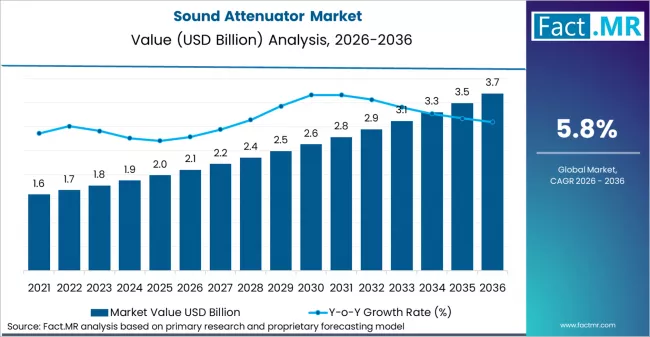
Sound Attenuator Market Market Value Analysis | Source: Fact.MR
Sound Attenuator Market Definition
The sound attenuator market refers to the production and sale of devices designed to reduce airflow noise in ventilation, heating, and air‑conditioning (HVAC) systems. Sound attenuators, often called duct silencers, contain acoustic absorbent material and baffles arranged to lessen noise without significantly restricting airflow. Their primary function is to improve acoustic comfort in buildings by minimizing mechanical noise transmitted through ductwork. Key end uses include commercial and institutional buildings, industrial facilities, healthcare centers, transportation hubs, and residential HVAC installations.
Market Inclusions
This report covers global and regional market sizes for sound attenuators with a defined forecast period. It includes segment breakdowns by product type (rectangular, circular, modular attenuators), application (HVAC systems, industrial ventilation), and end user. Pricing trends, raw material supply, and trade flow data are included to reflect overall market dynamics.
Market Exclusions
The scope excludes unrelated HVAC components such as fans, filters, diffusers, and standard ductwork not engineered for noise control. Other acoustic products like baffled ceiling systems, acoustic panels, and vibration isolators are not covered. Niche airflow silencers used exclusively in specialized piping or exhaust systems outside HVAC are omitted.
Research Methodology
- Primary Research: Interviews were conducted with HVAC engineers, acoustic consultants, and product manufacturers.
- Desk Research: Data was sourced from industry reports, HVAC standards publications, and construction statistics.
- Market‑Sizing and Forecasting: A hybrid model was used, combining top‑down construction and ventilation demand with bottom‑up shipment data.
- Data Validation and Update Cycle: Findings were validated through expert review and aligned with recent sales and project data, with periodic updates.
Sound Attenuator Market Summary
- Sound Attenuator Market Definition
- The sound attenuator market refers to the production and sale of devices designed to reduce airflow noise in ventilation, heating, and air conditioning (HVAC) systems. Sound attenuators, also known as duct silencers, contain acoustic absorbent materials and baffles arranged to reduce noise without significantly restricting airflow. These products are critical for improving acoustic comfort in buildings by minimizing mechanical noise transmitted through ductwork. The key end uses of sound attenuators include commercial buildings, industrial facilities, healthcare centers, transportation hubs, and residential HVAC systems, where noise control and comfort are priorities.
- Demand Drivers in the Market
- Noise Control Regulations: Increasing noise control regulations in commercial and residential spaces are driving the demand for sound attenuators. Stricter environmental and building codes emphasize reducing mechanical noise in ventilation systems.
- Growing Focus on Indoor Comfort: As awareness of the impact of noise pollution on comfort and well-being rises, there is growing demand for quieter HVAC systems, particularly in multi-use commercial and residential spaces.
- Efficiency in Sound Dampening: The ability of duct silencers to effectively reduce airborne noise while maintaining airflow efficiency makes them a popular choice for a wide range of applications.
- Urbanization and Infrastructure Growth: Rapid urbanization and expansion in developing regions, especially in countries like India, Vietnam, and Saudi Arabia, are driving the need for noise reduction solutions in both new construction and retrofit projects.
- Key Segments Analyzed in the FMR Report
- Product Type: Duct silencers are expected to dominate the market, capturing 59% of the market share by 2026 due to their widespread application in HVAC systems to control noise in ducts and ventilation systems.
- Material: Galvanized steel is projected to hold 51% of the market share by 2026, favored for its durability, corrosion resistance, and ease of fabrication, making it the preferred choice for duct silencers in demanding environments.
- End Use: Commercial HVAC and industrial ventilation applications are expected to lead demand, driven by the increasing construction of commercial buildings, industrial facilities, and the growing need for soundproofing in HVAC systems.
- Analyst Opinion at FMR
- Shambhu Nath Jha, Principal Consultant, FactMR predicts that "Sound attenuators will continue to see robust growth, particularly in emerging markets where rapid infrastructure development and stricter noise regulations are propelling demand. As building codes evolve and noise control becomes a priority, the market for sound attenuators will expand steadily."
- Strategic Implications/Executive Takeaways
- Compliance with Noise Regulations: Manufacturers should focus on producing sound attenuators that meet increasingly stringent noise and airflow standards, positioning themselves for success in regions with strict regulatory frameworks.
- Target Emerging Markets: Fast-growing markets in South Asia, the Middle East, and Latin America, such as India and Saudi Arabia, offer significant opportunities for expansion due to rapid urbanization and construction activity.
- Customization and Innovation: Providing customized solutions for specific applications, such as industrial and residential needs, and investing in innovation, particularly with environmentally friendly materials, will enhance competitive advantage.
- Methodology
- Primary Research: Interviews with HVAC engineers, acoustic consultants, and product manufacturers were conducted to understand current trends, demand drivers, and technological developments within the sound attenuator market.
- Desk Research: Data was sourced from industry reports, HVAC standards publications, and construction statistics to assess the demand dynamics and forecast future growth in the market.
- Market Sizing and Forecasting: A hybrid model was employed, combining top-down demand analysis with bottom-up shipment data to forecast market growth and size.
Segmental Analysis
Sound Attenuator Market Analysis by Product Type
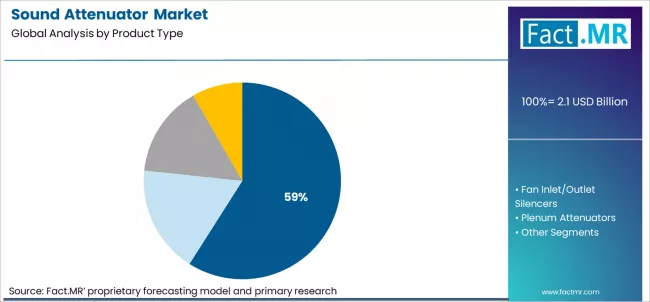
Sound Attenuator Market Analysis By Product Type | Source: Fact.MR
- Market Overview: Duct silencers are expected to capture 59% of the market share by 2026. Duct silencers are widely used in HVAC systems to reduce the noise generated by airflow through ducts, making them an essential component in both commercial and residential applications where noise control is a priority.
- Demand Drivers:
- Increasing Noise Control Regulations: As noise regulations in commercial and residential spaces become stricter, the demand for effective sound attenuation solutions, such as duct silencers, grows. These silencers help ensure that HVAC systems comply with local noise standards.
- Efficiency in Sound Dampening: Duct silencers provide an efficient and cost-effective solution for reducing airborne noise in ventilation systems. Their ability to significantly lower sound levels, while maintaining airflow efficiency, makes them a popular choice for a variety of building types.
- Rising Demand for Quiet Environments: With the growing focus on improving the comfort of living and working environments, the demand for quieter HVAC systems drives the use of duct silencers in commercial and residential buildings.
Sound Attenuator Market Analysis by Material
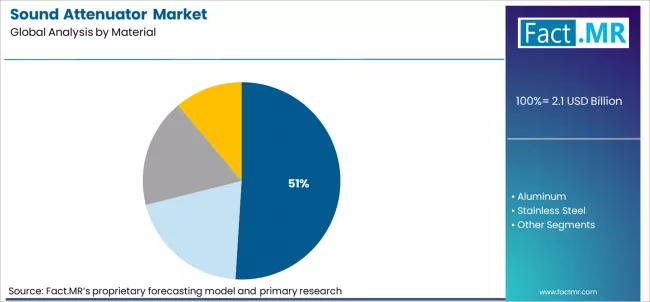
Sound Attenuator Market Analysis By Material | Source: Fact.MR
- Market Overview: Galvanized steel is projected to hold 51% of the market share by 2026. Galvanized steel is widely used for sound attenuators due to its durability, corrosion resistance, and ease of fabrication. It is the preferred material for duct silencers, as it provides long-lasting performance in demanding environments.
- Demand Drivers:
- Durability and Corrosion Resistance: Galvanized steel is highly resistant to corrosion, making it an ideal choice for HVAC systems, particularly in humid or industrial environments. This property enhances the lifespan of sound attenuators and reduces maintenance costs.
- Cost-Effectiveness: Galvanized steel offers a cost-effective solution without compromising on performance, making it a popular material choice for manufacturers of sound attenuators, particularly for large-scale commercial and industrial projects.
- Structural Strength and Adaptability: Galvanized steel provides the strength needed to support the weight and pressure demands of HVAC systems, while also being flexible enough for customization in various sizes and configurations to meet different noise attenuation requirements.
Sound Attenuator Market Drivers, Restraints, and Opportunities
FMR analysts observe that the sound attenuator market is a mature, performance‑driven segment within HVAC and industrial noise control, rooted in long‑standing requirements to reduce airflow noise in ductwork and equipment. Historically, basic silencers were added as aftermarket fixes; as building codes and indoor environmental quality expectations tightened, specification of engineered sound attenuators became standard. The 2026 valuation reflects stable baseline demand tied to global construction, retrofit activity, and measurable acoustic criteria that appear in building and ventilation standards.
While demand for simple, low‑cost attenuation methods persists in cost‑sensitive projects, engineered sound attenuators with defined insertion loss performance are gaining share. These advanced solutions carry higher per‑unit pricing, contributing to net market value growth even as unit volumes align with broader construction and HVAC installation cycles. The market exists because designers and contractors increasingly rely on performance‑rated components to meet regulatory and occupant comfort requirements rather than informal or ad‑hoc noise control.
- Performance Compliance Demand: Specifiers and engineers are selecting sound attenuators to achieve measurable noise reduction in HVAC systems, replacing basic baffling that cannot meet defined criteria.
- Regulatory Standards Influence: Codes and standards such as ASHRAE ventilation noise criteria and local building acoustics requirements push adoption of certified attenuators that meet specified insertion loss targets.
- Regional Construction Dynamics: In North America and Europe, stringent indoor noise and HVAC performance expectations drive higher uptake of advanced attenuators, while simpler methods remain more common in some Asia‑Pacific markets.
Regional Analysis
The market analysis covers key global regions, including South Asia and Pacific, Middle East & Africa, North America, Latin America, and Western Europe. It is segmented geographically, with specific market dynamics for each region. The full report provides a detailed market attractiveness analysis.
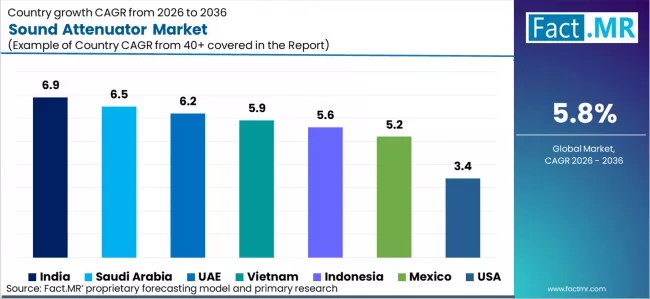
Sound Attenuator Market Cagr Analysis By Country | Source: Fact.MR
| Country | CAGR (2026-2036) |
|---|---|
| India | 6.9% |
| Saudi Arabia | 6.5% |
| UAE | 6.2% |
| Vietnam | 5.9% |
| Indonesia | 5.6% |
| Mexico | 5.2% |
| USA | 3.4% |
| Germany | 2.9% |
Source: Fact.MR analysis. Updated Feb 19, 2026
Source: Fact MR (FMR) analysis, based on proprietary forecasting model and primary research.
South Asia and Pacific:
South Asia and Pacific are "emerging markets" for sound attenuators, driven by increasing demand for noise control in industrial, commercial, and residential sectors.
- India: Demand for sound attenuators in India is projected to rise at 6.9% CAGR through 2036. Rapid urbanization and growing industrial and construction activities are key drivers of market growth in India, with rising awareness of noise pollution control.
- Vietnam: Demand for sound attenuators in Vietnam is projected to rise at 5.9% CAGR through 2036. The construction boom and increasing need for noise reduction in industrial sectors continue to support demand.
- Indonesia: Demand for sound attenuators in Indonesia is projected to rise at 5.6% CAGR through 2036. Increasing infrastructure projects and focus on environmental noise control contribute to market growth.
Middle East & Africa:
The Middle East, particularly Saudi Arabia and the UAE, is witnessing growing demand for sound attenuators, driven by rapid construction and industrial development in these regions.
- Saudi Arabia: Demand for sound attenuators in Saudi Arabia is projected to rise at 6.5% CAGR through 2036. Ongoing infrastructure development and a focus on noise control in both residential and commercial sectors support steady growth in the market.
- UAE: Demand for sound attenuators in the UAE is projected to rise at 6.2% CAGR through 2036. The real estate boom and emphasis on sustainable building practices contribute to increased demand for soundproofing solutions.
Latin America:
In Latin America, particularly in Mexico, demand for sound attenuators is growing due to an expanding construction industry and the need for better noise control in urban areas.
- Mexico: Demand for sound attenuators in Mexico is projected to rise at 5.2% CAGR through 2036. Increasing demand for commercial and residential spaces and focus on reducing noise pollution in construction projects are key growth drivers.
North America:
In North America, the USA continues to be a significant market for sound attenuators, with demand driven by residential and commercial construction, along with a focus on environmental noise control.
- USA: Demand for sound attenuators in the U.S. is projected to rise at 3.4% CAGR through 2036. Rising construction activity and a growing focus on soundproofing in buildings continue to drive demand for noise reduction solutions.
Western Europe:
Germany remains a "mature market" for sound attenuators, where demand is driven by regulations and a strong focus on sustainability and noise control technologies.
- Germany: Demand for sound attenuators in Germany is projected to rise at 2.9% CAGR through 2036. Germany’s stringent noise control regulations and focus on energy-efficient and sustainable construction continue to drive demand for soundproofing products.
Fact MR's analysis of the Sound Attenuator Market in South Asia and Pacific, Middle East & Africa, North America, Latin America, and Western Europe consists of country-wise assessments that include India, Saudi Arabia, UAE, Vietnam, Indonesia, Mexico, the United States, and Germany. Readers can find detailed trends, regulatory updates, and company-specific investments shaping the market’s growth in these countries.
How Are Key Players Competing in the Sound Attenuator Market?
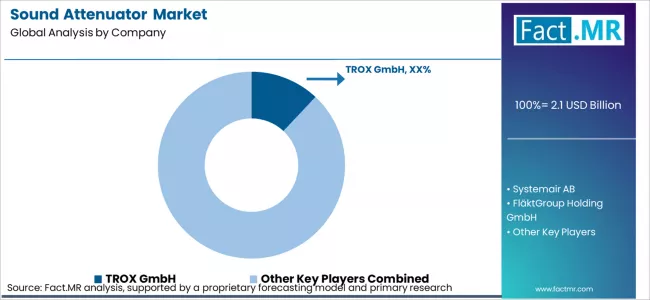
Sound Attenuator Market Analysis By Company | Source: Fact.MR
The sound attenuator market is highly competitive, with key players like TROX GmbH and Systemair AB offering advanced air handling and ventilation solutions designed to reduce noise in industrial and commercial spaces. FläktGroup Holding GmbH and Greenheck Fan Corporation continue to lead with their innovative acoustic products tailored for HVAC systems. Halton Group and Lindab International AB focus on integrating sound attenuation features into their air distribution solutions, enhancing noise control in buildings and industrial settings. Price Industries Limited and Johnson Controls International plc offer high-performance sound attenuators, combining efficiency and effective noise reduction. Nailor Industries Inc. emphasizes the development of customized products that provide optimal sound dampening across various industries, from commercial to industrial applications. These companies are competing through technological advancements, product customization, and regional expansions to meet the growing demand for noise control solutions in increasingly complex environments.
Recent Industry Developments
- Patent - Compact air plenum silencer (Published May 1, 2023): Nailor Industries of Texas published a patent application covering a compact plenum silencer for air-handling/HVAC noise attenuation
- Patent - Sound attenuator for a terminal unit (Published Jun 6, 2024): Johnson Controls published a patent application for a terminal-unit sound attenuator architecture integrated into HVAC terminal equipment to reduce duct-borne noise.
- Product documentation / launch evidence - Halton SA sound attenuator technical description first release (First release Feb 28, 2024): Halton issued the first release of its SA sound attenuator technical description, documenting the product’s configurations and performance data for duct noise reduction.
Key Players of the Sound Attenuator Market
- TROX GmbH
- Systemair AB
- FläktGroup Holding GmbH
- Greenheck Fan Corporation
- Halton Group
- Lindab International AB
- Price Industries Limited
- Johnson Controls International plc
- Nailor Industries Inc.
Report Scope
| Metric | Value |
|---|---|
| Quantitative Units | USD 2.1 billion (2026) to USD 3.7 billion (2036), at a CAGR of 5.8% |
| Market Definition | The Sound Attenuator Market includes products designed to reduce noise in ventilation systems, used in applications such as commercial HVAC, industrial ventilation, and data centers. |
| By Product Type | Duct Silencers, Fan Inlet/Outlet Silencers, Plenum Attenuators, Other |
| By End Use | Commercial HVAC, Industrial Ventilation, Data Centers, Others |
| By Material | Galvanized Steel, Aluminum, Stainless Steel, Composite/Other |
| By Sales Channel | HVAC Contractors, Direct OEM Sales, Distributors, Other |
| Regions Covered | North America, Latin America, Europe, East Asia, South Asia, Oceania, Middle East and Africa |
| Countries Covered | United States, Canada, Mexico, Brazil, Argentina, Germany, France, United Kingdom, Italy, Spain, China, India, Japan, South Korea, Indonesia, Australia, and 40+ countries |
| Key Companies Profiled | TROX GmbH, Systemair AB, FläktGroup Holding GmbH, Greenheck Fan Corporation, Halton Group, Lindab International AB, Price Industries Limited, Johnson Controls International plc, Nailor Industries Inc. |
| Forecast Period | 2026 to 2036 |
| Approach | Hybrid top-down and bottom-up market modeling validated through primary interviews with manufacturers and supported by trade data benchmarking and market research. |
Source: Fact.MR analysis. Updated Feb 19, 2026
Bibliographies
- Patent - Compact Air Plenum Silencer: Nailor Industries of Texas. (2023, May 1). Compact air plenum silencer. Google Patents.
- Patent - Sound Attenuator for a Terminal Unit: Johnson Controls. (2024, June 6). Sound attenuator for a terminal unit. Google Patents.
- Product Documentation / Launch Evidence - Halton SA Sound Attenuator Technical Description First Release: Halton. (2024, February 28). Halton SA sound attenuator technical description first release. Halton.
Segmentation
Sound Attenuator Market Key Segments
-
By Product Type
- Duct Silencers
- Fan Inlet/Outlet Silencers
- Plenum Attenuators
- Other
-
By End Use
- Commercial HVAC
- Industrial Ventilation
- Data Centers
- Others
-
By Material
- Galvanized Steel
- Aluminum
- Stainless Steel
- Composite/Other
-
By Sales Channel
- HVAC Contractors
- Direct OEM Sales
- Distributors
- Other
-
Region
- North America
- USA
- Canada
- Mexico
- Europe
- Germany
- UK
- France
- Italy
- Spain
- Nordic Countries
- BENELUX
- Rest of Europe
- Asia Pacific
- China
- Japan
- South Korea
- India
- Australia
- Rest of Asia Pacific
- Latin America
- Brazil
- Argentina
- Rest of Latin America
- Middle East and Africa
- Kingdom of Saudi Arabia
- United Arab Emirates
- South Africa
- Rest of Middle East and Africa
- Other Regions
- Oceania
- Central Asia
- Other Markets
- North America
Frequently Asked Questions
How large is the demand for Sound Attenuators in the global market in 2026?
What will be the market size of Sound Attenuators in the global market by 2036?
What is the expected demand growth for Sound Attenuators in the global market between 2026 and 2036?
Which product type is expected to dominate the market?
Which region is expected to show the highest growth rate for Sound Attenuators?
How significant is the growth outlook for Saudi Arabia in this market?
What is the growth outlook for the United States in this report?
What is the growth forecast for Germany in the Sound Attenuator market?
Which company is identified as a leading player in the Sound Attenuator market?
What are Sound Attenuators used for?
What does the Sound Attenuator market include in this report?
How is the market forecast developed in this report?
What is meant by the Sound Attenuator market in this report?
Who worked on this report


Preview the report firsthand - request a free sample
Free SampleGet the brochure for pricing and purchase details
Download PDF