- Base Value(2025): 12.4 Bn
- Estimated Value(2026): 12.9 Bn
- Forecast Value (2036): 19.7 Bn
- CAGR (2026 - 2036): 4.3%
Spinal Surgery Products Market Analysis and Forecast by Fact.MR
- The Spinal Surgery Products Market is expected to grow from USD 12.9 billion in 2026 to USD 19.7 billion by 2036, at a 4.3% CAGR.
- Driven by rising degenerative disc disease prevalence in aging populations, growing surgical adoption of minimally invasive spine techniques that reduce recovery times and hospital stays, and expanding use of navigation-enabled and robotics-assisted spinal implant placemen.
- Spinal fusion devices account for 48.3% share while degenerative disc disease contributes 44.8% share as companies invest in 3D-printed patient-specific implants, biologic bone graft substitutes, and AI-enabled surgical planning platforms.
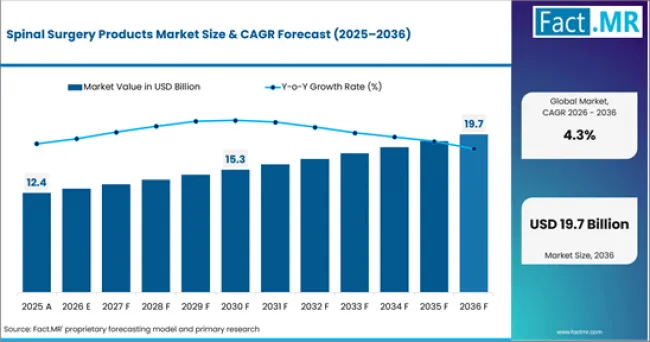
Spinal Surgery Products Market Value Analysis | Source: Fact.MR
Summary of Spinal Surgery Products Market
- Market Snapshot
- In 2025, the global Spinal Surgery Products Market was valued at approximately USD 12.4 billion.
- The market is estimated to reach USD 12.9 billion in 2026 and is projected to attain USD 19.7 billion by 2036.
- The spinal surgery products market is likely to expand at a CAGR of 4.3% during the forecast period.
- The market is anticipated to create an absolute dollar opportunity of USD 6.8 billion between 2026 and 2036.
- Spinal Fusion Devices accounts for 48.3% of product segment share in 2026.
- U.S. (4.8%) and China (4.6%) are the key growth markets during the forecast period.
- Demand and Growth Drivers
- The changing demographics of the world are leading to an increasing incidence of degenerative disc disease, spinal stenosis, and osteoporotic vertebral fractures requiring surgery.
- The adoption of minimally invasive spine surgery continues to grow with clinical evidence demonstrating decreased blood loss, shorter hospital stays and faster recovery than open approaches.
- With surgical navigation and robotics assisted pedicle screw placement, implant accuracy is getting better and revision surgery rates are going down.
- Biologic bone graft products, including recombinant proteins and demineralized bone matrices, are improving fusion rates and increasing the number of patients who can be treated.
- Growing availability of specialist spine surgery in emerging markets is driving procedure volumes in regions where surgical intervention was rarely available.
- Product and Segment View
- Spinal fusion devices are anticipated to command the largest share of product with 48.3% in 2026, driven by the high volume of lumbar and cervical fusion procedures performed worldwide.
- Titanium based systems account for 57.2% of material share which speaks to the well-established biocompatibility, strength and imaging compatibility of titanium spinal implants.
- Key segmentation includes:
- These products enable:
- Vertebral stabilization and fusion: interbody cages, pedicle screw systems and plate constructs
- Cervical and lumbar motion preservation via disc replacement in selected indications.
- Navigation-guided implant placement for enhanced accuracy and reduced radiation to surgical team
- Geography and Competitive Outlook
- U.S. leads at 4.8% driven by largest spine surgery market, established surgical robotics adoption and strong reimbursement for spinal procedures.
- China at 4.6% and India at 4.5% are due to increased access to spine surgery, investment in hospital infrastructure and more training for specialist surgeons.
- South Korea has a strong hospital infrastructure and a high penetration of surgical technology at 4.4%.
- Major players are Medtronic , Johnson and Johnson (DePuy Synthes), Stryker, Zimmer Biomet and Globus Medical .
- Analyst Opinion
- Shambhu Nath Jha, Principal Consultant at Fact.MR, says "The spinal surgery products market is shaped by two parallel trends: procedure volume growth driven by aging demographics, and product mix enrichment driven by technology adoption. Medtronic leads with 28% market share through its AiBLE ecosystem that integrates surgical planning, navigation, and implant technology. The February 2026 FDA approval of Infuse bone graft for TLIF procedures expanded Medtronic biologic portfolio into the most commonly performed lumbar fusion procedure. Competition is intensifying as Globus Medical, now merged with NuVasil, challenges the traditional Medtronic-DePuy-Stryker triopoly with an integrated robotics and implant platform."
Key Growth Drivers, Constraints, and Opportunities
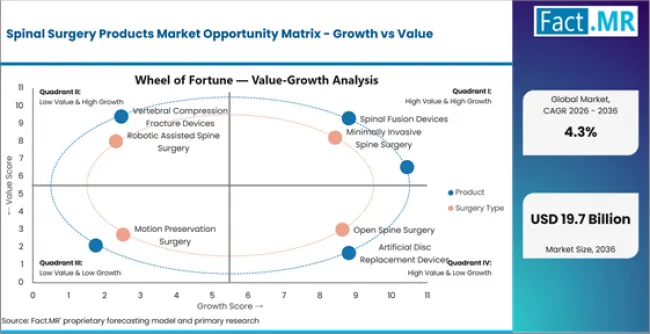
Spinal Surgery Products Market Opportunity Matrix Growth Vs Value | Source: Fact.MR
Key Factors Driving Growth
- The increasing prevalence of degenerative disc disease in populations older than 50 years of age is widening the pool of surgical candidates for lumbar and cervical fusion procedures.
- The uptake of robotic-assisted spine surgery is enhancing pedicle screw placement accuracy, as demonstrated by the penetration of Medtronic Mazor and Globus ExcelsiusGPS platform.
- Biologic bone graft technology advancement like Medtronic Infuse approval for TLIF in February 2026 is improving fusion rates and expanding procedure indications.
Key Market Constraints
- In addition, high costs of implants and the need for surgical facilities pose barriers to access in resource-limited and price-sensitive healthcare settings.
- In established markets, payers and government health systems are squeezing procedure prices and average selling prices of devices.
- Long surgeon training requirements in markets with limited infrastructure for surgical education hinder adoption of advanced minimally invasive and robotic-assisted techniques.
Key Opportunity Areas
- 3D printed patient-specific spinal implants are an increasing premium product tier, offering better anatomical fit and faster surgical time.
- Ambulatory surgery center expansion for spine procedures provides a lower cost setting that may improve procedure volumes.
- For surgeons, value is created via AI-driven surgical planning that optimizes implant selection and placement based on patient imaging data, which also benefits device manufacturers.
Segment-wise Analysis of the Spinal Surgery Products Market
- The spinal fusion devices segment is projected to hold the majority share of 48.3% in 2026, owing to the high volume of cervical and lumbar fusion procedures across the globe.
- The leading application is degenerative disc disease with 44.8% share due to the largest patient population requiring the surgical spine intervention.
- 46.5% of procedure approach share is comprised of posterior spine procedures reflecting the well-established role of posterior access in lumbar fusion surgery.
The market is segmented on the basis of product, surgery type, application, material, procedure approach, and region. Spinal fusion devices command the highest procedure volume, while minimally invasive approaches see the fastest growth based on clinical evidence and patient preference. MIS accounts for 36.1% of the share of surgery type.
Which Product Segment Dominates the Spinal Surgery Products Market?
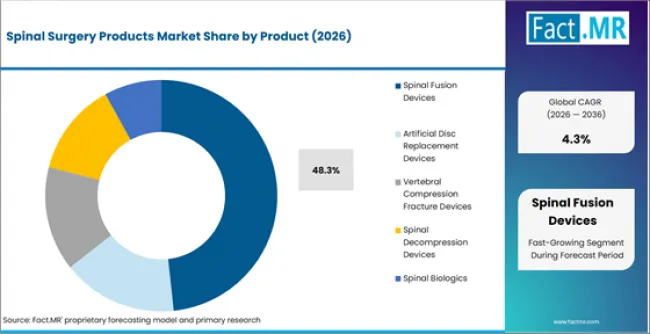
Spinal Surgery Products Market Analysis By Product | Source: Fact.MR
Spinal fusion devices to account for 48.3% of product segment value in 2026 Their dominance points to the fundamental importance of interbody cages, pedicle screw systems and anterior/posterior plate constructs in the most performed surgical procedures for degenerative disease and instability of the spine.
The fastest growing product category in spinal biologics is bone graft substitutes and recombinant proteins due to clinical evidence of improved fusion rates. Spinal instruments and non-fusion devices play a complementary role in decompression, motion preservation and surgical access.
Which Surgery Type is Growing Fastest in the Spinal Surgery Products Market?
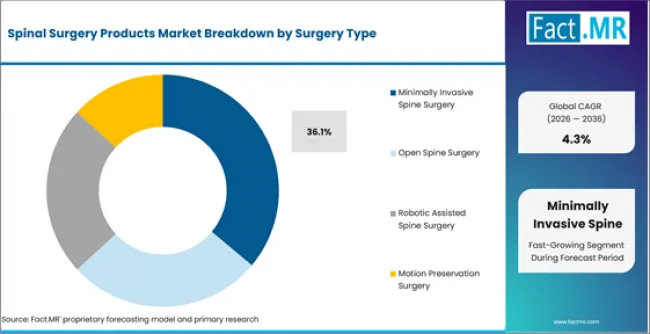
Spinal Surgery Products Market Analysis By Surgery Type | Source: Fact.MR
Minimally invasive spine surgery is growing faster than open approaches and will represent 36.1% of surgery type share in 2026. Clinical evidence supporting adoption of MIS for both lumbar and cervical indications includes demonstrated reduced blood loss, shorter hospital stays and similar fusion rates.
Robotic-assisted spine surgery is the fastest growing surgical technique and platform installations are increasing in academic medical centers and high-volume spine practices. Open spine surgery still accounts for the largest share for complex deformity correction and multi-level fusion procedures.
Which Product Trend is Shaping the Next Phase of Growth in the Spinal Surgery Products Market?
The key technology trends that are driving product development in spinal surgery are AI-enabled surgical planning and navigation-guided implant placement. The Medtronic AiBLE ecosystem includes preoperative imaging analysis, intra-operative navigation and robotic-assisted screw placement, and is designed to improve surgical precision and reduce procedure variability.
Medtronic wins FDA clearance for its Stealth AXiS Surgical System for spine, cranial and ENT applications, moving its platform strategy forward. Companies that offer complete surgical workflow solutions, as opposed to standalone implant products, are gaining competitive advantages as the industry moves toward integrated planning-navigation-robotics ecosystems.
Regional Outlook Across Key Markets
- U.S. leads at 4.8% (largest spine surgery market with strong reimbursement and mature robotics adoption).
- China at 4.6% and India at 4.5% reflect growing access to spine surgery and rising hospital investments.
- South Korea is at 4.4% supported by advanced hospital infrastructure and high surgical technology adoption.
.webp "Top Country Growth Comparison Spinal Surgery Products Market Cagr (2026 2036)")
Top Country Growth Comparison Spinal Surgery Products Market Cagr (2026 2036) | Source: Fact.MR
CAGR Table
| Country | CAGR (%) |
|---|---|
| USA | 4.8% |
| China | 4.6% |
| India | 4.5% |
| South Korea | 4.4% |
| Germany | 4.2% |
| Japan | 4.2% |
| United Kingdom | 4.1% |
| France | 4.1% |
| Italy | 4% |
Source: Fact.MR analysis. Updated Jun 17, 2026
Source: Fact.MR analysis, based on proprietary forecasting model and primary research.
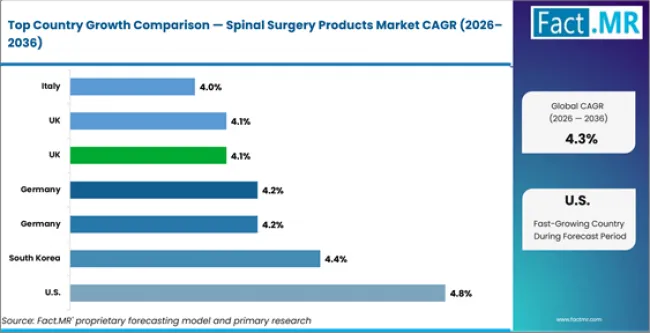
Spinal Surgery Products Market Cagr Analysis By Country | Source: Fact.MR
U.S. Spinal Surgery Products Market Growth Outlook
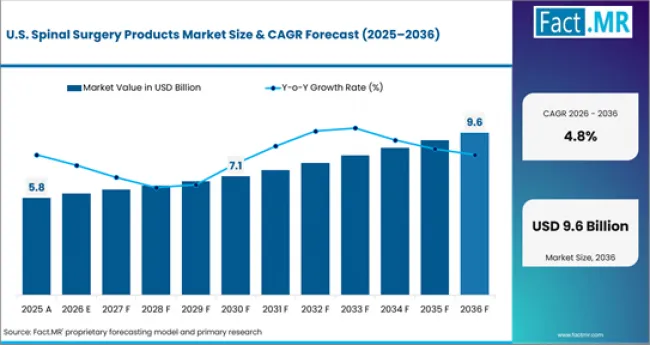
Spinal Surgery Products Market Country Value Analysis | Source: Fact.MR
The U.S. Spinal Surgery Products Market is projected to grow at a CAGR of 4.8% through 2036. FDA regulatory pathways and Medicare/commercial insurance reimbursement frameworks shape spinal device procurement and procedure economics. The February 2026 Infuse bone graft TLIF approval expanded Medtronic biologic portfolio in the largest spine surgery market.
- FDA device approval pathways including the February 2026 Infuse TLIF approval shape the competitive landscape for spinal biologics.
- Medicare and commercial insurance reimbursement for spine surgery sustains procedure volumes and device procurement.
- Ambulatory surgery center expansion creates new treatment settings for lower-acuity spine procedures.
China Spinal Surgery Products Demand Trends
The China Spinal Surgery Products Market is projected to grow at a CAGR of 4.6% through 2036. Centralized drug and device procurement through VBP is compressing spinal implant pricing while expanding procedure volumes. Hospital spine surgery department expansion in Tier 2 cities is broadening treatment access.
- VBP procurement cycles for spinal implants are compressing device pricing while increasing procedure volume access.
- Hospital expansion in Tier 2 and Tier 3 cities is broadening spine surgery specialist access.
- Domestic spinal implant manufacturers are developing competitive product portfolios under technology self-sufficiency policies.
Market Outlook for Spinal Surgery Products in India
The India Spinal Surgery Products Market is projected to grow at a CAGR of 4.5% through 2036. Ayushman Bharat and private hospital investment are expanding specialist spine surgery access. Cost-effectiveness requirements shape implant selection toward value-oriented domestic and imported device options.
- Ayushman Bharat coverage expansion is improving patient access to spine surgery in public hospital settings.
- Private hospital chain investment in spine surgery departments is creating premium treatment capacity in metropolitan centers.
- Cost-effectiveness requirements drive adoption of value-oriented spinal implant options alongside premium technology.
South Korea Spinal Surgery Products Demand Trends
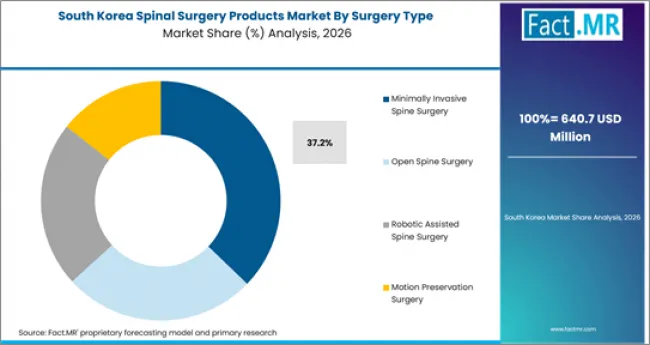
Spinal Surgery Products Market South Korea Market Share Analysis By Surgery Type | Source: Fact.MR
The South Korea Spinal Surgery Products Market is projected to grow at a CAGR of 4.4% through 2036. Advanced hospital infrastructure and high surgical technology adoption support premium spinal device procurement. Quality certification and preference for validated surgical systems shape equipment specification decisions.
- Advanced hospital infrastructure supports rapid adoption of robotic-assisted and navigation-guided spine surgery systems.
- Quality certification requirements shape procurement decisions toward validated spinal implant and instrument systems.
- Government healthcare investment supports specialist surgical training and technology adoption in spine surgery.
Spinal Surgery Products Growth Assessment in Germany
The Germany Spinal Surgery Products Market is projected to grow at a CAGR of 4.2% through 2036. EU MDR compliance requirements for spinal implants and GKV reimbursement decisions shape device procurement. Hospital consolidation is centralizing spine surgery into higher-volume specialized centers.
- EU MDR compliance requirements create regulatory barriers that favor established spinal implant manufacturers with validated product portfolios.
- GKV reimbursement and reference pricing influence spinal device selection and procedure economics.
- Hospital consolidation concentrates spine surgery volume into specialized centers with advanced navigation and robotics infrastructure.
Competitive Benchmarking and Company Positioning
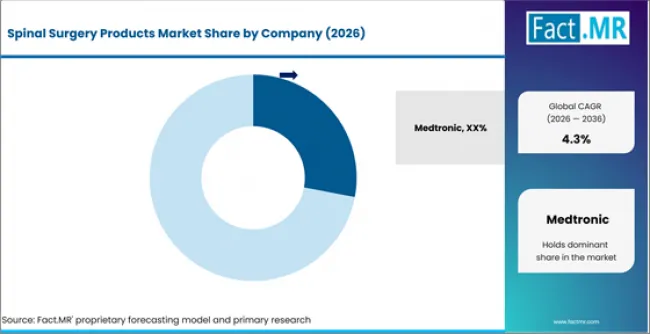
Spinal Surgery Products Market Analysis By Company | Source: Fact.MR
Spinal Surgery Products Market Analysis By Company
- Medtronic leads with approximately 28.0% market share through its AiBLE surgical ecosystem, comprehensive spinal implant portfolio, Mazor robotics platform, and the February 2026 Infuse bone graft TLIF FDA approval.
- Johnson and Johnson (DePuy Synthes) and Stryker compete through broad spinal implant portfolios, established surgeon relationships, and growing navigation and robotics platforms.
- Zimmer Biomet and Globus Medical serve specific market segments through focused spinal technology portfolios, with Globus strengthened by its NuVasil merger creating an integrated robotics and implant platform.
The competitive landscape is concentrated among three major players: Medtronic, DePuy Synthes, and Stryker, which collectively control the majority of global spinal device revenue. Medtronic leads through its AiBLE ecosystem that integrates surgical planning, Stealth navigation, and Mazor robotic-assisted placement.
Globus Medical (now including NuVasil) is the most significant competitive challenger, offering the ExcelsiusGPS robotics platform integrated with a comprehensive implant portfolio. Competition is increasingly shaped by surgical ecosystem completeness rather than standalone implant performance.
Key Companies in the Spinal Surgery Products Market
Medtronic, Johnson & Johnson (DePuy Synthes), Stryker Corporation, Zimmer Biomet, Globus Medical, NuVasive, RTI Surgical, Orthofix Medical, Alphatec Holdings, SeaSpine Holdings are the leading companies.
Recent Industry Developments
FDA clears Medtronic Inceptiv spinal cord stimulator (2024)
- Medtronic received FDA approval for its Inceptiv closed-loop spinal cord stimulation system, designed to treat chronic pain by automatically adjusting stimulation based on neural signals in the spinal cord.
FDA clears SurGenTec ION-L lumbar facet fixation system (2026)
- The U.S. FDA has granted 510(k) clearance for SurGenTec’s ION-L lumbar facet fixation system, intended for patients with degenerative disc disease (L3–S1) who have failed conservative treatment. The system is designed for minimally invasive posterior spinal fusion using bilateral facet joint fixation.
FDA approval of Xstim spine fusion stimulator (2024)
- Xstim received FDA PMA approval for its spine fusion bone growth stimulation system, supporting spinal fusion procedures in patients with degenerative spine conditions.
Leading Companies Shaping the Spinal Surgery Products Market
- Medtronic
- Johnson & Johnson (DePuy Synthes)
- Stryker Corporation
- Zimmer Biomet
- Globus Medical
- NuVasive
- RTI Surgical
- Orthofix Medical
- Alphatec Holdings
- SeaSpine Holdings
Sources and Research References
- Medtronic plc. (2024, April 26). Medtronic receives FDA approval for Inceptiv™ closed-loop spinal cord stimulator.
- Medical Device Network. (2026). FDA clears SurGenTec facet fixation system for degenerative disc disease treatment.
- U.S. Food and Drug Administration. (2024). Xstim spine fusion stimulator (P230025).
This bibliography is provided for reader reference and is not exhaustive. The full report contains the complete reference list and detailed citations.
Key Questions This Report Addresses
- What is the estimated size of the global Spinal Surgery Products Market in 2026, and how is it projected to grow through 2036?
- What incremental revenue opportunity is the market expected to create between 2026 and 2036?
- Which product segment holds the largest share in 2026, and what procedure volume factors support spinal fusion device leadership?
- How is the balance between open and minimally invasive spine surgery expected to shift over the forecast period?
- Which application is projected to generate the most incremental revenue through 2036?
- Which countries are projected to register the highest CAGR, and what demographics and healthcare factors accelerate growth?
- How do demand patterns in the U.S. compare with China and India in terms of procedure volumes and technology adoption?
- What reimbursement pressures and access constraints could limit growth in specific markets or procedure categories?
- Who are the leading companies, and how are they differentiating through surgical ecosystems, robotics platforms, and implant technology?
- What recent FDA approvals in 2025 and 2026 are reshaping competitive positioning in the spinal surgery market?
- Which surgical technology or biologic trend is driving the next phase of growth?
- How is robotic-assisted spine surgery adoption changing implant specification and procurement dynamics?
- What role are 3D-printed implants, biologic bone grafts, and AI surgical planning playing in reshaping the product landscape?
- What demand-side drivers sustain growth, and how do they vary between degenerative disease and trauma indications?
Spinal Surgery Products Market Definition
The spinal surgery products market covers implantable devices, biologics, and surgical instruments used in spinal fusion, decompression, disc replacement, and minimally invasive spine procedures for the treatment of degenerative disc disease, spinal stenosis, scoliosis, and traumatic spinal injuries across posterior, anterior, and lateral surgical approaches.
Spinal Surgery Products Market Inclusions
- Global and regional market size and forecasts for 2026 to 2036 across product, surgery type, application, material, procedure approach, and region.
- Demand analysis based on spine surgery volumes, degenerative disease prevalence, hospital capacity, and surgeon training pipeline.
- Competitive landscape including implant portfolios, surgical robotics platforms, and distribution strategies of leading companies.
Spinal Surgery Products Market Exclusions
- General orthopedic implants not designed specifically for spinal applications.
- Pain management devices including spinal cord stimulators and intrathecal drug delivery systems.
- Physical therapy, rehabilitation equipment, and conservative spine treatment modalities without surgical implant components.
Spinal Surgery Products Market Research Methodology
- Methodology combines secondary research from spine surgery journals, orthopedic device registries, and hospital procedure databases with primary validation.
- Market sizing covers 30+ countries with inputs including spine surgery volumes, surgeon density, hospital infrastructure, and implant pricing analysis.
- Primary validation includes 20+ interviews across spine surgeons, hospital procurement managers, device manufacturers, and surgical navigation specialists.
Segmentation
Scope of Analysis
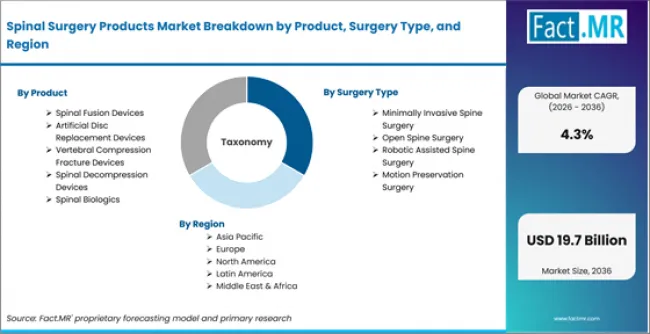
Spinal Surgery Products Market Breakdown By Product, Surgery Type, And Region | Source: Fact.MR
| Parameter | Details |
|---|---|
| Quantitative Units | USD 12.9 billion to USD 19.7 billion, at a CAGR of 4.3% |
| Market Definition | The spinal surgery products market covers implantable devices, biologics, and surgical instruments used in spinal fusion, decompression, disc replacement, and minimally invasive spine procedures for the treatment of degenerative disc disease, spinal stenosis, scoliosis, and traumatic spinal injuries across posterior, anterior, and lateral surgical approaches. |
| Regions Covered | North America, Latin America, Europe, East Asia, South Asia and Pacific, Middle East and Africa |
| Countries Covered | U.S., China, India, South Korea, ANZ, Germany, Japan, UK, France, Italy, 30 plus countries |
| Key Companies | Medtronic, Johnson & Johnson (DePuy Synthes), Stryker Corporation, Zimmer Biomet, Globus Medical, NuVasive, RTI Surgical, Orthofix Medical |
| Forecast Period | 2026 to 2036 |
| Approach | Hybrid demand-side and top-down methodology built on spine surgery procedure volumes, degenerative disease prevalence, hospital infrastructure, and primary interviews |
Source: Fact.MR analysis. Updated Jun 17, 2026
Spinal Surgery Products Market Segmentation
-
Spinal Surgery Products Market Segmented by Product:
- Spinal Fusion Devices
- Interbody Fusion Cages
- Degenerative Disc Disease Applications
- Spinal Stabilization Products
- Pedicle Screw Fixation Systems
- Spinal Deformity Applications
- Posterior Fixation Systems
- Interbody Fusion Cages
- Artificial Disc Replacement Devices
- Cervical Disc Replacement Systems
- Motion Preservation Applications
- Neck Disorder Products
- Lumbar Disc Replacement Devices
- Lower Back Applications
- Dynamic Spine Systems
- Cervical Disc Replacement Systems
- Vertebral Compression Fracture Devices
- Balloon Kyphoplasty Systems
- Osteoporotic Fracture Applications
- Minimally Invasive Spine Products
- Vertebroplasty Cement Delivery Systems
- Spinal Compression Applications
- Bone Stabilization Systems
- Balloon Kyphoplasty Systems
- Spinal Decompression Devices
- Laminectomy Surgical Systems
- Nerve Compression Applications
- Spinal Canal Products
- Discectomy Instruments
- Herniated Disc Applications
- Minimally Invasive Surgical Systems
- Laminectomy Surgical Systems
- Spinal Biologics
- Bone Graft Substitutes
- Fusion Enhancement Applications
- Regenerative Spine Products
- Stem Cell Based Biologics
- Spinal Healing Applications
- Advanced Orthobiologic Systems
- Bone Graft Substitutes
- Spinal Fusion Devices
-
Spinal Surgery Products Market Segmented by Surgery Type:
- Minimally Invasive Spine Surgery
- Tubular Retraction Systems
- Small Incision Applications
- Precision Surgical Products
- Endoscopic Spine Procedures
- Outpatient Applications
- Advanced Visualization Systems
- Tubular Retraction Systems
- Open Spine Surgery
- Traditional Fusion Procedures
- Complex Spine Applications
- Hospital Surgical Products
- Open Decompression Procedures
- Severe Compression Applications
- Neurosurgical Systems
- Traditional Fusion Procedures
- Robotic Assisted Spine Surgery
- Navigation Guided Systems
- Precision Placement Applications
- Digital Surgical Products
- Robotic Arm Assisted Procedures
- Complex Alignment Applications
- Smart Operating Systems
- Navigation Guided Systems
- Motion Preservation Surgery
- Dynamic Stabilization Procedures
- Flexible Spine Applications
- Mobility Preservation Products
- Artificial Disc Procedures
- Disc Replacement Applications
- Advanced Spine Systems
- Dynamic Stabilization Procedures
- Minimally Invasive Spine Surgery
-
Spinal Surgery Products Market Segmented by Application:
- Degenerative Disc Disease
- Lumbar Degeneration Treatment
- Chronic Back Pain Applications
- Fusion Surgery Products
- Cervical Degeneration Treatment
- Neck Pain Applications
- Disc Replacement Systems
- Lumbar Degeneration Treatment
- Spinal Deformity
- Scoliosis Correction Applications
- Pediatric Spine Systems
- Spinal Alignment Products
- Kyphosis Management
- Adult Spine Applications
- Corrective Surgical Systems
- Scoliosis Correction Applications
- Trauma And Fracture
- Spinal Trauma Stabilization
- Emergency Applications
- Fixation Products
- Vertebral Fracture Repair
- Osteoporosis Applications
- Bone Support Systems
- Spinal Trauma Stabilization
- Tumor And Infection
- Spinal Tumor Resection
- Oncology Applications
- Spinal Reconstruction Products
- Infection Management Procedures
- Spinal Abscess Applications
- Surgical Debridement Systems
- Spinal Tumor Resection
- Degenerative Disc Disease
-
Spinal Surgery Products Market Segmented by Material:
- Titanium Based Systems
- Titanium Alloy Implants
- High Strength Applications
- Long Term Spine Products
- Porous Titanium Systems
- Bone Integration Applications
- Fusion Enhancement Products
- Titanium Alloy Implants
- Polymer Based Systems
- PEEK Interbody Devices
- Radiolucent Applications
- Spinal Fusion Products
- Bioabsorbable Polymer Systems
- Temporary Support Applications
- Regenerative Spine Products
- PEEK Interbody Devices
- Stainless Steel Systems
- Surgical Instrument Steel Systems
- Spine Procedure Applications
- Reusable Surgical Products
- Fixation Steel Devices
- Cost Effective Applications
- Spinal Stabilization Systems
- Surgical Instrument Steel Systems
- Biologic Material Systems
- Demineralized Bone Matrix
- Bone Growth Applications
- Fusion Biologic Products
- Collagen Based Systems
- Regenerative Applications
- Orthobiologic Support Products
- Demineralized Bone Matrix
- Titanium Based Systems
-
Spinal Surgery Products Market Segmented by Procedure Approach:
- Posterior Spine Procedures
- Posterior Fusion Procedures
- Spinal Stabilization Applications
- Fixation Products
- Posterior Decompression Procedures
- Nerve Relief Applications
- Surgical Spine Systems
- Posterior Fusion Procedures
- Anterior Spine Procedures
- Anterior Cervical Procedures
- Neck Stabilization Applications
- Disc Replacement Products
- Anterior Lumbar Procedures
- Lower Back Applications
- Fusion Surgery Systems
- Anterior Cervical Procedures
- Lateral Spine Procedures
- Lateral Lumbar Interbody Fusion
- Minimally Invasive Applications
- Spinal Alignment Products
- Transpsoas Access Procedures
- Precision Access Applications
- Advanced Spine Systems
- Lateral Lumbar Interbody Fusion
- Posterior Spine Procedures
-
Spinal Surgery Products Market by Region:
- North America
- USA
- Canada
- Mexico
- Latin America
- Brazil
- Chile
- Rest of Latin America
- Western Europe
- Germany
- UK
- Italy
- Spain
- France
- Nordic
- BENELUX
- Rest of Western Europe
- Eastern Europe
- Russia
- Poland
- Hungary
- Balkan & Baltic
- Rest of Eastern Europe
- East Asia
- China
- Japan
- South Korea
- South Asia and Pacific
- India
- ASEAN
- Australia & New Zealand
- Rest of South Asia and Pacific
- Middle East & Africa
- Kingdom of Saudi Arabia
- Other GCC Countries
- Turkiye
- South Africa
- Other African Union
- Rest of Middle East & Africa
- North America
Frequently Asked Questions
How big is the spinal surgery products market in 2026?
What will be the size of the spinal surgery products market in 2036?
How much will the spinal surgery products market grow between 2026 and 2036?
What are the key products in the spinal surgery products market?
Which surgery type segment is expected to contribute a significant share in the spinal surgery products market in 2026?
Who worked on this report


Preview the report firsthand - request a free sample
Free SampleGet the brochure for pricing and purchase details
Download PDF