- Base Value(2025): 13.6 Bn
- Estimated Value(2026): 14.3 Bn
- Forecast Value (2036): 22.8 Bn
- CAGR (2026 - 2036): 4.8%
Electrosurgery Devices Market Analysis and Forecast by Fact.MR
According to Fact.MR estimates, the global electrosurgery devices market market was valued at USD 13.6 billion in 2025. The market is projected to reach USD 14.3 billion in 2026 and is expected to grow to USD 22.8 billion by 2036, expanding at a CAGR of 4.8%. Electrosurgical Generators is anticipated to account for 38.0% of the product segment in 2026, while General Surgery is expected to remain the leading application with around 29.0% share.
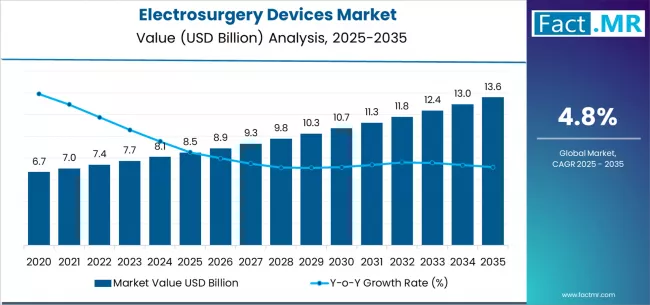
Electrosurgery Devices Market Market Value Analysis | Source: Fact.MR
Summary of Electrosurgery Devices Market
- Market Snapshot
- The Electrosurgery Devices market was valued at USD 13.6 billion in 2025.
- By 2036, the Electrosurgery Devices market is expected to be worth USD 22.78 billion.
- From 2026 to 2036, the market is projected to expand at a CAGR of 4.8%.
- The market is projected to create an incremental opportunity of USD 8.53 billion between 2026 and 2036.
- In 2026, Electrosurgical Generators are expected to account for 38% of the product segment, driven by sustained demand for monopolar and bipolar cutting and coagulation capability across general surgery, gynecological, and urological procedures.
- The United States (5.2%) and Mexico (4.9%) are two of the fastest-growing markets in the world.
- Demand and Growth Drivers
- Demand is shaped by rising surgical volumes across general surgery, gynecological, urological, and cardiovascular specialties, where electrosurgical cutting, coagulation, and vessel sealing remain the standard energy platform for tissue management.
- Growth reflects the shift toward advanced energy platforms that integrate radiofrequency, ultrasonic, and hybrid modalities, enabling faster procedures, reduced blood loss, and shorter operative times in both open and laparoscopic settings.
- Adoption is increasing due to ambulatory surgical center expansion and the shift of low-to-moderate complexity surgical volumes out of hospitals, which drives procurement of compact, multi-purpose electrosurgical generators and single-use instrument kits.
- Product and Segment View
- Electrosurgical Generators lead the product segment at 38% share in 2026, anchored by monopolar and bipolar systems serving general surgery, gynecological, and urological procedural volumes.
- Hospitals account for 61% of end-use demand in 2026, driven by concentrated surgical volumes in multi-specialty hospitals, teaching hospitals, and high-acuity inpatient settings.
- Monopolar Electrosurgery leads the technology segment at 44% share in 2026, reflecting the large installed base of monopolar cut-and-coagulation platforms across surgical specialties.
- Geography and Competitive Outlook
- North America anchors the market, with the United States at a 5.2% CAGR supported by high surgical volumes, strong ASC expansion, and advanced energy platform adoption across major hospital networks.
- Latin America grows strongly, with Mexico at 4.9% supported by hospital infrastructure investment, growing surgical capacity, and increasing access to electrosurgical technology in mid-tier healthcare facilities.
- Europe and Asia Pacific contribute steadily, with Germany (4.6%), France (4.5%), South Korea (4.4%), the UK (4.3%), and Japan (4.3%) growing on surgical volume expansion, minimally invasive procedure adoption, and equipment replacement cycles. Leading players include Medtronic, J&J Ethicon, Olympus, ConMed, B. Braun Aesculap, Erbe, Karl Storz, Stryker, Boston Scientific, and Zimmer Biomet.
- Analyst Opinion
- Electrosurgery remains one of the most commercially predictable medical device categories because it sits inside virtually every surgical procedure. The strategic question is no longer whether electrosurgery grows, but how the product mix evolves. Generators are a replacement and expansion market, while single-use instruments and accessories carry higher margins and recurring revenue. Advanced energy platforms that integrate radiofrequency with ultrasonic or hybrid technology are commanding price premiums and shifting competitive dynamics from price-driven generator sales toward platform loyalty. The ASC channel is the single most important growth driver in developed markets, because it creates net new procedural sites that each require generator procurement and ongoing instrument purchasing. Firms that control the generator-to-instrument ecosystem and lock in ASC procurement contracts will capture the highest margin growth over the forecast period.
Why is the Electrosurgery Devices Market Growing?
- Surgical volume expansion across general surgery, gynecological, urological, and cardiovascular specialties sustains baseline demand for electrosurgical generators and instruments.
- Ambulatory surgical center expansion is creating net new procedural sites that each require electrosurgical generator procurement and ongoing instrument supply.
- Advanced energy platforms integrating radiofrequency with hybrid modalities are commanding price premiums and accelerating replacement of legacy generator installed base.
Surgical volume expansion is the baseline demand driver. Global surgical volumes continue to grow at low single-digit rates across general surgery, gynecological, urological, and cardiovascular specialties. Each procedure requires electrosurgical capability, which makes the category structurally tied to surgical activity. Aging populations in developed markets and expanding surgical access in emerging markets both support sustained procedural volume growth.
ASC expansion is the most important structural growth driver in developed markets. Ambulatory surgical centers are taking a growing share of low-to-moderate complexity surgical volumes, particularly in the United States, where payer economics and patient preference favor outpatient settings. Each new ASC requires generator procurement, instrument stocking, and ongoing consumable purchasing, creating net new demand that adds to rather than displaces hospital-based volumes.
Technology evolution is the third driver. Advanced energy platforms that combine radiofrequency with ultrasonic, bipolar, or hybrid energy are being adopted for vessel sealing, tissue dissection, and complex coagulation. These platforms carry higher average selling prices than legacy generators and create instrument-level vendor lock-in, which shifts competitive dynamics toward platform-based revenue models.
Segment-wise Analysis of Electrosurgery Devices Market
- Electrosurgical Generators lead the product segment at 38% share in 2026, anchored by monopolar and bipolar systems installed across hospital operating rooms and ambulatory surgical centers.
- General Surgery leads the application segment at 29% share in 2026, reflecting broad procedural use across gastrointestinal, hepatobiliary, and abdominal surgical volumes.
- Direct Sales dominate the distribution channel at 63% share in 2026, driven by OEM manufacturer-to-hospital procurement contracts and institutional purchasing relationships.
The market segments across product, application, end use, technology, distribution channel, and packaging. Product coverage includes electrosurgical generators, instruments and accessories, argon plasma and smoke management systems. Application coverage spans general surgery, gynecological, urological, cardiovascular, orthopedic, and oncological procedures. Technology coverage includes monopolar electrosurgery, bipolar electrosurgery, advanced energy platforms, and smoke evacuation technology.
Electrosurgical Generators Lead the Product Segment
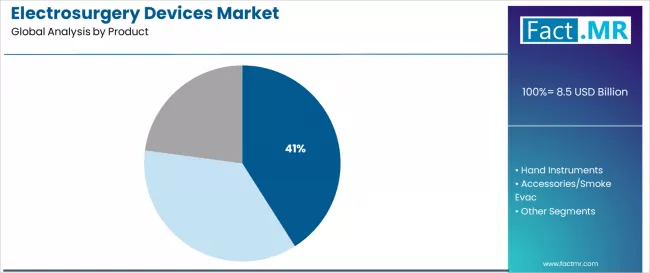
Electrosurgery Devices Market Analysis By Product | Source: Fact.MR
Electrosurgical generators account for 38% of product revenue in 2026, including monopolar generators, bipolar generators, and advanced multi-mode platforms. The installed base of generators across hospital operating rooms and ASCs is large, and replacement cycles every 7 to 10 years create predictable upgrade demand. Advanced generators supporting multiple energy modalities command premium pricing and are replacing single-mode legacy units.
Electrosurgical instruments and accessories represent the second largest product pool and carry higher recurring revenue characteristics. Active electrodes, pencils, bipolar forceps, vessel sealers, patient return electrodes, and cords generate consumable revenue tied to surgical procedure volumes. Single-use instruments are growing faster than reusable alternatives due to infection control preferences and reduced reprocessing costs.
General Surgery Leads the Application Segment
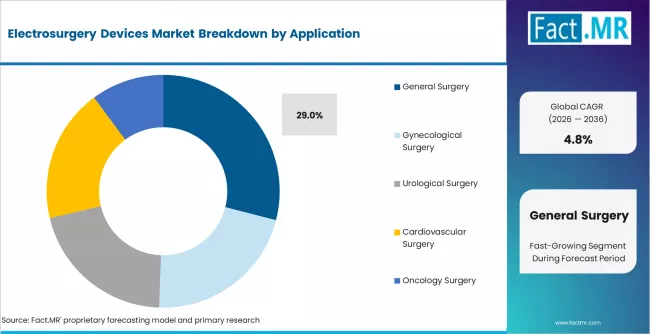
Electrosurgery Devices Market Analysis By Application | Source: Fact.MR
General surgery accounts for 29% of application demand in 2026, driven by gastrointestinal, hepatobiliary, and abdominal surgical volumes that rely on electrosurgical cutting and coagulation for tissue management. Gynecological surgery is the second largest application pool, anchored by hysterectomy, laparoscopy, and fertility procedures. Urological, cardiovascular, and oncological surgical specialties form additional application pools with distinct procedural requirements.
The application mix is shifting toward minimally invasive and laparoscopic approaches across most specialties, which favors advanced bipolar and hybrid energy instruments that offer precision tissue sealing in confined surgical spaces.
Key Growth Drivers, Constraints, and Market Scope
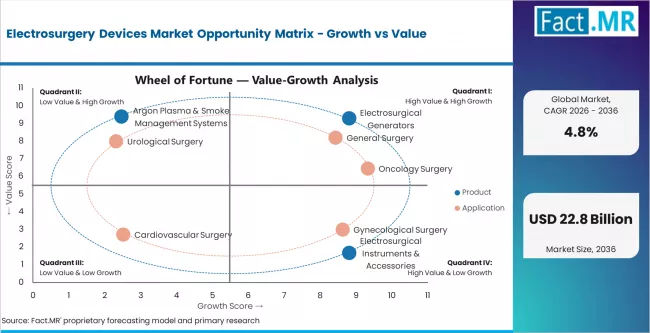
Electrosurgery Devices Market Opportunity Matrix Growth Vs Value | Source: Fact.MR
- Surgical volume expansion, ASC proliferation, and advanced energy platform adoption are creating structural demand growth across the forecast period.
- Pricing pressure from group purchasing organizations, single-use versus reusable instrument cost dynamics, and hospital capital budgets constrain growth rates in developed markets.
- Emerging market infrastructure investment and growing surgical access in Asia Pacific and Latin America present expanding addressable market opportunities.
The electrosurgery devices market is a mature but structurally growing category. Demand fundamentals are tied to surgical activity, which grows predictably, and the product mix is evolving toward higher-value advanced energy platforms and recurring-revenue consumable models.
Growth Drivers
Three primary forces drive growth. First, surgical volume expansion across major specialties sustains baseline demand for generators and instruments. Second, ASC expansion creates net new procedural sites requiring generator procurement and consumable supply. Third, advanced energy platforms integrating radiofrequency with hybrid modalities command price premiums and accelerate upgrade cycles, increasing revenue per installed generator.
Constraints
Group purchasing organization pricing pressure in hospital procurement limits average selling price increases for generators and instruments. Single-use instrument adoption increases per-procedure cost, which creates pushback from cost-sensitive facilities. Hospital capital budgets compete across multiple equipment categories, and generator replacement can be deferred when budgets are tight. In emerging markets, limited electrosurgical training and preference for lower-cost manual surgical techniques slow adoption in some facilities.
Opportunities
The largest near-term opportunity is in ASC expansion across the United States and other developed markets, where each new ASC requires electrosurgical equipment procurement. Advanced energy platforms integrating multiple modalities create upgrade opportunities within the existing hospital installed base. Emerging markets in Latin America, the Middle East, and Asia Pacific present growing addressable market opportunities as surgical infrastructure expands and electrosurgical technology adoption accelerates.
Regional Outlook Across Key Markets
.webp "Top Country Growth Comparison Electrosurgery Devices Market Cagr (2026 2036)")
Top Country Growth Comparison Electrosurgery Devices Market Cagr (2026 2036) | Source: Fact.MR
| Country | CAGR (2026-2036) |
|---|---|
| United States | 5.2% |
| Mexico | 4.9% |
| Germany | 4.6% |
| France | 4.5% |
| South Korea | 4.4% |
| United Kingdom | 4.3% |
| Japan | 4.3% |
Source: Fact.MR analysis. Updated Apr 27, 2026
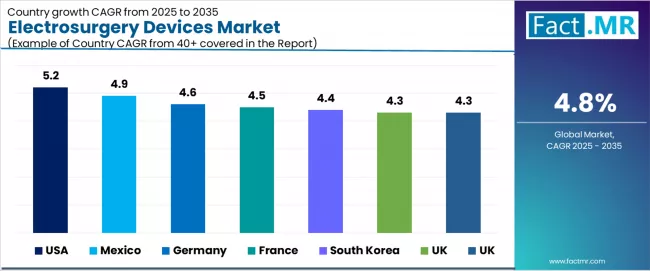
Electrosurgery Devices Market Cagr Analysis By Country | Source: Fact.MR
- North America leads growth, with the United States at a 5.2% CAGR driven by high surgical volumes, strong ASC expansion, and advanced energy platform adoption.
- Latin America grows strongly with Mexico (4.9%), supported by hospital infrastructure investment and expanding surgical capacity.
- Europe contributes steady growth, with Germany (4.6%), France (4.5%), and the UK (4.3%) sustained by equipment replacement cycles and minimally invasive procedure adoption.
- Asia Pacific grows on expanding surgical access, with South Korea (4.4%) and Japan (4.3%) supported by hospital modernization and technology upgrade programs.
Regional performance reflects surgical volume distribution, healthcare infrastructure investment, and ASC expansion patterns. North America dominates in absolute revenue, supported by the largest installed base of advanced generators and the most active ASC expansion program globally. Europe grows steadily on equipment replacement and minimally invasive adoption. Asia Pacific and Latin America grow on expanding surgical access and hospital modernization.
United States
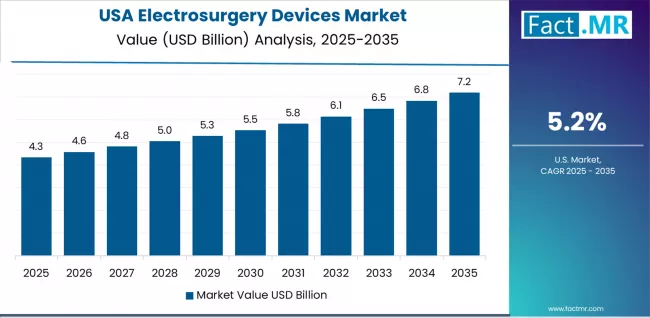
Electrosurgery Devices Market Country Value Analysis | Source: Fact.MR
The United States is the largest single-country market, with 2026 revenue exceeding USD 4 billion and a 5.2% CAGR through 2036. The country has the largest installed base of electrosurgical generators, the most active ASC expansion, and strong adoption of advanced energy platforms across major hospital networks. Medtronic, J&J Ethicon, and Stryker anchor domestic competitive dynamics.
- ASC expansion is creating net new procedural sites requiring full electrosurgical equipment procurement.
- Advanced energy platforms are accelerating generator replacement cycles across major hospital networks.
- Single-use instrument adoption is growing, driven by infection control standards and reprocessing cost avoidance.
Mexico
Mexico records a 4.9% CAGR through 2036. Demand is supported by hospital infrastructure investment, growing public and private sector surgical capacity, and expanding access to electrosurgical technology in mid-tier healthcare facilities across major metropolitan areas.
- Hospital infrastructure investment supports generator procurement and operating room modernization.
- Growing private healthcare sector expands surgical volumes and equipment adoption.
- Urban hospital networks are upgrading from basic electrosurgical systems to advanced energy platforms.
Germany
Germany posts a 4.6% CAGR through 2036. Demand reflects the country's high surgical volume base, strong minimally invasive procedure adoption, and established hospital equipment replacement cycles. Erbe Elektromedizin, headquartered in Germany, anchors domestic electrosurgical innovation.
- High surgical volume base across general, gynecological, and urological specialties sustains steady equipment demand.
- Erbe Elektromedizin anchors domestic electrosurgical innovation and supplies major German hospital networks.
- Equipment replacement cycles and minimally invasive procedure adoption support consistent upgrade demand.
France
France records a 4.5% CAGR through 2036. Demand is sustained by public hospital modernization programs, growing ambulatory surgery adoption, and established procurement relationships with major electrosurgical device manufacturers.
- Public hospital modernization programs support equipment procurement and operating room upgrades.
- Growing ambulatory surgery adoption creates additional equipment demand outside hospital settings.
- Established French hospital procurement networks maintain steady electrosurgical device purchasing.
South Korea
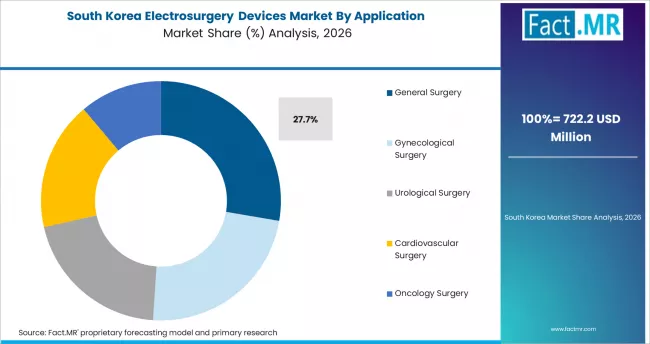
Electrosurgery Devices Market South Korea Market Share Analysis By Application | Source: Fact.MR
South Korea records a 4.4% CAGR through 2036. Demand is supported by hospital modernization, growing minimally invasive surgery adoption, and strong technology upgrade appetite across Korean hospital networks.
- Hospital modernization and technology upgrade programs sustain electrosurgical equipment demand.
- Growing minimally invasive surgery adoption across specialties drives advanced instrument procurement.
- Korean medical device industry supports domestic assembly and distribution of electrosurgical platforms.
United Kingdom
The United Kingdom records a 4.3% CAGR through 2036. Demand reflects NHS hospital equipment replacement cycles, growing day surgery and ambulatory activity, and procurement through centralized NHS supply chains.
- NHS hospital equipment replacement cycles create predictable generator procurement demand.
- Growing day surgery and ambulatory surgical volumes expand equipment requirements.
- Centralized NHS procurement supports standardized electrosurgical platform adoption.
Japan
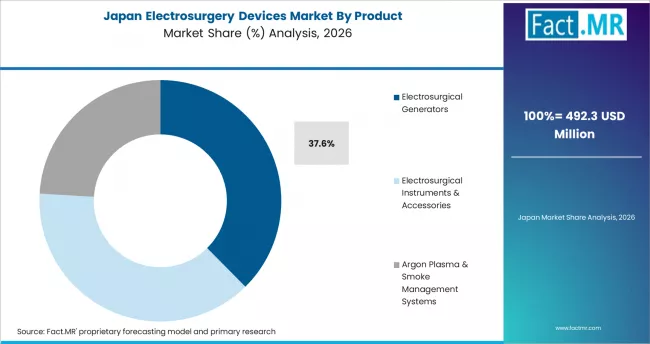
Electrosurgery Devices Market Japan Market Share Analysis By Product | Source: Fact.MR
Japan records a 4.3% CAGR through 2036. Demand is sustained by the country's high surgical volume, strong minimally invasive procedure adoption, and established hospital equipment procurement patterns. Olympus anchors domestic electrosurgical and endoscopic integration.
- High surgical volume and aging population sustain baseline electrosurgical equipment demand.
- Olympus anchors domestic electrosurgical and endoscopic technology integration.
- Minimally invasive and laparoscopic procedure adoption supports advanced instrument procurement.
Competitive Benchmarking and Company Positioning
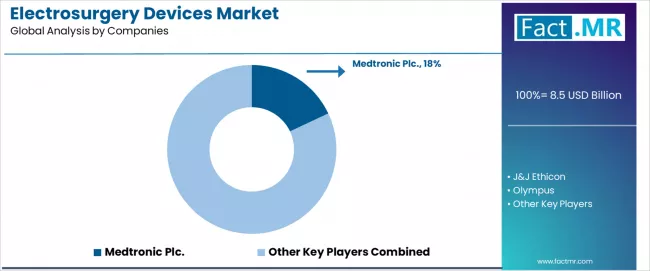
Electrosurgery Devices Market Analysis By Company | Source: Fact.MR
- Medtronic holds the leading competitive position with an estimated 34.9% share in 2026, anchored by its advanced energy platform portfolio, hospital procurement relationships, and global distribution infrastructure.
- J&J Ethicon, Olympus, and ConMed hold strong secondary positions through differentiated product portfolios, established surgical specialty relationships, and broad geographic presence.
- B. Braun Aesculap, Erbe, Karl Storz, Stryker, Boston Scientific, and Zimmer Biomet compete across specific surgical specialties, regional markets, and product niches.
The electrosurgery devices market is moderately concentrated. Medtronic dominates through its advanced energy platform portfolio spanning generators, vessel sealers, and integrated energy instruments, combined with deep hospital procurement relationships and a global distribution network. J&J Ethicon competes strongly through its Harmonic and Enseal platforms and established surgical franchise. Olympus participates with integrated electrosurgical and endoscopic solutions.
ConMed, B. Braun Aesculap, and Erbe hold meaningful positions across specific surgical specialties and regional markets. ConMed competes through its generator portfolio and laparoscopic instrument range. B. Braun Aesculap brings broad surgical device infrastructure and European hospital relationships. Erbe Elektromedizin offers specialized electrosurgical generators and argon plasma coagulation systems with strong positioning in European and Asian markets.
Karl Storz, Stryker, Boston Scientific, and Zimmer Biomet participate through complementary product lines and cross-selling into electrosurgery from their core surgical device positions. Karl Storz integrates electrosurgical capability with its endoscopic platform. Stryker cross-sells from operating room infrastructure and instruments. Boston Scientific and Zimmer Biomet bring specialty surgical device expertise.
Competitive dynamics are shaped by the shift from standalone generator sales toward integrated energy platform ecosystems. Firms that control the generator-to-instrument ecosystem, lock in ASC and hospital procurement contracts, and build recurring consumable revenue will capture the strongest margin growth. Single-use instrument adoption is increasing competitive intensity in the consumable layer.
Competitive Analysis
Strategic positioning depends on platform integration depth and procurement relationship strength. Medtronic and J&J Ethicon lead on platform breadth and hospital procurement coverage. Erbe and ConMed compete on generator specialization and surgical specialty depth. The key competitive question is whether platform loyalty or price competition dominates the next procurement cycle as advanced energy platforms become more standardized and group purchasing organizations consolidate vendor selection.
Benchmarking Table
| Company | Generator Portfolio | Instrument Range | Advanced Energy | Global Reach |
|---|---|---|---|---|
| Medtronic | Very High | Very High | Very High | Global |
| J&J Ethicon | High | Very High | Very High | Global |
| Olympus | High | High | High | Global |
| ConMed | High | High | Medium-High | Global |
| Erbe | Very High | Medium-High | High | Europe/Asia |
Source: Fact.MR analysis. Updated Apr 27, 2026
Recent Developments
- Medtronic expanded its advanced energy platform portfolio in 2025, launching next-generation vessel sealing and tissue management instruments designed for laparoscopic and robotic-assisted surgical procedures.
- J&J Ethicon introduced updated Harmonic and Enseal energy instruments in 2025, strengthening its competitive position in advanced energy surgical platforms.
- Erbe Elektromedizin announced expanded U.S. distribution partnerships in 2026, broadening access to its electrosurgical generator and argon plasma coagulation platforms across American hospital networks.
Leading Companies Shaping Electrosurgery Devices Market
-
Major Players
- Medtronic Plc.
- Johnson & Johnson (Ethicon)
- Olympus Corporation
- ConMed Corporation
- B. Braun Aesculap
- Erbe Elektromedizin
- Karl Storz SE & Co. KG
-
Emerging Players
- Stryker Corporation
- Boston Scientific Corporation
- Zimmer Biomet Holdings
- Bovie Medical (Apyx Medical)
- BOWA-electronic GmbH
- Encision Inc.
- Megadyne Medical Products
- Symmetry Surgical
- Kirwan Surgical Products
- Applied Medical Resources
Analysis by Product, Application, End Use, Technology, Distribution Channel, and Region
-
Electrosurgery Devices Market Market Segmented by Product:
- Electrosurgical Generators
- Monopolar Generators
- Bipolar Generators
- Monopolar Generators
- Electrosurgical Instruments & Accessories
- Monopolar Instruments
- Bipolar Instruments (Forceps, Vessel Sealers)
- Active Electrodes & Pencils
- Patient Return Electrodes
- Cords, Cables & Footswitches
- Monopolar Instruments
- Argon Plasma & Smoke Management Systems
- Smoke Evacuation Devices
- Argon Beam Coagulation Systems
- Smoke Evacuation Devices
- Electrosurgical Generators
-
Electrosurgery Devices Market Market Segmented by Application:
- General Surgery
- Gastrointestinal Surgery
- Hepatobiliary Procedures
- Gastrointestinal Surgery
- Gynecological Surgery
- Hysterectomy & Laparoscopy
- Fertility Procedures
- Hysterectomy & Laparoscopy
- Urological Surgery
- Prostate & Kidney Procedures
- Endoscopic Surgeries
- Prostate & Kidney Procedures
- Cardiovascular Surgery
- Vascular Sealing & Cutting
- Oncology Surgery
- Tumor Resection Procedures
- General Surgery
-
Electrosurgery Devices Market Market Segmented by End Use:
- Hospitals
- Multi-Specialty Hospitals
- Teaching Hospitals
- Multi-Specialty Hospitals
- Ambulatory Surgical Centers (ASCs)
- Day Care Surgery Units
- Outpatient Surgical Clinics
- Day Care Surgery Units
- Specialty Clinics
- ENT & Gynecology Clinics
- Urology & Cosmetic Clinics
- ENT & Gynecology Clinics
- Hospitals
-
Electrosurgery Devices Market Market Segmented by Technology:
- Monopolar Electrosurgery
- Cut & Coagulation Systems
- High-Frequency Current Systems
- Cut & Coagulation Systems
- Bipolar Electrosurgery
- Precision Tissue Sealing
- Reduced Thermal Damage Systems
- Precision Tissue Sealing
- Advanced Energy Platforms
- RF & Hybrid Energy Systems
- Ultrasonic-Electrosurgical Hybrid Tools
- RF & Hybrid Energy Systems
- Smoke Evacuation Technology
- Surgical Smoke Filtration Systems
- Air Quality Control Units
- Surgical Smoke Filtration Systems
- Monopolar Electrosurgery
-
Electrosurgery Devices Market Market Segmented by Distribution Channel:
- Direct Sales
- OEM Medical Device Manufacturers
- Hospital Procurement Contracts
- OEM Medical Device Manufacturers
- Distributors
- Regional Medical Equipment Suppliers
- Healthcare Supply Chains
- Regional Medical Equipment Suppliers
- System Integrators
- OR (Operating Room) Integration Providers
- Surgical Suite Installation Partners
- OR (Operating Room) Integration Providers
- Direct Sales
-
Electrosurgery Devices Market Market Segmented by Packaging:
- Sterile Device Packaging
- Single-Use Sterile Instruments
- Surgical Kits
- Single-Use Sterile Instruments
- Heavy Equipment Packaging
- Generator Transport Systems
- Shock-Proof Medical Crates
- Generator Transport Systems
- Accessories Packaging
- Cable & Electrode Kits
- Disposable Component Packs
- Cable & Electrode Kits
- Sterile Device Packaging
-
Electrosurgery Devices Market Market by Region:
- North America
- USA
- Canada
- Mexico
- Latin America
- Brazil
- Chile
- Rest of Latin America
- Western Europe
- Germany
- UK
- Italy
- Spain
- France
- Nordic
- BENELUX
- Rest of Western Europe
- Eastern Europe
- Russia
- Poland
- Hungary
- Balkan & Baltic
- Rest of Eastern Europe
- East Asia
- China
- Japan
- South Korea
- South Asia and Pacific
- India
- ASEAN
- Australia & New Zealand
- Rest of South Asia and Pacific
- Middle East & Africa
- Kingdom of Saudi Arabia
- Other GCC Countries
- Turkiye
- South Africa
- Other African Union
- Rest of Middle East & Africa
- North America
Sources and Research References
- World Health Organization (WHO) global surgery and safe surgery publications
- U.S. Food and Drug Administration (FDA) 510(k) clearance database for electrosurgical devices
- Centers for Medicare and Medicaid Services (CMS) ambulatory surgical center data and procedural statistics
- Medtronic, J&J Ethicon, Olympus, ConMed, Erbe, and Stryker corporate filings and investor presentations
- National surgical volume databases from CMS, NHS Digital, and OECD health statistics
- Peer-reviewed surgical technology journals including Surgical Endoscopy, Journal of Laparoendoscopic and Advanced Surgical Techniques, and Minimally Invasive Therapy
- Primary interviews with hospital procurement leads, operating room directors, ASC administrators, and electrosurgical device sales executives
This bibliography is provided for reader reference and is not exhaustive. The full report contains the complete reference list and detailed citations.
Key Questions This Report Addresses
- What is the size of the electrosurgery devices market in 2026 and 2036?
- What CAGR is the market expected to record between 2026 and 2036?
- Which product and technology segments are projected to lead the market in 2026?
- Which surgical application accounts for the largest share of demand?
- How is ASC expansion influencing market growth in developed markets?
- Which countries are the fastest-growing markets through 2036?
- Who are the leading companies in electrosurgery, and how are they competitively differentiated?
- How does Fact.MR estimate and validate the market forecast?
Electrosurgery Devices Market Definition
The electrosurgery devices market covers medical devices that use high-frequency electrical current to cut, coagulate, seal, or ablate tissue during surgical procedures. The scope includes electrosurgical generators, electrosurgical instruments and accessories, argon plasma coagulation systems, and smoke evacuation devices used across general surgery, gynecological, urological, cardiovascular, orthopedic, and oncological surgical settings.
Electrosurgery Devices Market Inclusions
The market includes monopolar and bipolar electrosurgical generators, active electrodes and pencils, patient return electrodes, bipolar forceps and vessel sealers, cords and cables, footswitches, argon beam coagulation systems, and surgical smoke evacuation devices. It covers capital equipment, single-use instruments, reusable accessories, and maintenance and service contracts. Work across open surgery, laparoscopic and minimally invasive surgery, and robotic-assisted surgery is in scope.
Electrosurgery Devices Market Exclusions
The market excludes standalone ultrasonic surgical devices not integrated with electrosurgical generators, surgical lasers, manual surgical instruments, and general surgical lighting or operating room infrastructure not specific to electrosurgery. Interventional radiology ablation systems, standalone radiofrequency ablation systems for non-surgical applications, and patient monitoring equipment fall outside the scope.
Electrosurgery Devices Market Research Methodology
- Primary Research: Interviews with surgical device procurement leads, hospital operating room directors, ambulatory surgical center administrators, electrosurgical device sales and marketing executives, and biomedical engineering professionals.
- Desk Research: FDA 510(k) and CE mark clearance databases, hospital capital expenditure reports, surgical volume statistics from national health databases, company annual reports, and peer-reviewed electrosurgery literature.
- Market Sizing: Demand-side model built on surgical procedure volumes by specialty, generator installed base and replacement cycles, single-use instrument attach rates, ASC expansion data, and regional procurement pricing benchmarks.
- Data Validation: Triangulated across company reported segment revenues, hospital procurement data, procedure volume statistics, and primary interviews. Sensitivity testing on ASC expansion rates, single-use adoption, and pricing trends.
Segmentation
Scope of Analysis
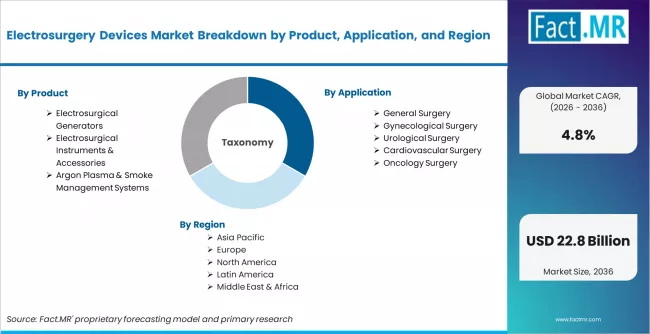
Electrosurgery Devices Market Breakdown By Product, Application, And Region | Source: Fact.MR
| Parameter | Details |
|---|---|
| Quantitative Units | USD 14.25 billion in 2026 to USD 22.78 billion by 2036, at a CAGR of 4.8% |
| Market Definition | Medical devices using high-frequency electrical current to cut, coagulate, seal, or ablate tissue during surgical procedures, including generators, instruments, accessories, argon plasma systems, and smoke evacuation devices. |
| Regions | North America, Latin America, Europe, East Asia, South Asia and Pacific, Middle East and Africa |
| Countries | United States, Mexico, Germany, France, South Korea, United Kingdom, Japan, and 25+ additional countries |
| Companies | Medtronic, J&J Ethicon, Olympus, ConMed, B. Braun Aesculap, Erbe, Karl Storz, Stryker, Boston Scientific, Zimmer Biomet |
| Forecast Period | 2026 to 2036 |
| Approach | Demand-side model built on surgical procedure volumes, generator installed base, instrument attach rates, ASC expansion data, and primary interviews with hospital procurement leads, OR directors, and device manufacturers. |
Source: Fact.MR analysis. Updated Apr 27, 2026
Frequently Asked Questions
How big is the electrosurgery devices market in 2026?
What will be the size of the electrosurgery devices market in 2036?
How fast is the electrosurgery devices market expected to grow between 2026 and 2036?
Which product segment leads the electrosurgery devices market in 2026?
Which country is the fastest-growing market for electrosurgery devices?
Which is the second-fastest-growing market?
What does the electrosurgery devices market include?
How does Fact.MR estimate and validate the market forecast?
Who worked on this report


Preview the report firsthand - request a free sample
Free SampleGet the brochure for pricing and purchase details
Download PDF