- Base Value(2025): 226 Mn
- Forecast Value (2035): 608 Mn
- CAGR (2035): 36%
Drug-Eluting Spinal Cages Market Outlook 2025 to 2035
The global drug-eluting spinal cages market is expected to reach USD 608 Million by 2035, up from USD 206 Million in 2025. During the forecast period 2025 to 2035, the industry is projected to expand at a CAGR of 10.4%.
The market potential of drug-eluting spinal cages is propelled by the fact that the incidence of spinal disorders has been on the rise, the demand of the least invasive fusion surgery has been on the rise, and the biomaterials that have ensured controlled release of drugs. The increased use of cages that offer both mechanical and localized drug delivery improves healing and lowers postoperative complications.
In addition, market growth and technological advancement still continue to be enhanced by innovation of bioresorbable polymers and regenerative drugs and old age of the world population.
Quick Stats for Drug-Eluting Spinal Cages Market
- Industry Value (2025): USD 206 Million
- Projected Value (2035): USD 608 Million
- Forecast CAGR (2025 to 2035): 10.4%
- Leading Segment (2025): PEEK (Polyetheretherketone) Cages (36% Market Share)
- Fastest Growing Country (2025-2035): China (11% CAGR)
- Top Key Players: Medtronic, DePuy Synthes (Johnson & Johnson), Stryker, NuVasive, Globus Medical, and Zimmer Biomet
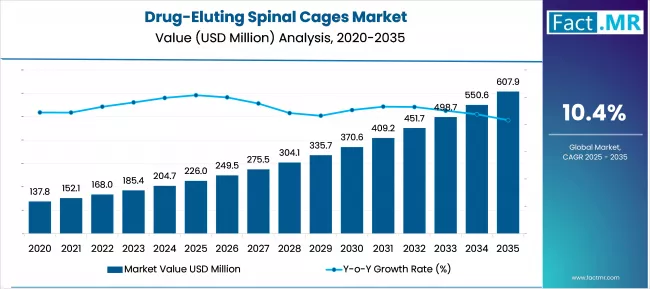
Drug Eluting Spinal Cages Market Market Value Analysis | Source: Fact.MR
What are the drivers of the Drug-Eluting Spinal Cages Market?
The market of drug-eluting spinal cages is growing fast, with the rates of spinal injuries, degenerative disc diseases, and the need to find more sophisticated methods of spinal fusion increasing. The combination of managed drug-delivery technology and biocompatible cage materials helps in improving the healing process, infection prevention, and the outcome of a postoperative process.
Innovation is being expedited by increased adoption of more minimally invasive and personalized treatments, progress in bioactive coatings, 3D printing, and biodegradable polymers. The medtech companies, biomaterial scientists and pharmaceutical developers are collaborating to develop multifunctional, regenerative spinal implants that enable quick recovery, enhanced rates of fusion or permanent wellness of the patient.
What are the regional trends of the Drug-Eluting Spinal Cages Market?
The instrument of drug-eluting spinal cages market has unique regional dynamics determined by the healthcare infrastructure, innovation capacity, and rate of adoption of surgery procedures.
- The market is dominated by North America, which is characterized by superior spinal care, high expenditure on healthcare, and early acceptance of bioengineered implants.
- Europe comes next with priorities on regulatory-supported innovations and biocompatible materials.
- In smart biomaterials, manufacturing and R&D is driven by East Asia, involving Japan, China and South Korea.
- South Asia & Pacific are also experiencing increasing growth because of the increasing healthcare access and medical tourism.
- Latin America and Middle East and Africa are the developing markets, and over time they are slowly implementing the advanced spinal fusion technologies due to global collaboration and through the modernization of hospitals in the countries.
What are the challenges and restraining factors of the Drug-Eluting Spinal Cages Market?
The drug-eluting spinal cages market has a number of issues which prevent its use in a broader sense. Complex processes of integrating drugs, strict regulatory approvals and in-depth clinical testing hinder commercialization since the manufacturing costs are high. There is a technical challenge to ensure accurate control of drug release in the long term, biocompatibility and mechanical stability.
Low levels of familiarity with the surgeon and mistrust in long-term results delay clinical acceptance. Also, limitations on reimbursement, the possibility of cytotoxicity, and the problem of material degradation limit the penetration of the market.
The disparities in medical facilities, ethical issues regarding application of growth factors as well as differences in international regulations add to the inhibitory effect of global expansion thus prompting the necessity to make production cost-effective, standardize testing as well as ensuring strong long-term clinical validation.
Country-Wise Insights
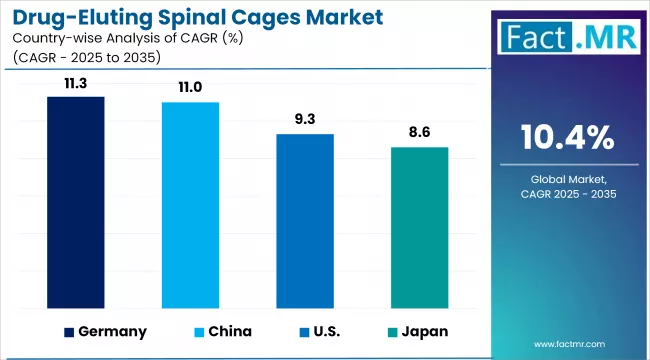
Drug Eluting Spinal Cages Market Cagr Analysis By Country | Source: Fact.MR
The United States leads spinal innovation through advanced bioactive implants
The US is the leader in the drug-eluting spinal cages market because of its superior healthcare system, robust research and development community, and overall utilization of new form of spinal fusion technologies. This is an advantage of the country that has a concentration of the leading medtech organisations, including Medtronic, Stryker, and DePuy Synthes, that spend much on the development of bioactive and drug-integrated implants.
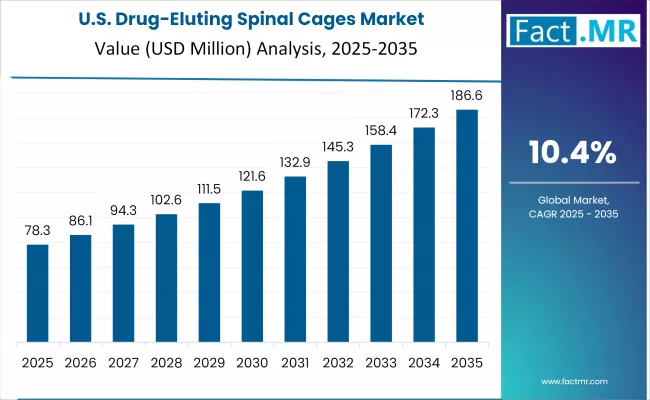
Drug Eluting Spinal Cages Market Country Value Analysis | Source: Fact.MR
Vibrant clinical research, good reimbursement frameworks and FDA backing of new product in spine facilitates commercialization. The increasing number of requests in minimal invasive and patient-specific spinal solutions in addition to the technological advances in the field of 3D printing, bioresorbable polymers, and drug-release coats make the U.S. the most integrated country in the sphere of spinal implants innovation and production.
Germany drives precision-engineered, drug-releasing spinal implant advancements
Drug eluting spinal cages are mostly found in Europe and Germany is the leader in the market due to the advanced orthopedic care chain, accuracy in engineering and strict drug regulation on safety and performance. Good cooperation between medical universities, biotech companies, and the manufacturers of implants in the country allows reinventing the product continuously.
The rise in the number of spinal fusion surgery, ageing population and interest in biocompatible and antibacterial and osteo-inductive materials all favour the continuous growth in the market. The focus of Germany on clinical validation, material science innovation, and integration of controlled drug-release systems makes it a key participant in the developed technology of spinal implants in Europe.
Japan pioneers bioresorbable, drug-eluting spinal cage technologies regionally
The country is Japan, which is the leader in the Asian-Pacific market in terms of innovations in the drug-eluting spinal cages market driven by the aging population, high healthcare standards, and early use of biomaterials and nanotechnology. The local companies and research institutes have joined efforts to come up with lightweight, bioresorbable, and drug-releasing cages to enhance the speed of recovery and minimal postoperative infections.
Regenerative medicine and personalized healthcare is greatly supported by the government and thus encourages investment in R&D. Combination of intelligent drug-delivery systems and less invasive spinal fusion is in line with the focus on precision and patient-specific solutions in Japan and thus it will be a regional leader in the development of spinal implants and their clinical implementation.
Category-Wise Analysis
PEEK cages dominate due to biocompatibility, strength, and drug-integration advantages
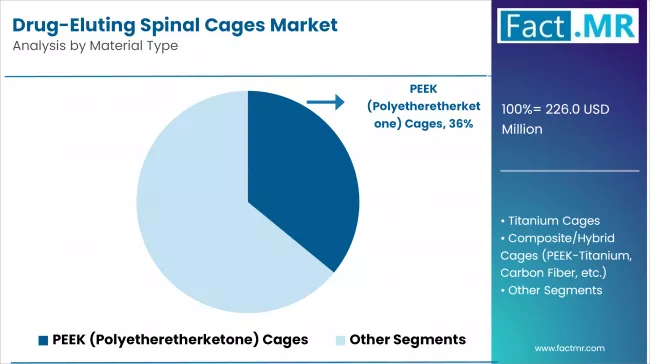
Drug Eluting Spinal Cages Market Analysis By Material Type | Source: Fact.MR
PEEK (Polyetheretherketone) cages are leading the drug eluting spinal cages industry because they are highly biocompatible, radiolucid, and strong resembling to natural bone. This is because they can be used with antibiotics, anti-inflammatory drugs or bone growth factors which make them attractive in controlled drug release and maximum integration into the bone.
The recent development of technologies in 3D printing and surface modification also enhances the adhesion properties of drugs and tissue integration. The corrosion and wear resistance of PEEK and the PEEK compatibility with both fusion and minimal invasive methods make it highly stable over time and allows quicker recovery testing its popularity in contemporary spinal fusion operations across the globe.
Antibiotic-eluting cages lead by reducing infections and improving healing
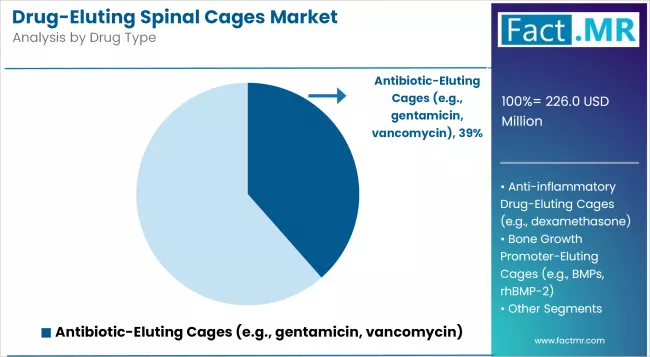
Drug Eluting Spinal Cages Market Analysis By Drug Type | Source: Fact.MR
Among the types of drugs, antibiotic-eluting cages occupy the most significant position because of their vital importance in fewer postoperative infections and complicated conditions around implants. The ability of the incorporation of antibiotics such as gentamicin or vancomycin allows the localized, prolonged delivery of drugs directly at the surgical site so that systemic toxicity is minimized and rapid healing is achieved. Such cages come in especially handy during high risk or revision spinal surgery.
Drugs can be retained and released at a better rate due to advances in coating technology, nanoporous structures, and biodegradable polymers. As infection control expands, antibiotic-eluting cages remain the standard of safe and effective spinal fusion solutions in all hospitals and high-level operating center throughout the world.
Lumbar fusion leads due to rising degeneration and superior healing outcomes
The most common market segment in the drug-eluting spinal cages market is lumbar fusion due to the very high incubation of degenerative disc diseases and lower back ailments. Lumbar cages with drug-eluting technology promote fusion rates by promoting bone regeneration and suppressing inflammatory and risk of infection. Minimal invasive lumbar surgery, image-guided surgery, and bioactive material innovations are widening their area of clinical success.
As the populations are aging and leading sedentary lives, which lead to lumbar spine degeneration, the demand on such advanced implants is only growing which contributes to better patient outcomes and a faster recovery as well as a long-term stability of the spine in major healthcare markets.
Competitive Analysis
Key players in the drug-eluting spinal cages market include Medtronic, DePuy Synthes (Johnson & Johnson), Stryker, NuVasive, Globus Medical, and Zimmer Biomet.
Competition in the market for drug-eluting spinal cages is very high, with Medtronic, Stryker, DePuy Synthes, Zimmer Biomet, and B. Braun among the major players in the business that dominate innovation. Such organizations aim at combining drug-delivery platform with state-of-the-art biomaterials such as PEEK, titanium, and bioresorbable polymers to improve the fusion results and lessen the incidence of postoperative infections. The medtech companies, pharmaceutical developers, and research institutions are engaging in strategic alliances that are speeding up the development of products. Ongoing research and development work aims at more effective drug-release control, biointegration, and least invasive compatibility. Competition is also enhanced by the increasing demand of personalized spinal implants in the world, which provide quicker healing, increased biocompatibility, and long-term clinical success among various groups of patients.
Recent Development
- In October 2025, Onkos Surgical received a 510(k) clearance of its ELEOS Proximal Tibia device with NanoCept antibacterial technology the first 510(k) clearance of an antibacterial coating over a 510(k)-cleared product to date (translatable to the spine device strategies).
- In January 2024, Silver Bullet Therapeutics, Inc. revealed the permission of FDA to begin a pre-market 510(k) trial of their antimicrobial/coating technologies and emphasized coating validation collaborations - their proprietary antimicrobial coating technology (platinum/silver blend) is a commercial antimicrobial coating method that could be utilized to spinal implants to provide a sustained release of antimicrobial ions.
Fact.MR has provided detailed information about the price points of key manufacturers of Drug-Eluting Spinal Cages Market positioned across regions, sales growth, production capacity, and speculative technological expansion, in the recently published report.
Methodology and Industry Tracking Approach
The data were obtained in the report by Fact.MR (2025) on the market of drug-eluting spinal cages, which collected the data of more than 3,200 respondents in 20 countries, such as spine surgeons, orthopedic specialists, biomedical engineers, and healthcare administrators. About 60 percent were end-users in clinical applications, and 40 percent were manufacturers, researchers, and purchasers. The research included primary survey and secondary surveys that examined peer-reviewed publications, patent applications, regulatory archives and company reports carried out between October 2024 and August 2025. Technology evolution, clinical outcomes, regulatory effect, and growth potential among regional and material-based market segments were assessed using advanced statistical modeling and trend analysis.
With Fact.MR monitoring consumer behavior, product efficacy, industry trends, and market opportunities since 2018, this report is becoming an authoritative source of information that stakeholders can rely on.
Segmentation
Segmentation of Drug-Eluting Spinal Cages Market
-
By Material Type :
- Titanium Cages
- PEEK (Polyetheretherketone) Cages
- Composite/Hybrid Cages (PEEK-Titanium, Carbon Fiber, etc.)
- Biodegradable Polymer Cages
- Ceramic-Based Cages
-
By Drug Type :
- Antibiotic-Eluting Cages (e.g., gentamicin, vancomycin)
- Anti-inflammatory Drug-Eluting Cages (e.g., dexamethasone)
- Bone Growth Promoter-Eluting Cages (e.g., BMPs, rhBMP-2)
- Analgesic-Eluting Cages
- Anticancer/Antimetastatic Drug-Eluting Cages
-
By Spinal Fusion Type / Procedure :
- Cervical Fusion
- Thoracic Fusion
- Lumbar Fusion
- Lumbosacral Fusion
- Others (Multilevel/Revision Procedures)
-
By Technology / Drug Delivery Mechanism :
- Surface Coating-Based Drug Release
- Porous Matrix Incorporation
- Microcapsule/Nanoparticle Embedded Cages
- Hydrogel-Coated Systems
- Layer-by-Layer Drug Deposition Technology
-
By Region :
- North America
- Latin America
- Western Europe
- Eastern Europe
- East Asia
- South Asia & Pacific
- Middle East & Africa
Frequently Asked Questions
What was the global Drug-Eluting Spinal Cages Market size reported by Fact.MR for 2025?
Who are the major players operating in the Drug-Eluting Spinal Cages Market?
What is the estimated valuation of the Drug-Eluting Spinal Cages Market in 2035?
What Value CAGR did the Drug-Eluting Spinal Cages Market exhibit over the last five years?
Who worked on this report


Preview the report firsthand - request a free sample
Free SampleGet the brochure for pricing and purchase details
Download PDF