- Base Value(2026): 2.9 Bn
- Estimated Value(2026): 2.9 Bn
- Forecast Value (2036): 5.0 Bn
- CAGR (2026 - 2036): 5.6%
Industrial Sensors for Steel Manufacturing Market Forecast Outlook 2026 to 2036
The industrial sensors for steel manufacturing market is projected to reach USD 2.9 billion in 2026, growing to USD 5 billion by 2036, with a CAGR of 5.6%.
Key Takeaways from Industrial Sensors for Steel Manufacturing Market
- Industrial Sensors for Steel Manufacturing Market Value (2026): USD 2.9 billion
- Industrial Sensors for Steel Manufacturing Market Forecast Value (2036): USD 5 billion
- Industrial Sensors for Steel Manufacturing Market Forecast CAGR 2026 to 2036: 5.6%
- Leading Segment in Industrial Sensors for Steel Manufacturing Market: Capex Purchase Mode (80%)
- Key Growth Region in Industrial Sensors for Steel Manufacturing Market: Asia Pacific
- Key Players in Industrial Sensors for Steel Manufacturing Market: Siemens AG, Endress+Hauser Group, ABB Ltd., Emerson Electric Co., Honeywell International Inc., Yokogawa Electric Corporation, SICK AG, Keyence Corporation, Pepperl+Fuchs GmbH, ifm electronic gmbh
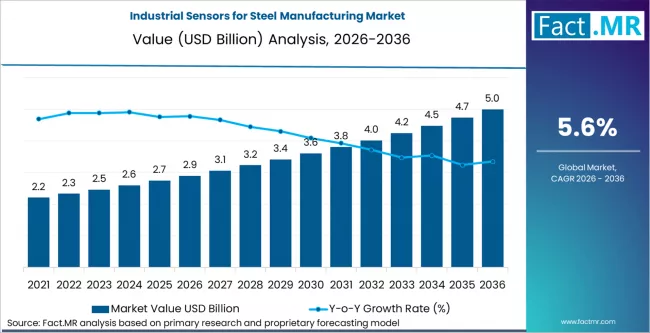
Industrial Sensors For Steel Manufacturing Market Market Value Analysis | Source: Fact.MR
This market will be commercially crucial as manufacturers increasingly rely on advanced sensor technologies to enhance operational efficiency, reduce waste, and ensure quality control across production lines. As the steel industry faces rising pressure to improve sustainability and meet stricter regulatory standards, the adoption of industrial sensors will be key to driving smarter, more efficient operations.
Buyer intent will center on long-term investments in automation and predictive maintenance, as these technologies offer significant cost savings and improve uptime. Decision-making will prioritize suppliers that can demonstrate proven reliability and scalability, as integrating sensors into complex steel manufacturing systems requires substantial expertise. With economic pressures and a focus on optimizing resources, this market will be driven by a shift toward smarter, data-driven production processes.
Industrial Sensors for Steel Manufacturing Market
| Metric | Value |
|---|---|
| Estimated Value in (2026E) | USD 2.9 billion |
| Forecast Value in (2036F) | USD 5 billion |
| Forecast CAGR 2026 to 2036 | 5.6% |
Source: Fact.MR analysis. Updated Jan 29, 2026
Category
| Category | Segments |
|---|---|
| Process Stage | Steelmaking or Meltshop; Casting; Rolling or Finishing; Utilities and Emissions |
| Deployment | Replacement and Upgrades; New Installations |
| Connectivity | Wired; Wireless |
| Compliance Need | Standard Industrial; Safety-rated or SIL |
| Purchase Mode | Capex; Sensor-as-a-Service |
| Region | North America; Europe; Asia Pacific; Latin America; Middle East & Africa |
Source: Fact.MR analysis. Updated Jan 29, 2026
Segmental Analysis
What Is the Impact of Purchase Mode on the Industrial Sensors for Steel Manufacturing Market?
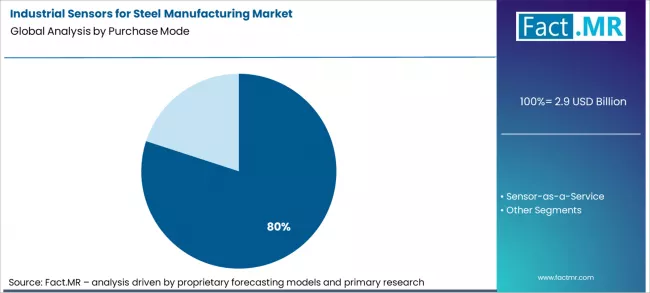
Industrial Sensors For Steel Manufacturing Market Analysis By Purchase Mode | Source: Fact.MR
In the industrial sensors for steel manufacturing market, purchase mode is a key factor in shaping the demand for sensor technologies. Capex (Capital Expenditure) leads the market with an 80% share, as steel manufacturers typically make significant investments in industrial sensors to improve operational efficiency, safety, and quality control. Capital expenditure on sensors is often seen as a long-term investment, as they are essential for continuous monitoring, automation, and process optimization in steel plants. While Sensor-as-a-Service offers a more flexible, subscription-based model, the preference for Capex-based purchases remains strong in the steel manufacturing sector due to the large-scale, permanent nature of sensor deployments.
What Is the Impact of Connectivity on the Industrial Sensors for Steel Manufacturing Market?
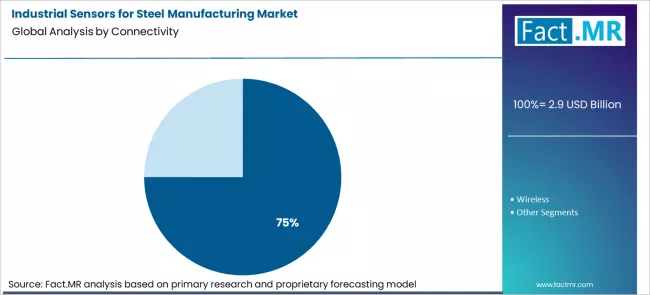
Industrial Sensors For Steel Manufacturing Market Analysis By Connectivity | Source: Fact.MR
Connectivity plays a crucial role in the functionality and performance of industrial sensors, with wired sensors holding a 75% share in the market. Wired sensors are favored for their reliability, stability, and ability to transmit large volumes of data over long distances without the concerns of signal interference or power limitations. They are particularly suited for the harsh and demanding environments of steel manufacturing plants, where continuous data collection is necessary for process control and quality assurance. While wireless sensors offer greater flexibility and ease of installation, wired sensors remain dominant in the market due to their robustness and consistent performance in steel manufacturing applications.
What is the Strategic Outlook for the Industrial Sensors for Steel Manufacturing Market in 2026?
The industrial sensors market for steel manufacturing has shifted from hardware volume to "data integrity," driven by the transition to "Green Steel." Steelmakers now prioritize carbon accounting, a shift in sensor adoption focus. This change aligns with the rising demand for sensors capable of withstanding the harsh environments of Electric Arc Furnaces (EAF) and supporting precision in hydrogen-based steelmaking. As global demand recovers, the market for sensors, particularly those focused on carbon monitoring, continues to grow, with steelmakers moving towards reliability and earlier integration of sensors into the equipment lifecycle.
Analysis of the Industrial Sensors for Steel Manufacturing Market by Key Country
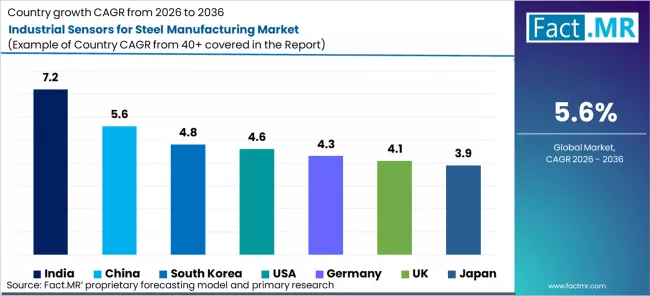
Industrial Sensors For Steel Manufacturing Market Cagr Analysis By Country | Source: Fact.MR
| Country | CAGR (2026-2036) |
|---|---|
| USA | 4.6% |
| China | 5.6% |
| India | 7.2% |
| Germany | 4.3% |
| Japan | 3.9% |
| South Korea | 4.8% |
| UK | 4.1% |
Source: Fact.MR analysis. Updated Jan 29, 2026
The report covers an in-depth analysis of 40+ countries; top-performing countries are highlighted below.
What is the Outlook on the Industrial Sensors for Steel Manufacturing Market in the USA?
USA market in industrial sensors for steel manufacturing is projected to grow at a CAGR of 4.6% from 2026 to 2036. The demand for industrial sensors is increasing due to their crucial role in improving automation, operational efficiency, and safety within steel plants. These sensors are essential for monitoring temperature, pressure, and other critical parameters during the steel production process. As the USA continues to invest in modernizing steel manufacturing facilities and improving energy efficiency, the market for industrial sensors is expected to see steady growth, driven by both technological advancements and regulatory compliance.
What is the Demand for Industrial Sensors for Steel Manufacturing in China?
China sales of industrial sensors for steel manufacturing are expected to grow at a CAGR of 5.6% from 2026 to 2036. As China’s steel industry continues to modernize, the demand for advanced industrial sensors is rising. These sensors are essential for optimizing production processes, enhancing product quality, and improving energy efficiency. With China’s strong focus on increasing automation and reducing environmental impact in manufacturing, the market for industrial sensors in steel plants is expected to experience steady growth. Companies in China should focus on offering innovative sensor solutions that support sustainable industrial practices.
What is the Sales Outlook on Industrial Sensors for Steel Manufacturing in India?
India demand for industrial sensors for steel manufacturing is projected to grow at a CAGR of 7.2% from 2026 to 2036. The rapid expansion of India’s steel manufacturing industry, along with growing industrial automation, is driving the need for advanced sensors. These sensors are critical for maintaining production efficiency, reducing downtime, and improving safety in steel plants. With India’s emphasis on improving its industrial infrastructure and meeting international quality standards, the market for industrial sensors is expected to see significant growth. Manufacturers should focus on providing cost-effective and reliable sensor solutions tailored to India’s growing industrial base.
What is the Demand for Industrial Sensors for Steel Manufacturing in Germany?
Germany market in industrial sensors for steel manufacturing is forecast to grow at a CAGR of 4.3% from 2026 to 2036. Germany’s advanced steel manufacturing sector is increasingly relying on industrial sensors to improve efficiency, safety, and quality control in production processes. These sensors are used to monitor critical parameters such as temperature, pressure, and vibration, ensuring that steel products meet high standards. As Germany continues to lead in industrial innovation and sustainability, the market for industrial sensors in steel manufacturing is expected to grow steadily, supported by both domestic demand and international exports.
What is the Sales Outlook on Industrial Sensors for Steel Manufacturing in Japan?
Japan demand for industrial sensors for steel manufacturing is set to grow at a CAGR of 3.9% from 2026 to 2036. Japan’s steel manufacturing industry, known for its technological innovations, requires high-performance sensors to maintain operational efficiency and product quality. These sensors help monitor key parameters, optimize processes, and reduce energy consumption. Despite the maturity of the market, ongoing investments in industrial automation and sustainability will continue to drive moderate growth in the demand for industrial sensors for steel manufacturing.
What is the Market Expansion Outlook for Industrial Sensors for Steel Manufacturing in South Korea?
South Korea demand for industrial sensors for steel manufacturing is projected to grow at a CAGR of 4.8% from 2026 to 2036. South Korea’s steel industry is increasingly adopting industrial sensors to improve manufacturing efficiency and reduce waste. These sensors are used to monitor key parameters such as temperature and pressure, helping to enhance product quality and minimize downtime. With South Korea’s focus on industrial automation and process optimization, the market for industrial sensors is expected to experience steady growth, driven by the need for advanced technologies to support high-quality production.
What is the Market Expansion Outlook for Industrial Sensors for Steel Manufacturing in the UK?
UK sales of industrial sensors for steel manufacturing are expected to grow at a CAGR of 4.1% from 2026 to 2036. The UK’s steel manufacturing sector, which is focusing on increasing automation and improving energy efficiency, is driving the demand for industrial sensors. These sensors help monitor various parameters during the steel production process, ensuring quality control, safety, and operational efficiency. With the UK’s continued focus on reducing carbon emissions and improving industrial processes, the market for industrial sensors is expected to grow steadily, supported by both domestic demand and exports to other regions.
How Are Key Players Competing in the Industrial Sensors for Steel Manufacturing Market?
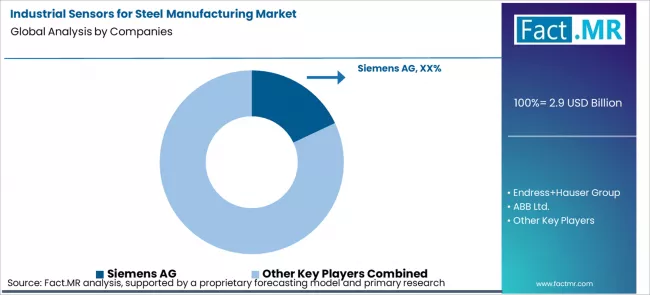
Industrial Sensors For Steel Manufacturing Market Analysis By Company | Source: Fact.MR
Recent developments in industrial sensors for steel manufacturing highlight a shift toward integrated automation, strategic partnerships, and advanced field instrumentation. Siemens AG introduced the Simatic Automation Workstation, consolidating PLC, HMI, and edge functions, streamlining data flow across sensor networks in industrial environments. Endress+Hauser Group formed a strategic partnership with SICK AG to expand its sensor portfolio for process measurement and gas flow instrumentation, with plans for a joint venture to enhance global production. Yokogawa Electric Corporation launched its AXG series magnetic flowmeter, offering high accuracy in flow measurement for steel mill processes like water and cooling systems. Pepperl+Fuchs GmbH continues to supply a range of sensors, including inductive, capacitive, and ultrasonic models for automation. As automation and smart factory adoption rise, sensor deployment and integration into broader process control systems are increasingly essential for realtime monitoring, predictive maintenance, and overall operational efficiency.
Key Players of the Industrial Sensors for Steel Manufacturing Market
- Endress+Hauser Group
- Siemens AG
- ABB Ltd.
- Emerson Electric Co.
- Honeywell International Inc.
- Yokogawa Electric Corporation
- SICK AG
- Keyence Corporation
- Pepperl+Fuchs GmbH
- ifm electronic gmbh
Bibliographies
- World Steel Association. (2024). Digitalisation and sensor-enabled monitoring in steel production. World Steel Association.
- International Energy Agency. (2024). Smart sensing and instrumentation in energy-intensive industries. International Energy Agency.
- Organisation for Economic Co-operation and Development. (2023). Industrial digital transformation: Sensors, data acquisition, and process optimisation. OECD Publishing.
- U.S. Department of Energy. (2024). Advanced sensors and real-time monitoring technologies for steel manufacturing. Office of Energy Efficiency and Renewable Energy.
- European Commission, Joint Research Centre. (2023). Best available techniques (BAT) for iron and steel production: Monitoring and sensor systems. European Commission.
Segmentation
Scope of the Report
| Items | Values |
|---|---|
| Quantitative Units (2026) | USD Billion |
| Process Stage | Steelmaking or Meltshop, Casting, Rolling or Finishing, Utilities and Emissions |
| Deployment | Replacement and Upgrades, New Installations |
| Connectivity | Wired, Wireless |
| Compliance Need | Standard Industrial, Safety-rated or SIL |
| Purchase Mode | Capex, Sensor-as-a-Service |
| Regions Covered | North America, Europe, Asia Pacific, Latin America, Middle East & Africa |
| Countries Covered | United States, Canada, Mexico, Germany, United Kingdom, France, Japan, South Korea, China, India, Brazil, and other countries |
| Key Companies Profiled | Siemens AG, Endress+Hauser Group, ABB Ltd., Emerson Electric Co., Honeywell International Inc., Yokogawa Electric Corporation, SICK AG, Keyence Corporation, Pepperl+Fuchs GmbH, ifm electronic gmbh |
| Additional Attributes | Dollar revenue by process stage, deployment, connectivity, compliance need, purchase mode, and region; regional demand trends, competitive landscape, technological advancements in industrial sensors for steel manufacturing, operational performance optimization initiatives, and product development strategies |
Source: Fact.MR analysis. Updated Jan 29, 2026
Industrial Sensors for Steel Manufacturing Market Key Segments
-
Process Stage :
- Steelmaking or Meltshop
- Casting
- Rolling or Finishing
- Utilities and Emissions
-
Deployment :
- Replacement and Upgrades
- New Installations
-
Connectivity :
- Wired
- Wireless
-
Compliance Need :
- Standard Industrial
- Safety-rated or SIL
-
Purchase Mode :
- Capex
- Sensor-as-a-Service
-
Region :
- North America
- USA
- Canada
- Mexico
- Europe
- Germany
- UK
- France
- Italy
- Spain
- Rest of Europe
- Asia Pacific
- China
- Japan
- South Korea
- India
- Australia
- Rest of Asia Pacific
- Latin America
- Brazil
- Argentina
- Rest of Latin America
- Middle East and Africa
- Kingdom of Saudi Arabia
- United Arab Emirates
- South Africa
- Rest of Middle East and Africa
- Other Regions
- Oceania
- Central Asia
- Other Markets
- North America
Frequently Asked Questions
How big is the industrial sensors for steel manufacturing market in 2026?
What will be the size of industrial sensors for steel manufacturing market in 2036?
How much will be the industrial sensors for steel manufacturing market growth between 2026 and 2036?
What are the key product types in the industrial sensors for steel manufacturing market?
Which deployment segment to contribute significant share in the industrial sensors for steel manufacturing market in 2026?
Who worked on this report


Preview the report firsthand - request a free sample
Free SampleGet the brochure for pricing and purchase details
Download PDF