- Forecast Value (2035): 6.7 Bn
- CAGR (2035): 7.2%
Station Signage Market Outlook 2025 2035
The global station signage market is expected to reach USD 6.7 Billion by 2035, up from estimated value of USD 3.5 Billion in 2025. During the forecast period (2025 to 2035), the industry is projected to expand at a CAGR of 6.8%.
The increasing demand of real-time information about passengers, blistering urbanization, and investments in smart transport infrastructure stimulate the development of the station signage market. The increasing focus on energy-efficient and sustainable designs and the incorporation of digital and IoT-based solutions give a further boost in adoption of railway, metro, airport, and bus terminals, improving the commuter experience and operational efficiency.
Quick Stats for Station Signage Market
- Industry Value (2025): USD 3.5 Billion
- Projected Value (2035): USD 6.7 Billion
- Forecast CAGR (2025 to 2035): 6.8%
- Leading Segment (2025): Digital Signage (35% Market Share)
- Fastest Growing Country (2025-2035): Germany (5.2% CAGR)
- Top Key Players:are Daktronics, Inc., LG Electronics, Samsung Electronics, NEC Corporation, Sony Corporation, Panasonic Corporation, Barco NV, Sharp Corporation, and E Ink Holdings Inc.
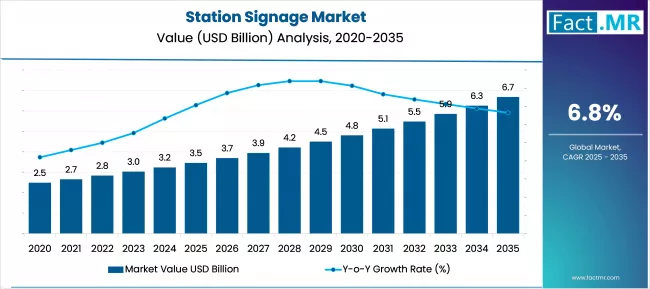
Station Signage Market Market Value Analysis | Source: Fact.MR
What are the key factors driving growth in the Station Signage Market?
The station signage market is experiencing several dynamics and they include the rising rates of urbanization, the development of transport systems and the need to have improved communication among the passengers. Development of digital signage would be used to boost real-time information exchange whereas the sustainability objectives support the use of energy-saving display technologies.
The current signage system is also being developed because governments across the globe are investing in smart transport infrastructure. Wayfinding and emergency communication devices are also demanded by improved security measures that pertain to the safety of the passengers. Besides that, the rising pressure of hassle-free transportation is pushing the transport operators to adopt signage systems that are not only innovative but also long lasting and efficient in an effort to fulfill the different commuter and operation needs.
What are the key trends driving growth in the Station Signage market?
High rate of incorporating digital and interactive signage that operates on LED and LCD technology are the main directions in the station signage market. The content management paradigm and the introduction of the IoT-based systems and AI integration are changing the dynamics of the content management process and offering real-time updates in line with the flows of the passengers.
A shift in the trend is also influenced by the aspect of sustainability whereby things have come to be geared towards energy-saving, environment-friendly, and recyclable materials. The practice of customization and modular design is gaining popularity, and this is why the scaling between transport hubs can be easily accomplished.
In addition, the popularity of multilingual screens and touch screens will be enhanced, which means that international travelers will have more access. These patterns lead to look into the fact that there is a shift towards the direction of smart and user-friendly solutions, which are aligned with smart city and digital transformation processes on a global scale.
What factors hinder the growth of the Station Signage market?
Despite the high rate of growth, station signage market is encumbered by factors that could limit its high adoption. Initial cost of installation and maintenance is normally high and therefore investments are limited particularly with the small transit networks. The possibility of integration with the old infrastructure being complex might slow down deployments, technological changes could be fast, thereby leading to a short lifecycle of products and increasing costs of replacement.
There is also the issue of cybersecurity in the interconnected signage systems although it is a threat, not in a transit hub where there is high rate of traffic. Manufacturers may have a difficult time making sure that they operate under regulations of different geographies. These problems have resulted in it being significant to develop cost-effective and scalable and secure solutions to allow the station signage industry to remain growing in the long-term.
What are the key regional trends driving the Station Signage Market growth?
North America
The station signage market of North America is fueled by smart transport programs, high rate of technology adoption and high level of investment in urban mobility programs. The area focuses on efficient, digital, and interactive signage that improves passenger experience and ensures safety as well as conforms to rigid regulatory structures.
East Asia
The station signage market has a high rate of growth in East Asia because of huge infrastructural developments, urbanization and increased volumes of commuters. Governments and operators focus on the digital signage integration of AI and IoT, which improves the real-time communication, the development of the smart city and high-speed rail.
Western Europe
The station signage market of Western Europe is influenced by the ideas of sustainability, innovation, and the adherence to the environmental policies. The area implements light-efficient LED and modular lighting signage, contributes to the accessibility, and multilingualism. Substantial investment on the modernization of the public transport promotes the further uptake of metro, airport, and railway networks.
Country-wise Outlook
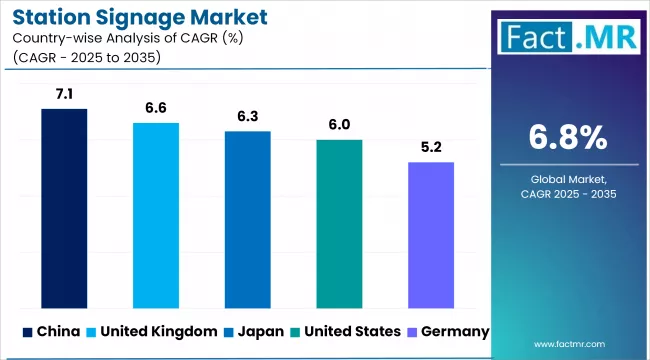
Station Signage Market Cagr Analysis By Country | Source: Fact.MR
Technological Innovation and Passenger Experience Drive the United States’ Station Signage Market
The U.S. station signage market is developing rather fast as transport hubs focus on the digital revolution to make commuter experience and safety more impressive. The need to use real-time signage and smart wayfinding is in the digital and interactive signages high investments that are in airports, metro systems and bus terminals.
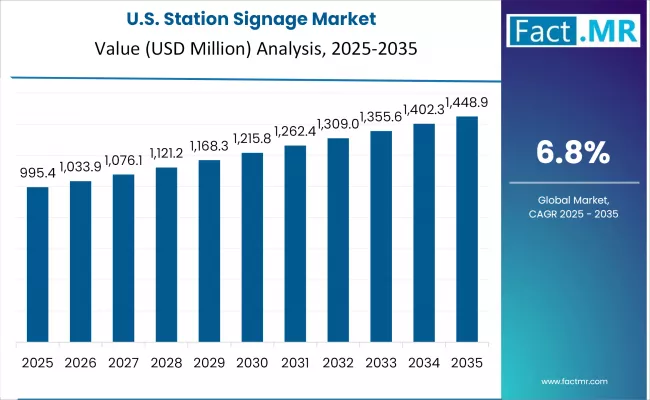
Station Signage Market Country Value Analysis | Source: Fact.MR
The U.S. is on the forefront of innovation through strong R&D, sustainability objectives, and integration of IoT-powered displays. It is still concentrated on the convenience of the passengers, adherence to the regulations, and energy-efficient technologies that support its international transit signage.
Urbanization and Smart Infrastructure Fuel China’s Station Signage Market
The market station signage in China is increasing quickly due to the rapid urbanization processes, massive metro projects and increase in the demand of modern transport infrastructure. The use of advanced signage solutions is being embraced at a faster pace by government-led investments in smart cities and digital transport systems.
The domestic players are able to take advantage of the economies of scale and international companies work with the local companies to provide the high capacity and durable systems. Combination of AI, multilingual displays and automation assists commuter in thickly populated cities and China is the powerhouse of signage innovation and replicating deployment.
Sustainability and Engineering Expertise Propel Germany’s Station Signage Market
The station signage market in Germany is flourishing with transit authorities resorting to the implementation of environmental friendly and high performance solutions in an effort to upscale the transport infrastructure. The presence of well-developed environmental policies, along with the precision of engineering, promotes the use of long-lasting and energy-efficient signage.
Domestic and foreign firms are oriented on the modular systems, IoT-based monitoring, and the custom car designs of railway stations, airports, and metro networks. Having concentrated on sustainability and technological advancements, Germany has been at the forefront of the station signage industry in Europe, which guarantees efficiency, safety, and improved passenger experiences in transportation centers.
Category-Wise Market Outlook
Digital Signage Surges Ahead with Smart and Interactive Capabilities
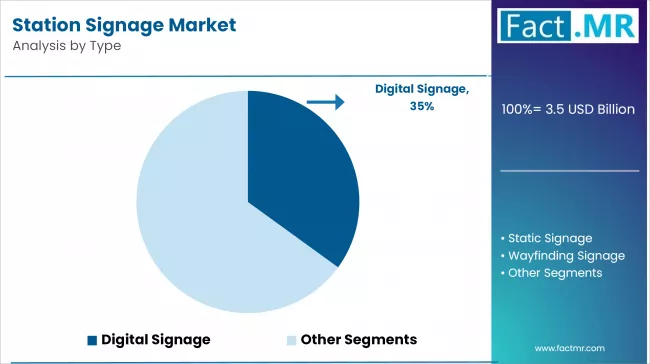
Station Signage Market Analysis By Type | Source: Fact.MR
Digital signage is the rapidly growing category, which is stipulated by the need to have real-time updates, dynamic content, and intelligent transit options. Digital signage allows better commuter experience and efficiency through high-definition display solutions, integrating IoT, controlling it in the cloud, and many more. The fact that it can modify messages in real time makes it the most appealing to LTUs of the contemporary world looking to achieve the continuity of information.
Metro Stations Lead Adoption with High Passenger Throughput Needs
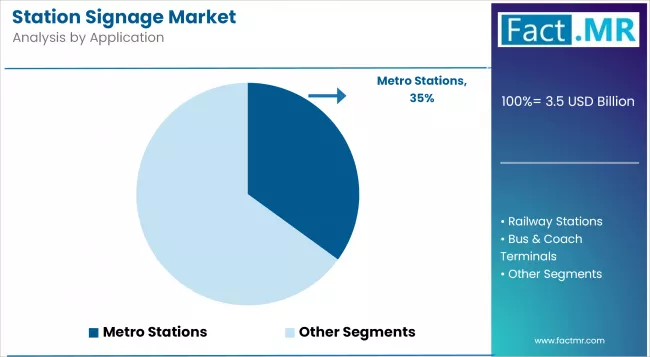
Station Signage Market Analysis By Application | Source: Fact.MR
In the applications, Metro Stations are experiencing the most dramatic development because of the need to expand urbanization and rapid transit through mass transportation, which is driving the demand of sophisticated signage. These systems accommodate high amounts of commuter traffic, which demands the use of digital wayfinding, safety warnings, and multilingual screens. Metro networks allocate a lot of resources to intelligent signage to enhance crowd control, minimize confusion, and provide a facilitated passage of the passengers, so this sub- segment has become a leader in the adoption.
LED Displays Dominate with Energy-Efficient and Durable Design
As far as display technology is concerned, LED signage is growing at the dominant rate because of its energy value, brightness, and resistance to unfriendly conditions. LEDs offer superior visibility in transit centers, indoor and outdoor as well as during heavy working hours and they are less expensive to maintain. Their adaptability to produce huge and continuous displays makes them be the technology that is favored in updating transport signs.
Competitive Analysis
Competitive Outlook: Station Signage Market
The Station Signage Market is a competitive environment that is characterized by a combination of both established multinational companies and specialized providers of signage. The advanced digital display solutions take the lead with Samsung Electronics, LG Electronics, Sony Corporation, Panasonic Corporation, NEC Corporation and Sharp Corporation being the leading electronics giants which have expertise in the fields of LED, OLED and LCD technology. To improve the real-time transit information companies such as Daktronics, Barco NV, and E Ink Holdings Inc. are developing real-time transit communication using energy-efficient, high-visibility and durable signage systems applicable in railway stations, airports and metro hubs. They are still concerned with high definition clarity, reliability and intelligent integration to enhance commuter navigation and safety.
Simultaneously, JCDecaux Group, Stratacache, Absen, Leyard and Unilumin Group are growing by using interactive displays, large format LEDs and cloud-based solutions that help support dynamic advertisement and real-time passenger information. There is mounting competition in the field of IoT-based, AI-powered, and eco-friendly signage solutions. This innovation, scale and flexibility will keep the Station Signage Market very competitive and will also guarantee the technological advancement and even globally.
Key players in the Station Signage market are Daktronics, Inc., LG Electronics, Samsung Electronics, NEC Corporation, Sony Corporation, Panasonic Corporation, Barco NV, Sharp Corporation, E Ink Holdings Inc., JCDecaux Group, Stratacache, Absen Optoelectronic Co., Ltd., Leyard Optoelectronic Co., Ltd., Unilumin Group Co., Ltd.
Recent Development:
- In 2025, TriMet, in partnership with Connectpoint, launched solar-powered ePaper digital signage at transit stops. The signs offer high readability outdoors while consuming minimal power, increasing sustainability and reducing maintenance demands.
- In September 2024, Redmon Transit Display rolled out enhanced digital signage features for transit hubs, including real-time schedule updates, improved visibility, and better data integration for passenger information systems.
Fact.MR has provided detailed information about the price points of key manufacturers of Station Signage market positioned across regions, sales growth, production capacity, and speculative technological expansion, in the recently published report.
Methodology and Industry Tracking Approach
The Station Signage Market in 2025 survey study performed by Fact.MR is a survey research that surveyed more than 10,000 participants in 30 countries with 250 and above participants per country. A sample of almost two-thirds of the end-users, such as transit authorities, metro operators, airport managers, and commercial facility providers, was present; the rest of the one-third consisted of industry experts including urban planners, equipment designers, regulatory experts, and sustainability consultants.
The information gathered in the period of September 2024 and August 2025 was devoted to the adoption trends, the integration of technologies, the changes in regulations, and innovations in support of smart and sustainable transit infrastructure. Over 250 secondary sources such as patents, product release, policy framework, and sustainability reports were analyzed using trend forecasting and advanced modelling methods.
Since 2018, Fact.MR has been paying special attention to consumer adoptions, technological solutions, regulatory conditions, and market maturity in the transit solutions, such as Station Signage. This experienced background makes the report more believable and can be used in the formulation of strategic advice to the stakeholders by providing well-informed recommendations and practical insights in the planning and growth of the business in the ever-changing Station Signage Market.
Segmentation
Segmentation of Station Signage Market Research
-
By Type :
- Digital Signage
- Static Signage
- Wayfinding Signage
- Safety & Regulatory Signage
- Advertising Signage
-
By Application :
- Railway Stations
- Metro Stations
- Bus & Coach Terminals
- Airports
- Ports & Ferry Terminals
-
By Installation Location :
- Indoor Signage
- Outdoor Signage
-
By Display Technology :
- LED
- LCD
- Projection-Based
-
By End User :
- Public Transport Authorities
- Private Transport Operators
- Commercial Advertisers
-
By Region :
- North America
- Latin America
- Western Europe
- Eastern Europe
- East Asia
- South Asia & Pacific
- Middle East & Africa
Frequently Asked Questions
What was the Global Station Signage Market Size Reported by Fact.MR for 2025?
Who are the Major Players Operating in the Station Signage Market?
What is the Estimated Valuation of the Station Signage Market in 2035?
What Value CAGR did the Station Signage Market Exhibit Over the Last Five Years?
Who worked on this report


Preview the report firsthand - request a free sample
Free SampleGet the brochure for pricing and purchase details
Download PDF