Low-Toxicity Heat Transfer Fluids for Renewables Market
Low-Toxicity Heat Transfer Fluids for Renewables Market Size and Share Forecast Outlook 2026 to 2036
Low-toxicity heat transfer fluids for renewables market is projected to grow from USD 422.0 million in 2026 to USD 980.8 million by 2036, at a CAGR of 8.8%. Bio-based synthetic esters & glycols will dominate with a 28.0% market share, while concentrated solar power (csp) & thermal storage will lead the renewable application segment with a 34.0% share.
Low-Toxicity Heat Transfer Fluids for Renewables Market Forecast and Outlook 2026 to 2036
The global low-toxicity heat transfer fluids for renewables market is projected to reach USD 980.85 million by 2036. The market is valued at USD 422.00 million in 2026 and is set to rise at a CAGR of 8.8% during the assessment period.
By fluid chemistry, bio-based synthetic esters & glycols hold a leading 28% share. Concentrated Solar Power (CSP) & thermal storage represents the dominant renewable application at 34%, while the OEM & system-integrator spec fluids (bundled with equipment) model is the primary commercial model, accounting for 46.00% market share.
Key Takeaways from the Low-Toxicity Heat Transfer Fluids for Renewables Market
- Market Value for 2026: USD 422.00 Million
- Market Value for 2036: USD 980.85 Million
- Forecast CAGR (2026-2036): 8.8%
- Leading Fluid Chemistry Share (2026): Bio-based Synthetic Esters & Glycols (28%)
- Leading Renewable Application Share (2026): Concentrated Solar Power (CSP) & Thermal Storage (34%)
- Leading Commercial Model Share (2026): OEM & System-Integrator Spec Fluids (46.00%)
- Key Players in the Market: Therminol, Globaltherm, BASF SE, Eastman Chemical Company
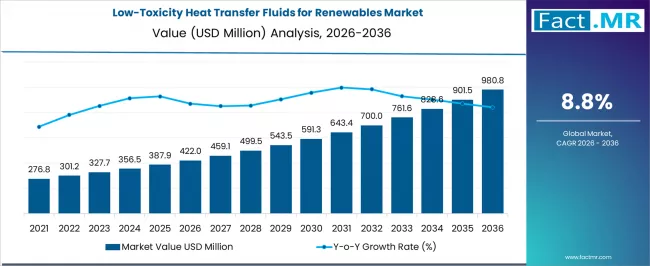
Defining trends involve the transition from traditional, high-hazard mineral oils and synthetic aromatics to engineered fluids that combine high thermal stability, excellent low-temperature properties, and inherent environmental safety. Innovation is rapidly advancing in non-flammable, high-temperature ionic liquids and phase-change material (PCM)-enhanced fluids for next-generation thermal storage. Integration of these specialized fluids with system design for optimal lifetime performance and end-of-life recyclability is becoming a key competitive differentiator.
Regulatory pressures and stringent environmental, health, and safety (EHS) standards for industrial and utility-scale renewable projects are primary market drivers. Policies promoting the circular economy and minimizing liability from potential leaks or spills in sensitive environments act as significant catalysts, positioning low-toxicity HTFs as a critical component for sustainable project permitting, operation, and decommissioning.
Low-Toxicity Heat Transfer Fluids for Renewables Market
| Metric | Value |
|---|---|
| Market Value (2026) | USD 422.00 Million |
| Market Forecast Value (2036) | USD 980.85 Million |
| Forecast CAGR (2026-2036) | 8.8% |
Category
| Category | Segments |
|---|---|
| Fluid Chemistry | Bio-based synthetic esters & glycols, Low-toxicity silicone HTFs (food-grade silicones), Low-toxicity mineral-oil replacements (solvent-refined blends), Ionic-liquid & deep eutectic solvent HTFs (specialty), Water-based heat transfer (antifreeze blends, high-temp glycols), PCM-enhanced low-toxicity fluids |
| Renewable Application | Concentrated Solar Power (CSP) & thermal storage, Solar process heat & district heating systems, Geothermal heat transfer loops, Biomass & bioenergy thermal systems, Hybrid renewable systems and industrial heat recovery |
| Commercial Model | OEM & system-integrator spec fluids (bundled with equipment), Independent fluid suppliers & chemical houses, On-site blending & reclaim service providers |
| Region | North America, Latin America, Western Europe, Eastern Europe, East Asia, South Asia & Pacific, MEA |
Segmental Analysis
By Fluid Chemistry, Which Technology Balances High Performance with Renewable Feedstocks?
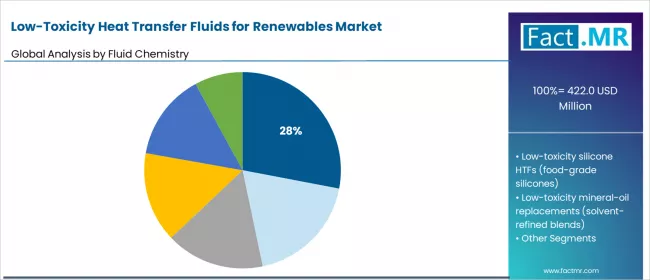
Bio-based synthetic esters & glycols lead the segment with a 28% share. This dominance is due to their superior environmental profile, readily biodegradable and derived from renewable sources, coupled with excellent thermal stability, low pour points, and non-toxicity. They effectively replace petroleum-based fluids in medium-to-high temperature applications, offering a compelling performance and sustainability package that aligns perfectly with the ethos of renewable energy projects, especially in sensitive or regulated locations.
By Renewable Application, Which Technology Has the Most Stringent and High-Value Thermal Demands?
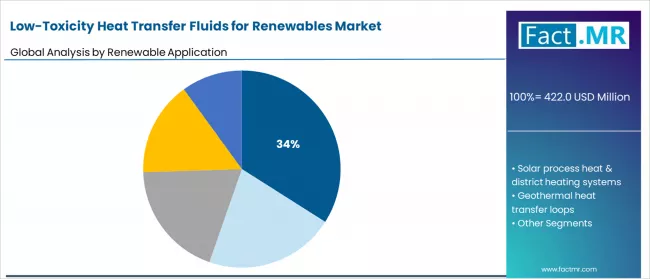
Concentrated Solar Power (CSP) & thermal storage commands the largest application share at 34%. CSP plants operate at very high temperatures (often above 400°C) and utilize massive volumes of HTF, where fluid longevity, stability, and safety are paramount for economic viability. The shift from toxic diphenyl oxide/biphenyl blends to advanced, low-toxicity synthetic fluids or molten salts is a critical industry transition, driven by risk mitigation and the need for reliable, large-scale thermal storage integration.
By Commercial Model, Who Holds the Greatest Influence on Initial Fluid Specification?
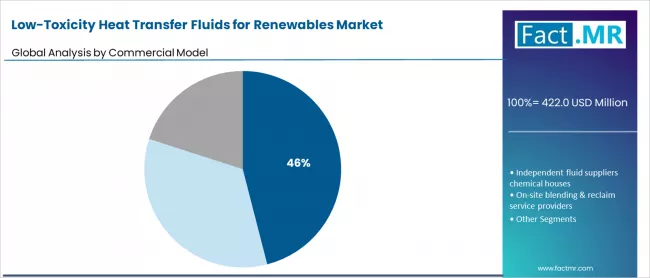
The OEM & system-integrator spec fluids (bundled with equipment) model is the dominant commercial model at 46.00%. Manufacturers of CSP receivers, geothermal heat exchangers, and solar thermal collectors specify and often pre-fill their systems with a certified HTF as part of the performance guarantee. This locks in significant initial volume and creates a long-term service relationship for fluid analysis and top-up, making OEM approval the most critical channel for market entry.
What are the Drivers, Restraints, and Key Trends of the Low-Toxicity Heat Transfer Fluids for Renewables Market?
Market growth is driven by the global expansion of CSP, geothermal, and large-scale solar thermal projects, particularly in regions with strict environmental regulations. Increasing insurer and financier scrutiny of project liabilities related to hazardous chemical spills pushes adoption of safer fluids. The operational need for longer fluid life and lower maintenance costs in remote renewable installations favors high-stability, low-fouling advanced chemistries. Regulations like REACH and TSCA are also restricting certain traditional HTF formulations.
A significant restraint is the higher upfront cost of advanced low-toxicity fluids compared to conventional mineral oils or first-generation synthetics. Performance trade-offs in extreme temperature ranges or specific heat capacity for some new chemistries require careful system redesign. The long qualification and approval cycles with cautious OEMs and engineering firms can slow the adoption of innovative fluids. Furthermore, a lack of standardized regulatory definitions for "low-toxicity" or "biodegradable" in this context can create market confusion.
Key trends include the development of "drop-in" replacement fluids that are compatible with existing system materials and require no retrofitting. There is strong R&D in fluids that also function as direct storage media (e.g., single-tank thermocline systems). The growth of hybrid renewable+storage projects is driving demand for versatile fluids that can interface with multiple heat sources and sinks. Furthermore, fluid monitoring and reclaim/reconditioning services are becoming a standard part of the product offering.
Analysis of the Low-Toxicity Heat Transfer Fluids for Renewables Market by Key Countries
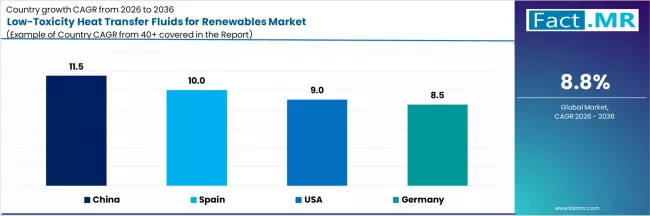
| Country | CAGR (2026-2036) |
|---|---|
| China | 11.50% |
| Spain | 10.00% |
| USA | 9.00% |
| Germany | 8.50% |
| Chile | 9.50% |
How does China's Leadership in CSP and Industrial Decarbonization Drive Market Growth?
China leads with an 11.50% CAGR, driven by its ambitious deployment of CSP with thermal storage as part of its renewable energy and carbon neutrality goals. Domestic manufacturing of solar thermal components and a push for technological self-sufficiency are spurring local development and adoption of high-temperature HTFs. Large-scale district heating projects utilizing solar thermal also contribute to significant demand for reliable, non-toxic glycol and water-based systems.
Why is Spain's Established CSP Fleet and Retrofitting Focus a Key Driver?
Spain's 10.00% growth is anchored in its world-leading base of operational CSP plants. As these plants age, the need to replace original, often more hazardous HTFs during maintenance or performance upgrades creates a substantial retrofit market. Spanish engineering expertise and a supportive regulatory environment for thermal renewables make it a critical testing ground for next-generation, low-toxicity fluid technologies aiming to extend plant life and improve safety.
What Role does the USA's Diverse Renewable Thermal Landscape and R&D Play?
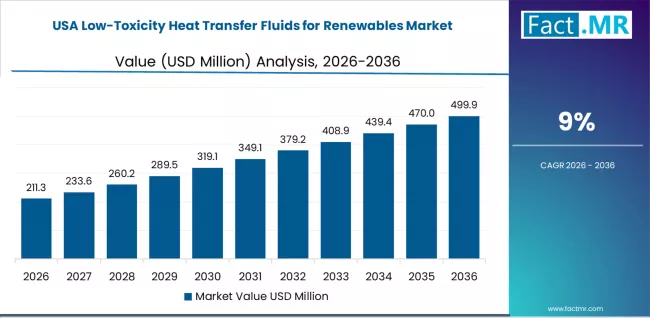
The USA's 9.00% growth is sustained by a mix of pioneering CSP projects in the Southwest, a growing geothermal sector, and extensive solar process heat applications in industry. Strong national laboratory support (NREL, Sandia) for thermal energy R&D and stringent environmental regulations in states like California drive innovation and adoption of advanced fluids. The market demands fluids that meet both high-performance specs and rigorous environmental compliance standards.
How does Germany's Engineering for District Heating and Industrial Efficiency Influence the Market?
Germany's 8.50% growth reflects its focus on Energiewende (energy transition) through large-scale solar thermal integration into district heating networks and industrial process heat. The emphasis on system efficiency, safety in populated areas, and long-term reliability creates premium demand for high-quality, non-toxic, and non-flammable silicone or glycol-based fluids for medium-temperature applications.
What Factors Underpin Chile's CSP Expansion in Environmentally Sensitive Areas?
Chile's 9.50% growth is motivated by its massive CSP development in the Atacama Desert, one of the world's driest and most ecologically sensitive regions. The extreme environmental scrutiny on these projects mandates the use of HTFs with the lowest possible ecological impact in case of leakage. This makes Chile a key market for the most advanced, readily biodegradable, and high-stability fluid chemistries, setting a benchmark for environmental stewardship in CSP.
Competitive Landscape of the Low-Toxicity Heat Transfer Fluids for Renewables Market
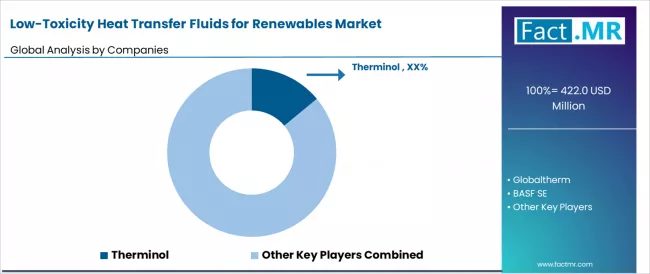
The competitive landscape is characterized by competition between specialized thermal fluid manufacturers and diversified chemical conglomerates. Dedicated heat transfer fluid companies like Therminol (Eastman) and Globaltherm compete with deep expertise in formulation for extreme temperatures and long fluid life, offering extensive technical support and fluid analysis services.
Chemical giants like BASF SE and Eastman Chemical Company leverage their broad petrochemical and advanced materials portfolios to develop synthetic and bio-based fluid platforms. Competition intensifies around securing approvals and partnership agreements with major CSP plant developers, turbine OEMs, and solar thermal system integrators, providing comprehensive lifecycle support including fluid recycling and disposal services.
Key Players in the Low-Toxicity Heat Transfer Fluids for Renewables Market
- Therminol
- Globaltherm
- BASF SE
- Eastman Chemical Company
Scope of Report
| Items | Values |
|---|---|
| Quantitative Units | USD Million |
| Fluid Chemistry | Bio-based synthetic esters & glycols, Low-toxicity silicone HTFs, Low-toxicity mineral-oil replacements, Ionic-liquid & deep eutectic solvent HTFs, Water-based heat transfer, PCM-enhanced fluids |
| Renewable Application | CSP & thermal storage, Solar process heat & district heating, Geothermal loops, Biomass & bioenergy systems, Hybrid systems & heat recovery |
| Commercial Model | OEM & system-integrator spec fluids, Independent fluid suppliers, On-site blending & reclaim services |
| Key Countries | China, Spain, USA, Germany, Chile |
| Key Companies | Therminol, Globaltherm, BASF SE, Eastman Chemical Company |
| Additional Analysis | Analysis of thermal stability & decomposition rates, corrosion inhibition compatibility, freeze protection efficacy, pumpability at low temperatures, environmental fate & toxicity testing data, and total cost of ownership over a 20-year project life. |
Low-Toxicity Heat Transfer Fluids for Renewables Market by Segments
-
Fluid Chemistry :
- Bio-based synthetic esters & glycols
- Low-toxicity silicone HTFs (food-grade silicones)
- Low-toxicity mineral-oil replacements (solvent-refined blends)
- Ionic-liquid & deep eutectic solvent HTFs (specialty)
- Water-based heat transfer (antifreeze blends, high-temp glycols)
- PCM-enhanced low-toxicity fluids
-
Renewable Application :
- Concentrated Solar Power (CSP) & thermal storage
- Solar process heat & district heating systems
- Geothermal heat transfer loops
- Biomass & bioenergy thermal systems
- Hybrid renewable systems and industrial heat recovery
-
Commercial Model :
- OEM & system-integrator spec fluids (bundled with equipment)
- Independent fluid suppliers & chemical houses
- On-site blending & reclaim service providers
-
Region :
-
North America
- USA
- Canada
-
Latin America
- Chile
- Mexico
- Brazil
- Rest of Latin America
-
Western Europe
- Spain
- Germany
- UK
- Italy
- France
- BENELUX
- Rest of Western Europe
-
Eastern Europe
- Russia
- Poland
- Czech Republic
- Rest of Eastern Europe
-
East Asia
- China
- Japan
- South Korea
- Rest of East Asia
-
South Asia & Pacific
- India
- Australia
- ASEAN
- Rest of South Asia & Pacific
-
MEA
- Saudi Arabia
- UAE
- South Africa
- Turkiye
- Rest of MEA
-
Table of Content
- Executive Summary
- Global Market Outlook
- Demand to side Trends
- Supply to side Trends
- Technology Roadmap Analysis
- Analysis and Recommendations
- Market Overview
- Market Coverage / Taxonomy
- Market Definition / Scope / Limitations
- Market Background
- Market Dynamics
- Drivers
- Restraints
- Opportunity
- Trends
- Scenario Forecast
- Demand in Optimistic Scenario
- Demand in Likely Scenario
- Demand in Conservative Scenario
- Opportunity Map Analysis
- Product Life Cycle Analysis
- Supply Chain Analysis
- Investment Feasibility Matrix
- Value Chain Analysis
- PESTLE and Porter’s Analysis
- Regulatory Landscape
- Regional Parent Market Outlook
- Production and Consumption Statistics
- Import and Export Statistics
- Market Dynamics
- Global Market Analysis 2021 to 2025 and Forecast, 2026 to 2036
- Historical Market Size Value (USD Million) Analysis, 2021 to 2025
- Current and Future Market Size Value (USD Million) Projections, 2026 to 2036
- Y to o to Y Growth Trend Analysis
- Absolute $ Opportunity Analysis
- Global Market Pricing Analysis 2021 to 2025 and Forecast 2026 to 2036
- Global Market Analysis 2021 to 2025 and Forecast 2026 to 2036, By Fluid Chemistry
- Introduction / Key Findings
- Historical Market Size Value (USD Million) Analysis By Fluid Chemistry, 2021 to 2025
- Current and Future Market Size Value (USD Million) Analysis and Forecast By Fluid Chemistry, 2026 to 2036
- Bio-based synthetic esters & glycols
- Low-toxicity silicone HTFs (food-grade silicones)
- Low-toxicity mineral-oil replacements (solvent-refined blends)
- Ionic-liquid & deep eutectic solvent HTFs (specialty)
- Water-based heat transfer (antifreeze blends, high-temp glycols)
- PCM-enhanced low-toxicity fluids
- Bio-based synthetic esters & glycols
- Y to o to Y Growth Trend Analysis By Fluid Chemistry, 2021 to 2025
- Absolute $ Opportunity Analysis By Fluid Chemistry, 2026 to 2036
- Global Market Analysis 2021 to 2025 and Forecast 2026 to 2036, By Renewable Application
- Introduction / Key Findings
- Historical Market Size Value (USD Million) Analysis By Renewable Application, 2021 to 2025
- Current and Future Market Size Value (USD Million) Analysis and Forecast By Renewable Application, 2026 to 2036
- Concentrated Solar Power (CSP) & thermal storage
- Solar process heat & district heating systems
- Geothermal heat transfer loops
- Biomass & bioenergy thermal systems
- Hybrid renewable systems and industrial heat recovery
- Concentrated Solar Power (CSP) & thermal storage
- Y to o to Y Growth Trend Analysis By Renewable Application, 2021 to 2025
- Absolute $ Opportunity Analysis By Renewable Application, 2026 to 2036
- Global Market Analysis 2021 to 2025 and Forecast 2026 to 2036, By Commercial Model
- Introduction / Key Findings
- Historical Market Size Value (USD Million) Analysis By Commercial Model, 2021 to 2025
- Current and Future Market Size Value (USD Million) Analysis and Forecast By Commercial Model, 2026 to 2036
- OEM system-integrator spec fluids (bundled with equipment)
- Independent fluid suppliers chemical houses
- On-site blending & reclaim service providers
- OEM system-integrator spec fluids (bundled with equipment)
- Y to o to Y Growth Trend Analysis By Commercial Model, 2021 to 2025
- Absolute $ Opportunity Analysis By Commercial Model, 2026 to 2036
- Global Market Analysis 2021 to 2025 and Forecast 2026 to 2036, By Region
- Introduction
- Historical Market Size Value (USD Million) Analysis By Region, 2021 to 2025
- Current Market Size Value (USD Million) Analysis and Forecast By Region, 2026 to 2036
- North America
- Latin America
- Western Europe
- Eastern Europe
- East Asia
- South Asia and Pacific
- Middle East & Africa
- Market Attractiveness Analysis By Region
- North America Market Analysis 2021 to 2025 and Forecast 2026 to 2036, By Country
- Historical Market Size Value (USD Million) Trend Analysis By Market Taxonomy, 2021 to 2025
- Market Size Value (USD Million) Forecast By Market Taxonomy, 2026 to 2036
- By Country
- USA
- Canada
- Mexico
- By Fluid Chemistry
- By Renewable Application
- By Commercial Model
- By Country
- Market Attractiveness Analysis
- By Country
- By Fluid Chemistry
- By Renewable Application
- By Commercial Model
- Key Takeaways
- Latin America Market Analysis 2021 to 2025 and Forecast 2026 to 2036, By Country
- Historical Market Size Value (USD Million) Trend Analysis By Market Taxonomy, 2021 to 2025
- Market Size Value (USD Million) Forecast By Market Taxonomy, 2026 to 2036
- By Country
- Brazil
- Chile
- Rest of Latin America
- By Fluid Chemistry
- By Renewable Application
- By Commercial Model
- By Country
- Market Attractiveness Analysis
- By Country
- By Fluid Chemistry
- By Renewable Application
- By Commercial Model
- Key Takeaways
- Western Europe Market Analysis 2021 to 2025 and Forecast 2026 to 2036, By Country
- Historical Market Size Value (USD Million) Trend Analysis By Market Taxonomy, 2021 to 2025
- Market Size Value (USD Million) Forecast By Market Taxonomy, 2026 to 2036
- By Country
- Germany
- UK
- Italy
- Spain
- France
- Nordic
- BENELUX
- Rest of Western Europe
- By Fluid Chemistry
- By Renewable Application
- By Commercial Model
- By Country
- Market Attractiveness Analysis
- By Country
- By Fluid Chemistry
- By Renewable Application
- By Commercial Model
- Key Takeaways
- Eastern Europe Market Analysis 2021 to 2025 and Forecast 2026 to 2036, By Country
- Historical Market Size Value (USD Million) Trend Analysis By Market Taxonomy, 2021 to 2025
- Market Size Value (USD Million) Forecast By Market Taxonomy, 2026 to 2036
- By Country
- Russia
- Poland
- Hungary
- Balkan & Baltic
- Rest of Eastern Europe
- By Fluid Chemistry
- By Renewable Application
- By Commercial Model
- By Country
- Market Attractiveness Analysis
- By Country
- By Fluid Chemistry
- By Renewable Application
- By Commercial Model
- Key Takeaways
- East Asia Market Analysis 2021 to 2025 and Forecast 2026 to 2036, By Country
- Historical Market Size Value (USD Million) Trend Analysis By Market Taxonomy, 2021 to 2025
- Market Size Value (USD Million) Forecast By Market Taxonomy, 2026 to 2036
- By Country
- China
- Japan
- South Korea
- By Fluid Chemistry
- By Renewable Application
- By Commercial Model
- By Country
- Market Attractiveness Analysis
- By Country
- By Fluid Chemistry
- By Renewable Application
- By Commercial Model
- Key Takeaways
- South Asia and Pacific Market Analysis 2021 to 2025 and Forecast 2026 to 2036, By Country
- Historical Market Size Value (USD Million) Trend Analysis By Market Taxonomy, 2021 to 2025
- Market Size Value (USD Million) Forecast By Market Taxonomy, 2026 to 2036
- By Country
- India
- ASEAN
- Australia & New Zealand
- Rest of South Asia and Pacific
- By Fluid Chemistry
- By Renewable Application
- By Commercial Model
- By Country
- Market Attractiveness Analysis
- By Country
- By Fluid Chemistry
- By Renewable Application
- By Commercial Model
- Key Takeaways
- Middle East & Africa Market Analysis 2021 to 2025 and Forecast 2026 to 2036, By Country
- Historical Market Size Value (USD Million) Trend Analysis By Market Taxonomy, 2021 to 2025
- Market Size Value (USD Million) Forecast By Market Taxonomy, 2026 to 2036
- By Country
- Kingdom of Saudi Arabia
- Other GCC Countries
- Turkiye
- South Africa
- Other African Union
- Rest of Middle East & Africa
- By Fluid Chemistry
- By Renewable Application
- By Commercial Model
- By Country
- Market Attractiveness Analysis
- By Country
- By Fluid Chemistry
- By Renewable Application
- By Commercial Model
- Key Takeaways
- Key Countries Market Analysis
- USA
- Pricing Analysis
- Market Share Analysis, 2025
- By Fluid Chemistry
- By Renewable Application
- By Commercial Model
- Canada
- Pricing Analysis
- Market Share Analysis, 2025
- By Fluid Chemistry
- By Renewable Application
- By Commercial Model
- Mexico
- Pricing Analysis
- Market Share Analysis, 2025
- By Fluid Chemistry
- By Renewable Application
- By Commercial Model
- Brazil
- Pricing Analysis
- Market Share Analysis, 2025
- By Fluid Chemistry
- By Renewable Application
- By Commercial Model
- Chile
- Pricing Analysis
- Market Share Analysis, 2025
- By Fluid Chemistry
- By Renewable Application
- By Commercial Model
- Germany
- Pricing Analysis
- Market Share Analysis, 2025
- By Fluid Chemistry
- By Renewable Application
- By Commercial Model
- UK
- Pricing Analysis
- Market Share Analysis, 2025
- By Fluid Chemistry
- By Renewable Application
- By Commercial Model
- Italy
- Pricing Analysis
- Market Share Analysis, 2025
- By Fluid Chemistry
- By Renewable Application
- By Commercial Model
- Spain
- Pricing Analysis
- Market Share Analysis, 2025
- By Fluid Chemistry
- By Renewable Application
- By Commercial Model
- France
- Pricing Analysis
- Market Share Analysis, 2025
- By Fluid Chemistry
- By Renewable Application
- By Commercial Model
- India
- Pricing Analysis
- Market Share Analysis, 2025
- By Fluid Chemistry
- By Renewable Application
- By Commercial Model
- ASEAN
- Pricing Analysis
- Market Share Analysis, 2025
- By Fluid Chemistry
- By Renewable Application
- By Commercial Model
- Australia & New Zealand
- Pricing Analysis
- Market Share Analysis, 2025
- By Fluid Chemistry
- By Renewable Application
- By Commercial Model
- China
- Pricing Analysis
- Market Share Analysis, 2025
- By Fluid Chemistry
- By Renewable Application
- By Commercial Model
- Japan
- Pricing Analysis
- Market Share Analysis, 2025
- By Fluid Chemistry
- By Renewable Application
- By Commercial Model
- South Korea
- Pricing Analysis
- Market Share Analysis, 2025
- By Fluid Chemistry
- By Renewable Application
- By Commercial Model
- Russia
- Pricing Analysis
- Market Share Analysis, 2025
- By Fluid Chemistry
- By Renewable Application
- By Commercial Model
- Poland
- Pricing Analysis
- Market Share Analysis, 2025
- By Fluid Chemistry
- By Renewable Application
- By Commercial Model
- Hungary
- Pricing Analysis
- Market Share Analysis, 2025
- By Fluid Chemistry
- By Renewable Application
- By Commercial Model
- Kingdom of Saudi Arabia
- Pricing Analysis
- Market Share Analysis, 2025
- By Fluid Chemistry
- By Renewable Application
- By Commercial Model
- Turkiye
- Pricing Analysis
- Market Share Analysis, 2025
- By Fluid Chemistry
- By Renewable Application
- By Commercial Model
- South Africa
- Pricing Analysis
- Market Share Analysis, 2025
- By Fluid Chemistry
- By Renewable Application
- By Commercial Model
- USA
- Market Structure Analysis
- Competition Dashboard
- Competition Benchmarking
- Market Share Analysis of Top Players
- By Regional
- By Fluid Chemistry
- By Renewable Application
- By Commercial Model
- Competition Analysis
- Competition Deep Dive
- Therminol
- Overview
- Product Portfolio
- Profitability by Market Segments (Product/Age /Sales Channel/Region)
- Sales Footprint
- Strategy Overview
- Marketing Strategy
- Product Strategy
- Channel Strategy
- Globaltherm
- BASF SE
- Eastman Chemical Company
- Therminol
- Competition Deep Dive
- Assumptions & Acronyms Used
- Research Methodology
List Of Table
- Table 1: Global Market Value (USD Million) Forecast by Region, 2021 to 2036
- Table 2: Global Market Value (USD Million) Forecast by Fluid Chemistry, 2021 to 2036
- Table 3: Global Market Value (USD Million) Forecast by Renewable Application, 2021 to 2036
- Table 4: Global Market Value (USD Million) Forecast by Commercial Model, 2021 to 2036
- Table 5: North America Market Value (USD Million) Forecast by Country, 2021 to 2036
- Table 6: North America Market Value (USD Million) Forecast by Fluid Chemistry, 2021 to 2036
- Table 7: North America Market Value (USD Million) Forecast by Renewable Application, 2021 to 2036
- Table 8: North America Market Value (USD Million) Forecast by Commercial Model, 2021 to 2036
- Table 9: Latin America Market Value (USD Million) Forecast by Country, 2021 to 2036
- Table 10: Latin America Market Value (USD Million) Forecast by Fluid Chemistry, 2021 to 2036
- Table 11: Latin America Market Value (USD Million) Forecast by Renewable Application, 2021 to 2036
- Table 12: Latin America Market Value (USD Million) Forecast by Commercial Model, 2021 to 2036
- Table 13: Western Europe Market Value (USD Million) Forecast by Country, 2021 to 2036
- Table 14: Western Europe Market Value (USD Million) Forecast by Fluid Chemistry, 2021 to 2036
- Table 15: Western Europe Market Value (USD Million) Forecast by Renewable Application, 2021 to 2036
- Table 16: Western Europe Market Value (USD Million) Forecast by Commercial Model, 2021 to 2036
- Table 17: Eastern Europe Market Value (USD Million) Forecast by Country, 2021 to 2036
- Table 18: Eastern Europe Market Value (USD Million) Forecast by Fluid Chemistry, 2021 to 2036
- Table 19: Eastern Europe Market Value (USD Million) Forecast by Renewable Application, 2021 to 2036
- Table 20: Eastern Europe Market Value (USD Million) Forecast by Commercial Model, 2021 to 2036
- Table 21: East Asia Market Value (USD Million) Forecast by Country, 2021 to 2036
- Table 22: East Asia Market Value (USD Million) Forecast by Fluid Chemistry, 2021 to 2036
- Table 23: East Asia Market Value (USD Million) Forecast by Renewable Application, 2021 to 2036
- Table 24: East Asia Market Value (USD Million) Forecast by Commercial Model, 2021 to 2036
- Table 25: South Asia and Pacific Market Value (USD Million) Forecast by Country, 2021 to 2036
- Table 26: South Asia and Pacific Market Value (USD Million) Forecast by Fluid Chemistry, 2021 to 2036
- Table 27: South Asia and Pacific Market Value (USD Million) Forecast by Renewable Application, 2021 to 2036
- Table 28: South Asia and Pacific Market Value (USD Million) Forecast by Commercial Model, 2021 to 2036
- Table 29: Middle East & Africa Market Value (USD Million) Forecast by Country, 2021 to 2036
- Table 30: Middle East & Africa Market Value (USD Million) Forecast by Fluid Chemistry, 2021 to 2036
- Table 31: Middle East & Africa Market Value (USD Million) Forecast by Renewable Application, 2021 to 2036
- Table 32: Middle East & Africa Market Value (USD Million) Forecast by Commercial Model, 2021 to 2036
List Of Figures
- Figure 1: Global Market Pricing Analysis
- Figure 2: Global Market Value (USD Million) Forecast 2021 to 2036
- Figure 3: Global Market Value Share and BPS Analysis by Fluid Chemistry, 2026 and 2036
- Figure 4: Global Market Y to o to Y Growth Comparison by Fluid Chemistry, 2026 to 2036
- Figure 5: Global Market Attractiveness Analysis by Fluid Chemistry
- Figure 6: Global Market Value Share and BPS Analysis by Renewable Application, 2026 and 2036
- Figure 7: Global Market Y to o to Y Growth Comparison by Renewable Application, 2026 to 2036
- Figure 8: Global Market Attractiveness Analysis by Renewable Application
- Figure 9: Global Market Value Share and BPS Analysis by Commercial Model, 2026 and 2036
- Figure 10: Global Market Y to o to Y Growth Comparison by Commercial Model, 2026 to 2036
- Figure 11: Global Market Attractiveness Analysis by Commercial Model
- Figure 12: Global Market Value (USD Million) Share and BPS Analysis by Region, 2026 and 2036
- Figure 13: Global Market Y to o to Y Growth Comparison by Region, 2026 to 2036
- Figure 14: Global Market Attractiveness Analysis by Region
- Figure 15: North America Market Incremental Dollar Opportunity, 2026 to 2036
- Figure 16: Latin America Market Incremental Dollar Opportunity, 2026 to 2036
- Figure 17: Western Europe Market Incremental Dollar Opportunity, 2026 to 2036
- Figure 18: Eastern Europe Market Incremental Dollar Opportunity, 2026 to 2036
- Figure 19: East Asia Market Incremental Dollar Opportunity, 2026 to 2036
- Figure 20: South Asia and Pacific Market Incremental Dollar Opportunity, 2026 to 2036
- Figure 21: Middle East & Africa Market Incremental Dollar Opportunity, 2026 to 2036
- Figure 22: North America Market Value Share and BPS Analysis by Country, 2026 and 2036
- Figure 23: North America Market Value Share and BPS Analysis by Fluid Chemistry, 2026 and 2036
- Figure 24: North America Market Y to o to Y Growth Comparison by Fluid Chemistry, 2026 to 2036
- Figure 25: North America Market Attractiveness Analysis by Fluid Chemistry
- Figure 26: North America Market Value Share and BPS Analysis by Renewable Application, 2026 and 2036
- Figure 27: North America Market Y to o to Y Growth Comparison by Renewable Application, 2026 to 2036
- Figure 28: North America Market Attractiveness Analysis by Renewable Application
- Figure 29: North America Market Value Share and BPS Analysis by Commercial Model, 2026 and 2036
- Figure 30: North America Market Y to o to Y Growth Comparison by Commercial Model, 2026 to 2036
- Figure 31: North America Market Attractiveness Analysis by Commercial Model
- Figure 32: Latin America Market Value Share and BPS Analysis by Country, 2026 and 2036
- Figure 33: Latin America Market Value Share and BPS Analysis by Fluid Chemistry, 2026 and 2036
- Figure 34: Latin America Market Y to o to Y Growth Comparison by Fluid Chemistry, 2026 to 2036
- Figure 35: Latin America Market Attractiveness Analysis by Fluid Chemistry
- Figure 36: Latin America Market Value Share and BPS Analysis by Renewable Application, 2026 and 2036
- Figure 37: Latin America Market Y to o to Y Growth Comparison by Renewable Application, 2026 to 2036
- Figure 38: Latin America Market Attractiveness Analysis by Renewable Application
- Figure 39: Latin America Market Value Share and BPS Analysis by Commercial Model, 2026 and 2036
- Figure 40: Latin America Market Y to o to Y Growth Comparison by Commercial Model, 2026 to 2036
- Figure 41: Latin America Market Attractiveness Analysis by Commercial Model
- Figure 42: Western Europe Market Value Share and BPS Analysis by Country, 2026 and 2036
- Figure 43: Western Europe Market Value Share and BPS Analysis by Fluid Chemistry, 2026 and 2036
- Figure 44: Western Europe Market Y to o to Y Growth Comparison by Fluid Chemistry, 2026 to 2036
- Figure 45: Western Europe Market Attractiveness Analysis by Fluid Chemistry
- Figure 46: Western Europe Market Value Share and BPS Analysis by Renewable Application, 2026 and 2036
- Figure 47: Western Europe Market Y to o to Y Growth Comparison by Renewable Application, 2026 to 2036
- Figure 48: Western Europe Market Attractiveness Analysis by Renewable Application
- Figure 49: Western Europe Market Value Share and BPS Analysis by Commercial Model, 2026 and 2036
- Figure 50: Western Europe Market Y to o to Y Growth Comparison by Commercial Model, 2026 to 2036
- Figure 51: Western Europe Market Attractiveness Analysis by Commercial Model
- Figure 52: Eastern Europe Market Value Share and BPS Analysis by Country, 2026 and 2036
- Figure 53: Eastern Europe Market Value Share and BPS Analysis by Fluid Chemistry, 2026 and 2036
- Figure 54: Eastern Europe Market Y to o to Y Growth Comparison by Fluid Chemistry, 2026 to 2036
- Figure 55: Eastern Europe Market Attractiveness Analysis by Fluid Chemistry
- Figure 56: Eastern Europe Market Value Share and BPS Analysis by Renewable Application, 2026 and 2036
- Figure 57: Eastern Europe Market Y to o to Y Growth Comparison by Renewable Application, 2026 to 2036
- Figure 58: Eastern Europe Market Attractiveness Analysis by Renewable Application
- Figure 59: Eastern Europe Market Value Share and BPS Analysis by Commercial Model, 2026 and 2036
- Figure 60: Eastern Europe Market Y to o to Y Growth Comparison by Commercial Model, 2026 to 2036
- Figure 61: Eastern Europe Market Attractiveness Analysis by Commercial Model
- Figure 62: East Asia Market Value Share and BPS Analysis by Country, 2026 and 2036
- Figure 63: East Asia Market Value Share and BPS Analysis by Fluid Chemistry, 2026 and 2036
- Figure 64: East Asia Market Y to o to Y Growth Comparison by Fluid Chemistry, 2026 to 2036
- Figure 65: East Asia Market Attractiveness Analysis by Fluid Chemistry
- Figure 66: East Asia Market Value Share and BPS Analysis by Renewable Application, 2026 and 2036
- Figure 67: East Asia Market Y to o to Y Growth Comparison by Renewable Application, 2026 to 2036
- Figure 68: East Asia Market Attractiveness Analysis by Renewable Application
- Figure 69: East Asia Market Value Share and BPS Analysis by Commercial Model, 2026 and 2036
- Figure 70: East Asia Market Y to o to Y Growth Comparison by Commercial Model, 2026 to 2036
- Figure 71: East Asia Market Attractiveness Analysis by Commercial Model
- Figure 72: South Asia and Pacific Market Value Share and BPS Analysis by Country, 2026 and 2036
- Figure 73: South Asia and Pacific Market Value Share and BPS Analysis by Fluid Chemistry, 2026 and 2036
- Figure 74: South Asia and Pacific Market Y to o to Y Growth Comparison by Fluid Chemistry, 2026 to 2036
- Figure 75: South Asia and Pacific Market Attractiveness Analysis by Fluid Chemistry
- Figure 76: South Asia and Pacific Market Value Share and BPS Analysis by Renewable Application, 2026 and 2036
- Figure 77: South Asia and Pacific Market Y to o to Y Growth Comparison by Renewable Application, 2026 to 2036
- Figure 78: South Asia and Pacific Market Attractiveness Analysis by Renewable Application
- Figure 79: South Asia and Pacific Market Value Share and BPS Analysis by Commercial Model, 2026 and 2036
- Figure 80: South Asia and Pacific Market Y to o to Y Growth Comparison by Commercial Model, 2026 to 2036
- Figure 81: South Asia and Pacific Market Attractiveness Analysis by Commercial Model
- Figure 82: Middle East & Africa Market Value Share and BPS Analysis by Country, 2026 and 2036
- Figure 83: Middle East & Africa Market Value Share and BPS Analysis by Fluid Chemistry, 2026 and 2036
- Figure 84: Middle East & Africa Market Y to o to Y Growth Comparison by Fluid Chemistry, 2026 to 2036
- Figure 85: Middle East & Africa Market Attractiveness Analysis by Fluid Chemistry
- Figure 86: Middle East & Africa Market Value Share and BPS Analysis by Renewable Application, 2026 and 2036
- Figure 87: Middle East & Africa Market Y to o to Y Growth Comparison by Renewable Application, 2026 to 2036
- Figure 88: Middle East & Africa Market Attractiveness Analysis by Renewable Application
- Figure 89: Middle East & Africa Market Value Share and BPS Analysis by Commercial Model, 2026 and 2036
- Figure 90: Middle East & Africa Market Y to o to Y Growth Comparison by Commercial Model, 2026 to 2036
- Figure 91: Middle East & Africa Market Attractiveness Analysis by Commercial Model
- Figure 92: Global Market - Tier Structure Analysis
- Figure 93: Global Market - Company Share Analysis
- FAQs -
How big is the low-toxicity heat transfer fluids for renewables market in 2026?
The global low-toxicity heat transfer fluids for renewables market is estimated to be valued at USD 422.0 million in 2026.
What will be the size of low-toxicity heat transfer fluids for renewables market in 2036?
The market size for the low-toxicity heat transfer fluids for renewables market is projected to reach USD 980.8 million by 2036.
How much will be the low-toxicity heat transfer fluids for renewables market growth between 2026 and 2036?
The low-toxicity heat transfer fluids for renewables market is expected to grow at a 8.8% CAGR between 2026 and 2036.
What are the key product types in the low-toxicity heat transfer fluids for renewables market?
The key product types in low-toxicity heat transfer fluids for renewables market are bio-based synthetic esters & glycols, low-toxicity silicone htfs (food-grade silicones), low-toxicity mineral-oil replacements (solvent-refined blends), ionic-liquid & deep eutectic solvent htfs (specialty), water-based heat transfer (antifreeze blends, high-temp glycols) and pcm-enhanced low-toxicity fluids.
Which renewable application segment to contribute significant share in the low-toxicity heat transfer fluids for renewables market in 2026?
In terms of renewable application, concentrated solar power (csp) & thermal storage segment to command 34.0% share in the low-toxicity heat transfer fluids for renewables market in 2026.