- Estimated Value(2026): 12.1 Bn
- Forecast Value (2036): 27.4 Bn
- CAGR (2026 - 2036): 8.4%
Stem Cell Therapy Market Forecast and Outlook 2026 to 2036
In 2025, the stem cell therapy market surpassed a valuation of USD 11.2 billion. Based on Fact.MR analysis, demand for stem cell therapy products and services is estimated to grow to USD 12.1 billion in 2026 and USD 27.4 billion by 2036. Fact.MR projects a CAGR of 8.4% during the forecast period.
The stem cell therapy market is expected to create an absolute dollar opportunity of about USD 15.3 billion between 2026 and 2036. Market growth is fueled by increasing regulatory approvals for cell-based therapies, expanding clinical trial pipelines across cardiovascular, orthopaedic, and neurological indications, and growing adoption of iPSC-derived cell therapies supported by government-funded regenerative medicine programmes. Market expansion is moderated by high manufacturing costs for autologous therapies, complex regulatory pathways requiring extensive clinical evidence, and reimbursement coverage gaps in emerging markets.
Edward Lanphier, CEO of Fate Therapeutics said, "I am extremely proud of the progress the Fate team delivered in 2025, including bringing to fruition the treatment of FT819 off-the-shelf CAR T cells as outpatient therapy, eliminating the need for extended hospital stay requirements seen today... which now uniquely expands autoimmune [access]."
Country growth reflects regulatory approval pace, government funding commitments, and clinical infrastructure maturity. The United States leads at 9.8% CAGR driven by FDA Regenerative Medicine Advanced Therapy designation approvals and large private biotech investment. Germany follows at 9.1% supported by Hospital Exemption pathway utilization and EU Advanced Therapy Medicinal Product regulation enforcement. Japan posts 8.7% through its Sakigake Priority Review designation and Act on the Safety of Regenerative Medicine framework. China registers 8.0% on national cell therapy guideline expansion and state-backed clinical programmes. South Korea advances at 7.8% through MFDS conditional approval frameworks and domestic biotech investment in allogeneic MSC platforms.
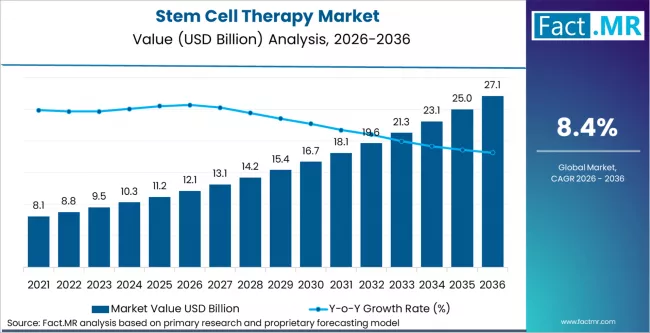
Stem Cell Therapy Market Market Value Analysis | Source: Fact.MR
| Metric | Value |
|---|---|
| Estimated Value in 2026 | USD 12.1 billion |
| Forecast Value in 2036 | USD 27.4 billion |
| Forecast CAGR (2026 to 2036) | 8.4% |
Source: Fact.MR analysis. Updated Mar 9, 2026
Market Definition
The stem cell therapy market includes therapies, research tools, and services using stem cells to repair or replace damaged tissues. It covers mesenchymal, hematopoietic, embryonic, induced pluripotent, and neural stem cells. Applications span regenerative medicine, drug discovery, and disease research across hospitals, research institutes, and biotech companies.
Market Inclusions
Includes global and regional forecasts from 2026 to 2036 by cell type, application, and end user. Covers approved therapies, clinical stage products, contract manufacturing services, and research stem cell products. Also includes pricing trends, regulatory approvals, government funding, and manufacturing technology adoption.
Market Exclusions
Excludes gene therapies without stem cells, CAR T therapies without stem cell origin, monoclonal antibodies, and non-cellular regenerative devices. Diagnostic stem cell uses and veterinary applications are excluded unless linked to human therapy development.
Research Methodology
- Primary Research: Interviews with clinical investigators, hospital procurement teams, biotech R&D leaders, CDMO executives, and regulatory advisors across North America, Europe, and Asia Pacific.
- Desk Research: Sources included FDA RMAT records, EMA ATMP opinions, Japan PMDA Sakigake approvals, government funding disclosures, company presentations, and clinical trial databases from 2024 and 2025.
- Market Sizing and Forecasting: A hybrid model combined clinical pipeline estimates with therapy pricing by cell type and indication. Regulatory timelines and manufacturing cost data informed forecasts.
- Data Validation and Update Cycle: Results validated using company revenues, regulatory approvals, clinical trial records, and funding announcements with annual forecast updates.
Summary of Stem Cell Therapy Market
- Market Definition
- Stem cell therapy includes treatment and research uses of mesenchymal, hematopoietic, embryonic, iPSC, and neural stem cells across hospitals, research centres, and biotech companies.
- Demand Drivers
- Faster regulatory approvals in the US and Europe are accelerating commercial launch of stem cell therapies.
- Japan’s regenerative medicine framework and Sakigake pathway support faster therapy approvals and attract biotech investment.
- Government funding programmes in the US and EU are supporting cell therapy research and manufacturing expansion.
- Key Segments Analyzed
- By Cell Type: Mesenchymal Stem Cells hold about 47% share in 2026 due to wider clinical applications and established manufacturing.
- By Application: Regenerative Medicine leads with about 62% share driven by cardiovascular, orthopaedic, and neurological therapies.
- By End User: Hospitals and clinics hold the largest share as approved therapies must be administered in regulated clinical settings.
- By Geography: Asia Pacific leads, contributing the highest expansion rates.
- Analyst Opinion at FACT.MR
- Shambhu Nath Jha, Principal Consultant at Fact.MR opines, “CXOs will find this report useful as regulatory approval acceleration, allogeneic manufacturing scale up, and expanding reimbursement coverage in the United States, Japan, and Germany are transforming stem cell therapy into a commercial market.
- Strategic Implications
- Developers should focus on allogeneic MSC and iPSC therapies which enable scalable off the shelf treatments.
- CDMOs should expand GMP compliant manufacturing facilities to meet future commercial demand.
- Companies should engage early with FDA RMAT, EMA ATMP, and PMDA Sakigake programmes to accelerate approvals.
- Methodology
- Market sizing combined therapy pipeline estimates with pricing data by cell type and indication.
- Regulatory timelines, funding programmes, and CDMO pricing trends were analysed using global regulatory databases.
- Regional forecasts used clinical trial data, national funding programmes, reimbursement expansion, and expert interviews.
Segmental Analysis
Stem Cell Therapy Market Analysis by Cell Type
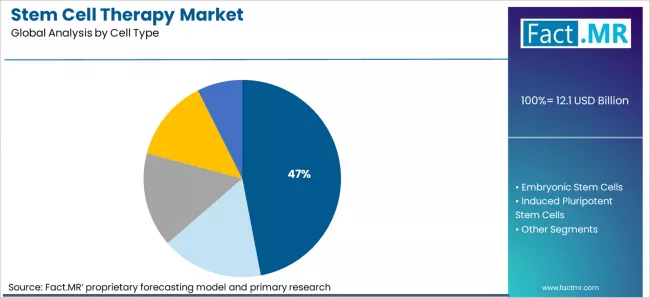
Stem Cell Therapy Market Analysis By Cell Type | Source: Fact.MR
Based on FACT.MR's stem cell therapy market report, Mesenchymal Stem Cells are estimated to hold about 47% share in 2026. MSCs lead due to wider approved products, multiple clinical uses, and established GMP manufacturing supporting large scale production.
- Mesoblast Pipeline Advancement: In early 2025, Mesoblast received FDA acceptance of its BLA for remestemcel L targeting steroid refractory acute GvHD in paediatric patients, strengthening the commercial pathway for allogeneic MSC therapies. [1]
- JCR Pharmaceuticals MSC Expansion: In 2024, JCR Pharmaceuticals reported rising sales of TEMCELL HS Inj. for acute GvHD in Japan supported by national reimbursement coverage. The company also plans to expand TEMCELL into new indications. [2]
- Allogeneic Manufacturing Scale Up Trend: In 2024, Lonza expanded cGMP MSC manufacturing capacity at its Houston facility to support commercial production for multiple cell therapy developers. [3]
Stem Cell Therapy Market Analysis by Application
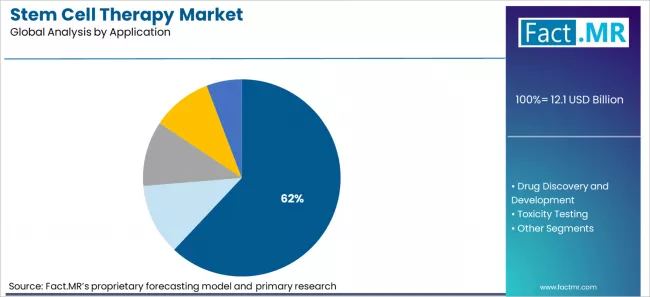
Stem Cell Therapy Market Analysis By Application | Source: Fact.MR
Based on FACT.MR's stem cell therapy market report, Regenerative Medicine is estimated to hold about 62% share in 2026. The segment leads due to high value therapies for cardiovascular, orthopaedic, and neurological diseases where treatment alternatives are limited.
- Bio Cardia Cardiovascular Programme: In 2024, Bio Cardia continued enrolment for its CardiAMP Heart Failure II trial evaluating autologous cell therapy for heart failure patients. [4]
- Neurological iPSC Application Development: In 2025, ReNeuron reported progress in its hRPC stem cell therapy programme for retinal diseases with preparation for IND enabling studies. [5]
- Drug Discovery Revenue Growth Trend: In 2024, STEMCELL Technologies reported rising demand for iPSC derived cell models used in drug testing and disease research by pharmaceutical companies. [6]
Key Dynamics
Drivers, Restraints, and Opportunities
FACT.MR analysts observe that the stem cell therapy market has shifted from a research focused field to an emerging commercial therapy segment. Growth reflects regulatory approvals, early MSC product launches, and expanding clinical research across multiple therapeutic areas.
Market development is shaped by high clinical potential alongside manufacturing cost and regulatory challenges. Autologous therapies offer personalised treatment but face scalability limits, while allogeneic platforms support larger scale production.
- FDA RMAT Designation Driving U.S. Commercial Pipeline: The FDA RMAT programme has granted over 270 designations by 2024, accelerating development timelines for regenerative therapies. Updated guidance in 2024 clarified manufacturing requirements for allogeneic products. [7]
- Japan Sakigake Conditional Approval Commercialization: Japan's Sakigake and regenerative medicine framework allow conditional approval of stem cell therapies with post market evidence requirements, supporting faster commercialization. [8]
- EU ATMP Hospital Exemption Expanding European Access: The EU ATMP Hospital Exemption allows hospitals to produce and use advanced therapies before full EMA approval, supporting early clinical adoption across European academic centres. [9]
Regional Analysis
The stem cell therapy market is analysed across North America, Europe, Asia Pacific, Latin America, and Middle East and Africa, covering 40+ countries with distinct demand profiles shaped by regulatory approval frameworks, government funding programmes, clinical infrastructure maturity, and reimbursement coverage for advanced therapy products. The full report offers market attractiveness analysis based on regulatory pipeline density and commercial launch timelines.
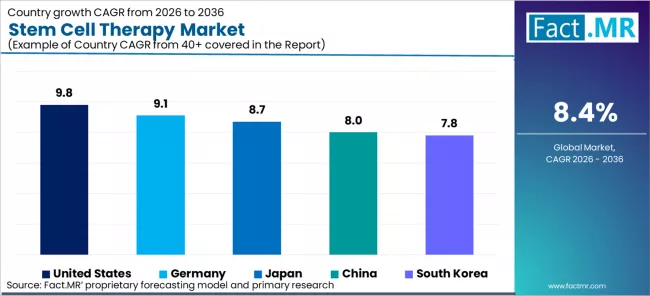
Stem Cell Therapy Market Cagr Analysis By Country | Source: Fact.MR
| Country | CAGR (2026-2036) |
|---|---|
| United States | 9.8% |
| Germany | 9.1% |
| Japan | 8.7% |
| China | 8.0% |
| South Korea | 7.8% |
Source: Fact.MR analysis. Updated Mar 9, 2026
Source: Fact.MR (FACT.MR) analysis, based on proprietary forecasting model and primary research
North America Stem Cell Therapy Market Analysis
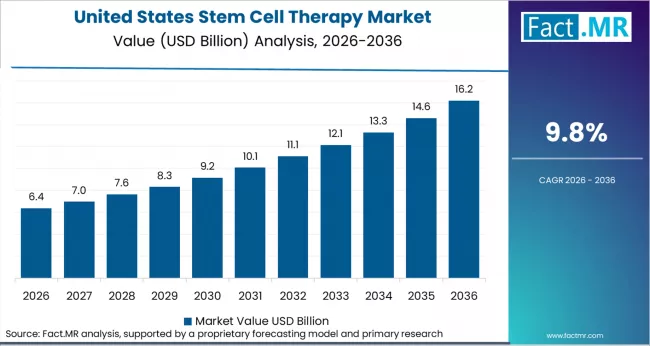
Stem Cell Therapy Market Country Value Analysis | Source: Fact.MR
- United States: The United States stem cell therapy market is expected to expand at a CAGR of 9.8% through 2036. FDA RMAT designations exceeded 50 new requests in 2024, highlighting a strong development pipeline. Updated FDA guidance in 2024 clarified manufacturing requirements for allogeneic therapies, supporting Mesoblast’s BLA acceptance in 2025. NIH regenerative medicine grants exceeded USD 200 million in 2024, strengthening the clinical research ecosystem.
FACT.MR's North American analysis covers the United States, Canada, and Mexico. The report includes RMAT pipeline data, government funding programmes, CDMO investment trends, and country level CAGR forecasts.
Europe Stem Cell Therapy Market Analysis
- Germany: Germany is anticipated to witness around 9.1% CAGR in stem cell therapy demand through 2036. The Paul Ehrlich Institut updated ATMP hospital exemption oversight in 2024, enabling expanded hospital manufacturing programmes. Germany’s GKV insurance system updated reimbursement assessment rules in 2025, improving market access for developers. University hospitals such as Charité Berlin and Frankfurt expanded cell therapy programmes.
FACT.MR's European analysis covers Germany, France, the United Kingdom, Italy, Spain, the Netherlands, the Nordics, and Rest of Europe. The report includes ATMP approvals, hospital exemption adoption, reimbursement policies, and country growth forecasts.
Asia Pacific Stem Cell Therapy Market Analysis
- China: China is projected to record about 8.0% CAGR in the stem cell therapy market through 2036. Updated NMPA guidance in 2024 clarified clinical trial pathways for MSC and iPSC therapies. The National Health Commission supported over 100 active stem cell clinical trials under the national biomedical innovation programme. Domestic developers including Cellular Biomedicine Group advanced regulatory submissions.
- South Korea: South Korea is likely to experience close to 7.8% CAGR growth in stem cell therapy adoption through 2036. The MFDS updated conditional approval rules in 2024, expanding eligibility for stem cell therapy products. Domestic companies such as Medytox and HLB Life Science increased investment in MSC therapy programmes. The national pharmaceutical strategy in 2025 identified regenerative medicine as a priority export sector.
- Japan: Japan’s stem cell therapy sector is forecast to grow at nearly 8.7% CAGR by 2036. Updated PMDA guidance in 2024 clarified post market data requirements for regenerative therapies. JCR Pharmaceuticals reported growing TEMCELL sales supported by national reimbursement coverage. Japan’s AMED programme continued funding regenerative medicine research in 2024.
FACT.MR's Asia Pacific analysis covers China, Japan, South Korea, India, Australia and New Zealand, ASEAN, and Rest of Asia Pacific. The report includes regulatory approval timelines, funding programmes, and regional growth forecasts.
Competitive Aligners for Market Players
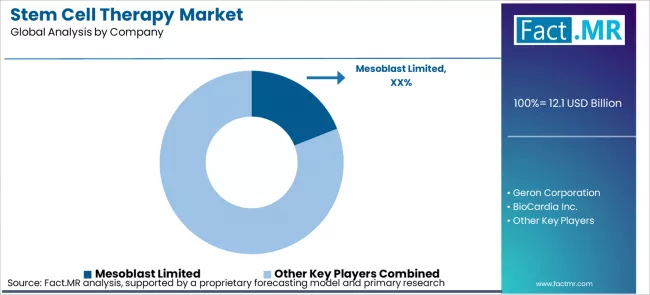
Stem Cell Therapy Market Analysis By Company | Source: Fact.MR
The global stem cell therapy market remains moderately fragmented, with only a few companies holding approved commercial products while many others are still advancing through clinical development. Large pharmaceutical players such as Novartis, Bristol Myers Squibb, and JCR Pharmaceuticals currently lead in approved product revenue. At the same time, several independent biotechnology companies including Mesoblast, BioCardia, Geron Corporation, and ReNeuron are progressing clinical programmes toward regulatory approval. In this market, success depends heavily on the ability to navigate complex regulatory pathways and scale up GMP compliant manufacturing for allogeneic therapies.
Companies with strong manufacturing infrastructure and regulatory experience hold a clear advantage. Lonza Group plays a key role as a leading contract manufacturer supporting commercial scale cell therapy production. Meanwhile, Takeda Pharmaceutical Company has strengthened its position in Europe through its TiGenix acquisition and the approved therapy Alofisel.
Hospitals and treatment centres often form long term partnerships with specific therapy providers, integrating certain products into their treatment protocols. These relationships create high switching costs. Research organisations and biotech developers purchasing stem cell tools and CDMO services, however, maintain stronger pricing leverage by comparing suppliers such as STEMCELL Technologies and Lonza Group through competitive procurement processes.
Recent Developments
- In 2025, Mesoblast Limited received FDA BLA acceptance for remestemcel-L in paediatric steroid-refractory acute graft-versus-host disease, representing the first allogeneic MSC therapy to reach the FDA BLA review stage and establishing a commercial milestone for the MSC cell therapy segment globally.
- In January 2025, STEMCELL Technologies announced expanded clinical-grade iPSC differentiation product portfolio for cardiac, neural, and hematopoietic cell applications, targeting growing pharmaceutical and biotech customer demand for standardized human cell models in drug discovery toxicity testing and disease modelling workflows.
Key Players
- Mesoblast Limited
- Geron Corporation
- BioCardia Inc.
- Lonza Group AG
- Novartis AG
- Bristol Myers Squibb
- JCR Pharmaceuticals Co.
- STEMCELL Technologies
- ReNeuron Group PLC
- Takeda Pharmaceutical Company
Bibliography
- [1] Mesoblast Limited. (2025). Corporate Update: FDA Biologics License Application Acceptance for Remestemcel-L in Paediatric Steroid-Refractory Acute GvHD. February 2025. mesoblast.com
- [2] JCR Pharmaceuticals Co. Ltd. (2024). Annual Report FY2024: TEMCELL HS Commercial Sales Growth and Clinical Programme Extension Plans under Japan ASRM Act. November 2024. jcrpharm.co.jp
- [3] Lonza Group AG. (2024). Press Release: Expanded cGMP Bioreactor-Based MSC Manufacturing Capacity Investment at Houston Facility. September 2024. lonza.com
- [4] BioCardia Inc. (2024). Clinical Programme Update: CardiAMP Heart Failure II Pivotal Trial Patient Enrolment Status. October 2024. biocardia.com
- [5] ReNeuron Group PLC. (2025). Pre-Clinical Programme Update: hRPC Stem Cell Therapy Manufacturing Process Development for IND-Enabling Studies. January 2025. reneuron.com
- [6] STEMCELL Technologies Inc. (2024). Commercial Market Update: Expanding iPSC-Derived Cell Model Demand for Pharmaceutical Drug Toxicity Testing. November 2024. stemcell.com
- [7] U.S. Food and Drug Administration. (2024). Guidance for Industry: Regenerative Medicine Advanced Therapy Designation Manufacturing Comparability Requirements for Allogeneic Cell Therapies. November 2024. fda.gov
- [8] Pharmaceuticals and Medical Devices Agency, Japan. (2024). Guidance Update: Real-World Evidence Data Collection Requirements for Conditionally Approved Regenerative Medicine Products under ASRM Act. 2024. pmda.go.jp
- [9] Paul-Ehrlich-Institut, Germany. (2024). Guidance Update: Hospital Exemption ATMP Oversight Framework GMP Requirements for Hospital-Manufactured Stem Cell Products. 2024. pei.de
This Report Addresses
- Strategic insights on RMAT and ATMP approval pipelines, MSC and iPSC manufacturing scale up, Sakigake commercialization, CDMO capacity expansion, and reimbursement growth.
- Market forecast from USD 12.1 billion in 2026 to USD 27.4 billion by 2036 at 8.4% CAGR by cell type, application, end use, and region.
- Growth opportunities across U.S. RMAT MSC pipelines, EU ATMP hospital exemption programmes, Japan Sakigake approvals, China NMPA framework, and CDMO manufacturing services.
- Regional outlook with CAGR for United States 9.8%, Germany 9.1%, Japan 8.7%, China 8.0%, and South Korea 7.8%.
- Competitive analysis of Mesoblast, BioCardia, Geron, Lonza, Novartis, Bristol Myers Squibb, JCR Pharmaceuticals, STEMCELL Technologies, ReNeuron, and Takeda.
- Technology tracking covering MSC bioreactor manufacturing, iPSC differentiation platforms, clinical grade cell products, GMP cell banking, and AI based cell quality analysis.
- Regulatory analysis including FDA RMAT updates, EMA ATMP approvals, Germany hospital exemption rules, Japan Sakigake framework, China IND pathway, and Korea MFDS approvals.
- Report delivered in Excel datasets, PowerPoint summary, and detailed PDF supported by regulatory data, clinical trial records, funding disclosures, and primary interviews.
Segmentation
Scope of Report
| Items | Values |
|---|---|
| Quantitative Units | USD 12.1 billion (2026) to USD 27.4 billion (2036), at a CAGR of 8.4% |
| Market Definition | The stem cell therapy market includes therapies, research tools, and CDMO services using mesenchymal, hematopoietic, embryonic, iPSC, and neural stem cells for regenerative medicine, drug discovery, toxicity testing, and disease modelling across hospitals, research institutes, and biotech companies. |
| Cell Type Segmentation | Embryonic Stem Cells, Induced Pluripotent Stem Cells, Mesenchymal Stem Cells, Hematopoietic Stem Cells, Neural Stem Cells |
| Application Segmentation | Regenerative Medicine, Drug Discovery and Development, Toxicity Testing, Disease Modeling, Others |
| End Use Segmentation | Hospitals and Clinics, Research Institutes, Biotechnology Companies, Others |
| Application Coverage | MSC therapies for GvHD, cardiovascular and orthopaedic treatment; iPSC derived neural and cardiac therapies; haematopoietic stem cell transplants; iPSC cell models for drug discovery; stem cell CDMO manufacturing services for clinical and commercial developers. |
| Regions Covered | North America, Europe, Asia Pacific, Latin America, Middle East and Africa |
| Countries Covered | United States, Canada, Mexico, Germany, United Kingdom, France, Italy, Spain, Netherlands, Nordics, Rest of Europe, China, Japan, South Korea, India, Australia and New Zealand, ASEAN, Rest of Asia Pacific, Brazil, Chile, Ecuador, Rest of Latin America, Kingdom of Saudi Arabia, UAE, South Africa, Turkey, Rest of Middle East and Africa |
| Key Companies Profiled | Mesoblast Limited, Geron Corporation, BioCardia Inc., Lonza Group AG, Novartis AG, Bristol Myers Squibb, JCR Pharmaceuticals Co., STEMCELL Technologies, ReNeuron Group PLC, Takeda Pharmaceutical Company |
| Forecast Period | 2026 to 2036 |
| Approach | A hybrid top down and bottom up model was applied. Top down inputs included clinical pipeline estimates by cell type, government regenerative medicine funding, and reimbursement expansion timelines. Bottom up inputs considered average therapy pricing, CDMO manufacturing cost trends, regulatory milestones, and clinical trial data from interviews with developers and hospital procurement teams. |
Source: Fact.MR analysis. Updated Mar 9, 2026
Stem Cell Therapy Market by Segment
-
By Cell Type :
- Embryonic Stem Cells
- Induced Pluripotent Stem Cells
- Mesenchymal Stem Cells
- Hematopoietic Stem Cells
- Neural Stem Cells
-
By Application :
- Regenerative Medicine (cardiovascular, orthopedic, neurological)
- Drug Discovery and Development
- Toxicity Testing
- Disease Modeling
- Others (cosmetic, veterinary applications)
-
By End Use :
- Hospitals and Clinics
- Research Institutes
- Biotechnology Companies
- Others
-
By Region :
- North America
- United States
- Canada
- Mexico
- Europe
- Germany
- United Kingdom
- France
- Italy
- Spain
- Netherlands
- Nordics
- Rest of Europe
- Asia Pacific
- China
- Japan
- South Korea
- India
- Australia and New Zealand
- ASEAN
- Rest of Asia Pacific
- Latin America
- Brazil
- Chile
- Ecuador
- Rest of Latin America
- Middle East and Africa
- Kingdom of Saudi Arabia
- United Arab Emirates
- South Africa
- Turkey
- Rest of Middle East and Africa
- North America
Frequently Asked Questions
How large is the stem cell therapy market in 2025?
What will the market size be in 2026?
What is the projected market size by 2036?
What is the expected CAGR from 2026 to 2036?
Which cell type segment is poised to lead the market?
Which application segment holds the largest share?
Which country shows the fastest growth rate?
How fast is the market expected to expand in Germany?
What is the forecast CAGR for Japan?
What growth rate is expected for China?
What are the main growth drivers of the market?
What is the primary constraint in this market?
Who worked on this report


Preview the report firsthand - request a free sample
Free SampleGet the brochure for pricing and purchase details
Download PDF