- Market Value (2025): USD 1.38 Bn
- Estimated Value (2026): USD 1.46 Bn
- Forecast Value (2036): USD 2.63 Bn
- CAGR (2026-2036): 6.1%
What is the Stereo Microscopes Market forecast to be worth by 2036?
USD 1.5 billion in 2026 to USD 2.6 billion by 2036, with a CAGR of 6.1%.
- As per Fact.MR analysis, the stereo microscopes market was valued at USD 1.38 billion in 2025.
- Demand is projected to increase from USD 1.46 billion in 2026 to USD 2.63 billion by 2036.
- The forecast records a 6.1% CAGR from 2026 to 2036 as demand rises for precision inspection and detailed imaging across industrial and research applications.
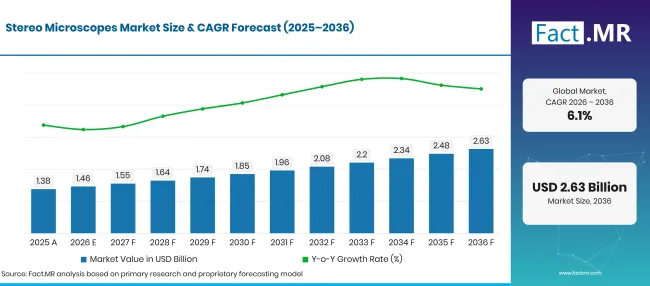
Stereo Microscopes Market Forecast Global | Source: Fact.MR
| Year | Basis | Market Value (USD billion) |
|---|---|---|
| 2025 | Actual | 1.38 |
| 2026 | Estimate | 1.46 |
| 2036 | Forecast | 2.63 |
| CAGR 2026 to 2036 | Forecast period | 6.1% |
Source: Fact.MR analysis. Updated Oct 27, 2026
What are the defining numbers behind Stereo Microscopes Market growth?
USD 1.1 billion in absolute market opportunity between 2026 and 2036
- Demand Drivers in the Market
- Research laboratories and universities use stereo microscopes for specimen handling, teaching, sample preparation, and visual examination. Germany recorded EUR 137.1 billion in research and development expenditure in 2024, equivalent to 3.17% of GDP, according to the Federal Statistical Office in March 2026 [1].
- Industrial inspection creates opportunities for stereo microscopes in electronics assembly, component verification, precision manufacturing, and surface examination. The National Science Board's 2026 report estimated U.S. R&D expenditure at USD 993 billion in 2024; this is a preliminary estimate subject to revision [2]. [2]
- Digital imaging and documentation are relevant to laboratories that need to record observations, share images, and maintain inspection records. Digital systems can support repeatable workflows, but buyers also consider total ownership costs, software compatibility, resolution, and operator requirements.
- Key Segments Analyzed
- By Product Type: Digital stereo microscopes will account for 38.2% of the market in 2026, reflecting demand for image capture, documentation, and computer-assisted inspection.
- By Application: Research segment holds 35.8% share in 2026, supported by laboratory investigations, specimen examination, and scientific education.
- By End-User: Academic Institutions will represent 32.1% in 2026, driven by teaching laboratories and institutional research requirements.
- By Distribution Channel: Direct Sales segment leads with 52.3% share in 2026, shaped by rising importance of technical specifications, demonstrations, application guidance, and equipment selection.
- Analyst Opinion at Fact.MR
- Shambhu Nath Jha, Principal Consultant at Fact.MR, states, “Stereo microscope demand is likely to be influenced by the need for reliable visual inspection across research and industrial environments. Digital imaging can improve documentation and collaboration, but purchasing decisions will continue to depend on optical performance, application suitability, and total ownership costs.”
- Strategic Implications
- Manufacturers need to distinguish digital configurations through measurable specifications such as image resolution and illumination performance alongside working distance and software compatibility.
- Distributors should provide demonstrations and application-specific guidance so that laboratories can compare optical performance before making purchasing decisions.
- Academic institutions can evaluate microscope purchases against teaching requirements, expected instrument utilization, maintenance arrangements, and available budgets.
- Industrial buyers must assess magnification, depth of field, operator ergonomics, and inspection repeatability against the characteristics of the components being examined.
- Suppliers strengthen their market position through after-sales support and replacement-part availability as well as calibration guidance where applicable and training for digital imaging workflows.
Germany is set to record 5.7% CAGR through 2036. Brazil is projected to post 4.8%, followed by the USA at 5.3%. The UK is estimated to advance at 7.1%, while Japan is forecast at 6.4%.
How does the Stereo Microscopes Market break down by segment?
Fact.MR finds that Digital Leads Product Type at 38.2%; Research leads Application at 35.8%; Academic Institutions leads End-User at 32.1%; and Direct Sales Leads Distribution Channel at 52.3%.
Which Product Type dominates?
Digital stereo microscopes are set to hold 38.2% share in 2026.
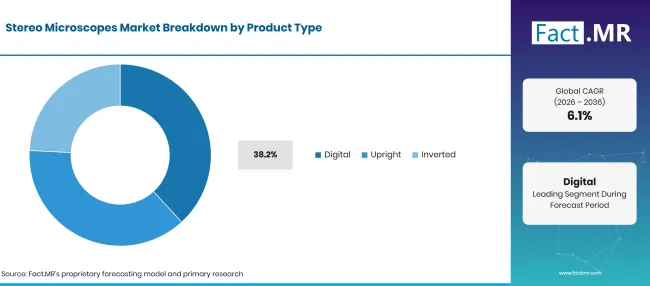
Stereo Microscopes Market Breakdown Product Type | Source: Fact.MR
| Product Type | Share (2026) |
|---|---|
| Digital (Leading segment) | 38.2% |
| Other segments combined | 61.8%* |
| Total | 100.0% |
Source: Fact.MR analysis. Updated Oct 27, 2026
Digital stereo microscopes support image capture, display, storage, and sharing alongside optical observation. These capabilities can help research teams document samples and industrial users maintain inspection records. Adoption depends on image quality, camera performance, software functionality, and the cost of the complete system. Stereo microscope configurations vary by magnification, illumination, working distance, and digital camera integration; other microscope architectures should not be treated as interchangeable product-type segments.
What leads the Application segment?
Research is set to represent 35.8% share in 2026.
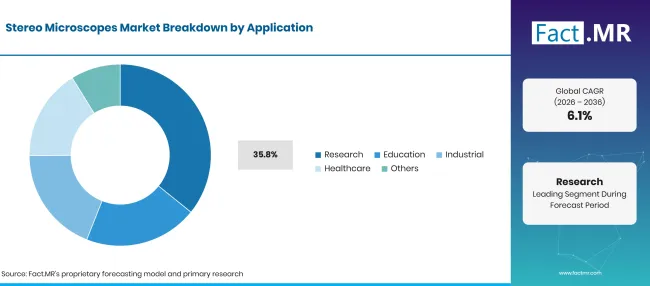
Stereo Microscopes Market Breakdown Application | Source: Fact.MR
| Application | Share (2026) |
|---|---|
| Research (Leading segment) | 35.8% |
| Other segments combined | 64.2%* |
| Total | 100.0% |
Source: Fact.MR analysis. Updated Oct 27, 2026
Research laboratories use stereo microscopes for examining specimens, handling small samples, preparing materials, and conducting preliminary visual assessments. Education creates demand for instruments used in practical demonstrations and laboratory instruction. Industrial applications include component inspection, assembly, and quality checks. Healthcare-related applications depend on the relevant clinical or laboratory procedure and the instrument's intended use.
How does End-User shape demand?
Academic Institutions are likely to account for 32.1% share in 2026.
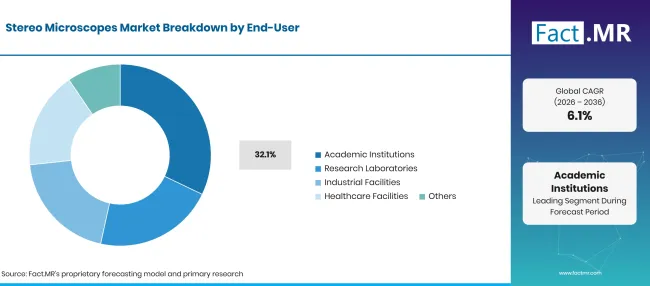
Stereo Microscopes Market Breakdown End User | Source: Fact.MR
| End-User | Share (2026) |
|---|---|
| Academic Institutions (Leading segment) | 32.1% |
| Other segments combined | 67.9%* |
| Total | 100.0% |
Source: Fact.MR analysis. Updated Oct 27, 2026
Academic institutions purchase stereo microscopes for teaching laboratories, student demonstrations, and research activities. Procurement often involves budget approvals, equipment standardization, maintenance arrangements, and multi-user requirements. Research laboratories may place greater emphasis on optical performance and image documentation, while industrial facilities prioritize inspection speed and consistency. Healthcare facilities evaluate intended use, procedural needs, and applicable equipment requirements. These different priorities create opportunities for suppliers to offer application-specific configurations.
What leads the Distribution Channel segment?
Direct Sales leads with 52.3% share in 2026.
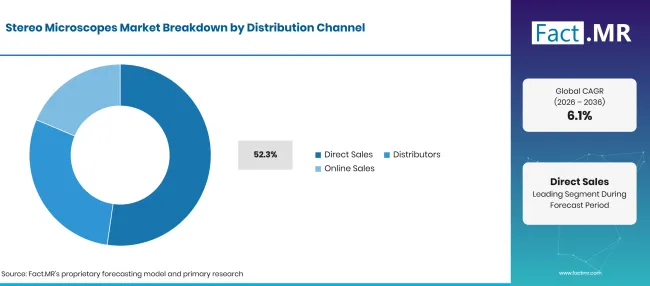
Stereo Microscopes Market Breakdown Distribution Channel | Source: Fact.MR
| Distribution Channel | Share (2026) |
|---|---|
| Direct Sales (Leading segment) | 52.3% |
| Other segments combined | 47.7%* |
| Total | 100.0% |
Source: Fact.MR analysis. Updated Oct 27, 2026
Direct sales can be advantageous for higher-value instruments requiring demonstrations, technical discussions, configuration choices, and application support. Distributors offer local product access and after-sales assistance, while online sales can help buyers compare specifications and obtain standard configurations. The preferred channel varies with instrument complexity, purchasing policy, supplier coverage, and the level of technical support required. Manufacturers benefit from maintaining consistent specifications and service commitments across channels.
What is accelerating Stereo Microscopes Market adoption, and what is holding it back?
Demand for documented inspection, research equipment, and digital imaging supports adoption, while equipment costs, budget constraints, and competing imaging methods can limit purchases.
Drivers Impact Analysis
| DRIVER | (~) % IMPACT ON CAGR | GEOGRAPHIC RELEVANCE | IMPACT TIMELINE |
|---|---|---|---|
| Expansion of research and laboratory activities | +1.0% | North America, Europe, Asia | Medium term (2–4 years) |
| Digital imaging and observation records | +0.9% | Global | Medium term (2–4 years) |
| Industrial inspection and precision assembly | +0.7% | Global | Short term (≤ 2 years) |
| Academic laboratory equipment procurement | +0.5% | Europe, Asia, Americas | Medium term (2–4 years) |
| Application-specific optical configurations | +0.4% | Global | Long term (≥ 4 years) |
Source: Fact.MR analysis. Updated Oct 27, 2026
Opportunity Impact Analysis
| OPPORTUNITY | (~) % IMPACT ON CAGR | GEOGRAPHIC RELEVANCE | IMPACT TIMELINE |
|---|---|---|---|
| Integrated digital imaging and documentation | +0.8% | Global | Medium term (2–4 years) |
| Industrial quality-control workflows | +0.6% | Asia, Europe, Americas | Medium term (2–4 years) |
| Modular illumination and camera configurations | +0.5% | Global | Long term (≥ 4 years) |
| University and research laboratory upgrades | +0.4% | Europe, Asia | Medium term (2–4 years) |
Source: Fact.MR analysis. Updated Oct 27, 2026
Restraints Impact Analysis
| RESTRAINT | (~) % IMPACT ON CAGR | GEOGRAPHIC RELEVANCE | IMPACT TIMELINE |
|---|---|---|---|
| Initial instrument and imaging-system costs | -0.8% | Global | Short term (≤ 2 years) |
| Budget limitations at educational institutions | -0.6% | Emerging markets | Medium term (2–4 years) |
| Competition from alternative imaging methods | -0.5% | Global | Medium term (2–4 years) |
| Training, maintenance, and software requirements | -0.4% | Global | Long term (≥ 4 years) |
Source: Fact.MR analysis. Updated Oct 27, 2026
Which countries are scaling the Stereo Microscopes Market through 2036?
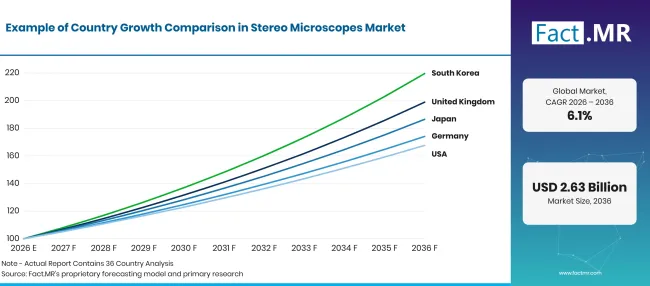
Stereo Microscopes Market Growth Index | Source: Fact.MR
| Country | CAGR (2026–2036) |
|---|---|
| Germany | 5.7% |
| Brazil | 4.8% |
| USA | 5.3% |
| UK | 7.1% |
| Japan | 6.4% |
Source: Fact.MR analysis. Updated Oct 27, 2026
What supports Germany adoption?
5.7% CAGR, supported by a substantial research base and industrial applications.
Germany’s stereo microscopes market is driven by demand for high-precision optical inspection and quality control in industrial manufacturing. Advanced imaging requirements in electronics inspection and materials analysis support adoption, while investment in laboratory equipment strengthens demand for stereo microscopes with high magnification and depth perception.
How is Brazil developing stereo microscope adoption?
4.8% CAGR, associated with research infrastructure and industrial inspection requirements.
Brazil's research and innovation ecosystem creates potential demand for optical instruments across universities, scientific laboratories, and industrial facilities. In June 2026, Brazil's Ministry of Science, Technology and Innovation reported that public investment in science and technology increased by 30% between 2021 and 2024, while resources allocated to R&D increased by 35% over the same period [3]. Public investment in science and technology provides a supportive environment for research infrastructure and laboratory modernization, potentially creating opportunities for optical equipment suppliers. [3]
What supports United States adoption?
5.3% CAGR, shaped by a large research ecosystem and industrial quality-control requirements.
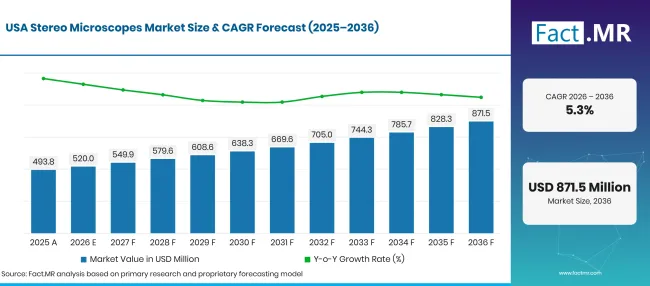
Stereo Microscopes Market Forecast Usa | Source: Fact.MR
The United States stereo microscopes market is supported by demand for precision inspection in semiconductor manufacturing and electronics assembly. Three-dimensional visualization assists component inspection and failure analysis across aerospace production and medical device manufacturing. Integration with digital imaging systems also supports detailed documentation and quality control.
How is the United Kingdom building adoption?
7.1% CAGR, led research spending and laboratory equipment requirements.
The UK's research base creates opportunities for stereo microscope suppliers serving higher education, scientific laboratories, and industrial users. The Office for National Statistics reported on August 7, 2026, that UK R&D expenditure reached GBP 79.4 billion in 2024. Businesses accounted for GBP 55.6 billion, while higher education accounted for GBP 17.9 billion [4]. The UK stereo microscopes market is supported by demand for detailed sample examination in life sciences research and materials testing.
What supports Japan adoption?
6.4% CAGR, backed by research-intensive industries and precision manufacturing.
Japan's established industrial and scientific research base creates opportunities for stereo microscopes used in electronics inspection, component evaluation, research, and precision assembly. The Statistics Bureau of Japan reported in its 2025 Survey of Research and Development that expenditure during fiscal year 2024 reached JPY 23.79 trillion, an increase of 7.9% from the previous fiscal year. R&D expenditure equalled 3.70% of GDP [5]. This research activity supports the broader case for laboratory and industrial optical equipment, while actual purchasing decisions remain dependent on equipment budgets and application-specific requirements.
Who leads the Stereo Microscopes Market?
Fact.MR identifies Leica Microsystems GmbH, Nikon Corporation, CARL ZEISS MICROSCOPY GMBH, Meiji Techno Co. Ltd., and Vision Engineering Ltd. as the five companies profiled in this market.
Leica Microsystems GmbH participates in the microscopy market with optical and digital imaging solutions. Nikon Corporation has an established optical-instrument business that includes microscopy products. CARL ZEISS MICROSCOPY GMBH competes through microscopy and imaging technologies for scientific and industrial applications. Meiji Techno Co. Ltd. supplies optical microscopes for laboratory, educational, and industrial settings. Vision Engineering Ltd. differentiates itself through ergonomic viewing systems and inspection microscopy.
Competition depends on optical performance, image quality, illumination, ergonomics, camera integration, and service support. Buyers compare instruments against the working distance, magnification, specimen characteristics, documentation requirements, and operating environment relevant to their applications. Suppliers also compete through distribution coverage, technical demonstrations, product availability, and maintenance support.
Which companies are the key providers?
Key companies include Leica Microsystems GmbH; Nikon Corporation; CARL ZEISS MICROSCOPY GMBH; Meiji Techno Co. Ltd.; and Vision Engineering Ltd.
- Leica Microsystems GmbH
- Nikon Corporation
- CARL ZEISS MICROSCOPY GMBH
- Meiji Techno Co. Ltd.
- Vision Engineering Ltd.
Bibliography
- [1] Statistisches Bundesamt (Destatis). (2026, March 27). 3,8 % mehr Ausgaben für Forschung und Entwicklung im Jahr 2024. https://www.destatis.de/DE/Presse/Pressemitteilungen/2026/03/PD26_107_218.htmlDestatis source
- [2] National Science Board. (2026, May 4). The State of U.S. Science and Engineering 2026 (NSB-SEP-2026-1). National Center for Science and Engineering Statistics, National Science Foundation. https://ncses.nsf.gov/pubs/nsbsep20261/overviewNCSES report
- [3] Ministério da Ciência, Tecnologia e Inovação. (2026, June 18). Após anos de retração, investimento público em ciência e tecnologia avança 30% no País. https://www.gov.br/mast/pt-br/assuntos/noticias/2026/junho/apos-anos-de-retracao-investimento-publico-em-ciencia-e-tecnologia-avanca-30-no-paisBrazil government source
- [4] Office for National Statistics. (2026, August 7). Gross domestic expenditure on research and development, UK: 2024. https://www.ons.gov.uk/economy/governmentpublicsectorandtaxes/researchanddevelopmentexpenditure/bulletins/ukgrossdomesticexpenditureonresearchanddevelopment/2024ONS source
- [5] Statistics Bureau of Japan. (2025, December 12). Summary of the results of the 2025 Survey of Research and Development. Statistics Bureau of Japan PDF
This Report Answers
- The report describes demand for stereo microscopes across research, education, industrial inspection, and healthcare-related applications.
- Segment analysis compares Digital stereo microscopes, Research applications, Academic Institutions, and Direct Sales using the 2026 shares.
- Country analysis discusses Germany, Brazil, the USA, the UK, and Japan alongside official government research and development statistics.
- The competitive overview profiles Leica Microsystems GmbH, Nikon Corporation, CARL ZEISS MICROSCOPY GMBH, Meiji Techno Co. Ltd., and Vision Engineering Ltd.
- Distribution analysis compares direct sales with distributors and online purchasing channels.
- Market assessment examines digital imaging, optical performance, procurement costs, and application-specific equipment requirements.
What does the Stereo Microscopes Market cover?
The market covers stereo microscopes used to examine specimens, components, and surfaces through three-dimensional optical viewing. It includes digital systems and conventional optical configurations serving research, teaching, industrial inspection, and other defined applications. The analysis considers purchases by academic institutions, research laboratories, industrial facilities, and healthcare facilities, along with the distribution channels used to supply these instruments.
What is included in the scope?
Included products are stereo microscopes sold for optical observation and inspection. Coverage includes digital imaging capabilities where integrated into the microscope system, application-specific optical configurations, and equipment purchased through direct sales, distributors, and online channels. The analysis considers instrument selection, intended use, imaging requirements, and associated purchasing considerations.
What is excluded from the scope?
The analysis excludes compound microscopes and other imaging instruments when they do not meet the stereo microscope definition. Standalone cameras, unrelated laboratory equipment, and imaging software sold independently are excluded unless explicitly included in the defined microscope product valuation. General research expenditure and government funding are used as contextual demand indicators rather than counted as stereo microscope market revenue.
How Was the Analysis Built?
The assessment considers public research, company portfolios, industry data, and geographic demand indicators. Quantities of source documents and interviews require confirmation from internal research records.
- Primary Research: Primary research includes discussions with manufacturers, service providers, technology developers, distributors, end users, and subject-matter experts. These conversations examine purchasing priorities, product adoption, operational challenges, approval requirements, competitive positioning, and the factors that influence wider market acceptance.
- Desk Research: Desk research covers government statistics, regulatory publications, company filings, trade data, technical studies, industry associations, standards, public policy, and other authoritative sources. Every source used in the analysis is documented in the bibliography.
- Market Sizing and Forecasting: Market estimates combine historical performance, demand indicators, pricing and volume trends, segment shares, company participation, country-level growth, adoption patterns, investment activity, and barriers to market expansion.
- Data Validation and Update Cycle: Findings are validated by comparing primary interviews with public data, company activity, regulatory changes, trade patterns, and industry developments. Regular updates review new product launches, capacity changes, partnerships, approvals, and shifts in commercial adoption.
Segmentation
What is the report's scope and coverage?
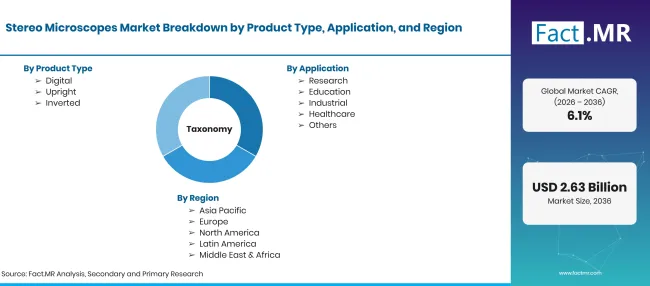
Stereo Microscopes Market Taxonomy | Source: Fact.MR
| Attribute | Details |
|---|---|
| Quantitative Units | USD billion in 2026 to USD billion by 2036, at CAGR |
| Market Definition | The stereo microscopes market comprises optical instruments that provide magnified three-dimensional views of specimens and components at relatively low magnification. These systems are used for biological dissection and laboratory examination as well as industrial inspection and precision assembly. |
| Product Type | Digital; Upright; Inverted |
| Application | Research; Education; Industrial; Healthcare; Others |
| End-User | Academic Institutions; Research Laboratories; Industrial Facilities; Healthcare Facilities; Others |
| Distribution Channel | Direct Sales; Distributors; Online Sales |
| Regions Covered | North America; Latin America; Western Europe; Eastern Europe; East Asia; South Asia & Pacific; Middle East & Africa |
| Countries Covered | Germany; Brazil; USA; UK; Japan |
| Companies Profiled | Leica Microsystems GmbH; Nikon Corporation; CARL ZEISS MICROSCOPY GMBH; Meiji Techno Co. Ltd.; Vision Engineering Ltd. |
| Forecast Period | 2026 to 2036 |
| Approach | Market segmentation and scenario-based analysis supported by official research and development statistics |
Source: Fact.MR analysis. Updated Oct 27, 2026
How is the market segmented?
-
By Product Type
- Digital
- Upright
- Inverted
-
By Application
- Research
- Education
- Industrial
- Healthcare
- Others
-
By End-User
- Academic Institutions
- Research Laboratories
- Industrial Facilities
- Healthcare Facilities
- Others
-
By Distribution Channel
- Direct Sales
- Distributors
- Online Sales
-
By Region
- North America
- Latin America
- Western Europe
- Eastern Europe
- East Asia
- South Asia & Pacific
- Middle East & Africa
Frequently Asked Questions
How big is the Stereo Microscopes Market in 2026?
What is the CAGR from 2026 to 2036?
Which product type has the largest share?
Which application leads the market?
Which end-user has the largest share?
Which countries are covered?
Which companies are profiled?
Who worked on this report


Preview the report firsthand - request a free sample
Free SampleGet the brochure for pricing and purchase details
Download PDF