- Market Value (2025): USD 2.01 Bn
- Estimated Value (2026): USD 2.32 Bn
- Forecast Value (2036): USD 9.77 Bn
- CAGR (2026-2036): 15.5%
What is the Automotive Stereo Camera Market forecast to be worth by 2036?
Fact.MR forecasts USD 2.3 billion in 2026 and USD 9.8 billion by 2036, representing a 15.5% CAGR.
- The market was valued at USD 2.01 billion in 2025.
- Revenue is projected to advance from USD 2.32 billion in 2026 to USD 9.77 billion in 2036.
- The 15.5% forecast CAGR reflects a larger role for stereo depth sensing in selected vehicle assistance architectures and additional value from perception processing.
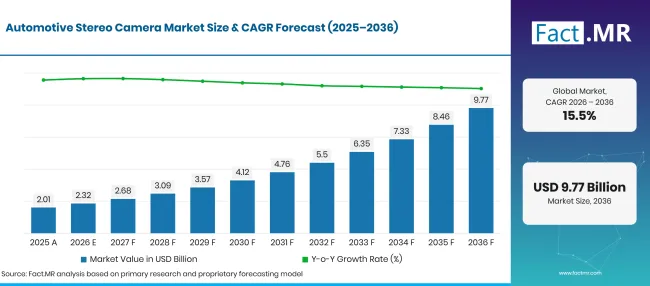
Automotive Stereo Camera Market Forecast Global | Source: Fact.MR
| Year | Basis | Market Value (USD billion) |
|---|---|---|
| 2025 | Actual | 2.01 |
| 2026 | Estimate | 2.32 |
| 2036 | Forecast | 9.77 |
| CAGR 2026 to 2036 | Forecast period | 15.5% |
Source: Fact.MR analysis. Updated Oct 23, 2026
What are the defining numbers behind Automotive Stereo Camera Market growth?
The forecast represents USD 7.5 billion of additional annual revenue between 2026 and 2036. Passenger cars account for 68.2% of 2026 demand, while OEM procurement represents 84.1%.
- Demand Drivers in the Market
- Automakers need distance information that can be interpreted together with object shape and road geometry. Astemo’s stereo-camera portfolio illustrates this combination through left-right image processing and recognition of objects and uneven road surfaces. [1] For buyers comparing forward camera sensing systems, the value of stereo lies in the extra depth information available to the vehicle’s control software.
- Consumer safety assessments increasingly examine how assistance behaves outside a narrow test sequence. Euro NCAP’s 2026 programme adds real-world driving evaluation and broader crash-prevention scenarios. [3] Fact.MR expects this to increase attention to stable perception and unobtrusive intervention. Stereo suppliers must demonstrate that their depth output improves the complete assistance system under the customer’s selected operating conditions.
- Automakers are bringing perception software and computing hardware closer together. Subaru’s November 2025 certification covered semiconductor soft IP for stereo recognition and AI inference in its next-generation EyeSight development. [7] This direction creates opportunities for sensor and processing suppliers that can meet a defined computing budget while preserving the timing required by vehicle controls.
- A common sensing package can support several model derivatives when its mounting and software interfaces are planned early. Fact.MR expects platform-wide procurement to remain the main route to scale. The commercial decision encompasses camera manufacture, calibration and integration with automotive pre-crash systems, making the cost of qualification relevant alongside the component price.
- Key Segments Analyzed
- By Type: Dynamic Stereo Camera accounts for 58.3% of market revenue in 2026.
- By Application: Passenger Cars represent 68.2% of demand in 2026.
- By Sales Channel: OEM supply holds 84.1% of the 2026 market.
- By Function: Analysis covers adaptive cruise control, lane departure warning, traffic sign recognition, blind spot detection, driver monitoring, parking assistance and other stereo-enabled uses.
- Analyst Opinion at Fact.MR
- Shambhu Nath Jha, Sr. Consultant, Fact.MR
- The purchasing decision is moving deeper into the vehicle programme. A stereo unit earns its place when its depth output remains useful after installation tolerances, software processing and control-system response are considered together. Fact.MR expects suppliers with a convincing integration case to hold stronger positions than vendors selling image resolution alone. The most attractive programmes will spread a qualified package across several model derivatives. However, a larger assistance budget does not guarantee a stereo award: the customer can choose another sensing architecture if it achieves the required performance at lower overall cost.
- Strategic Implications
- Suppliers should agree the optical mounting envelope before freezing the hardware design. The camera baseline, bracket tolerances and clear viewing area need to be compatible with each vehicle derivative. Resolving these interfaces early reduces the risk that an otherwise qualified module requires a costly redesign late in the programme.
- Automakers should evaluate perception latency together with the braking and steering response. A larger image or denser depth map only earns additional cost when it improves the intended function. Procurement specifications should therefore connect sensor output to measurable behaviour at vehicle level.
- Component partners should retain a clear division of responsibility for image capture, stereo matching and object interpretation. That division becomes more consequential when processing moves into a central controller. The commercial contract needs to cover software updates and regression testing as well as hardware supply.
- Service organisations should build model-specific replacement and alignment capability around the automotive windshield interface. Documented procedures, compatible mounts and diagnostic access support a repeatable repair. A replacement part without the appropriate installation support can leave the customer with substantial additional work.
The United Kingdom has the fastest forecast growth among the five countries examined, at 17.7%, followed by Brazil at 16.2%. The United States is expected to remain a substantial commercial opportunity. Germany and Japan present different supplier priorities, with programme integration and established perception development shaping procurement.
How does the Automotive Stereo Camera Market break down by segment?
The leading 2026 segments are Dynamic Stereo Camera at 58.3%, Passenger Cars at 68.2% and OEM supply at 84.1%. Function-level analysis examines what the stereo system contributes to each driving task.
Why does Dynamic Stereo Camera lead the type segment?
Dynamic Stereo Camera represents 58.3% of revenue in 2026.
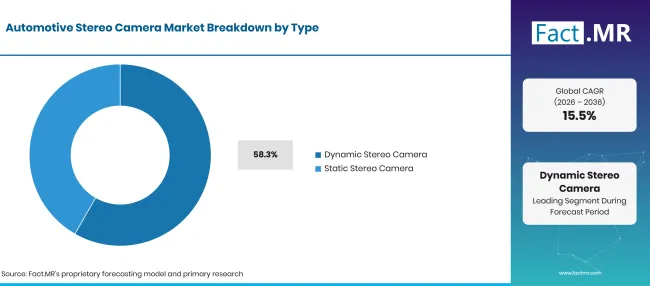
Automotive Stereo Camera Market Breakdown Type | Source: Fact.MR
| Type | Share (2026) |
|---|---|
| Dynamic Stereo Camera | 58.3% |
| Static Stereo Camera | 41.7% |
| Total | 100.0% |
Source: Fact.MR analysis. Updated Oct 23, 2026
The leading category sits within a demanding purchase decision: depth estimates must remain useful as other vehicles move, lighting changes and the host vehicle turns. Buyers therefore need to assess successive frames and the continuity of the resulting object tracks. An attractive single-frame result carries limited commercial value if the output becomes unstable when incorporated into a driving function.
The underlying geometry also has practical consequences. A stereo module relies on a known relationship between its two views. Housing stiffness and repeatable assembly deserve attention alongside image sensors and processors. Fact.MR expects suppliers to retain more value when they deliver a calibrated sensing package and application support that the customer can carry through production and servicing.
Why do passenger cars account for the largest application share?
Passenger Cars account for 68.2% of 2026 demand.
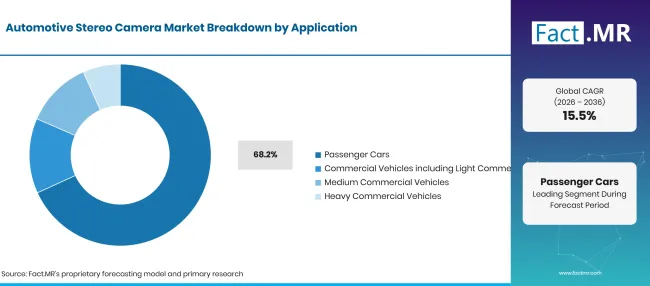
Automotive Stereo Camera Market Breakdown Application | Source: Fact.MR
| Application | Share (2026) |
|---|---|
| Passenger Cars | 68.2% |
| Commercial vehicle applications combined | 31.8% |
| Total | 100.0% |
Source: Fact.MR analysis. Updated Oct 23, 2026
Passenger-car programmes offer several ways to extend an approved design. A manufacturer can move a qualified unit between related vehicles or expand the features supported by the same hardware. This makes the durability of an engineering relationship commercially significant. A supplier that understands the customer’s software release cycle can pursue repeat programmes without treating each model as a completely new integration exercise.
Commercial vehicles require a separate assessment of mounting position, payload-related vehicle attitude and service conditions. Light commercial vehicles provide a nearer fit to passenger-car packaging than some medium and heavy applications. For those larger vehicles, installation height and the intended driving task can change the useful sensing range. Fact.MR expects focused programmes with a defined operating requirement to offer more credible opportunities than broad retrofit offers.
How does the required driving function change the stereo-camera specification?
Depth estimation is most valuable when the vehicle must locate an object in three dimensions and decide whether its path conflicts with the intended manoeuvre.
| Function | Stereo-camera contribution |
|---|---|
| Adaptive Cruise Control | Distance and relative-position inputs for following control |
| Lane Departure Warning | Road and lane geometry within the perception system |
| Traffic Sign Recognition | Visual sign interpretation combined with scene positioning |
| Blind Spot Detection | Nearby object location in suitable side-facing stereo configurations |
| Driver Monitoring | Depth cues in cabin configurations that use stereo capture |
| Parking Assistance | Short-range spatial information for manoeuvre support |
| Others | Free-space and obstacle geometry for additional qualified functions |
Source: Fact.MR analysis. Updated Oct 23, 2026
The function list does not imply that each installation uses a stereo pair. Many visual tasks can be served by a single camera, while a vehicle can combine cameras with radar or LiDAR sensors. The stereo component belongs in the commercial comparison where its depth information improves the intended task. Purchasers still need to specify the viewing direction, usable range and software output required by that installation.
Why does OEM supply hold most of the sales channel?
OEM supply represents 84.1% of revenue in 2026.
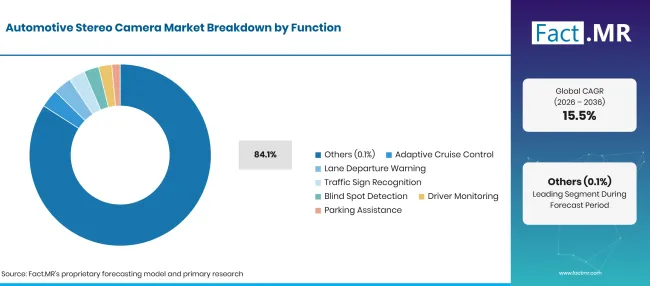
Automotive Stereo Camera Market Breakdown Function | Source: Fact.MR
| Sales Channel | Share (2026) |
|---|---|
| OEM | 84.1% |
| Aftermarket | 15.9% |
| Total | 100.0% |
Source: Fact.MR analysis. Updated Oct 23, 2026
The camera is installed as part of a broader vehicle architecture. Magna’s published stereo-module description places a synchronized, aligned camera pair behind the windscreen, illustrating the close relationship between optical hardware and vehicle packaging. [5] Factory procurement can coordinate these requirements with the controller and the assembly process. It also establishes the software configuration that will support the vehicle after delivery.
Aftermarket revenue has a different rhythm. Replacement demand follows the installed vehicle population and the need for compatible parts. Service support is particularly important where installation affects the alignment between cameras or their relationship to the road. Suppliers can strengthen this channel through identifiable part versions and clear model compatibility, while maintaining the functional requirements of the original installation.
What is accelerating Automotive Stereo Camera Market adoption, and what is holding it back?
Stereo sensing benefits when a vehicle programme can use depth information across several assistance functions. Its constraints are concentrated in execution: the optical path, computing load and installation need to work together. Research on adverse-weather stereo matching identifies degraded images and limited training coverage as persistent challenges. [8] Fact.MR consequently expects qualification for the intended operating conditions to remain a material part of the sales cycle.
Drivers Impact Analysis
| DRIVER | (~) % IMPACT ON CAGR | GEOGRAPHIC RELEVANCE | IMPACT TIMELINE |
|---|---|---|---|
| Expanded depth-perception requirements in vehicle assistance | +1.4% | United States, Germany, United Kingdom | 2026 to 2031 |
| Passenger-car platform adoption across model derivatives | +1.1% | United States, Japan, Germany | 2027 to 2033 |
| Co-development of stereo processing and vehicle computing | +0.9% | Japan, Germany, United States | 2027 to 2032 |
| Broader use of qualified perception outputs across functions | +0.6% | Germany, United Kingdom, Japan | 2028 to 2036 |
| Higher specification of assistance packages in new vehicles | +0.8% | Brazil, United Kingdom | 2026 to 2031 |
Source: Fact.MR analysis. Updated Oct 23, 2026
Opportunity Impact Analysis
| OPPORTUNITY | (~) % IMPACT ON CAGR | GEOGRAPHIC RELEVANCE | IMPACT TIMELINE |
|---|---|---|---|
| Richer free-space perception for complex driving scenes | +1.2% | Japan, Germany, United States | 2028 to 2036 |
| Compact stereo packages for selected light commercial vehicles | +0.7% | United Kingdom, Brazil, Germany | 2027 to 2032 |
| Stereo integration with complementary sensing architectures | +1.0% | United States, Japan, Germany | 2027 to 2035 |
| Compatible replacement modules and installation support | +0.5% | United States, United Kingdom, Japan | 2029 to 2036 |
Source: Fact.MR analysis. Updated Oct 23, 2026
Restraints Impact Analysis
| RESTRAINT | (~) % IMPACT ON CAGR | GEOGRAPHIC RELEVANCE | IMPACT TIMELINE |
|---|---|---|---|
| Substitution by lower-cost alternative sensing packages | -1.3% | Brazil, United States, Germany | 2026 to 2036 |
| Weather and low-visibility qualification burden | -0.9% | United Kingdom, Japan, Germany | 2026 to 2032 |
| Processing power and thermal constraints | -0.8% | Japan, United States, Germany | 2026 to 2031 |
| Installation tolerances and service calibration complexity | -0.5% | Brazil, United Kingdom, United States | 2026 to 2036 |
Source: Fact.MR analysis. Updated Oct 23, 2026
Which countries are scaling the Automotive Stereo Camera Market through 2036?
| Country | CAGR (2026 to 2036) |
|---|---|
| Germany | 11.6% |
| Brazil | 16.2% |
| United States | 15.8% |
| United Kingdom | 17.7% |
| Japan | 11.3% |
Source: Fact.MR analysis. Updated Oct 23, 2026
What will German vehicle programmes demand from stereo-camera suppliers?
Fact.MR forecasts an 11.6% CAGR for Germany, with programme integration central to supplier selection.
A stereo supplier addressing German vehicle programmes needs a clear answer to where perception processing will sit. Moving it into a central controller changes the hardware interface and the division of engineering responsibility. Fact.MR expects purchasing teams to compare those arrangements across several vehicle derivatives. The strongest commercial case combines a defined sensor package with predictable software support and evidence that changes in one function will not disrupt another. This makes integration capability a meaningful differentiator even when competing cameras have similar headline resolution.
How can Brazil convert stronger safety ratings into stereo-camera demand?
Brazil is projected to record a 16.2% CAGR as selected new-vehicle programmes broaden their assistance offerings.
Latin NCAP’s protocol for 2026 to 2029 gives greater weight to vulnerable-road-user AEB and includes night pedestrian and cyclist scenarios. [4] That raises the commercial importance of effective sensing for models competing on safety ratings. It does not prescribe a stereo architecture. For Brazilian programmes, Fact.MR expects suppliers to win business by showing that a stereo package fits the target vehicle price and supports the selected functions without unnecessary hardware. Availability of compatible replacement parts will also influence the practical attractiveness of a platform as the installed fleet grows.
Where does the United States create the clearest qualification requirement?
The United States carries a 15.8% CAGR forecast through 2036.
FMVSS No. 127 establishes AEB performance requirements for light vehicles, with general compliance applying from September 1, 2029 and specified additional time for certain manufacturers. Its requirements address lead-vehicle and pedestrian situations as well as false activation. [6] This gives suppliers a concrete vehicle-level qualification framework. The standard does not require stereo cameras. Fact.MR expects stereo proposals to compete on whether their additional depth information helps the complete system meet the customer’s requirements within its cost and processing limits. Programme selection should therefore be tracked separately from the overall expansion of AEB fitment.
Why is the United Kingdom the fastest-growing country in this comparison?
The United Kingdom is forecast to expand at 17.7%, the highest rate among the five markets assessed.
Fact.MR sees room for stereo packages that improve the everyday behaviour of assistance systems on a wider set of vehicles. Euro NCAP’s 2026 evaluation places attention on real-world driving and user acceptance, giving suppliers a reason to address unnecessary warnings and intrusive interventions as part of the system assessment. [3] For UK-focused vehicle programmes, the commercial opportunity lies in delivering that performance through a package suited to the chosen model range. A high growth rate also leaves more room for execution differences: a delayed vehicle programme or a change in sensing architecture can materially alter the timing of orders.
How does Japan’s in-house perception development shape purchasing?
Japan is projected to grow at an 11.3% CAGR, supported by continued development of integrated perception systems.
Subaru’s ASIL-C certification of semiconductor soft IP for its next-generation EyeSight illustrates how deeply an automaker can participate in stereo processing and AI inference. [7] The certification concerns that semiconductor development, rather than an approval of an entire driving system. For suppliers serving Japanese programmes, Fact.MR expects this kind of engineering approach to favour partners that can work within tightly specified interfaces. Opportunities extend from camera modules to image sensors and processing components, but those products occupy different positions in the value chain.
How do suppliers compete in the Automotive Stereo Camera Market?
Competition is defined by the package delivered to the vehicle programme. Astemo lists stereo cameras alongside radar and ADAS controllers, allowing the customer to consider a connected sensing and control offer. [1] DENSO’s portfolio includes both stereo vision sensors and compact stereo vision sensors. [2] Magna’s front-camera range includes mono and stereo modules, placing the architecture choice within a wider camera offering. [5] Their offers differ in the level of sensing and vehicle integration supplied to an OEM.
Subaru represents the in-house developer and vehicle manufacturer side of the market. Its work with AMD-based processing shows that OEMs may retain important perception functions internally while buying components and engineering support from partners. [7] Fact.MR expects suppliers to compete on optical consistency, production readiness, software responsibility and support over the vehicle lifecycle. A successful award can extend through related models, while a weak interface or service record can make future programmes harder to secure.
Which companies are the key providers?
Key companies profiled include Astemo, Ltd. (stereo-camera and vehicle sensing systems); DENSO Corporation (stereo vision and compact stereo vision sensors); Magna International Inc. (front stereo-camera modules); and Subaru Corporation (in-house EyeSight development and OEM integration).
- Astemo, Ltd.: stereo-camera and vehicle sensing systems.
- DENSO Corporation: stereo vision and compact stereo vision sensors.
- Magna International Inc.: front stereo-camera modules.
- Subaru Corporation: in-house EyeSight development and OEM integration.
Bibliography
- [1] Astemo, Ltd. (n.d.). Autonomous driving / advanced driver assistance systems.
- [2] DENSO Corporation (n.d.). Safety and cockpit systems.
- [3] Euro NCAP (2025, November 26). Euro NCAP announces 2026 protocol changes to tackle modern driving risks.
- [4] Latin NCAP (2025, November 21). Latin NCAP announces update to its assessment protocol.
- [6] National Highway Traffic Safety Administration (2026). Standard No. 127; Automatic emergency braking systems for light vehicles. 49 C.F.R. § 571.127
- [7] Subaru Corporation (2025, November 21). Subaru obtains ISO 26262 certification in SoC development for next-generation EyeSight.
- [8] Wang, Y., Liang, Y., Hu, Y., & Fu, Y. (2025). RobuSTereo: Robust zero-shot stereo matching under adverse weather. In Proceedings of the IEEE/CVF International Conference on Computer Vision (pp. 25134–25144). Author manuscript. https://arxiv.org/abs/2507.01653
This Report Answers
- Where does stereo depth information add commercial value within an assistance architecture?
- How do camera mounting and processing choices influence supplier selection?
- Why do passenger cars and OEM programmes account for the leading shares?
- How do country-level safety assessment and procurement conditions affect the outlook?
- Which providers offer stereo-camera products and which participate through in-house vehicle development?
What does the Automotive Stereo Camera Market cover?
The market covers automotive camera modules and integrated sensing systems that use a pair of optical views to generate depth information. It examines their use in passenger and commercial vehicles and the commercial relationships through which they reach production or replacement applications. The analysis connects product selection with the driving function and the installation requirements that determine a viable vehicle programme.
What is included in the scope?
Included products comprise stereo-camera modules and dedicated stereo-sensing assemblies supplied for automotive use, including associated processing when integral to the product sold. Both OEM and aftermarket channels are considered. Function coverage applies to installations in which stereo capture contributes to the stated vehicle task. Supplier analysis distinguishes merchant products from an automaker’s in-house system development.
What is excluded from the scope?
Standalone monocular cameras, radar and LiDAR units are excluded, as are generic dashcams and consumer imaging products. The full selling price of a vehicle or complete ADAS package is outside the camera-market boundary. Standalone controllers and separately traded semiconductors are outside the defined camera-product scope. Non-automotive industrial and robotics cameras are excluded.
How Was the Analysis Built?
The analysis draws on 120+ sources, 35+ company portfolios, 25+ countries, and more than 20 industry interviews.
- Primary Research: Primary research includes discussions with manufacturers, service providers, technology developers, distributors, end users, and subject-matter experts. These conversations examine purchasing priorities, product adoption, operational challenges, approval requirements, competitive positioning, and the factors that influence wider market acceptance.
- Desk Research: Desk research covers government statistics, regulatory publications, company filings, trade data, technical studies, industry associations, standards, public policy, and other authoritative sources. Every source used in the analysis is documented in the bibliography.
- Market Sizing and Forecasting: Market estimates combine historical performance, demand indicators, pricing and volume trends, segment shares, company participation, country-level growth, adoption patterns, investment activity, and barriers to market expansion.
- Data Validation and Update Cycle: Findings are validated by comparing primary interviews with public data, company activity, regulatory changes, trade patterns, and industry developments. Regular updates review new product launches, capacity changes, partnerships, approvals, and shifts in commercial adoption.
Segmentation
What is the report’s scope and coverage?
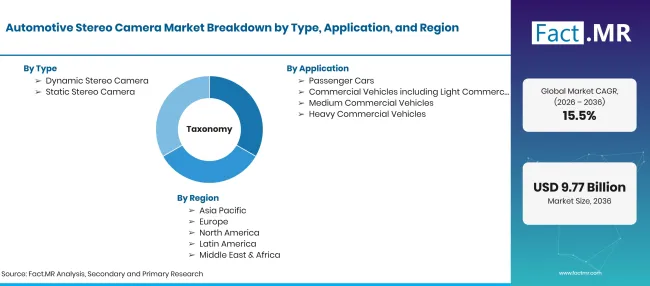
Automotive Stereo Camera Market Taxonomy | Source: Fact.MR
| Attribute | Details |
|---|---|
| Quantitative Units | USD billion; CAGR and segment shares in percent |
| Market Definition | Automotive stereo-camera modules and systems that use paired optical views to generate depth information for vehicle functions |
| Type | Dynamic Stereo Camera; Static Stereo Camera |
| Application | Passenger Cars; Commercial Vehicles including Light Commercial Vehicles; Medium Commercial Vehicles; Heavy Commercial Vehicles |
| Function | Adaptive Cruise Control; Lane Departure Warning; Traffic Sign Recognition; Blind Spot Detection; Driver Monitoring; Parking Assistance; Others |
| Sales Channel | OEM; Aftermarket |
| Regions Covered | North America; Latin America; Western Europe; Eastern Europe; East Asia; South Asia & Pacific; Middle East & Africa |
| Countries Covered | Germany; Brazil; United States; United Kingdom; Japan |
| Companies Profiled | Astemo; DENSO; Magna International; Subaru |
| Forecast Period | 2026 to 2036 |
| Approach | Assessment of stereo-sensing applications, optical integration, vehicle procurement, country outlook and documented supplier activity |
Source: Fact.MR analysis. Updated Oct 23, 2026
How is the market segmented?
-
By Type
- Dynamic Stereo Camera
- Static Stereo Camera
-
By Application
- Passenger Cars
- Commercial Vehicles including Light Commercial Vehicles
- Medium Commercial Vehicles
- Heavy Commercial Vehicles
-
By Function
- Adaptive Cruise Control
- Lane Departure Warning
- Traffic Sign Recognition
- Blind Spot Detection
- Driver Monitoring
- Parking Assistance
- Others
-
By Sales Channel
- OEM
- Aftermarket
-
By Region
- North America
- Latin America
- Western Europe
- Eastern Europe
- East Asia
- South Asia & Pacific
- Middle East & Africa
Frequently Asked Questions
How big is the Automotive Stereo Camera Market in 2026?
What is the forecast value and growth rate?
Which type accounts for the leading share?
Why is OEM procurement the largest sales channel?
Do vehicle safety requirements mandate stereo cameras?
Who worked on this report


Preview the report firsthand - request a free sample
Free SampleGet the brochure for pricing and purchase details
Download PDF