- Market Value (2025): USD 338.4 Mn
- Estimated Value (2026): USD 359.0 Mn
- Forecast Value (2036): USD 647.8 Mn
- CAGR (2026-2036): 6.1%
What is the Structural Bio Hot Melt Adhesives Market forecast to be worth by 2036?
USD 359.0 million in 2026 to USD 647.8 million by 2036 at a 6.1% CAGR.
- The Structural Bio Hot Melt Adhesives Market reached USD 338.4 million in 2025.
- Demand is projected to increase from USD 359.0 million in 2026 to USD 647.8 million by 2036.
- The market is forecast to record a 6.1% CAGR from 2026 to 2036 as manufacturers qualify renewable-content reactive hot melts for structural bonding lines.
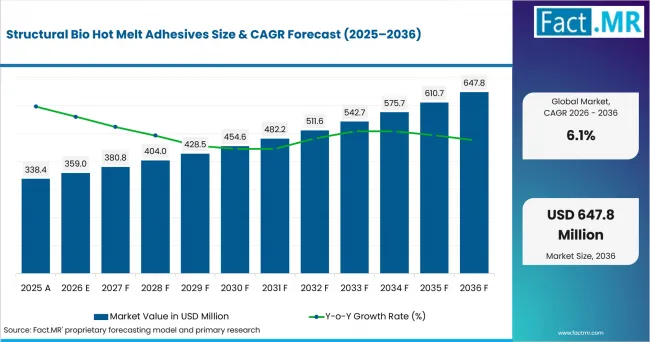
Structural Bio Hot Melt Adhesives Value Analysis | Source: Fact.MR
What are the defining numbers behind Structural Bio Hot Melt Adhesives Market growth?
An absolute opportunity of USD 288.8 million is expected between 2026 and 2036.
- Demand Drivers in the Market
- Electronics makers need structural hot melts that set fast and keep curing after parts are placed. Thin devices and automated lines leave little room for bond movement.
- Furniture and woodworking plants value reactive PUR systems with fast handling strength and later heat resistance. This suits profile wrapping and panel bonding on long production runs.
- Automotive interior suppliers need bonds for textiles, foams and plastics. Low-monomer grades may gain use where plants focus on worker exposure and process control.
- Footwear and textile plants are testing bio-based or mass-balance feedstocks. The bond must keep its wash resistance and flexibility. Line speed also needs to stay close to the current process.
- Packaging converters have a large paper-board base for fast-set bonding. The U.S. Census Bureau reported in March 2026 that seasonally adjusted shipments of paperboard containers reached USD 7.73 billion in January 2026. This gives hot-melt suppliers a broad base for carton and board bonding.
- Key Segments Analyzed
- By PUR Platform: Reactive PUR is expected to hold 65.0% share in 2026. Moisture-cure chemistry gives fast green strength and a crosslinked final bond.
- By Structural Bonding Use: Packaging / paper-board is projected to hold 31.0% share in 2026. Fast-setting bonds suit high-speed carton and board lines.
- By Cure / Process: Moisture cure is anticipated to hold 58.0% share in 2026. It is widely used with one-component reactive polyurethane hot melts.
- By Bio-Based Content: <10% is estimated to hold 30.0% share in 2026. A modest renewable-content change is easier to add while keeping familiar process settings.
- Analyst Opinion at Fact.MR
- Shambhu Nath Jha, Principal Consultant at Fact.MR, states, “The commercial test for structural bio hot melts is whether bio-based content fits the same approval window as conventional PUR. Demand is projected to favor formulas that keep line speed and bond life close to current grades. Suppliers should pair clear content claims with simple use data and test results.”
- Strategic Implications
- Electronics suppliers should test dispensing temperature and open time on production equipment. Henkel reported in February 2025 that its new Chennai application center has five specialized labs for adhesive and thermal-management work.
- Woodworking and furniture producers should give priority to low-monomer grades where worker handling rules shape plant use. Clear melt-temperature and cure data can make plant approval easier.
- Packaging converters should test board grade, coat weight and set speed together. Fiber quality can change the bond result even when the adhesive formula stays the same.
Brazil is forecast to record an 8.2% CAGR through 2036 as footwear and furniture widen the base for hot-melt approval. Portugal is projected to post 7.3% as footwear and textile bonding remain active uses. The USA is expected to reach 6.3% as packaging and electronics add demand. Germany is anticipated to record 5.5% as automotive interiors and woodworking support reactive PUR use. Japan is estimated to reach 4.8% as electronics and automotive lines favor precise dispensing.
How does the Structural Bio Hot Melt Adhesives Market break down by segment?
Reactive PUR is projected to lead PUR Platform at 65.0% share in 2026; Packaging / paper-board leads Structural Bonding Use at 31.0% share.
Which PUR Platform dominates?
Reactive PUR is expected to hold 65.0% share in 2026.
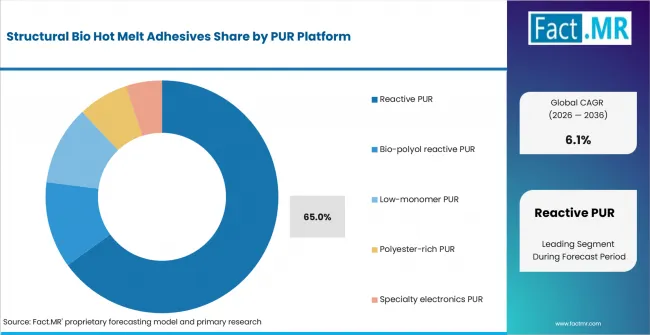
Structural Bio Hot Melt Adhesives Analysis By Pur Platform | Source: Fact.MR
Reactive PUR is expected to lead because the bond sets as it cools and then cures with moisture. Parts gain early handling strength before the final crosslinked bond forms. This two-step cure suits durable assembly lines that need fast movement after bonding. Bio-polyol reactive PUR offers more bio-based feedstock while keeping a familiar PUR cure route.
What leads the Structural Bonding Use segment?
Packaging / paper-board is projected to account for 31.0% share in 2026.
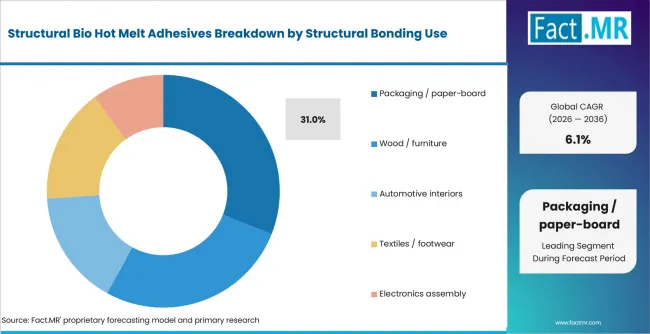
Structural Bio Hot Melt Adhesives Analysis By Structural Bonding Use | Source: Fact.MR
Packaging / paper-board is projected to lead because hot melts set fast on high-speed lines. They bond porous fiber surfaces without a long drying stage. Wood / furniture follows where profile wrapping and panel bonding need heat resistance. Automotive interiors use PUR hot melts for trim and textile parts. Electronics assembly needs tighter process control. Textiles / footwear need flexibility after repeated use.
How does Cure / Process shape demand?
Moisture cure is anticipated to represent 58.0% share in 2026.
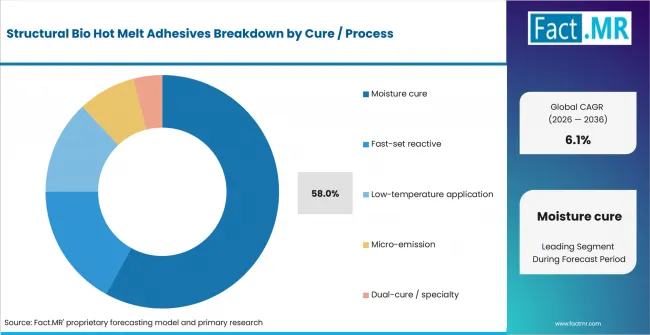
Structural Bio Hot Melt Adhesives Analysis By Cure Process | Source: Fact.MR
Moisture cure is anticipated to lead because one-component reactive PUR gains handling strength as it cools. The bond then keeps curing after assembly. Fast-set grades suit short cycle times. Low-temperature grades suit heat-sensitive parts. Micro-emission grades support tighter handling needs. Dual-cure or specialty systems serve jobs that need another cure route.
What supports demand within Bio-Based Content?
<10% is estimated to capture 30.0% share in 2026.
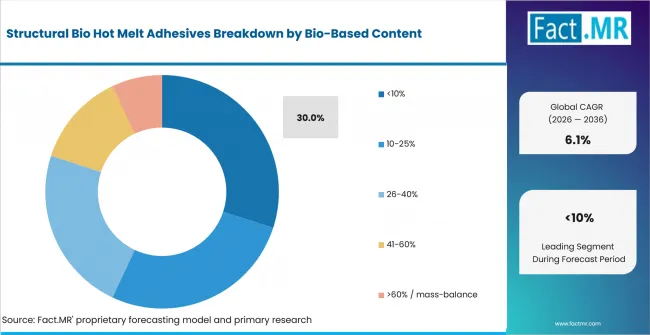
Structural Bio Hot Melt Adhesives Analysis By Bio Based Content | Source: Fact.MR
The <10% band is estimated to lead because a small bio-based share is easier to use in familiar PUR processing. The 10-25% and 26-40% bands allow more renewable input. The 41-60% band needs closer feedstock and bond checks. The >60% / mass-balance group serves programs that place more weight on content claims and traceable sourcing.
What is accelerating Structural Bio Hot Melt Adhesives Market adoption, and what is holding it back?
Bio-based feedstock and fast structural bonding are expected to support adoption. Longer approval work and feedstock consistency may slow conversion.
Drivers Impact Analysis
| DRIVER | (~) % IMPACT ON CAGR | GEOGRAPHIC RELEVANCE | IMPACT TIMELINE |
|---|---|---|---|
| Renewable-content substitution in reactive PUR | +1.1% | North America, Europe | Medium term (2-4 years) |
| Low-monomer and workplace-exposure requirements | +0.8% | Europe, Japan | Short term (<= 2 years) |
| Fast-set structural bonding in automated assembly | +0.7% | Global | Medium term (2-4 years) |
| Furniture, textile and automotive lamination demand | +0.5% | Europe, Latin America, East Asia | Long term (>= 4 years) |
Opportunity Impact Analysis
| OPPORTUNITY | (~) % IMPACT ON CAGR | GEOGRAPHIC RELEVANCE | IMPACT TIMELINE |
|---|---|---|---|
| Bio-polyol reactive PUR for qualified assemblies | +0.8% | Europe, North America | Medium term (2-4 years) |
| Micro-emission PUR in furniture and automotive interiors | +0.6% | Germany, Japan | Short term (<= 2 years) |
| Higher renewable-content textile and footwear laminates | +0.5% | Portugal, Brazil | Long term (>= 4 years) |
Restraints Impact Analysis
| RESTRAINT | (~) % IMPACT ON CAGR | GEOGRAPHIC RELEVANCE | IMPACT TIMELINE |
|---|---|---|---|
| Long customer qualification cycles for structural bonds | -0.5% | Global | Short term (<= 2 years) |
| Bio-feedstock variability and formulation control | -0.4% | Global | Medium term (2-4 years) |
| Heat-sensitive substrate limits at application temperature | -0.3% | Textiles, electronics | Medium term (2-4 years) |
Which countries are scaling the Structural Bio Hot Melt Adhesives Market through 2036?
- The country comparison spans 3.4 percentage points across the five profiled markets.
- Brazil remains 0.9 percentage point above Portugal as footwear and plant assembly widen the use base.
- Portugal remains 1.0 percentage point above the USA because footwear and textile bonding support specialist hot-melt use.
- The USA remains 0.8 percentage point above Germany as packaging and electronics provide several durable-bonding routes.
- Germany remains 0.7 percentage point above Japan because automotive interiors and woodworking sustain reactive PUR approval.
- Japan closes the displayed range as precision electronics and vehicle assembly support controlled hot-melt use.
Similar CAGRs can lead to different entry conditions. Approval depends on local end uses and line equipment. Worker-safety rules and customer tests also shape entry. Full report coverage includes North America, Latin America, Western Europe, Eastern Europe, East Asia, South Asia & Pacific, and Middle East & Africa.
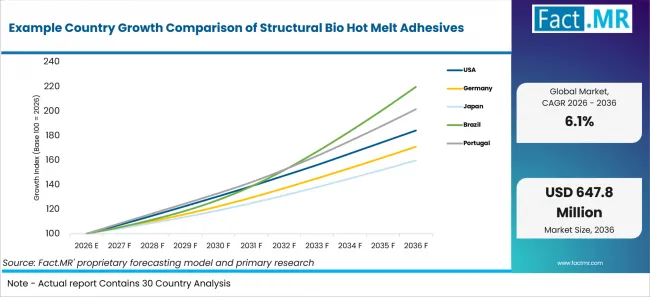
Example Country Growth Comparison Of Structural Bio Hot Melt Adhesives | Source: Fact.MR
| Country | CAGR (2026-2036) |
|---|---|
| Brazil | 8.2% |
| Portugal | 7.3% |
| United States | 6.3% |
| Germany | 5.5% |
| Japan | 4.8% |
What supports Brazil adoption?
8.2% CAGR, supported by footwear, furniture and industrial assembly.
Brazil has several routes for reactive PUR hot melts in furniture and footwear. The Brazilian Institute of Geography and Statistics reported in March 2026 that industrial production rose 1.8% in January 2026 from December 2025. This plant activity supports trials of fast-set bonds. Bio-polyol grades are easier to add when they run on current coating and bonding equipment.
How is Portugal developing demand?
7.3% CAGR, led by footwear and textile bonding.
Portugal has a clear fit for structural hot melts in footwear and textile bonding. Statistics Portugal reported in February 2026 that sports footwear made up 25.7% of the country's sports-goods imports in 2025. The footwear base favors flexible bonds that keep strength after repeated bending. Textile plants also value steady line speed and wash-resistant cured bonds.
What supports USA adoption?
6.3% CAGR, backed by packaging, electronics and product assembly.
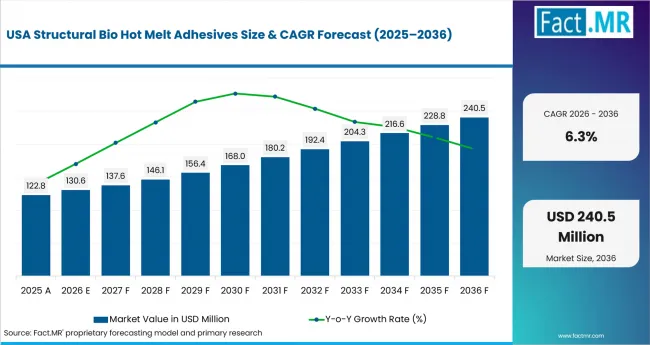
Structural Bio Hot Melt Adhesives Country Value Analysis | Source: Fact.MR
The United States combines large packaging use with electronics and durable-product assembly. The Federal Reserve reported in June 2026 that its computer and electronic product output index reached 138.1 in May 2026, with 2017 equal to 100. Device plants are therefore a relevant base for precise hot-melt dispensing. Packaging and woodworking add demand for fast set and moisture resistance.
What is supporting Germany adoption?
5.5% CAGR, shaped by automotive interiors and woodworking.
Germany's reactive PUR use is linked to automotive interiors and plant bonding. Destatis reported in April 2026 that new orders in the automotive industry rose 3.8% in February 2026 from January 2026. Vehicle programs need repeatable bonds for textiles and trim parts. Low-monomer and micro-emission grades suit plants that focus on handling and process control.
How does Japan perform?
4.8% CAGR, led by electronics and automotive bonding.
Japan's opportunity is concentrated in precision electronics and automotive assembly. METI reported in February 2026 that production of large passenger cars reached 373,982 units in January 2026. This factory base supports controlled bonding for interior trim and layered parts. Low-temperature and specialty reactive grades suit lines that need accurate dispensing and short handling times.
Who leads the Structural Bio Hot Melt Adhesives Market?
Henkel supplies reactive polyurethane hot-melt adhesives for electronics and industrial assembly applications. Its electronics portfolio includes PUR hot melts designed for structural bonding across different substrates. Application evaluation can include substrate compatibility, processing behavior, initial handling strength, and final bond performance.
H.B. Fuller supplies reactive hot-melt adhesives for woodworking, packaging, technical textiles, automotive, and electronics applications. These systems combine rapid initial setting as the adhesive cools with subsequent moisture-driven chemical curing, producing a durable final bond.
Bostik, an Arkema company, supplies reactive polyurethane hot-melt systems for textile and flexible-substrate lamination, including flexible-packaging applications.
In its February 2025 LIGNA 2025 material, KLEIBERIT described adhesive developments focused on reintegrating recycled materials into the raw-material cycle, using PET bottles as an example. The company also documented a broad portfolio of PUR hot-melt adhesives containing non-petroleum-based raw materials. These capabilities support KLEIBERIT's relevance in bio-based and lower-fossil-content reactive PUR hot-melt applications.
Which companies are the key providers?
Companies profiled include Henkel; H.B. Fuller; Bostik / Arkema; and KLEIBERIT.
- Henkel
- H.B. Fuller
- Bostik / Arkema
- KLEIBERIT
Bibliography
- U.S. Census Bureau. (2026, March 18). Monthly full report on manufacturers’ shipments, inventories and orders: January 2026.
- Board of Governors of the Federal Reserve System. (2026, June 15). Industrial production and capacity utilization—G.17: Table 1D. Industrial production: Industry subtotals and individual series.
- Federal Statistical Office (Destatis). (2026, April 8). New orders in manufacturing in February 2026: +0.9% on the previous month.
- Ministry of Economy, Trade and Industry. (2026, February 27). Indices of industrial production: Preliminary report for January 2026.
- Brazilian Institute of Geography and Statistics. (2026, March 6). Industrial production up 1.8% in January.
- Instituto Nacional de Estatística, I.P. (2026, March). Desporto em números—2025 | Sport in numbers—2025.
- Henkel. (2025, February 27). Henkel strengthens its electronics footprint in India.
- Chanak, M. (2025, February 9). Reactive hot melt adhesives: A game-changer in bonding technology. H.B. Fuller.
- Arkema. (2025, September 12). Arkema will showcase innovations at K2025 in Düsseldorf.
- KLEIBERIT SE & Co. KG. (2025, February). Designed for professionals. Engineered for the future.
This Report Answers
- The report explains where structural bio hot melt adhesives are used across PUR Platform and Structural Bonding Use. It also covers Cure / Process and Bio-Based Content.
- Segment analysis identifies the four supplied leaders for 2026: Reactive PUR, Packaging / paper-board, Moisture cure and <10% bio-based content.
- Country analysis covers the United States, Germany, Japan, Brazil and Portugal. It links each market to a current factory or end-use signal that can shape reactive hot-melt approval.
- Competitive analysis reviews Henkel, H.B. Fuller, Bostik / Arkema and KLEIBERIT. It focuses on electronics, woodworking, automotive, textile and packaging uses.
- Application analysis reviews early handling strength and final bond life. It also considers use temperature and low-monomer handling when plants select a grade.
What does the Structural Bio Hot Melt Adhesives Market cover?
The Structural Bio Hot Melt Adhesives Market covers renewable-content hot-applied systems used for durable assembly. It falls within adhesives and sealants but focuses on hot-melt processing and bio-based content.
Coverage includes reactive polyurethane systems for packaging, furniture, automotive interiors, textiles, footwear and electronics. Related process context includes adhesive equipment for controlled melt delivery.
What is included in the scope?
The scope includes reactive PUR and bio-polyol reactive PUR, plus low-monomer and specialty grades. Adjacent chemistry is covered by polyurethane materials.
Application coverage includes paper-board, furniture, automotive interiors, textiles, footwear and electronics assembly. Adjacent categories include packaging adhesives and automotive adhesives.
The report considers textile lamination and other hot-melt bonding routes. Related categories include textile adhesives and polyester hot melt adhesives. Broader technology comparisons include recyclable PU adhesives and lamination adhesives where cure route and material compatibility shape use.
What is excluded from the scope?
The scope excludes conventional fossil-only hot melts outside the bio-based, bio-attributed or mass-balance boundary. Pressure-sensitive tapes sold as finished products fall outside this scope. Solvent-borne structural adhesives and water-based dispersion adhesives are outside the hot-melt route. Two-component liquid polyurethane systems processed outside hot-melt lines are outside the market boundary.
Consumer craft glues and glue sticks fall outside the structural scope. Raw polyols, isocyanates and polymer resins are treated as upstream inputs until they are formulated into a structural hot melt adhesive.
How Was the Analysis Built?
The analysis draws on 120+ sources, 35+ company portfolios, 25+ countries, and more than 20 industry interviews.
- Primary Research: Primary research includes discussions with manufacturers, service providers, technology developers, distributors, end users, and subject-matter experts. These conversations examine purchasing priorities, product adoption, operational challenges, approval requirements, competitive positioning, and the factors that influence wider market acceptance.
- Desk Research: Desk research covers government statistics, regulatory publications, company filings, trade data, technical studies, industry associations, standards, public policy, and other authoritative sources. Every source used in the analysis is documented in the bibliography.
- Market Sizing and Forecasting: Market estimates combine historical performance, demand indicators, pricing and volume trends, segment shares, company participation, country-level growth, adoption patterns, investment activity, and barriers to market expansion.
- Data Validation and Update Cycle: Findings are validated by comparing primary interviews with public data, company activity, regulatory changes, trade patterns, and industry developments. Regular updates review new product launches, capacity changes, partnerships, approvals, and shifts in commercial adoption.
What is the report’s scope and coverage?
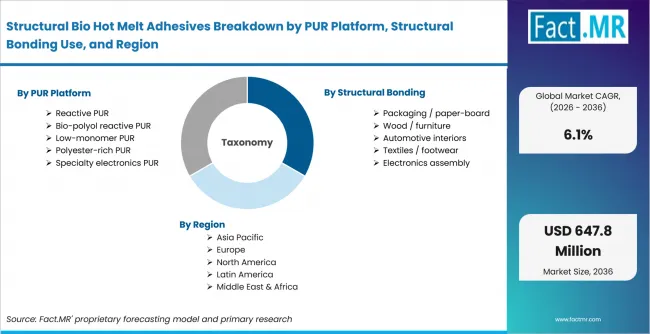
Structural Bio Hot Melt Adhesives Breakdown By Pur Platform, Structural Bonding Use, And Region | Source: Fact.MR
| Attribute | Details |
|---|---|
| Quantitative Units | USD million |
| Market Definition | Structural bio hot melt adhesives are hot-applied bonding materials with renewable, bio-attributed or mass-balance content that provide structural or durable assembly performance after cooling and, for reactive PUR, chemical curing. |
| PUR Platform | Reactive PUR; Bio-polyol reactive PUR; Low-monomer PUR; Polyester-rich PUR; Specialty electronics PUR |
| Structural Bonding Use | Packaging / paper-board; Wood / furniture; Automotive interiors; Textiles / footwear; Electronics assembly |
| Cure / Process | Moisture cure; Fast-set reactive; Low-temperature application; Micro-emission; Dual-cure / specialty |
| Bio-Based Content | <10%; 10-25%; 26-40%; 41-60%; >60% / mass-balance |
| Regions Covered | North America; Latin America; Western Europe; Eastern Europe; East Asia; South Asia & Pacific; Middle East & Africa |
| Countries Covered | United States; Germany; Japan; Brazil; Portugal |
| Key Companies Profiled | Henkel; H.B. Fuller; Bostik / Arkema; KLEIBERIT |
| Forecast Period | 2026 to 2036 |
| Approach | Hybrid top-down and bottom-up approach using application demand, reactive PUR use, country manufacturing indicators, segment mix and provider portfolio review. |
How is the market segmented?
-
By PUR Platform:
- Reactive PUR
- Bio-polyol reactive PUR
- Low-monomer PUR
- Polyester-rich PUR
- Specialty electronics PUR
-
By Structural Bonding Use:
- Packaging / paper-board
- Wood / furniture
- Automotive interiors
- Textiles / footwear
- Electronics assembly
-
By Cure / Process:
- Moisture cure
- Fast-set reactive
- Low-temperature application
- Micro-emission
- Dual-cure / specialty
-
By Bio-Based Content:
- <10%
- 10-25%
- 26-40%
- 41-60%
- >60% / mass-balance
-
By Region:
- North America
- Latin America
- Western Europe
- Eastern Europe
- East Asia
- South Asia & Pacific
- Middle East & Africa