- Market Value (2025): USD 61.8 Bn
- Estimated Value (2026): USD 65.5 Bn
- Forecast Value (2036): USD 117.0 Bn
- CAGR (2026-2036): 6.0%
What is the Sugar and Sugar Substitute Market forecast to be worth by 2036?
USD 65.5 Billion in 2026 to USD 117.0 Billion by 2036, at a 6.0% CAGR.
- As per Fact.MR analysis, the sugar and sugar substitute market reached USD 61.8 Billion in 2025.
- Demand will increase from USD 65.5 Billion in 2026 to USD 117.0 Billion in 2036.
- The market is forecast to record a 6.0% CAGR during 2026 to 2036 driven by reformulation initiatives in commercial food and beverage processing, heightened diabetic and pre-diabetic preventative care, and consumer migration toward low-glycemic nutritive and zero-calorie natural sweeteners.
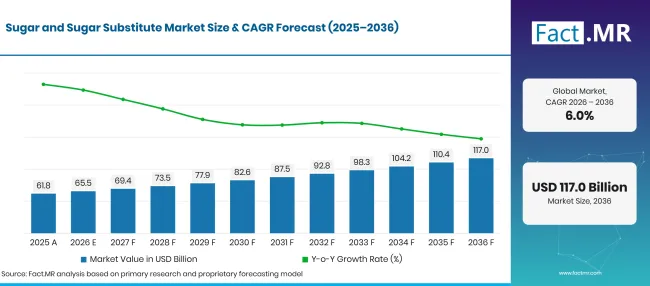
Factmr Sugar And Sugar Substitute Market Forecast Global | Source: Fact.MR
| Year | Basis | Market Value (USD Billion) |
|---|---|---|
| 2025 | Actual | 61.8 |
| 2026 | Estimate | 65.5 |
| 2036 | Forecast | 117.0 |
| CAGR 2026 to 2036 | Forecast period | 6.0% |
Source: Fact.MR analysis. Updated Oct 21, 2026
What are the defining numbers behind Sugar and Sugar Substitute Market growth?
USD 51.5 Billion absolute chance between 2026 and 2036, with natural sweeteners and food and beverage applications generating the largest processing volume.
- Demand Drivers in the Market
- Federal sugar taxes and front-of-package warning label mandates implemented across the Americas and Western Europe are compelling multinational beverage corporations to reduce sucrose loads by 20% to 50% across high-volume carbonated soft drink and juice lines. Official agricultural economic outlook assessments confirm that global sugar consumption growth is moderating while industrial procurement of non-caloric alternatives accelerates across domestic food processors [1]. Formulation teams integrate steviol glycosides and rare sugars to preserve mouthfeel without incurring punitive fiscal penalties.
- Escalating incidence of type 2 diabetes, childhood obesity, and metabolic syndrome is prompting widespread consumer migration toward zero-glycemic and low-calorie packaged food staples. Comprehensive commodity balance evaluations indicate that domestic sweetener deliveries to industrial users are increasingly diversified toward specialized nutritive and non-nutritive fraction blends to meet wellness benchmarks [2]. Health-conscious households actively seek table-top sachets and baked goods formulated with natural plant-derived sweetening compounds.
- Technological breakthroughs in enzymatic bioconversion and precision fermentation are resolving historic lingering bitterness, metallic aftertastes, and liquorice notes in high-potency botanical sweeteners. Recent clinical nutrition literature confirms that modern natural non-caloric sweeteners maintain glycemic homeostasis without triggering detrimental insulin spikes or postprandial blood glucose surges [3]. Ingredient manufacturers utilize targeted masking flavor technologies and rebaudioside M blends to replicate the exact temporal sweetness profile of sucrose.
- Proliferation of functional beverages, sports hydration elixirs, and keto-friendly snack bars is generating massive industrial demand for bulking sweeteners that provide clean bulking texture without rapid carbohydrate digestion. Systematic biomedical reviews indicate that balanced substitution of conventional sugars with well-tolerated alternatives supports weight management goals when integrated into calorie-controlled dietary regimens [4]. Food developers leverage multi-sweetener synergies to achieve optimal sensory parity while optimizing cost-per-sweetness ratios.
- Key Segments Analyzed
- By Product Type: Natural Sweeteners holds 58.9% share in 2026, preferred across industrial blending plants and clean-label consumer packaged goods brands for its plant-derived origin, non-GMO positioning, and consumer-perceived health safety.
- By Application: Food and Beverages accounts for 68.5% share in 2026 as beverage bottling corporations, confectionery producers, dairy processing facilities, and commercial bakeries reformulate signature recipes.
- By Sales Channel: Supermarkets/Hypermarkets accounts for 53.7% share in 2026, providing dominant retail shelf frontage, bulk merchandising capacity, and widespread multi-brand availability for household table-top sweeteners and alternative sweetening ingredients.
- Analyst Opinion at Fact.MR
- Shambhu Nath Jha, Lead Consultant at Fact.MR, states, “The commercial battlefield in the sweetener sector is no longer defined by simple calorie subtraction; it is dictated by sensory biomimicry and clean-label integrity. Industrial food processors will not compromise on texture, moisture retention, or browning kinetics merely to lower sugar percentages. Food technologists and ingredient refiners who master precision co-crystallization and multi-glycoside blending will capture long-term commercial contracts as food conglomerates eliminate synthetic additives without alienating consumer taste preferences.”
- Strategic Implications
- Refining conglomerates are investing heavily in enzymatic bioconversion tanks and bioreactors to scale production of next-generation steviol glycosides, tagatose, and rare sugars. Adult dietary behavior surveys document a measurable rise in regular non-nutritive sweetener consumption among consumers managing chronic metabolic conditions, cementing sustained baseline commercial demand [5]. Processors who transition infrastructure toward bio-fermented natural sweeteners achieve higher profit margins than conventional sucrose milling operations.
- Industrial bakery and dairy formulators are establishing modular blending protocols that combine high-potency plant extracts with soluble dietary fibers like inulin, polydextrose, and resistant dextrin. This hybrid compounding strategy resolves texture deficits, restores cryoprotection in frozen desserts, and replicates the essential moisture-binding functionality of cane sugar.
- Global sweetening ingredient suppliers are locking in long-term agricultural sourcing agreements with stevia and monk fruit cultivation cooperatives in Southeast Asia, East Africa, and Latin America. Forward contract execution insulates processing plants against seasonal harvest variability while ensuring rigorous non-GMO Project Verification and USDA Organic compliance.
- Packaging engineers are developing barrier laminates and hermetically sealed desiccant pouches to protect hygroscopic sugar substitute crystals from ambient moisture absorption and agglomeration. Ensuring free-flowing properties in industrial dry dispensing hoppers reduces production downtime across automated confectionery and beverage bottling lines.
The United States is projected to record a 7.3% CAGR, while the United Kingdom advances at 6.6%, driven by aggressive carbonated drink sugar taxation, sports nutrition innovation, and rapid retail clean-label adoption. Germany expands at 5.7%, supported by advanced food science manufacturing, strict European Food Safety Authority purity standards, and widespread organic bakery demand. Japan achieves a 4.9% CAGR, fueled by functional Foods with Function Claims (FFC) beverages and an aging demographic prioritizing low-glycemic nutrition. Brazil registers a 4.2% CAGR, anchored by its historic status as a global sugarcane milling titan transitioning gradually toward specialized ethanol co-products and export-grade natural sweetener blends.
How does the Sugar and Sugar Substitute Market break down by segment?
Natural Sweeteners 58.9%; Food and Beverages 68.5%; Supermarkets/Hypermarkets 53.7% in 2026.
Which Product Type dominates?
Natural Sweeteners holds 58.9% share in 2026.
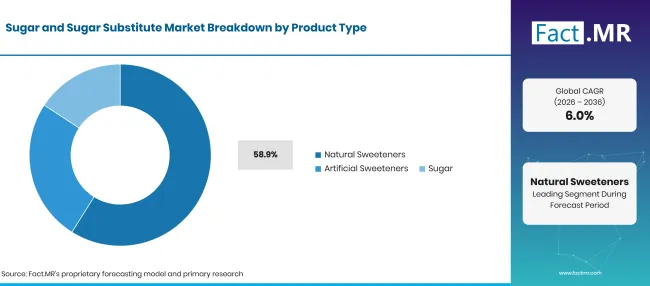
Factmr Sugar And Sugar Substitute Market Breakdown Product Type | Source: Fact.MR
| Product Type | Share (2026) |
|---|---|
| Natural Sweeteners (Leading segment) | 58.9% |
| Other segments combined | 41.1%* |
| Total | 100.0% |
Source: Fact.MR analysis. Updated Oct 21, 2026
Natural sweeteners dominate processing procurement allocations, propelled by consumer aversion to chemical food additives and the expanding commercial accessibility of stevia extracts, monk fruit concentrates, thaumatin, and allulose. Industrial processors prefer natural extracts because front-of-pack claims referencing plant-based origin resonate powerfully across millennial and Gen-Z demographics. In parallel, conventional artificial sweetener compounds like sucralose, acesulfame potassium, and aspartame maintain enduring application in budget-conscious beverage manufacturing and oral pharmaceutical syrups due to their low cost-per-sweetness factor and thermal resilience. Refiners also modernize conventional nutritive sweeteners such as high fructose corn syrup, invert sugar syrups, and glucose-fructose blends to service traditional confectionery and bakery applications. The rapid commercialization of high-purity stevia extracts has transformed industrial beverage formulations, offering up to 300 times the sweetness of sucrose without introducing caloric liabilities.
What leads the Application segment?
Food and Beverages accounts for 68.5% share in 2026.
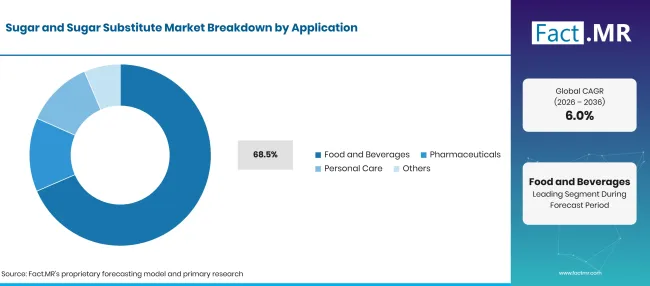
Factmr Sugar And Sugar Substitute Market Breakdown Application | Source: Fact.MR
| Application | Share (2026) |
|---|---|
| Food and Beverages (Leading segment) | 68.5% |
| Other segments combined | 31.5%* |
| Total | 100.0% |
Source: Fact.MR analysis. Updated Oct 21, 2026
Food and beverage processing absorbs more than two-thirds of total global sweetener volumes, driven by continuous recipe reformulations across soft drinks, dairy desserts, bakery fillings, and sugar confectionery. Soft drink manufacturers deploy innovative sweetening systems to satisfy consumer demand for full-flavored zero-sugar sodas, sparkling botanical waters, and functional teas. Supplement manufacturers utilize advanced sweet perception powders to neutralize the bitter astringency of active botanical extracts, caffeine, and amino acids in powdered sports pre-workout drinks. Food scientists are also exploring bio-engineered sweet protein extracts like brazzein and monellin to unlock ultra-intense, clean-breaking sweetness for low-calorie nutrition bars. Retail consumers frequently purchase packaged sugar balance sachets containing optimized erythritol and monk fruit blends for tabletop coffee sweetening and home baking applications.
How does Sales Channel influence distribution?
Supermarkets/Hypermarkets accounts for 53.7% share in 2026.
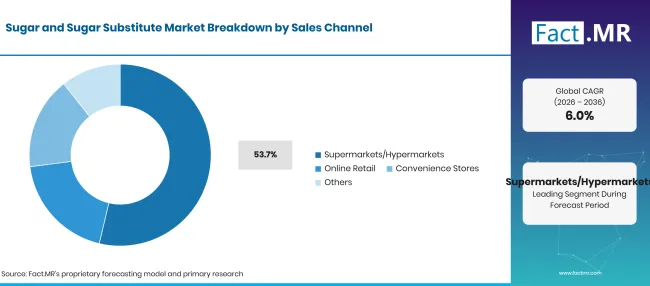
Factmr Sugar And Sugar Substitute Market Breakdown Sales Channel | Source: Fact.MR
| Sales Channel | Share (2026) |
|---|---|
| Supermarkets/Hypermarkets (Leading segment) | 53.7% |
| Other segments combined | 46.3%* |
| Total | 100.0% |
Source: Fact.MR analysis. Updated Oct 21, 2026
Supermarket and hypermarket chains remain the commanding retail distribution channel for consumer sugar and sugar substitute products, offering expansive aisle space dedicated to specialty baking sugars, organic cane crystals, and diverse sugar-free tabletop dispensers. Volume merchandising and competitive multi-pack promotions allow large retail conglomerates to capture consistent household pantry restocking purchases. Online retail channels are demonstrating the fastest percentage growth, powered by direct-to-consumer digital brands marketing zero-glycemic erythritol alternative sweeteners to keto and diabetic communities. Specialty baking outlets and natural grocers cater to culinary purists seeking rare allulose sweeteners that caramelize, brown, and freeze like conventional sucrose. Convenience stores fulfill immediate impulse requirements through pocket-sized sweetening tablets and single-serve tabletop canisters located at coffee dispensing stations.
What is accelerating Sugar and Sugar Substitute Market adoption, and what is holding it back?
Government-mandated sugar levies, heightened metabolic disease awareness, and breakthroughs in natural glycoside synthesis accelerate market expansion. High production costs of rare sugars, complex clean-label sensory matching challenges, and crop yield vulnerabilities in sugarcane and stevia plantations restrict frictionless adoption.
Drivers Impact Analysis
| DRIVER | (~) % IMPACT ON CAGR | GEOGRAPHIC RELEVANCE | IMPACT TIMELINE |
|---|---|---|---|
| Implementation of national sugar reduction taxes on packaged beverages | +1.3% | North America, Western Europe | Short term (<= 2 years) |
| Rising clinical and consumer focus on diabetic and low-glycemic dietary management | +1.1% | Global | Medium term (2–4 years) |
| Advances in enzymatic bioconversion producing clean-tasting Reb-M glycosides | +1.0% | North America, East Asia | Medium term (2–4 years) |
| Consumer preference for clean-label plant-derived natural sweetening ingredients | +0.8% | Global | Medium term (2–4 years) |
| Proliferation of low-calorie functional sports and wellness RTD beverages | +0.6% | North America, Europe | Long term (>= 4 years) |
Source: Fact.MR analysis. Updated Oct 21, 2026
Opportunity Impact Analysis
| OPPORTUNITY | (~) % IMPACT ON CAGR | GEOGRAPHIC RELEVANCE | IMPACT TIMELINE |
|---|---|---|---|
| Commercialization of allulose and tagatose for low-calorie bakery browning | +1.2% | USA, East Asia, Latin America | Short term (<= 2 years) |
| Precision fermentation platforms synthesizing rare sweet proteins cost-effectively | +1.0% | North America, Western Europe | Medium term (2–4 years) |
| Dual-action sweetening fibers combining prebiotics with high-intensity sweetness | +0.8% | Western Europe, Japan | Medium term (2–4 years) |
| Bulk replacement syrups engineered for frozen desserts requiring cryoprotection | +0.6% | Global | Long term (>= 4 years) |
Source: Fact.MR analysis. Updated Oct 21, 2026
Restraints Impact Analysis
| RESTRAINT | (~) % IMPACT ON CAGR | GEOGRAPHIC RELEVANCE | IMPACT TIMELINE |
|---|---|---|---|
| High cost-in-use premiums of rare sugars compared to subsidized commodity sucrose | -1.1% | Emerging Markets, South Asia | Short term (<= 2 years) |
| Regulatory lag in novel sweetener authorizations across select jurisdictions | -0.9% | European Union, East Asia | Medium term (2–4 years) |
| Off-flavor notes and lingering cooling sensations in unblended polyol formulations | -0.7% | Global | Medium term (2–4 years) |
| Agricultural volatility in stevia leaf and sugarcane yields due to climate extremes | -0.5% | Latin America, South Asia | Long term (>= 4 years) |
Source: Fact.MR analysis. Updated Oct 21, 2026
Which countries are scaling the Sugar and Sugar Substitute Market through 2036?
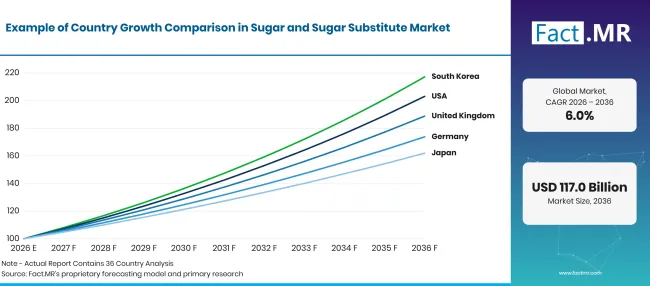
Factmr Sugar And Sugar Substitute Market Growth Index | Source: Fact.MR
| Country | CAGR (2026–2036) |
|---|---|
| USA | 7.3% |
| UK | 6.6% |
| Germany | 5.7% |
| Japan | 4.9% |
| Brazil | 4.2% |
Source: Fact.MR analysis. Updated Oct 21, 2026
Why is the United States leading global market expansion?
7.3% CAGR, driven by intensive commercial beverage reformulation, massive demand for keto and low-carb pantry goods, and rapid FDA approvals for novel non-caloric sweeteners.
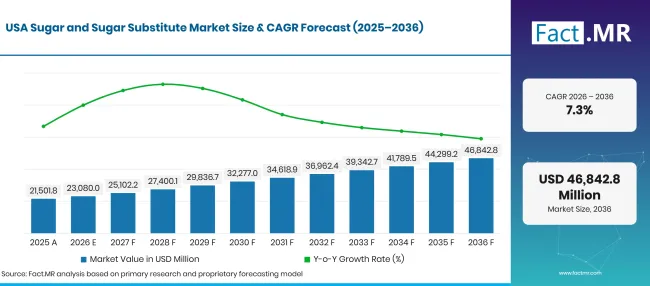
Factmr Sugar And Sugar Substitute Market Forecast Usa | Source: Fact.MR
American food and beverage conglomerates are aggressively stripping added sugars from flagship retail portfolios to comply with updated nutritional facts labeling guidelines and meet consumer demand for metabolic wellness. Major beverage bottlers headquartered in Atlanta, New York, and Texas are transitioning multi-million-case carbonated drink lines to sophisticated blends of bioconverted stevia, monk fruit, and erythritol. The booming commercial market for keto-friendly baked goods, protein bars, and zero-calorie coffee creamers drives steady procurement of bulk natural sweetener blends. Furthermore, culinary developers incorporate liquid organic agave nectar into clean-label cocktail mixers, organic dressings, and artisanal granolas.
How is the United Kingdom advancing sugar reduction?
6.6% CAGR, supported by the mandatory Soft Drinks Industry Levy, aggressive retailer salt-and-sugar targets, and high consumer penetration of tabletop sweeteners.
The United Kingdom represents one of the world's most regulated sweetener markets following the implementation and planned expansion of the national Soft Drinks Industry Levy. British beverage manufacturers reformulated over 70% of commercial soft drinks to avoid punitive tiered tax thresholds, creating permanent baseline demand for high-potency non-nutritive sweeteners. Leading UK supermarket chains are establishing stringent private-label sugar reduction milestones across ready-meals, yogurts, and morning breakfast cereals. British health-conscious shoppers regularly substitute refined white sugar with table-top stevia dispensers and unrefined date sugar solutions to retain natural micronutrients in home culinary preparation.
What sustains consistent botanical demand in Germany?
5.7% CAGR, rooted in Germany's advanced industrial bakery sector, strict organic certification frameworks, and discerning consumer preference for non-GMO ingredients.
Germany stands as Europe’s premier hub for industrial confectionery, commercial baking, and food science research. German consumers demand transparent, clean-label ingredient decks, prompting local processors to reject synthetic artificial sweeteners in favor of certified organic beet sugar, birch xylitol, and water-extracted stevia formulations. Regulatory oversight by the Federal Office of Consumer Protection and Food Safety (BVL) ensures adherence to stringent EFSA additive limits, compelling ingredient manufacturers to maintain impeccable purity documentation. Leading German bakeries and chocolate manufacturers deploy isomalt and tagatose to achieve optimal crystalline snap and shelf stability in sugar-free luxury confectionery.
Why is Japan registering steady adoption across functional foods?
4.9% CAGR, propelled by the thriving Foods with Function Claims (FFC) landscape, an aging demographic managing blood glucose levels, and high appreciation for subtle sweetening profiles.
Japanese food and beverage formulators operate within a sophisticated functional food regulatory environment where sweeteners must deliver verifiable physiological benefits alongside taste. Major beverage corporations in Tokyo and Osaka market green teas and functional soft drinks fortified with rare sugars that moderate postprandial glucose uptake. Japanese consumers traditionally prefer delicate, non-cloying sweetness levels, which favors the integration of enzymatic stevia derivatives and thaumatin over intensely lingering sweeteners. Tokyo personal care and pharmaceutical laboratories also absorb substantial volumes of pharmaceutical-grade sorbitol and mannitol for medicinal throat lozenges and dental care preparations.
What opportunities are unfolding across Brazil?
4.2% CAGR, backed by Brazil's undisputed position as the world's largest sugarcane producer, rising domestic diabetes awareness, and expanding investments in export-grade refined sweeteners.
Brazil’s agricultural landscape is dominated by expansive sugarcane milling infrastructure in São Paulo and Paraná, which supplies both global food markets and domestic bio-ethanol energy grids. While commodity cane sugar remains deeply integrated into local culinary habits, rising urban obesity rates in Rio de Janeiro and Belo Horizonte are sparking commercial interest in reduced-calorie sweetening alternatives. Domestic beverage packagers and dairy cooperatives are expanding diet and light product offerings formulated with sucralose, stevia, and blended polyols. Brazilian ingredient refiners are increasingly leveraging their immense biomass processing capabilities to build dedicated facilities for specialty prebiotic oligosaccharides and export-grade natural sweetener extracts.
Who leads the Sugar and Sugar Substitute Market?
Tate & Lyle PLC maintains a formidable global footprint in commercial texturants and sweetening systems, offering proprietary stevia leaf extracts, allulose syrups, and sucralose formulations engineered for seamless recipe drop-in. Cargill Incorporated commands massive agricultural processing infrastructure spanning raw cane and beet refining, corn-based nutritive syrups, and world-leading fermentation-derived Reb M stevia systems under its EverSweet portfolio. Archer Daniels Midland Company (ADM) delivers comprehensive functional sweetening solutions, combining plant-based sweetening molecules with advanced taste-modification systems and clean-label dietary fibers.
Ingredion Incorporated excels in nature-based starches, specialty nutritive sweeteners, and high-potency stevia extracts optimized for beverage stability and texture enhancement. Roquette Frères leads European polyol and bio-fermentation processing, manufacturing pharmaceutical-grade maltitol, xylitol, and sorbitol alongside novel plant proteins. PureCircle Limited (subsidiary of Ingredion) operates dedicated stevia breeding, agronomy, and extraction networks that lead the commercialization of sustainable steviol glycosides. The Hershey Company actively innovates in reduced-sugar and zero-sugar confectionery, reformulating iconic chocolate and candy brands with erythritol and allulose. Ajinomoto Co. Inc. brings specialized amino acid and high-intensity peptide sweetening expertise, supplying aspartame, advantame, and savory flavor modulators to global pharmaceutical and food processors.
Which companies are the key providers?
Key companies include Tate & Lyle PLC; Cargill Incorporated; Archer Daniels Midland Company; Ingredion Incorporated; Roquette Frères; PureCircle Limited; The Hershey Company; and Ajinomoto Co. Inc.
- Tate & Lyle PLC
- Cargill Incorporated
- Archer Daniels Midland Company
- Ingredion Incorporated
- Roquette Frères
- PureCircle Limited
- The Hershey Company
- Ajinomoto Co. Inc.
Bibliography
- [1] McConnell, M., & Valdes, C. (2025). Sugar and Sweeteners Outlook: January 2025 (SSM-437). USDA Economic Research Service.
- [2] McConnell, M., & Valdes, C. (2025). Sugar and Sweeteners Outlook: December 2025 (SSM-448). USDA Economic Research Service.
- [3] Arshad, M. S., et al. (2025). Beyond Sugar: A Holistic Review of Sweeteners and Their Role in Modern Nutrition. Nutrients, 17(3), 482.
- [4] Sharma, A., et al. (2024). Chronic Use of Artificial Sweeteners: Pros and Cons. Cureus, 16(8), e67512.
- [5] Kim, H., et al. (2026). Factors associated with current non-nutritive sweetener use among adults. Nutrition Research and Practice, 20(5), 612–624.
This Report Answers
- The report evaluates processing efficiencies, crystallization thermodynamics, and sweetening potency ratios across natural, artificial, and conventional sucrose formats.
- Application assessments detail why commercial beverage bottlers and packaged confectionery producers represent more than two-thirds of total industrial volume demand.
- Country-level analysis investigates the fiscal tax policies and dietary guidelines enabling the United States and the United Kingdom to achieve market-leading growth rates.
- Sensory science comparisons examine the temporal lingering profiles and thermal stability of Reb-M, allulose, and erythritol under high-heat commercial processing.
- Competitive profiling benchmarks refining capacities, enzymatic fermentation patents, and agricultural grower contracts across premier global sweetener producers.
What does the Sugar and Sugar Substitute Market cover?
The market encompasses commercial shipments of caloric sugars derived from sugarcane and sugar beets, nutritive carbohydrate syrups, high-intensity artificial sweeteners, and plant-derived natural sweeteners. It evaluates raw material flows into industrial beverage bottling plants, commercial bakeries, packaged dairy lines, confectionery manufacturing facilities, pharmaceutical syrups, and retail tabletop packets. The analysis assesses wholesale merchant refiners, specialty ingredient chemical producers, and consumer-packaged sweetening brands.
What is included in the scope?
The scope covers merchant wholesale shipments of refined white cane sugar, beet sugar, raw unrefined sugars, high fructose corn syrup, invert syrups, polyols (erythritol, xylitol, sorbitol, maltitol), synthetic high-intensity sweeteners (sucralose, aspartame, acesulfame-K, saccharin), and plant extracts (stevia, monk fruit, thaumatin, allulose). Revenue values represent finished sweetener deliveries valued at factory-gate and wholesale distribution pricing points. Bulk sweetener shipments to commercial food manufacturers and packaged retail tabletop boxes are fully integrated within report totals.
What is excluded from the scope?
The scope excludes agricultural farm gate values of unharvested standing sugarcane fields and sugar beet crops prior to initial extraction and milling. Illicit unregulated syrups, synthetic flavor compounds lacking direct sweetening equivalence, and industrial animal feed molasses are outside the scope. Commercial sugar harvesting harvesters, milling centrifuges, and automated bottling packaging machinery are excluded from ingredient valuation totals.
How Was the Analysis Built?
The analysis draws on 120+ sources, 35+ company portfolios, 25+ countries, and more than 20 industry interviews.
- Primary Research: Primary research includes discussions with manufacturers, service providers, technology developers, distributors, end users, and subject-matter experts. These conversations examine purchasing priorities, product adoption, operational challenges, approval requirements, competitive positioning, and the factors that influence wider market acceptance.
- Desk Research: Desk research covers government statistics, regulatory publications, company filings, trade data, technical studies, industry associations, standards, public policy, and other authoritative sources. Every source used in the analysis is documented in the bibliography.
- Market Sizing and Forecasting: Market estimates combine historical performance, demand indicators, pricing and volume trends, segment shares, company participation, country-level growth, adoption patterns, investment activity, and barriers to market expansion.
- Data Validation and Update Cycle: Findings are validated by comparing primary interviews with public data, company activity, regulatory changes, trade patterns, and industry developments. Regular updates review new product launches, capacity changes, partnerships, approvals, and shifts in commercial adoption.
Segmentation
What is the report’s scope and coverage?
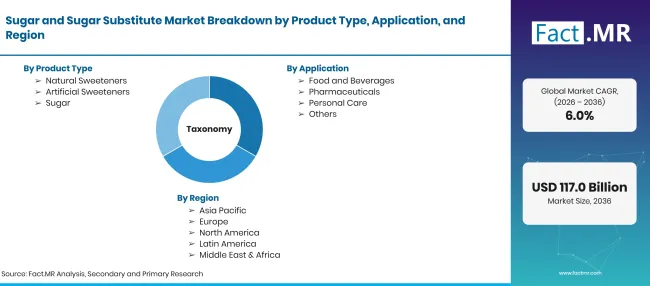
Factmr Sugar And Sugar Substitute Market Taxonomy | Source: Fact.MR
| Attribute | Details |
|---|---|
| Quantitative Units | USD Billion in 2026 to USD Billion by 2036 at 6.0% CAGR |
| Market Definition | Commercial shipments of caloric sucrose, nutritive carbohydrate syrups, and non-caloric natural and artificial sweetener compounds used in food, beverage, pharmaceutical, and consumer applications. |
| Product Type | Natural Sweeteners; Artificial Sweeteners; Sugar |
| Application | Food and Beverages; Pharmaceuticals; Personal Care; Others |
| Sales Channel | Supermarkets/Hypermarkets; Online Retail; Convenience Stores; Others |
| Regions Covered | North America; Latin America; Western Europe; Eastern Europe; East Asia; South Asia & Pacific; Middle East & Africa |
| Countries Covered | USA; UK; Germany; Japan; Brazil |
| Companies Profiled | Tate & Lyle PLC; Cargill Incorporated; Archer Daniels Midland Company; Ingredion Incorporated; Roquette Frères; PureCircle Limited; The Hershey Company; Ajinomoto Co. Inc. |
| Forecast Period | 2026 to 2036 |
| Approach | Primary interviews with food science technologists, agricultural commodity refiners, commercial beverage formulation directors, and retail category managers combined with global import-export trade flow audits. |
Source: Fact.MR analysis. Updated Oct 21, 2026
How is the market segmented?
-
By Product Type
- Natural Sweeteners
- Artificial Sweeteners
- Sugar
-
By Application
- Food and Beverages
- Pharmaceuticals
- Personal Care
- Others
-
By Sales Channel
- Supermarkets/Hypermarkets
- Online Retail
- Convenience Stores
- Others
-
By Region
- North America
- Latin America
- Western Europe
- Eastern Europe
- East Asia
- South Asia & Pacific
- Middle East & Africa
Frequently Asked Questions
How big is the sugar and sugar substitute market in 2026?
What is the CAGR from 2026 to 2036?
Which product type leads?
Which application leads?
Which companies participate in sugar and sugar substitutes?
Who worked on this report


Preview the report firsthand - request a free sample
Free SampleGet the brochure for pricing and purchase details
Download PDF