Erythritol Market (2026 - 2036)

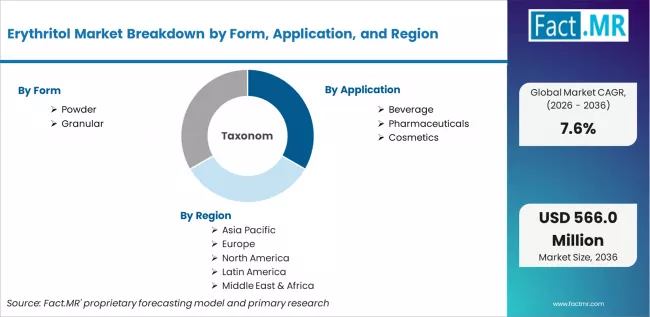
Erythritol Market is segmented by Form (Powder and Granular), Application (Beverages, Pharmaceuticals, Cosmetics, Bakery and Confectionery, Dairy, and Other Applications), and Region. Forecast for 2026 to 2036.

Core Findings

    Erythritol Market Forecast and Outlook By Fact.MR

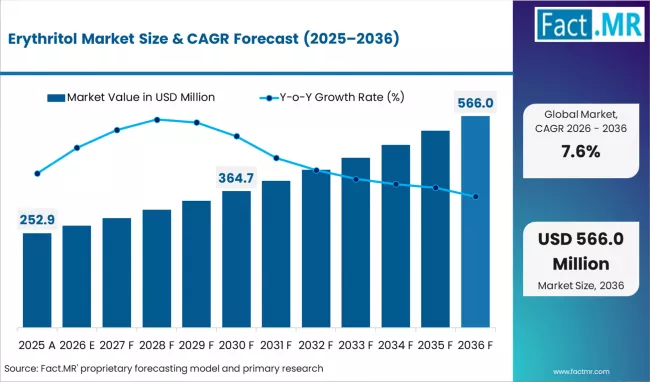
    In 2025, the erythritol market was valued at USD 261.2 million. Based on Fact MR analysis, demand for erythritol is estimated to grow to USD 272.1 million in 2026 and USD 567.0 million by 2036. FMR projects a CAGR of 7.6% during the forecast period.

    The absolute dollar growth from 2026 to 2036 is USD 294.9 million. Expansion reflects steady adoption of sugar alcohol sweeteners in processed foods rather than a structural shift in the global sweetener industry. Erythritol is widely incorporated into sugar free beverages, bakery products, confectionery, and tabletop sweetener formulations. Food manufacturers continue using erythritol to reduce caloric content while maintaining sweetness profiles in packaged foods. Growth remains influenced by fermentation feedstock costs, fluctuations in corn based raw materials, and regulatory scrutiny related to labeling of sugar substitutes in food products.

    China leads with a CAGR of 7.5%, supported by large scale fermentation capacity and strong supply of erythritol for global food ingredient markets. The United States follows with a CAGR of 6.2%, driven by demand for reduced sugar beverages and packaged foods formulated with alternative sweeteners. India records a CAGR of 5.3%, reflecting gradual expansion of sugar substitute use in packaged food products. Germany shows a CAGR of 4.1%, supported by steady demand for low calorie food ingredients across confectionery and bakery sectors. Japan records the slowest growth at 3.9%, reflecting a mature sweetener market where erythritol demand is tied largely to replacement and reformulation cycles. Regulatory oversight and price competition among sugar alcohol producers act as structural constraints in these established markets.
    Erythritol Market Market Value Analysis

    Erythritol Market

    Metric Details
    Industry Size (2026E) USD 272.1 million
    Industry Value (2036F) USD 567.0 million
    CAGR (2026 to 2036) 7.6%

    Erythritol Market Definition

    The Erythritol Market includes the production and trade of erythritol, a low calorie sugar alcohol used as a sweetening ingredient in food and beverage products. Erythritol is produced through the fermentation of glucose derived from corn or other carbohydrate sources. It provides sweetness similar to sugar while containing minimal calories and a low impact on blood glucose levels. This ingredient is commonly used in sugar free foods, beverages, bakery products, confectionery, and dietary supplements. Its primary function is to replace traditional sugar in processed foods while maintaining sweetness and supporting reduced calorie formulations.

    Market Inclusions

    This report covers global and regional market sizes for erythritol with forecast analysis for the study period. The market is segmented by product type including powder and granular erythritol. Application segments include beverages, bakery products, confectionery, dairy products, and dietary supplements. End users include food processing companies, beverage manufacturers, and nutraceutical producers. The report also evaluates pricing structures, production patterns, and selected trade flow analysis across major sweetener manufacturing and consumption regions.

    Market Exclusions

    The report excludes other sugar alcohols such as sorbitol, xylitol, and maltitol that belong to separate sweetener categories. Traditional sugar products including sucrose, fructose, and high fructose corn syrup are not included. The scope also excludes finished consumer food and beverage products that contain erythritol as an ingredient. Non nutritive artificial sweeteners such as aspartame, sucralose, and saccharin are outside the defined market scope.

    Research Methodology

    • Primary Research: Interviews were conducted with sweetener manufacturers, food ingredient suppliers, beverage companies, and product development specialists.
    • Desk Research: Public information was collected from food ingredient industry publications, company reports, regulatory databases, and trade statistics.
    • Market-Sizing and Forecasting: A hybrid model combining bottom up production analysis with top down demand assessment across food and beverage sectors was applied.
    • Data Validation and Update Cycle: Findings were cross verified using multiple industry data sources and expert inputs, with periodic updates conducted as new production and trade data becomes available.

    Summary of the Erythritol Market

    • Market Definition
      • The market comprises the production and commercial distribution of erythritol, a low calorie sugar alcohol used as a sweetening ingredient in food and beverage products. Erythritol is produced through fermentation of glucose derived from corn or other carbohydrate sources and provides sweetness comparable to sugar while contributing minimal calories and a low glycemic response.
    • Demand Drivers
      • Increasing demand for reduced sugar and low calorie food products across packaged food and beverage categories.
      • Rising use of erythritol in sugar free beverages, bakery products, confectionery items, and tabletop sweetener formulations.
      • Expansion of food reformulation initiatives aimed at lowering caloric content and reducing added sugars in processed foods.
      • Growing use of erythritol in blended sweetener systems combined with plant based sweeteners to improve sweetness profiles.
    • Key Segments Analyzed
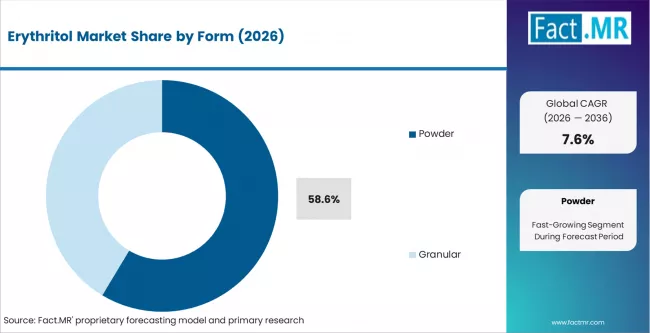
      • Form: Powder erythritol accounts for about 58.6% share due to ease of blending and compatibility with dry ingredient formulations.
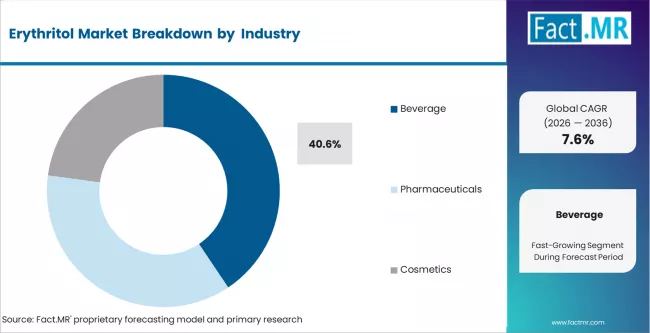
      • Application: Beverage applications represent roughly 40.6% share supported by use in low calorie drinks, flavored water, and carbonated beverages.
      • Food Processing Use: Bakery, confectionery, dairy products, and tabletop sweeteners represent additional demand segments for erythritol.
      • Geography: China records the fastest expansion supported by large scale fermentation capacity and global sweetener supply.
    • Analyst Opinion at Fact MR
      • Shambhu Nath Jha, Principal Consultant, Fact MR, opines, "In this updated edition of the Erythritol Market report, industry participants will observe that demand continues to expand as food manufacturers reformulate products to reduce sugar content. Erythritol allows manufacturers to maintain sweetness while lowering caloric contribution in processed foods. Companies with large scale fermentation infrastructure and stable carbohydrate feedstock supply will maintain stronger positions in global erythritol production."
    • Strategic Implications or Executive Takeaways
      • Expand fermentation capacity to support rising demand for low calorie sweeteners in global food ingredient markets.
      • Strengthen supply chain stability for carbohydrate feedstocks used in erythritol fermentation processes.
      • Develop sweetener blends combining erythritol with plant derived sweeteners to improve flavor balance in reduced sugar foods.
      • Maintain regulatory compliance with food additive approval frameworks governing sugar substitute use.
    • Methodology
      • Primary interviews conducted with sweetener manufacturers, food ingredient suppliers, beverage producers, and product development specialists.
      • Desk research based on food ingredient industry publications, company reports, regulatory databases, and international trade statistics.
      • Market sizing developed through a hybrid approach combining bottom up production analysis and top down demand assessment across food and beverage sectors.
      • Findings validated through multiple industry sources and expert consultations following Fact MR internal modeling standards.

    Segmental Analysis

    Erythritol Market Analysis by Form
    Erythritol Market Analysis By Form

    • Market Overview: Powdered erythritol is projected to account for around 58.6% share of the erythritol market by 2026. Powdered erythritol is widely used in food and beverage formulations due to its ease of blending, consistent sweetness profile, and compatibility with dry ingredient mixtures. Manufacturers prefer powdered erythritol for applications such as tabletop sweeteners, bakery products, confectionery items, and powdered beverage mixes. The ingredient dissolves easily and provides sweetness without contributing calories or raising blood glucose levels. Food processors rely on powdered erythritol to maintain product stability and achieve uniform sweetness distribution in large scale production.
    • Demand Drivers:
      • Food Formulation Compatibility: Powdered erythritol blends easily with dry ingredients in bakery, confectionery, and tabletop sweetener products.
      • Calorie Reduction in Foods: Food manufacturers use erythritol to develop reduced calorie and sugar free food products.
      • Ease of Processing: Powder form allows efficient handling and mixing within automated food manufacturing systems.

    Erythritol Market Analysis by Application
    Erythritol Market Analysis By Application

    • Market Overview: Beverage applications are expected to represent approximately 40.6% share of the erythritol market in 2026. Beverage manufacturers incorporate erythritol as a low calorie sweetener in products such as flavored water, carbonated drinks, energy beverages, and ready to drink teas. The ingredient provides sweetness while maintaining a low glycemic index, which supports its use in reduced sugar beverage formulations. Beverage producers also combine erythritol with other sweeteners to achieve balanced sweetness profiles in sugar free drinks.
    • Demand Drivers:
      • Low Calorie Beverage Development: Beverage manufacturers use erythritol to formulate sugar reduced and calorie controlled drinks.
      • Sugar Reduction Strategies: Food and beverage producers adopt erythritol as an alternative sweetener in response to consumer demand for lower sugar products.
      • Sweetener Blending Applications: Erythritol is often combined with other sweeteners to maintain flavor balance and sweetness intensity in beverage formulations.

    Key Dynamics

    Erythritol Market Drivers, Restraints, and Opportunities

    FMR analysts observe that the erythritol market developed from fermentation-based sugar alcohol production used in reduced-calorie sweetener formulations. Industrial production expanded when erythritol demonstrated stable sweetness properties, low caloric contribution, and compatibility with large-scale food manufacturing processes. The present market valuation reflects the widespread use of erythritol in sugar-free confectionery, beverages, bakery products, and tabletop sweeteners. Demand persists because erythritol provides sweetness while maintaining product texture and shelf stability in formulations designed to reduce sugar content.

    A structural shift is occurring as conventional sugar substitutes compete within a rapidly expanding category of reduced-calorie sweeteners. Traditional sweeteners such as sorbitol and maltitol remain widely used in confectionery products where cost efficiency remains important for large-scale food manufacturing. Erythritol increasingly appears in blended sweetener systems combined with stevia or monk fruit extracts to improve sweetness balance and reduce aftertaste in low-sugar formulations. These blended systems often command higher ingredient prices due to fermentation processing and purification requirements. Even when total sweetener volumes remain stable, higher pricing associated with specialty low-calorie sweetener blends supports gradual value expansion.

    • Sugar Reduction Reformulation: Food manufacturers incorporate erythritol into sugar-reduced beverages, confectionery, and bakery products to maintain sweetness while lowering caloric content.
    • Food Additive Approval: Regulatory frameworks such as the U.S. Food and Drug Administration Generally Recognized as Safe (GRAS) designation and European Food Safety Authority approval for E968 erythritol regulate its use in food products.
    • Asia Fermentation Production: China and South Korea host large fermentation manufacturing facilities that produce erythritol used in global food ingredient supply chains.

    Regional Analysis

    The market analysis covers key global regions, including East Asia, South Asia, North America, and Western Europe. It is segmented geographically, with specific market dynamics for each region. The full report provides a detailed market attractiveness analysis.

    Top Country Growth Comparison Erythritol Market Cagr (2026 2036)

    Country CAGR (2026-2036)
    China 7.5%
    USA 6.2%
    India 5.3%
    Germany 4.1%
    Japan 3.9%

    Source: Fact MR (FMR) analysis, based on proprietary forecasting model and primary research
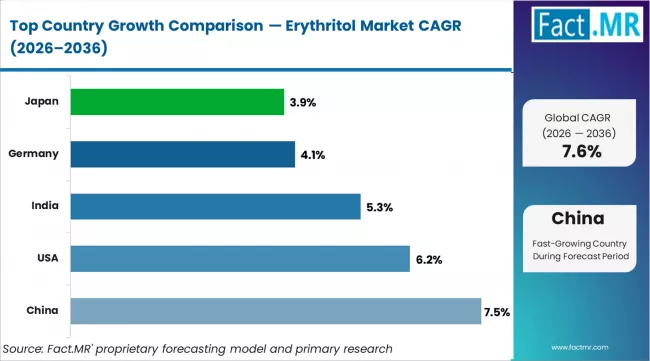
    Erythritol Market Cagr Analysis By Country

    East Asia

    China and Japan represent key markets supported by demand for low calorie sweeteners, food ingredient innovation, and expansion of sugar substitute manufacturing. Key companies include Cargill, Incorporated, Jungbunzlauer Suisse AG, and Shandong Sanyuan Biotechnology.

    • China: Demand for erythritol in China is projected to rise at 7.5% CAGR through 2036. Growth is supported by expansion of sugar substitute manufacturing (03-2025) and ingredient production capacity increases by Shandong Sanyuan Biotechnology (08-2025).
    • Japan: Demand for erythritol in Japan is projected to rise at 3.9% CAGR through 2036. Growth is supported by food ingredient innovation programs promoted by the Ministry of Agriculture, Forestry and Fisheries (04-2025) and product development initiatives by Jungbunzlauer Suisse AG (07-2025).

    South Asia

    India represents a growing market supported by demand for sugar alternatives, functional food ingredients, and low calorie beverage formulations.

    • India: Demand for erythritol in India is projected to rise at 5.3% CAGR through 2036. Growth is supported by food processing initiatives promoted by the Ministry of Food Processing Industries (05-2025) and expansion of ingredient distribution by Cargill, Incorporated (09-2025).

    North America
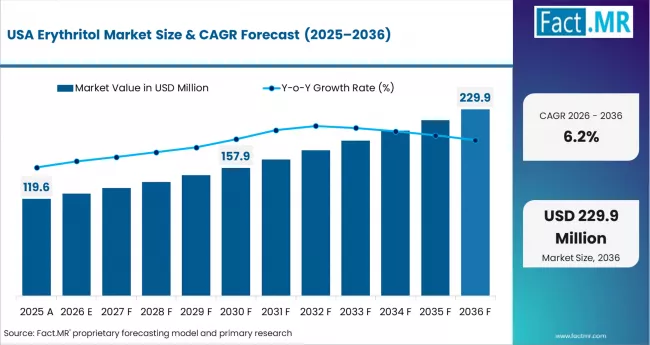
    Erythritol Market Country Value Analysis

    The USA represents an important market supported by demand for sugar free foods, beverage formulations, and dietary ingredient innovation.

    • USA: Demand for erythritol in the U.S. is projected to rise at 6.2% CAGR through 2036. Growth is supported by low calorie product development programs (04-2025) and ingredient manufacturing expansion by Cargill, Incorporated (08-2025).

    Western Europe
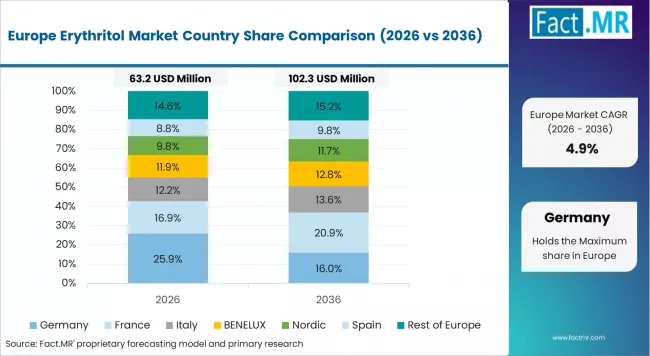
    Erythritol Market Europe Country Market Share Analysis, 2026 & 2036

    Germany represents a key market supported by food ingredient innovation, functional food demand, and sugar substitute adoption.

    • Germany: Demand for erythritol in Germany is projected to rise at 4.1% CAGR through 2036. Growth is supported by food innovation initiatives promoted by the Federal Ministry of Food and Agriculture (03-2025) and ingredient supply expansion by Jungbunzlauer Suisse AG (07-2025).

    Fact MR's analysis of the erythritol market in East Asia, South Asia, North America, and Western Europe consists of country-wise assessments that include China, the USA, India, Germany, and Japan. Readers can find detailed trends, regulatory updates, and company-specific investments shaping market growth in these countries.

    Competitive Landscape
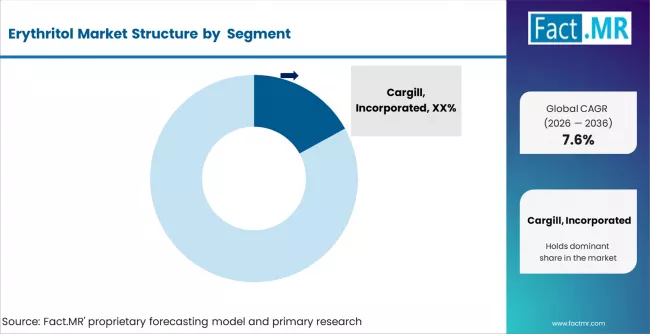
    Erythritol Market Analysis By Company

    Competitive Structure and Buyer Dynamics in the Erythritol Market

    The competitive structure of the Erythritol Market is moderately concentrated, with several global food ingredient producers and regional biotechnology companies supplying large volumes of sugar alcohol sweeteners. Major participants including Cargill, Incorporated, Archer Daniels Midland Company, and Jungbunzlauer Suisse AG maintain strong market presence through extensive fermentation infrastructure and global food ingredient distribution networks. A significant portion of production capacity is also held by Chinese manufacturers such as Shandong Sanyuan Biotechnology Co., Ltd., Zhucheng Dongxiao Biotechnology Co., Ltd., Baolingbao Biology Co., Ltd., and Zhucheng Xingmao Corn Developing Co., Ltd., which operate large scale fermentation facilities. Additional firms including Mitsubishi Corporation, ProAgro GmbH, and Buxtrade GmbH participate through distribution, ingredient processing, or specialized supply channels. Competition in the market is primarily driven by product purity, fermentation efficiency, and supply reliability for food and beverage manufacturers.

    Several companies maintain structural advantages through integrated agricultural sourcing and fermentation based production systems. Firms such as Cargill, Incorporated and Archer Daniels Midland Company benefit from vertically integrated operations that include corn processing, carbohydrate fermentation, and global ingredient distribution. Jungbunzlauer Suisse AG maintains strong technical expertise in fermentation derived ingredients and established relationships with international food manufacturers. Large food and beverage companies often adopt multi supplier procurement strategies to reduce dependency on a single erythritol producer. Procurement teams evaluate suppliers based on product consistency, regulatory compliance, and long term supply stability. This purchasing behavior limits excessive supplier pricing leverage. Producers operating large fermentation facilities with stable raw material access retain stronger negotiating influence within long term ingredient supply contracts.

    Key Players of the Erythritol Market

    • Cargill, Incorporated
    • Archer Daniels Midland Company
    • Jungbunzlauer Suisse AG
    • Shandong Sanyuan Biotechnology Co., Ltd.
    • Zhucheng Dongxiao Biotechnology Co., Ltd.
    • Baolingbao Biology Co., Ltd.
    • Zhucheng Xingmao Corn Developing Co., Ltd.
    • Mitsubishi Corporation
    • ProAgro GmbH
    • Buxtrade GmbH

    Report Scope

    Erythritol Market Breakdown By Form, Application, And Region

    Metric Value
    Quantitative Units USD 272.1 million (2026) to USD 567.0 million (2036), at a CAGR of 7.6%
    Market Definition The erythritol market includes production and commercialization of the sugar alcohol erythritol used as a low-calorie sweetener and functional ingredient across food, beverage, pharmaceutical, and personal care formulations.
    Form Segmentation Powder, Granular
    Application Coverage Beverages, Pharmaceuticals, Cosmetics, Bakery and Confectionery, Dairy, Other Applications
    Key Companies Profiled Cargill, Incorporated, Archer Daniels Midland Company, Jungbunzlauer Suisse AG, Shandong Sanyuan Biotechnology Co., Ltd., Zhucheng Dongxiao Biotechnology Co., Ltd., Baolingbao Biology Co., Ltd., Zhucheng Xingmao Corn Developing Co., Ltd., Mitsubishi Corporation, ProAgro GmbH, Buxtrade GmbH
    Forecast Period 2026 to 2036
    Approach Hybrid top-down and bottom-up market modeling validated through interviews with ingredient manufacturers and food processing companies, supported by production benchmarking, application demand analysis, and trade data evaluation.

    Erythritol Market Key Segments

    • Form :

      • Powder
      • Granular
    • Application :

      • Beverages
      • Pharmaceuticals
      • Cosmetics
      • Bakery and Confectionery
      • Dairy
      • Other Applications
    • Region :

      • North America
        • USA
        • Canada
        • Mexico
      • Europe
        • Germany
        • UK
        • France
        • Italy
        • Spain
        • Nordic Countries
        • BENELUX
        • Rest of Europe
      • Asia Pacific
        • China
        • Japan
        • South Korea
        • India
        • Australia
        • Rest of Asia Pacific
      • Latin America
        • Brazil
        • Argentina
        • Rest of Latin America
      • Middle East and Africa
        • Kingdom of Saudi Arabia
        • United Arab Emirates
        • South Africa
        • Rest of Middle East and Africa
      • Other Regions
        • Oceania
        • Central Asia
        • Other Markets

    Bibliographies

    [1] Ministry of Food Processing Industries, India. (2025). Food processing initiatives.

    [2] Shandong Sanyuan Biotechnology Co., Ltd. (2025). Sugar substitute manufacturing expansion.

    [3] Jungbunzlauer Suisse AG. (2025). Product development initiatives.

    [4] Cargill, Incorporated. (2025). Ingredient manufacturing expansion.

    [5] Ministry of Agriculture, Forestry and Fisheries, Japan. (2025). Food ingredient innovation programs.

    [6] U.S. Food and Drug Administration. (2025). GRAS designation for erythritol.

    [7] European Food Safety Authority. (2023). Approval for E968 erythritol.

    [8] Federal Ministry of Food and Agriculture, Germany. (2025). Food innovation initiatives.

    [9] Archer Daniels Midland Company. (2025). Low calorie product development.

    This Report Addresses

    • Market size estimation and revenue forecasts for the Erythritol Market from 2026 to 2036, supported by fermentation production benchmarks and global sweetener trade indicators.
    • Growth opportunity mapping across powder and granular erythritol formulations produced through carbohydrate fermentation processes.
    • Segment and regional revenue forecasts covering beverages, bakery and confectionery products, dairy products, pharmaceuticals, cosmetics, and other food ingredient applications across major food manufacturing regions.
    • Competition strategy assessment including fermentation production capability, carbohydrate feedstock integration, and ingredient distribution benchmarking among global sweetener manufacturers.
    • Regulatory and food ingredient compliance analysis covering frameworks such as the United States Food and Drug Administration GRAS designation and European Food Safety Authority approval for E968 erythritol governing its use in food formulations.
    • Market report delivery in PDF, Excel, PPT, and interactive dashboard formats designed for food ingredient procurement planning, sugar reduction product development strategy, and sweetener market evaluation.
    • Supply chain vulnerability assessments identifying corn based glucose feedstock availability, fermentation production concentration, and regional sweetener manufacturing dependencies affecting erythritol supply.

    Table of Content

    1. Executive Summary
      • Global Market Outlook
      • Demand to side Trends
      • Supply to side Trends
      • Technology Roadmap Analysis
      • Analysis and Recommendations
    2. Market Overview
      • Market Coverage / Taxonomy
      • Market Definition / Scope / Limitations
    3. Research Methodology
      • Chapter Orientation
      • Analytical Lens and Working Hypotheses
        • Market Structure, Signals, and Trend Drivers
        • Benchmarking and Cross-market Comparability
        • Market Sizing, Forecasting, and Opportunity Mapping
      • Research Design and Evidence Framework
        • Desk Research Programme (Secondary Evidence)
          • Company Annual and Sustainability Reports
          • Peer-reviewed Journals and Academic Literature
          • Corporate Websites, Product Literature, and Technical Notes
          • Earnings Decks and Investor Briefings
          • Statutory Filings and Regulatory Disclosures
          • Technical White Papers and Standards Notes
          • Trade Journals, Industry Magazines, and Analyst Briefs
          • Conference Proceedings, Webinars, and Seminar Materials
          • Government Statistics Portals and Public Data Releases
          • Press Releases and Reputable Media Coverage
          • Specialist Newsletters and Curated Briefings
          • Sector Databases and Reference Repositories
          • Fact.MR Internal Proprietary Databases and Historical Market Datasets
          • Subscription Datasets and Paid Sources
          • Social Channels, Communities, and Digital Listening Inputs
          • Additional Desk Sources
        • Expert Input and Fieldwork (Primary Evidence)
          • Primary Modes
            • Qualitative Interviews and Expert Elicitation
            • Quantitative Surveys and Structured Data Capture
            • Blended Approach
          • Why Primary Evidence is Used
          • Field Techniques
            • Interviews
            • Surveys
            • Focus Groups
            • Observational and In-context Research
            • Social and Community Interactions
          • Stakeholder Universe Engaged
            • C-suite Leaders
            • Board Members
            • Presidents and Vice Presidents
            • R&D and Innovation Heads
            • Technical Specialists
            • Domain Subject-matter Experts
            • Scientists
            • Physicians and Other Healthcare Professionals
          • Governance, Ethics, and Data Stewardship
            • Research Ethics
            • Data Integrity and Handling
        • Tooling, Models, and Reference Databases
      • Data Engineering and Model Build
        • Data Acquisition and Ingestion
        • Cleaning, Normalisation, and Verification
        • Synthesis, Triangulation, and Analysis
      • Quality Assurance and Audit Trail
    4. Market Background
      • Market Dynamics
        • Drivers
        • Restraints
        • Opportunity
        • Trends
      • Scenario Forecast
        • Demand in Optimistic Scenario
        • Demand in Likely Scenario
        • Demand in Conservative Scenario
      • Opportunity Map Analysis
      • Product Life Cycle Analysis
      • Supply Chain Analysis
      • Investment Feasibility Matrix
      • Value Chain Analysis
      • PESTLE and Porter’s Analysis
      • Regulatory Landscape
      • Regional Parent Market Outlook
      • Production and Consumption Statistics
      • Import and Export Statistics
    5. Global Market Analysis 2021 to 2025 and Forecast, 2026 to 2036
      • Historical Market Size Value (USD Million) Analysis, 2021 to 2025
      • Current and Future Market Size Value (USD Million) Projections, 2026 to 2036
        • Y to o to Y Growth Trend Analysis
        • Absolute $ Opportunity Analysis
    6. Global Market Pricing Analysis 2021 to 2025 and Forecast 2026 to 2036
    7. Global Market Analysis 2021 to 2025 and Forecast 2026 to 2036, By Form
      • Introduction / Key Findings
      • Historical Market Size Value (USD Million) Analysis By Form, 2021 to 2025
      • Current and Future Market Size Value (USD Million) Analysis and Forecast By Form, 2026 to 2036
        • Powder
        • Granular
      • Y to o to Y Growth Trend Analysis By Form, 2021 to 2025
      • Absolute $ Opportunity Analysis By Form, 2026 to 2036
    8. Global Market Analysis 2021 to 2025 and Forecast 2026 to 2036, By Application
      • Introduction / Key Findings
      • Historical Market Size Value (USD Million) Analysis By Application, 2021 to 2025
      • Current and Future Market Size Value (USD Million) Analysis and Forecast By Application, 2026 to 2036
        • Beverage
        • Pharmaceuticals
        • Cosmetics
      • Y to o to Y Growth Trend Analysis By Application, 2021 to 2025
      • Absolute $ Opportunity Analysis By Application, 2026 to 2036
    9. Global Market Analysis 2021 to 2025 and Forecast 2026 to 2036, By Region
      • Introduction
      • Historical Market Size Value (USD Million) Analysis By Region, 2021 to 2025
      • Current Market Size Value (USD Million) Analysis and Forecast By Region, 2026 to 2036
        • North America
        • Latin America
        • Western Europe
        • Eastern Europe
        • East Asia
        • South Asia and Pacific
        • Middle East & Africa
      • Market Attractiveness Analysis By Region
    10. North America Market Analysis 2021 to 2025 and Forecast 2026 to 2036, By Country
      • Historical Market Size Value (USD Million) Trend Analysis By Market Taxonomy, 2021 to 2025
      • Market Size Value (USD Million) Forecast By Market Taxonomy, 2026 to 2036
        • By Country
          • USA
          • Canada
          • Mexico
        • By Form
        • By Application
      • Market Attractiveness Analysis
        • By Country
        • By Form
        • By Application
      • Key Takeaways
    11. Latin America Market Analysis 2021 to 2025 and Forecast 2026 to 2036, By Country
      • Historical Market Size Value (USD Million) Trend Analysis By Market Taxonomy, 2021 to 2025
      • Market Size Value (USD Million) Forecast By Market Taxonomy, 2026 to 2036
        • By Country
          • Brazil
          • Chile
          • Rest of Latin America
        • By Form
        • By Application
      • Market Attractiveness Analysis
        • By Country
        • By Form
        • By Application
      • Key Takeaways
    12. Western Europe Market Analysis 2021 to 2025 and Forecast 2026 to 2036, By Country
      • Historical Market Size Value (USD Million) Trend Analysis By Market Taxonomy, 2021 to 2025
      • Market Size Value (USD Million) Forecast By Market Taxonomy, 2026 to 2036
        • By Country
          • Germany
          • UK
          • Italy
          • Spain
          • France
          • Nordic
          • BENELUX
          • Rest of Western Europe
        • By Form
        • By Application
      • Market Attractiveness Analysis
        • By Country
        • By Form
        • By Application
      • Key Takeaways
    13. Eastern Europe Market Analysis 2021 to 2025 and Forecast 2026 to 2036, By Country
      • Historical Market Size Value (USD Million) Trend Analysis By Market Taxonomy, 2021 to 2025
      • Market Size Value (USD Million) Forecast By Market Taxonomy, 2026 to 2036
        • By Country
          • Russia
          • Poland
          • Hungary
          • Balkan & Baltic
          • Rest of Eastern Europe
        • By Form
        • By Application
      • Market Attractiveness Analysis
        • By Country
        • By Form
        • By Application
      • Key Takeaways
    14. East Asia Market Analysis 2021 to 2025 and Forecast 2026 to 2036, By Country
      • Historical Market Size Value (USD Million) Trend Analysis By Market Taxonomy, 2021 to 2025
      • Market Size Value (USD Million) Forecast By Market Taxonomy, 2026 to 2036
        • By Country
          • China
          • Japan
          • South Korea
        • By Form
        • By Application
      • Market Attractiveness Analysis
        • By Country
        • By Form
        • By Application
      • Key Takeaways
    15. South Asia and Pacific Market Analysis 2021 to 2025 and Forecast 2026 to 2036, By Country
      • Historical Market Size Value (USD Million) Trend Analysis By Market Taxonomy, 2021 to 2025
      • Market Size Value (USD Million) Forecast By Market Taxonomy, 2026 to 2036
        • By Country
          • India
          • ASEAN
          • Australia & New Zealand
          • Rest of South Asia and Pacific
        • By Form
        • By Application
      • Market Attractiveness Analysis
        • By Country
        • By Form
        • By Application
      • Key Takeaways
    16. Middle East & Africa Market Analysis 2021 to 2025 and Forecast 2026 to 2036, By Country
      • Historical Market Size Value (USD Million) Trend Analysis By Market Taxonomy, 2021 to 2025
      • Market Size Value (USD Million) Forecast By Market Taxonomy, 2026 to 2036
        • By Country
          • Kingdom of Saudi Arabia
          • Other GCC Countries
          • Turkiye
          • South Africa
          • Other African Union
          • Rest of Middle East & Africa
        • By Form
        • By Application
      • Market Attractiveness Analysis
        • By Country
        • By Form
        • By Application
      • Key Takeaways
    17. Key Countries Market Analysis
      • USA
        • Pricing Analysis
        • Market Share Analysis, 2025
          • By Form
          • By Application
      • Canada
        • Pricing Analysis
        • Market Share Analysis, 2025
          • By Form
          • By Application
      • Mexico
        • Pricing Analysis
        • Market Share Analysis, 2025
          • By Form
          • By Application
      • Brazil
        • Pricing Analysis
        • Market Share Analysis, 2025
          • By Form
          • By Application
      • Chile
        • Pricing Analysis
        • Market Share Analysis, 2025
          • By Form
          • By Application
      • Germany
        • Pricing Analysis
        • Market Share Analysis, 2025
          • By Form
          • By Application
      • UK
        • Pricing Analysis
        • Market Share Analysis, 2025
          • By Form
          • By Application
      • Italy
        • Pricing Analysis
        • Market Share Analysis, 2025
          • By Form
          • By Application
      • Spain
        • Pricing Analysis
        • Market Share Analysis, 2025
          • By Form
          • By Application
      • France
        • Pricing Analysis
        • Market Share Analysis, 2025
          • By Form
          • By Application
      • India
        • Pricing Analysis
        • Market Share Analysis, 2025
          • By Form
          • By Application
      • ASEAN
        • Pricing Analysis
        • Market Share Analysis, 2025
          • By Form
          • By Application
      • Australia & New Zealand
        • Pricing Analysis
        • Market Share Analysis, 2025
          • By Form
          • By Application
      • China
        • Pricing Analysis
        • Market Share Analysis, 2025
          • By Form
          • By Application
      • Japan
        • Pricing Analysis
        • Market Share Analysis, 2025
          • By Form
          • By Application
      • South Korea
        • Pricing Analysis
        • Market Share Analysis, 2025
          • By Form
          • By Application
      • Russia
        • Pricing Analysis
        • Market Share Analysis, 2025
          • By Form
          • By Application
      • Poland
        • Pricing Analysis
        • Market Share Analysis, 2025
          • By Form
          • By Application
      • Hungary
        • Pricing Analysis
        • Market Share Analysis, 2025
          • By Form
          • By Application
      • Kingdom of Saudi Arabia
        • Pricing Analysis
        • Market Share Analysis, 2025
          • By Form
          • By Application
      • Turkiye
        • Pricing Analysis
        • Market Share Analysis, 2025
          • By Form
          • By Application
      • South Africa
        • Pricing Analysis
        • Market Share Analysis, 2025
          • By Form
          • By Application
    18. Market Structure Analysis
      • Competition Dashboard
      • Competition Benchmarking
      • Market Share Analysis of Top Players
        • By Regional
        • By Form
        • By Application
    19. Competition Analysis
      • Competition Deep Dive
        • Cargill, Incorporated
          • Overview
          • Product Portfolio
          • Profitability by Market Segments (Product/Age /Sales Channel/Region)
          • Sales Footprint
          • Strategy Overview
            • Marketing Strategy
            • Product Strategy
            • Channel Strategy
        • Archer Daniels Midland Company
        • Jungbunzlauer Suisse AG
        • Shandong Sanyuan Biotechnology Co., Ltd.
        • Zhucheng Dongxiao Biotechnology Co., Ltd.
        • Baolingbao Biology Co., Ltd.
    20. Assumptions & Acronyms Used

    List Of Table

    • Table 1: Global Market Value (USD Million) Forecast by Region, 2021 to 2036
    • Table 2: Global Market Value (USD Million) Forecast by Form, 2021 to 2036
    • Table 3: Global Market Value (USD Million) Forecast by Application, 2021 to 2036
    • Table 4: North America Market Value (USD Million) Forecast by Country, 2021 to 2036
    • Table 5: North America Market Value (USD Million) Forecast by Form, 2021 to 2036
    • Table 6: North America Market Value (USD Million) Forecast by Application, 2021 to 2036
    • Table 7: Latin America Market Value (USD Million) Forecast by Country, 2021 to 2036
    • Table 8: Latin America Market Value (USD Million) Forecast by Form, 2021 to 2036
    • Table 9: Latin America Market Value (USD Million) Forecast by Application, 2021 to 2036
    • Table 10: Western Europe Market Value (USD Million) Forecast by Country, 2021 to 2036
    • Table 11: Western Europe Market Value (USD Million) Forecast by Form, 2021 to 2036
    • Table 12: Western Europe Market Value (USD Million) Forecast by Application, 2021 to 2036
    • Table 13: Eastern Europe Market Value (USD Million) Forecast by Country, 2021 to 2036
    • Table 14: Eastern Europe Market Value (USD Million) Forecast by Form, 2021 to 2036
    • Table 15: Eastern Europe Market Value (USD Million) Forecast by Application, 2021 to 2036
    • Table 16: East Asia Market Value (USD Million) Forecast by Country, 2021 to 2036
    • Table 17: East Asia Market Value (USD Million) Forecast by Form, 2021 to 2036
    • Table 18: East Asia Market Value (USD Million) Forecast by Application, 2021 to 2036
    • Table 19: South Asia and Pacific Market Value (USD Million) Forecast by Country, 2021 to 2036
    • Table 20: South Asia and Pacific Market Value (USD Million) Forecast by Form, 2021 to 2036
    • Table 21: South Asia and Pacific Market Value (USD Million) Forecast by Application, 2021 to 2036
    • Table 22: Middle East & Africa Market Value (USD Million) Forecast by Country, 2021 to 2036
    • Table 23: Middle East & Africa Market Value (USD Million) Forecast by Form, 2021 to 2036
    • Table 24: Middle East & Africa Market Value (USD Million) Forecast by Application, 2021 to 2036

    List Of Figures

    • Figure 1: Global Market Pricing Analysis
    • Figure 2: Global Market Value (USD Million) Forecast 2021 to 2036
    • Figure 3: Global Market Value Share and BPS Analysis by Form, 2026 and 2036
    • Figure 4: Global Market Y-o-Y Growth Comparison by Form, 2026 to 2036
    • Figure 5: Global Market Attractiveness Analysis by Form
    • Figure 6: Global Market Value Share and BPS Analysis by Application, 2026 and 2036
    • Figure 7: Global Market Y-o-Y Growth Comparison by Application, 2026 to 2036
    • Figure 8: Global Market Attractiveness Analysis by Application
    • Figure 9: Global Market Value (USD Million) Share and BPS Analysis by Region, 2026 and 2036
    • Figure 10: Global Market Y-o-Y Growth Comparison by Region, 2026 to 2036
    • Figure 11: Global Market Attractiveness Analysis by Region
    • Figure 12: North America Market Incremental Dollar Opportunity, 2026 to 2036
    • Figure 13: Latin America Market Incremental Dollar Opportunity, 2026 to 2036
    • Figure 14: Western Europe Market Incremental Dollar Opportunity, 2026 to 2036
    • Figure 15: Eastern Europe Market Incremental Dollar Opportunity, 2026 to 2036
    • Figure 16: East Asia Market Incremental Dollar Opportunity, 2026 to 2036
    • Figure 17: South Asia and Pacific Market Incremental Dollar Opportunity, 2026 to 2036
    • Figure 18: Middle East & Africa Market Incremental Dollar Opportunity, 2026 to 2036
    • Figure 19: North America Market Value Share and BPS Analysis by Country, 2026 and 2036
    • Figure 20: North America Market Value Share and BPS Analysis by Form, 2026 and 2036
    • Figure 21: North America Market Y-o-Y Growth Comparison by Form, 2026 to 2036
    • Figure 22: North America Market Attractiveness Analysis by Form
    • Figure 23: North America Market Value Share and BPS Analysis by Application, 2026 and 2036
    • Figure 24: North America Market Y-o-Y Growth Comparison by Application, 2026 to 2036
    • Figure 25: North America Market Attractiveness Analysis by Application
    • Figure 26: Latin America Market Value Share and BPS Analysis by Country, 2026 and 2036
    • Figure 27: Latin America Market Value Share and BPS Analysis by Form, 2026 and 2036
    • Figure 28: Latin America Market Y-o-Y Growth Comparison by Form, 2026 to 2036
    • Figure 29: Latin America Market Attractiveness Analysis by Form
    • Figure 30: Latin America Market Value Share and BPS Analysis by Application, 2026 and 2036
    • Figure 31: Latin America Market Y-o-Y Growth Comparison by Application, 2026 to 2036
    • Figure 32: Latin America Market Attractiveness Analysis by Application
    • Figure 33: Western Europe Market Value Share and BPS Analysis by Country, 2026 and 2036
    • Figure 34: Western Europe Market Value Share and BPS Analysis by Form, 2026 and 2036
    • Figure 35: Western Europe Market Y-o-Y Growth Comparison by Form, 2026 to 2036
    • Figure 36: Western Europe Market Attractiveness Analysis by Form
    • Figure 37: Western Europe Market Value Share and BPS Analysis by Application, 2026 and 2036
    • Figure 38: Western Europe Market Y-o-Y Growth Comparison by Application, 2026 to 2036
    • Figure 39: Western Europe Market Attractiveness Analysis by Application
    • Figure 40: Eastern Europe Market Value Share and BPS Analysis by Country, 2026 and 2036
    • Figure 41: Eastern Europe Market Value Share and BPS Analysis by Form, 2026 and 2036
    • Figure 42: Eastern Europe Market Y-o-Y Growth Comparison by Form, 2026 to 2036
    • Figure 43: Eastern Europe Market Attractiveness Analysis by Form
    • Figure 44: Eastern Europe Market Value Share and BPS Analysis by Application, 2026 and 2036
    • Figure 45: Eastern Europe Market Y-o-Y Growth Comparison by Application, 2026 to 2036
    • Figure 46: Eastern Europe Market Attractiveness Analysis by Application
    • Figure 47: East Asia Market Value Share and BPS Analysis by Country, 2026 and 2036
    • Figure 48: East Asia Market Value Share and BPS Analysis by Form, 2026 and 2036
    • Figure 49: East Asia Market Y-o-Y Growth Comparison by Form, 2026 to 2036
    • Figure 50: East Asia Market Attractiveness Analysis by Form
    • Figure 51: East Asia Market Value Share and BPS Analysis by Application, 2026 and 2036
    • Figure 52: East Asia Market Y-o-Y Growth Comparison by Application, 2026 to 2036
    • Figure 53: East Asia Market Attractiveness Analysis by Application
    • Figure 54: South Asia and Pacific Market Value Share and BPS Analysis by Country, 2026 and 2036
    • Figure 55: South Asia and Pacific Market Value Share and BPS Analysis by Form, 2026 and 2036
    • Figure 56: South Asia and Pacific Market Y-o-Y Growth Comparison by Form, 2026 to 2036
    • Figure 57: South Asia and Pacific Market Attractiveness Analysis by Form
    • Figure 58: South Asia and Pacific Market Value Share and BPS Analysis by Application, 2026 and 2036
    • Figure 59: South Asia and Pacific Market Y-o-Y Growth Comparison by Application, 2026 to 2036
    • Figure 60: South Asia and Pacific Market Attractiveness Analysis by Application
    • Figure 61: Middle East & Africa Market Value Share and BPS Analysis by Country, 2026 and 2036
    • Figure 62: Middle East & Africa Market Value Share and BPS Analysis by Form, 2026 and 2036
    • Figure 63: Middle East & Africa Market Y-o-Y Growth Comparison by Form, 2026 to 2036
    • Figure 64: Middle East & Africa Market Attractiveness Analysis by Form
    • Figure 65: Middle East & Africa Market Value Share and BPS Analysis by Application, 2026 and 2036
    • Figure 66: Middle East & Africa Market Y-o-Y Growth Comparison by Application, 2026 to 2036
    • Figure 67: Middle East & Africa Market Attractiveness Analysis by Application
    • Figure 68: Global Market - Tier Structure Analysis
    • Figure 69: Global Market - Company Share Analysis

    - FAQs -

    How large is the demand for Erythritol in the global market in 2026?

    Demand for Erythritol in the global market is estimated to be valued at USD 272.1 million in 2026.

    What will be the market size of Erythritol in the global market by 2036?

    Market size for Erythritol is projected to reach USD 567.0 million by 2036.

    What is the expected demand growth for Erythritol in the global market between 2026 and 2036?

    Demand for Erythritol in the global market is expected to grow at a CAGR of 7.6% during 2026 to 2036.

    Which Form Segment is poised to lead global demand by 2026?

    Powder erythritol is expected to remain the dominant form, accounting for approximately 58.6% of the global market share in 2026.

    Which Company is Identified as a Leading Participant in the Erythritol Market?

    Cargill, Incorporated is identified as a leading participant in the erythritol market due to its strong presence in food ingredients and sweetener production.

    What is Driving Erythritol Demand in the United States?

    Demand growth in the United States is supported by increasing use of low calorie sweeteners in beverages, bakery products, and sugar free food formulations.

    What is the United States Growth Outlook in this Report?

    The United States erythritol market is projected to expand at a CAGR of 6.2% during 2026 to 2036.

    Why is China an Important Market for Erythritol?

    China represents a significant market due to its large scale production of food ingredients and growing use of alternative sweeteners in processed foods.

    What is the China Growth Outlook in this Report?

    The China erythritol market is projected to expand at a CAGR of 7.5% during 2026 to 2036.

    What Factors Support Erythritol Demand in India?

    India demand growth is associated with increasing use of sugar substitutes in packaged foods and rising demand for reduced calorie sweetening ingredients.

    What is the India Growth Outlook in this Report?

    The India erythritol market is projected to expand at a CAGR of 5.3% during 2026 to 2036.

    Why is Germany an Important Market for Erythritol in Europe?

    Germany represents a significant market due to established food processing industries and increasing use of alternative sweeteners in functional food products.

    What is the Germany Growth Outlook in this Report?

    The Germany erythritol market is projected to expand at a CAGR of 4.1% during 2026 to 2036.

    Why is Japan Considered an Important Market for Erythritol?

    Japan represents an established market for sugar substitutes due to long standing development of low calorie sweeteners in food manufacturing.

    What is the Japan Growth Outlook in this Report?

    The Japan erythritol market is projected to expand at a CAGR of 3.9% during 2026 to 2036.

    What is Erythritol and What is It Mainly Used For?

    Erythritol is a sugar alcohol used as a low calorie sweetener in food and beverage products, including confectionery, bakery items, and beverages.

    What does Erythritol Market Mean in this Report?`

    Erythritol market refers to global production, trade, and industrial consumption of erythritol used as a sugar substitute in food manufacturing.

    What is Included in the Scope of this Erythritol Market Report?

    The scope includes erythritol categorized by form and its application across food processing, beverage manufacturing, and nutritional product industries.

    What is Excluded from the Scope of this Report?

    Other sugar alcohols and unrelated sweetening ingredients are excluded unless integrated with erythritol based formulations.

    What does Market Forecast Mean on this Page?

    Market forecast represents a projection of future demand based on food ingredient consumption trends and adoption of low calorie sweeteners.

    How is the Erythritol Market Forecast Developed in this Report?

    Forecast analysis is developed using food ingredient production statistics, trade data for sweetening agents, and consumption trends in processed food industries.

    Erythritol Market