- Base Value(2025): 1.02 Bn
- Estimated Value(2026): 1.09 Bn
- Forecast Value (2036): 2.04 Bn
- CAGR (2026 - 2036): 6.5%
Super Magnetic Particles Market Size, Market Forecast and Outlook By Fact.MR
The super magnetic particles market was valued at USD 1.02 billion in 2025, projected to reach USD 1.09 billion in 2026, and is forecast to expand to USD 2.04 billion by 2036 at a 6.5% CAGR. Accelerating adoption of magnetic bead-based assay platforms in clinical diagnostics and pharmaceutical research is driving procurement of functionalized superparamagnetic particles across life science, data storage, and industrial sensor applications. What were once specialized laboratory reagents confined to research institutions have become standardized components in high-throughput screening workflows mandated by regulatory testing protocols.
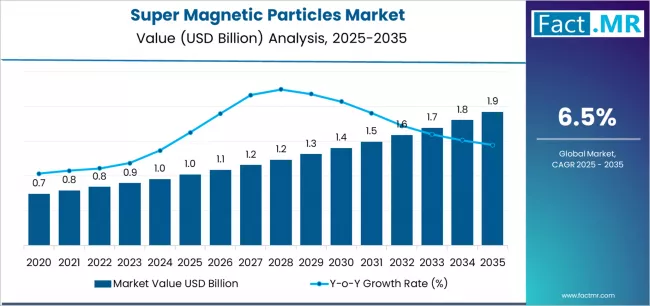
Super Magnetic Particles Market Market Value Analysis | Source: Fact.MR
Summary of Super Magnetic Particles Market
- Market Overview
- The market is valued at USD 1.02 billion in 2025 and is projected to reach USD 2.04 billion by 2036.
- The industry is expected to grow at a 6.5% CAGR from 2026 to 2036, creating an incremental opportunity of USD 0.95 billion.
- The market operates as a high-value, technology-intensive specialty materials category where particle functionalization capabilities, coating precision, and regulatory compliance define competitive positioning.
- Demand and Growth Drivers
- Demand is rising as clinical diagnostic laboratories transition from centrifugation-based separation to magnetic bead-based immunoassay platforms for faster, automated sample processing.
- Pharmaceutical research operations are expanding procurement of functionalized magnetic particles for drug target screening, cell sorting, and nucleic acid isolation workflows.
- Data storage and sensor manufacturing sectors are increasing consumption of rare-earth and ferrite-based magnetic particles for next-generation recording media and magnetoresistive sensor arrays.
- Among key countries, the USA leads at 7.9% CAGR, followed by Mexico at 7.2%, Germany at 6.8%, France at 6.5%, the UK at 6.0%, South Korea at 5.9%, and Japan at 5.6%.
- Product and Segment View
- Super magnetic particles are engineered micro- and nanoscale particles exhibiting superparamagnetic behavior, enabling rapid magnetic separation without residual magnetization after field removal.
- Iron Oxide Nanoparticles dominates the Type segment with 58.0% share in 2026, as iron oxide cores provide the optimal balance of magnetic response, biocompatibility, and surface functionalization versatility for diagnostic and research applications.
- Biomedical Separation & Assays commands 39.0% of the Application segment, reflecting the structural shift toward automated magnetic separation platforms in clinical testing laboratories and pharmaceutical research facilities.
- Silica/Biopolymer-Coated holds 62.0% share in the Coating segment, as silica and biopolymer surface treatments enable stable covalent attachment of antibodies, proteins, and nucleic acid probes.
- Scope includes all grades of superparamagnetic particles for separation, assay, data storage, and industrial sensor applications. It excludes permanent magnet assemblies, bulk ferrite materials, and non-particulate magnetic substrates.
- Geography and Competitive Outlook
- The USA and Mexico are the fastest-growing markets in the Americas, with expanding pharmaceutical research infrastructure and diagnostic laboratory automation driving procurement volumes.
- Germany and the UK represent established European markets where diagnostic kit manufacturers and biosensor developers sustain high-value demand for functionalized magnetic particles.
- Competition is shaped by particle functionalization expertise, ISO 13485 quality certification, and application-specific product portfolios, with key players including Merck KGaA, Thermo Fisher Scientific Inc., Miltenyi Biotec GmbH, Sigma-Aldrich (part of Merck Group), Ocean Nanotech, Inc., Bangs Laboratories, Inc., Chemicell GmbH, Sisco Research Laboratories Pvt. Ltd., Ademtech, S.A..
Super Magnetic Particles Market Key Takeaways
| Metric | Details |
|---|---|
| Industry Size (2026) | USD 1.09 billion |
| Industry Value (2036) | USD 2.04 billion |
| CAGR (2026 to 2036) | 6.5% |
Source: Fact.MR analysis. Updated Mar 27, 2026
Source: Fact.MR, 2026
An absolute dollar opportunity of USD 0.95 billion between 2026 and 2036 positions this as a high-growth specialty materials market where particle functionalization expertise, coating consistency, and batch-to-batch reproducibility define supplier selection criteria. Raw material costs for iron oxide precursors remain stable, but the technical complexity of surface functionalization with silica, streptavidin, or antibody conjugates creates substantial value-added pricing power for established manufacturers. Quality management costs associated with ISO 13485 compliance for diagnostic-grade particles add structural pricing layers that limit new entrant penetration.
All major super magnetic particles markets reflect accelerated procurement trajectories. USA sets the pace with a 7.9% CAGR, followed by Mexico at 7.2% as pharmaceutical contract research operations expand bead-based assay capacity. Germany advances at a 6.8% rate, supported by diagnostic kit manufacturers scaling magnetic separation platforms. France tracks at 6.5% and the UK registers a 6.0% expansion trajectory. South Korea expands at 5.9% while Japan maintains a 5.6% pace anchored by its established biosensor and data storage industries.
Imperatives for Stakeholders in Super Magnetic Particles Market
Design for biomedical precision, not just magnetism
- Offer complete magnetic systems: super magnetic particles + surface modification + biocompatibility testing + application protocols + technical documentation + research support programs.
- Preconfigured biomedical workflows: particle specifications, separation procedures, quality control, and supply chain systems for biotechnology operations.
Supply chain integration readiness
- Real-time inventory monitoring, quality tracking, and smart logistics integration (biomedical management systems, research monitoring platforms).
Quality-by-design approach
- Advanced synthesis systems, consistent biocompatibility control, biomedical safety compatibility, and comprehensive documentation systems.
Value-based pricing models
- Clear base particle price + transparent service tiers (technical support, biocompatibility assurance, delivery guarantees); contracts for supply reliability and research services.
Segmental Analysis
Primary Classification: The market segments by type into iron oxide nanoparticles, ferrites, and rare-earth magnets, representing evolution from basic magnetic materials to sophisticated biocompatible solutions for advanced biomedical applications optimization.
Secondary Classification: Application segmentation divides the market into biomedical separation and assays, data storage and sensors, and industrial applications, reflecting distinct requirements for biocompatibility, magnetic performance, and application specifications.
Tertiary Classification: Coating segmentation covers silica/biopolymer-coated and polymer-coated applications, while distribution channels span direct manufacturer sales, biotechnology distributors, and specialized magnetic particle suppliers.
Regional Classification: Geographic distribution covers North America, Europe, Asia Pacific, and other regions, with developed biotechnology markets leading adoption while emerging economies show strong growth patterns driven by biomedical expansion and magnetic technology infrastructure development programs.
The segmentation structure reveals technology progression from traditional magnetic materials toward sophisticated biocompatible particles with enhanced separation capabilities, while application diversity spans from biomedical diagnostics to specialized data storage applications requiring precise magnetic specifications.
By Type, the Iron Oxide Nanoparticles Segment Accounts for Dominant Market Share
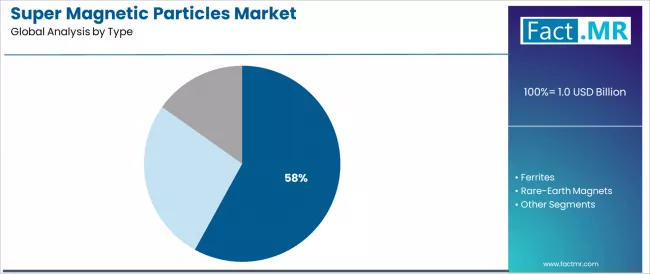
Super Magnetic Particles Market Analysis By Type | Source: Fact.MR
Market Position: Iron oxide nanoparticles command the leading position in the super magnetic particles market with 58.0% market share through proven biomedical technologies, including efficient magnetic separation systems, reliable biocompatibility mechanisms, and biomedical optimization that enable biotechnology companies to achieve optimal separation conditions across diverse research and diagnostic environments.
Value Drivers: The segment benefits from biomedical researcher preference for biocompatible magnetic systems that provide consistent separation performance, biomedical reliability, and safety compatibility without requiring specialized handling requirements. Advanced iron oxide processing features enable enhanced magnetic uniformity, reliable separation control, and integration with existing biomedical management systems, where biocompatibility and separation effectiveness represent critical research requirements.
Competitive Advantages: Iron oxide nanoparticles differentiate through proven biomedical reliability, safety compatibility, and integration with established research management systems that enhance biomedical effectiveness while maintaining optimal safety standards suitable for diverse biomedical applications.
Key market characteristics:
- Advanced magnetic designs with optimized biocompatibility uniformity and separation reliability capabilities
- Enhanced biomedical effectiveness, enabling 92-96% satisfaction with consistent separation performance
- Safety compatibility, including biocompatibility optimization, separation efficiency, and quality monitoring for biomedical operations
Ferrites Show Electronic Market Position
Ferrites maintain a 27.0% market position in the super magnetic particles market due to their electronic configuration advantages and industrial application benefits. These systems appeal to manufacturers requiring magnetic solutions with enhanced electronic properties for industrial magnetic operations. Market growth is driven by electronic component expansion, emphasizing magnetic solutions and performance consistency through optimized electronic handling designs.
Rare-Earth Magnets Serve High-Performance Markets
Rare-earth magnets capture 15.0% market share through high-performance magnetic requirements and specialized applications. These particles provide advanced solutions for high-field applications, permanent magnets, and processing where standard magnetic materials limit conventional particle deployment.
By Application, the Biomedical Separation & Assays Segment Shows Strong Growth
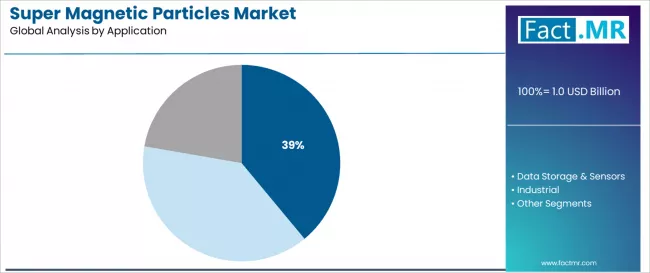
Super Magnetic Particles Market Analysis By Application | Source: Fact.MR
Market Context: Biomedical separation and assays applications demonstrate strong market presence in the super magnetic particles market with 39.0% market share due to widespread adoption of precision medicine technologies and increasing focus on cell separation, diagnostic assays, and biomedical research that maximize separation effectiveness while maintaining biomedical safety integrity standards.
Appeal Factors: Biotechnology researchers prioritize particle biocompatibility, separation precision, and integration with existing research infrastructure that enables coordinated biomedical procedures across multiple research protocols. The segment benefits from substantial biotechnology industry investment and biomedical modernization programs that emphasize acquisition of advanced magnetic particle systems for research optimization and diagnostic applications.
Growth Drivers: Biomedical expansion programs incorporate magnetic particles as essential components for research operations, while diagnostic growth increases demand for reliable separation capabilities that comply with biomedical standards and enhance research performance.
Application dynamics include:
- Strong growth in biotechnology facilities and research networks requiring advanced magnetic particle capabilities
- Increasing adoption in diagnostic chains and research applications for biotechnology operators
- Rising integration with research control systems for separation optimization and biomedical assurance
Data Storage & Sensors Applications Maintain Technology Demand
Data storage and sensors applications capture 28.0% market share through technology requirements in data recording, sensor technologies, and electronic applications. These facilities demand high-performance magnetic particle systems capable of supporting technology protocols while providing data reliability and sensor precision capabilities.
Industrial Applications Show Manufacturing Growth
Industrial applications account for 33.0% market share, including manufacturing processes, specialty applications, and industrial uses requiring reliable magnetic capabilities for industry-focused magnetic operations and manufacturing optimization.
By Coating, Silica/Biopolymer-Coated Particles Drive Market Leadership
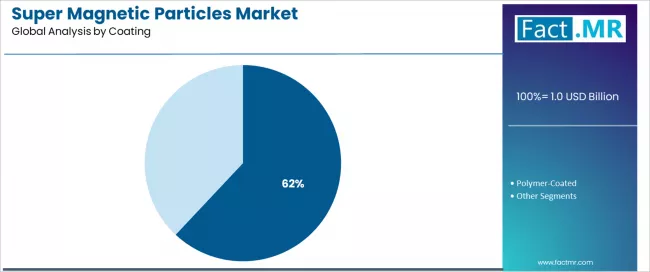
Super Magnetic Particles Market Analysis By Coating | Source: Fact.MR
Market Context: Silica/biopolymer-coated particles dominate the market with 62.0% market share, reflecting the primary demand source for magnetic particle technology in biocompatible applications and biomedical research optimization.
Business Model Advantages: Silica/biopolymer-coated particles provide direct market demand for biocompatible surface systems, driving biocompatibility innovation and safety optimization while maintaining biomedical control and performance consistency requirements.
Operational Benefits: Silica/biopolymer-coated particles offer biocompatibility optimization, surface enhancement, and biomedical quality improvement that drive consistent demand for magnetic particle systems while providing access to latest biomedical technologies.
Polymer-Coated Applications Show Specialized Demand
Polymer-coated applications capture 38.0% market share through specialized magnetic requirements in custom applications, specialized coatings, and industrial uses. These applications demand advanced coating systems capable of supporting specialized protocols while providing custom properties and application control capabilities.
What are the Drivers, Restraints, and Key Trends of the Super Magnetic Particles Market?
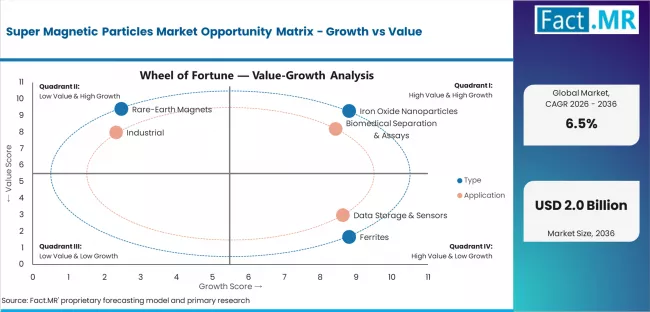
Super Magnetic Particles Market Opportunity Matrix Growth Vs Value | Source: Fact.MR
| Category | Factor | Impact | Why It Matters |
|---|---|---|---|
| Driver | Precision medicine advancement & diagnostic growth (personalized medicine, biomarker detection) | ★★★★★ | Growing medical precision requires advanced magnetic particle systems with enhanced separation capabilities and biocompatible properties proven effective across biomedical applications. |
| Driver | Biotechnology research expansion & drug discovery growth (cell therapy, pharmaceutical research) | ★★★★★ | Transforms research requirements from "basic separation" to "precision biomedical systems"; researchers that offer reliable magnetic systems and biocompatibility features gain competitive advantage. |
| Driver | Data storage density & sensor technology advancement (high-density storage, IoT sensors) | ★★★★☆ | Global technology activities need sophisticated, reliable magnetic particles; demand for performance-controlled and quality-assured magnetic solutions expanding addressable market. |
| Restraint | High particle cost & research budget constraints (especially for smaller research institutions) | ★★★★☆ | Smaller research organizations defer magnetic particle adoption; increases price sensitivity and slows advanced particle adoption in budget-conscious markets. |
| Restraint | Alternative separation technologies (microfluidics, optical separation, different magnetic methods) | ★★★☆☆ | Alternative separation methods offer established research operations and different cost structures, potentially limiting magnetic particle adoption in specific research applications. |
| Trend | Surface functionalization & bioconjugation advancement (targeted delivery, specific binding) | ★★★★★ | Advanced functionalization properties, biomedical optimization, and targeting analytics transform research operations; biocompatibility integration and precision enhancement become core value propositions. |
| Trend | Nanotechnology integration & multifunctional particles (theranostics, combined functionality) | ★★★★☆ | Multifunctional magnetic solutions for advanced applications and therapeutic requirements; specialized functionality capabilities drive competition toward comprehensive solutions. |
Source: Fact.MR analysis. Updated Mar 27, 2026
Analysis of the Super Magnetic Particles Market by Key Country
The super magnetic particles market demonstrates varied regional dynamics with growth leaders including USA (7.9% growth rate) and Mexico (7.2% growth rate) driving expansion through biotechnology infrastructure development and research modernization initiatives. Steady performers encompass Germany (6.8% growth rate), France (6.5% growth rate), and developed regions, benefiting from established research networks and biotechnology sector growth.
Growing markets feature UK (6.0% growth rate), South Korea (5.9% growth rate), and Japan (5.6% growth rate), where biotechnology advancement and research optimization requirements support strong growth patterns. Regional synthesis reveals North American markets leading adoption through biotechnology expansion and research development, while European countries maintain strong expansion supported by medical research and biotechnology infrastructure investment. Asian markets show solid growth driven by biotechnology applications and research technology integration trends.
.webp "Top Country Growth Comparison Super Magnetic Particles Market Cagr (2026 2036)")
Top Country Growth Comparison Super Magnetic Particles Market Cagr (2026 2036) | Source: Fact.MR
| Region/Country | 2026-2036 Growth | How to win | What to watch out |
|---|---|---|---|
| USA | 7.9% | Focus on biomedical solutions | Regulatory changes; research funding fluctuations |
| Germany | 6.8% | Lead with quality systems | Research budget constraints; regulatory compliance |
| France | 6.5% | Provide research applications | Economic factors; funding competition |
| UK | 6.0% | Offer biotechnology expertise | Brexit effects; research collaboration changes |
| Mexico | 7.2% | Push accessible solutions | Infrastructure limitations; research capacity |
| South Korea | 5.9% | Focus on technology integration | Market constraints; competitive dynamics |
| Japan | 5.6% | Emphasize precision manufacturing | Demographic challenges; research priorities |
Source: Fact.MR analysis. Updated Mar 27, 2026
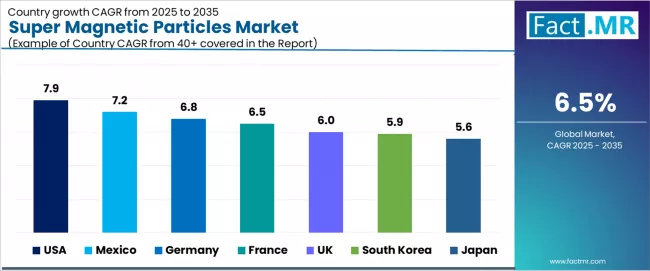
Super Magnetic Particles Market Cagr Analysis By Country | Source: Fact.MR
USA Drives Biotechnology Magnetic Leadership
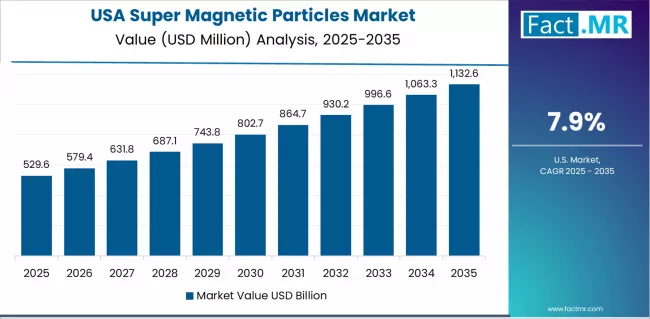
Super Magnetic Particles Market Country Value Analysis | Source: Fact.MR
USA establishes biotechnology magnetic leadership through comprehensive biomedical development programs and advanced biotechnology infrastructure expansion, integrating super magnetic particles as standard components in research networks and biomedical operations. The country 7.9% growth rate reflects industry initiatives promoting biomedical innovation capabilities and domestic biotechnology development that drives adoption of advanced magnetic particle systems in research and diagnostic facilities. Growth concentrates in major biotechnology regions, including Boston, San Francisco, and Research Triangle, where biomedical development showcases integrated magnetic systems that appeal to researchers seeking separation precision capabilities and biomedical management applications.
American manufacturers are developing advanced magnetic particle solutions that combine domestic innovation advantages with biomedical control features, including enhanced biocompatibility capabilities and improved separation systems. Distribution channels through biotechnology distributors and specialized suppliers expand market access, while industry support for biomedical advancement supports adoption across diverse research and diagnostic segments.
Strategic Market Indicators:
- Government biotechnology programs providing substantial support for domestic magnetic particle technology development
- Export market development for advanced magnetic solutions targeting international biomedical markets
Germany Maintains Biomedical Quality Excellence
Germany advanced biotechnology market demonstrates sophisticated magnetic particle deployment with documented biocompatibility effectiveness in research applications and biomedical facilities through integration with existing magnetic systems and biotechnology infrastructure. The country leverages engineering expertise in magnetic technologies and biomedical systems integration to maintain a 6.8% growth rate. Biotechnology facilities showcase premium installations where magnetic particle systems integrate with comprehensive research platforms and biomedical management systems to optimize biocompatibility effectiveness and research outcomes.
German manufacturers prioritize system quality and biomedical compliance in magnetic particle development, creating demand for premium systems with advanced features, including biomedical integration and biocompatibility monitoring systems. The market benefits from established biotechnology infrastructure and willingness to invest in advanced magnetic technologies that provide long-term biomedical benefits and compliance with international biotechnology standards.
Market Intelligence Brief:
- Engineering focuses on biomedical standardization and biocompatibility compliance, driving premium segment growth
- Technology collaboration between German manufacturers and international biotechnology companies
- Professional training programs expanding magnetic particle system integration in biomedical scenarios
France Shows Biotechnology Innovation Leadership
France market expansion benefits from diverse biotechnology demand, including biomedical research development in biotechnology regions, facility upgrades, and government biotechnology programs that increasingly incorporate advanced magnetic particle solutions for biomedical applications. The country maintains a 6.5% growth rate, driven by rising biotechnology activity and increasing recognition of advanced magnetic benefits, including enhanced biomedical management and research effectiveness.
Market dynamics focus on sophisticated magnetic particle solutions that balance biocompatibility performance with research considerations important to French biotechnology operators. Growing biomedical modernization creates continued demand for modern magnetic particle systems in new biotechnology infrastructure and research facility modernization projects.
Strategic Market Considerations:
- Biotechnology and biomedical segments leading growth with focus on biocompatibility control and research applications
- Regional biotechnology requirements driving diverse product portfolio from standard systems to premium solutions
- Technology integration challenges balanced by strong biocompatibility effectiveness and research capabilities
United Kingdom Shows Biotechnology Research Expertise
United Kingdom biotechnology market demonstrates integrated magnetic particle deployment with documented biocompatibility effectiveness in research applications and biomedical facilities through integration with existing magnetic systems and biotechnology infrastructure. The country maintains a 6.0% growth rate, supported by biomedical research programs and biotechnology quality requirements that promote advanced magnetic particle systems for biomedical applications. Biotechnology facilities across regions showcase systematic installations where magnetic particle systems integrate with comprehensive research platforms to optimize biocompatibility control and research outcomes.
UK biotechnology providers prioritize system reliability and biomedical compatibility in magnetic particle procurement, creating demand for validated systems with proven biotechnology features, including biocompatibility monitoring integration and research management systems. The market benefits from established biotechnology infrastructure and quality requirements that support magnetic particle technology adoption and biocompatibility effectiveness.
Market Intelligence Brief:
- Biomedical compatibility requirements driving standardized magnetic particle system adoption
- Biotechnology partnerships providing biocompatibility validation and effectiveness data
- Technology integration between UK biotechnology providers and international magnetic particle companies
Mexico Emerges as Accessible Biotechnology Market
Mexico market growth benefits from expanding biotechnology access, including biomedical modernization in research centers, biotechnology facility upgrades, and government biotechnology programs that increasingly incorporate magnetic particle solutions for biomedical applications. The country maintains a 7.2% growth rate, driven by rising biotechnology activity and increasing recognition of magnetic particle benefits, including enhanced accessibility and biomedical effectiveness.
Market dynamics focus on accessible magnetic particle solutions that meet international biomedical standards and biocompatibility effectiveness requirements important to Mexican biotechnology operators. Growing biomedical development creates continued demand for modern magnetic particle systems in new biotechnology infrastructure and biomedical facility modernization projects.
Strategic Market Considerations:
- Biotechnology modernization and biomedical segments leading growth with focus on accessibility and biocompatibility applications
- Regional biotechnology requirements driving affordable product adoption from standard systems to integrated solutions
- Infrastructure development challenges balanced by strong biotechnology growth and modernization capabilities
Japan Drives Quality Biotechnology Technology
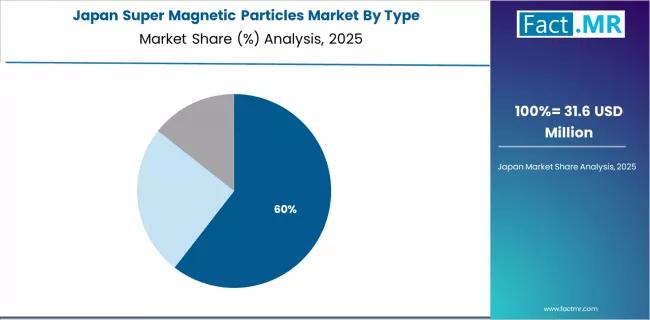
Super Magnetic Particles Market Japan Market Share Analysis By Type | Source: Fact.MR
Japan market growth benefits from precision biotechnology demand, including advanced biomedical facilities in research regions, quality integration, and biotechnology enhancement programs that increasingly incorporate magnetic particle solutions for biomedical applications. The country maintains a 5.6% growth rate, driven by biotechnology technology advancement and increasing recognition of precision magnetic particle benefits, including accurate biocompatibility management and enhanced biomedical outcomes.
Market dynamics focus on high-precision magnetic particle solutions that meet Japanese quality standards and biotechnology effectiveness requirements important to biotechnology operators. Advanced biotechnology technology adoption creates continued demand for sophisticated magnetic particle systems in biomedical facility infrastructure and biotechnology modernization projects.
Strategic Market Considerations:
- Biotechnology and precision segments leading growth with focus on advanced magnetic particle systems and quality applications
- Quality requirements driving premium product adoption from sophisticated magnetic particle systems
- Technology integration challenges balanced by strong biotechnology effectiveness and precision capabilities
- Biotechnology quality initiatives beginning to influence procurement standards and magnetic particle requirements
South Korea Establishes Biotechnology Integration Excellence
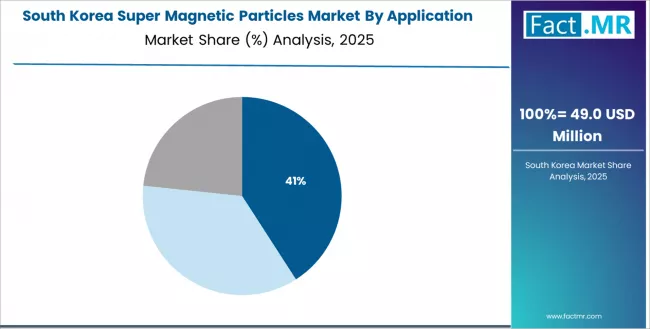
Super Magnetic Particles Market South Korea Market Share Analysis By Application | Source: Fact.MR
South Korea establishes strong market presence through comprehensive biotechnology programs and biomedical infrastructure development, integrating magnetic particle systems across biotechnology and biomedical applications. The country 5.9% growth rate reflects biotechnology industry development and biomedical adoption that supports use of magnetic particle systems in biotechnology facilities and biomedical operations. Growth concentrates in major biotechnology regions, where biomedical technology showcases deployment that appeals to researchers seeking proven magnetic particle capabilities and biotechnology management applications.
Korean manufacturers leverage established biotechnology relationships and technical support capabilities, including biomedical design programs and training support that create customer relationships and operational advantages. The market benefits from biotechnology standards and biomedical safety requirements that support magnetic particle system use while advancing technology development and biotechnology optimization.
Strategic Market Indicators:
- Established biotechnology standards providing consistent demand for magnetic particle technology advancement
- Biotechnology integration programs expanding magnetic particle capabilities in biomedical scenarios
Europe Market Split by Country
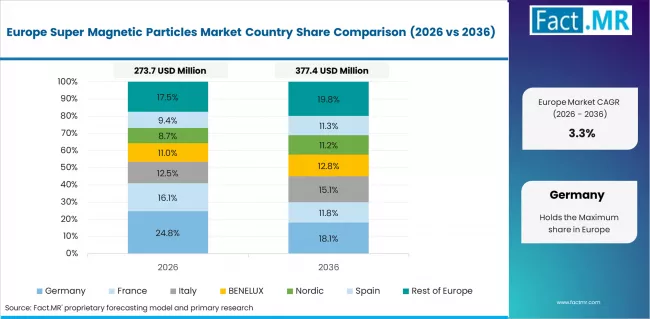
Super Magnetic Particles Market Europe Country Market Share Analysis, 2026 & 2036 | Source: Fact.MR
The super magnetic particles market in Europe is projected to grow strongly over the forecast period, with Germany expected to maintain its leadership position with approximately 29.3% market share in 2026, declining slightly to 28.9% by 2036, supported by its advanced biotechnology infrastructure and major research hubs. The United Kingdom follows with a 25.8% share in 2026, projected to reach 25.4% by 2036, driven by comprehensive biomedical operations and research programs. France holds a 23.5% share in 2026, expected to increase to 23.9% by 2036 through specialized biotechnology applications and research compliance requirements. Italy commands a 12.7% share, while Spain accounts for 5.9% in 2026. The rest of Europe region is anticipated to gain momentum, expanding its collective share from 2.8% to 3.1% by 2036, attributed to increasing magnetic particle adoption in Nordic biotechnology countries and emerging Eastern European research facilities implementing biotechnology modernization programs.
Advanced Biocompatibility Standards Define Japanese Magnetic Market Dynamics
Japanese Super Magnetic Particles operations reflect the country's exacting quality standards and sophisticated biomedical expectations. Major biotechnology manufacturers maintain rigorous supplier qualification processes that often exceed international standards, requiring extensive documentation, biocompatibility testing, and facility audits that can take 15-20 months to complete. This creates high barriers for new suppliers but ensures consistent quality that supports premium magnetic particle positioning.
The Japanese market demonstrates unique application preferences with Biomedical Separation & Assays accounting for 50.0%, Data Storage & Sensors 30.0%, and Industrial 20.0%. Companies require specific biocompatibility specifications and performance requirements that differ from Western applications, driving demand for customized magnetic particle capabilities.
Japanese market demonstrates unique type preferences with Iron Oxide Nanoparticles accounting for 65.0%, Ferrites 25.0%, and Rare-Earth Magnets 10.0%. Companies require specific magnetic control and biocompatibility specifications that differ from Western applications, driving demand for customized magnetic technologies.
Regulatory oversight emphasizes comprehensive biomedical management and safety requirements that surpass most international standards. The biotechnology registration system requires detailed biocompatibility information, creating advantages for suppliers with transparent safety chains and comprehensive biomedical documentation systems.
Supply chain management focuses on relationship-based partnerships rather than purely transactional procurement. Japanese companies typically maintain long-term supplier relationships spanning decades, with annual contract negotiations emphasizing biocompatibility consistency over price competition. This stability supports investment in specialized biotechnology equipment tailored to Japanese magnetic particle specifications.
Research Excellence Drive Magnetic Market Dynamics in South Korea
South Korean Super Magnetic Particles operations reflect the country's advanced biotechnology sector and research-oriented business model. Major biotechnology companies drive sophisticated procurement strategies, establishing direct relationships with global suppliers to secure consistent quality and pricing for their biomedical and research magnetic operations targeting both domestic and international markets.
The Korean market demonstrates particular strength in coating distribution with Silica/Biopolymer-Coated accounting for 70.0%, Polymer-Coated 30.0%. This research-focused approach creates demand for specific biocompatibility specifications that differ from Western applications, requiring suppliers to adapt magnetic particle processing and surface modification techniques.
Regulatory frameworks emphasize magnetic particle safety and biocompatibility standards, with Korean biotechnology administration standards often exceeding international requirements. This creates barriers for smaller magnetic particle suppliers but benefits established manufacturers who can demonstrate research capabilities. The regulatory environment particularly favors suppliers with comprehensive certification and biocompatibility documentation systems.
Supply chain efficiency remains critical given Korea's research focus and innovation dependence. Companies increasingly pursue long-term contracts with suppliers in United States, Germany, and Japan to ensure reliable access to advanced materials while managing research development risks. Technical innovation investments support performance advancement during competitive market periods.
The market faces pressure from research advancement pace and competition from international manufacturers, driving innovation investments and technology development among domestic producers. The premium positioning of Korean biotechnology brands internationally continues to support demand for high-quality magnetic particle materials that meet stringent biocompatibility specifications.
Competitive Landscape of the Super Magnetic Particles Market
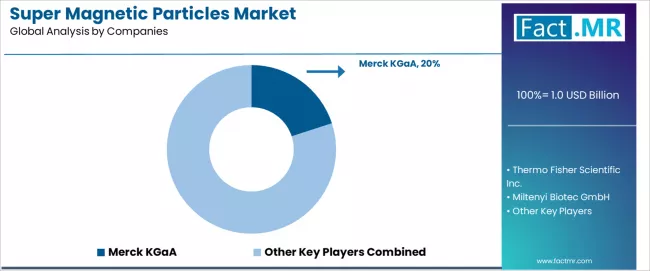
Super Magnetic Particles Market Analysis By Company | Source: Fact.MR
Structure: Approximately 12-18 credible players; top 4-6 hold 68-73% by revenue.
Leadership is maintained through: technology innovation, biocompatibility expertise, and product development (synthesis technology + surface modification + biomedical applications).
What is commoditizing: basic magnetic particles and standard coating technologies.
Margin Opportunities: custom biomedical services, research integration, and incorporation into biotechnology workflows (separation optimization, biocompatibility analytics).
| Stakeholder | What they actually control | Typical strengths | Typical blind spots |
|---|---|---|---|
| Research leaders | R&D capabilities, biocompatibility expertise, synthesis innovation | Latest technologies first; superior biomedical features; research leadership | Cost pressures; market accessibility challenges |
| Established brands | Distribution networks, brand recognition, market presence | Wide availability, proven reliability, research trust | Technology refresh cycles; innovation pace |
| Biocompatibility specialists | Surface modification expertise, premium positioning, biomedical markets | Win biomedical applications; superior biocompatibility | Market size limitations; cost sensitivity |
| Application integrators | Technical support, research expertise, customer solutions | Specialized market access; integrated solutions | Technology dependence; market concentration |
| Synthesis producers | Manufacturing capabilities, cost optimization, scale advantages | Production efficiency; competitive pricing | Technology gaps; biocompatibility challenges |
Source: Fact.MR analysis. Updated Mar 27, 2026
The competitive landscape features innovative players leveraging advanced biotechnology relationships and comprehensive magnetic particle capabilities. Research leaders maintain leadership through cutting-edge synthesis technologies, biocompatibility innovations, and superior biomedical features that create competitive advantages and market differentiation. Biocompatibility specialists focus on high-end biomedical applications and research markets, offering superior biocompatibility with enhanced safety performance.
Established brands provide market presence, distribution reach, and research trust with proven reliability and support capabilities that create customer loyalty and operational advantages. Application integrators offer specialized market access through technical support and research expertise, delivering focused solutions through biotechnology integration systems. Synthesis producers focus on manufacturing capabilities and cost optimization, providing scale advantages through production efficiency strategies.
Market dynamics reflect rapid innovation cycles and biocompatibility advancement while established players expand through strategic partnerships and research development. Competition intensifies around synthesis technology, biocompatibility performance, and integrated biomedical solutions that provide comprehensive research support systems. Leading companies invest heavily in R&D programs focusing on biocompatibility enhancement, synthesis optimization, and research accessibility that differentiate their offerings in rapidly growing biotechnology markets.
Key Players in the Super Magnetic Particles Market
- Merck KGaA
- Thermo Fisher Scientific Inc.
- Miltenyi Biotec GmbH
- Sigma-Aldrich (part of Merck Group)
- Ocean Nanotech, Inc.
- Bangs Laboratories, Inc.
- Chemicell GmbH
- Sisco Research Laboratories Pvt. Ltd.
- Ademtech, S.A.
- Chemicell GmbH
Bibliography
- Merck KGaA. (2024). Merck Annual Report 2024: Life Science Business Sector Overview. Merck KGaA, Darmstadt.
- Thermo Fisher Scientific Inc. (2024). Thermo Fisher 2024 Annual Report: Laboratory Products and Biopharma Services. Thermo Fisher Scientific, Waltham.
- International Organization for Standardization. (2024). ISO 13485:2024 Medical Devices: Quality Management Systems. ISO, Geneva.
- United States Food and Drug Administration. (2024, August). 510(k) Premarket Notification Database: Magnetic Separation-Based Diagnostic Devices. U.S. FDA.
- European Medicines Agency. (2024). Guideline on the Quality of Biological Active Substances Produced by Stable Transgene Expression. EMA, Amsterdam.
- Miltenyi Biotec GmbH. (2024). MACS Technology Annual Product Catalog 2024: Magnetic Cell Separation Reagents. Miltenyi Biotec, Bergisch Gladbach.
- This bibliography is provided for reader reference. The full Fact.MR report contains the complete reference list with primary research documentation.
This Report Addresses
- Market sizing and quantitative forecast metrics detailing the precise specialty materials expenditure dedicated to super magnetic particles across major diagnostic, pharmaceutical, and industrial sectors through 2036.
- Segmentation analysis mapping the procurement patterns for specific particle types and evaluating the coating technology dynamics driving functionalization specifications.
- Regional deployment intelligence comparing the diagnostic laboratory automation trends in North America against the biosensor manufacturing expansion strategies prevalent in European and East Asian markets.
- Regulatory compliance assessment analyzing how ISO 13485 quality mandates and FDA 510(k) clearance requirements shape particle manufacturing standards for diagnostic applications.
- Competitive posture evaluation tracking functionalization chemistry portfolios, quality certification breadth, and application-specific product lines that define market positioning among leading particle manufacturers.
- Capital project strategic guidance defining the particle synthesis and surface modification capabilities required to service expanding demand from clinical diagnostics and pharmaceutical research sectors.
- Supply chain vulnerability analysis identifying iron oxide precursor sourcing constraints and quality consistency challenges affecting batch-to-batch reproducibility for regulated diagnostic applications.
- Custom data delivery formats encompassing interactive dashboards, raw Excel datasets, and comprehensive PDF narrative reports.
Super Magnetic Particles Market Definition
Super magnetic particles are engineered micro- and nanoscale materials that display superparamagnetic properties, meaning they respond to external magnetic fields but retain no residual magnetism once the field is removed. These particles consist of magnetic cores, typically iron oxide, coated with functional surface layers such as silica, dextran, or synthetic polymers. The coatings enable conjugation with antibodies, proteins, or nucleic acid probes for targeted separation, detection, and purification tasks. Primary procurement channels span clinical diagnostic kit manufacturers, pharmaceutical research laboratories, data storage component fabricators, and industrial sensor producers.
Super Magnetic Particles Market Inclusions
Market scope includes all commercial grades of superparamagnetic particles sold for biomedical separation, diagnostic assays, data storage media, and industrial sensing applications. Coverage spans global and regional market sizes, the forecast period from 2026 to 2036, segment breakdowns by particle type, application, and coating technology. Functionalization chemistry assessments and batch reproducibility metrics are incorporated.
Super Magnetic Particles Market Exclusions
The scope excludes permanent magnet assemblies, bulk ferrite powders used in electronics manufacturing, and non-particulate magnetic substrates. Magnetic resonance imaging contrast agents classified as pharmaceutical products under drug registration frameworks fall outside the analytical parameters. Magnetic fluids sold as finished industrial lubricants or sealing media are omitted.
Super Magnetic Particles Market Research Methodology
- Primary Research: Analysts engaged with diagnostic assay development managers, pharmaceutical separation scientists, and magnetic media engineers to map procurement specifications and performance requirements.
- Desk Research: Data collection aggregated published reagent catalog volumes, patent filings related to magnetic particle functionalization, and clinical trial registries utilizing magnetic bead-based separation protocols.
- Market-Sizing and Forecasting: Baseline values derive from a bottom-up aggregation of diagnostic kit production volumes consuming magnetic particles, applying sector-specific growth coefficients for research, clinical, and industrial channels.
- Data Validation and Update Cycle: Projections are cross-validated against publicly reported life science reagent revenue from leading diagnostics companies and quarterly procurement data from hospital reference laboratories.
Segmentation
Scope of the Report
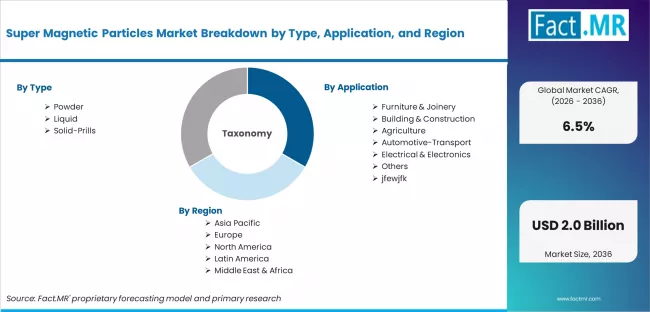
Super Magnetic Particles Market Breakdown By Type, Application, And Region | Source: Fact.MR
| Metric | Value |
|---|---|
| Quantitative Units | USD 1.09 billion to USD 2.04 billion, at a CAGR of 6.5% |
| Market Definition | Super magnetic particles are engineered micro- and nanoscale materials exhibiting superparamagnetic behavior, used in biomedical separation, diagnostic assays, data storage components, and industrial sensor applications. |
| Type Segmentation | Iron Oxide Nanoparticles, Ferrites, Rare-Earth Magnets |
| Application Segmentation | Biomedical Separation & Assays, Data Storage & Sensors, Industrial |
| Coating Segmentation | Silica/Biopolymer-Coated, Polymer-Coated |
| Regions Covered | North America, Latin America, Europe, East Asia, South Asia, Oceania, Middle East & Africa |
| Countries Covered | USA, Mexico, Germany, France, UK, South Korea, Japan, and 40 plus countries |
| Key Companies Profiled | Merck KGaA, Thermo Fisher Scientific Inc., Miltenyi Biotec GmbH, Sigma-Aldrich (part of Merck Group), Ocean Nanotech, Inc., Bangs Laboratories, Inc., Chemicell GmbH, Sisco Research Laboratories Pvt. Ltd., Ademtech, S.A. |
| Forecast Period | 2026 to 2036 |
| Approach | Forecasting models apply a bottom-up methodology starting with diagnostic kit and reagent production volumes consuming magnetic particles and projecting adoption rates across clinical, pharmaceutical, and industrial channels. |
Source: Fact.MR analysis. Updated Mar 27, 2026
Super Magnetic Particles Market by Segments
-
Type :
- Iron Oxide Nanoparticles
- Ferrites
- Rare-Earth Magnets
-
Application :
- Biomedical Separation & Assays
- Data Storage & Sensors
- Industrial
-
Coating :
- Silica/Biopolymer-Coated
- Polymer-Coated
-
Region :
- North America
- United States
- Canada
- Mexico
- Europe
- Germany
- United Kingdom
- France
- Italy
- Spain
- Rest of Europe
- Asia Pacific
- Japan
- South Korea
- China
- India
- Australia & New Zealand
- Rest of Asia Pacific
- Latin America
- Brazil
- Rest of Latin America
- Middle East & Africa
- GCC Countries
- South Africa
- Rest of Middle East & Africa
- North America
Frequently Asked Questions
How large is the demand for super magnetic particles in the global market in 2026?
What will be the market size of super magnetic particles in the global market by 2036?
What is the expected demand growth for super magnetic particles in the global market between 2026 and 2036?
Which Type segment is poised to lead global sales by 2026?
How significant is the role of Biomedical Separation & Assays in driving super magnetic particles adoption in 2026?
What is driving demand in the USA?
What is the growth outlook for Japan in this report?
What does Fact.MR use as the basis for its super magnetic particles forecast?
Who worked on this report


Preview the report firsthand - request a free sample
Free SampleGet the brochure for pricing and purchase details
Download PDF