- Market Value (2025): USD 395.9 Mn
- Estimated Value (2026): USD 420.0 Mn
- Forecast Value (2036): USD 759.3 Mn
- CAGR (2026-2036): 6.1%
What is the Magnetic Shielding Sheets Market forecast to be worth by 2036?
USD 759.3 million by 2036 at a 6.1% CAGR.
- The Magnetic Shielding Sheets Market reached approximately USD 395.9 million in 2025.
- Demand is projected to increase from USD 420.0 million in 2026 to USD 759.3 million by 2036.
- The market is projected to expand at a 6.1% CAGR from 2026 to 2036.
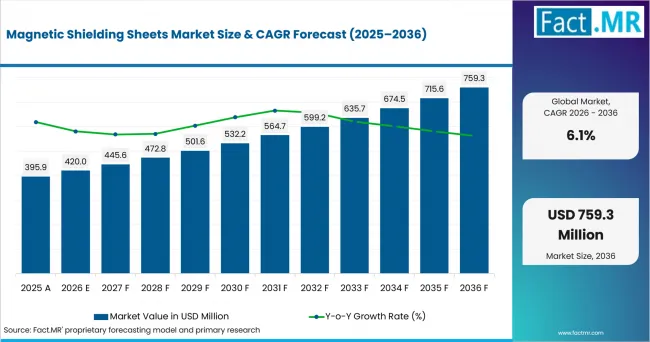
Magnetic Shielding Sheets Market Value Analysis | Source: Fact.MR
What are the defining numbers behind Magnetic Shielding Sheets Market growth?
An absolute opportunity of USD 339.3 million is expected between 2026 and 2036.
- Demand Drivers in the Market
- Device miniaturization is increasing local interference inside smartphones, tablets, wearables and compact computing systems. TDK describes magnetic noise-suppression sheets as a response to dense component placement and notes that flexible sheets can be applied over IC packages, cables, housings and gaps between circuit boards, allowing designers to treat noise close to its source.
- Automotive electrification is creating a second demand path. TDK introduced a 0.006 mm permalloy film sheet in 2024 specifically to address low-frequency noise associated with vehicle electrification, while Germany produced 1.67 million electric passenger cars in 2025 according to the VDA. More inverters, high-voltage switching devices, sensors and connected modules increase the number of electromagnetic compatibility interfaces that require shielding or absorption.
- High-frequency electronics are broadening the required shielding bandwidth. 3M positions its AB3000 magnetic shielding material for near-field applications from 1 GHz to 10 GHz, while its AB6000 hybrid absorber combines a metal shielding layer with a magnetic absorbing layer for applications extending to 18 GHz. This supports sheet demand in high-speed digital electronics, wireless equipment and tightly packed assemblies.
- Telecommunications rollout adds recurring demand for shielding around radios, base-station electronics and network hardware. Brazil reported 748 municipalities with licensed 5G base stations in its 2024 management reporting, while Ofcom continued to record expanding 5G standalone coverage in the UK during 2026. Denser radio infrastructure raises the value of compact, frequency-selective shielding materials in equipment design and maintenance.
- Medical, industrial and aerospace systems require stable signals around sensors, processors and power electronics. Magnetic sheets provide a conformable option where a full metal housing is impractical, especially when the design must preserve access, weight targets or tight internal clearances.
- Key Segments Analyzed
- Soft Magnetic Shielding Sheets account for 38.7% of Product in 2026. Their high permeability and low coercivity help redirect magnetic flux while allowing use in thin sheet and laminated formats suited to compact assemblies.
- Nickel Iron Alloys represent 35.4% of Material in 2026. Their magnetic permeability and low hysteresis make them suitable for shielding sensors and other low-field components where stable attenuation is required.
- Consumer Electronics hold 41.8% of Application in 2026. Smartphones, tablets, laptops and wearables combine multiple radios, processors, cameras, displays and charging functions within limited internal space, increasing the need for localized shielding.
- Electronics Manufacturers account for 44.6% of End Use in 2026. Shielding sheets are typically selected during PCB and product design, then converted into die-cut or laminated parts for integration during manufacturing.
- High Frequency Shielding holds 42.1% of Shielding Effectiveness in 2026. Wireless connectivity and high-speed digital interfaces create interference across higher frequency ranges, increasing demand for materials designed for RF-rich electronic systems.
- Analyst Opinion at Fact.MR
- Shambhu Nath Jha, Principal Consultant, Fact.MR
- "Magnetic shielding sheets are becoming a design-in material rather than a late-stage EMC patch. The commercial advantage comes from controlling interference in millimeters of available space, at the frequency band that matters, without forcing the OEM to redesign the enclosure. Suppliers that combine thin-gauge magnetic materials, predictable permeability, die-cut convertibility and automotive or electronics qualification will capture more of the value as devices add radios, sensors, high-speed interfaces and power electronics."
- Strategic Implications
- Material suppliers should organize product portfolios around frequency, permeability, thickness and converting method rather than only alloy family. The buyer often begins with an interference problem at a defined location and band, so an application-ready selection path is more useful than a broad material catalog.
- Converters should invest in precision die-cutting, lamination and adhesive integration. Both 3M and TDK offer magnetic sheets in thin, flexible formats, and the installed value rises when a material can be supplied as a repeatable part that fits an IC package, cable, sensor, battery-management module or enclosure feature with minimal assembly labor.
- Automotive and industrial suppliers need separate low-frequency and high-frequency strategies. EV power electronics can create strong low-frequency magnetic fields, while communications, infotainment, sensors and high-speed processors produce higher-frequency noise. Hybrid structures that combine magnetic absorption with conductive shielding can reduce the need to choose one mechanism for the entire assembly.
How does the Magnetic Shielding Sheets Market break down by segment?
The Magnetic Shielding Sheets Market is segmented by Product, Material, Application, End Use and Shielding Effectiveness.
Why do Soft Magnetic Shielding Sheets lead Product with 38.7% share in 2026?
Soft Magnetic Shielding Sheets hold a 38.7% share of Product in 2026.
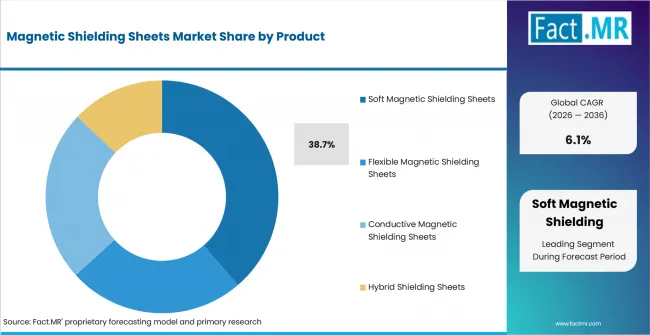
Magnetic Shielding Sheets Market Analysis By Product | Source: Fact.MR
Soft magnetic materials combine high permeability with low coercivity, allowing magnetic flux to follow the sheet rather than pass through a sensitive component. This makes the format useful around sensors, ICs, signal paths and compact electromechanical assemblies where attenuation must be achieved without a thick structural shield.
The segment also gives designers several engineering routes. Nickel-iron alloy sheets address precision magnetic shielding, silicon steel offers a familiar electrical material platform, and amorphous alloys can provide high permeability in thin sections. The ability to tune thickness, lamination and alloy composition supports broader use than a single-purpose conductive barrier.
The category also overlaps naturally with the EMI shielding value chain, where designers increasingly combine absorption, magnetic flux control and conductive shielding to manage interference close to the source.
Why do Nickel Iron Alloys lead Material with 35.4% share in 2026?
Nickel Iron Alloys hold a 35.4% share of Material in 2026.
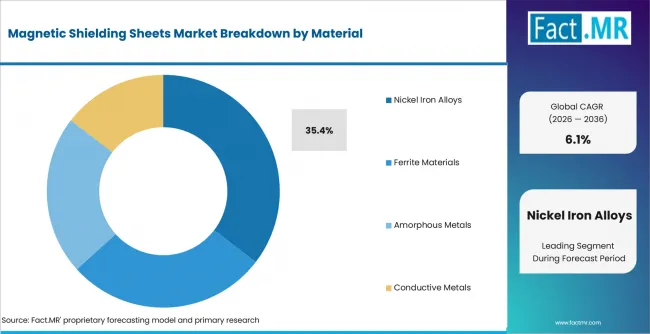
Magnetic Shielding Sheets Market Analysis By Material | Source: Fact.MR
Nickel-iron alloys are used when the design needs high magnetic permeability and low coercivity, particularly for low-field and precision shielding. Their performance allows a relatively thin sheet or formed enclosure to redirect magnetic flux before it reaches a sensor, signal path or measurement element.
The material is also established in fabrication. It can be rolled, annealed, laminated and formed into application-specific shapes, which is important when shielding must be integrated into a repeatable production part. Ferrite, amorphous metal and conductive metal alternatives remain important, but nickel-iron alloys retain a strong position where predictable magnetic behavior and precision outweigh raw-material cost.
Why does Consumer Electronics lead Application with 41.8% share in 2026?
Consumer Electronics hold a 41.8% share of Application in 2026.
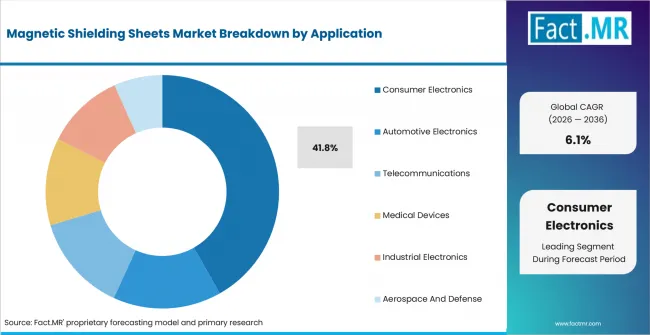
Magnetic Shielding Sheets Market Analysis By Application | Source: Fact.MR
Smartphones, tablets, laptops and wearables place processors, cameras, display drivers, NFC antennas, wireless charging coils and multiple radio systems within a small enclosure. Each additional function raises the possibility that one circuit becomes a noise source for another. TDK specifically cites smartphones and tablets as core applications for flexible magnetic sheets, while 3M lists consumer electronics among the main industries for its magnetic EMI absorbers.
The demand mechanism is reinforced by growth in wearable devices, where small housings and multiple sensing and wireless functions leave little space for rigid shielding. Thin adhesive-backed sheets can be placed directly over a noise source, between boards or around a cable without changing the external form factor.
Why do Electronics Manufacturers lead End Use with 44.6% share in 2026?
Electronics Manufacturers hold a 44.6% share of End Use in 2026.
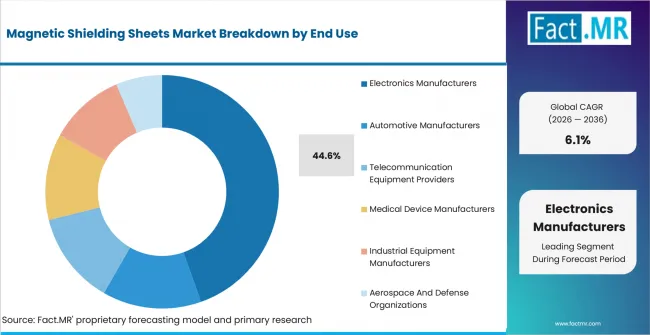
Magnetic Shielding Sheets Market Analysis By End Use | Source: Fact.MR
The shielding sheet is normally selected at the point where the product architecture, PCB stack, enclosure, cable routing and antenna placement are being defined. Electronics manufacturers therefore control the highest-volume design-in decisions and can standardize a selected material across several product variants once the EMC performance has been validated.
Manufacturing scale also favors this end-use group. Magnetic composites can be supplied in rolls or sheets and converted into die-cut parts, allowing automated placement or repeatable manual assembly. 3M and TDK both market flexible sheet formats with multiple thickness options, which supports high-volume conversion without requiring a separate machined shield for every location.
Why does High Frequency Shielding lead Shielding Effectiveness with 42.1% share in 2026?
High Frequency Shielding holds a 42.1% share of Shielding Effectiveness in 2026.
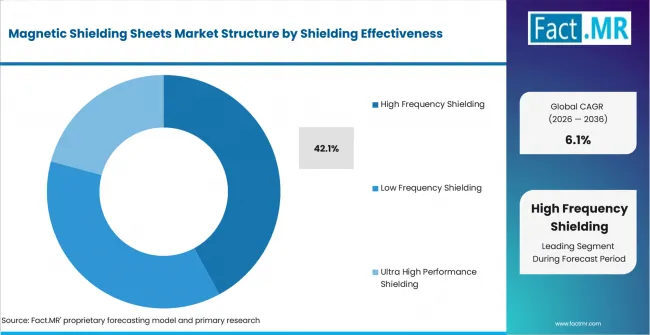
Magnetic Shielding Sheets Market Analysis By Shielding Effectiveness | Source: Fact.MR
High-frequency noise is increasingly common in compact electronics because data rates, processor clocks and wireless frequencies continue to rise. 3M offers magnetic absorber and shielding materials spanning hundreds of megahertz into multi-gigahertz ranges, while TDK describes Flexield as a wide-band noise-suppression sheet for dense electronic devices. This gives sheet-based shielding a direct role in RF-rich assemblies where a conductive enclosure alone may leave internal reflections or near-field coupling unresolved.
Telecommunications equipment adds a second route. Expansion of 5G services increases radio density, phased-array electronics and high-speed network hardware, all of which raise the need for frequency-specific suppression around boards, cables and modules.
What is accelerating Magnetic Shielding Sheets Market adoption, and what is holding it back?
Vehicle electrification increases both low-frequency magnetic fields and high-frequency switching noise. Adoption is constrained by the fact that shielding is application-specific.
Drivers Impact Analysis
| Factor | (~) % Impact on CAGR | Geographic Relevance | Impact Timeline |
|---|---|---|---|
| Higher RF density in smartphones, wearables and compact electronics | +0.85% | Germany, USA, UK, Japan, Brazil | 2026-2036 |
| EV, ADAS and high-voltage power-electronics integration | +0.70% | Germany, USA, Japan, Brazil, UK | 2026-2036 |
| 5G and high-speed network equipment deployment | +0.55% | Brazil, UK, USA, Japan, Germany | 2026-2036 |
Opportunity Impact Analysis
| Factor | (~) % Impact on CAGR | Geographic Relevance | Impact Timeline |
|---|---|---|---|
| Ultra-thin hybrid magnetic and conductive sheet designs | +0.45% | Japan, USA, Germany, UK | 2026-2035 |
| Precision die-cut shielding for sensors, cameras and compact modules | +0.35% | USA, Germany, Japan, UK, Brazil | 2027-2036 |
| Higher-specification medical, aerospace and industrial electronics | +0.30% | USA, Germany, UK, Japan | 2027-2036 |
Restraints Impact Analysis
| Factor | (~) % Impact on CAGR | Geographic Relevance | Impact Timeline |
|---|---|---|---|
| Specialty alloy and high-permeability material cost | -0.40% | Global | 2026-2036 |
| Frequency-specific qualification and processing sensitivity | -0.35% | Electronics, automotive, medical and aerospace | 2026-2036 |
| Substitution by filters, coatings, foils and shielded enclosures | -0.25% | Global | 2026-2035 |
Which countries are scaling the Magnetic Shielding Sheets Market through 2036?
- Germany combines a substantial electronics manufacturing base with high electric-vehicle production. Germany Trade & Invest reports EUR 225 billion in electronics industry turnover in 2025, while VDA data show that 40% of passenger cars produced in Germany during 2025 were electric. These systems create shielding needs across power electronics, sensors, ADAS, infotainment and communications modules.
- Brazil is expanding 5G infrastructure across a wider set of municipalities. Anatel reported 748 municipalities with licensed 5G base stations in its 2024 management results, increasing the installed base of radio and network equipment that must manage high-frequency interference under tropical outdoor and dense urban conditions.
- USA demand is supported by semiconductor, data-center, defense and advanced electronics investment. The U.S. Department of Commerce reported nearly USD 450 billion in planned electronics manufacturing investment by early 2025, while later Micron expansion plans added substantial domestic memory manufacturing and R&D capacity. More local electronic production increases demand for EMC materials in modules, assemblies and production test environments.
- UK growth is tied to continuing mobile-network upgrades. Ofcom reported in Spring 2026 that 5G standalone coverage outside premises ranged from 49% to 85% across the three operators that had deployed it, broadening the installed base of radios and network hardware that operate at high data rates and dense frequency reuse.
- Japan combines advanced electronic-component manufacturing with domestic expertise in magnetic materials. METI continued its supply-security support for advanced electronic components in 2026, including an approved plan for TDK, while Japanese suppliers continue to commercialize ultra-thin magnetic sheets for automotive and compact-device noise suppression.
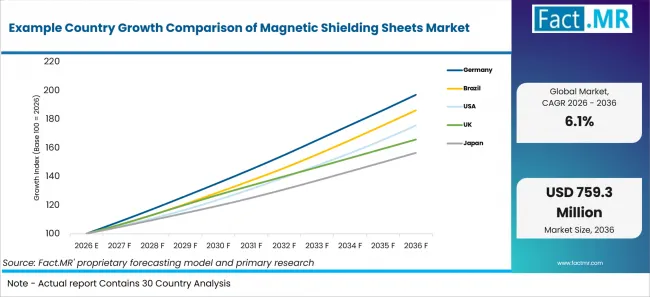
Example Country Growth Comparison Of Magnetic Shielding Sheets Market | Source: Fact.MR
Country CAGR (2026-2036)
| Country | CAGR (2026-2036) |
|---|---|
| Germany | 7.0% |
| Brazil | 6.4% |
| USA | 5.8% |
| UK | 5.2% |
| Japan | 4.6% |
What is driving Germany's growth through 2036?
The Germany Magnetic Shielding Sheets Market is projected to grow at a 7.0% CAGR from 2026 to 2036.
Germany has two demand pools that reinforce each other: electronics manufacturing and vehicle electrification. Germany Trade & Invest reports that the national electronics industry generated EUR 225 billion in turnover in 2025 and accounted for a substantial share of industrial R&D. This supports demand for shielding materials across automation, communications, sensors and embedded electronics.
Automotive requirements are becoming more demanding at the same time. VDA reported 1.67 million electric passenger cars produced in Germany in 2025, equal to 40% of domestic passenger-car output. Inverters, battery-management systems, cameras, radar, infotainment and high-speed vehicle networks create both low-frequency and high-frequency interference paths, making thin magnetic and hybrid sheets useful at module level.
What is driving Brazil's growth through 2036?
The Brazil Magnetic Shielding Sheets Market is projected to grow at a 6.4% CAGR from 2026 to 2036.
Brazil is adding radio infrastructure faster than the original 5G rollout schedule required. Anatel reported nearly 30,000 licensed 5G radio base stations in its 2024 management reporting and said 748 municipalities already had licensed stations. This expansion increases demand for RF modules, network equipment and supporting electronics that need high-frequency noise control.
The opportunity extends beyond telecommunications because the same electronics ecosystem supplies industrial automation, connected devices and vehicle electronics. Shielding sheets are attractive when equipment makers need localized attenuation inside a cabinet or module without adding a heavier secondary enclosure.
What is driving USA's growth through 2036?
The USA Magnetic Shielding Sheets Market is projected to grow at a 5.8% CAGR from 2026 to 2036.
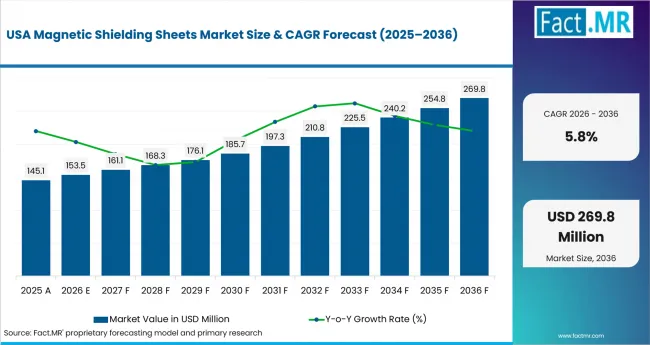
Magnetic Shielding Sheets Market Country Value Analysis | Source: Fact.MR
Domestic semiconductor and advanced-electronics manufacturing is expanding the number of high-density assemblies produced and qualified in the country. The U.S. Department of Commerce reported nearly USD 450 billion in planned electronics manufacturing investment by early 2025, while Micron later outlined a USD 200 billion program spanning memory manufacturing, packaging and R&D in several states.
These investments feed multiple shielding-intensive applications, including data centers, automotive electronics, aerospace, defense and high-performance computing. Magnetic sheets can be integrated into boards, modules, cables and enclosures where local EMI absorption is needed but space is too constrained for a conventional shield can or thick metal structure.
What is driving UK's growth through 2036?
The UK Magnetic Shielding Sheets Market is projected to grow at a 5.2% CAGR from 2026 to 2036.
The UK continues to expand mobile network capability rather than relying only on legacy 4G coverage. Ofcom reported in Spring 2026 that 5G standalone coverage outside premises ranged from 49% to 85% across the three operators that had deployed it, while overall 4G geographic coverage from at least one operator remained 96%.
As network equipment moves to higher data rates and denser radio architectures, manufacturers and integrators need better control of coupling around RF boards, power supplies, cables and antenna-adjacent electronics. Flexible magnetic sheets are useful because they can be converted to fit irregular or confined locations inside radio and network hardware.
What is driving Japan's growth through 2036?
The Japan Magnetic Shielding Sheets Market is projected to grow at a 4.6% CAGR from 2026 to 2036.
Japan combines a mature electronic-component supply base with continued public support for advanced component capacity. METI listed approved supply-security plans for advanced electronic components in 2026, including TDK, and continues to track production of electrical machinery, electronic devices and information-communications equipment through its Current Survey of Production.
Domestic material innovation also supports adoption. TDK introduced an ultra-thin permalloy sheet in 2024 for low-frequency noise linked to vehicle electrification and continues to offer Flexield products for compact electronic devices. This creates a local path from material R&D through automotive, consumer and industrial electronics qualification.
Who Leads the Magnetic Shielding Sheets Market?
Key players in the Magnetic Shielding Sheets Market include 3M Company, Parker Chomerics, TDK Corporation, Yageo Corporation (KEMET), Proterial Ltd. (Hitachi Metals), Kitagawa Industries Co., Ltd. and Tech-Etch Inc.
Buyers compare suppliers on usable frequency range, magnetic permeability, sheet thickness, temperature tolerance, adhesive options, convertibility and EMC qualification support. 3M supplies magnetic absorbers and hybrid shielding sheets for high-frequency applications, while TDK offers soft-magnetic composites and ultra-thin permalloy products. KEMET provides adhesive-backed Flex Suppressor sheets, and Parker Chomerics supplies conductive foil solutions that can be combined with magnetic materials in hybrid designs.
Proterial Ltd., formerly Hitachi Metals, brings established magnetic-material expertise to the market. The company adopted the Proterial name in January 2023, while older technical documentation and approved-vendor references may still carry the Hitachi Metals name.
Which companies are the key providers?
Key providers are 3M Company, Parker Chomerics, TDK Corporation, Yageo Corporation (KEMET), Proterial Ltd. (Hitachi Metals), Kitagawa Industries Co., Ltd. and Tech-Etch Inc.
- 3M Company
- Parker Chomerics
- TDK Corporation
- Yageo Corporation (KEMET)
- Proterial Ltd. (Hitachi Metals)
- Kitagawa Industries Co., Ltd.
- Tech-Etch Inc.
Bibliography
- 3M Company. (2026). 3M EMI Absorber & Magnetic Shielding Material AB3000 Series. 3M.
- 3M Company. (2026). 3M EMI Shielding Absorber AB6000HF/SHF Series. 3M.
- TDK Corporation. (2016). Noise Suppression Sheet Flexield IFL Series: Product Overview. TDK Product Center.
- TDK Corporation. (2024). Noise Suppression Sheets: Ultra-thin, lightweight permalloy film sheets to shield low frequency band noise. TDK.
- KEMET Electronics Corporation. (2024). FLEX SUPPRESSOR Magnetic Sheet for RFID. KEMET.
- Parker Hannifin Corporation. (n.d.). CHO-FOIL EMI Shielding Foil Tape. Parker Chomerics.
- Germany Trade & Invest. (2026). The Electronics Industry in Germany. Germany Trade & Invest.
- German Association of the Automotive Industry. (2026). New record: 40% electric share of passenger car production in 2025. VDA.
- Agencia Nacional de Telecomunicacoes. (2025). Annual Management Report 2024: Connectivity, Consumer Rights and the Digital Economy. Anatel.
- U.S. Department of Commerce. (2025). Four Years of Transformation at the Department of Commerce. U.S. Department of Commerce.
- U.S. Department of Commerce. (2025). Micron Technology investment for memory chip manufacturing in the United States. U.S. Department of Commerce.
- Ofcom. (2026). Connected Nations update: Spring 2026. Ofcom.
- Ministry of Economy, Trade and Industry, Japan. (2026). Advanced Electronic Components. METI.
- Ministry of Economy, Trade and Industry, Japan. (2026). Current Survey of Production: 2025 Interim Total Computation. METI.
- Proterial, Ltd. (2023). Proterial Integrated Report 2023. Proterial, Ltd.
This Report Answers
- How large is the Magnetic Shielding Sheets Market in 2026 and what value is projected for 2036?
- What is the forecast CAGR from 2026 to 2036?
- Which Product, Material, Application, End Use and Shielding Effectiveness segments lead in 2026?
- What demand mechanisms are increasing the need for magnetic shielding sheets?
- How are Germany, Brazil, USA, UK and Japan developing through 2036?
- Which companies are active in magnetic shielding sheets and related EMI materials?
- What products and applications are included or excluded from the market scope?
What does the Magnetic Shielding Sheets Market cover?
The Magnetic Shielding Sheets Market covers commercial sheet-form materials whose primary function is magnetic-field control, near-field EMI absorption or combined magnetic and conductive shielding. Revenue includes soft magnetic alloy sheets, flexible magnetic composites, conductive magnetic sheets and hybrid constructions sold into consumer electronics, automotive electronics, telecommunications, medical, industrial, aerospace and defense applications.
What is included in the scope?
Included products are nickel-iron alloy sheets, silicon-steel and amorphous soft-magnetic sheets, polymer-based and laminated flexible magnetic sheets, copper- and aluminum-based conductive magnetic sheets, and hybrid magnetic-EMI or thermal-magnetic sheet constructions. The scope includes sheet and roll formats sold for die-cutting, lamination or direct installation in the applications and end uses represented by the market segmentation.
What is excluded from the scope?
The scope excludes standalone EMI filters, conductive coatings and paints, rigid shield cans, wire braids, gaskets, full electromagnetic test chambers, magnetic cores sold only for transformers or inductors, permanent magnets, and general metal foil that is not sold for a magnetic or EMI shielding function. These adjacent categories are counted only when the commercial product is supplied as a qualifying magnetic shielding sheet or hybrid sheet.
How Was the Analysis Built?
The analysis combines demand by magnetic-sheet product type with material, application, end-use purchasing and shielding-effectiveness requirements. Consumer electronics, automotive electronics, telecommunications, medical devices, industrial electronics, aerospace and defense demand are evaluated separately before being reconciled into the global forecast.
- Primary Research: Interviews with magnetic-material suppliers, EMI component manufacturers, converters, electronics OEMs, automotive electronics suppliers, telecommunications equipment providers, medical-device manufacturers and procurement teams are used to test material selection, frequency ranges, thickness preferences, qualification cycles, converting requirements and supplier-switching behavior.
- Desk Research: The review covers electronics and vehicle production, 5G infrastructure deployment, semiconductor manufacturing investment, advanced electronic-component policy and first-party documentation on magnetic absorbers, noise-suppression sheets, permalloy films and hybrid shielding materials.
- Market Sizing and Forecasting: Estimates combine electronic-device production, shielding material intensity, application penetration, material mix, average selling value, country manufacturing activity and replacement or redesign demand. Forecast assumptions are cross-checked against downstream electronics, EV, telecommunications and semiconductor investment together with supplier commercialization milestones.
Segmentation
What is the report's scope and coverage?
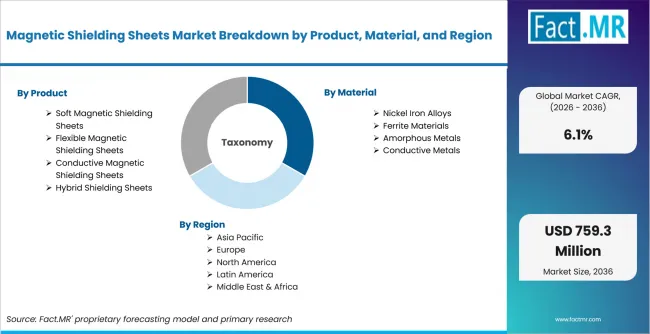
Magnetic Shielding Sheets Market Breakdown By Product, Material, And Region | Source: Fact.MR
| Scope Item | Coverage |
|---|---|
| Quantitative Units | USD million |
| Market Definition | Sheet-form magnetic and hybrid materials sold to absorb, redirect or attenuate magnetic-field and electromagnetic interference in electronic assemblies. |
| Segments Covered | Product, Material, Application, End Use and Shielding Effectiveness |
| Regions Covered | North America, Latin America, Europe, East Asia, South Asia and Pacific, Middle East and Africa |
| Countries Covered | Germany, Brazil, USA, UK and Japan |
| Key Companies Profiled | 3M Company; Parker Chomerics; TDK Corporation; Yageo Corporation (KEMET); Proterial Ltd. (Hitachi Metals); Kitagawa Industries Co., Ltd.; Tech-Etch Inc. |
| Forecast Period | 2026-2036 |
| Base Year | 2025 |
| Market Value, 2026 | USD 420.0 million |
| Market Value, 2036 | USD 759.3 million |
| CAGR, 2026-2036 | 6.1% |
| Absolute Opportunity | USD 339.3 million |
| Approach | Hybrid bottom-up and top-down modelling using electronic-device production, shielding intensity, material mix, application penetration, country manufacturing activity and primary validation |
How is the market segmented?
-
By Product:
- Soft Magnetic Shielding Sheets
- Nickel Iron Alloy Sheets
- Silicon Steel Sheets
- Amorphous Alloy Sheets
- Flexible Magnetic Shielding Sheets
- Polymer Based Shielding Sheets
- Laminated Shielding Sheets
- Conductive Magnetic Shielding Sheets
- Copper Based Shielding Sheets
- Aluminum Based Shielding Sheets
- Hybrid Shielding Sheets
- Magnetic And EMI Shielding Sheets
- Thermal And Magnetic Shielding Sheets
- Soft Magnetic Shielding Sheets
-
By Material:
- Nickel Iron Alloys
- Ferronickel Alloys
- Ferrite Materials
- Manganese Zinc Ferrites
- Nickel Zinc Ferrites
- Amorphous Metals
- Iron Based Amorphous Metals
- Cobalt Based Amorphous Metals
- Conductive Metals
- Copper
- Aluminum
- Nickel Iron Alloys
-
By Application:
- Consumer Electronics
- Smartphones
- Tablets And Laptops
- Wearable Devices
- Automotive Electronics
- Electric Vehicles
- Advanced Driver Assistance Systems
- Infotainment Systems
- Telecommunications
- Base Stations
- Network Equipment
- Medical Devices
- Diagnostic Equipment
- Patient Monitoring Devices
- Industrial Electronics
- Automation Systems
- Power Equipment
- Aerospace And Defense
- Avionics
- Defense Electronics
- Consumer Electronics
-
By End Use:
- Electronics Manufacturers
- Automotive Manufacturers
- Telecommunication Equipment Providers
- Medical Device Manufacturers
- Industrial Equipment Manufacturers
- Aerospace And Defense Organizations
-
By Shielding Effectiveness:
- High Frequency Shielding
- Broadband Shielding
- Precision Shielding
- Low Frequency Shielding
- Standard Shielding
- Enhanced Shielding
- Ultra High Performance Shielding
- Mission Critical Systems
- High Sensitivity Systems
- High Frequency Shielding
-
By Region:
- North America
- Latin America
- Western Europe
- Eastern Europe
- East Asia
- South Asia and Pacific
- Middle East & Africa
Frequently Asked Questions
What is the Magnetic Shielding Sheets Market value in 2026?
At what CAGR is the market projected to grow?
What value is projected for 2036?
Which Product leads the market?
Which Material leads the market?
Which Application leads the market?
Which End Use leads the market?
Which Shielding Effectiveness segment leads the market?
What is a major demand driver?
What is a major market restraint?
Who worked on this report


Preview the report firsthand - request a free sample
Free SampleGet the brochure for pricing and purchase details
Download PDF