- Market Value (2025): USD 987.2 Mn
- Estimated Value (2026): USD 1080.0 Mn
- Forecast Value (2036): USD 2652.1 Mn
- CAGR (2026-2036): 9.4%
What is the Sustainable Bundle Machines Market forecast to be worth by 2036?
USD 1,080.0 million in 2026 to USD 2,652.1 million by 2036 at a 9.4% CAGR.
- 2025 market value: USD 987.2 million.
- 2026 to 2036 value progression: USD 1,080.0 million to USD 2,652.1 million.
- 2026 to 2036 CAGR: 9.4%.
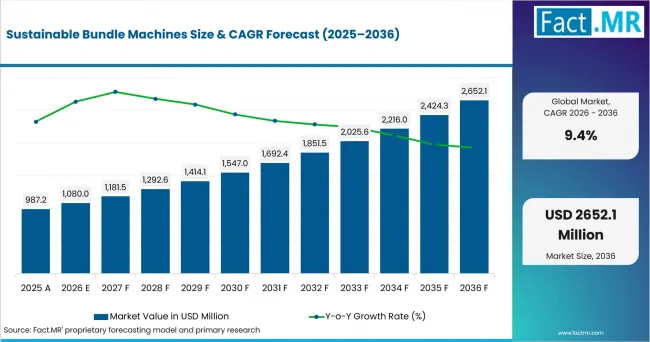
Sustainable Bundle Machines Value Analysis | Source: Fact.MR
What are the defining numbers behind Sustainable Bundle Machines Market growth?
The market is projected to add USD 1,572.1 million in revenue between 2026 and 2036. In 2026, Paper band holds 31.0% of Sustainable Medium, Automatic bundler accounts for 39.0% of Machine Type, Beverage multipacks represent 27.0% of Application, and Plastic elimination accounts for 38.0% of Sustainability Goal.
- Demand Drivers in the Market
- Packaging rules are changing what buyers ask from end-of-line equipment. The European Commission states that the Packaging and Packaging Waste Regulation entered into force on 11 February 2025 and generally applies from 12 August 2026. Because the regulation addresses packaging composition, reuse, recoverability and waste prevention, packaging teams have more reason to specify machines that can run paper-based, recyclable or lower-material bundle formats.
- The material shift is already visible on commercial lines. Krones has documented beverage multipacks that use cardboard clips and kraft-paper bands instead of conventional shrink film. ATS-Tanner markets recyclable paper bands made with recycled fibre. Moving to these media is not a simple material substitution. Feeding, tension, sealing and pack stability all have to work with the new substrate, which creates demand for compatible machines and retrofit modules.
- Energy use adds another purchasing criterion. Sidel reports that EvoFilm Stretch works at ambient temperature and removes the need for a shrink tunnel. In its referenced configuration, the company reports about 50% less film use and about 90% lower energy consumption than shrink wrapping. For plants with large multipack volumes, that changes the operating-cost calculation around secondary packaging equipment.
- The result is a closer link between bundle machinery and sustainable packaging investment. Once a brand changes the secondary-pack material, it often has to reconsider feeding, sealing, pack formation and energy use on the machine as well.
- Key Segments Analyzed
- Sustainable Medium: Paper band accounts for 31.0% in 2026. It uses a narrow strip of material to secure the bundle, can carry printed information and can fit paper-recycling routes when the band construction is specified correctly.
- Machine Type: Automatic bundler represents 39.0% in 2026. Plants running continuous packaging lines need grouping, material application and discharge to happen without adding a manual step or creating a new bottleneck.
- Application: Beverage multipacks account for 27.0% in 2026. Bottles and cans are repeatedly grouped in high volumes, so changes in secondary-pack material have a direct effect on equipment choice and operating cost.
- Sustainability Goal: Plastic elimination represents 38.0% in 2026. In selected multipack formats, brands can replace shrink film with paper clips, bands, wraps or other securing systems, but only if the packaging line can handle the new format reliably.
- Analyst Opinion at Fact.MR
- “The buying decision is practical. A packaging team may want less plastic, but the new bundle still has to leave the line at speed, stay intact on conveyors and survive distribution. Suppliers that can prove those conditions with paper, recycled film or low-energy wrapping give buyers a clearer engineering case for conversion.” - Shambhu Nath Jha, Senior Consultant, Fact.MR
- Strategic Implications
- Material compatibility needs to be engineered into the machine rather than added as a sustainability claim. Paper, recycled film and compostable film respond differently to tension, sealing temperature and moisture. Buyers therefore need defined operating windows for each medium they plan to run.
- A full line replacement is rarely the first choice for an established plant. Many beverage, food and personal-care sites already have conveyors, collators and wrappers in place. Retrofit modules that add paper banding, clip application, stretch wrapping or lower-film operation can make the conversion easier to approve because they preserve more of the installed equipment.
- Pack testing is part of the sale. A new bundle format has little value if it opens on the conveyor, deforms on the pallet or creates more product damage in distribution. Suppliers that can validate the complete pack under line and logistics conditions can compete for a wider share of packaging automation projects.
How does the Sustainable Bundle Machines Market break down by segment?
The market is segmented by Sustainable Medium, Machine Type, Application and Sustainability Goal.
Why does Paper band lead Sustainable Medium?
Paper band accounts for 31.0% of Sustainable Medium in 2026.
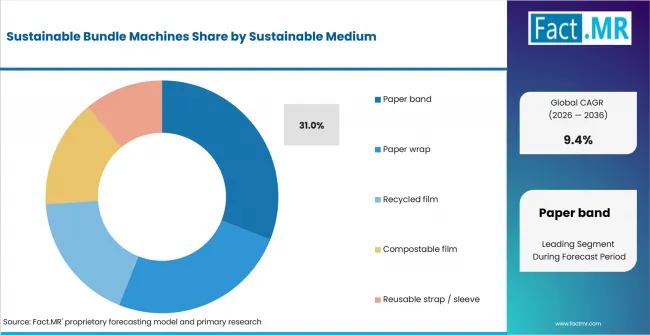
Sustainable Bundle Machines Analysis By Sustainable Medium | Source: Fact.MR
A paper band secures the pack with far less coverage than a full wrap. ATS-Tanner states that TruePaper can enter the normal paper-recycling cycle and is available with more than 50% recycled fibre. For packaging teams trying to reduce secondary material without moving to a full carton, that makes the format relevant alongside other paper packaging materials.
The machine still has to control tension and sealing precisely. Ultrasonic sealing can close many paper-band applications without adhesive, while the exposed band can carry barcodes, batch information or branding. The format therefore works where the buyer needs both restraint and information on a compact secondary pack.
Why does Automatic bundler lead Machine Type?
Automatic bundler represents 39.0% of Machine Type in 2026.
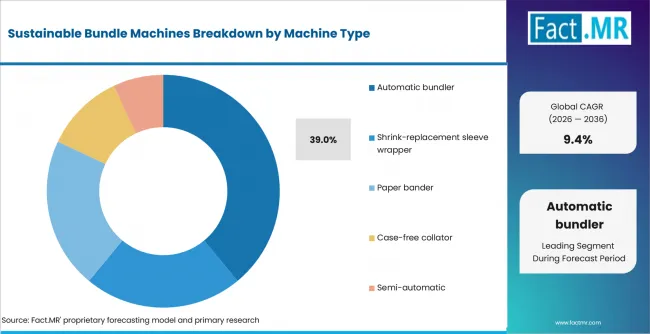
Sustainable Bundle Machines Analysis By Machine Type | Source: Fact.MR
At industrial line speeds, bundling is a sequence of small tasks that must stay synchronized: collating the products, keeping spacing consistent, applying the medium and releasing a stable pack. Automation matters because a material-saving format can lose its economic advantage if it requires extra labour or slows the line.
Krones integrates LitePac Top functions into the Variopac Pro platform, which illustrates how paper-based multipacks can be built into existing secondary-packaging architecture. Buyers therefore assess the machine through familiar operating questions such as uptime, changeover time and integration with upstream and downstream equipment.
Why do Beverage multipacks lead Application?
Beverage multipacks account for 27.0% of Application in 2026.
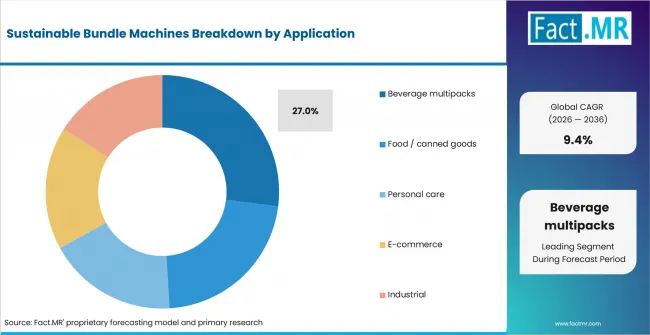
Sustainable Bundle Machines Analysis By Application | Source: Fact.MR
Beverage lines create a repeated bundling task across cans and bottles, often over long production runs. That makes material savings visible quickly. Krones has commercial references for paper-based PET bottle multipacks, while Sidel offers stretch wrapping that removes the shrink tunnel and cuts film use in the company's reference case.
A beverage bundle must also remain stable through conveying, palletisation and distribution. Machine selection is therefore closely connected with case packing machines and other end-of-line equipment rather than being treated as a separate sustainability purchase.
Why does Plastic elimination lead Sustainability Goal?
Plastic elimination represents 38.0% of Sustainability Goal in 2026.
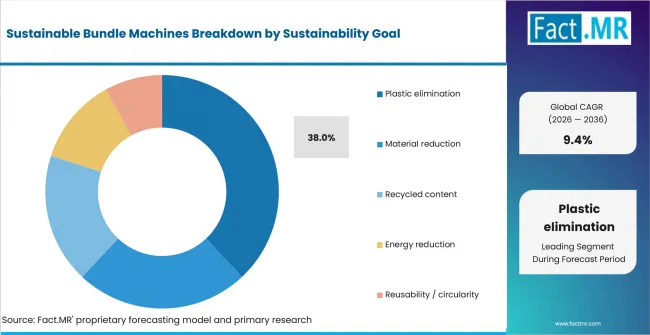
Sustainable Bundle Machines Analysis By Sustainability Goal | Source: Fact.MR
Some buyers are trying to remove shrink film from selected bundles, not merely use a thinner film. Krones LitePac Top uses cardboard clips and, in some pack formats, paper bands. France's anti-waste framework also sets a 2040 objective to end single-use plastic packaging, giving manufacturers a longer-term reason to redesign secondary packs.
That redesign creates a direct equipment requirement. Paper clips, wraps and bands need different handling from shrink film, so the conversion depends on machines that can form and secure the new pack consistently. The same investment logic appears in paper-based wraparound packaging where fibre replaces more conventional secondary formats.
What is accelerating Sustainable Bundle Machines Market adoption, and what is holding it back?
Three forces are moving the market. Regulation is pushing producers to reduce packaging waste, brand owners are testing alternatives to conventional shrink film, and machine suppliers now offer paper or lower-film formats at industrial speeds. Together, these changes make bundle equipment part of the packaging redesign decision rather than a downstream afterthought.
Conversion remains demanding. Paper can react to moisture and tension differently from plastic film, recycled-film behaviour varies with formulation, and compostable films can have narrower sealing windows. Before changing a high-volume format, plants usually need to qualify the material, machine settings, product geometry and distribution performance as one system.
Drivers Impact Analysis
| DRIVER | (~) % IMPACT ON CAGR | GEOGRAPHIC RELEVANCE | IMPACT TIMELINE |
|---|---|---|---|
| Packaging reduction and recyclability requirements | +1.3% | Europe and regulated US states | Near to long term |
| Conversion from shrink film to paper-based bundles | +1.0% | Europe and beverage-producing markets | Near to mid term |
| Lower-energy secondary packaging processes | +0.7% | Europe and North America | Mid to long term |
Opportunity Impact Analysis
| OPPORTUNITY | (~) % IMPACT ON CAGR | GEOGRAPHIC RELEVANCE | IMPACT TIMELINE |
|---|---|---|---|
| Retrofit modules for existing bundling lines | +0.8% | Europe and North America | Near to mid term |
| Multi-material machines for paper and recycled film | +0.6% | Global packaged-goods manufacturing | Mid to long term |
| Case-free and low-material bundle formats | +0.5% | Europe, USA and UK | Mid to long term |
Restraints Impact Analysis
| RESTRAINT | (~) % IMPACT ON CAGR | GEOGRAPHIC RELEVANCE | IMPACT TIMELINE |
|---|---|---|---|
| Material-performance variability during conversion | -0.7% | Global | Near to long term |
| Pack-stability and distribution qualification costs | -0.5% | Europe and North America | Near to mid term |
| Capital cost and integration downtime | -0.4% | Europe and North America | Near to mid term |
Which countries are scaling the Sustainable Bundle Machines Market through 2036?
- Germany: The national packaging framework now sits alongside the EU PPWR, putting more attention on packaging avoidance, recyclability and ecological fee design. For manufacturers, the practical response is equipment that can switch between recyclable paper formats, recycled-content media and lower-material bundles without requiring a new line each time.
- USA: California SB 54 requires a 25% reduction in covered plastic material by 2032 and sets recyclability or compostability conditions for covered packaging. Brands selling across several states can respond at the packaging-line level by reducing material at source and building more format flexibility into their equipment.
- Italy: CONAI reported that 77.3% of packaging placed on the Italian market was recycled in 2025. A system already organized around collection and recycling gives producers a practical reason to consider how bundle design, secondary material and machine choice affect the recyclability of the finished pack.
- France: The anti-waste circular-economy law sets a 2040 objective to end single-use plastic packaging and works through staged reduction, reuse and recycling targets. That puts paper bands, paper wraps and lower-plastic bundle formats directly into packaging redesign discussions at food, beverage and personal-care plants.
- UK: Extended Producer Responsibility shifts packaging waste-management costs toward liable producers, while fee modulation increasingly reflects recyclability. Packaging teams therefore have a financial reason to examine whether a bundle can use less material or move to a structure that is easier to recycle.
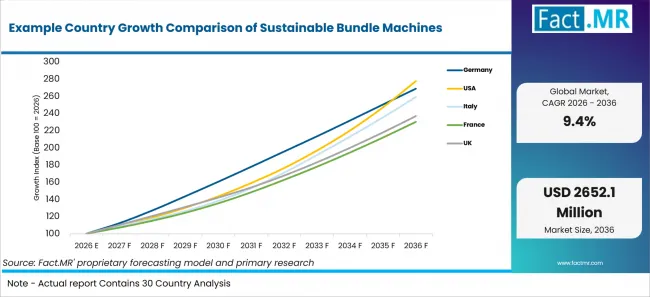
Example Country Growth Comparison Of Sustainable Bundle Machines | Source: Fact.MR
Country CAGR (2026-2036)
| Country | CAGR (2026-2036) |
|---|---|
| Germany | 10.4% |
| USA | 10.8% |
| Italy | 10.0% |
| France | 8.7% |
| UK | 9.0% |
What is driving Germany's growth through 2036?
Germany is projected to grow at a 10.4% CAGR through 2036. The country's 2026 packaging-law implementation framework links national requirements with the EU PPWR and creates incentives around recyclable material combinations, recycled content and renewable raw materials.
The equipment consequence is flexibility. A German plant that can move between film, paper bands and other reduced-material formats has more room to respond to packaging redesign without replacing the complete end-of-line system. Domestic access to suppliers such as Krones and Mosca also supports installation, trials and service for these conversions.
What is driving USA's growth through 2036?
The USA market is projected to grow at a 10.8% CAGR through 2036. California SB 54 requires a 25% reduction in covered plastic material by 2032 and places producer responsibility at the centre of the compliance framework.
For a brand operating several plants or selling across state lines, it can be simpler to build flexible packaging capability into common equipment than to maintain a separate line architecture for one jurisdiction. Machines that can run reduced-film bundles, paper bands or recyclable formats help manufacturers make that choice without giving up line output or distribution performance.
What is driving Italy's growth through 2036?
Italy is projected to grow at a 10.0% CAGR through 2036. CONAI reported that 10.97 million tonnes of packaging were recycled in 2025, equal to 77.3% of packaging placed on the market.
Italy also has an established base of end-of-line packaging machinery. Robopac offers shrink and stretch-film equipment, including stretch wrapping that avoids the external energy used by a shrink tunnel. That gives plants a practical route from conventional shrink bundles toward lower-energy configurations while retaining familiar secondary-packaging workflows.
What is driving France's growth through 2036?
France is projected to grow at an 8.7% CAGR through 2036. The country's anti-waste circular-economy law sets an objective to phase out single-use plastic packaging by 2040 and uses staged reduction, reuse and recycling targets to move industry in that direction.
Secondary bundling is one place where a producer can reduce plastic without changing the primary bottle, can or container. Paper bands and wraps preserve grouping and handling functions, but the conversion works only when sealing reliability and pack stability hold up at production speed.
What is driving UK's growth through 2036?
The UK is projected to grow at a 9.0% CAGR through 2036. Extended Producer Responsibility makes liable producers responsible for packaging waste-management costs, while the Year 2 framework introduces recyclability-based fee categories.
That changes the packaging discussion from material price alone to the cost and recyclability of the finished pack. Paper bands, case-free collating and lower-film wrapping can reduce material use, but the machine still has to accommodate format changes without creating downtime or product damage.
Who Leads the Sustainable Bundle Machines Market?
Key players in the Sustainable Bundle Machines Market include Krones, Sidel, BW Packaging, ATS-Tanner, Mosca and Robopac. Buyers compare them on the media their machines can run, the stability of the finished bundle, line speed, changeover behaviour, retrofit options and service support.
Their positions differ by application. Krones has commercial references for paper-based beverage multipacks through LitePac Top. Sidel brings a stretch-wrapping route that reduces film and removes the shrink tunnel in its reference configuration. ATS-Tanner focuses on banding systems and paper media, Mosca on strapping and banding, Robopac on shrink and stretch formats, and BW Packaging on integrated packaging equipment able to work with recyclable and recycled materials.
Which companies are the key providers?
Key companies include Krones, Sidel, BW Packaging, ATS-Tanner, Mosca and Robopac.
- Krones
- Sidel
- BW Packaging
- ATS-Tanner
- Mosca
- Robopac
Bibliography
- European Commission. (2025). Packaging waste. Directorate-General for Environment.
- California Department of Resources Recycling and Recovery. (2023). SB 54 Rulemaking Workshop: Plastic Pollution Prevention and Packaging Producer Responsibility Act Regulations. CalRecycle.
- Federal Ministry for the Environment, Climate Action, Nature Conservation and Nuclear Safety, Germany. (2026). Gesetz zur Anpassung des Verpackungsrechts und anderer Rechtsbereiche an die Verordnung (EU) 2025/40. Federal Government of Germany.
- UK Department for Environment, Food & Rural Affairs. (2025). Extended Producer Responsibility for Packaging: 2025 base fees. UK Government.
- UK Department for Environment, Food & Rural Affairs. (2026). Year 2 illustrative waste disposal fees: Extended producer responsibility for packaging. UK Government.
- French Ministry for Ecological Transition. (2020). La loi anti-gaspillage pour une économie circulaire. Government of France.
- CONAI. (2026). L’Italia supera il 77% di riciclo degli imballaggi. Consorzio Nazionale Imballaggi.
- Krones. (2023). Coca-Cola HBC opting for cardboard instead of plastic. Krones AG.
- Krones. (n.d.). LitePac Top packaging: Sustainable alternatives to film-wrapped packs. Krones AG.
- Sidel. (2023). Sidel expands overwrapping portfolio with EvoFilm Stretch. Sidel.
- ATS-Tanner. (n.d.). TruePaper: PPWR-compliant packaging with TruePaper. ATS-Tanner Banding Systems AG.
- Mosca. (n.d.). UCB fully automatic corrugated cardboard strapping machine. Mosca GmbH.
- Robopac. (n.d.). Horizontal Stretch Wrapping - FW Series. Aetna Group.
- BW Packaging. (n.d.). Sustainability. Barry-Wehmiller Packaging.
This Report Answers
- How much revenue does the market generate in 2026, and what does the forecast imply for equipment demand?
- Which bundle media are becoming practical alternatives to conventional shrink film?
- Where does automatic bundling create an operating advantage over manual or semi-automatic handling?
- Which applications produce recurring demand for bundle-format conversion?
- How are plastic-reduction and producer-responsibility rules changing machine specifications?
- When can a retrofit be preferable to replacing the complete end-of-line system?
- What changes when a plant moves from virgin film to paper, recycled film or compostable media?
- How do country packaging rules translate into equipment demand?
- What technical capabilities matter when buyers compare bundle-machine suppliers?
- Which companies participate in the market?
What does the Sustainable Bundle Machines Market cover?
The market counts revenue from machinery that collates, bands, wraps, sleeves or otherwise secures several products into one bundle using the Sustainable Medium categories defined in this report. It covers equipment used in beverage, food and canned goods, personal care, e-commerce and industrial applications.
What is included in the scope?
Included equipment comprises automatic bundlers, shrink-replacement sleeve wrappers, paper banders, case-free collators and semi-automatic systems designed for paper band, paper wrap, recycled film, compostable film or reusable strap and sleeve formats.
Complete machines and factory-configured bundle-making systems are included.
What is excluded from the scope?
The scope excludes primary filling and sealing equipment, pallet stretch wrappers used only to stabilize pallets, packaging materials sold without machinery, conventional cartons or cases with no bundle-machine function, manual hand-strapping tools and standalone coding or labeling equipment.
Case packing and palletising functions are counted only when they are integrated into the bundle-machine offering itself.
How Was the Analysis Built?
- Primary research draws on packaging engineers, plant managers, sustainability teams, procurement staff, end-of-line integrators, machine distributors, material converters and service technicians working across beverage, food, personal-care, e-commerce and industrial packaging.
- Desk research reviews packaging regulation, producer-responsibility requirements, government waste statistics, official machinery specifications, material technical documentation and recycling data from relevant industry bodies.
- Market sizing considers the installed base of bundling equipment, replacement and retrofit cycles, average machine pricing, line throughput, conversion to alternative media, the mix of automatic and semi-automatic systems, application demand and adoption of paper, recycled film and reusable bundle formats.
- Validation compares machine capability with material behaviour, pack-stability requirements and country packaging rules. The analysis is updated as regulations take effect, bundle formats change, machines are introduced and suppliers expand the media their equipment can process.
What is the report's scope and coverage?
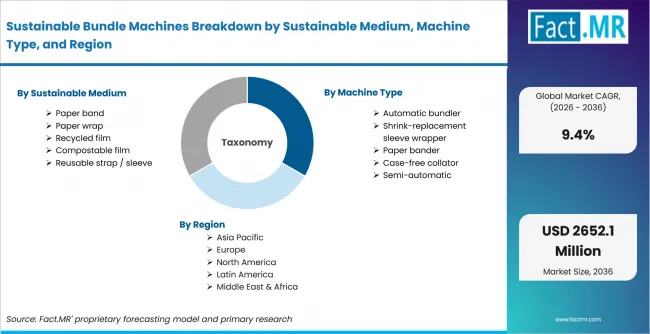
Sustainable Bundle Machines Breakdown By Sustainable Medium, Machine Type, And Region | Source: Fact.MR
| Attribute | Details |
|---|---|
| Quantitative Units | USD million |
| Market Definition | Machinery used to group products into bundles using paper, recycled, compostable, reusable or lower-material secondary-packaging formats |
| Segments Covered | Sustainable Medium; Machine Type; Application; Sustainability Goal |
| Geographic Coverage | Global market with detailed country analysis for Germany, USA, Italy, France and UK |
| Countries Covered | Germany; USA; Italy; France; UK |
| Key Companies | Krones; Sidel; BW Packaging; ATS-Tanner; Mosca; Robopac |
| Forecast Period | 2026-2036 |
| Base Year | 2026 |
| Market Value, 2026 | USD 1,080.0 million |
| Market Value, 2036 | USD 2,652.1 million |
| CAGR, 2026-2036 | 9.4% |
| Absolute Opportunity | USD 1,572.1 million |
| Approach | Installed-base, replacement-cycle and packaging-conversion analysis using machine pricing, application demand and primary research |
How is the market segmented?
-
By Sustainable Medium
- Paper band
- Paper wrap
- Recycled film
- Compostable film
- Reusable strap / sleeve
-
By Machine Type
- Automatic bundler
- Shrink-replacement sleeve wrapper
- Paper bander
- Case-free collator
- Semi-automatic
-
By Application
- Beverage multipacks
- Food / canned goods
- Personal care
- E-commerce
- Industrial
-
By Sustainability Goal
- Plastic elimination
- Material reduction
- Recycled content
- Energy reduction
- Reusability / circularity