- Market Value (2025): USD 870.8 Mn
- Estimated Value (2026): USD 930.0 Mn
- Forecast Value (2036): USD 1795.5 Mn
- CAGR (2026-2036): 6.8%
What is the Paper Bundle Packers Market forecast to be worth by 2036?
USD 930.0 million in 2026 to USD 1,795.5 million by 2036 at a 6.8% CAGR.
- The Paper Bundle Packers Market crossed a valuation of USD 870.8 million in 2025.
- Demand is projected to increase from USD 930.0 million in 2026 to USD 1,795.5 million by 2036.
- The market is forecast to record 6.8% CAGR from 2026 to 2036, supported by paper-compatible automation in food, fulfillment and print packing lines.
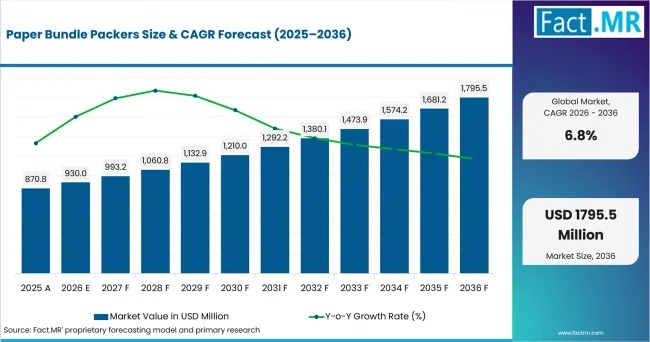
Paper Bundle Packers Value Analysis | Source: Fact.MR
What are the defining numbers behind Paper Bundle Packers Market growth?
An absolute opportunity of USD 865.5 million is expected between 2026 and 2036.
- Demand Drivers in the Market
- Packaging engineers are expected to use paper banding where a narrow strip can hold cartons or trays while leaving codes and branding visible.
- Fulfillment operators are anticipated to add tabletop and semi-automatic packers where mixed orders need a neat group before outer-carton closing.
- Print finishers are projected to keep banding machines in use where leaflets, labels and booklets need edge protection during handling.
- Brand owners are expected to test paper sleeves and wraps as European packaging rules place more attention on recyclable grouped-pack formats.
- Key Segments Analyzed
- By Bundling Technology: Paper banding is expected to hold 32.0% share in 2026 owing to clean product grouping and low material coverage.
- By Machine Format: Inline automatic systems are projected to account for 43.0% share in 2026 as continuous lines need synchronized bundle flow.
- By Bundle Application: Food & beverage multipacks are anticipated to capture 27.0% share in 2026 since repeat pack counts favor stable paper grouping.
- By Throughput: 20-40 bundles/min is estimated to represent 32.0% share in 2026, reflecting the balance between output and changeover flexibility.
- Analyst Opinion at Fact.MR
- Shambhu Nath Jha, Principal Consultant at Fact.MR, states, “Paper bundle packing is becoming a line-qualification decision. Plants are expected to compare paper-feed stability, seal behavior and product marking before approving wider rollouts. Suppliers that combine machine trials, paper-grade support and quick service response should fit the way food, fulfillment and print customers buy equipment.”
- Strategic Implications
- Machine builders should prove paper-feed stability across several band widths and product surfaces before proposing high-speed installations.
- Converters should provide paper grades that hold tension during sealing and transport while keeping print quality suitable for visible bands.
- Food packers should validate bundle strength under chilled storage and pallet movement before shifting recurring multipack programs.
- UK commercial teams should treat PackUK's December 2025 Year 2 EPR figures as illustrative: the published green fee for paper and board is GBP 190 per tonne for 2026 to 2027, and PackUK states that the figures are intended for planning and are subject to change.
The USA is forecast to record 8.2% CAGR through 2036, driven by e-commerce scale and paperboard-container demand. Germany is projected to post 7.8% CAGR as packaging recovery rules and machine-building depth support paper bundling. Italy is anticipated to advance at 7.5% CAGR, backed by food and personal care pack conversion. The UK is estimated to reach 6.8% CAGR through online retail and EPR fee signals. The Netherlands is forecast to record 6.3% CAGR as high e-commerce participation supports compact fulfillment automation.
How does the Paper Bundle Packers Market break down by segment?
Paper banding is projected to lead Bundling Technology at 32.0% share in 2026; inline automatic systems lead Machine Format at 43.0% share.
Which Bundling Technology dominates?
Paper banding is expected to hold 32.0% share in 2026.
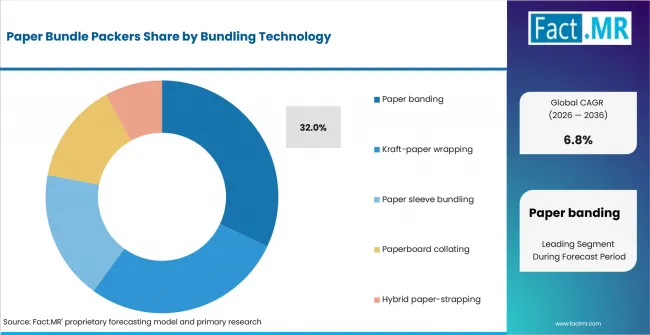
Paper Bundle Packers Analysis By Bundling Technology | Source: Fact.MR
Paper banding leads because it creates a tight bundle with limited material and clear product visibility. It suits cartons, leaflets, trays and light consumer packs where packaging teams want restraint while wrap coverage stays low.
Eurostat reported in October 2025 that paper and cardboard accounted for 40.4% of EU packaging waste in 2023. Paper and cardboard was the largest material category in EU packaging waste that year.
What leads the Machine Format segment?
Inline automatic systems are projected to account for 43.0% share in 2026.
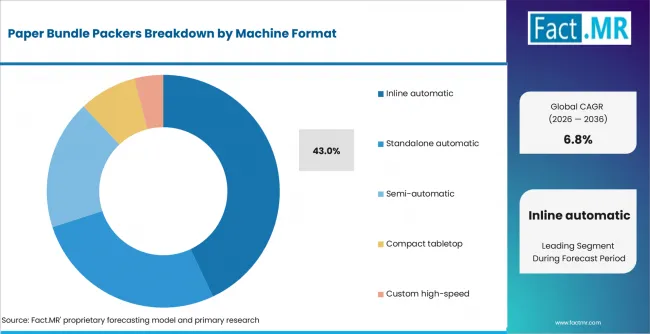
Paper Bundle Packers Analysis By Machine Format | Source: Fact.MR
Inline automatic systems lead because they remove repeated manual handling from packing lines. They are selected where bundle flow must stay synchronized with upstream filling, carton loading or collation equipment.
Bandall states that its automatic banding systems can integrate with existing packaging lines, reduce manual work and support continuous, high-output banding operations using paper or film materials.
How does Bundle Application shape demand?
Food & beverage multipacks are anticipated to capture 27.0% share in 2026.
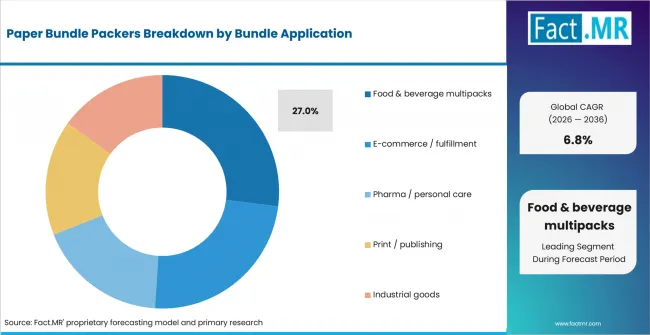
Paper Bundle Packers Analysis By Bundle Application | Source: Fact.MR
Food and beverage multipacks lead because cans, cartons and tray packs often move through repeat counts. Paper bundle packers help plants lower wrap coverage while keeping grouped units stable for shelf handling.
Food and beverage multipacks lead because bundled cartons and trays need shelf-ready presentation and stable handling. Paper banders and sleeve systems are expected to remain useful where plants group repeated pack sizes on established lines.
What supports 20-40 bundles/min within Throughput?
20-40 bundles/min is estimated to represent 32.0% share in 2026.
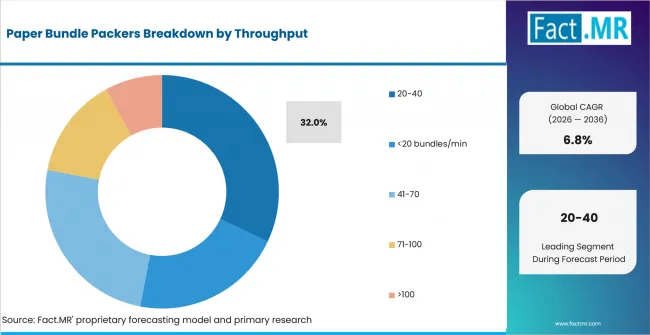
Paper Bundle Packers Analysis By Throughput | Source: Fact.MR
The 20-40 bundles/min band fits plants that need reliable output and frequent product-size changes. It suits tabletop and semi-automatic machines used beside manual benches or short-run packing cells.
Sollas’ SXP series can wrap up to 80 products per minute. The SXP can package a wide range of products individually or as bundles, handle paper and film, and switch between different products with minimal changeover time.
What is accelerating Paper Bundle Packers Market adoption, and what is holding it back?
Demand is expected to rise through paper-based bundling and line automation, while adoption is constrained by paper strength, material cost and machine qualification.
Drivers Impact Analysis
| DRIVER | (~) % IMPACT ON CAGR | GEOGRAPHIC RELEVANCE | IMPACT TIMELINE |
|---|---|---|---|
| Plastic-film replacement in grouped packs | +1.2% | Europe, North America | Short term (<= 2 years) |
| Inline automation in food and fulfillment | +1.0% | USA, Germany, Netherlands | Medium term (2-4 years) |
| Paper banding for print and mixed cartons | +0.7% | Europe, USA | Medium term (2-4 years) |
| Retail-ready multipack redesign | +0.6% | Europe, North America | Long term (>= 4 years) |
Source: Fact.MR analysis. Updated Sep 9, 2026
- Plastic-film replacement in grouped packs: Paper bundling is gaining relevance as packaging users look for recyclable alternatives to plastic film. Paper bands can group products securely while supporting packaging-reduction goals and compatibility with fiber-based recycling systems.
- Inline automation in food and fulfillment: Automated banding helps operators reduce repeated manual handling and maintain consistent bundle spacing after filling or collation. Integration with existing production lines can improve throughput, bundle uniformity, and handling efficiency across food and fulfillment operations.
- Paper banding for print and mixed cartons: Print rooms and fulfillment operations use paper bands to group variable products while keeping labels, barcodes, and printed information visible. The format is well suited to mixed cartons and short-run bundles that require simple identification and separation.
Opportunity Impact Analysis
| OPPORTUNITY | (~) % IMPACT ON CAGR | GEOGRAPHIC RELEVANCE | IMPACT TIMELINE |
|---|---|---|---|
| Compact tabletop packers for fulfillment rooms | +0.8% | USA, UK, Netherlands | Short term (<= 2 years) |
| Paper sleeve bundling for food and personal care | +0.7% | Europe | Medium term (2-4 years) |
| Paper-based beverage multipack systems | +0.5% | Germany, Italy, USA | Long term (>= 4 years) |
Source: Fact.MR analysis. Updated Sep 9, 2026
- Compact tabletop packers for fulfillment rooms: Smaller fulfillment cells can adopt paper banding without major line changes by placing compact tabletop equipment beside existing packing stations. This creates an accessible automation route for lower-volume operations that need consistent bundling with limited floor space.
- Paper sleeve bundling for food and personal care: Paper sleeves can group trays, cartons, and cosmetic packs while also providing printable branding space. The format supports bundle identification, product presentation, and reduced reliance on plastic overwrap across food and personal-care packaging.
- Integrated paper-based beverage multipacks: Paper-based multipack systems create an opportunity to replace conventional plastic grouping materials in beverage packaging. Cardboard clips and kraft-paper bands can secure containers while maintaining handling performance and supporting fiber-based packaging strategies.
Restraints Impact Analysis
| RESTRAINT | (~) % IMPACT ON CAGR | GEOGRAPHIC RELEVANCE | IMPACT TIMELINE |
|---|---|---|---|
| Paper tension and tear limits | -0.5% | Global | Short term (<= 2 years) |
| Material and fee pressure | -0.4% | UK, USA, Europe | Medium term (2-4 years) |
| Line trials before pack approval | -0.3% | Food and beverage plants | Medium term (2-4 years) |
Source: Fact.MR analysis. Updated Sep 9, 2026
- Paper tension and tear limits: Paper bands and sleeves must maintain adequate strength during conveying, handling, and transport. Manufacturers therefore need to validate band width, paper quality, tension settings, and seal performance before replacing established bundling materials.
- Material and fee pressure: Paper and board costs can influence the economics of paper bundling systems. Buyers are likely to focus on band width, material utilization, roll waste, and seal consistency to keep packaging costs manageable during machine trials and commercial operation.
- Line trials before pack approval: Food and personal-care companies typically validate new bundle formats through handling, transport, and shelf-performance testing before full-scale conversion. These qualification steps can slow adoption where packaging changes require evidence of product protection, bundle stability, and line compatibility.
Which countries are scaling the Paper Bundle Packers Market through 2036?
- The country comparison spans 1.9 percentage points between the USA and the Netherlands.
- The USA remains 0.4 percentage point above Germany through e-commerce scale and paperboard-container demand.
- Germany remains 0.3 percentage point above Italy through packaging recovery pressure and machinery depth.
- Italy remains 0.7 percentage point above the UK as packaging recovery programs support paper-based grouped packs.
- The UK remains 0.5 percentage point above the Netherlands through online retail growth and EPR fee signals.
- The Netherlands closes the displayed range through high online-buying participation and compact fulfillment automation.
Comparable CAGRs create different entry conditions due to retail channel structure, packaging recovery rules, machine-line maturity and converter support. Full report coverage includes North America, Latin America, Western Europe, Eastern Europe, East Asia, South Asia & Pacific, Middle East & Africa.
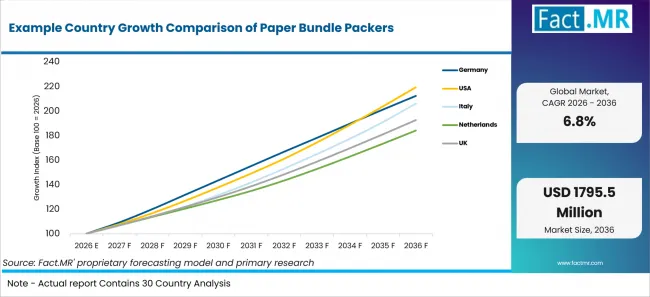
Example Country Growth Comparison Of Paper Bundle Packers | Source: Fact.MR
| Country | CAGR (2026-2036) |
|---|---|
| United States | 8.2% |
| Germany | 7.8% |
| Italy | 7.5% |
| United Kingdom | 6.8% |
| Netherlands | 6.3% |
Source: Fact.MR analysis. Updated Sep 9, 2026
What supports USA adoption?
8.2% CAGR, supported by e-commerce scale and paperboard-container demand.
USA packaging and fulfillment operators are expected to keep paper bundle packers close to parcel benches and food multipack lines. The U.S. Census Bureau reported that second-quarter 2026 retail e-commerce sales reached USD 340.2 billion, up 12.2% from the second quarter of 2025 and equal to 17.1% of total U.S. retail sales.
What supports Germany’s growth?
7.8% CAGR, supported by recycling rules and machinery depth.
Germany's packaging machine builders are expected to benefit from food, personal care and print customers that need paper-compatible grouping. The German Environment Agency and Central Agency Packaging Register reported in January 2026 that around 5.5 million tonnes of packaging waste collected by Germany’s dual systems were recovered in 2024; paper and cardboard packaging met the statutory recycling target.
How is Italy developing demand?
7.5% CAGR, backed by packaging recovery programs and consumer-goods bundling.
Italian food and personal care plants are expected to use paper bundle packers where grouped packs need shelf presentation and material clarity. CONAI reported in June 2025 that Italy recycled 76.7% of packaging placed on the market in 2024, or around 10.7 million tonnes out of more than 13.95 million tonnes.
What supports the United Kingdom’s growth?
6.8% CAGR, supported by online retail and packaging EPR rules.
UK fulfillment rooms are expected to keep testing compact paper banders where parcel volumes need tidy group handling. The Office for National Statistics reported that online spending values rose 11.0% in the three months to July 2026 compared with the same period a year earlier and 3.0% compared with the three months to April 2026.
How does the Netherlands perform?
6.3% CAGR, driven by e-commerce participation and compact packing cells.
Dutch fulfillment and food distributors are projected to use paper bundle packers where small spaces need clean grouping and easy material records. Eurostat reported in its 2026 digitalisation publication that 94% of Dutch internet users bought goods or services online in 2025, the second-highest share in the EU after Ireland at 95%.
Which companies are the key providers?
Key companies include ATS-Tanner; Bandall; Mosca; Sollas; Krones; and HUGO BECK.
- ATS-Tanner
- Bandall
- Mosca
- Sollas
- Krones
- HUGO BECK
Bibliography
- ATS-Tanner Banding Systems AG. (2025, July 18). Three Machines – One Platform. The new US-2500 product line is here!
- CONAI. (2025, June 25). Packaging recycling: Italy reaches 76.7%.
- European Commission, Directorate-General for Environment. (2026, August 11). New EU packaging rules start to apply, including restrictions on PFAS in food-contact packaging.
- Eurostat. (2025, October 22). Plastic packaging waste in the EU: 35.3 kg per person.
- PackUK, & Department for Environment, Food & Rural Affairs. (2025, December 16). Year 2 illustrative waste disposal fees: Extended producer responsibility for packaging.
- Eurostat. (2026, April 23). Digitalisation in Europe – 2026 edition.
- German Environment Agency, & Central Agency Packaging Register. (2026, January 27). Facts against myths: Packaging waste recycling in Germany is working.
- Krones. (2026, March 17). Sustainable and fully automated packaging solutions.
- Mosca Strap & Consumables GmbH & Co. KG. (2024, May). Paper strap [Product data sheet].
- Hugo Beck. (2026, March 19). Hugo Beck to launch new sleeve wrapper for sustainable transport packaging at interpack.
- Office for National Statistics. (2026, August 21). Retail sales, Great Britain: July 2026.
- U.S. Census Bureau. (2026, August 18). Quarterly retail e-commerce sales [Second quarter 2026 release].
- U.S. Census Bureau. (2026, September 3). Census Bureau releases new Annual Integrated Economic Survey data.
This Report Answers
- The report explains where paper bundle packers are used across bundling technology and machine format. It covers bundle application, throughput and region.
- Segment analysis identifies the leading subsegments and the operating reasons plants prioritize them.
- Country analysis examines the listed markets and the packaging, retail and recovery mechanisms supporting adoption.
- Competitive analysis reviews active providers across paper banding, strapping, wrapping and beverage multipack automation.
- Application analysis assesses how pack stability, code visibility and material handling influence machine selection.
What does the Paper Bundle Packers Market cover?
The Paper Bundle Packers Market covers machinery used to group products with paper-based bands, wraps, sleeves or board collars.
Coverage includes food and beverage multipacks, e-commerce fulfillment, personal care, pharmaceuticals, print and industrial goods. Related coverage on paper packaging materials and packaging automation solutions frames upstream material and machinery context.
What is included in the scope?
The scope includes paper banding machines, kraft-paper wrapping systems, paper sleeve bundlers, paperboard collating equipment and hybrid paper-strapping solutions. It covers equipment sold for inline, standalone, semi-automatic, compact tabletop and custom high-speed use.
It includes systems supporting paper-based wraparound packaging and recyclable grouped packs when machine revenue is tied to paper-based bundling or grouped-product handling. Adjacent case packing machines remain outside the count when they serve only carton loading.
What is excluded from the scope?
The scope excludes paper rolls, paperboard sheets, labels, cartons and packaging materials sold separately from a bundling machine. It also excludes filled products, standalone palletizers and ordinary case packers serving only case loading.
The assessment excludes plastic-only shrink wrappers, stretch wrappers and strap systems outside paper-compatible bundle handling. General warehouse automation remains outside the count when paper bundling functions are absent.
How Was the Analysis Built?
The analysis draws on 120+ sources, 35+ company portfolios, 25+ countries, and more than 20 industry interviews.
- Primary Research: Primary research includes discussions with manufacturers, service providers, technology developers, distributors, end users, and subject-matter experts. These conversations examine purchasing priorities, product adoption, operational challenges, approval requirements, competitive positioning, and the factors that influence wider market acceptance.
- Desk Research: Desk research covers government statistics, regulatory publications, company filings, trade data, technical studies, industry associations, standards, public policy, and other authoritative sources. Every source used in the analysis is documented in the bibliography.
- Market Sizing and Forecasting: Market estimates combine historical performance, demand indicators, pricing and volume trends, segment shares, company participation, country-level growth, adoption patterns, investment activity, and barriers to market expansion.
- Data Validation and Update Cycle: Findings are validated by comparing primary interviews with public data, company activity, regulatory changes, trade patterns, and industry developments. Regular updates review new product launches, capacity changes, partnerships, approvals, and shifts in commercial adoption.
Segmentation
What is the report’s scope and coverage?
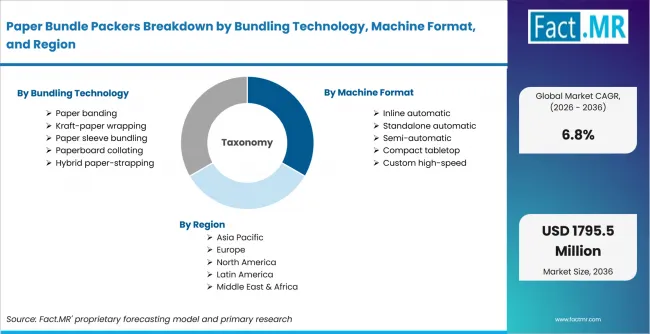
Paper Bundle Packers Breakdown By Bundling Technology, Machine Format, And Region | Source: Fact.MR
| Attribute | Details |
|---|---|
| Quantitative Units | USD million |
| Market Definition | Machines and systems that group products into paper-based bundles using paper bands, kraft-paper wraps, paper sleeves, paperboard collars or hybrid paper-strapping formats. |
| Bundling Technology | Paper banding; Kraft-paper wrapping; Paper sleeve bundling; Paperboard collating; Hybrid paper-strapping |
| Machine Format | Inline automatic; Standalone automatic; Semi-automatic; Compact tabletop; Custom high-speed |
| Bundle Application | Food & beverage multipacks; E-commerce / fulfillment; Pharma / personal care; Print / publishing; Industrial goods |
| Throughput | <20 bundles/min; 20-40 bundles/min; 41-70 bundles/min; 71-100 bundles/min; >100 bundles/min |
| Regions Covered | North America; Latin America; Western Europe; Eastern Europe; East Asia; South Asia & Pacific; Middle East & Africa |
| Countries Covered | United States; Germany; Italy; United Kingdom; Netherlands |
| Key Companies Profiled | ATS-Tanner; Bandall; Mosca; Sollas; Krones; HUGO BECK |
| Forecast Period | 2026 to 2036 |
| Approach | Hybrid top-down and bottom-up approach using machine format mix; paper bundling applications; throughput bands; country adoption; and provider portfolio review. |
Source: Fact.MR analysis. Updated Sep 9, 2026
How is the market segmented?
-
By Bundling Technology
- Paper banding
- Kraft-paper wrapping
- Paper sleeve bundling
- Paperboard collating
- Hybrid paper-strapping
-
By Machine Format
- Inline automatic
- Standalone automatic
- Semi-automatic
- Compact tabletop
- Custom high-speed
-
By Bundle Application
- Food & beverage multipacks
- E-commerce / fulfillment
- Pharma / personal care
- Print / publishing
- Industrial goods
-
By Throughput
- <20 bundles/min
- 20-40 bundles/min
- 41-70 bundles/min
- 71-100 bundles/min
- >100 bundles/min
-
By Region
- North America
- Latin America
- Western Europe
- Eastern Europe
- East Asia
- South Asia & Pacific
- Middle East & Africa
Frequently Asked Questions
How big is the paper bundle packers market in 2026?
What is the CAGR of the paper bundle packers market from 2026 to 2036?
Which bundling technology leads the paper bundle packers market?
Which machine format leads the paper bundle packers market?
Who are the leading companies in the paper bundle packers market?
Who worked on this report


Preview the report firsthand - request a free sample
Free SampleGet the brochure for pricing and purchase details
Download PDF