- Base Value(2025): 109.3 Mn
- Estimated Value(2026): 125 Mn
- Forecast Value (2036): 480 Mn
- CAGR (2026 - 2036): 14.4%
Biochar-Infused Sustainable Cement Additives Market Forecast 2026 to 2036
In 2025, the biochar-infused sustainable cement additives market was valued at USD 109.3 million. Based on Fact MR's analysis, demand for biochar-infused sustainable cement additives is estimated to grow to USD 125 million in 2026 and USD 480 million by 2036. FMR projects a CAGR of 14.4% during the forecast period.
The absolute dollar growth from 2026 to 2036 is USD 355 million. This growth is driven by the increasing demand for eco-friendly and sustainable building materials, with biochar-infused additives offering benefits like improved material strength, carbon sequestration, and reduced environmental impact. However, challenges such as high production costs and scaling biochar production may affect the growth rate in certain regions.
Australia leads with a CAGR of 16.5%, driven by strong sustainability initiatives and increasing demand for green construction materials. The USA follows with a 14.8% CAGR, supported by growing environmental regulations and interest in carbon reduction in the construction sector. Germany shows a 13.2% growth rate, fueled by Europe’s strong focus on sustainable building practices. China grows at 12.5%, driven by increasing adoption of green technologies in its rapidly expanding construction sector.
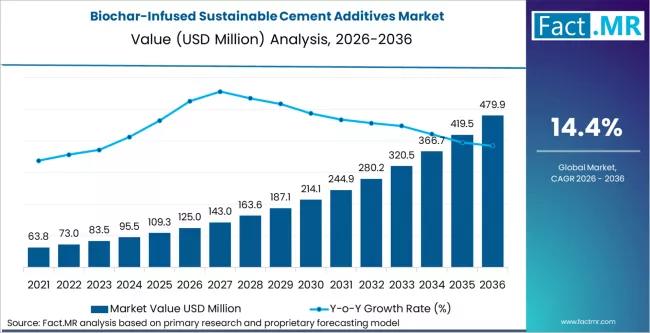
Biochar Infused Sustainable Cement Additives Market Market Value Analysis | Source: Fact.MR
Biochar‑Infused Sustainable Cement Additives Market Definition
The Biochar‑Infused Sustainable Cement Additives Market refers to the production and sale of biochar‑based additive formulations incorporated into cement and concrete to improve performance and sustainability. Biochar is a carbon‑rich material produced by pyrolysis of biomass that enhances cement composites by refining microstructure, increasing durability, and reducing overall carbon footprint. These additives help lower cement content, improve workability, and contribute to long‑term strength and durability. Key end uses include infrastructure, residential and commercial construction, precast concrete products, and sustainable building projects where reduced environmental impact and improved performance are priorities.
Market Inclusions
This report covers global and regional market sizes for biochar‑infused sustainable cement additives with a defined forecast period. It includes segment breakdowns by additive type (raw biochar, engineered biochar blends), application (structural concrete, non‑structural concrete, mortar, grouts), and end‑use sector (residential, commercial, infrastructure). Pricing trends, raw material supply dynamics, and trade flow data are included to reflect overall market behavior.
Market Exclusions
The scope excludes traditional cementitious additives not based on biochar or sustainable biomass feedstocks. It does not cover finished concrete products, construction services, or unrelated cement components such as aggregates and traditional chemical admixtures like superplasticizers and retarders. Niche industrial uses of biochar outside cement and concrete formulations are omitted.
Research Methodology
- Primary Research: Interviews were conducted with material scientists, additive formulators, cement producers, and construction experts.
- Desk Research: Data was sourced from industry reports, construction material publications, and trade association statistics.
- Market‑Sizing and Forecasting: A hybrid model was used, combining top‑down construction material forecasts with bottom‑up shipment and revenue data.
- Data Validation and Update Cycle: Findings were validated through expert review and aligned with recent production, trade, and sales figures, with periodic updates.
Biochar-Infused Sustainable Cement Additives Market
-
Market Definition
-
The biochar-infused sustainable cement additives market includes the production and sale of biochar-based additives used to improve the performance and sustainability of cement and concrete. Biochar, a carbon-rich material derived from biomass pyrolysis, is used to refine the microstructure of cement, increase durability, and lower the carbon footprint of construction materials. These additives provide enhanced workability, strength, and long-term performance in concrete, contributing to more sustainable building practices. Key end uses include infrastructure, residential, and commercial construction, as well as sustainable building projects where reduced environmental impact and improved material performance are priorities.
-
-
Demand Drivers
-
Growing regulatory pressures and environmental standards driving the construction industry to adopt low-carbon materials.
-
Increasing focus on sustainable and eco-friendly building materials, particularly in markets with a strong commitment to reducing carbon emissions in the construction sector.
-
The rising adoption of biochar as a carbon-negative alternative in concrete and cement production, improving both environmental sustainability and material performance.
-
The increasing demand for durable, high-performance concrete that supports long-term sustainability in both residential and commercial projects.
-
-
Key Segments Analyzed
- Material Type: Biochar Blends are expected to dominate, accounting for 52% of the market share by 2026. These blends combine biochar with other additives to enhance sustainability and cement performance.
- Application: Ready-Mix Concrete is projected to capture 45% of the market share, benefiting from the use of biochar-infused additives for improved strength, durability, and environmental benefits in large-scale construction projects.
- End-Use Industry: Residential Construction leads with 40% of the market share, supported by increasing consumer demand for sustainable housing and eco-friendly building materials.
- Geography: Australia is projected to have the highest growth rate, driven by strong sustainability initiatives in the construction sector. The USA and Germany also show substantial growth due to robust green construction trends.
-
Analyst Opinion at FMR
-
Shambhu Nath Jha, Principal Consultant at Fact MR (FMR), notes, "The biochar-infused sustainable cement additives market is experiencing rapid growth as construction industries globally move toward more sustainable practices. The demand for biochar-based additives is driven by both environmental regulations and consumer preference for green construction solutions. These additives not only enhance cement durability and performance but also provide a significant carbon sequestration benefit, positioning them as a key player in the future of construction."
-
-
Strategic Implications/Executive Takeaways
- Invest in biochar-based product innovation to meet growing consumer demand for sustainable and high-performance construction materials.
- Strengthen strategic partnerships with construction companies and infrastructure projects to gain early adoption of biochar-based cement additives.
- Focus on enhancing scalability and cost-efficiency in biochar production to make these products more accessible and reduce production costs.
- Position products as key solutions to meet sustainability goals and carbon reduction targets in the construction industry.
-
Methodology
- Primary Research: Interviews were conducted with material scientists, additive formulators, cement producers, and construction experts.
- Desk Research: Data was sourced from industry reports, construction material publications, and trade association statistics.
- Market Sizing and Forecasting: A hybrid model was used, combining top-down construction material forecasts with bottom-up shipment and revenue data.
- Data Validation and Update Cycle: Findings were validated through expert review and aligned with recent production, trade, and sales figures, with periodic updates.
Segmental Analysis
Biochar-Infused Sustainable Cement Additives Market Analysis by Material Type
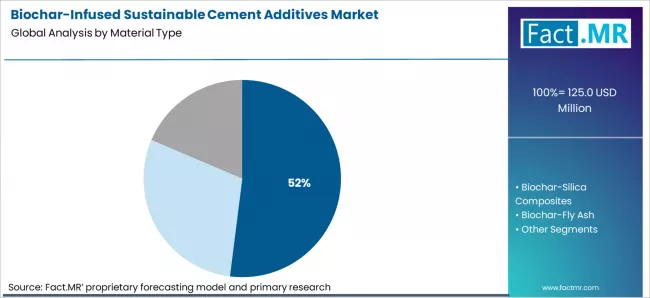
Biochar Infused Sustainable Cement Additives Market Analysis By Material Type | Source: Fact.MR
- Market Overview: Biochar blends are projected to capture 52% of the biochar-infused sustainable cement additives market by 2026. Biochar blends, which combine biochar with other materials like cement and other additives, are used to enhance the sustainability and performance of concrete. They provide a carbon-negative alternative to traditional cement additives, improving the environmental footprint of the construction industry.
- Demand Drivers:
- Sustainability Focus: With increasing emphasis on sustainable construction practices, biochar blends are gaining traction due to their ability to reduce the carbon footprint of concrete production. Biochar is a carbon-rich material produced from organic waste, contributing to a more sustainable construction industry.
- Improved Concrete Properties: Biochar blends enhance the properties of cement by improving strength, durability, and thermal insulation. This makes them an attractive choice for eco-conscious builders and construction projects aiming to improve the quality and longevity of concrete structures.
- Cost-Effectiveness and Performance: Biochar-infused blends offer an affordable alternative to traditional cement additives, allowing manufacturers to reduce material costs while meeting environmental standards and improving concrete performance.
Biochar-Infused Sustainable Cement Additives Market Analysis by Application
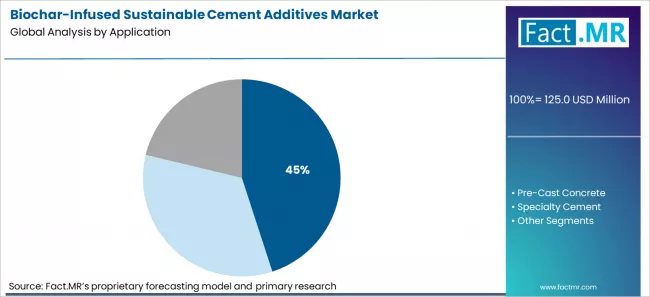
Biochar Infused Sustainable Cement Additives Market Analysis By Application | Source: Fact.MR
- Market Overview: Ready-mix concrete is expected to account for 45% of the market share by 2026. Ready-mix concrete, widely used in construction projects, benefits from the integration of biochar-infused additives to enhance sustainability and improve the properties of the final mix.
- Demand Drivers:
- Widespread Use in Construction: Ready-mix concrete is commonly used for various construction applications, including residential, commercial, and infrastructure projects. The demand for sustainable and high-performance concrete drives the adoption of biochar-infused cement additives in ready-mix concrete.
- Regulatory and Environmental Standards: Increasing environmental regulations and pressure to reduce greenhouse gas emissions in the construction sector are pushing the adoption of more sustainable materials like biochar-infused additives.
- Performance and Durability Requirements: Biochar-infused additives in ready-mix concrete help improve the material's thermal insulation, mechanical strength, and resistance to cracking, making it an attractive solution for contractors aiming to meet both performance and sustainability goals.
Biochar Infused Sustainable Cement Additives Market Drivers, Restraints, and Opportunities
FMR analysts observe that the biochar‑infused sustainable cement additives market is a growth‑aligned, transitional segment driven by the construction industry’s shift toward low‑carbon materials. Historically, traditional cement formulations relied on pozzolans and mineral additives to improve strength and durability; growing regulatory and purchaser focus on embodied carbon created structural demand for biochar as a sustainable, carbon‑rich additive that can sequester carbon and enhance performance. The 2026 valuation reflects this dual pressure of performance and compliance as green building standards and low‑emission procurement guidelines become more common in commercial and infrastructure projects.
While demand for conventional cement additives persists across cost‑sensitive projects, engineered biochar blends that deliver measurable carbon reduction and improved microstructure are gaining share. These advanced additives carry higher per‑unit prices, contributing to net market value growth even as unit volumes grow moderately with broader construction activity. The market exists because performance expectations and regulatory drivers increasingly reward low‑carbon ingredient adoption, even where traditional additives remain entrenched.
- Low‑Carbon Materials Demand: Specification of carbon‑reducing materials in infrastructure and green building projects is replacing some traditional pozzolans with biochar‑enhanced additives to meet sustainability benchmarks.
- Regulatory Standards Pressure: Standards such as LEED and the EU’s Construction Products Regulation push adoption of certified low‑carbon cement systems, raising uptake of biochar‑infused formulations.
- Regional Construction Trends: In Europe and North America, where carbon‑neutral targets and green procurement policies are stronger, adoption of biochar additives outpaces markets with lower regulatory emphasis.
Regional Analysis
The market analysis covers key global regions, including North America, Europe, East Asia, and Australia. It is segmented geographically, with specific market dynamics for each region. The full report provides a detailed market attractiveness analysis.
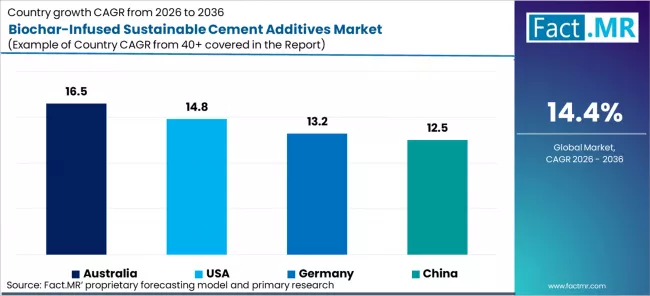
Biochar Infused Sustainable Cement Additives Market Cagr Analysis By Country | Source: Fact.MR
| Country | CAGR (2026-2036) |
|---|---|
| Australia | 16.5% |
| USA | 14.8% |
| Germany | 13.2% |
| China | 12.5% |
Source: Fact.MR analysis. Updated Feb 24, 2026
Source: Fact MR (FMR) analysis, based on proprietary forecasting model and primary research.
Australia:
Australia is a "leading market" for biochar-infused sustainable cement additives, driven by its strong commitment to sustainability in the construction sector and growing demand for eco-friendly building materials.
- Australia: Demand for biochar-infused sustainable cement additives in Australia is projected to rise at 16.5% CAGR through 2036. Australia’s push for sustainable construction practices and focus on reducing carbon emissions in the building industry continue to drive market growth for biochar-infused additives.
North America:
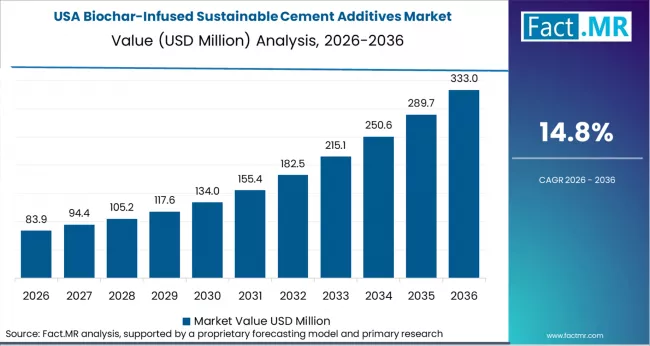
Biochar Infused Sustainable Cement Additives Market Country Value Analysis | Source: Fact.MR
In North America, particularly in the USA, the market for biochar-infused sustainable cement additives is growing, supported by increasing regulatory pressure on reducing carbon footprints in the construction industry.
- USA: Demand for biochar-infused sustainable cement additives in the U.S. is projected to rise at 14.8% CAGR through 2036. The growing focus on sustainable construction methods and government incentives for green building materials contribute to the strong demand for biochar-infused additives in cement production.
Europe:
In Europe, Germany is a key player in the market for biochar-infused sustainable cement additives, driven by its robust construction industry and strong environmental regulations.
- Germany: Demand for biochar-infused sustainable cement additives in Germany is projected to rise at 13.2% CAGR through 2036. Germany’s advanced approach to sustainable construction and regulatory incentives for carbon reduction continue to boost the adoption of biochar-infused additives in the cement sector.
East Asia:
In East Asia, China is a significant market for biochar-infused sustainable cement additives, supported by its rapid urbanization and growing focus on sustainable building materials.
- China: Demand for biochar-infused sustainable cement additives in China is projected to rise at 12.5% CAGR through 2036. China’s expanding construction industry and government focus on green building practices contribute to the increasing demand for biochar-based cement additives.
Fact MR's analysis of the biochar-infused sustainable cement additives market in Australia, North America, Europe, and East Asia consists of country-wise assessments that include Australia, the USA, Germany, and China. Readers can find detailed trends, regulatory updates, and company-specific investments shaping the market’s growth in these countries.
How Are Key Players Competing in the Biochar-Infused Sustainable Cement Additives Market?
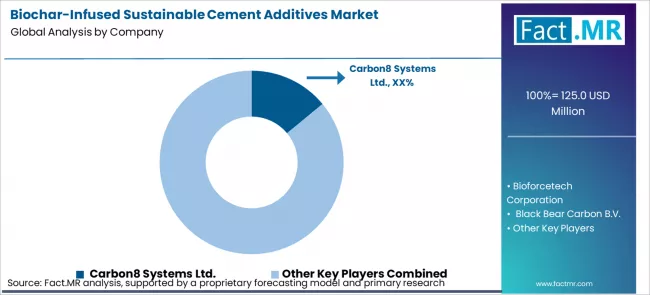
Biochar Infused Sustainable Cement Additives Market Analysis By Company | Source: Fact.MR
In the biochar-infused sustainable cement additives market, companies like Carbon8 Systems Ltd., Bioforcetech Corporation, and Black Bear Carbon B.V. are leveraging innovative technologies to create eco-friendly solutions for the cement industry. These players focus on incorporating biochar, a sustainable material, to enhance the performance and carbon footprint reduction of cement. Airex Energy Ltd. and Pacific Biochar focus on sustainable manufacturing practices, offering additives that not only improve cement strength and durability but also contribute to carbon capture and storage. The market’s growth is driven by the rising demand for greener building materials and the push towards reducing carbon emissions in construction. Differentiation is centered around product effectiveness, scalability, and alignment with environmental goals.
Recent Industry Developments
- Strategic Offtake Agreement (Corporate): On January 23, 2026, climate-tech firm Sow & Reap Chara signed a 10-year pact with Sagar Cements to install 20 integrated biochar and gasification units at cement plants; the syngas will fuel the energy-intensive calcination process while the produced biochar serves as a carbon-sequestering additive.
- International Certification Merger (Regulatory): In 2024, the International Biochar Initiative (IBI) and Carbon Standards International (CSI) announced a merger of the IBI Biochar Standard with the World Biochar Certificate to create a unified global certification for biochar safety and carbon removal reliability in industrial materials.
- Holcim Biochar Industrialization (Corporate): In early 2026, global building leader Holcim announced the mainstreaming of biochar-infused concrete after successfully proving its performance through 2,500 cubic meters of test pavement and its high-profile "Basic Services Unit" carbon-sink prototype at the Venice Biennale.
Key Players of the Biochar-Infused Sustainable Cement Additives Market
- Carbon8 Systems Ltd.
- Bioforcetech Corporation
- Black Bear Carbon B.V.
- Airex Energy Ltd.
- Pacific Biochar
Report Scope
| Metric | Value |
|---|---|
| Quantitative Units | USD 125 million (2026) to USD 480 million (2036), at a CAGR of 14.4% |
| Market Definition | The Biochar-Infused Sustainable Cement Additives Market includes the use of biochar-based materials in cement to enhance sustainability, offering improvements in concrete properties for the construction industry. |
| By Material Type | Biochar Blends - 52%, Biochar-Silica Composites - 28%, Biochar-Fly Ash - 20% |
| By Application | Ready-Mix Concrete - 45%, Pre-Cast Concrete - 32%, Specialty Cement - 23% |
| By End-Use Industry | Residential Construction - 40%, Commercial Construction - 32%, Infrastructure - 28% |
| Regions Covered | North America, Latin America, Europe, East Asia, South Asia, Oceania, Middle East and Africa |
| Countries Covered | United States, Canada, Mexico, Brazil, Argentina, Germany, France, United Kingdom, Italy, Spain, China, India, Japan, South Korea, Indonesia, Australia, and 40+ countries |
| Key Companies Profiled | Carbon8 Systems Ltd., Bioforcetech Corporation, Black Bear Carbon B.V., Airex Energy Ltd., Pacific Biochar |
| Forecast Period | 2026 to 2036 |
| Approach | Hybrid top-down and bottom-up market modeling validated through primary interviews with manufacturers and supported by trade data benchmarking and market research. |
Source: Fact.MR analysis. Updated Feb 24, 2026
Bibliographies
- Bioforcetech Corporation. (2026). Biochar-based products for industrial and construction applications (product portfolio). Bioforcetech Corporation.
- Airex Energy Ltd. (2026). Biochar production and applications relevant to low-carbon construction materials (product and applications portfolio). Airex Energy Ltd.
- Carbon8 Systems Ltd. (2026). Carbon8 products for carbonated aggregate and cementitious applications (product portfolio). Carbon8 Systems Ltd.
- Black Bear Carbon B.V. (2025). Recovered carbon black solutions and applications relevant to construction materials (product portfolio). Black Bear Carbon B.V.
- Pacific Biochar. (2025). Biochar products and applications for construction and cement-related uses (product portfolio). Pacific Biochar.
Segmentation
Biochar-Infused Sustainable Cement Additives Market Key Segments
-
By Material Type :
- Biochar Blends
- Biochar-Silica Composites
- Biochar-Fly Ash
-
By Application :
- Ready-Mix Concrete
- Pre-Cast Concrete
- Specialty Cement
-
By End-Use Industry :
- Residential Construction
- Commercial Construction
- Infrastructure
-
Region :
- North America
- USA
- Canada
- Mexico
- Europe
- Germany
- UK
- France
- Italy
- Spain
- Nordic Countries
- BENELUX
- Rest of Europe
- Asia Pacific
- China
- Japan
- South Korea
- India
- Australia
- Rest of Asia Pacific
- Latin America
- Brazil
- Argentina
- Rest of Latin America
- Middle East and Africa
- Kingdom of Saudi Arabia
- United Arab Emirates
- South Africa
- Rest of Middle East and Africa
- Other Regions
- Oceania
- Central Asia
- Other Markets
- North America
Frequently Asked Questions
How large is the demand for Biochar-Infused Sustainable Cement Additives in the global market in 2026?
What will be the market size of Biochar-Infused Sustainable Cement Additives in the global market by 2036?
What is the expected demand growth for Biochar-Infused Sustainable Cement Additives in the global market between 2026 and 2036?
Which material type is expected to dominate the market?
Which region is expected to show the highest growth rate for Biochar-Infused Sustainable Cement Additives?
How significant is the growth outlook for the United States in this market?
What is the growth outlook for Germany in this report?
What is the growth forecast for China in the Biochar-Infused Sustainable Cement Additives market?
Which company is identified as a leading player in the Biochar-Infused Sustainable Cement Additives market?
What are Biochar-Infused Sustainable Cement Additives used for?
What does the Biochar-Infused Sustainable Cement Additives market include in this report?
How is the market forecast developed in this report?
What is meant by the Biochar-Infused Sustainable Cement Additives market in this report?
Who worked on this report


Preview the report firsthand - request a free sample
Free SampleGet the brochure for pricing and purchase details
Download PDF