
- Market Value (2025): USD 330.2 Mn
- Estimated Value (2026): USD 350.0 Mn
- Forecast Value (2036): USD 626.8 Mn
- CAGR (2026-2036): 6.0%
Thermally Inhibited Starches Market Forecast and Outlook 2026 to 2036
The thermally inhibited starches market is projected to grow from USD 350.0 million in 2026 to USD 626.8 million by 2036. Demand for thermally inhibited starches is likely to grow at a CAGR of 6.0% over the forecast period.
Demand for thermally inhibited starches is rising as food makers need the heat, acid and shear tolerance of chemically cross-linked starch from an ingredient that can be labeled simply as starch. Suppliers of thermally inhibited starches are offering rice, corn, potato and tapioca starches that are dry-heated under controlled conditions so that granules stay intact through retorting, UHT treatment and homogenization. For example, in November 2026, Ingredion reported that net sales volume in its Texture & Healthful Solutions segment grew for the tenth consecutive quarter, with continued clean label growth globally.
In November 2026, Ingredion also said third-quarter operating income in that segment fell by USD 10 million to USD 95 million, driven by unfavorable tapioca costs and manufacturing expense and by unfavorable price mix. Demand for thermally inhibited starches is growing, but raw material swings affect margins and pricing. Tate & Lyle has said it plans to recover higher costs through calendar 2027 customer contract renewals.
Key Takeaways from the Thermally Inhibited Starches Market
- Sales of thermally inhibited starches stood at USD 330.2 million in 2025
- Thermally Inhibited Starches Market Value (2026): USD 350.0 million
- Thermally Inhibited Starches Market Forecast Value (2036): USD 626.8 million
- Thermally Inhibited Starches Market Forecast CAGR (2026-2036): 6.0%
- Leading Product Type: Thermally inhibited rice (24.7%)
- Key Market Participants: Ingredion, Tate & Lyle, Avebe, Roquette, Cargill
- Key Growth Countries: France, United Kingdom, United States, Netherlands, Germany
Thermally Inhibited Starches Market
| Metric | Value |
|---|---|
| Estimated Value in (2026) | USD 350.0 million |
| Forecast Value in (2036) | USD 626.8 million |
| Forecast CAGR (2026 to 2036) | 6.0% |
Source: Fact.MR analysis.
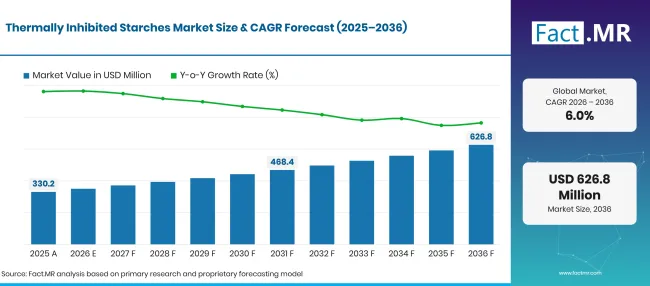
Thermally Inhibited Starches Forecast Global | Source: Fact.MR
Category
| Category | Segments |
|---|---|
| Product Type | Thermally inhibited rice, Thermally inhibited corn, Thermally inhibited potato, Thermally inhibited blended starch, Thermally inhibited tapioca |
| Functionality | Film forming, Stabilizing, Texturizing, Gelling, Thickening |
| Application | Soups and sauces, Bakery fillings, Ready meals, Dairy and desserts, Infant food |
| End User | Ingredient blenders, Contract manufacturers, Infant nutrition brands, Foodservice operators, Food manufacturers |
| Key Countries | France; United Kingdom; United States; Netherlands; Germany |
Source: Fact.MR analysis. Updated Nov 24, 2026
Segmental Analysis
Why does thermally inhibited rice starch lead product demand in the Thermally Inhibited Starches Market?
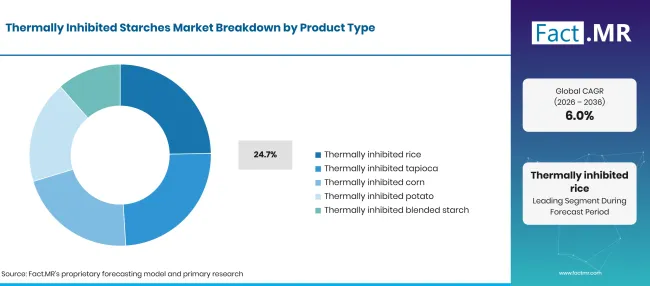
Thermally Inhibited Starches Breakdown Product Type | Source: Fact.MR
Thermally inhibited rice starch accounts for 24.7% of revenue in 2026, approximately USD 86.5 million, supported by its fine granule structure, mild flavor and smooth texture. Physical heat treatment can improve processing tolerance while preserving desirable sensory characteristics. Food manufacturers are examining rice-based grades for dairy desserts, infant foods and specialized formulations requiring consistent thickening performance.
How is film forming leading functionality demand in the Thermally Inhibited Starches Market?
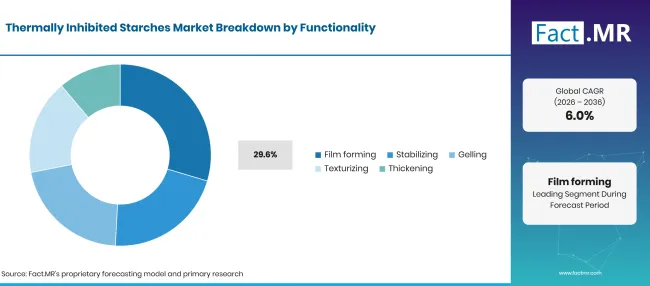
Thermally Inhibited Starches Breakdown Functionality | Source: Fact.MR
Film forming accounts for 29.6% of revenue in 2026, equivalent to approximately USD 103.6 million, making it the largest individual functionality segment in the report. Although thermally inhibited starches are widely used for thickening and texture control, film forming represents a separate application in food coatings. Formulators are examining heat-treated starches for coating adhesion, flexibility and moisture management. These properties support the development of starch-based coatings for processed foods.
Why do soups and sauces lead application demand in the Thermally Inhibited Starches Market?
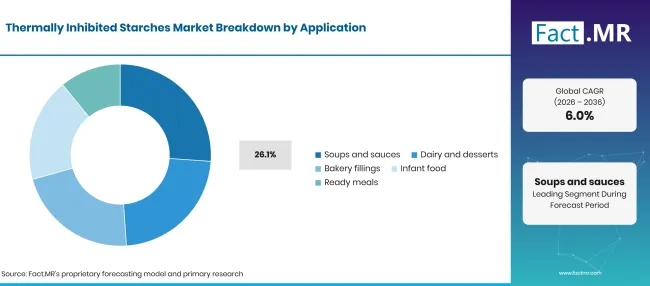
Thermally Inhibited Starches Breakdown Application | Source: Fact.MR
Soups and sauces hold 26.1% of revenue in 2026, equivalent to approximately USD 91.4 million, as commercial cooking exposes starch ingredients to heat, acidity and mechanical shear. Thermally inhibited grades can help maintain sauce consistency during processing and subsequent storage. Manufacturers are selecting formulations according to viscosity retention, freeze-thaw behavior and suitability for retorted or refrigerated products.
How are ingredient blenders leading end-user demand in the Thermally Inhibited Starches Market?
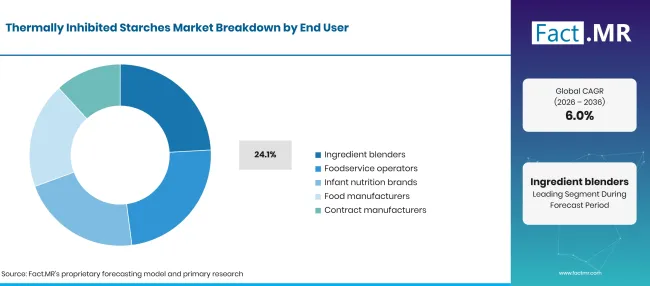
Thermally Inhibited Starches Breakdown End User | Source: Fact.MR
Ingredient blenders capture 24.1% of revenue in 2026, approximately USD 84.4 million, as seasoning and stabilizer manufacturers incorporate thermally inhibited starches into customized texture systems. These businesses combine starch with gums, proteins and other ingredients to achieve specific processing properties. Consistent thickening performance helps blenders develop products for food brands.
Thermally Inhibited Starches Market-Drivers, Restraints & Trends
Drivers
Regulatory scrutiny of food processing and additives is increasing interest in ingredients that can be declared simply as starch. For example, in August 2026, the U.S. FDA proposed mandatory GRAS notification (published in the Federal Register on August 11), and HHS and USDA submitted a proposed federal definition of ultra-processed foods for federal review. Suppliers of thermally inhibited starches are offering a physical alternative to chemically modified starch that performs in demanding processes.
Restraints
Demand for thermally inhibited starches is constrained by higher cost than modified starch and by energy use in dry heat treatment. For example, Tate & Lyle reported in November 2026 that half-year adjusted EBITDA fell 8% at constant currency to GBP 197 million and said it plans to recover higher costs through calendar 2027 contract renewals. Such cost pass-through could slow adoption in price-sensitive value products.
Trend
Broader Raw Material Bases Demand for inhibited starches from potato, rice and tapioca as well as waxy corn is rising as buyers seek specific textures and supply security. Suppliers are adding crops to their ranges. Avebe launched PuraMYL 440, an instant clean-label potato starch, in November 2026.
Trend
Infant and Clinical Nutrition Use Demand for stable, unmodified starches in baby food and medical nutrition is rising as manufacturers seek simple ingredient declarations.
Thermally Inhibited Starches Market Analysis by Key Country
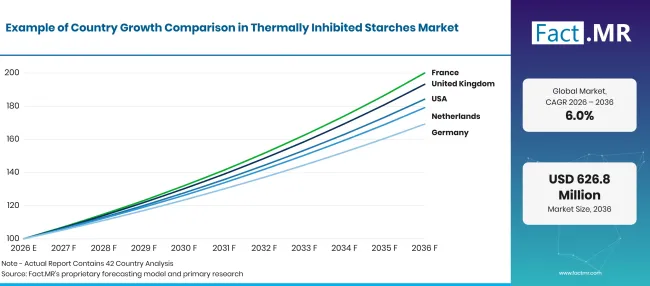
Thermally Inhibited Starches Growth Index | Source: Fact.MR
| Country | CAGR (2026-2036) |
|---|---|
| France | 7.2% |
| United Kingdom | 6.8% |
| United States | 6.3% |
| Netherlands | 6.0% |
| Germany | 5.4% |
Source: Fact.MR analysis.
What is driving thermally inhibited starches demand in France?
Demand for thermally inhibited starches in France is forecast to rise at a 7.2% CAGR through 2036, the fastest among the five countries.
French sauce and ready-meal manufacturers are examining physically processed starches that maintain viscosity during heating and storage. Food processors are exploring starch alternatives that meet clean-label preferences while preserving familiar product textures. Formulation choices will depend on heat tolerance, thickening efficiency and consistency during industrial cooking.
How are retailer standards supporting thermally inhibited starches sales in the United Kingdom?
Sales of thermally inhibited starches in the United Kingdom are set to increase at a 6.8% CAGR through 2036 as supermarkets place greater emphasis on ingredient transparency in private-label foods.
Manufacturers of chilled soups, sauces and prepared meals are reviewing starch specifications to meet retailer expectations. British processors are testing heat-treated starches for cooking and reheating applications. Suppliers offering dependable viscosity, convenient formulation support and suitable ingredient declarations may gain additional orders.
What is shaping thermally inhibited starches demand in the United States?
Demand for thermally inhibited starches in the United States is expected to advance at a 6.3% CAGR through 2036, supported by food manufacturers seeking functional alternatives to chemically modified starches.
In November 2026, Ingredion reported continued volume growth within its Texture & Healthful Solutions business, including demand for clean-label ingredients. American producers are evaluating heat-treated starches for dressings, soups and sauces that encounter demanding processing conditions. Product developers will examine acid tolerance, viscosity retention, shear resistance and ingredient costs when replacing established starch formulations.
How is potato starch shaping thermally inhibited starches sales in the Netherlands?
Sales of thermally inhibited starches in the Netherlands are likely to expand at a 6.0% CAGR through 2036, reflecting the country's expertise in potato starch processing.
Avebe introduced PuraMYL 440 in November 2026, offering instant texture development for cold-prepared foods; Avebe says the potato starch is physically modified through thermal inhibition and can be declared as potato starch. Dutch sauce and dairy manufacturers are exploring starches with suitable thickening and processing characteristics. Further opportunities will reflect ingredient functionality, manufacturing efficiency and product quality.
Why is growth slower for thermally inhibited starches in Germany?
Demand for thermally inhibited starches in Germany is forecast to increase at a 5.4% CAGR through 2036, the slowest among the five countries.
Cost-conscious food manufacturers are concentrating on ingredient efficiency while managing pressure on selling prices. In October 2026, the German Food and Drink Industries Federation reported that industry revenue fell 2.3% in the first half of 2026 while sales volume rose 0.9%. Commercial decisions will reflect processing performance, competitive pricing, reliable supply and the economics of replacing conventional starches.
Competitive Landscape for Thermally Inhibited Starches Market
The competitive advantage in thermally inhibited starches increasingly depends on how effectively manufacturers improve starch performance through controlled physical processing. Avebe has developed a specialized position through thermally inhibited potato starches under its PuraMYL portfolio. Ingredion (NOVATION Endura), Tate & Lyle (CLARIA) and Cargill (SimPure) compete with functional native and clean-label starches aimed at the same process-tolerance needs; these suppliers describe the ranges as functional native or clean-label starches rather than as thermally inhibited. Roquette participates in the broader specialty starch supply chain. Ingredion’s recommended acquisition of Tate & Lyle, announced in June 2026 and expected to complete in the second half of 2027, would combine two of the five key players.
Product innovation is extending thermal inhibition beyond conventional cooked sauces into applications requiring immediate thickening during cold preparation. On November 12, 2026, Avebe introduced PuraMYL 440, a thermally inhibited potato starch designed to develop texture without a cooking step. The product targets dressings, sauces, coatings and plant-based meat formulations, offering manufacturers opportunities to simplify production. Ingredion's NOVATION portfolio provides an alternative through application-specific starches designed for processing tolerance, while Tate & Lyle's CLARIA range emphasizes functional performance and sensory quality.
Recent Developments
- In June 2026, Ingredion announced a recommended all-cash offer for Tate & Lyle; Tate & Lyle shareholders approved it on July 28, 2026, and completion is expected in the second half of 2027, subject to antitrust conditions and court sanction.
- In November 2026, Avebe launched PuraMYL 440, a thermally inhibited potato starch for cold-prepared sauces, dressings, coatings and plant-based meat.
Key Players in Thermally Inhibited Starches Market
Key companies operating in the market include Ingredion, Tate & Lyle, Avebe, Roquette, and Cargill.
- Ingredion
- Tate & Lyle
- Avebe
- Roquette
- Cargill
Bibliography
- Bundesvereinigung der Deutschen Ernährungsindustrie. (2026, October 28). Halbjahresbilanz der Ernährungsindustrie 1/2026.
- Ingredion Incorporated. (2026, November 5). Ingredion Incorporated reports third quarter 2026 results. Westchester, IL: Ingredion Incorporated
- Royal Avebe. (2026, November 12). Avebe launches instant clean label potato starch for cold applications.
- Ingredion Incorporated. (2026, June 8). Ingredion announces recommended all-cash acquisition of Tate & Lyle. https://ir.ingredionincorporated.com/news-releases/news-release-details/ingredion-announces-recommended-all-cash-acquisition-tate-lyle
- Ingredion Incorporated. (2026, July 28). Form 8-K: Tate & Lyle shareholders approve recommended acquisition by Ingredion.
- Tate & Lyle PLC. (2026, November 5). Results for the six months to 30 September 2026. Tate & Lyle
- U.S. Department of Health and Human Services. (2026, August 10). HHS announces ultra-processed foods and GRAS reforms.
- Gibson Dunn. (2026, August 11). FDA proposes mandatory GRAS notification for food substances, with a time-limited streamlined path.
Segmentation
Scope of Report
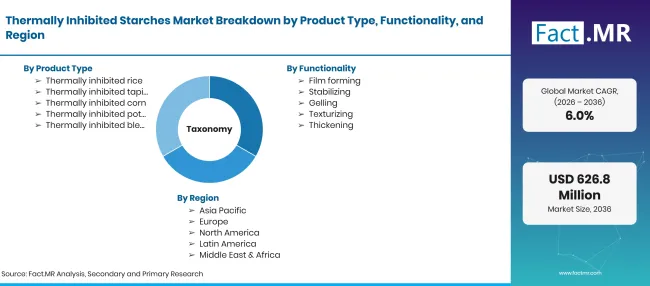
Thermally Inhibited Starches Taxonomy | Source: Fact.MR
| Items | Values |
|---|---|
| Quantitative Units (2026) | USD 350.0 Million |
| Product Type | Thermally inhibited rice, Thermally inhibited corn, Thermally inhibited potato, Thermally inhibited blended starch, Thermally inhibited tapioca |
| Functionality | Film forming, Stabilizing, Texturizing, Gelling, Thickening |
| Application | Soups and sauces, Bakery fillings, Ready meals, Dairy and desserts, Infant food |
| End User | Ingredient blenders, Contract manufacturers, Infant nutrition brands, Foodservice operators, Food manufacturers |
| Regions Covered | North America, Latin America, Europe, Asia Pacific, Middle East & Africa |
| Countries Covered | France, United Kingdom, United States, Netherlands, Germany, and other countries |
| Key Companies Profiled | Ingredion, Tate & Lyle, Avebe, Roquette, Cargill |
| Additional Attributes | Dollar revenue in the Thermally Inhibited Starches Market is segmented by product type (rice, corn, potato, tapioca, blended starch), functionality, application, end user and region. |
Source: Fact.MR analysis. Updated Nov 24, 2026
Thermally Inhibited Starches Market by Segments
-
Product Type
- Thermally inhibited rice
- Thermally inhibited corn
- Thermally inhibited potato
- Thermally inhibited blended starch
- Thermally inhibited tapioca
-
Functionality
- Film forming
- Stabilizing
- Texturizing
- Gelling
- Thickening
-
Application
- Soups and sauces
- Bakery fillings
- Ready meals
- Dairy and desserts
- Infant food
-
End User
- Ingredient blenders
- Contract manufacturers
- Infant nutrition brands
- Foodservice operators
- Food manufacturers
-
Region:
- North America
- United States
- Canada
- Europe
- Germany
- United Kingdom
- France
- Italy
- Spain
- Netherlands
- Rest of Europe
- Asia Pacific
- China
- India
- Japan
- South Korea
- Australia
- Rest of Asia Pacific
- Latin America
- Brazil
- Mexico
- Argentina
- Rest of Latin America
- Middle East & Africa
- GCC Countries
- South Africa
- Rest of Middle East & Africa
- North America
Table of Contents
Key Takeaways
- Market Size and CAGR
- Top Growth Driver
- Fastest Growing Segment
- Leading Region
- Key Companies
- Emerging Opportunities

