- Market Value (2025): USD 268.6 Mn
- Estimated Value (2026): USD 293.3 Mn
- Forecast Value (2036): USD 707.8 Mn
- CAGR (2026-2036): 9.2%
Targeted Cognitive Support Blends Market Forecast and Outlook 2026 to 2036
The global targeted cognitive support blends market was valued at USD 268.6 million in 2025 and reached USD 293.3 million in 2026. The market will expand to USD 707.8 million by 2036, registering a CAGR of 9.2% during the forecast period.
Interest in targeted cognitive support blends is rising as consumers seek nutritional support for memory, focus and mood at different life stages. Brands are bringing together B-vitamins, omega-3 DHA, choline, amino acids and botanicals in research-backed formulas. In April 2026, Balchem reported an fMRI pilot study of 20 post-menopausal women in which a 1,650 mg dose of VitaCholine increased working-memory network connectivity within three hours. The study found no difference in working-memory performance, so the result is an early imaging finding rather than evidence of a cognitive benefit. Such early findings are adding to interest in targeted cognitive nutrition, although larger studies would be needed to show effects on performance.
Key Takeaways from the Targeted Cognitive Support Blends Market
- Sales of targeted cognitive support blends stood at USD 268.6 million in 2025
- Targeted Cognitive Support Blends Market Value (2026): USD 293.3 million
- Targeted Cognitive Support Blends Market Forecast Value (2036): USD 707.8 million
- Targeted Cognitive Support Blends Market Forecast CAGR (2026-2036): 9.2%
- Leading Cognitive Blend Active: B-vitamins (29.1%)
- Key Market Participants: DSM-Firmenich, Lonza, Balchem, Kerry Group, Glanbia Nutritionals, IFF
- Key Growth Regions: India, China, United States, Germany, United Kingdom
The rising prevalence of age-related cognitive decline is bringing greater attention to nutrition for healthy ageing. In April 2026, the Alzheimer’s Association reported that 7.4 million Americans aged 65 and above were living with Alzheimer’s dementia. It estimated the cost of care for Alzheimer’s and other dementias at USD 409 billion in 2026, a figure that excludes unpaid care. This has encouraged nutrition brands to develop cognitive support blends for older adults and clinical nutrition settings, with a focus on maintaining cognitive health without making disease-related claims.
Targeted Cognitive Support Blends Market
| Metric | Value |
|---|---|
| Estimated Value in (2025) | USD 268.6 million |
| Estimated Value in (2026) | USD 293.3 million |
| Forecast Value in (2036) | USD 707.8 million |
| Forecast CAGR (2026 to 2036) | 9.2% |
Source: Fact.MR analysis. Updated Nov 23, 2026
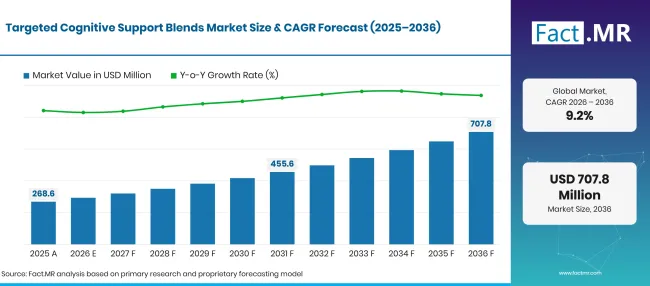
Targeted Cognitive Support Blends Forecast Global | Source: Fact.MR
Category
| Category | Segments |
|---|---|
| Cognitive Blend Active | B-vitamins, Omega-3 DHA, Nootropic botanicals, Choline donors, Amino acids |
| Delivery Form | Liquid / emulsion, Capsule / tablet, Powder, Microencapsulated bead, Ready-to-drink / food |
| Health Application | Clinical nutrition, Cognitive health, Gut / microbiome, General nutrition, Bone / joint |
| Customer Channel | Supplement brand, Ingredient manufacturer, Medical nutrition OEM, Pharmacy, Direct-to-consumer |
| Region | India; China; United States; Germany; United Kingdom |
Source: Fact.MR analysis. Updated Nov 23, 2026
Segmental Analysis
Why do B-vitamins lead active ingredient demand in the Targeted Cognitive Support Blends Market?
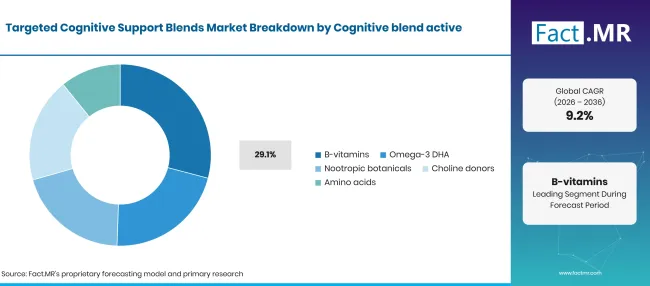
Targeted Cognitive Support Blends Breakdown Cognitive Blend Active | Source: Fact.MR
B-vitamins lead the active ingredient segment with a 29.1% market share in 2026, valued at USD 85.4 million. Vitamins B6, B12 and folate are widely used in cognitive formulations because of their role in normal nervous-system function and psychological health. Their compatibility with choline, omega-3 and botanical ingredients also gives formulators flexibility when designing blended products. The EU’s authorized health claims for B6 and B12 continue to offer a familiar regulatory basis for product positioning. Meanwhile, carotenoids and herbal ingredients are attracting brands exploring more specialized cognitive formulations.
How are liquid and emulsion formats leading delivery demand in the Targeted Cognitive Support Blends Market?
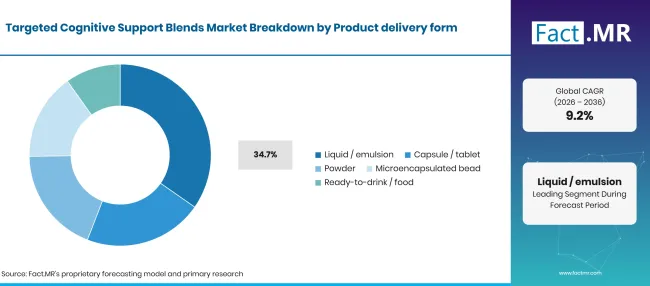
Targeted Cognitive Support Blends Breakdown Product Delivery Form | Source: Fact.MR
Liquid and emulsion formats generate 34.7% of market revenue in 2026, reaching USD 101.8 million. Their popularity comes from the ease of incorporating oil-based ingredients such as DHA into drinks, nutritional shots and ready-to-consume supplements. These formats also give brands room to experiment with flavours, serving sizes and combinations of active ingredients. Powders and capsules are finding buyers among consumers who prefer portable products, longer storage convenience and measured daily servings. Product innovation across these formats is widening the reach of cognitive nutrition beyond conventional supplements.
Why does clinical nutrition lead health application demand in the Targeted Cognitive Support Blends Market?
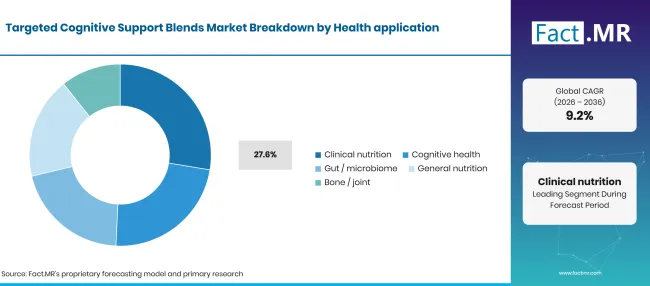
Targeted Cognitive Support Blends Breakdown Health Application | Source: Fact.MR
Clinical nutrition contributes 27.6% of market revenue in 2026, valued at USD 81.0 million. Nutritional products for older adults and people with specific dietary needs create opportunities for blends containing carefully measured quantities of B-vitamins, choline and omega-3. The WHO’s 2026 guidance on brain health also brings attention to balanced dietary patterns and cognitive health, while distinguishing general nutrition from supplements intended to prevent dementia. Preventive wellness and sports nutrition are attracting interest as consumers explore nutritional support for concentration, mental performance and everyday wellbeing.
How are supplement brands shaping customer demand in the Targeted Cognitive Support Blends Market?
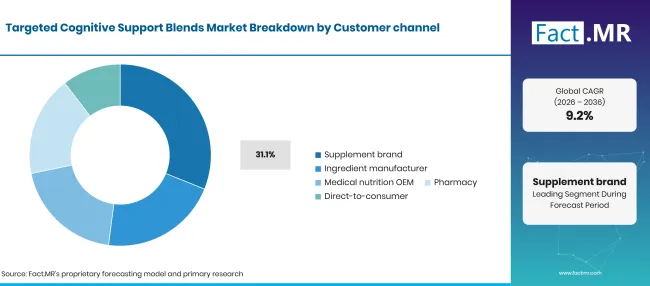
Targeted Cognitive Support Blends Breakdown Customer Channel | Source: Fact.MR
Supplement brands generate 31.1% of market revenue in 2026, reaching USD 91.2 million. Their product ranges are moving beyond general multivitamins, with formulations aimed at study focus, workplace concentration, menopause-related cognitive concerns and healthy ageing. This positioning allows brands to reach consumers with different nutritional priorities. A CDC report published in 2026 found that supplement use was particularly common among older American adults. Clinical nutrition companies and functional food manufacturers are also entering the category with specialized products for consumers seeking cognitive support through everyday nutrition.
Targeted Cognitive Support Blends Market: Drivers, Restraints & Trends
Driver: Rising Interest in Brain Health and Functional Nutrition:
Interest in brain health is extending beyond traditional supplements, giving targeted cognitive support blends a wider consumer base. This is because functional nutrition brands are exploring ingredients associated with memory, concentration and mood as part of everyday wellness. In October 2026, Glanbia Nutrition identified brain and mood support as an emerging area for functional products, citing magnesium and choline. This industry focus is creating room for specialized cognitive nutrition formulations across different age groups. Greater consumer awareness of mental wellbeing is also encouraging brands to move beyond general multivitamins towards more focused nutritional offerings.
Restraint: Strict Health-Claim Regulations and Limited Clinical Evidence:
Strict health-claim regulations create a difficult commercial environment for targeted cognitive support blends. Brands cannot freely associate their products with dementia prevention, memory disorders or other medical outcomes. Emerging botanicals and nootropic ingredients also face limitations where clinical evidence or authorized claims are insufficient. Human trials add to formulation costs and can delay product launches. Smaller companies may struggle to finance this research, while cautious label positioning can make it harder to communicate product differences to consumers.
Trend: Women’s Life-Stage Cognitive Nutrition:
Women’s cognitive health is receiving greater attention as brands explore nutritional needs associated with menopause, hormonal changes and ageing. In September 2026, Balchem highlighted women’s health research at Vitafoods Asia, including findings from a 20-person pilot study on choline and working-memory network connectivity in postmenopausal women. The pilot reported imaging changes but found no difference in working-memory performance, so the evidence remains preliminary. This creates an opportunity for the market to move towards life-stage-specific formulations, provided claims stay within what the evidence supports. Greater recognition of women’s neurological health is widening the market for gender-specific cognitive nutrition.
Trend: Digital Overload and Everyday Focus:
Extended screen exposure, demanding work schedules and constant digital engagement are changing how consumers approach cognitive wellness. This is opening opportunities beyond age-related brain health, particularly among younger professionals seeking everyday support for concentration and mental performance. The market can benefit from positioning cognitive nutrition around modern lifestyle challenges, provided product claims remain evidence-based. Everyday mental performance is becoming a wider commercial focus alongside traditional memory and healthy-ageing applications.
Targeted Cognitive Support Blends Market Analysis by Key Country
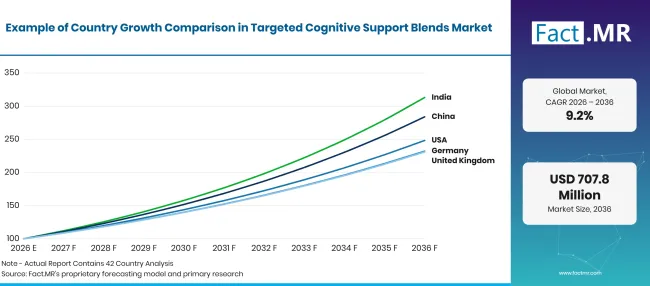
Targeted Cognitive Support Blends Growth Index | Source: Fact.MR
| Country | CAGR (2026-2036) |
|---|---|
| India | 12.1% |
| China | 11.0% |
| United States | 9.5% |
| Germany | 8.8% |
| United Kingdom | 8.7% |
Source: Fact.MR analysis. Updated Nov 23, 2026
What is driving targeted cognitive support blends demand in India?
In July 2026, India’s Press Information Bureau highlighted the expansion of the Jan Aushadhi nutraceutical basket, which includes nutritional products for children, women and older adults.
This wider access to affordable nutrition is creating a favourable environment for targeted cognitive support blends. Students, working professionals and ageing consumers offer distinct customer groups for specialised formulations. Rising interest in herbal ingredients, preventive nutrition and affordable daily supplements is also widening sales opportunities. Expansion of pharmacy-led nutrition distribution can further improve access to cognitive wellness products across urban and smaller cities.
How is research capacity supporting targeted cognitive support blends sales in China?
China introduced an action plan in April 2025 to encourage health-related consumption, improve food quality and expand services for older people.
These measures are creating favourable conditions for specialised nutrition, including cognitive support blends. The country’s ageing population is increasing interest in maintaining memory and mental performance through everyday wellness routines. Traditional botanical ingredients also offer opportunities for locally relevant formulations. Wider availability of specialised foods, greater health awareness and rising spending on senior wellness are adding momentum to the market.
What is shaping targeted cognitive support blends demand in the United States?
The CDC released its 2026 National Nutrition Report in June 2026, identifying low omega-3 levels in more than half of the American population.
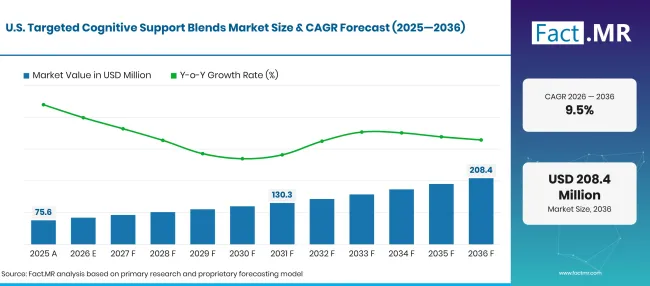
Targeted Cognitive Support Blends Forecast Usa | Source: Fact.MR
This nutritional gap is drawing attention to nutrient intake and specialised supplementation. American consumers are also showing interest in products addressing focus, memory and healthy ageing. Retail availability, established supplement purchasing habits and wider acceptance of functional nutrition are helping brands reach different consumer groups. These factors are creating room for cognitive blends combining vitamins, omega-3 and other researched ingredients.
Why is Germany an important market for targeted cognitive support blends?
Germany’s Federal Statistical Office reported in August 2026 that 19.3 million people aged 65 and above lived in the country in 2025, representing 23% of the population.
This demographic shift is strengthening interest in nutritional support for healthy ageing and cognitive wellbeing. Consumers are showing greater attention to ingredient quality, scientific evidence and responsible supplement use. Pharmacy distribution, specialist nutrition retailers and growing awareness of age-related nutritional needs are creating further sales opportunities for targeted cognitive support blends.
How is diagnosis and brain-health care supporting targeted cognitive support blends demand in the United Kingdom?
In May 2026, the UK Parliament’s Health and Social Care Committee published its report on healthy ageing, examining physical activity and the health needs of an ageing population.
This policy focus is bringing greater attention to preventive health and wellbeing in later life. Targeted cognitive support blends can benefit from this interest as older consumers explore nutrition alongside lifestyle measures to maintain mental performance. Pharmacy sales, online supplement channels and demand for convenient daily nutrition are also creating opportunities for sales growth across the country.
Competitive Landscape for Targeted Cognitive Support Blends Market
Competition in the targeted cognitive support blends market is shaped by ingredient portfolios, clinical research and formulation services. dsm-firmenich offers life’sDHA® algal omega-3 oils, while Balchem develops VitaCholine® for choline-based cognitive nutrition. Kerry’s cognitive health portfolio includes Sensoril® ashwagandha and Eupoly-3® omega-3 solutions for stress, focus and brain health. IFF brings HOWARU® Calm probiotic for mood and stress support. Recent competition is also moving towards better delivery options and stronger human evidence. Balchem’s 2026 pilot research on choline and working-memory network connectivity in postmenopausal women adds early clinical data, although it found no difference in working-memory performance, while Lonza’s Organicaps™ plant-based capsules strengthen its nutraceutical delivery offering.
Recent Developments
- On July 15, 2026, dsm-firmenich partnered with Italy-based Nous to commercialize Koncentra, a botanical ingredient designed for energy, focus and mood support. The collaboration also includes clinical research and regulatory support.
- On November 3, 2026, Lonza signed an agreement to acquire five manufacturing sites in the United States from Merck KGaA. The acquisition will expand Lonza’s contract development and manufacturing capabilities in the country.
- On May 5, 2026, Balchem showcased its upcoming Optifolin+ ingredient at Vitafoods Europe 2026. The choline-enriched folate ingredient targets women’s health, healthy aging and cognitive health applications.
- On March 19, 2026, Kerry Group reported new enzyme and postbiotic innovations developed during 2025. The company also expanded its manufacturing facilities in Egypt and Rwanda to strengthen its nutrition business.
- On August 1, 2025, Glanbia acquired Sweetmix, a Brazilian nutritional premix and ingredients solutions company. The acquisition expanded Glanbia’s Health & Nutrition business and strengthened its premix capabilities.
Key Players in Targeted Cognitive Support Blends Market
Key companies operating in the market include DSM-Firmenich, Lonza, Balchem, Kerry Group, Glanbia Nutritionals, and IFF.
- DSM-Firmenich
- Lonza
- Balchem
- Kerry Group
- Glanbia Nutritionals
- IFF
Targeted Cognitive Support Blends Market by Segments
-
Cognitive Blend Active
- B-vitamins
- Omega-3 DHA
- Nootropic botanicals
- Choline donors
- Amino acids
-
Delivery Form
- Liquid / emulsion
- Capsule / tablet
- Powder
- Microencapsulated bead
- Ready-to-drink / food
-
Health Application
- Clinical nutrition
- Cognitive health
- Gut / microbiome
- General nutrition
- Bone / joint
-
Customer Channel
- Supplement brand
- Ingredient manufacturer
- Medical nutrition OEM
- Pharmacy
- Direct-to-consumer
-
Region
- North America
- United States
- Canada
- Mexico
- Europe
- Germany
- United Kingdom
- France
- Italy
- Spain
- Rest of Europe
- Asia Pacific
- China
- India
- Japan
- South Korea
- Australia
- Rest of Asia Pacific
- Latin America
- Brazil
- Mexico
- Argentina
- Rest of Latin America
- Middle East & Africa
- GCC Countries
- South Africa
- Rest of Middle East & Africa
- North America
Bibliography
- Alzheimer’s Association. (2026). 2026 Alzheimer’s disease facts and figures.
- Centers for Disease Control and Prevention. (2026). CDC releases 2026 National Nutrition Report.
- Destatis. (2026, August 18). Older people.
- European Commission. (n.d.). EU register of health claims.
- Press Information Bureau. (2026, July 30). Affordable nutrition for every Indian: Jan Aushadhi nutraceuticals. Government of India.
- State Council of the People’s Republic of China. (2025, April 10). China unveils plan to boost health-related consumption.
- UK Parliament, Health and Social Care Committee. (2026, May 22). Healthy ageing: Physical activity in an ageing society.
- World Health Organization. (2026, July 15). Risk reduction of cognitive decline and dementia: WHO guidelines (2nd ed.).
Segmentation
Scope of Report
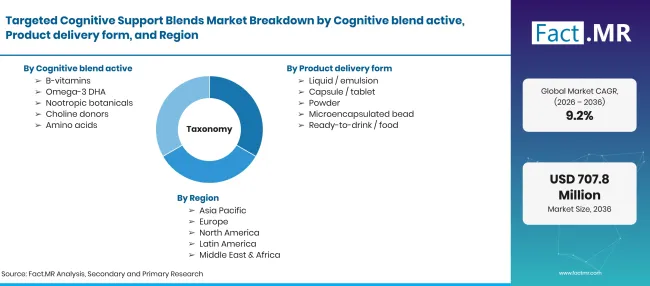
Targeted Cognitive Support Blends Taxonomy | Source: Fact.MR
| Items | Values |
|---|---|
| Quantitative Units (2026) | USD 293.3 Million |
| Cognitive Blend Active | B-vitamins, Omega-3 DHA, Nootropic botanicals, Choline donors, Amino acids |
| Delivery Form | Liquid / emulsion, Capsule / tablet, Powder, Microencapsulated bead, Ready-to-drink / food |
| Health Application | Clinical nutrition, Cognitive health, Gut / microbiome, General nutrition, Bone / joint |
| Customer Channel | Supplement brand, Ingredient manufacturer, Medical nutrition OEM, Pharmacy, Direct-to-consumer |
| Regions Covered | North America, Latin America, Europe, East Asia, South Asia and Pacific, Middle East & Africa |
| Countries Covered | India, China, United States, Germany, United Kingdom, and other countries |
| Key Companies Profiled | DSM-Firmenich, Lonza, Balchem, Kerry Group, Glanbia Nutritionals, IFF |
| Additional Attributes | Dollar revenue in the Targeted Cognitive Support Blends Market is segmented by cognitive blend active (B-vitamins, omega-3 DHA, nootropic botanicals, choline donors, amino acids), delivery form, health application, customer channel and region. |
Source: Fact.MR analysis. Updated Nov 23, 2026
Frequently Asked Questions
How big is the global Targeted Cognitive Support Blends Market in 2026?
What will be the size of the Targeted Cognitive Support Blends Market by 2036?
How fast will the Targeted Cognitive Support Blends Market grow during the forecast period?
Which cognitive blend active segment holds the largest share of the Targeted Cognitive Support Blends Market?
Who worked on this report


Preview the report firsthand - request a free sample
Free SampleGet the brochure for pricing and purchase details
Download PDF