- Market Value (2025): USD 93.9 Mn
- Estimated Value (2026): USD 100.0 Mn
- Forecast Value (2036): USD 187.7 Mn
- CAGR (2026-2036): 6.5%
Maltogenic Freshness Enzymes Market Forecast and Outlook 2026 to 2036
The global maltogenic freshness enzymes market was valued at USD 93.9 million in 2025 and reached USD 100.0 million in 2026. The market is set to expand at a CAGR of 6.5% during the forecast period, reaching USD 187.7 million by 2036.
Industrial bakers are turning to maltogenic freshness enzymes to keep bread, buns, tortillas and cakes soft for longer, reducing product returns and waste during distribution. Enzyme manufacturers are refining maltogenic amylases and combining them with lipases and other amylases to suit different bakery applications. In November 2026, Novonesis reported 9% organic growth in Food & Health Biosolutions during the first nine months of 2026, with Food & Beverages contributing to growth. These developments point to wider use of freshness enzymes in commercial baking.
Key Takeaways from the Maltogenic Freshness Enzymes Market
- Sales of maltogenic freshness enzymes stood at USD 93.9 million in 2025
- Maltogenic Freshness Enzymes Market Value (2026): USD 100.0 million
- Maltogenic Freshness Enzymes Market Forecast Value (2036): USD 187.7 million
- Maltogenic Freshness Enzymes Market Forecast CAGR (2026-2036): 6.5%
- Leading Product Type: Maltogenic amylase (28.1%)
- Key Market Participants: Novonesis, IFF, DSM-Firmenich, AB Enzymes, Puratos, Kerry Group
- Key Growth Regions: France, United States, Belgium, United Kingdom, Germany
In June 2026, IFF highlighted how enzymes are helping bakers achieve better product performance through processing rather than relying heavily on additives. This shift is encouraging the use of maltogenic freshness enzymes as manufacturers reformulate products with cleaner labels. Their ability to maintain softness, improve crumb texture and reduce bakery waste makes them relevant to commercial baking operations. Clean-label reformulation is creating further opportunities for these enzymes across Europe and North America.
Maltogenic Freshness Enzymes Market
| Metric | Value |
|---|---|
| Estimated Value in (2025) | USD 93.9 million |
| Estimated Value in (2026) | USD 100.0 million |
| Forecast Value in (2036) | USD 187.7 million |
| Forecast CAGR (2026 to 2036) | 6.5% |
Source: Fact.MR analysis. Updated Nov 24, 2026
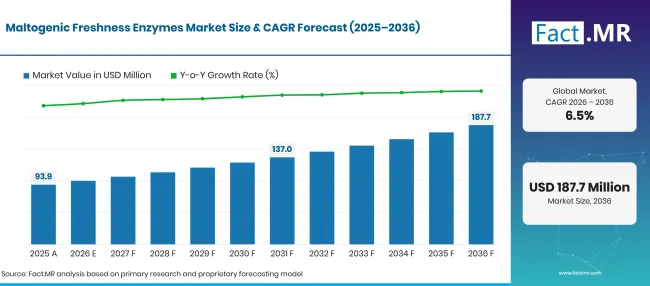
Maltogenic Freshness Enzymes Forecast Global | Source: Fact.MR
| Category | Segments |
|---|---|
| Product Type | Maltogenic amylase, Customized bakery enzyme system, Amylase blend, Maltogenic enzyme preparation, Amylase-lipase blend |
| Product Form | Dry powder, Encapsulated, Granule and agglomerate, Custom premix, Liquid concentrate |
| Application | Frozen dough, Cakes and sweet goods, Buns and rolls, Tortillas and flatbreads, Packaged bread |
| Buyer Type | Bakery ingredient suppliers, Industrial bakeries, Foodservice bakers, Flour millers, In-store bakeries |
| Region | France; United States; Belgium; United Kingdom; Germany |
Source: Fact.MR analysis. Updated Nov 24, 2026
Segmental Analysis
Why does maltogenic amylase lead product demand in the Maltogenic Freshness Enzymes Market?
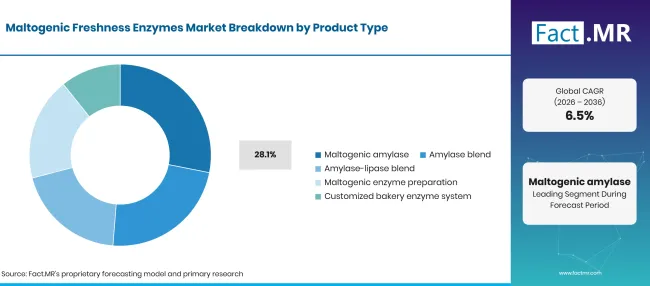
Maltogenic Freshness Enzymes Breakdown Product Type | Source: Fact.MR
Maltogenic amylase holds the leading 28.1% product position in 2026 because it slows starch retrogradation, helping bread retain a soft crumb during storage. Its familiar role in commercial baking also makes formulation changes easier for manufacturers. In October 2026, AB Enzymes introduced VERON® MaxiFresh, a maltogenic amylase solution designed to improve moisture retention, softness and crumb resilience. Lipases and other amylases are also finding wider use as bakers look for better dough strength and texture control across different bakery products.
How is dry powder leading form demand in the Maltogenic Freshness Enzymes Market?
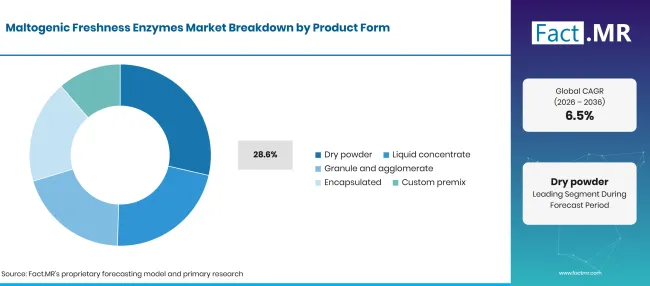
Maltogenic Freshness Enzymes Breakdown Product Form | Source: Fact.MR
Dry powder contributes 28.6% of market revenue in 2026, largely because bakery manufacturers can blend it directly into flour mixes, premixes and bread improvers. Its longer storage stability and convenient handling suit large production facilities. Liquid enzymes are gaining ground in automated bakeries where accurate dosing and continuous processing matter. Granulated preparations are also attracting attention because they help limit airborne enzyme dust. Novonesis' November 2025 enzyme-handling guidance discussed protective coatings and granulation as approaches to improving workplace handling.
Why does frozen dough lead application demand in the Maltogenic Freshness Enzymes Market?
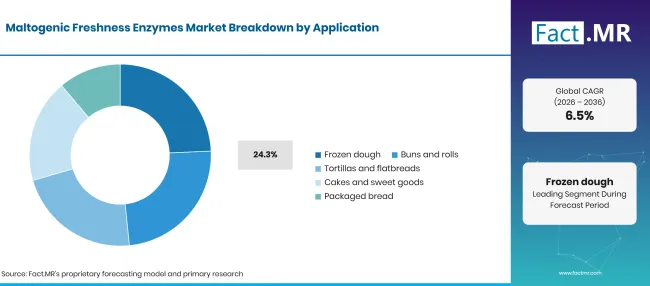
Maltogenic Freshness Enzymes Breakdown Application | Source: Fact.MR
Frozen dough captures 24.3% of market revenue in 2026 as manufacturers work to preserve dough structure and softness through freezing, storage and thawing. Enzyme formulations help maintain the texture consumers expect from freshly baked products. Puratos discussed tailored enzyme solutions for retaining softness and moisture in frozen patisserie after defrosting in 2026. Packaged bread, cakes and tortillas are also creating opportunities, particularly where manufacturers need longer shelf life, consistent texture and reduced product waste across retail distribution.
How are bakery ingredient suppliers leading buyer demand in the Maltogenic Freshness Enzymes Market?
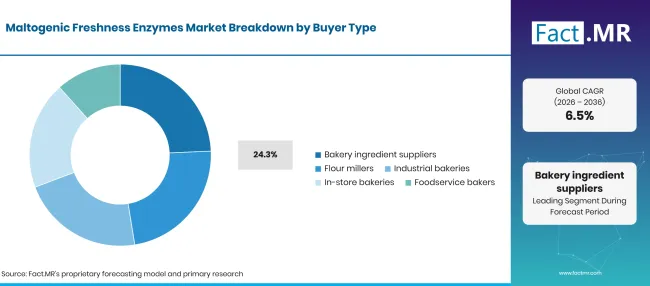
Maltogenic Freshness Enzymes Breakdown Buyer Type | Source: Fact.MR
Bakery ingredient suppliers contribute 24.3% of market revenue in 2026 because they incorporate freshness enzymes into ready-to-use improvers and premixes for commercial bakeries. This arrangement simplifies enzyme handling and formulation for downstream customers. IFF discussed the use of combined enzyme and ingredient systems to improve softness and freshness in flatbreads in June 2026. Industrial bakeries are also increasing direct enzyme use, while foodservice operators are adopting tailored formulations to maintain consistent quality in frozen and bake-off products.
Maltogenic Freshness Enzymes Market-Drivers, Restraints & Trends
Drivers
Bakery manufacturers' focus on production efficiency Bakery manufacturers are turning to maltogenic freshness enzymes because longer product freshness helps reduce unsold stock, retailer returns and losses across distribution networks. Enzymes also give manufacturers more flexibility when flour quality and processing conditions vary. In November 2026, Novonesis reported 12% organic growth in its Food & Beverages business during the first nine months, with baking among the industries contributing to growth. Wider adoption of freshness-focused formulations creates room for maltogenic enzyme use across industrial bakeries.
Restraints
High formulation costs and performance limitations: Smaller bakeries may avoid maltogenic freshness enzymes because formulation costs add pressure to already tight margins. Their performance also depends on flour quality, dosage and baking conditions, making trials necessary before commercial use. Enzymes do not prevent mould on their own, so manufacturers may still need separate preservation systems. These additional formulation and testing expenses can discourage adoption, particularly among price-sensitive bakeries.
Trend
Label-Friendly Softness: Bakers are shifting towards enzyme-based formulations to simplify ingredient lists without sacrificing softness or shelf life. In June 2026, IFF discussed how baking enzymes can replace emulsifiers in certain applications or reduce their use through combined formulations. This creates an opportunity for maltogenic freshness enzymes in packaged bread and other bakery categories where clean-label positioning matters. Going forward, manufacturers that combine freshness improvement with simpler formulations can find wider commercial applications.
Trend
Wider Commercial Adoption of Biosolutions: Food manufacturers are giving greater attention to biological solutions that improve processing efficiency, product consistency and resource use. Novonesis reported 7% organic sales growth for 2025, with Food & Health Biosolutions recording 8% growth. This wider acceptance of biosolutions creates opportunities for maltogenic freshness enzymes as bakeries look to reduce production losses and improve finished-product quality. Future opportunities lie in broader adoption across packaged bread, frozen bakery and large-scale foodservice production.
Maltogenic Freshness Enzymes Market by Analysis by Key Country
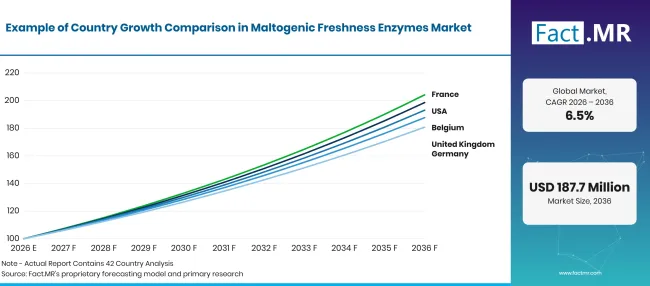
Maltogenic Freshness Enzymes Growth Index | Source: Fact.MR
| Country | CAGR (2026-2036) |
|---|---|
| France | 7.4% |
| United States | 7.1% |
| Belgium | 6.8% |
| United Kingdom | 6.5% |
| Germany | 6.1% |
Source: Fact.MR analysis. Updated Nov 24, 2026
What is driving maltogenic freshness enzymes demand in France?
France's strong bakery culture creates a sizeable market for freshness-enhancing ingredients, particularly as manufacturers serve both artisan outlets and large retail chains. In June 2026, INSEE reported that bakery and pastry shop sales increased 4.8% in volume during 2025.
This activity creates opportunities for maltogenic freshness enzymes in packaged bread, viennoiseries and other baked goods. Demand is also supported by manufacturers' efforts to maintain softness and reduce product waste across retail distribution.
How is food policy supporting maltogenic freshness enzymes sales in the United States?
Commercial baking at scale is a major reason behind the US market's expansion. Frozen bakery products, packaged bread and tortillas need consistent texture across production and distribution, creating room for enzymes that slow staling.
The US Bureau of Labor Statistics recorded 356,600 employees in bakeries and tortilla manufacturing in December 2024. Large-scale production, convenience food consumption and demand for longer-lasting bakery products are driving sales of maltogenic freshness enzymes.
What is shaping maltogenic freshness enzymes demand in Belgium?
Belgium's food-processing base offers opportunities for maltogenic freshness enzymes, particularly among industrial bakeries supplying supermarkets and foodservice businesses.
Statbel released consolidated 2025 industrial production data in August 2026, covering manufacturing deliveries by value and volume. This provides a useful indication of the scale of the country's processing sector. Demand for bakery improvers, longer-lasting packaged products and consistent crumb quality is creating opportunities for freshness enzyme adoption.
How is fortification shaping maltogenic freshness enzymes sales in the United Kingdom?
Wrapped bread production gives the UK a strong commercial base for freshness enzymes.
According to the Federation of Bakers' 2025 annual report, around 13 million loaves and bakery goods are sold daily, with 83.7% of bread and morning goods purchases being pre-packed.This creates a practical need for ingredients that preserve softness during storage. Packaged bread, supermarket bakery operations and large plant bakeries are the main avenues driving maltogenic freshness enzyme sales.
Why is growth slower for maltogenic freshness enzymes in Germany?
Germany's extensive bread and frozen bakery industry creates opportunities for maltogenic freshness enzymes, particularly in products distributed through retail and foodservice channels.
The German Bakers' Association reported bakery trade revenue of EUR 18.14 billion in 2025, with around 8,659 registered bakery businesses. Frozen bread, rolls and industrial bakery production add to the need for consistent softness and storage quality. Manufacturers' focus on production efficiency and reducing bakery waste is also supporting enzyme adoption.
Competitive Landscape for Maltogenic Freshness Enzymes Market
Competition in the maltogenic freshness enzymes market centres on enzyme performance and bakery application expertise. Novonesis markets its Novamyl range for maintaining crumb softness, elasticity and moistness, while IFF offers POWERFRESH enzymes for controlling starch firming in packaged bread. AB Enzymes has expanded its VERON portfolio with MaxiFresh, a maltogenic amylase designed for lean and high-sugar baked products.
DSM-Firmenich serves commercial bakers through its BakeZyme range, while Kerry integrates Biobake enzymes into bakery freshness solutions. Puratos combines enzyme technology with bread improvers and technical formulation services. Product selection depends on softness retention, crumb resilience, formulation compatibility, dosage economics and shelf-life performance. Competition is moving beyond basic anti-staling activity towards enzymes that preserve moistness and texture across different bakery formulations.
Recent Developments
- On September 2, 2026, Novonesis announced an investment of €600 million to expand its Patalganga facility in India and build an advanced enzyme production plant for food, beverages and other industries.
- On August 13, 2025, IFF launched POWERFRESH® ACE 2000 in the U.S. market. The enzyme solution helps industrial bakeries maintain bread softness, resilience and texture throughout shelf life.
- On May 20, 2025, dsm-firmenich opened its Princeton Baking Innovation Center in New Jersey, USA. The facility supports bakery product development, application testing and collaboration with commercial bakers.
- On October 26, 2026, AB Enzymes launched VERON® MaxiFresh, a new maltogenic amylase for bakery applications. The enzyme helps maintain softness, moistness and crumb resilience in bread and sweet baked products.
- On March 10, 2026, Puratos announced an agreement to acquire Dawn Foods, subject to regulatory approvals. The acquisition aims to combine their bakery ingredient portfolios and strengthen their global presence in professional baking.
Key Players in Maltogenic Freshness Enzymes Market
Key companies operating in the market include Novonesis, IFF, DSM-Firmenich, AB Enzymes, Puratos, and Kerry Group.
- Novonesis
- IFF
- DSM-Firmenich
- AB Enzymes
- Puratos
- Kerry Group
Bibliography
- Bureau of Labor Statistics. (2025). Table B-1b. Employees on nonfarm payrolls by industry sector and selected industry detail, not seasonally adjusted. U.S. Department of Labor.
- European Commission. (n.d.). EU list and applications: Food enzymes. Directorate-General for Health and Food Safety.
- Statistisches Bundesamt (Destatis). (2026, October 13). 10% fewer gingerbread products produced in Germany in 2025.
- Institut national de la statistique et des études économiques (INSEE). (2026, June 18). Le compte du commerce en 2025: Les entreprises en France.
- Office for National Statistics. (2026, November 12). Manufacture of bakery and farinaceous products: Total (£m).
- Statbel. (2026, August 27). Industrial production: Production per product code and main activity (PRODCOM), 2025.
Segmentation
Scope of Report
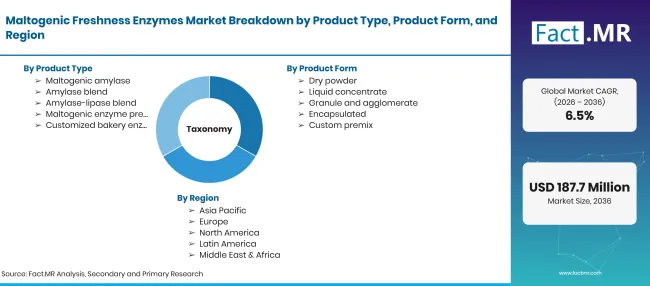
Maltogenic Freshness Enzymes Taxonomy | Source: Fact.MR
| Items | Values |
|---|---|
| Quantitative Units (2026) | USD 100.0 Million |
| Product Type | Maltogenic amylase, Customized bakery enzyme system, Amylase blend, Maltogenic enzyme preparation, Amylase-lipase blend |
| Product Form | Dry powder, Encapsulated, Granule and agglomerate, Custom premix, Liquid concentrate |
| Application | Frozen dough, Cakes and sweet goods, Buns and rolls, Tortillas and flatbreads, Packaged bread |
| Buyer Type | Bakery ingredient suppliers, Industrial bakeries, Foodservice bakers, Flour millers, In-store bakeries |
| Regions Covered | North America, Latin America, Europe, East Asia, South Asia and Pacific, Middle East & Africa |
| Countries Covered | France, United States, Belgium, United Kingdom, Germany, and other countries |
| Key Companies Profiled | Novonesis, IFF, DSM-Firmenich, AB Enzymes, Puratos, Kerry Group |
| Additional Attributes | Dollar revenue in the Maltogenic Freshness Enzymes Market is segmented by product type (maltogenic amylase, amylase blends, amylase-lipase blends, customized systems), product form, application, buyer type and region. |
Source: Fact.MR analysis. Updated Nov 24, 2026
Maltogenic Freshness Enzymes Market by Segments
-
Product Type
- Maltogenic amylase
- Customized bakery enzyme system
- Amylase blend
- Maltogenic enzyme preparation
- Amylase-lipase blend
-
Product Form
- Dry powder
- Encapsulated
- Granule and agglomerate
- Custom premix
- Liquid concentrate
-
Application
- Frozen dough
- Cakes and sweet goods
- Buns and rolls
- Tortillas and flatbreads
- Packaged bread
-
Buyer Type
- Bakery ingredient suppliers
- Industrial bakeries
- Foodservice bakers
- Flour millers
- In-store bakeries
-
Region
- North America
- United States
- Canada
- Mexico
- Europe
- Germany
- United Kingdom
- France
- Belgium
- Italy
- Spain
- Rest of Europe
- Asia Pacific
- China
- India
- Japan
- South Korea
- Australia
- Rest of Asia Pacific
- Latin America
- Brazil
- Mexico
- Argentina
- Rest of Latin America
- Middle East & Africa
- GCC Countries
- South Africa
- Rest of Middle East & Africa
- North America
Frequently Asked Questions
How big is the global Maltogenic Freshness Enzymes Market in 2026?
What will be the size of the Maltogenic Freshness Enzymes Market by 2036?
How fast will the Maltogenic Freshness Enzymes Market grow during the forecast period?
Which product type segment holds the largest share of the Maltogenic Freshness Enzymes Market?
Who worked on this report


Preview the report firsthand - request a free sample
Free SampleGet the brochure for pricing and purchase details
Download PDF