- Market Value (2025): USD 55.6 Mn
- Estimated Value (2026): USD 60.0 Mn
- Forecast Value (2036): USD 128.3 Mn
- CAGR (2026-2036): 7.9%
Kokumi Flavor Enhancers Market Forecast and Outlook 2026 to 2036
The global kokumi flavor enhancers market was valued at USD 55.6 million in 2025 and reached USD 60.0 million in 2026. At a CAGR of 7.9%, the market will expand to USD 128.3 million by 2036.
Food manufacturers are turning to kokumi flavor enhancers as they reduce salt, sugar and fat without compromising taste and mouthfeel. Ingredient makers are introducing gamma-glutamyl peptides, yeast extracts, protein hydrolysates and fermentation-based blends to add depth, roundness and a lasting savory sensation. For instance, in November 2026, CJ BIO announced plans to unveil TasteNrich Harmony KOKU at Fi Europe 2026 in Frankfurt. Such product introductions are bringing kokumi ingredients into a wider range of food formulations.
Key Takeaways from the Kokumi Flavor Enhancers Market
- Sales of kokumi flavor enhancers stood at USD 55.6 million in 2025
- Kokumi Flavor Enhancers Market Value (2026): USD 60.0 million
- Kokumi Flavor Enhancers Market Forecast Value (2036): USD 128.3 million
- Kokumi Flavor Enhancers Market Forecast CAGR (2026-2036): 7.9%
- Leading Product Type: Protein hydrolysate kokumi (23.7%)
- Key Market Participants: Ajinomoto, Givaudan, Kerry Group, IFF, DSM-Firmenich, Symrise
- Key Growth Regions: South Korea, United States, Germany, Japan, United Kingdom
Food reformulation is creating new opportunities for kokumi ingredients as manufacturers work to reduce salt and sugar without losing flavor depth. In October 2026, Kerry Group reported third-quarter volume growth of 4.1%, with snacks, meat, dairy and beverages leading performance, and highlighted its Tastesense reduction technologies. This shift is bringing kokumi peptides into formulations alongside umami and sweetness modulators, particularly as food brands seek simpler ways to improve taste across Asian, North American and European markets.
Kokumi Flavor Enhancers Market
| Metric | Value |
|---|---|
| Estimated Value in (2025) | USD 55.6 million |
| Estimated Value in (2026) | USD 60.0 million |
| Forecast Value in (2036) | USD 128.3 million |
| Forecast CAGR (2026 to 2036) | 7.9% |
Source: Fact.MR analysis. Updated Nov 24, 2026
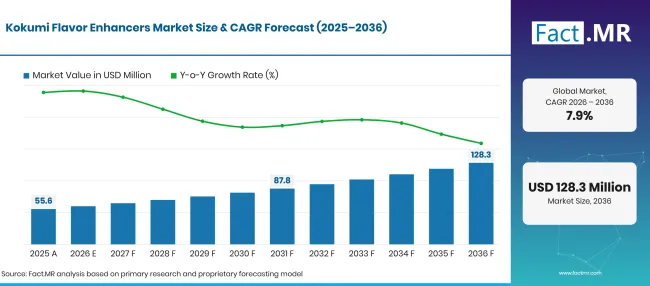
Kokumi Flavor Enhancers Forecast Global | Source: Fact.MR
Category
| Category | Segments |
|---|---|
| Product Type | Protein hydrolysate kokumi, γ-Glutamyl peptide blends, Natural complex flavor bases, Yeast-extract glutamyl peptides, Fermentation-derived peptides |
| Product Form | Dry powder, Encapsulated, Liquid concentrate, Granule and agglomerate, Custom premix |
| Application | Nutrition and supplements, Savory and other, Bakery and confectionery, Dairy and alternatives, Beverages |
| Buyer Type | Contract formulator, Beverage producer, Nutrition brand, Ingredient blender, Food manufacturer |
| Region | South Korea; United States; Germany; Japan; United Kingdom |
Source: Fact.MR analysis. Updated Nov 24, 2026
Segmental Analysis
Why does protein hydrolysate kokumi lead product demand in the Kokumi Flavor Enhancers Market?
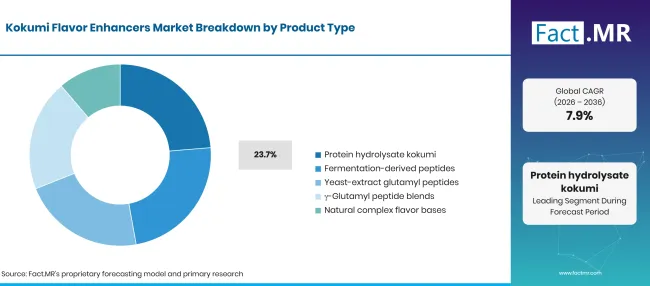
Kokumi Flavor Enhancers Breakdown Product Type | Source: Fact.MR
Protein hydrolysates lead with a 23.7% market share in 2026, valued at USD 14.2 million, as they deliver kokumi-active peptides through cost-efficient protein processing. Soy, wheat, dairy and pea proteins also give manufacturers flexibility across savory foods and nutritional formulations.
Other product types, including purified gamma-glutamyl compounds, are gaining attention for their targeted flavor effects. In November 2025, research published in the Journal of Agricultural and Food Chemistry identified a kokumi-active glycopeptide in enzymatically hydrolyzed vegetable protein, strengthening the scientific case for this ingredient category.
How is dry powder leading form demand in the Kokumi Flavor Enhancers Market?
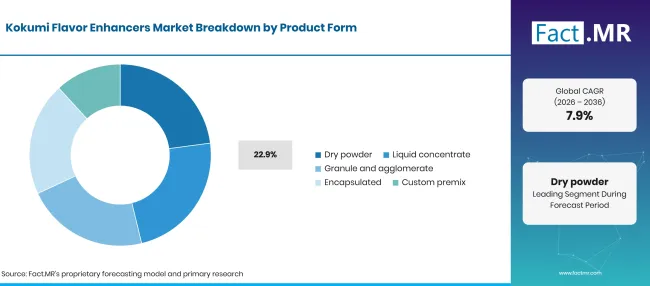
Kokumi Flavor Enhancers Breakdown Product Form | Source: Fact.MR
Dry powder holds a 22.9% market share in 2026, worth USD 13.7 million, because manufacturers can blend it directly into seasoning mixes, soups, snack coatings and nutritional powders without adding moisture. Liquid concentrates are also gaining attention among beverage and sauce manufacturers seeking easier dispersion.
However, powder formats offer greater convenience for dry food processing and storage. In May 2026, ADM introduced new soy protein ingredients, including ProFam 883, designed for protein-rich beverages and powders, highlighting the continued focus on versatile dry ingredient formats.
Why do nutrition and supplements lead application demand in the Kokumi Flavor Enhancers Market?
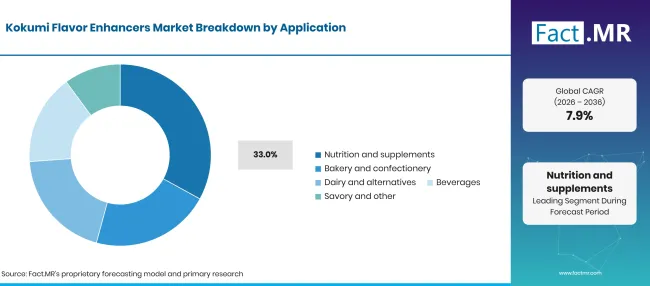
Kokumi Flavor Enhancers Breakdown Application | Source: Fact.MR
Nutrition and supplements contribute 33.0% of market revenue in 2026, reaching USD 19.8 million. Protein shakes, meal replacements and fortified beverages use kokumi ingredients to improve body and soften bitter protein notes.
Meanwhile, savory snacks and dairy applications are gaining traction as manufacturers explore reduced-salt and protein-enriched recipes. In October 2026, Ingredion showcased a vanilla prebiotic and protein shake with zero added sugar at SupplySide Global, highlighting the industry's focus on combining nutritional value with better taste and texture.
How are contract formulators leading buyer demand in the Kokumi Flavor Enhancers Market?
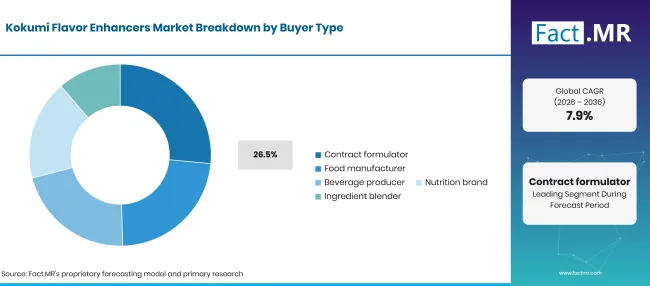
Kokumi Flavor Enhancers Breakdown Buyer Type | Source: Fact.MR
Contract formulators contribute 26.5% of market revenue in 2026, valued at USD 15.9 million. Food brands increasingly turn to specialist formulation teams to combine peptides, flavor modulators and texture ingredients into ready-to-use taste systems.
Direct purchases by food manufacturers are also gaining ground as larger companies expand their internal product development capabilities. In November 2026, IFF launched CONCEPT MUSE, an AI-based platform that helps its experts and customers develop food and beverage concepts together. Such collaborative tools are making specialist formulation services more relevant to ingredient adoption.
Kokumi Flavor Enhancers Market-Drivers, Restraints & Trends
Drivers
Nutrition-led food reformulation Food manufacturers are exploring kokumi ingredients because reducing salt, sugar and fat can leave familiar products tasting flat, thin or less satisfying. Kokumi helps restore richness, continuity and savory depth without relying entirely on these ingredients. Regulatory pressure is adding to this shift, particularly among packaged food brands reviewing their formulations to meet changing nutrition standards. On October 9, 2026, the US FDA issued a final rule allowing salt substitutes across 139 food standards of identity, giving manufacturers more flexibility in sodium reduction. This creates wider opportunities for kokumi ingredients in snacks, sauces, soups and prepared meals.
Restraints
Limited awareness and formulation costs Kokumi faces an awareness gap outside East Asian food markets, where the concept is less familiar to both consumers and food manufacturers. Unlike sweetness or umami, kokumi is not always easy to identify through conventional taste descriptions, making its commercial value harder to communicate. Ingredient costs, peptide standardization and bitterness control add further complications, particularly for smaller food producers working with tight formulation budgets. Manufacturers may also need repeated sensory trials before incorporating kokumi into existing recipes. These factors can extend product development cycles and discourage adoption when the improvement in taste does not justify the additional formulation expense.
Trend:
Reformulation-led demand for kokumi ingredients: Kokumi is gaining relevance as food manufacturers look beyond salt substitutes to restore the fullness lost during recipe changes. The opportunity extends across snacks, sauces, dairy and prepared meals, where taste consistency can influence repeat purchases. In May 2026, WHO's updated SHAKE the Salt Habit guidance highlighted food reformulation as a central part of sodium reduction strategies. This creates wider opportunities for kokumi ingredients in mainstream food development, particularly in products where reduced sodium can weaken savory character.
Trend
Fermentation and consistent ingredient sourcing: Fermentation is attracting interest as food ingredient manufacturers explore more consistent ways to develop savory flavor components. For the kokumi market, this opens opportunities to expand ingredient production, improve batch consistency and serve food manufacturers across multiple applications. The wider opportunity lies in making fermentation-derived flavor ingredients easier to use across commercial food formulations and a wider range of applications.
Kokumi Flavor Enhancers Market Analysis by Key Country
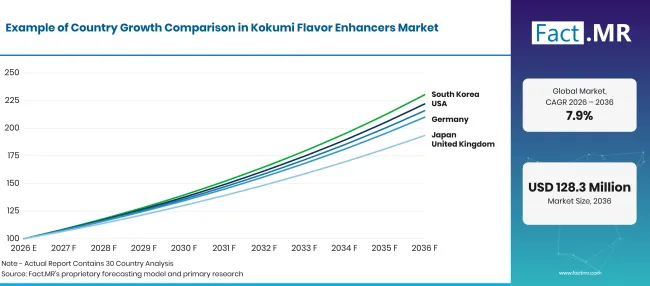
Kokumi Flavor Enhancers Growth Index | Source: Fact.MR
| Country | CAGR (2026-2036) |
|---|---|
| South Korea | 8.7% |
| United States | 8.3% |
| Germany | 8.0% |
| Japan | 7.7% |
| United Kingdom | 6.8% |
Source: Fact.MR analysis. Updated Nov 24, 2026
What is driving kokumi flavor enhancers demand in South Korea?
South Korea's 8.7% CAGR makes it the fastest-growing market among the five countries, supported by strong exports of processed foods, sauces and convenient meals.
Korean manufacturers are looking to retain savory depth as they expand these products into overseas markets. In 2025, South Korea's Ministry of Agriculture, Food and Rural Affairs reported that agri-food exports crossed USD 10 billion, with ramyeon exports reaching USD 1.52 billion, up 21.9%. This expanding processed-food business is opening more opportunities for kokumi ingredients in noodles, sauces and ready meals.
How is food policy supporting kokumi flavor enhancers sales in the United States?
Regulatory changes are putting greater attention on ingredient safety and transparency in the United States, where kokumi flavor enhancers are growing at an 8.3% CAGR. On August 10, 2026, the FDA proposed mandatory notification of GRAS determinations, bringing ingredient documentation under closer scrutiny.
This creates an opportunity for kokumi manufacturers with clear safety records and well-documented ingredient profiles. Reduced-sodium snacks, prepared meals and savory sauces are important application areas as food brands work on healthier formulations.
What is shaping kokumi flavor enhancers demand in Germany?
Germany's kokumi flavor enhancers market is advancing at an 8.0% CAGR as food manufacturers look for ways to differentiate packaged foods through richer taste and improved mouthfeel.
Cost pressure is also encouraging more efficient recipe development. On 2 November 2026, Germany's Federal Statistical Office (Destatis) reported that real food retail turnover in September fell 1.4% month on month and 1.1% year on year. This commercial pressure makes ingredient efficiency and product differentiation important considerations. Kokumi ingredients are finding opportunities in soups, meat alternatives, sauces and savory snacks.
How is seasoning demand shaping kokumi flavor enhancers sales in Japan?
Japan's long-standing familiarity with kokumi gives local ingredient manufacturers an advantage in introducing new savory applications.
The market is advancing at a 7.7% CAGR, with seasoning innovation, frozen meals and packaged foods creating additional sales opportunities. Ajinomoto reported on November 9, 2026, that its first-half FY2026 revenue reached a record JPY 831.1 billion, while Seasonings and Foods sales increased to JPY 481.5 billion from JPY 435.9 billion a year earlier. This activity strengthens opportunities for kokumi ingredients across domestic and international food formulations.
Why is growth slower for kokumi flavor enhancers in the United Kingdom?
At a 6.8% CAGR, the United Kingdom is recording the slowest growth among the five countries because food manufacturers are navigating strict nutrition policies while balancing taste, ingredient costs and consumer acceptance.
On January 5, 2026, restrictions on advertising less healthy foods took effect, covering television advertising before 9 pm and paid online advertising. This is encouraging brands to review product formulations, although established salt-reduction and flavor-modification ingredients still have stronger commercial familiarity. Kokumi adoption is gaining opportunities in reduced-salt sauces, soups and prepared foods.
Competitive Landscape for Kokumi Flavor Enhancers Market
Competition in the kokumi flavor enhancers market centres on flavor science, peptide expertise and the ability to solve taste challenges during food reformulation. Ajinomoto has a distinct position through its research into glutathione and gamma-glutamyl peptides, while Givaudan, Symrise, IFF and DSM-Firmenich compete through broader taste modulation, savory ingredients and application development. Kerry Group brings yeast extract expertise and its Tastesense technologies for improving taste and mouthfeel in reduced-sugar formulations. Buyers place importance on sensory performance, ingredient stability, clean-label compatibility and overall formulation costs.
Recent company activity also shows how competition is moving towards faster formulation, sensory research and nutrition-focused taste solutions. In October 2026, Symrise expanded its Symvision AI platform to connect consumer research with product concept development and sensory design. IFF reported 6% comparable currency-neutral Taste sales growth in Q3 2026, while dsm-firmenich recorded 4% organic growth in Taste, Texture & Health for 2025. These developments underline the value of combining ingredient technology with customer-specific formulation expertise. Companies that can demonstrate kokumi performance in reduced-salt and reduced-fat foods have an opportunity to strengthen their position.
Recent Developments
- On August 7, 2025, Ajinomoto invested in Australian plant-based food company v2food to combine its food technology and plant-based protein expertise with Ajinomoto’s Deliciousness Technology. The investment aims to accelerate sustainable food product development.
- On July 3, 2026, Givaudan inaugurated a new production facility in Cikarang, Indonesia, following an investment of CHF 50 million. The facility will manufacture savoury, sweet and snack flavour powders to expand its regional production capacity.
- On September 30, 2025, Kerry Group launched Smart Taste™, a new range of taste solutions for food and beverage manufacturers. The portfolio combines flavour expertise and food science to address ingredient costs, sugar reduction, supply challenges and changing consumer preferences.
- On May 29, 2026, IFF entered into an agreement to sell its Food Ingredients business to CVC Capital Partners for approximately USD 4.3 billion. IFF will retain a 10% minority stake in the business and focus on its Taste, Scent, and Health & Biosciences operations.
- On April 8, 2026, DSM-Firmenich launched next-generation Vertis™ Textured Vegetable Proteins with integrated ModulaSENSE® taste modulation technology. The new pea protein variants are designed to reduce bitter, earthy and beany notes in plant-based meat products.
- On October 22, 2025, Symrise announced a strategic investment in US-based biotechnology company Cellibre. The partnership will focus on precision fermentation technologies to develop natural flavour ingredients and expand taste-balancing solutions.
Key Players in Kokumi Flavor Enhancers Market
Key companies operating in the market include Ajinomoto, Givaudan, Kerry Group, IFF, DSM-Firmenich, and Symrise.
- Ajinomoto
- Givaudan
- Kerry Group
- IFF
- DSM-Firmenich
- Symrise
Bibliography
- Department of Health and Social Care. (2026, January 5). Landmark junk food ad ban to protect kids' health. GOV.UK. h
- Ministry of Agriculture, Food and Rural Affairs. (2026, January 20). Exports of K-Food Plus reached USD 13.6 billion in 2025, up 5.1% year-over-year. Republic of Korea.
- Statistisches Bundesamt. (2026, November 2). Einzelhandelsumsatz im September 2026 real um 2,0 % niedriger als im Vormonat.
- U.S. Food and Drug Administration. (2026a, October 9). FDA issues final rule on salt substitutes in standardized foods.
- U.S. Food and Drug Administration. (2026b). Generally recognized as safe (GRAS) notification program.
- World Health Organization. (2026, May 12). SHAKE the salt habit (2nd ed.).
Segmentation
Scope of Report
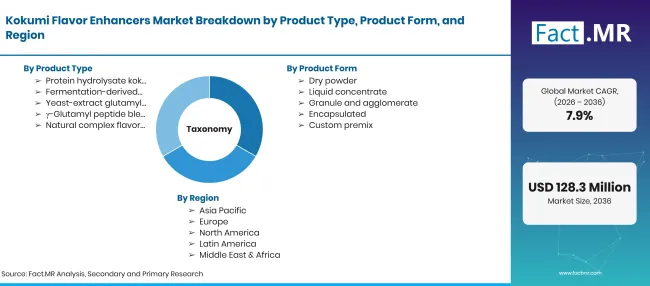
Kokumi Flavor Enhancers Taxonomy | Source: Fact.MR
| Items | Values |
|---|---|
| Quantitative Units (2026) | USD 60.0 Million |
| Product Type | Protein hydrolysate kokumi, γ-Glutamyl peptide blends, Natural complex flavor bases, Yeast-extract glutamyl peptides, Fermentation-derived peptides |
| Product Form | Dry powder, Encapsulated, Liquid concentrate, Granule and agglomerate, Custom premix |
| Application | Nutrition and supplements, Savory and other, Bakery and confectionery, Dairy and alternatives, Beverages |
| Buyer Type | Contract formulator, Beverage producer, Nutrition brand, Ingredient blender, Food manufacturer |
| Regions Covered | North America, Latin America, Europe, Asia Pacific, Middle East & Africa |
| Countries Covered | South Korea, United States, Germany, Japan, United Kingdom, and other countries |
| Key Companies Profiled | Ajinomoto, Givaudan, Kerry Group, IFF, DSM-Firmenich, Symrise |
| Additional Attributes | Dollar revenue in the Kokumi Flavor Enhancers Market is segmented by product type (protein hydrolysates, glutamyl peptide blends, yeast-extract peptides, fermentation-derived peptides), product form, application, buyer type and region. |
Source: Fact.MR analysis. Updated Nov 24, 2026
Kokumi Flavor Enhancers Market by Segments
-
Product Type
- Protein hydrolysate kokumi
- γ-Glutamyl peptide blends
- Natural complex flavor bases
- Yeast-extract glutamyl peptides
- Fermentation-derived peptides
-
Product Form
- Dry powder
- Encapsulated
- Liquid concentrate
- Granule and agglomerate
- Custom premix
-
Application
- Nutrition and supplements
- Savory and other
- Bakery and confectionery
- Dairy and alternatives
- Beverages
-
Buyer Type
- Contract formulator
- Beverage producer
- Nutrition brand
- Ingredient blender
- Food manufacturer
-
Region
- North America
- United States
- Canada
- Mexico
- Europe
- Germany
- United Kingdom
- France
- Italy
- Spain
- Rest of Europe
- Asia Pacific
- China
- India
- Japan
- South Korea
- Australia
- Rest of Asia Pacific
- Latin America
- Brazil
- Argentina
- Rest of Latin America
- Middle East & Africa
- GCC Countries
- South Africa
- Rest of Middle East & Africa
- North America
Frequently Asked Questions
How big is the global Kokumi Flavor Enhancers Market in 2026?
What will be the size of the Kokumi Flavor Enhancers Market by 2036?
How fast will the Kokumi Flavor Enhancers Market grow during the forecast period?
Which product type segment holds the largest share of the Kokumi Flavor Enhancers Market?
Who worked on this report


Preview the report firsthand - request a free sample
Free SampleGet the brochure for pricing and purchase details
Download PDF