- Market Value (2025): USD 356.6 Mn
- Estimated Value (2026): USD 384.4 Mn
- Forecast Value (2036): USD 815.4 Mn
- CAGR (2026-2036): 7.8%
High-Stability Edible Barriers Market Forecast and Outlook 2026 to 2036
The global high-stability edible barriers market was valued at USD 356.6 million in 2025 and reached USD 384.4 million in 2026. The market is projected to reach USD 815.4 million by 2036, expanding at a CAGR of 7.8% during the 2026 to 2036 assessment period.
Food processors and fresh-produce packers are increasingly exploring edible barriers to control moisture loss, oxygen exposure and microbial activity during storage and distribution. Manufacturers are also focusing on formulations that can work with existing food-processing and packhouse equipment. In July 2026, the World Resources Institute India and the Indian Council of Agricultural Research held RESET 2026 to address food loss and waste across agricultural supply chains. These initiatives highlight the importance of practical preservation technologies that can reduce post-harvest deterioration. Edible barriers offer an additional preservation option for businesses handling perishable food products.
Key Takeaways from the High-Stability Edible Barriers Market
- High-Stability Edible Barriers Market Value (2025): USD 356.6 million
- High-Stability Edible Barriers Market Value (2026): USD 384.4 million
- High-Stability Edible Barriers Market Forecast Value (2036): USD 815.4 million
- High-Stability Edible Barriers Market Forecast CAGR (2026 to 2036): 7.8%
- Leading Barrier Type: Nanocellulose-reinforced (31.9%)
- Key Market Participants: Apeel Sciences, Mori, Sufresca, Akorn Technology, Xampla and Mantrose-Haeuser
- Key Growth Regions: India, China, the United States, France and Germany
India's post-harvest losses highlight the challenges of maintaining food quality across long agricultural supply chains. According to the Ministry of Food Processing Industries, fruit losses ranged from 6.02% to 15.05%, while vegetable losses ranged from 4.87% to 11.61% in the 2020 to 2022 assessment. Edible coatings that help control moisture loss and deterioration offer packers another preservation option during storage and transportation.
High-Stability Edible Barriers Market
| Metric | Value |
|---|---|
| Estimated Value in 2025 | USD 356.6 million |
| Estimated Value in 2026 | USD 384.4 million |
| Forecast Value in 2036 | USD 815.4 million |
| Forecast CAGR (2026 to 2036) | 7.8% |
Source: Fact.MR analysis. Updated Nov 23, 2026
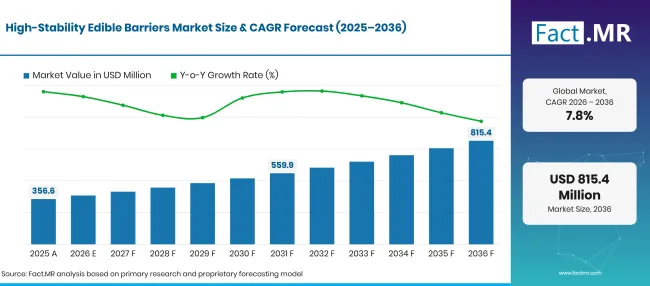
High Stability Edible Barriers Forecast Global | Source: Fact.MR
Category
| Category | Segments |
|---|---|
| Barrier Type | Nanocellulose-reinforced, Protein composite, Polysaccharide composite, Lipid-rich, Multilayer hybrid |
| Food Substrate | Bakery / confectionery, Fresh vegetables, Meat / seafood, Fresh fruit, Prepared / specialty foods |
| Application Method | Dip coating, Spray coating, Roller / curtain, Casting / wrapping, In-line hybrid |
| Barrier Function | Antimicrobial, Oxygen control, Moisture control, Mechanical protection, Multi-function |
| Region | India, China, United States, France, Germany |
Source: Fact.MR analysis. Updated Nov 23, 2026
Segmental Analysis
Why are nanocellulose-reinforced formulations the leading barrier type in the High-Stability Edible Barriers Market?
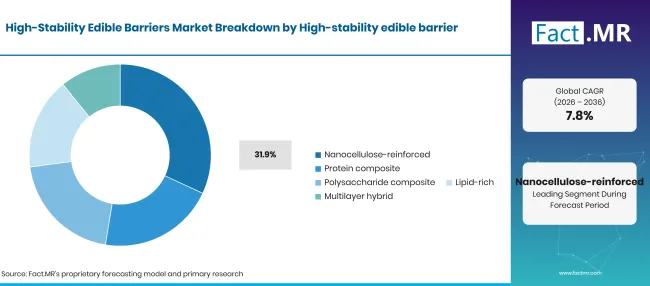
High Stability Edible Barriers Breakdown High Stability Edible Barrier | Source: Fact.MR
Nanocellulose-reinforced formulations capture 31.9% of the market in 2026, representing approximately USD 122.6 million. Their tensile strength and resistance to cracking help edible films withstand humidity changes, temperature fluctuations and repeated handling. Cellulose nanofibers improve the structural integrity of thin films without making them excessively rigid. Their compatibility with polysaccharide and protein-based materials also allows manufacturers to develop flexible coatings with consistent barrier properties. These characteristics make nanocellulose-reinforced formulations suitable for food applications where film strength and preservation performance are important.
How is bakery and confectionery positioned as the leading food substrate in the High-Stability Edible Barriers Market?
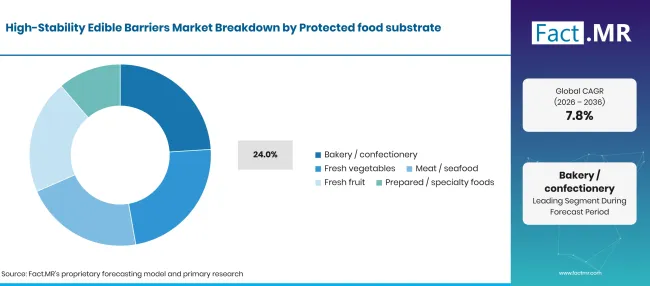
High Stability Edible Barriers Breakdown Protected Food Substrate | Source: Fact.MR
Bakery and confectionery products contribute 24.0% of market revenue in 2026, equivalent to approximately USD 92.3 million. Moisture movement between fillings, crusts and outer coatings can affect texture, appearance and shelf life. Edible barriers help maintain crispness, slow staling and protect product quality during storage and transportation. Their use in glazes, fillings and enrobing processes also makes them suitable for existing bakery operations. Packaged cakes, pastries, biscuits and confectionery products offer practical applications where maintaining texture and freshness is important.
Why does dip coating lead application methods in the High-Stability Edible Barriers Market?
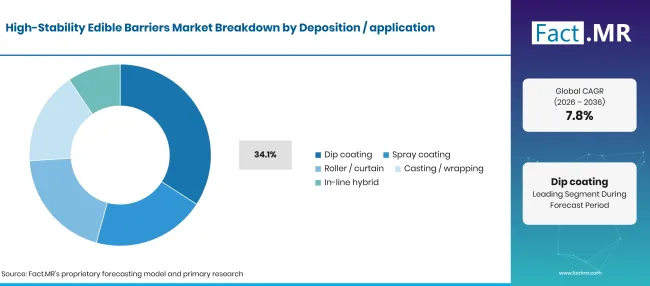
High Stability Edible Barriers Breakdown Deposition Application | Source: Fact.MR
Dip coating represents 34.1% of market revenue in 2026, equivalent to approximately USD 131.1 million. The method allows processors to cover entire food surfaces through immersion, making it suitable for fresh produce and processed foods with uneven shapes. Existing wash tanks and treatment systems can often accommodate this process without major equipment changes. Dip coating also helps maintain consistent film thickness when formulation characteristics and immersion conditions are properly controlled. Its straightforward operation and relatively low equipment investment make it a practical option for growers, packhouses and medium-sized food processors.
How are antimicrobial barriers shaping performance demand in the High-Stability Edible Barriers Market?
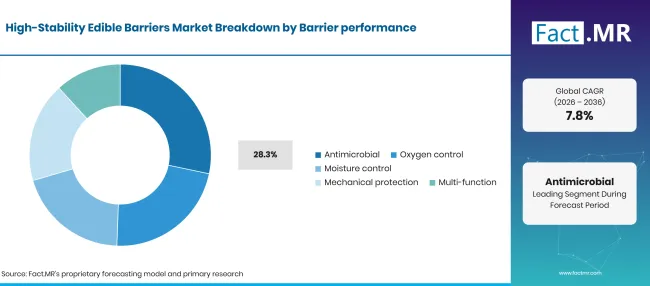
High Stability Edible Barriers Breakdown Barrier Performance | Source: Fact.MR
Antimicrobial barriers contribute 28.3% of market revenue in 2026, equivalent to approximately USD 108.8 million. These coatings help limit microbial spoilage while controlling moisture loss and oxidation, addressing several food preservation concerns through a single treatment. Mori uses silk protein extracted through a salt-and-water process to develop protective coatings for produce, meat and prepared foods. Combining antimicrobial ingredients with film-forming materials gives processors another approach to maintaining product quality during storage and transportation. This application is particularly relevant for perishable foods where microbial activity can shorten usable shelf life.
High-Stability Edible Barriers Market: Drivers, Restraints and Trends
Driver: Rising Focus on Food Waste Reduction
Food retailers and packers are paying closer attention to post-harvest losses because spoiled produce directly affects inventory, operating costs and product availability. In July 2026, WRI India and ICAR held RESET 2026 to discuss food loss and waste reduction across agricultural supply chains. Edible barriers offer another preservation option by helping control moisture loss and deterioration without depending entirely on additional plastic packaging. This creates demand across food processing, storage, retail and distribution.
Restraint: Consumer Trust and Ingredient Transparency
Consumer concerns about coating ingredients and food-contact safety can affect retailer acceptance and slow market penetration. Differences in food-contact regulations, ingredient disclosure requirements and approval procedures across countries add further challenges. Manufacturers need to demonstrate coating safety, explain ingredient composition and maintain consistent product performance. Limited consumer awareness of edible barrier materials can also affect acceptance, particularly in markets where these treatments are relatively unfamiliar.
Trend: Bio-Based Edible Coatings Gaining Wider Food Applications
Food producers and packers are exploring bio-based edible coatings because conventional plastic wraps and linings face increasing environmental scrutiny. In February 2026, N&E Innovations, a Singapore-based developer, was reported to have developed an edible antimicrobial coating that extends the shelf life of fruits, vegetables and meats and reduces spoilage along the supply chain. This development highlights the wider application of bio-based edible barriers across fresh produce and protein categories. Similar adoption of plant- and bio-based materials is creating additional opportunities across fresh and prepared foods.
Trend: Edible Coatings Gaining Ground as Alternatives to Plastic Wrap
Fresh-produce retailers are exploring edible coatings because conventional shrink wraps contribute to packaging waste and disposal costs. In June 2025, Akorn Technology launched its Natural Advantage edible coating for English cucumbers and bell peppers. The formulation is designed to maintain produce freshness and reduce dependence on single-use plastic wrapping. Wider interest in packaging reduction is creating opportunities for crop-specific edible barrier applications across fruits and vegetables.
High-Stability Edible Barriers Market Analysis by Key Country
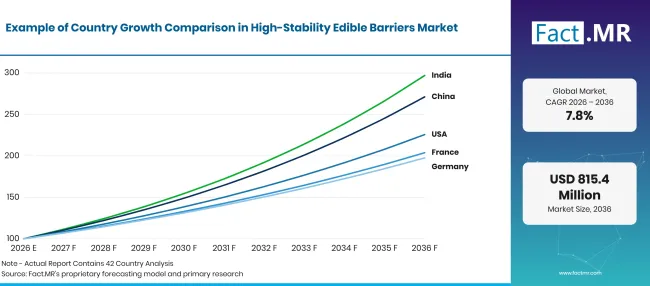
High Stability Edible Barriers Growth Index | Source: Fact.MR
| Country | CAGR (2026 to 2036) |
|---|---|
| India | 11.5% |
| China | 10.5% |
| United States | 8.5% |
| France | 7.4% |
| Germany | 7.0% |
Source: Fact.MR analysis. Updated Nov 23, 2026
What is driving high-stability edible barriers market growth in India?
India's high-stability edible barriers market is projected to expand at a CAGR of 11.5% during the assessment period. In July 2026, WRI India hosted RESET 2026 in collaboration with the Indian Council of Agricultural Research to address food loss and waste across agricultural supply chains.
India's large fruit and vegetable supply network faces post-harvest losses during storage and transportation. According to the Ministry of Food Processing Industries, fruit losses reached 6.02% to 15.05% and vegetable losses ranged from 4.87% to 11.61% during the 2020 to 2022 assessment. Edible barriers offer an additional preservation layer for processors and exporters handling perishable produce.
Why is China emerging as a strong market for high-stability edible barriers?
China's high-stability edible barriers market is projected to expand at a CAGR of 10.5% through 2036. China introduced the national standard GB/T 46685-2025 on October 31, 2025, with implementation beginning May 1, 2026.
The standard establishes technical guidelines for packaging fresh edible agricultural products, including vegetables, fruits, meat, seafood and eggs. It emphasizes product protection, loss reduction and the selection of suitable packaging materials. China's extensive agricultural processing and distribution network creates opportunities for preservation technologies that help maintain food quality during transportation and storage.
How is the focus on sustainable food packaging driving the US market?
The United States high-stability edible barriers market is projected to expand at a CAGR of 8.5% during the forecast period.
In April 2025, the USDA National Institute of Food and Agriculture listed a research project by Atlantic Sea Solutions focused on edible biopolymer composite coatings to extend the shelf life of perishable foods. This research highlights institutional interest in alternative preservation materials for food applications. US retailers and food processors are exploring ways to reduce spoilage across fresh-produce and prepared-food categories. These initiatives create opportunities for edible barriers that combine food preservation with lower dependence on conventional packaging materials.
Why are food-waste reduction efforts creating opportunities in France?
France's high-stability edible barriers market is projected to expand at a CAGR of 7.4% between 2026 and 2036.
In September 2026, the French Ministry of Agriculture reported that 3.9 million tonnes of edible food were wasted in 2024. This volume highlights the importance of preservation methods that maintain food quality between production, processing and retail. Edible barriers offer an additional way to slow moisture loss and deterioration in perishable products. Food retailers and processors are exploring preservation methods that can reduce discarded inventory and improve product handling across distribution networks.
How are packaging regulations influencing high-stability edible barriers market growth in Germany?
Germany's high-stability edible barriers market is projected to expand at a CAGR of 7.0% during the assessment period. On August 12, 2026, the European Union's Packaging and Packaging Waste Regulation (EU) 2025/40 began applying across member states.
The regulation establishes measures covering packaging waste reduction, recyclability and packaging design. Germany's focus on lower-waste packaging is creating interest in alternative food preservation methods. Edible barriers offer food businesses another approach to protecting fresh produce and extending usable shelf life without relying entirely on conventional plastic wraps.
Competitive Landscape for High-Stability Edible Barriers Market
The high-stability edible barriers market includes specialist coating developers such as Apeel Sciences, Mori, Sufresca and Akorn Technology, alongside Xampla and established coating formulators such as Mantrose-Haeuser. Their approaches range from plant-derived and lipid-based coatings to silk-protein films and confectionery surface treatments. Buyers evaluate manufacturers on measurable shelf-life improvement, food-contact approvals, coating consistency and compatibility with existing production equipment.
Recent activity highlights a stronger focus on commercial applications. Xampla sells its Morro Edible Film, a pea-protein and starch film used to wrap dissolvable food portions such as Gousto's stock cubes, separately from its Morro Coating for paper-based packaging; only the edible film line falls within this market. Meanwhile, Apeel Sciences reorganized its business around supply-chain operations and the use of existing packhouse equipment in June 2026. Manufacturers that combine reliable preservation performance with straightforward application and transparent ingredient information are better positioned to secure repeat business.
Recent Developments
- On June 3, 2025, Apeel Sciences was named one of Food & Wine's 2025 Game Changers for its plant-based edible coating technology, which helps extend fruit and vegetable freshness and reduce food spoilage.
- On June 6, 2025, Akorn Technology launched its Natural Advantage edible coating for English cucumbers and bell peppers to maintain freshness and reduce the use of single-use plastic wraps.
- In February 2026, N&E Innovations was reported to have developed an edible antimicrobial coating that extends the shelf life of fruits, vegetables and meats.
- On February 26, 2025, Mantrose-Haeuser introduced MantroShield, a fat-free encapsulated acid solution for gummy coatings designed to improve sour flavour and shelf-life stability.
Key Players in High-Stability Edible Barriers Market
Key companies operating in the market include Apeel Sciences, Mori, Sufresca, Akorn Technology, Xampla, and Mantrose-Haeuser.
- Apeel Sciences
- Mori
- Sufresca
- Akorn Technology
- Xampla
- Mantrose-Haeuser
Bibliography
- Akorn Technology. (n.d.). Edible coatings for fresh produce.
- Apeel Sciences. (2025, June 3). Apeel Sciences recognized by Food & Wine as a 2025 Game Changer for Food Innovation.
- Biofuels Digest. (2026, February 16). N&E Innovations' biobased coating extends shelf life of produce, meat.
- China State Administration for Market Regulation. (2025, October 31). Technical guidelines for packaging of fresh edible agricultural products (GB/T 46685-2025). National Public Service Platform for Standards Information.
- European Parliament & Council of the European Union. (2025). Regulation (EU) 2025/40 on packaging and packaging waste. Official Journal of the European Union.
- Mantrose-Haeuser Co., Inc. (n.d.). MantroShield: A new, fat-free line of encapsulated food acids [Product announcement].
- Ministry of Food Processing Industries. (2025, July 31). Wastage of vegetables due to lack of processing facilities. Press Information Bureau, Government of India.
- Ribeiro, C., et al. (2025). The state of the art and innovations in active and edible coatings and films for functional food applications. Polymers, 17(18), 2472. https://pmc.ncbi.nlm.nih.gov/articles/PMC12473381/
- WRI India. (2026, July 13). RESET 2026 catalyses national action on food loss and food waste.
- Xampla. (n.d.). Morro Edible Film.
- Xampla. (2025, October 15). Xampla supercharges global commercialisation of Morro materials with new hires and promotions.
Segmentation
Scope of Report
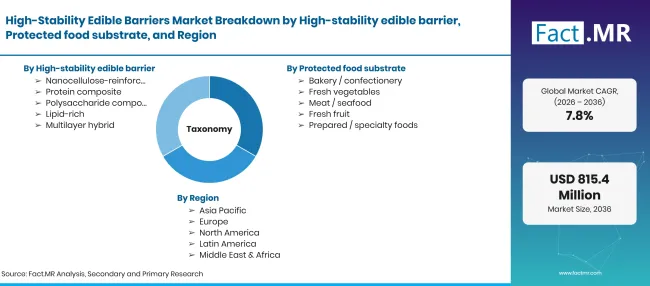
High Stability Edible Barriers Taxonomy | Source: Fact.MR
| Items | Values |
|---|---|
| Quantitative Units (2026) | USD 384.4 million |
| Barrier Type | Nanocellulose-reinforced, Protein composite, Polysaccharide composite, Lipid-rich, Multilayer hybrid |
| Food Substrate | Bakery / confectionery, Fresh vegetables, Meat / seafood, Fresh fruit, Prepared / specialty foods |
| Application Method | Dip coating, Spray coating, Roller / curtain, Casting / wrapping, In-line hybrid |
| Barrier Function | Antimicrobial, Oxygen control, Moisture control, Mechanical protection, Multi-function |
| Regions Covered | North America, Latin America, Europe, East Asia, South Asia and Pacific, Middle East & Africa |
| Countries Covered | India, China, United States, France, Germany and other countries |
| Key Companies Profiled | Apeel Sciences, Mori, Sufresca, Akorn Technology, Xampla, Mantrose-Haeuser |
| Additional Attributes | Dollar revenue in the High-Stability Edible Barriers Market is segmented by barrier type, food substrate, application method, barrier function and region. |
Source: Fact.MR analysis. Updated Nov 23, 2026
High-Stability Edible Barriers Market by Segments
-
Barrier Type
- Nanocellulose-reinforced
- Protein composite
- Polysaccharide composite
- Lipid-rich
- Multilayer hybrid
-
Food Substrate
- Bakery / confectionery
- Fresh vegetables
- Meat / seafood
- Fresh fruit
- Prepared / specialty foods
-
Application Method
- Dip coating
- Spray coating
- Roller / curtain
- Casting / wrapping
- In-line hybrid
-
Barrier Function
- Antimicrobial
- Oxygen control
- Moisture control
- Mechanical protection
- Multi-function
-
Region
- North America
- United States
- Canada
- Mexico
- Europe
- Germany
- United Kingdom
- France
- Italy
- Spain
- Rest of Europe
- Asia Pacific
- China
- India
- Japan
- South Korea
- Australia
- Rest of Asia Pacific
- Latin America
- Brazil
- Mexico
- Argentina
- Rest of Latin America
- Middle East & Africa
- GCC Countries
- South Africa
- Rest of Middle East & Africa
- North America
Frequently Asked Questions
How big is the global High-Stability Edible Barriers Market in 2026?
What will be the size of the High-Stability Edible Barriers Market by 2036?
How fast will the High-Stability Edible Barriers Market grow during the forecast period?
Which barrier type segment holds the largest share of the High-Stability Edible Barriers Market?
Who worked on this report


Preview the report firsthand - request a free sample
Free SampleGet the brochure for pricing and purchase details
Download PDF