- Base Value(2025): 11.1 Bn
- Estimated Value(2026): 12.3 Bn
- Forecast Value (2036): 36.7 Bn
- CAGR (2026 - 2036): 11.5%
Tire Pressure Monitoring Sensor and Module Systems Market Size, Share and Forecast by Fact.MR
In 2025, the tire pressure monitoring systems market was valued at USD 11.1 billion. Fact MR analysis indicates demand for tire pressure monitoring systems is expected to reach USD 12.3 billion in 2026 and USD 36.7 billion by 2036. FACT MR estimates the market will expand at a CAGR of 11.5% across the forecast period.
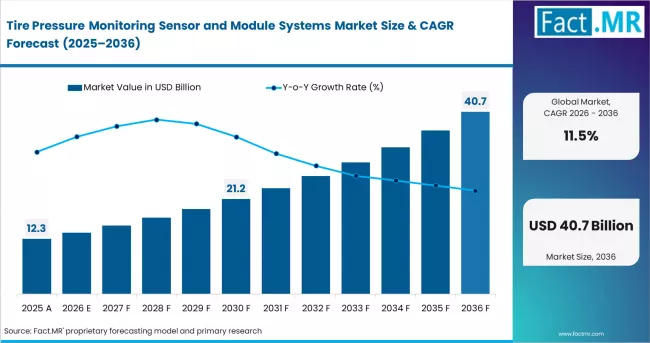
Tire Pressure Monitoring Sensor And Module Systems Market Value Analysis | Source: Fact.MR
Summary of Tire Pressure Monitoring Sensor and Module Systems Market
- Market Definition
- The market includes electronic systems used to monitor and alert vehicle tire pressure levels in real time.
- Demand Drivers
- Regulatory mandates across major automotive markets are enforcing TPMS adoption in new vehicles.
- Growth in passenger vehicles and SUVs is increasing OEM integration of TPMS systems.
- Aftermarket demand is rising due to sensor battery replacement cycles.
- Key Segments Analyzed
- System Type: Direct TPMS leads with approximately 78.0% share in 2026.
- Sensor Fitment: Valve-mounted sensors lead with approximately 62.0% share in 2026.
- Geography: Asia Pacific leads growth driven by automotive production expansion.
- Analyst Opinion at Fact MR
- Shambhu Nath Jha, Senior Analyst at Fact MR, opines, ‘CXOs will find that regulatory compliance and OEM integration cycles define long-term TPMS market growth and profitability. Companies aligning with evolving safety mandates and strengthening OEM partnerships will secure sustained revenue visibility while leveraging aftermarket replacement demand to enhance margin stability over the forecast period.’
- Strategic Implications / Executive Takeaways
- Focus on direct TPMS systems aligned with global regulatory requirements.
- Expand aftermarket distribution to capture replacement demand cycles.
- Invest in integration with electric and connected vehicle platforms.
- Methodology
- Based on vehicle production volumes and TPMS penetration rates across OEM and aftermarket channels to estimate demand patterns.
- Supported by analysis of regulatory mandates and OEM adoption trends influencing system integration across global automotive markets.
- Validated through supplier shipment data and lifecycle modeling of sensor replacement cycles to ensure accuracy of forecasts.
Tire Pressure Monitoring Sensor and Module Systems Market
| Metric | Value |
|---|---|
| Estimated Value in 2026 | USD 12.3 Billion |
| Forecast Value in 2036 | USD 36.7 Billion |
| Forecast CAGR (2026 to 2036) | 11.5% |
Source: Fact.MR analysis. Updated Apr 28, 2026
The increase from USD 12.3 billion in 2026 to USD 36.74 billion in 2036 reflects strong expansion, indicating structural growth driven by safety compliance and automotive electronics integration. Demand remains supported by regulatory mandates across passenger vehicles and increasing system adoption in electric vehicles. Replacement demand linked to sensor battery lifecycle supports recurring revenue streams.
India leads with a projected CAGR of 7.1% through 2036, driven by regulatory adoption of vehicle safety systems and rising passenger vehicle production. China follows at 6.6%, supported by large-scale automotive manufacturing and government safety mandates. Brazil grows at 6.0%, underpinned by expanding vehicle parc and aftermarket replacement demand. Mexico records 5.8%, with growth anchored in automotive exports and OEM integration. South Korea grows at 5.3%, driven by advanced vehicle electronics adoption.
Segment Analysis
Tire Pressure Monitoring Sensor and Module Systems Market Analysis by System Type
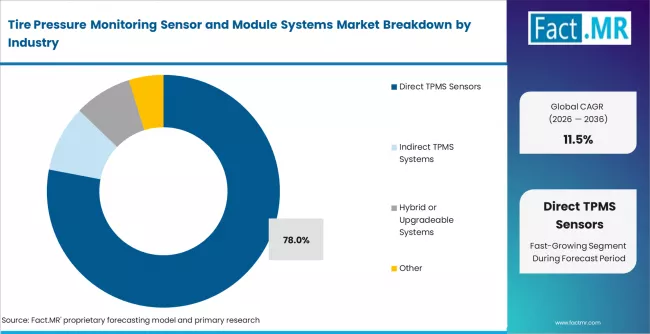
Tire Pressure Monitoring Sensor And Module Systems Market Analysis By Mounted Sensors | Source: Fact.MR
Based on FACTMR's tire pressure monitoring systems market report, consumption of Direct TPMS Sensors is estimated to hold 78.0% share in 2026. This segment leads due to its ability to provide real-time pressure readings from individual tires, enabling higher accuracy compared to indirect systems. Direct TPMS is also mandated under multiple safety regulations globally, making it the default choice for OEM integration. Its ability to support advanced diagnostics and integration with connected vehicle platforms further strengthens its adoption across passenger and electric vehicles.
- Company Expansion: Continental expanded TPMS production capacity in 2024 to support increasing OEM demand across Europe and Asia. The expansion aligns with long-term supply contracts with automotive manufacturers integrating direct TPMS as a standard feature. [1]
- Technology Development: Sensata introduced extended-life TPMS sensors in 2025 with improved battery performance and durability. These sensors are designed to match vehicle lifecycle expectations, reducing replacement frequency and enhancing aftermarket value. [2]
- Industry Trend: OEMs are standardizing direct TPMS systems globally to meet regulatory requirements and improve safety compliance. This shift is reducing reliance on indirect TPMS systems, particularly in developed automotive markets where precision monitoring is critical. [3]
Tire Pressure Monitoring Sensor and Module Systems Market Analysis by Sensor Fitment
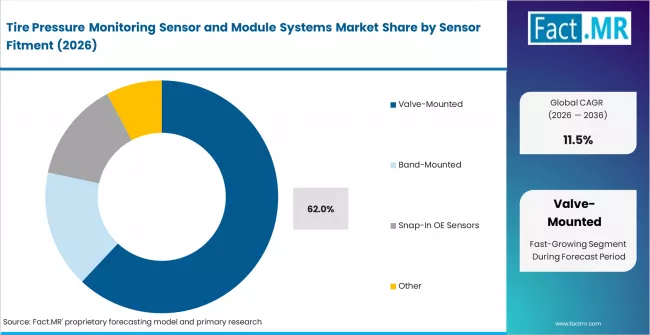
Tire Pressure Monitoring Sensor And Module Systems Market Analysis By Sensor Fitment | Source: Fact.MR
Based on FACTMR's tire pressure monitoring systems market report, consumption of Valve-Mounted sensors is estimated to hold 62.0% share in 2026. These sensors dominate due to their direct placement inside the tire valve, allowing accurate pressure measurement and simplified installation during vehicle assembly. Their compatibility with existing wheel architectures and ease of replacement in aftermarket applications further support widespread adoption among OEMs and service providers.
- Company Investment: Huf Hülsbeck & Fürst expanded manufacturing capacity in 2024 to meet growing OEM requirements for valve-mounted TPMS sensors. The investment supports supply continuity across European and North American automotive production lines. [4]
- Product Innovation: Denso launched compact valve-mounted TPMS sensors in 2025 optimized for electric vehicle platforms. These designs focus on reducing weight and improving energy efficiency, aligning with EV performance requirements. [5]
- Logistics Trend: Global supply chains are increasingly standardizing valve-mounted sensors due to ease of distribution and compatibility across vehicle models. This standardization reduces inventory complexity for aftermarket distributors and improves service efficiency. [6]
Tire Pressure Monitoring Sensor and Module Systems Market Analysis by Vehicle Type
Based on FACTMR's tire pressure monitoring systems market report, passenger cars remain the leading segment in 2026. This dominance is driven by regulatory mandates requiring TPMS installation in passenger vehicles across major markets and the significantly higher production volumes compared to commercial vehicles. Increasing consumer awareness of vehicle safety and fuel efficiency further supports adoption in this segment.
- OEM Integration: Hyundai Mobis expanded TPMS deployment across passenger vehicle platforms in 2024, supporting integration in both domestic and export models. This reflects increasing OEM standardization of safety systems across entry-level and mid-range vehicles. [7]
- Technology Integration: Bosch introduced connected TPMS systems in 2025 that integrate with vehicle telematics and driver assistance systems. These systems enable real-time monitoring and predictive maintenance alerts, enhancing overall vehicle safety. [8]
- Market Trend: Rising global demand for SUVs and crossovers is increasing TPMS installation rates, as these vehicles require enhanced safety and performance monitoring. Growth in this segment directly contributes to higher TPMS system adoption.
Drivers, Restraints, and Opportunities
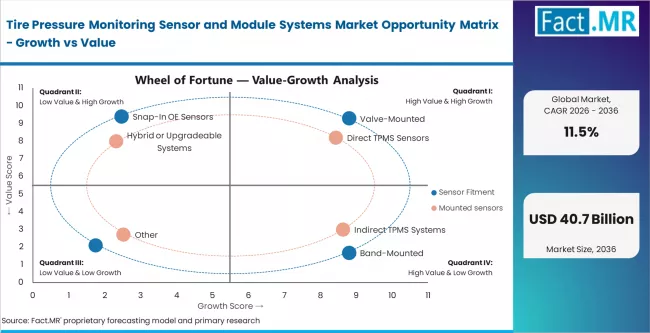
Tire Pressure Monitoring Sensor And Module Systems Market Opportunity Matrix Growth Vs Value | Source: Fact.MR
Fact MR analysis indicates that the TPMS market is structurally expanding due to regulatory enforcement and safety system integration. Market size is directly linked to vehicle production volumes and mandatory safety compliance requirements across key automotive regions.
Current dynamics show a shift from indirect systems toward direct TPMS systems. Indirect systems are declining due to lower accuracy, while direct systems provide real-time monitoring and regulatory compliance. Although direct systems have higher unit costs, their adoption increases overall market value.
- Regulatory Mandates: Regulations such as the TREAD Act in the United States and EU safety directives mandate TPMS installation in passenger vehicles, ensuring baseline demand.
- Vehicle Electrification: Growth in electric vehicles increases demand for advanced TPMS integration supporting efficiency and performance.
- Asia Manufacturing Growth: Expanding automotive production in India and China drives OEM TPMS demand supported by safety regulation alignment.
Regional Analysis
The tire pressure monitoring systems market is assessed across Asia Pacific, North America, Europe, Latin America, and Middle East and Africa. Geographic segmentation reflects automotive production trends, safety regulations, and aftermarket demand. The full report offers market attractiveness analysis.
.webp "Top Country Growth Comparison Tire Pressure Monitoring Sensor And Module Systems Market Cagr (2026 2036)")
Top Country Growth Comparison Tire Pressure Monitoring Sensor And Module Systems Market Cagr (2026 2036) | Source: Fact.MR
CAGR Table
| Country | CAGR (2026 to 2036) |
|---|---|
| India | 7.1% |
| China | 6.6% |
| Brazil | 6.0% |
| Mexico | 5.8% |
| South Korea | 5.3% |
Source: Fact.MR analysis. Updated Apr 28, 2026
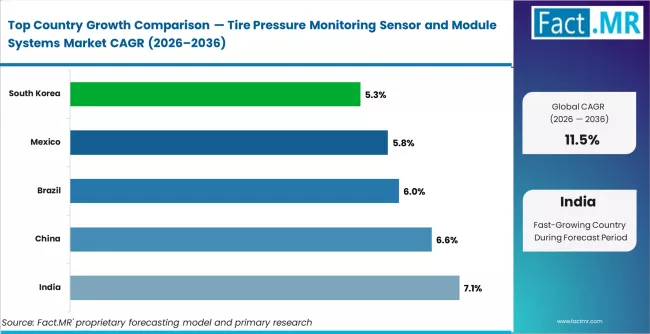
Tire Pressure Monitoring Sensor And Module Systems Market Cagr Analysis By Country | Source: Fact.MR
Source: Fact.MR (FACTMR) analysis, based on proprietary forecasting model and primary research
Asia Pacific TPMS Market Analysis
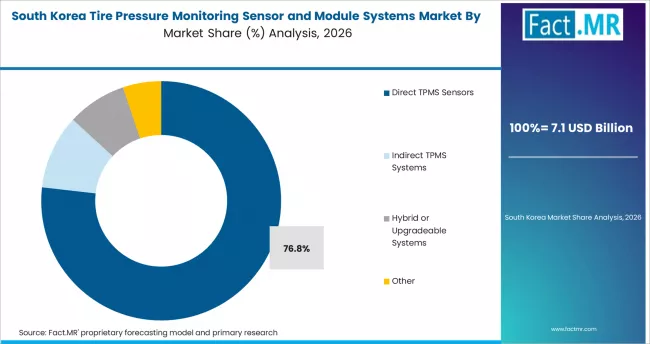
Tire Pressure Monitoring Sensor And Module Systems Market South Korea Market Share Analysis By Mounted Sensors | Source: Fact.MR
Asia Pacific acts as the global automotive production hub. Companies such as Denso, Hyundai Mobis, and Pacific Industrial dominate supply through OEM integration and manufacturing scale.
- India: The market in India continues to expand with strong regulatory backing. Demand for TPMS is projected to rise at 7.1% CAGR over the study period, supported by mandates introduced by the Ministry of Road Transport and Highways. OEMs expanded integration across passenger vehicles in 2024. Increasing safety awareness and production growth are reinforcing adoption.
- China: Government-led safety mandates are shaping TPMS demand across China. Domestic automotive production remains high, and suppliers are scaling capacity to align with OEM requirements. Demand is projected to expand at 6.6% CAGR through 2036, reflecting policy-driven adoption. Expansion is tied more to regulation than discretionary uptake.
- South Korea: South Korea shows steady progression supported by strong domestic OEM presence. TPMS integration is already standardized across most vehicle platforms. Suppliers are focusing on advanced sensor technologies and connected systems. The industry size is expected to reach 5.3% CAGR by 2036, driven by technology adoption trends.
FACTMR's analysis of TPMS market in Asia Pacific consists of country-wise assessment that includes India, China, Japan, ASEAN, and Australia. Readers can find regulatory adoption trends and OEM integration data.
Latin America TPMS Market Analysis
Latin America represents a developing automotive market with increasing adoption of vehicle safety systems and aftermarket demand.
- Brazil: Rising vehicle ownership continues to support TPMS demand across Brazil. OEMs are aligning vehicle production with export safety standards, increasing system integration rates. Growth is supported by both new vehicle sales and replacement demand in the aftermarket. The market is projected to expand at 6.0% CAGR through 2036.
FACTMR's analysis of TPMS market in Latin America consists of country-wise assessment that includes Brazil and Rest of Latin America. Readers can find vehicle parc growth and replacement demand trends.
North America TPMS Market Analysis
North America operates as a mature, regulation-driven market with strong OEM integration and stable replacement demand.
- Mexico: Mexico’s automotive sector continues to benefit from its role as an export manufacturing hub. TPMS integration is largely driven by compliance with U.S. safety requirements. OEM production expansion supports consistent demand across vehicle segments. The market is anticipated to reach 5.8% CAGR over the assessment period.
FACTMR's analysis of TPMS market in North America consists of country-wise assessment that includes the United States, Canada, and Mexico. Readers can find OEM integration and replacement demand insights.
Competitive Aligners for Market Players
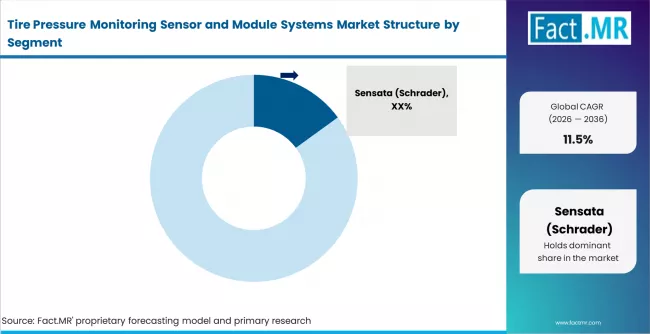
Tire Pressure Monitoring Sensor And Module Systems Market Analysis By Company | Source: Fact.MR
The tire pressure monitoring systems market exhibits a moderately concentrated structure, with a group of Tier-1 suppliers accounting for a substantial share of global supply. Competitive positioning is largely determined by OEM contract acquisition, system accuracy, and compliance with evolving automotive safety standards. Suppliers that can consistently meet regulatory requirements and deliver reliable sensor performance tend to secure long-term agreements with vehicle manufacturers.
Companies such as Sensata (Schrader), Continental, and Denso benefit from established relationships with global OEMs and extensive manufacturing footprints across key automotive regions. Their competitive advantage is reinforced by vertically integrated capabilities, strong R&D investment in sensor technology, and the ability to support platform-level integration across multiple vehicle models. Long-term supply contracts and validated product performance create high switching costs for OEMs.
The market also reflects strong barriers to entry due to stringent certification requirements and the need for proven reliability under varying operating conditions. New entrants face challenges in qualifying for OEM supply chains, where validation cycles are long and compliance standards are strict.
Buyer behavior is primarily shaped by OEM procurement strategies focused on reliability, lifecycle performance, and regulatory compliance. Automotive manufacturers typically maintain limited supplier pools to ensure consistency and quality. This approach stabilizes pricing dynamics, while aftermarket demand introduces additional revenue opportunities for established suppliers through sensor replacement cycles.
Key Players
- Sensata (Schrader)
- Continental
- Huf Hülsbeck & Fürst
- Denso
- Hitachi Astemo
- Pacific Industrial
- ZF
- Alps Alpine
- Hyundai Mobis
- Bosch
Bibliography
- [1] Continental AG. Automotive Sensor Production Report. 2024. continental.com
- [2] Sensata Technologies. TPMS Product Release. 2025. sensata.com
- [3] European Commission. Vehicle Safety Regulation Update. 2024. europa.eu
- [4] Huf Hülsbeck & Fürst. Manufacturing Expansion Report. 2024. huf-group.com
- [5] Denso Corporation. Product Innovation Release. 2025. denso.com
- [6] OICA. Global Automotive Industry Report. 2024. oica.net
- [7] Hyundai Mobis. Annual Report. 2024. mobis.co.kr
- [8] Bosch. Mobility Solutions Update. 2025. bosch.com
This Report Addresses
- Market intelligence on TPMS demand across OEM and aftermarket channels
- Market size forecast from USD 12.38 Billion in 2026 to USD 36.74 Billion by 2036
- Growth opportunity mapping across vehicle segments and regions
- Segment-level forecasts by system type, fitment, and vehicle category
- Competitive strategy and supplier positioning analysis
- Product innovation and compliance tracking
- Regulatory impact analysis on automotive safety systems
- Report delivery in PDF, Excel, and presentation formats
Tire Pressure Monitoring Sensor and Module Systems Market Definition
The tire pressure monitoring sensor and module systems market refers to electronic systems installed in vehicles to monitor tire pressure levels in real time. These systems use sensors placed inside or near tires to detect pressure variations and alert drivers when pressure falls below safe thresholds. The primary function is to improve vehicle safety, fuel efficiency, and tire durability. These systems are widely used in passenger vehicles, SUVs, and commercial vehicles where maintaining optimal tire pressure is critical for safe driving performance and regulatory compliance.
Tire Pressure Monitoring Sensor and Module Systems Market Inclusions
The report covers global and regional market size, historical demand trends, and forecast outlook from 2026 to 2036. It includes segmentation by system type, sensor fitment, and vehicle type across OEM and aftermarket channels. The study evaluates pricing trends, regulatory impact, and technology adoption patterns. Supply chain dynamics, replacement cycles, and vehicle production-linked demand are also included.
Tire Pressure Monitoring Sensor and Module Systems Market Exclusions
The scope excludes broader automotive safety systems such as ADAS unless directly integrated with TPMS. It does not include tire manufacturing or wheel assembly components. Other automotive sensors such as temperature or braking sensors are excluded unless part of TPMS functionality. The analysis focuses strictly on tire pressure monitoring sensors, modules, and related system components.
Tire Pressure Monitoring Sensor and Module Systems Market Research Methodology
- Primary Research
- Interviews with OEMs, Tier-1 suppliers, aftermarket distributors, and automotive safety regulators.
- Desk Research
- Analysis of vehicle production data, regulatory frameworks, company filings, and safety compliance standards.
- Market-Sizing and Forecasting
- Hybrid model using vehicle production volumes, TPMS penetration rates, and replacement cycles.
- Data Validation and Update Cycle
- Validated through supplier shipment data, regulatory tracking, and annual updates.
Segmentation
Scope of Report
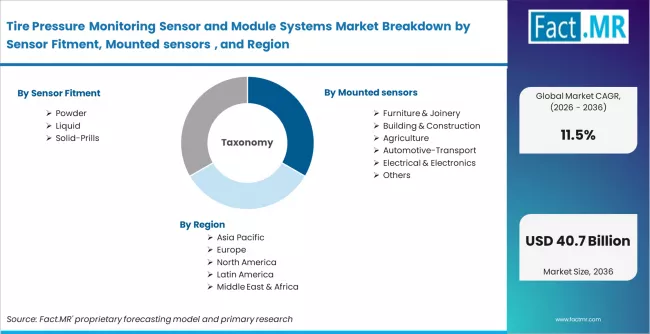
Tire Pressure Monitoring Sensor And Module Systems Market Breakdown By Sensor Fitment Mounted Sensors And Region | Source: Fact.MR
| Metric | Value |
|---|---|
| Quantitative Units | USD 12.38 Billion (2026) to USD 36.74 Billion (2036), at a CAGR of 11.5% |
| Market Definition | The tire pressure monitoring sensor and module systems market includes electronic systems designed to monitor tire pressure in real time using sensors and control modules integrated into vehicles. These systems improve vehicle safety, fuel efficiency, and tire performance across passenger and commercial vehicles. |
| System Type Segmentation | Direct TPMS Sensors, Indirect TPMS Systems, Hybrid or Upgradeable Systems, Other |
| Sensor Fitment Segmentation | Valve-Mounted, Band-Mounted, Snap-In OE Sensors, Other |
| Vehicle Type Segmentation | Passenger Cars, SUVs or Crossovers, Light Commercial Vehicles, Other |
| Regions Covered | North America, Europe, Asia Pacific, Latin America, Middle East and Africa |
Source: Fact.MR analysis. Updated Apr 28, 2026
TPMS Market by Segments
-
By System Type
- Direct TPMS Sensors
- Indirect TPMS Systems
- Hybrid or Upgradeable Systems
- Other
-
By Sensor Fitment
- Valve-Mounted
- Band-Mounted
- Snap-In OE Sensors
- Other
-
By Vehicle Type
- Passenger Cars
- SUVs or Crossovers
- Light Commercial Vehicles
- Other
-
By Region:
- North America
- United States
- Canada
- Mexico
- Latin America
- Brazil
- Argentina
- Chile
- Rest of Latin America
- Western Europe
- Germany
- France
- United Kingdom
- Italy
- Spain
- Nordic Countries
- BENELUX
- Rest of Western Europe
- Eastern Europe
- Russia
- Poland
- Hungary
- Balkan and Baltic
- Rest of Eastern Europe
- East Asia
- China
- Japan
- South Korea
- South Asia and Pacific
- India
- ASEAN
- Australia and New Zealand
- Rest of South Asia and Pacific
- Middle East and Africa
- Kingdom of Saudi Arabia
- Other GCC Countries
- Turkey
- South Africa
- Rest of Middle East and Africa
- North America
Frequently Asked Questions
How large is the tire pressure monitoring systems market in 2025?
What will be the market size in 2026?
What is the projected market size by 2036?
What is the expected CAGR from 2026 to 2036?
Which system type leads the TPMS market?
Which sensor fitment type dominates the market?
Which vehicle type segment holds the largest share?
What is driving TPMS demand globally?
Which region shows the fastest growth in the TPMS market?
Which country is growing the fastest in this market?
What is the growth outlook for China?
What is the expected growth rate in Brazil?
What is driving TPMS demand in Mexico?
What is the growth outlook for South Korea?
What are the key challenges in the TPMS market?
Who worked on this report


Preview the report firsthand - request a free sample
Free SampleGet the brochure for pricing and purchase details
Download PDF