- Market Value (2025): USD 2.12 Bn
- Estimated Value (2026): USD 2.3 Bn
- Forecast Value (2036): USD 4.0 Bn
- CAGR (2026-2036): 5.9 %
What is the Top Drives Market forecast to be worth by 2036?
USD 2.25 billion in 2026 to USD 3.99 billion by 2036 at a 5.9% CAGR.
- The valuation of the top drives market was USD 2.12 billion in 2025, a base built mainly on land rig activity in North America and on deepwater programs offshore Brazil.
- Revenue will grow from USD 2.25 billion in 2026 to USD 3.99 billion by 2036, as contractors replace older rotary table rigs and specify AC top drives on newbuilds.
- A 5.9% CAGR will come from longer horizontal wells, a steady upgrade cycle on rig fleets and new geothermal drilling programs in Europe and Asia.
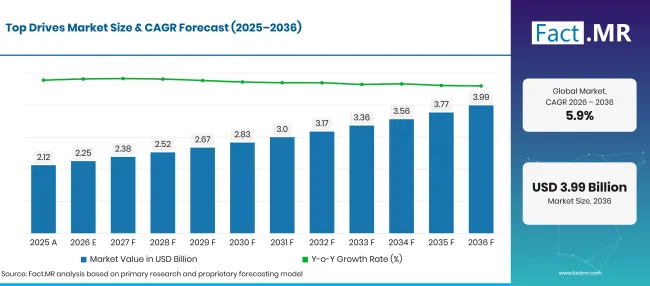
Top Drives Market Forecast Global | Source: Fact.MR
| Year | Basis | Market Value (USD billion) |
|---|---|---|
| 2025 | Actual | 2.12 |
| 2026 | Estimate | 2.25 |
| 2036 | Forecast | 3.99 |
| CAGR 2026 to 2036 | Forecast period | 5.9% |
Source: Fact.MR analysis. Updated Nov 6, 2026
What are the defining numbers behind Top Drives Market growth?
The 2026 to 2036 period adds USD 1.7 billion in new value, with electric units on land rigs and heavier systems for offshore wells taking most of it.
- Demand Drivers in the Market
- Steady hydrocarbon output: The U.S. Energy Information Administration put national crude oil production at 13.7 million barrels per day in 2025 and forecasts 14.3 million barrels per day for 2027 [1]. Holding that output requires constant new drilling, and every active rig needs a top drive that can deliver torque for long laterals.
- Deepwater development: Brazil’s oil output averaged 3.77 million barrels per day in 2025, and pre-salt fields delivered 79.63% of national oil and gas production [1]. Pre-salt wells are deep and heavy, so drillships and semisubmersibles in this region carry high-capacity units.
- Electric drive and automation: Rig control systems now steer the top drive directly, adjusting speed and torque to the formation without driller input. Honghua Group reported in March 2026 that its permanent-magnet top drive motor passed explosion-proof certification and offers about 30% higher torque density than common asynchronous direct-drive motors [3].
- Rig modernization: Many land rigs still drill with a kelly and rotary table or with first-generation top drives. Replacing them with AC units cuts connection time and pipe handling work, and the payback is quick when day rates stay firm.
- Key Segments Analyzed
- By Type: Electric Top Drives will hold 64.0% share in 2026, since AC motors with variable frequency control give finer torque regulation and link easily to automated rig software.
- By Application: Onshore Drilling will account for 59.7% of 2026 revenue, as land rigs far outnumber floating and platform rigs and drill more wells each year.
- By Capacity: 500-1000 Tons will capture 36.4% in 2026, given that this rating covers most modern land rigs and many offshore platform rigs.
- By End-User: Oil & Gas Industry will represent 65.4% of 2026 value, owing to the volume of exploration and development wells drilled for hydrocarbons.
- Analyst Opinion at Fact.MR
- Shambhu Nath Jha, Principal Consultant at Fact.MR, states, “Contractors will judge top drives on what they add to automated drilling, not on hoisting rating alone. Electric units with good diagnostics will win most fleet upgrades, while offshore buyers will keep paying for heavy systems that hold torque through long deepwater runs. Suppliers with spare parts and service crews close to the rig will hold an edge through 2036.”
- Strategic Implications
- Manufacturers should build predictive diagnostics and remote control into every new electric model, since contractors now rank uptime close to price when they choose equipment.
- Drilling contractors should plan top drive retrofits alongside rig control upgrades, because a modern drive delivers most of its benefit only when the automation system can command it.
- Distributors and service firms should stock wear parts and rebuild kits near busy basins, given that a single failed washpipe or gearbox can stop a rig for days.
- Investors should look at the aftermarket as closely as new unit sales, as the installed base on land rigs creates repeat revenue from overhauls and upgrades.
Germany heads the five profiled countries at 7.1%, as deep geothermal heat projects add a new class of buyer to a small rig base. Brazil follows at 6.5%, with pre-salt development keeping offshore rigs busy and favoring heavy units. The United States grows at 5.9% on a large but mature land fleet where upgrades outweigh new rig counts. The United Kingdom, at 5.3%, relies on sidetracks and well restoration in a basin past its peak. Japan closes the list at 4.7%, since its drilling demand comes mostly from geothermal surveys and research wells.
How does the Top Drives Market break down by segment?
Electric Top Drives will lead Type at 64.0%; Onshore Drilling will head Application at 59.7%; 500-1000 Tons will lead Capacity at 36.4%; Oil & Gas Industry will hold End-User at 65.4% in 2026.
Which Type leads?
Electric Top Drives represent 64.0% of 2026 sales.
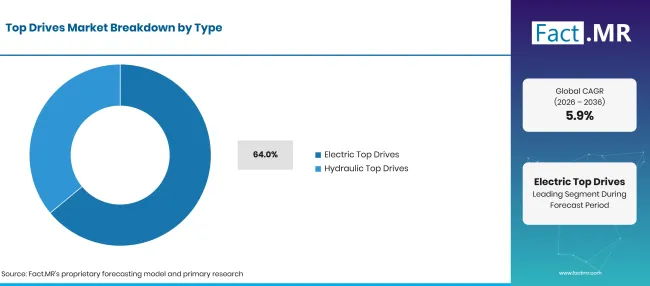
Top Drives Market Breakdown Type | Source: Fact.MR
| Type | Share (2026) |
|---|---|
| Electric Top Drives (Leading segment) | 64.0% |
| Other segments combined | 36.0%* |
| Total | 100.0% |
Source: Fact.MR analysis. Updated Nov 6, 2026
Directional and extended-reach wells need steady rotation and precise torque at the bit, and AC motors under variable frequency control supply both. Drillers can also feed motor data straight into rig automation software. Bentec describes its top drives as AC motor units under VFD control, and the four automated 1,250 hp land rigs it built for H&P to drill for PDO in Oman each carry an in-house top drive made to PDO specifications [4]. Heavy gear trains in these units depend on industrial motor brakes to hold the string during connections. Hydraulic top drives remain in use on smaller land rigs, workover units and mining rigs where weight and footprint count. They suit portable rigs that move often and run from a diesel hydraulic power pack. Their hydraulic hoses and pumps add service work.
What supports Onshore Drilling within Application?
Onshore Drilling takes 59.7% of 2026 revenue.
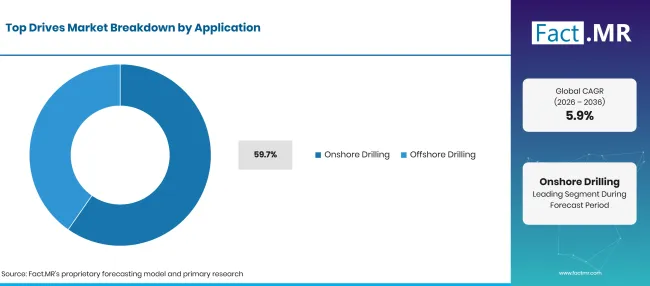
Top Drives Market Breakdown Application | Source: Fact.MR
| Application | Share (2026) |
|---|---|
| Onshore Drilling (Leading segment) | 59.7% |
| Other segments combined | 40.3%* |
| Total | 100.0% |
Source: Fact.MR analysis. Updated Nov 6, 2026
Land rigs drill most of the wells in shale basins, the Middle East and Central Asia, and each one turns over drill pipe many times a year. The EIA counted an annual average of 547 onshore rotary rigs in the United States during 2025, against 14 offshore [5]. Land contractors favor compact drives that move quickly between pads. Offshore rigs buy fewer units, but each one is larger and costs more to service. Drillships and semisubmersibles often run dual top drives or heavy single units rated above 1,000 tons. Pipe handling on these rigs also links to hydraulic cylinders in the racking and catwalk systems.
What leads the Capacity segment?
500-1000 Tons captures 36.4% of 2026 revenue.
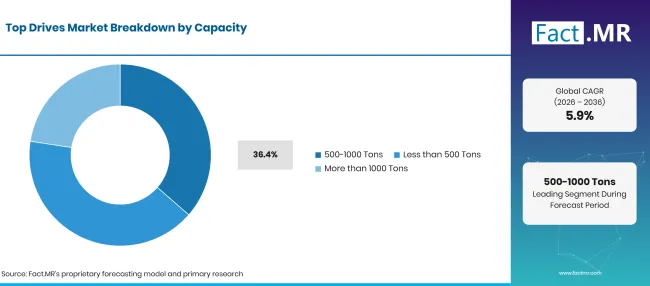
Top Drives Market Breakdown Capacity | Source: Fact.MR
| Capacity | Share (2026) |
|---|---|
| 500-1000 Tons (Leading segment) | 36.4% |
| Other segments combined | 63.6%* |
| Total | 100.0% |
Source: Fact.MR analysis. Updated Nov 6, 2026
Modern land rigs of 1,500 to 2,000 hp usually pair with drives rated between 500 and 750 tons, which covers most shale and conventional wells. NOV lists models across 500, 750 and 1,000 tons on its current top drive page, while HMH offers DDM machines rated up to 1,000 short tons for deep drilling. Premium Oilfield Technologies offers its GDM range from 150 to 1,000 tons. Units under 500 tons serve shallow wells, workover jobs and geothermal or water wells, often on truck-mounted rigs. These overlap with hydraulic workover units in several basins. Systems above 1,000 tons are bought almost only for deepwater floaters and the heaviest land rigs.
How does End-User shape demand?
Oil & Gas Industry accounts for 65.4% of 2026 value.
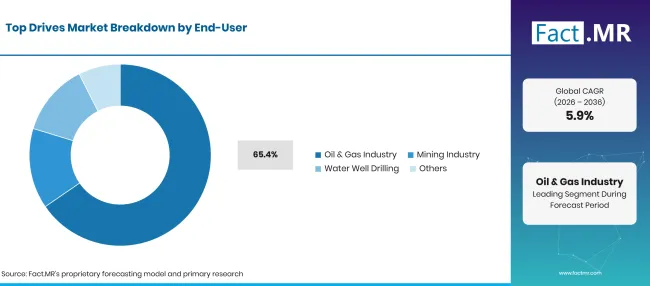
Top Drives Market Breakdown End User | Source: Fact.MR
| End-User | Share (2026) |
|---|---|
| Oil & Gas Industry (Leading segment) | 65.4% |
| Other segments combined | 34.6%* |
| Total | 100.0% |
Source: Fact.MR analysis. Updated Nov 6, 2026
Hydrocarbon wells need long strings, high torque and continuous circulation, which makes the top drive the core of the rig floor. Upstream budgets decide how many rigs work and how fast fleets get upgraded. Surface gear on these wells connects with flow control equipment used during drilling and completion. Mining companies use top drives on deep exploration holes and shaft pilot drilling, where core recovery and torque control count. Buyers of underground mining equipment also order drill rigs for ventilation and dewatering holes. Water well contractors and geothermal developers form the remaining demand, often with smaller hydraulic units.
What is accelerating Top Drives Market adoption, and what is holding it back?
Longer laterals, deepwater programs and rig automation push contractors toward modern electric top drives. Geothermal heat projects in Europe and Asia open a second customer base outside oil and gas. High purchase prices and specialist servicing slow adoption among smaller contractors. Swings in oil prices also delay rig upgrades when operators cut drilling budgets.
Drivers Impact Analysis
| DRIVER | (~) % IMPACT ON CAGR | GEOGRAPHIC RELEVANCE | IMPACT TIMELINE |
|---|---|---|---|
| Onshore oil and gas development drilling with longer laterals | +1.8% | North America, Middle East, Latin America | Medium term (2-4 years) |
| Offshore and deepwater drilling programs | +1.4% | Brazil, North America, Western Europe | Long term (>=4 years) |
| Adoption of electric top drives and automated drilling controls | +1.1% | North America, Western Europe, East Asia | Medium term (2-4 years) |
| Replacement of rotary table systems and older top drives | +0.8% | Global | Short term (<=2 years) |
| Higher-capacity equipment for complex and extended-reach wells | +0.6% | Global | Long term (>=4 years) |
Source: Fact.MR analysis. Updated Nov 6, 2026
Opportunity Impact Analysis
| OPPORTUNITY | (~) % IMPACT ON CAGR | GEOGRAPHIC RELEVANCE | IMPACT TIMELINE |
|---|---|---|---|
| High-capacity electric top drives for deepwater projects | +1.1% | Brazil, North America, Western Europe | Long term (>=4 years) |
| Predictive maintenance and remote diagnostics packages | +0.8% | North America, Western Europe, East Asia | Medium term (2-4 years) |
| Retrofit of conventional rigs with modern top drives | +0.6% | Global | Short term (<=2 years) |
| Geothermal and specialized deep drilling applications | +0.3% | Germany, Japan, North America | Long term (>=4 years) |
Source: Fact.MR analysis. Updated Nov 6, 2026
Restraints Impact Analysis
| RESTRAINT | (~) % IMPACT ON CAGR | GEOGRAPHIC RELEVANCE | IMPACT TIMELINE |
|---|---|---|---|
| High initial investment for advanced top drive systems | -0.9% | Global | Short term (<=2 years) |
| Maintenance costs and reliance on specialist servicing | -0.6% | Global | Medium term (2-4 years) |
| Volatile exploration budgets and rig activity | -0.4% | North America, Latin America, Western Europe | Medium term (2-4 years) |
| Integration challenges for smaller contractors | -0.2% | Emerging markets | Long term (>=4 years) |
Source: Fact.MR analysis. Updated Nov 6, 2026
Which countries are scaling the Top Drives Market through 2036?
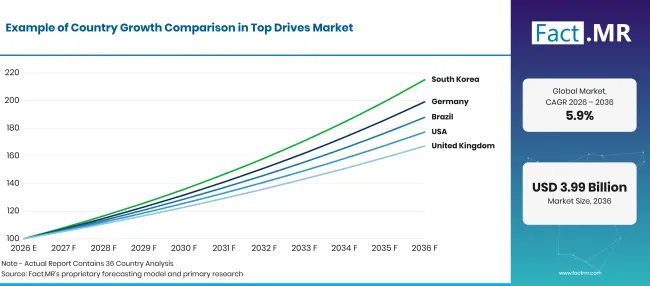
Top Drives Market Growth Index | Source: Fact.MR
| Country | CAGR (2026 to 2036) |
|---|---|
| Germany | 7.1% |
| Brazil | 6.5% |
| United States | 5.9% |
| United Kingdom | 5.3% |
| Japan | 4.7% |
Source: Fact.MR analysis. Updated Nov 6, 2026
What supports top drive adoption in Germany?
7.1% CAGR, driven by deep geothermal drilling for district heat.
Germany has few oil wells, but its heat transition calls for deep boreholes that need the same torque control as hydrocarbon drilling. The Federal Cabinet adopted the Federal Report on Energy Research 2025 in December 2025, which records about EUR 1.4 billion of federal energy research spending in 2024 and names the Explorationsinitiative Geothermie among measures starting in 2026 [6]. Contractors that win geothermal campaigns will need electric top drives able to run long, hot wells.
How is Brazil developing demand?
6.5% CAGR, backed by pre-salt offshore development.
Offshore fields carry almost all Brazilian output. ANP data show onshore wells delivered only 4.92% of national production in 2025, with cumulative oil output of 1.376 billion barrels for the year [2]. Floating rigs working these fields need heavy top drives with stable torque at depth.
What is supporting United States adoption?
5.9% CAGR, helped by a large land fleet moving to automated rigs.
Shale drilling keeps most of the domestic fleet on land, and contractors compete on how fast a rig can drill a long lateral. Offshore work adds a smaller stream of demand. The Bureau of Ocean Energy Management issued a Record of Decision in February 2026 that reaffirms Gulf of America Lease Sales 259 and 261, following its August 2025 Final Programmatic Environmental Impact Statement [7]. Retrofits of AC drives will form a steady share of purchases.
What supports top drive adoption in the United Kingdom?
5.3% CAGR, reflecting sidetrack and well restoration work in the North Sea.
The North Sea Transition Authority counted 38 development wellbores in 2025, including six mechanical sidetracks, with spending steady at about GBP 1.6 billion [8]. Operators also brought 56 wells back into service that year, adding 16 million barrels of oil [9]. The government’s Statutory Security of Supply Report 2025 states that the UK Continental Shelf provides about 43% of gross annual gas supply on a five-year average [10]. Platform rigs doing this work need reliable drives more than new capacity.
How does Japan perform?
4.7% CAGR, as geothermal exploration slowly expands.
Japan’s Cabinet approved the Seventh Strategic Energy Plan in February 2025, setting a 73% greenhouse gas reduction target for FY2040 against FY2013 [11]. A later explainer from the Agency for Natural Resources and Energy states that JOGMEC will lead geothermal resource surveys to lower development risk and cost [12]. Survey wells use smaller rigs, so unit volumes stay modest.
Who leads the Top Drives Market?
Suppliers fall into three groups. Full rig and equipment makers such as NOV and HMH sell top drives as part of complete drilling packages and hold large installed bases on land and offshore rigs.
Canrig, Bentec and Drillmec form a second group that pairs its own top drives with rig building or drilling work and gains field data to refine designs. Canrig’s Sigma unit, for example, is a 500-ton drive built for long lateral wells with automated control. Bentec delivered four automated land rigs with in-house top drives for drilling in Oman, as described in an October 2025 case study [4]. Honghua Group and Premium Oilfield Technologies form a third group offering wide rating ranges for land and offshore rigs. Honghua reported in April 2026 that an all-electric drilling system it co-developed reached 3,413 meters in Antarctica [13]. Through 2036, service reach and the quality of automation interfaces will separate suppliers more than hoisting ratings.
Which companies are the key providers?
Key companies in the Top Drives Market include NOV, HMH, Canrig, Bentec, Drillmec, Honghua Group and Premium Oilfield Technologies.
- NOV
- HMH
- Canrig
- Bentec
- Drillmec
- Honghua Group
- Premium Oilfield Technologies
Bibliography
- [1] U.S. Energy Information Administration. (2026, October 6). Short-Term Energy Outlook.
- [2] Agência Nacional do Petróleo, Gás Natural e Biocombustíveis. (2026, February). Boletim da Produção de Petróleo e Gás Natural, Edição nº 184: Encarte de Consolidação da Produção 2025.
- [3] Honghua Group. (2026, March 25)
- [4] BENTEC. (2025, October 27). Rig design and construction for H&P to drill for PDO.
- [5] U.S. Energy Information Administration. (2026, September 30). Crude Oil and Natural Gas Drilling Activity.
- [6] Federal Ministry for Economic Affairs and Energy. (2025, December 10). Kabinett verabschiedet Bundesbericht Energieforschung 2025: Innovationen für die Energieversorgung der Zukunft.
- [7] Bureau of Ocean Energy Management. (2026, February 24). BOEM Issues Record of Decision for Gulf Lease Sales 259 and 261.
- [8] North Sea Transition Authority. (2026, August 11). UKCS Wells Insights Report 2026.
- [9] North Sea Transition Authority. (2026, August 11). Reinstated wells produced 16 million boe in 2025.
- [10] Department for Energy Security and Net Zero. (2025, December 17). Statutory Security of Supply Report 2025.
- [11] Ministry of Economy, Trade and Industry. (2025, February 18). Cabinet Decision on the Seventh Strategic Energy Plan.
- [12] Agency for Natural Resources and Energy. (2025, November 11). A Closer Look at the 7th Strategic Energy Plan: Aiming to Substantially Expand Renewable Energy.
- [13] Honghua Group. (2026, April 10). 3413(3,413 meter record: all-electric drive equipment supports polar research).
This Report Answers
- How is revenue split between electric and hydraulic top drives, and why are contractors moving to AC units?
- Why do land rigs account for the bigger part of spending, and what keeps offshore demand distinct?
- Which hoisting ratings suit shale, conventional and deepwater wells?
- How are automation, remote diagnostics and service networks changing supplier choice?
- What explains the growth gap between Germany, Brazil, the United States, the United Kingdom and Japan?
- Which suppliers build complete rigs, and which focus on the drive itself?
What does the Top Drives Market cover?
This study tracks revenue from top drive units sold to drilling contractors, operators and rig builders worldwide. Each unit counts once at the point of sale, whether it goes onto a new rig or replaces an older drive.
Value is measured at manufacturer selling price in USD. Coverage spans electric and hydraulic designs, all hoisting ratings and every end-user group. Mining, water and geothermal boreholes are counted with oil and gas wells.
What is included in the scope?
Electric and hydraulic top drives sold as complete units, including drive motors, gearboxes and washpipe assemblies.
Integrated pipe handlers, guide dollies and control cabinets shipped as part of the top drive package. Retrofit kits that replace a kelly and rotary table drive with a top drive.Drives for land rigs, offshore platform rigs, jackups and floating rigs.
What is excluded from the scope?
Complete drilling rigs, rig leasing and drilling contractor service income.
Drill bits, drill pipe, drilling fluids and well completion equipment sold on their own. Standalone electric motors, industrial gearboxes and hydraulic power units not tied to a top drive. Spare parts and repair services billed separately from a unit sale.
How Was the Analysis Built?
The analysis draws on 120+ sources, 35+ company portfolios, 25+ countries, and more than 20 industry interviews.
- Primary Research: Primary research includes discussions with manufacturers, service providers, technology developers, distributors, end users, and subject-matter experts. These conversations examine purchasing priorities, product adoption, operational challenges, approval requirements, competitive positioning, and the factors that influence wider market acceptance.
- Desk Research: Desk research covers government statistics, regulatory publications, company filings, trade data, technical studies, industry associations, standards, public policy, and other authoritative sources. Every source used in the analysis is documented in the bibliography.
- Market Sizing and Forecasting: Market estimates combine historical performance, demand indicators, pricing and volume trends, segment shares, company participation, country-level growth, adoption patterns, investment activity, and barriers to market expansion.
- Data Validation and Update Cycle: Findings are validated by comparing primary interviews with public data, company activity, regulatory changes, trade patterns, and industry developments. Regular updates review new product launches, capacity changes, partnerships, approvals, and shifts in commercial adoption.
Segmentation
What is the report’s scope and coverage?
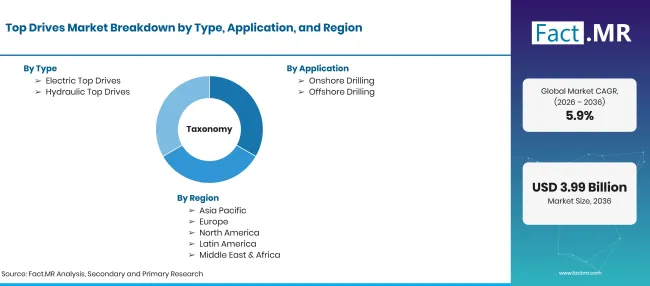
Top Drives Market Taxonomy | Source: Fact.MR
| Attribute | Details |
|---|---|
| Quantitative Units | USD billion |
| Market Definition | Top drive systems mounted in the derrick of drilling rigs to rotate the drill string, apply torque and allow continuous drilling with full stands of pipe. |
| Type | Electric Top Drives; Hydraulic Top Drives |
| Application | Onshore Drilling; Offshore Drilling |
| Capacity | 500-1000 Tons; Less than 500 Tons; More than 1000 Tons |
| End-User | Oil & Gas Industry; Mining Industry; Water Well Drilling; Others |
| Regions Covered | North America; Latin America; Western Europe; Eastern Europe; East Asia; South Asia & Pacific; Middle East & Africa |
| Countries Covered | Germany; Brazil; United States; United Kingdom; Japan |
| Companies Profiled | NOV; HMH; Canrig; Bentec; Drillmec; Honghua Group; Premium Oilfield Technologies |
| Forecast Period | 2026 to 2036 |
| Approach | Rig counts by country, new rig builds and retrofit rates were combined with unit prices by type and capacity, then checked against manufacturer portfolios. |
Source: Fact.MR analysis. Updated Nov 6, 2026
How is the market segmented?
-
By Type
- Electric Top Drives
- Hydraulic Top Drives
-
By Application
- Onshore Drilling
- Offshore Drilling
-
By Capacity
- 500-1000 Tons
- Less than 500 Tons
- More than 1000 Tons
-
By End-User
- Oil & Gas Industry
- Mining Industry
- Water Well Drilling
- Others
-
By Region
- North America
- Latin America
- Western Europe
- Eastern Europe
- East Asia
- South Asia & Pacific
- Middle East & Africa
Frequently Asked Questions
How large is the top drives market in 2026?
What growth rate will the top drives market record?
Which type leads?
Which application leads?
Which capacity leads?
Which end-user leads?
Which country will grow quickest?
Who are the main companies?
What holds the market back?
Who worked on this report


Preview the report firsthand - request a free sample
Free SampleGet the brochure for pricing and purchase details
Download PDF