- Market Value (2025): USD 229.0 Mn
- Estimated Value (2026): USD 239.4 Mn
- Forecast Value (2036): USD 372.1 Mn
- CAGR (2026-2036): 4.5%
What is the Fuel Antistat Market forecast to be worth by 2036?
USD 239.4 million in 2026 to USD 372.1 million by 2036 at a 4.5% CAGR.
- Worth USD 229.0 million in 2025, the fuel antistat market draws most of its revenue from jet fuel treated at refineries, terminals and airport fuel farms.
- Revenue will grow from USD 239.4 million in 2026 to USD 372.1 million by 2036 as airport throughput and low-sulfur distillate volumes keep conductivity treatment in steady use.
- A 4.5% CAGR reflects a treatment that scales with fuel throughput, with small dose rates per tonne but a recurring need at each handling stage.
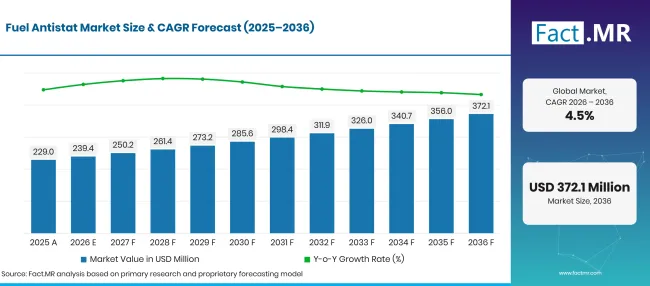
Fuel Antistat Market Forecast Global | Source: Fact.MR
| Year | Basis | Market Value (USD million) |
|---|---|---|
| 2025 | Actual | 229.0 |
| 2026 | Estimate | 239.4 |
| 2036 | Forecast | 372.1 |
| CAGR 2026 to 2036 | Forecast period | 4.5% |
Source: Fact.MR analysis. Updated Nov 6, 2026
What are the defining numbers behind Fuel Antistat Market growth?
The 2026 to 2036 period adds USD 132.7 million in new value, led by Additives in Product Type, Aviation in Application and Direct Sales in Distribution Channel.
- Demand Drivers in the Market
- Jet fuel volumes keep the treated base growing. U.S. demand for kerosene-type jet fuel averaged 1,737 thousand barrels per day in 2025, up from 1,690 thousand barrels per day in 2024 [1].
- Conductivity testing turns charge control into a routine check. ASTM D2624-26 sets portable, on-line and in-line methods for measuring the electrical conductivity of aviation and distillate fuels with and without a static dissipator additive [2].
- Desulfurized diesel and gasoline lose natural conductivity during hydrotreating, so terminals dose conductivity improvers before switch loading and pipeline transfer.
- New fuel pathways widen the qualification workload. ASTM D4054-26 gives the practice for evaluating new aviation turbine fuels and new fuel additives, which shapes how antistat suppliers test compatibility with emerging blends [3].
- Key Segments Analyzed
- By Product Type: Additives will hold 52.3% share in 2026, since dissipator chemistry is what lifts fuel conductivity at a few parts per million.
- By Application: Aviation will account for 35.4% of 2026 value as jet fuel passes through filters, hydrants and dispensers that generate charge at high flow rates.
- By Distribution Channel: Direct Sales will capture 58.7% in 2026, given that refiners and fuel farms buy approved grades under technical supply agreements.
- Analyst Opinion at Fact.MR
- Shambhu Nath Jha, Principal Consultant at Fact.MR, states, “Antistat volumes will track fuel throughput, so airport traffic and low-sulfur distillate output will set the pace of demand. Suppliers holding approvals for jet fuel will keep pricing power, because a refinery cannot switch dissipator grades without retesting. New fuel blends will open room for formulations that hold conductivity steady over longer storage times.”
- Strategic Implications
- Additive manufacturers should keep jet fuel approvals current and publish clear dose response data for low-sulfur diesel, where terminal buyers compare treat rates closely.
- Terminal and pipeline operators should log conductivity at receipt and dispatch, since readings fall with time and temperature and a single top-up dose often costs less than a rejected batch.
- Airport fuel suppliers should align dissipator dosing with filtration and hydrant upgrades, as new filter vessels and faster pumps raise the charge that fuel carries.
- Investors should weigh suppliers by approval breadth and terminal service reach, because those two assets decide repeat orders in this small but sticky additive niche.
Country growth spreads from 5.4% to 3.5%. The United Kingdom (5.4%) leads on rising passenger traffic through capacity-constrained hubs, while Brazil (4.9%) gains from long domestic routes that move jet fuel across a wide airport network. The United States (4.3%) treats a far greater volume but grows from a mature base. Germany (3.9%) relies on diesel and heating oil terminals as much as on airports, and Japan (3.5%) follows steady domestic flying with modest gains in fuel handled.
How does the Fuel Antistat Market break down by segment?
Additives will lead Product Type at 52.3%; Aviation will head Application at 35.4%; Direct Sales will hold Distribution Channel at 58.7% in 2026.
Which Product Type leads?
Additives represent 52.3% of 2026 sales.
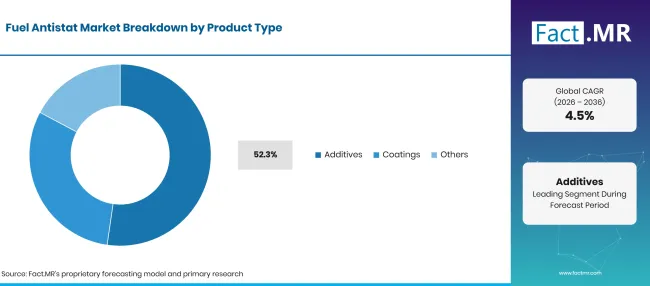
Fuel Antistat Market Breakdown Product Type | Source: Fact.MR
| Product Type | Share (2026) |
|---|---|
| Additives (Leading segment) | 52.3% |
| Other segments combined | 47.7%* |
| Total | 100.0% |
Source: Fact.MR analysis. Updated Nov 6, 2026
Refiners treat jet fuel and ultra-low sulfur diesel at tiny concentrations, yet the effect on charge relaxation is large, which keeps purpose-built dissipator chemistry at the center of spending. Innospec lists STADIS 450 as approved for civil and military aviation turbine fuels and offers STADIS 425 for diesel and gas oil [4]. BASF supplies KEROSTAT, a metal-free antistatic additive that raises the electrical conductivity of crude oil distillates in tanks, pipelines and switch loading [5]. Other product types cover blended multifunctional packages and dosing services sold alongside terminal treatments. Fuel moved through fuel storage containers and bulk tanks still needs conductivity checks before release. Operators of containment tanks at depots add a further point where top-up dosing takes place.
What supports Aviation within Application?
Aviation takes 35.4% of 2026 revenue.
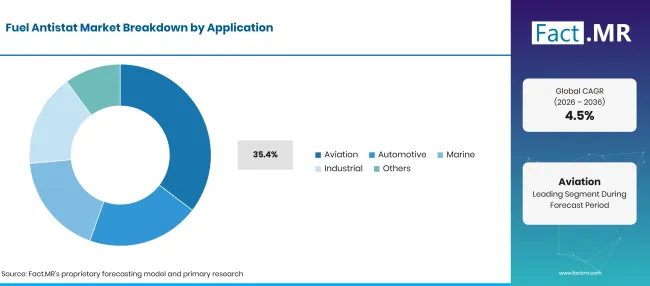
Fuel Antistat Market Breakdown Application | Source: Fact.MR
| Application | Share (2026) |
|---|---|
| Aviation (Leading segment) | 35.4% |
| Other segments combined | 64.6%* |
| Total | 100.0% |
Source: Fact.MR analysis. Updated Nov 6, 2026
Jet fuel passes through micro filters, filter water separators and hydrant pumps, and each stage can leave the fuel carrying charge. ASTM D1655-26b, the standard specification for aviation turbine fuels, sets the additive provisions that refiners follow when treating Jet A and Jet A-1 [6]. That written link between specification and additive keeps aviation buyers loyal to approved grades. Other applications include road diesel, gasoline, heating oil and marine distillates. Ship loading through marine loading arms moves large volumes at high flow, which raises charge risk at export terminals. Blended renewable diesel and fuel from the biodiesel supply chain also need checks once mixed with desulfurized fossil streams.
What leads the Distribution Channel segment?
Direct Sales holds 58.7% of 2026 demand.
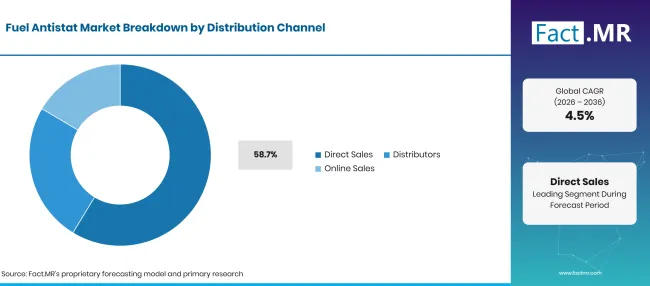
Fuel Antistat Market Breakdown Distribution Channel | Source: Fact.MR
| Distribution Channel | Share (2026) |
|---|---|
| Direct Sales (Leading segment) | 58.7% |
| Other segments combined | 41.3%* |
| Total | 100.0% |
Source: Fact.MR analysis. Updated Nov 6, 2026
Refiners and airport fuel farms usually buy under supply contracts that bundle the product with dosing equipment, conductivity audits and documentation for fuel quality records. Approval files and batch certificates must match the specification in force, so buyers prefer to deal with the producer. Distributors and other channels serve smaller terminals, private airfields and industrial users that buy in drums or totes. Pipeline operators who already manage oil and gas flow control equipment often source additives through the same service contractors. This channel will keep a stable role where volumes are too small for a direct account.
What is accelerating Fuel Antistat Market adoption, and what is holding it back?
Growth comes from rising jet fuel throughput, tighter conductivity checks and the steady spread of ultra-low sulfur fuels that no longer dissipate charge on their own. Restraints come from tiny dose rates that cap revenue per tonne, slow approval cycles for new grades and the need to avoid overtreatment, which can push fuel above the maximum conductivity limit.
Drivers Impact Analysis
| DRIVER | (~) % IMPACT ON CAGR | GEOGRAPHIC RELEVANCE | IMPACT TIMELINE |
|---|---|---|---|
| Rising jet fuel throughput at airports and fuel farms | +1.4% | North America, Western Europe, East Asia | Medium term (2-4 years) |
| Conductivity testing written into fuel specifications | +1.1% | Global | Short term (<=2 years) |
| Ultra-low sulfur diesel and gasoline needing conductivity improvers | +0.9% | Global | Medium term (2-4 years) |
| Hydrant and filtration upgrades at airports | +0.6% | Latin America, Middle East & Africa | Long term (>=4 years) |
Source: Fact.MR analysis. Updated Nov 6, 2026
Opportunity Impact Analysis
| OPPORTUNITY | (~) % IMPACT ON CAGR | GEOGRAPHIC RELEVANCE | IMPACT TIMELINE |
|---|---|---|---|
| Dissipator grades qualified for sustainable aviation fuel blends | +0.7% | Western Europe, North America | Long term (>=4 years) |
| Terminal dosing and conductivity audit services | +0.5% | North America, Western Europe | Medium term (2-4 years) |
| New airport fuel farms in growing aviation markets | +0.4% | Latin America, South Asia & Pacific | Long term (>=4 years) |
| Treatment packages for renewable diesel blends | +0.3% | Global | Medium term (2-4 years) |
Source: Fact.MR analysis. Updated Nov 6, 2026
Restraints Impact Analysis
| RESTRAINT | (~) % IMPACT ON CAGR | GEOGRAPHIC RELEVANCE | IMPACT TIMELINE |
|---|---|---|---|
| Long approval cycles for new aviation additives | -0.4% | Global | Medium term (2-4 years) |
| Low treat rates that limit revenue per tonne | -0.3% | Global | Short term (<=2 years) |
| Overtreatment risk against maximum conductivity limits | -0.2% | Global | Medium term (2-4 years) |
| Exposure to swings in flight activity and refinery runs | -0.1% | Global | Long term (>=4 years) |
Source: Fact.MR analysis. Updated Nov 6, 2026
Which countries are scaling the Fuel Antistat Market through 2036?
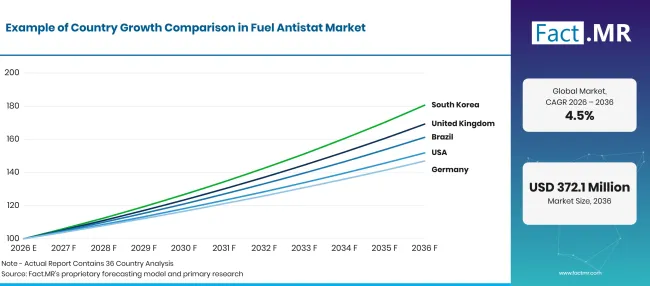
Fuel Antistat Market Growth Index | Source: Fact.MR
| Country | CAGR (2026 to 2036) |
|---|---|
| United Kingdom | 5.4% |
| Brazil | 4.9% |
| United States | 4.3% |
| Germany | 3.9% |
| Japan | 3.5% |
Source: Fact.MR analysis. Updated Nov 6, 2026
What supports adoption in the United Kingdom?
5.4% CAGR, driven by passenger growth at busy hub airports.
UK airports handled 299.4 million terminal passengers in 2025, a rise of 2% on 2024, according to Civil Aviation Authority data [7]. The Department for Transport’s 2026 forecast puts the central case at 491 million terminal passengers by 2050, against 292.3 million in 2024 [8]. More flights mean more jet fuel through hydrants at Heathrow, Gatwick and Manchester, where fuel farms treat and test every delivery. Pipeline supply to the main airports adds further treated volume.
How is Brazil developing demand?
4.9% CAGR, helped by a wide domestic route network.
Brazil depends on air travel to link distant state capitals, so jet fuel moves long distances by pipeline, coastal tanker and truck before it reaches the wing. Each transfer adds a point where conductivity must be checked. Each fuel farm upgrade brings new filtration and hydrant equipment that must be matched with the right dose. Low-sulfur diesel used in road freight forms a second base for conductivity improvers at distribution terminals.
What is shaping United States adoption?
4.3% CAGR, backed by a deep jet fuel supply chain.
The Federal Aviation Administration’s FY 2026 to 2046 forecast covers U.S. airline traffic, capacity and general aviation activity through the next two decades [9]. Broader fuel handling stays large, with total U.S. liquid fuels consumption of 20.7 million barrels per day in 2025, as reported by the Energy Information Administration [10]. Ultra-low sulfur diesel rules make conductivity improvers a standard terminal treatment, and pipeline batching adds frequent switch loading events.
What supports adoption in Germany?
3.9% CAGR, reflecting dense diesel terminals alongside airport demand.
German main airports handled 1.5 million passenger flights in 2025, and 45% of them were short-haul flights of up to 1,000 km, according to the Federal Statistical Office [11]. That mix means many short turnarounds and frequent refuelling at Frankfurt and Munich. Inland tank farms for diesel and heating oil add steady demand for conductivity treatment at rail and barge loading points.
How does Japan perform?
3.5% CAGR, as domestic flying grows at a measured pace.
Domestic passengers in Japan reached 112.5 million in FY2025, up 3.4% year on year, while international passengers on Japanese carriers rose 10.9% to 23.46 million, the Ministry of Land, Infrastructure, Transport and Tourism reported [12]. Haneda, Narita and Kansai pump large volumes through hydrant networks. Refiners already treat jet fuel to export grade, which keeps growth in line with traffic.
Who leads the Fuel Antistat Market?
Competition splits into three groups. Specialist fuel additive houses form the first: Innospec, Afton Chemical and Dorf Ketal sell dedicated dissipator and conductivity improver grades and compete on approval status, low treat rates and terminal service. Innospec’s STADIS 450 holds approval for civil and military jet fuel [4], which gives it a strong hold in aviation, while Afton Chemical offers HiTEC 4546 for low-sulfur diesel and gasoline and Dorf Ketal supplies non-metallic static dissipators such as SR1795.
Diversified chemical groups form the second: BASF sells KEROSTAT through its refinery additives range [5], and TotalEnergies offers a conductivity improver line through its additives and fuel solutions unit, both winning on breadth of refinery relationships. Oilfield and refinery service providers form the third, with Baker Hughes supplying TOLAD conductivity improvers as part of wider treatment programs. Over the forecast period, the edge will go to suppliers that qualify grades for new fuel blends and pair product with reliable on-site dosing support.
Which companies are the key providers?
Key companies include Innospec, Afton Chemical, BASF, Dorf Ketal, TotalEnergies and Baker Hughes.
- Innospec
- Afton Chemical
- BASF
- Dorf Ketal
- TotalEnergies
- Baker Hughes
Bibliography
- [1] U.S. Energy Information Administration. (2026, September 30). U.S. Product Supplied of Kerosene-Type Jet Fuel (Thousand Barrels per Day).
- [2] ASTM International. (2026, July 8). Standard Test Methods for Electrical Conductivity of Aviation and Distillate Fuels (ASTM D2624-26).
- [3] ASTM International. (2026, July 1). Standard Practice for Evaluation of New Aviation Turbine Fuels and Fuel Additives (ASTM D4054-26).
- [4] Innospec. (2026, April 10). Static Dissipators.
- [5] BASF. (2026). Refinery Additives for Middle Distillates.
- [6] ASTM International. (2026, August 10). Standard Specification for Aviation Turbine Fuels (ASTM D1655-26b).
- [7] Civil Aviation Authority. (2026, March 23). Annual airport data 2025: Table 09 Terminal and Transit Passengers.
- [8] Department for Transport. (2026, June 18). UK aviation forecast 2026.
- [9] Federal Aviation Administration. (2026, October 13). FAA Aerospace Forecasts.
- [10] U.S. Energy Information Administration. (2026, October 6). Short-Term Energy Outlook: Petroleum Products.
- [11] Statistisches Bundesamt. (2026, May 26). 45 % der Flüge 2025 waren Kurzstreckenflüge.
- [12] Ministry of Land, Infrastructure, Transport and Tourism. (2026, June 30)
This Report Answers
- How much revenue do dissipator additives earn compared with other antistat product types?
- Why does jet fuel handling generate the strongest pull for conductivity treatment?
- What keeps refiners and fuel farms buying direct from additive producers?
- How do conductivity test methods and fuel specifications shape purchasing?
- Which of the five profiled countries will grow quickest, and what fuel handling trends explain the gaps?
- Where can suppliers gain from new fuel blends and terminal service contracts?
What does the Fuel Antistat Market cover?
This study tracks additives that raise fuel conductivity so static charge can relax before it builds to a discharge. Static dissipator additives for jet fuel and conductivity improvers for desulfurized diesel and gasoline form the core of the revenue base.
Revenue is valued at the producer selling price for the additive itself, across aviation and other fuel uses and through direct and indirect channels. Refiners, pipeline operators, terminal owners, airport fuel suppliers and industrial fuel users are the main buyers.
What is included in the scope?
Static dissipator additives approved for aviation turbine fuels are included.
Conductivity improvers dosed into ultra-low sulfur diesel, gasoline, heating oil and marine distillates are included.Antistat components sold within multifunctional terminal packages count toward the market when the package is sold for conductivity control.Treatment at refineries, pipelines, storage depots and airport fuel farms is covered, including pipeline sections where steel pipe coatings protect the line wall.
What is excluded from the scope?
Fuel additives with no antistatic role, such as detergents, corrosion inhibitors, lubricity improvers and cold flow improvers sold on their own, are excluded.
Conductivity meters, filter water separators, tanks, hydrants and other handling hardware are excluded.Antistatic agents for plastics, textiles and packaging fall outside this study.Fuel sales, into-plane service fees and pipeline tariffs are not counted as antistat revenue.
How Was the Analysis Built?
The analysis draws on 120+ sources, 35+ company portfolios, 25+ countries, and more than 20 industry interviews.
- Primary Research: Primary research includes discussions with manufacturers, service providers, technology developers, distributors, end users, and subject-matter experts. These conversations examine purchasing priorities, product adoption, operational challenges, approval requirements, competitive positioning, and the factors that influence wider market acceptance.
- Desk Research: Desk research covers government statistics, regulatory publications, company filings, trade data, technical studies, industry associations, standards, public policy, and other authoritative sources. Every source used in the analysis is documented in the bibliography.
- Market Sizing and Forecasting: Market estimates combine historical performance, demand indicators, pricing and volume trends, segment shares, company participation, country-level growth, adoption patterns, investment activity, and barriers to market expansion.
- Data Validation and Update Cycle: Findings are validated by comparing primary interviews with public data, company activity, regulatory changes, trade patterns, and industry developments. Regular updates review new product launches, capacity changes, partnerships, approvals, and shifts in commercial adoption.
Segmentation
What is the report’s scope and coverage?
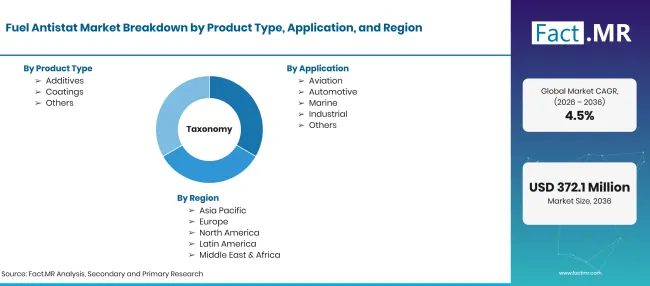
Factmr Fuel Antistat Market Taxonomy | Source: Fact.MR
| Attribute | Details |
|---|---|
| Quantitative Units | USD million |
| Market Definition | Chemical additives that raise the electrical conductivity of aviation and distillate fuels so electrostatic charge dissipates during storage, filtration, pumping and transfer. |
| Product Type | Additives; Other Product Types |
| Application | Aviation; Other Applications |
| Distribution Channel | Direct Sales; Other Distribution Channels |
| Regions Covered | North America; Latin America; Western Europe; Eastern Europe; East Asia; South Asia & Pacific; Middle East & Africa |
| Countries Covered | United Kingdom; Brazil; United States; Germany; Japan |
| Companies Profiled | Innospec; Afton Chemical; BASF; Dorf Ketal; TotalEnergies; Baker Hughes |
| Forecast Period | 2026 to 2036 |
| Approach | Jet fuel and distillate throughput by country, multiplied by typical treat rates and checked against supplier portfolios and terminal dosing practice. |
Source: Fact.MR analysis. Updated Nov 6, 2026
How is the market segmented?
-
By Product Type
- Additives
- Other Product Types
-
By Application
- Aviation
- Other Applications
-
By Distribution Channel
- Direct Sales
- Other Distribution Channels
-
By Region
- North America
- Latin America
- Western Europe
- Eastern Europe
- East Asia
- South Asia & Pacific
- Middle East & Africa
Frequently Asked Questions
How large is the fuel antistat market in 2026?
What growth rate will the fuel antistat market record?
Which product type leads?
Which application leads?
Which distribution channel leads?
Which country will grow quickest?
Who are the main companies?
What holds the market back?
Who worked on this report


Preview the report firsthand - request a free sample
Free SampleGet the brochure for pricing and purchase details
Download PDF