- Market Value (2025): USD 344.6 Mn
- Estimated Value (2026): USD 362.5 Mn
- Forecast Value (2036): USD 600.6 Mn
- CAGR (2026-2036): 5.2%
What is the Treadmill Belts Market forecast to be worth by 2036?
USD 362.5 million in 2026 to USD 600.6 million by 2036 at a 5.2% CAGR.
- Fact.MR estimates that the treadmill belts market reached USD 344.6 million in 2025, with gym fleets and home machines both feeding replacement orders.
- Revenue is set to climb from USD 362.5 million in 2026 to USD 600.6 million by 2036 as installed treadmills age and need new running surfaces.
- Value will compound at 5.2% CAGR over 2026 to 2036, since every powered treadmill in service needs several belt changes over its working life.
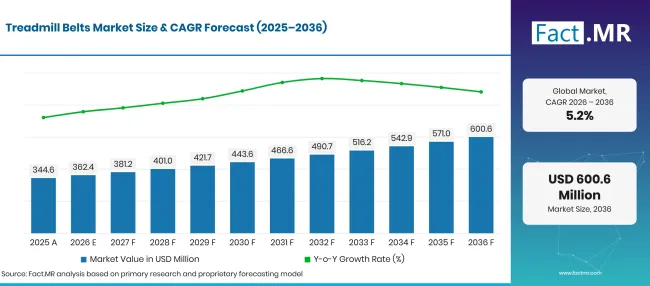
Factmr Treadmill Belts Market Forecast Global | Source: Fact.MR
| Year | Basis | Market Value (USD million) |
|---|---|---|
| 2025 | Actual | 344.6 |
| 2026 | Estimate | 362.5 |
| 2036 | Forecast | 600.6 |
| CAGR 2026 to 2036 | Forecast period | 5.2% |
Source: Fact.MR analysis. Updated Oct 19, 2026
What are the defining numbers behind Treadmill Belts Market growth?
The 2026 to 2036 period adds USD 238.1 million in new value, most of it from replacement belts for commercial fleets.
- Demand Drivers in the Market
- Commercial gyms, hotels and corporate fitness rooms run treadmills for long hours, and the belt is the part that wears first. Eurostat counted 1.8 million people employed in sport across the EU in 2025, 0.9% of total employment [1]. Every staffed facility keeps machines on a service schedule that includes belt checks and swaps.
- Home owners often fit a new belt to keep a machine running instead of buying a new treadmill. A belt costs a fraction of a full unit, so a worn surface on a sound frame is usually repaired.
- Online buying makes model-specific parts easy to find. Eurostat reported that 78% of EU internet users bought or ordered goods or services online in 2025 [2]. Listings that show belt length, width and thickness cut the risk of ordering the wrong part.
- Slat-belt treadmills for heavy commercial use are widening the product range. Their rubber-topped slats last longer than a continuous belt, but they still need periodic replacement and are sold through the original equipment maker.
- Service technicians and equipment distributors shape replacement choices for gyms. Many operators let their service partner pick the belt grade and stock, which favors brands with clear part catalogs.
- Key Segments Analyzed
- By Product Type: Motorized Treadmill Belts will hold 72.4% share in 2026, as powered machines make up most gym and home fleets and wear belts faster under motor drive.
- By Material: Rubber will account for 54.8% share in 2026, given that its grip and flex suit belts that run long hours under heavy users.
- By Application: Commercial Use will capture 61.3% share in 2026 through daily, high-hour operation that shortens belt life in gyms and clubs.
- By Distribution Channel: Online Stores will take 57.7% share in 2026, helped by searchable catalogs that match belts to treadmill model numbers.
- Analyst Opinion at Fact.MR
- Shambhu Nath Jha, Principal Consultant at Fact.MR, states, “A treadmill belt is a wear part, so this market grows with the installed base of machines, not with new treadmill sales alone. Gyms will keep paying for belts that last longer and arrive quickly, because a machine out of service costs them members. Suppliers that publish exact fit data for each model will win the home buyer who orders online.”
- Strategic Implications
- Belt manufacturers should publish length, width, thickness and model fit tables for every product so buyers order the right size the first time.
- Treadmill brands should keep replacement belts in stock for older models, since gym customers judge them on service as much as on new equipment.
- Online retailers should add model-number search and fit checks to belt listings, which will lower return rates on a bulky, hard-to-ship part.
- Gym operators should plan belt replacement by running hours, in step with lubrication and deck checks, to avoid machines standing idle at peak times.
Germany will lead the five countries at 6.0% CAGR, where a dense club network and high online buying lift belt orders. Brazil follows at 5.5% on the back of growing leisure-time exercise in its cities. The United States will grow at 4.9%, with a large installed base of commercial and home treadmills. In the United Kingdom, a 4.4% rate reflects steady gym and exercise machine use. Japan will expand at 3.9%, as a mature fitness base renews its machines at a slower pace.
How does the Treadmill Belts Market break down by segment?
Motorized Treadmill Belts will lead Product Type at 72.4%; Rubber will head Material at 54.8%; Commercial Use will top Application at 61.3%; Online Stores will rank first in Distribution Channel at 57.7%.
Which Product Type dominates?
Motorized Treadmill Belts make up 72.4% of 2026 sales.
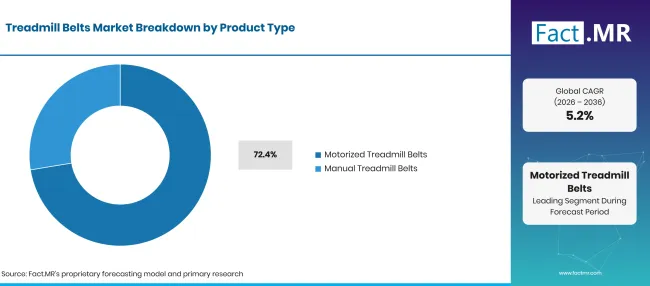
Factmr Treadmill Belts Market Breakdown Product Type | Source: Fact.MR
| Product Type | Share (2026) |
|---|---|
| Motorized Treadmill Belts (Leading segment) | 72.4% |
| Other segments combined | 27.6%* |
| Total | 100.0% |
Source: Fact.MR analysis. Updated Oct 19, 2026
Powered treadmills fill most gym floors and home exercise rooms, and their motors pull the belt across the deck at steady speed for hours. That friction wears the underside and the running surface, so belts on motorized machines need changing more often. Buyers pick by belt length, width, ply and the roller design of their model. Demand for compact home units adds volume, as seen in Fact.MR coverage of walking pads that use short, thin belts. Manual treadmill belts serve non-motorized machines, including curved models driven by the runner’s own stride. These belts wear more slowly, and their designs vary by model.
What supports Rubber within Material?
Rubber holds 54.8% of 2026 sales.
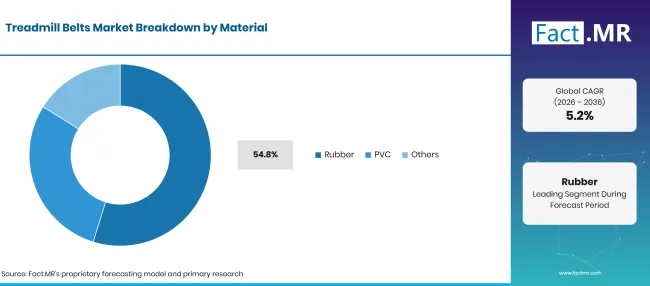
Factmr Treadmill Belts Market Breakdown Material 1 | Source: Fact.MR
| Material | Share (2026) |
|---|---|
| Rubber (Leading segment) | 54.8% |
| Other segments combined | 45.2%* |
| Total | 100.0% |
Source: Fact.MR analysis. Updated Oct 19, 2026
Belt makers choose rubber for the running surface on commercial machines because it grips well, flexes around rollers and absorbs impact. Gym buyers pay more for multi-ply rubber belts that keep their shape under heavy runners. Slat-belt treadmills also use rubber treads on each slat. PVC belts are lighter and cost less, which suits many home treadmills. Some makers also use polyurethane layers, a field covered in Fact.MR’s thermoplastic polyurethane analysis, to cut noise and friction. Material choice depends on the deck, motor power and expected hours of use.
What leads the Application segment?
Commercial Use takes 61.3% of 2026 sales.
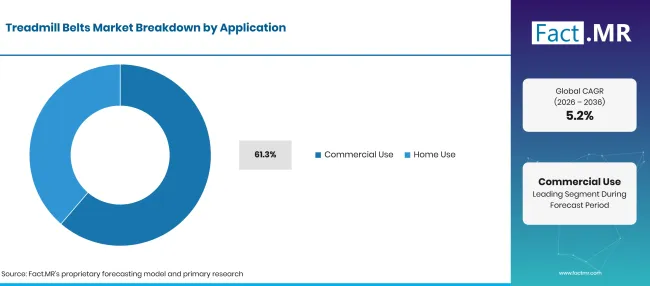
Factmr Treadmill Belts Market Breakdown Application | Source: Fact.MR
| Application | Share (2026) |
|---|---|
| Commercial Use (Leading segment) | 61.3% |
| Other segments combined | 38.7%* |
| Total | 100.0% |
Source: Fact.MR analysis. Updated Oct 19, 2026
Health clubs, hotels, universities and corporate gyms run treadmills from early morning to late evening. A belt in that setting can wear out in a fraction of the time it lasts at home. Operators of gym equipment fleets buy belts in batches and schedule swaps with their service partners. Home use is smaller but steady. Owners replace belts when they slip, fray or start to drag, and many prefer a repair to buying a new machine. Connected home treadmills, part of the wider smart fitness category, keep owners training at home and add to the base of machines that will need belts.
How does Distribution Channel shape demand?
Online Stores carry 57.7% of 2026 sales.
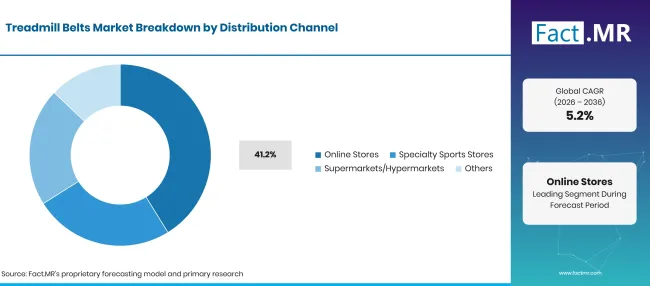
Factmr Treadmill Belts Market Breakdown Distribution Channel | Source: Fact.MR
| Distribution Channel | Share (2026) |
|---|---|
| Online Stores (Leading segment) | 57.7% |
| Other segments combined | 42.3%* |
| Total | 100.0% |
Source: Fact.MR analysis. Updated Oct 19, 2026
Buyers search online by treadmill brand and model number, then compare belt sizes, materials and prices across sellers. The U.S. Census Bureau reported that e-commerce made up 17.1% of total U.S. retail sales in the second quarter of 2026 [3]. Online sellers can also ship to homes and gyms that have no local parts dealer. Specialty sports stores serve buyers who want advice or fitting help. OEM supply covers belts fitted on new machines and replacement belts sold through the treadmill maker’s own service network. Retailers that also sell sports equipment use belt sales to keep treadmill owners coming back.
What is accelerating Treadmill Belts Market adoption, and what is holding it back?
Replacement needs across gym fleets and home machines will keep orders coming, and online catalogs will make the right part easier to find. Wrong-size orders, low-price imports and owners who put off maintenance will slow value growth.
Drivers Impact Analysis
| DRIVER | (~) % IMPACT ON CAGR | GEOGRAPHIC RELEVANCE | IMPACT TIMELINE |
|---|---|---|---|
| Recurring belt replacement in commercial fitness fleets | +1.4% | North America, Western Europe | Short term (<= 2 years) |
| Home owners repairing treadmills instead of replacing them | +1.1% | North America, Western Europe, East Asia | Short term (<= 2 years) |
| Online catalogs with model-specific fit data | +0.9% | North America, Western Europe, Latin America | Short term (<= 2 years) |
| Growth of slat-belt and heavy-duty commercial treadmills | +0.7% | North America, Western Europe | Medium term (2-4 years) |
| Preventive maintenance contracts at gyms and hotels | +0.6% | Global | Medium term (2-4 years) |
Source: Fact.MR analysis. Updated Oct 19, 2026
Opportunity Impact Analysis
| OPPORTUNITY | (~) % IMPACT ON CAGR | GEOGRAPHIC RELEVANCE | IMPACT TIMELINE |
|---|---|---|---|
| Longer-life multi-ply belts for high-hour commercial use | +0.8% | North America, Western Europe | Medium term (2-4 years) |
| Low-friction, maintenance-free belt and deck pairs | +0.7% | Global | Medium term (2-4 years) |
| Belts for compact walking pads and home units | +0.6% | East Asia, North America | Short term (<= 2 years) |
| Service networks in fast-growing gym markets | +0.4% | Latin America, South Asia & Pacific | Long term (>= 4 years) |
Source: Fact.MR analysis. Updated Oct 19, 2026
Restraints Impact Analysis
| RESTRAINT | (~) % IMPACT ON CAGR | GEOGRAPHIC RELEVANCE | IMPACT TIMELINE |
|---|---|---|---|
| Wrong-size orders and returns on model-specific parts | -0.6% | Global | Short term (<= 2 years) |
| Price competition from low-cost generic belts | -0.5% | Global | Short term (<= 2 years) |
| Owners delaying maintenance to save money | -0.4% | North America, Western Europe | Medium term (2-4 years) |
| Proprietary belt designs limiting third-party supply | -0.3% | Global | Medium term (2-4 years) |
Source: Fact.MR analysis. Updated Oct 19, 2026
Which countries are scaling the Treadmill Belts Market through 2036?
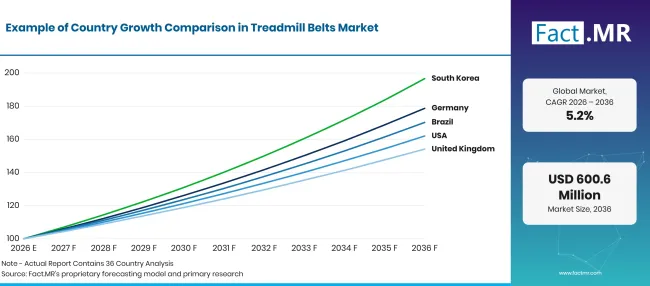
Factmr Treadmill Belts Market Growth Index | Source: Fact.MR
| Country | CAGR (2026 to 2036) |
|---|---|
| Germany | 6.0% |
| Brazil | 5.5% |
| United States | 4.9% |
| United Kingdom | 4.4% |
| Japan | 3.9% |
Source: Fact.MR analysis. Updated Oct 19, 2026
What supports Germany’s adoption?
6.0% CAGR, driven by a dense fitness club network and strong online buying.
German buyers are quick to order parts online. The Federal Statistical Office (Destatis) reported that 70% of people bought or ordered goods or services online in the three months before its 2025 survey [4]. Club chains run large treadmill fleets on long opening hours, so service partners order belts in volume. Home owners often source replacement belts through online parts shops.
How is Brazil scaling demand?
5.5% CAGR, backed by more adults exercising in their free time.
Brazil’s Ministry of Health reported in its Vigitel 2025 results that adults doing at least 150 minutes of moderate leisure-time activity each week rose from 30.3% in 2009 to 42.3% in 2024 [5]. Low-cost gym chains have opened across large cities to meet that demand. Their treadmills run for long hours, and many gyms rely on local suppliers for affordable replacement belts.
What supports United States adoption?
4.9% CAGR, helped by a very large installed base of commercial and home treadmills.
The U.S. Bureau of Labor Statistics counted 388,400 fitness trainer and instructor jobs in 2025 and projects 7% growth from 2025 to 2035 [6]. Each trainer works in a gym, studio or club that keeps treadmills in service. Safety rules also shape upkeep. In January 2026, the U.S. Consumer Product Safety Commission announced an expanded recall of about 47,000 Matrix Retail and Vision treadmills over a fire hazard [7].
How is the United Kingdom developing demand?
4.4% CAGR, on the back of steady gym and exercise machine use.
Sport England reported that 64.6% of adults in England, or 30.9 million people, met 150 minutes of activity a week in November 2024 to 2025, and that fitness activity grew by 921,000 people in a year [8]. Gym sessions and exercise machines led that rise. The Office for National Statistics put internet sales at 27.3% of all retail sales in August 2026 [9], so belts move easily through online sellers.
How does Japan perform?
3.9% CAGR, reflecting a mature fitness base that renews machines on longer cycles.
The Japan Sports Agency reported that 51.7% of adults aged 20 and over played sport or exercised at least once a week in its fiscal 2025 survey [10]. Online buying of goods is still lower than in Western markets. The Ministry of Economy, Trade and Industry put Japan’s goods e-commerce ratio at 9.8% in 2024 [11]. Fitness clubs and hospitals with cardiac rehabilitation devices still order belts through distributors.
Who leads the Treadmill Belts Market?
Three groups compete for belt sales. Commercial treadmill makers such as Life Fitness (Cybex), Precor, Technogym, Johnson Health Tech, TRUE Fitness and Woodway sell machines to clubs and then supply belts through their own service networks.
Their edge is that the belt matches the deck, rollers and warranty. Product news shows where they are investing: Life Fitness presented its Symbio Runner series at HFA in March 2025 [12], and Precor launched its Breakaway slat-belt treadmill in September 2025 [13]. Consumer brands iFIT (ProForm, NordicTrack) and BowFlex sell home treadmills and offer parts to owners online. Belt specialists such as Habasit supply treadmill belts to equipment makers and compete on low-friction, long-life constructions. Fit data, stock on hand and belt life per running hour will decide who wins the replacement order.
Which companies are the key providers?
Key companies include iFIT (ProForm, NordicTrack); BowFlex; Johnson Health Tech; Technogym; Life Fitness (Cybex); Precor; TRUE Fitness; Woodway; and Habasit.
- iFIT (ProForm, NordicTrack)
- BowFlex
- Johnson Health Tech
- Technogym
- Life Fitness (Cybex)
- Precor
- TRUE Fitness
- Woodway
- Habasit
Bibliography
- [1] Eurostat. (2026, July). Employment in sport.
- [2] Eurostat. (2026, February). E-commerce statistics for individuals.
- [3] U.S. Census Bureau. (2026, August 18). Monthly Retail Trade: Quarterly Retail E-Commerce Sales Report.
- [4] Statistisches Bundesamt (Destatis). (2026, September 23). Einkäufe von Personen über das Internet nach Alter [Online purchases by persons by age].
- [5] Ministério da Saúde, Brazil. (2026). Para o povo brasileiro viver mais e viver melhor: Resultados Vigitel 2025 [For Brazilians to live longer and better: Vigitel 2025 results].
- [6] U.S. Bureau of Labor Statistics. (2026, August 27). Fitness Trainers and Instructors: Occupational Outlook Handbook.
- [7] U.S. Consumer Product Safety Commission. (2026, January 22). Johnson Health Tech Expands Recall to Include Matrix Retail and Vision Treadmills Due to Fire Hazard.
- [8] Sport England. (2026, April 23). Active Lives Adult Survey: November 2024-25 Report.
- [9] Office for National Statistics. (2026, September 18). Internet sales as a percentage of total retail sales (ratio) (%).
- [10] Japan Sports Agency. (2026, March 11).[Results of the fiscal 2025 public opinion survey on sports participation].
- [11] Ministry of Economy, Trade and Industry, Japan. (2025, August 26).[Results of the fiscal 2024 market survey on electronic commerce].
- [12] Life Fitness. (2025, March 4). HFA 2025 Press Release.
- [13] Precor. (2025, September 16). Precor Introduces its Breakaway Treadmill, Combining Workout Innovation with Trusted Performance.
This Report Answers
- How much will treadmill belt revenue grow from 2026 to 2036, and how much comes from replacement demand?
- Which belt type, material, application and sales channel lead, and what keeps each one in front?
- Germany, Brazil, the United States, the United Kingdom and Japan are compared on gym activity, online buying and machine age.
- Treadmill makers and belt specialists are profiled by their role in new fitment and aftermarket supply.
- Where do wrong-size orders, cheap generic belts and delayed maintenance hold value back?
What does the Treadmill Belts Market cover?
This study tracks running belts for walking, jogging and running machines, both motorized and manual. Belts made with rubber or PVC surfaces are counted, whether they go into a new treadmill or replace a worn one.
Demand is measured at the belt level across commercial facilities and homes. Revenue includes belts sold online, through specialty sports stores and through treadmill makers’ own supply and service channels.
What is included in the scope?
Continuous belts for motorized decks, belts for manual and curved treadmills, and replacement treads for slat-belt machines are in scope. Belts for compact home units, such as under-desk walking treadmills, are counted too.
Belts that treadmill makers fit at the factory are counted at their component value. Replacement belts sold in kits with lubricant or fitting tools are counted at the belt value.
What is excluded from the scope?
Complete treadmills are not part of the revenue count. Motors, decks, rollers, consoles and other parts sold on their own are also left out.
Conveyor belts for industrial use and belts for other exercise machines, such as rowers or bikes, fall outside this study. Service labor for fitting belts is not counted.
How Was the Analysis Built?
The analysis draws on 120+ sources, 35+ company portfolios, 25+ countries, and more than 20 industry interviews.
- Primary Research: Primary research includes discussions with manufacturers, service providers, technology developers, distributors, end users, and subject-matter experts. These conversations examine purchasing priorities, product adoption, operational challenges, approval requirements, competitive positioning, and the factors that influence wider market acceptance.
- Desk Research: Desk research covers government statistics, regulatory publications, company filings, trade data, technical studies, industry associations, standards, public policy, and other authoritative sources. Every source used in the analysis is documented in the bibliography.
- Market Sizing and Forecasting: Market estimates combine historical performance, demand indicators, pricing and volume trends, segment shares, company participation, country-level growth, adoption patterns, investment activity, and barriers to market expansion.
- Data Validation and Update Cycle: Findings are validated by comparing primary interviews with public data, company activity, regulatory changes, trade patterns, and industry developments. Regular updates review new product launches, capacity changes, partnerships, approvals, and shifts in commercial adoption.
Segmentation
What is the report’s scope and coverage?
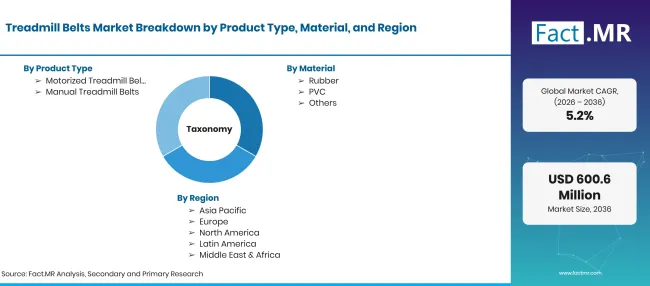
Factmr Treadmill Belts Market Taxonomy | Source: Fact.MR
| Attribute | Details |
|---|---|
| Quantitative Units | USD million in 2026 to USD million by 2036 at CAGR |
| Market Definition | Running belts for motorized and manual treadmills, sold fitted to new machines or as replacement parts. The scope covers rubber and PVC belts bought by commercial facilities and home owners. |
| Product Type | Motorized Treadmill Belts; Manual Treadmill Belts |
| Material | Rubber; PVC |
| Application | Commercial Use; Home Use |
| Distribution Channel | Online Stores; Specialty Sports Stores; OEM Supply |
| Regions Covered | North America; Latin America; Western Europe; Eastern Europe; East Asia; South Asia & Pacific; Middle East & Africa |
| Countries Covered | Germany; Brazil; United States; United Kingdom; Japan |
| Companies Profiled | iFIT (ProForm, NordicTrack); BowFlex; Johnson Health Tech; Technogym; Life Fitness (Cybex); Precor; TRUE Fitness; Woodway; Habasit |
| Forecast Period | 2026 to 2036 |
| Approach | Installed treadmill base by country and application, multiplied by belt replacement frequency per running hour and average belt price, cross-checked against OEM fitment and supplier portfolios. |
Source: Fact.MR analysis. Updated Oct 19, 2026
How is the market segmented?
-
By Product Type
- Motorized Treadmill Belts
- Manual Treadmill Belts
-
By Material
- Rubber
- PVC
-
By Application
- Commercial Use
- Home Use
-
By Distribution Channel
- Online Stores
- Specialty Sports Stores
- OEM Supply
-
By Region
- North America
- Latin America
- Western Europe
- Eastern Europe
- East Asia
- South Asia & Pacific
- Middle East & Africa
Frequently Asked Questions
How big is the treadmill belts market in 2026?
What is the CAGR of the treadmill belts market from 2026 to 2036?
Which product type leads the treadmill belts market?
Which material leads the treadmill belts market?
Which application leads the treadmill belts market?
Which distribution channel leads the treadmill belts market?
Which country will grow the most in the treadmill belts market?
Who are the main companies in the treadmill belts market?
Who worked on this report


Preview the report firsthand - request a free sample
Free SampleGet the brochure for pricing and purchase details
Download PDF