- Forecast Value (2036): 5.5 Bn
- CAGR (2036): 16.4%
What is the walking pads market forecast to be worth by 2036?
USD 1.2 billion in 2026 to USD 5.5 billion by 2036, at 16.4% CAGR.
- The walking pads market crossed a valuation of USD 1.0 billion in 2025.
- Demand is expected to increase from USD 1.2 billion in 2026 to USD 5.5 billion by 2036.
- The market is forecast to record 16.4% CAGR from 2026 to 2036 as hybrid work, small apartments and short indoor walking routines increase purchase frequency.
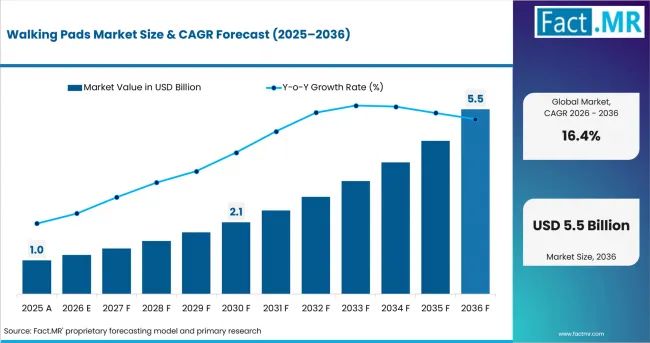
Walking Pads Market Value Analysis | Source: Fact.MR
What are the defining numbers behind walking pads growth?
USD 4.3 billion absolute opportunity by 2036. China, the United States and the United Kingdom lead the country view.
- Demand Drivers in the Market
- Hybrid workers need movement options that fit beside a desk because many workdays remain screen-based and seated.
- Apartment buyers choose compact equipment when floor space and storage height limit full-size treadmill ownership.
- Employer wellness teams are testing low-noise walking units as a practical add-on to standing desks and wellness rooms.
- Safety scrutiny is raising the value of warranty support, motor control and clearer load-rating documentation.
- Key Segments Analyzed
- By Motor Type: Quiet DC Motors are projected to capture 64.0% share in 2026 because desk use requires low sound and stable low-speed movement.
- By Sales Channel: Online Retail is expected to account for 62.0% of the market share in 2026 because walking pads are compared by price, reviews and delivery speed before purchase.
- By Buyer Type: Individual Consumers are estimated to hold 58.0% share in 2026 as most purchases are made for home offices and apartments.
- By Speed Range: Walking-Only models are likely to represent 55.0% share in 2026 since under-desk use usually needs steady low-speed operation.
- By Price Tier: Mid Price units are forecast to secure 47.0% share in 2026 because buyers seek better motors and warranty terms without paying for full treadmill features.
- By Application: Home Office is anticipated to contribute 46.0% of revenue in 2026 as remote and hybrid work keep exercise equipment near desks.
- By Product Type: Under-Desk Folding models are set to account for 43.0% share in 2026 because storage under sofas and beds matters in small homes.
- By Geography: China is expected to register a CAGR of 19.4% through 2036, supported by manufacturing scale and high online retail penetration.
- Analyst Opinion
- Shambhu Nath Jha, Principal Analyst at Fact.MR states, "Walking pads sell when they remove friction from exercise. I see buyers asking whether the unit is quiet enough for calls, thin enough to store and safe enough to keep using after the first month."
- Strategic Implications
- Brands should document belt stability, load rating and motor heat control before entering employer or wellness channels.
- Retailers need return policies that separate defective low-cost units from buyer misuse and desk-fit problems.
- Corporate wellness buyers should test noise and trip-risk performance before offering walking pads at scale.
- Suppliers can add service value through replacement remotes, clear maintenance guidance and spare belt availability.
Compact under-desk treadmills and foldable walking units form the core of this market. The World Health Organization reported in June 2024 that 31.0% of adults were not sufficiently active. This supports demand for low-friction indoor walking products that can fit into work hours and home routines without requiring a full gym setup.
China is projected to record 19.4% CAGR through 2036 as manufacturing scale and online retail depth support faster product turnover. The United States is expected to expand at 18.1% CAGR because hybrid workers and direct-to-consumer fitness brands support repeat demand. The United Kingdom is forecast to grow at 17.6% CAGR as hybrid work and small-home fitness needs keep compact treadmills visible to office workers. Australia is expected to advance at 17.2% CAGR as remote-work continuity supports home fitness purchases. Canada is projected to rise at 16.8% CAGR as telework routines create more room for short indoor walking sessions.
How does the walking pads market break down by segment?
Quiet DC Motors lead at 64.0%. Online Retail follows with 62.0% share in 2026.
Which product type leads?
Under-Desk Folding models hold 43.0% share in 2026.
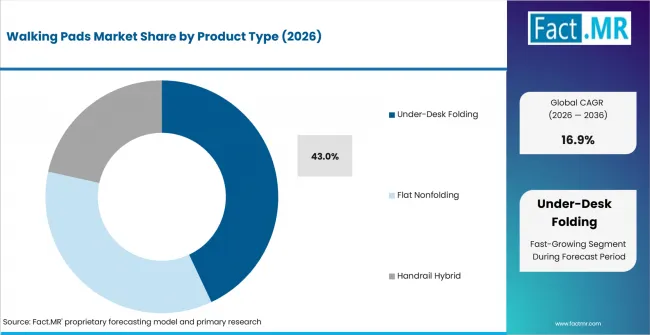
Walking Pads Market Analysis By Product Type | Source: Fact.MR
Under-Desk Folding models are expected to hold 43.0% share in 2026 because buyers want equipment that disappears after the workday. Foldable units compete with connected fitness products only when app control adds clear use value. Basic folding design still matters more than screen features for small homes.
Which speed range leads?
Walking-Only models hold 55.0% share in 2026.
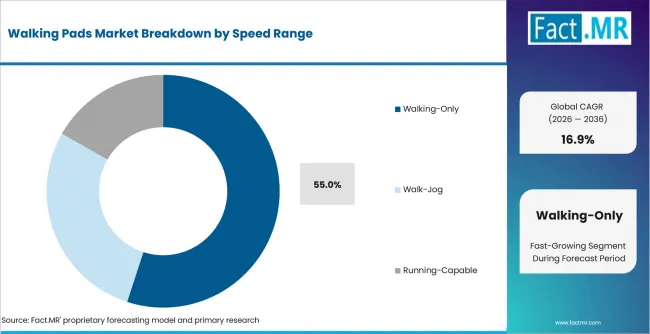
Walking Pads Market Analysis By Speed Range | Source: Fact.MR
Walking-Only models are projected to account for 55.0% share in 2026 because desk walking usually stays below jogging speed. Buyers in this range treat the product as workplace movement equipment rather than training hardware. That use case separates walking pads from broader sports equipment where performance and durability under higher loads matter more.
Which application leads?
Home Office holds 46.0% share in 2026.
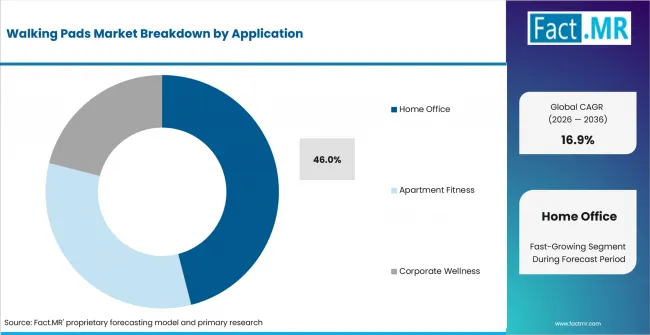
Walking Pads Market Analysis By Application | Source: Fact.MR
Home Office use is forecast to account for 46.0% share in 2026 because walking pads fit the gap between work tasks and daily movement. The United States Bureau of Labor Statistics reported in June 2025 that full-time employed people worked 8.4 hours on average weekdays worked in 2024. App-guided routines can help users structure short walking blocks, which connects the category with home fitness app purchases.
Which buyer type leads?
Individual Consumers hold 58.0% share in 2026.
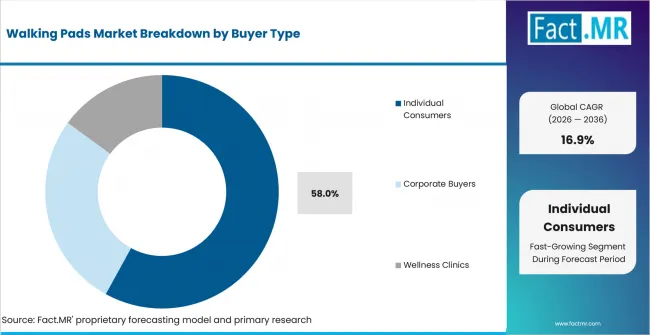
Walking Pads Market Analysis By Buyer Type | Source: Fact.MR
Individual Consumers are estimated to hold 58.0% share in 2026 because most units are bought one at a time for apartments and home offices. Consumer buyers check footprint, sound level and remote reliability before they compare coaching content. Wearable users also pair step goals with wireless health and fitness devices when they want movement data without a gym membership.
Which sales channel leads?
Online Retail holds 62.0% share in 2026.
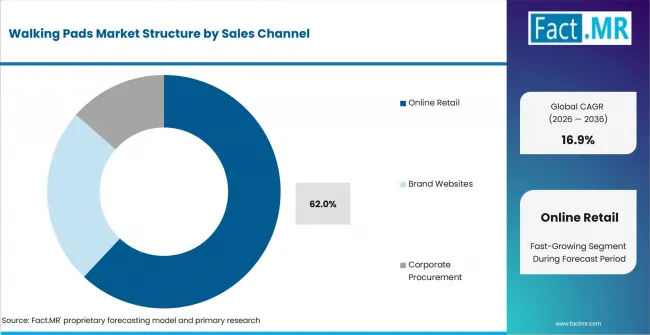
Walking Pads Market Analysis By Sales Channel | Source: Fact.MR
Online Retail is anticipated to hold 62.0% share in 2026 because compact treadmills ship well and buyers depend on reviews. The United States Census Bureau estimated in May 2026 that e-commerce accounted for 16.9% of total retail sales in the first quarter of 2026. This channel share keeps walking pads closer to home-use gym equipment than to dealer-led commercial treadmill procurement.
Which motor type leads?
Quiet DC Motors hold 64.0% share in 2026.

Walking Pads Market Analysis By Motor Type | Source: Fact.MR
Quiet DC Motors are likely to account for 64.0% share in 2026 because calls and shared apartments create a lower noise ceiling. UREVO lists CyberPad office models with a 1 to 6 km/h speed range and 0 to 14% auto-incline, which shows how suppliers now pair low-speed walking with compact exercise functions. Brushless designs overlap with connected training equipment when motor control and tracking are bundled.
Which price tier leads?
Mid Price units hold 47.0% share in 2026.
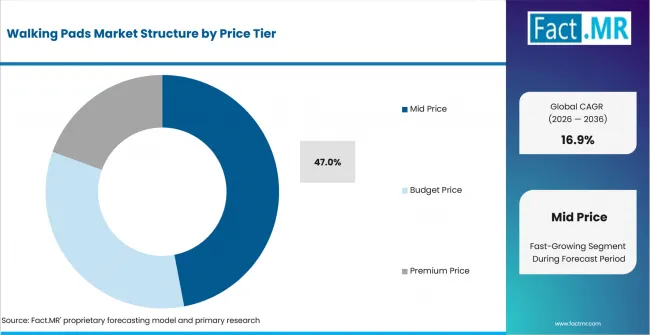
Walking Pads Market Analysis By Price Tier | Source: Fact.MR
Mid Price units are expected to hold 47.0% share in 2026 because buyers avoid the cheapest products when safety and warranty issues are visible. This tier offers stronger frames and quieter motors while staying below full-size treadmill pricing. It also competes for the same home budget that supports functional fitness equipment purchases.
What is accelerating walking pads demand, and what is holding it back?
Hybrid work and small-home fitness needs support demand. Safety recalls, noise complaints and product returns restrain wider use.
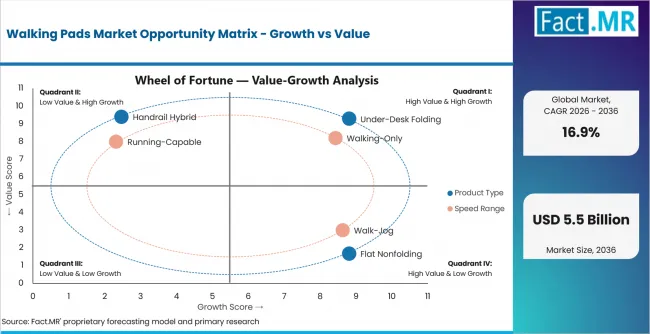
Walking Pads Market Opportunity Matrix Growth Vs Value | Source: Fact.MR
Walking pads fit a workday problem that ordinary treadmills do not solve. Desk workers may want more daily steps but still need to stay near calls and screens. Work pattern supports compact equipment that can be used in short intervals without changing clothes or leaving the desk.
The market is constrained by quality variation and safety exposure. The United States Consumer Product Safety Commission warned consumers in April 2026 to stop using certain Sperax walking pads and treadmills because of fall, burn and fire hazards. That alert does not weaken the whole category but it changes buyer screening. Retailers and employers are expected to give more weight to certified components, service response and clearer user instructions.
Where do the biggest walking pads opportunities sit?
Home-office bundles, employer wellness programs and quiet apartment equipment create the clearest revenue opportunities.
- Home-Office Bundles: Desk sellers and fitness brands can bundle walking pads with standing desks because buyers are already thinking about work posture and movement. Adjacent yoga equipment purchases show how small-format fitness goods can sit near daily routines.
- Employer Wellness Programs: Human resources teams can test a small number of walking pads before buying in bulk. The buyer case is stronger when suppliers document noise level, trip-risk controls and maintenance support.
- Quiet Apartment Equipment: Apartment buyers need low-height equipment that stores quickly and avoids disturbing neighbors. Indoor cycling categories such as turbo trainer products show how quiet operation can justify higher pricing in home fitness.
Which countries are scaling walking pads fastest?
China 19.4% CAGR, United States 18.1% CAGR, United Kingdom 17.6% CAGR, Australia 17.2% CAGR, Canada 16.8% CAGR. Japan 16.3% CAGR, and Germany 15.8% CAGR
Based on regional analysis, the walking pads market is segmented into North America and Europe. East Asia and Asia Pacific are also covered. The country view focuses on desk-work exposure, online retail readiness, compact-home needs and supplier presence.
.webp "Top Country Growth Comparison Walking Pads Market Cagr (2026 2036)")
Top Country Growth Comparison Walking Pads Market Cagr (2026 2036) | Source: Fact.MR
| Country | CAGR |
|---|---|
| China | 19.4% |
| United States | 18.1% |
| United Kingdom | 17.6% |
| Australia | 17.2% |
| Canada | 16.8% |
| Japan | 16.3% |
| Germany | 15.8% |
Source: Fact.MR analysis. Updated Jun 24, 2026
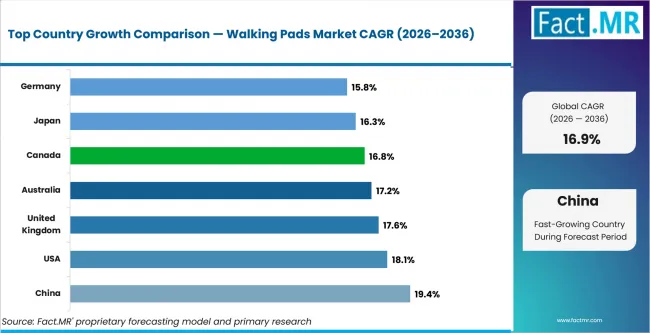
Walking Pads Market Cagr Analysis By Country | Source: Fact.MR
What powers China’s lead?
19.4% CAGR, supported by manufacturing scale and online retail depth.
China combines walking-pad production capacity with a large online buyer base. The National Bureau of Statistics of China reported in January 2025 that online retail sales of physical goods accounted for 26.8% of total retail sales of consumer goods in 2024. That channel structure helps compact treadmill brands test new models quickly and reach apartment buyers without relying on store-floor space. Suppliers with better after-sales parts and safety documentation should gain more durable share through 2036.
Why does the United States matter?
18.1% CAGR, driven by home-based work and e-commerce purchase habits.
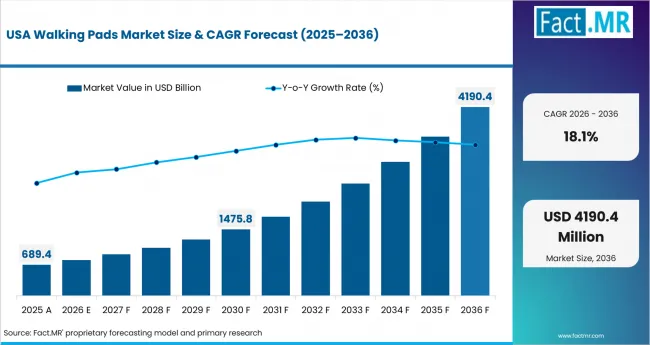
Walking Pads Market Country Value Analysis | Source: Fact.MR
The United States has a large desk-worker base and a retail system that can move bulky home-fitness items through direct shipping. The United States Census Bureau reported in May 2026 that first-quarter e-commerce sales increased 9.7% from the same quarter in 2025. This supports walking-pad sales because buyers can compare reviews and dimensions before purchase. Category growth remains tied to safety confidence and return rates.
What supports the United Kingdom outlook?
17.6% CAGR, attributable to hybrid work and small-home equipment needs.
British buyers often need equipment that fits shared flats and smaller home offices. The Office for National Statistics reported in November 2024 that 28.0% of working adults in Great Britain were hybrid workers. That mix gives walking pads a practical role during desk-based workdays. Retailers that offer clear noise guidance and simple returns should convert more cautious buyers.
How is Australia scaling walking-pad demand?
17.2% CAGR, backed by remote-work continuity and high urban housing costs.
Australia’s walking-pad case starts with the home work setting. The Australian Bureau of Statistics reported in December 2024 that 36.0% of employed people usually worked from home in August 2024. This gives compact treadmills a buyer base that already spends part of the week near a desk. Demand can move faster if suppliers keep delivery cost and warranty service predictable outside the largest cities.
What makes Canada relevant?
16.8% CAGR, driven by telework routines and ergonomics exposure.
Canada’s market is shaped by workers who save commuting time and still need better daily movement. Statistics Canada reported in June 2024 that work-from-home teleworkers reallocated more than one hour per day from commuting to other activities. Walking pads can claim part of that time when they are quiet enough for work calls. Workplace buyers should evaluate trip-risk controls before wider employee reimbursement.
Why is Japan a compact-equipment market?
16.3% CAGR, led by telework use and limited home space.
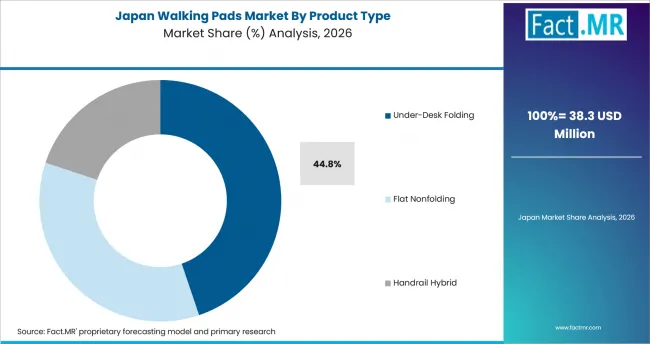
Walking Pads Market Japan Market Share Analysis By Product Type | Source: Fact.MR
Japan has a clear compact-equipment logic because many users balance telework with tight storage space. The Statistics Bureau of Japan reported in September 2025 that 47.3% of enterprises had introduced telework by the end of August 2024. Home-based telework was the most frequent type within that enterprise base. Walking-pad suppliers need thinner storage profiles and reliable service manuals to fit this buyer pattern.
How does Germany shape the European view?
15.8% CAGR, backed by home-office use and stricter product expectations.
Germany’s market is large but more cautious because buyers place more weight on durability and product safety. The ifo Institute reported in March 2025 that 24.5% of employees in Germany worked from home at least part of the time in February 2025. That creates a desk-work base but does not automatically convert into equipment purchases. Suppliers with tested components and transparent repair support are expected to perform better than price-only sellers.
Who leads the walking pads landscape?
WalkingPad, UREVO and Sperax lead visibility through online product depth and compact treadmill positioning. LifeSpan Fitness adds a workplace route through treadmill-desk equipment.
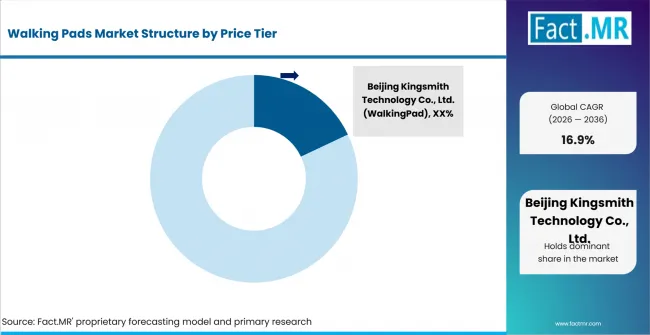
Walking Pads Market Analysis By Company | Source: Fact.MR
Competition is split between specialist walking-pad brands and broader home fitness equipment sellers. Buyers compare folded height, belt width, motor sound and warranty support. The same buyer also considers cardiac rehabilitation devices when walking is positioned as light wellness or recovery support.
WalkingPad uses folding design as its brand anchor and keeps the product close to small-space living. UREVO competes with incline features, brushless motor claims and office-focused units. Sperax sells at mass-market price points but faces higher safety scrutiny after the United States Consumer Product Safety Commission warning. LifeSpan Fitness remains relevant where the buyer wants an integrated treadmill-desk route rather than a consumer pad.
Smaller sellers such as DeerRun, Egofit and Goplus compete through price, compact dimensions and marketplace reviews. Their weak point is often service proof after the sale. Adjacent categories such as aqua gym equipment show that light fitness equipment can hold value when buyers trust the safety case.
Providers that combine quiet operation, stable belt tracking and fast replacement support should be better placed through 2036. Corporate buyers are expected to screen suppliers more tightly than individual consumers. That shift gives branded suppliers a route to higher average selling prices when they can prove safety and support.
Which companies are the key players?
WalkingPad, UREVO and Sperax are key players. LifeSpan Fitness, DeerRun, Egofit and Goplus are also profiled.
- Beijing Kingsmith Technology Co., Ltd. (WalkingPad)
- UREVO Inc.
- Sperax
- LifeSpan Fitness
- DeerRun
- Egofit
- Goplus Corp.
Bibliography
- [1] World Health Organization. (2024, June 26). Physical activity. World Health Organization.
- [2] U.S. Bureau of Labor Statistics. (2025, June 26). American Time Use Survey 2024 results. U.S. Bureau of Labor Statistics.
- [3] U.S. Census Bureau. (2026, May 18). Quarterly retail e-commerce sales: First quarter 2026. U.S. Census Bureau.
- [4] Office for National Statistics. (2024, November 11). Who are the hybrid workers? Office for National Statistics.
- [5] ifo Institute. (2025, March 24). Working from home rate in Germany stabilizes at just under 25%. ifo Institute.
- [6] Statistics Bureau of Japan, Ministry of Internal Affairs and Communications. (2025, September). Statistical Handbook of Japan 2025. Statistics Bureau of Japan.
- [7] Statistics Canada. (2024, June 5). Telework, time use, and well-being: Evidence from the 2022 Time Use Survey. Statistics Canada.
- [8] Australian Bureau of Statistics. (2024, December 9). Working arrangements, August 2024. Australian Bureau of Statistics.
- [9] National Bureau of Statistics of China. (2025, January 24). Total retail sales of consumer goods in December 2024. National Bureau of Statistics of China.
- [10] U.S. Consumer Product Safety Commission. (2026, April 16). CPSC warns consumers to stop using Sperax walking pads and treadmills immediately due to risk of serious injury from fall, burn and fire hazards. U.S. Consumer Product Safety Commission.
- [11] WalkingPad. (2026, May 29). WalkingPad by KingSmith draws attention at RiminiWellness 2026. WalkingPad.
- [12] UREVO. (2025, August 21). UREVO CyberPad review by Prime Technology HD: The intelligent treadmill that transforms your home workouts. UREVO.
This Report Addresses
- Strategic intelligence on walking pads across product type, speed range, application, buyer type and sales channel.
- Segment analysis covering Quiet DC Motors, Online Retail, Individual Consumers, Walking-Only models and Mid Price units.
- Regional outlook covering China, United States, United Kingdom, Australia, Canada, Japan and Germany.
- Competitive analysis of WalkingPad, UREVO and Sperax. LifeSpan Fitness, DeerRun, Egofit and Goplus are also profiled.
- Product assessment covering under-desk folding, flat nonfolding, handrail hybrid and incline walking models.
- Channel assessment covering online retail, brand websites, specialty fitness retailers and corporate procurement.
- Source-led market sizing using desk-worker exposure, online retail evidence, supplier counts, product pricing and safety alerts.
What does the walking pads market cover?
Compact under-desk treadmills and low-profile walking treadmills used for home-office, apartment and light wellness walking.
The walking pads market covers low-profile treadmills that fit under desks or store in small rooms. Products include folding under-desk models, flat walking-only pads and walk-jog hybrid units with detachable rails. The scope includes consumer purchases, employer wellness purchases and specialty wellness channel sales.
What is included in the scope?
Walking pads, compact treadmill bases, app-connected models, workday walking units and related direct-to-consumer sales.
The scope includes walking pads sold through brand websites, online marketplaces and specialty fitness retailers. It covers home-office use, apartment fitness, corporate wellness and light rehabilitation walking. Accessories bundled with the unit are counted when they are sold with the pad.
What is excluded from the scope?
Full-size running treadmills, commercial gym treadmills and ordinary fitness apps sold without walking-pad hardware.
The scope excludes full-size running treadmills designed for high-speed training. It also excludes gym-grade treadmill lines, outdoor walking equipment and standalone fitness subscriptions. Desk converters and office furniture are excluded unless they are bundled with a walking-pad system.
How was the analysis built?
80+ sources and 40+ company or retailer pages. 25+ countries were checked with 18+ buyer and channel assumptions.
- Primary Research: Interviews and channel checks covered fitness equipment distributors, workplace wellness buyers and online sellers. Buyer checks focused on noise level, storage height, return rate and warranty support.
- Desk Research: Desk research reviewed government labor data, public-health statistics, official safety alerts and company product pages. The review excluded syndicated market research figures and commercial market-size pages.
- Market-Sizing and Forecasting: Forecasting used an average selling price model and a shipment range model. The model was tested against hybrid-work data, online retail share and active supplier counts.
- Data Validation and Update Cycle: Estimates were checked against WalkingPad, UREVO, Sperax and LifeSpan product evidence. Safety alerts and remote-work updates were used to adjust replacement and quality-screening assumptions.
Segmentation
What is the report’s scope and coverage?
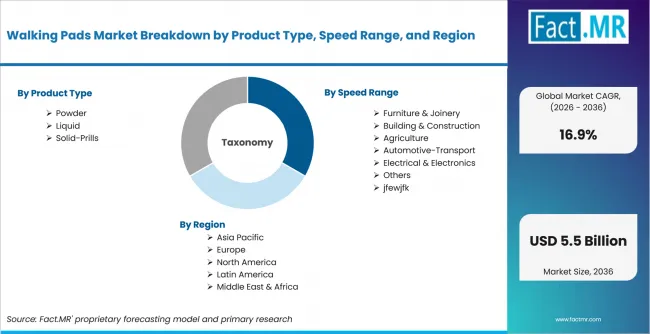
Walking Pads Market Breakdown By Product Type, Speed Range, And Region | Source: Fact.MR
| Attribute | Details |
|---|---|
| Quantitative Units | USD Billion in 2026 to USD Billion by 2036 at CAGR |
| Market Definition | Compact under-desk treadmills and low-profile walking units used for home-office, apartment and light wellness walking |
| Product Type | Under-Desk Folding, Flat Nonfolding, Handrail Hybrid, Incline Walking |
| Speed Range | Walking-Only, Walk-Jog, Running-Capable |
| Application | Home Office, Apartment Fitness, Corporate Wellness, Rehabilitation Walking |
| Buyer Type | Individual Consumers, Corporate Buyers, Wellness Clinics, Hotels Apartments |
| Sales Channel | Online Retail, Brand Websites, Specialty Fitness, Corporate Procurement |
| Motor Type | Quiet DC Motors, Brushless Motors, Standard AC |
| Price Tier | Budget Price, Mid Price, Premium Price |
| Regions Covered | North America, Europe, East Asia, Asia Pacific, Latin America, Middle East and Africa |
| Countries Covered | China, United States, United Kingdom, Australia, Canada, Japan and Germany |
| Key Companies Profiled | WalkingPad, UREVO, Sperax, LifeSpan Fitness, DeerRun, Egofit and Goplus |
| Forecast Period | 2026 to 2036 |
| Approach | Hybrid top-down and bottom-up approach using desk-worker exposure, online retail evidence, supplier counts, product pricing and safety alerts |
Source: Fact.MR analysis. Updated Jun 24, 2026
How is the market segmented?
-
By Product Type:
- Under-Desk Folding
- Flat Nonfolding
- Handrail Hybrid
- Incline Walking
-
By Speed Range:
- Walking-Only
- Walk-Jog
- Running-Capable
-
By Application:
- Home Office
- Apartment Fitness
- Corporate Wellness
- Rehabilitation Walking
-
By Buyer Type:
- Individual Consumers
- Corporate Buyers
- Wellness Clinics
- Hotels Apartments
-
By Sales Channel:
- Online Retail
- Brand Websites
- Specialty Fitness
- Corporate Procurement
-
By Motor Type:
- Quiet DC Motors
- Brushless Motors
- Standard AC
-
By Price Tier:
- Budget Price
- Mid Price
- Premium Price
-
By Region:
- North America
- United States
- Canada
- Mexico
- Latin America
- Brazil
- Argentina
- Rest of Latin America
- Europe
- Germany
- United Kingdom
- France
- Italy
- Spain
- Rest of Europe
- Asia Pacific
- China
- India
- Japan
- South Korea
- Australia
- ASEAN
- Middle East & Africa
- GCC Countries
- South Africa
- UAE
- Rest of Middle East & Africa
- North America
Frequently Asked Questions
How large is the Walking Pads Market expected to be in the near term?
What is the long term outlook for the Walking Pads Market?
How fast is the Walking Pads Market expected to grow?
What is the main driver behind walking pad adoption?
Which product type leads the Walking Pads Market?
Which application segment dominates demand?
Which sales channel is most important for walking pad purchases?
Which motor type is most commonly preferred?
Which price tier sees the highest adoption?
Which regions show strong walking pad adoption?
Why is the United States an important market?
What supports China’s leading position in the market?
What supports growth in the United Kingdom?
What restrains wider walking pad adoption?
Who are the leading companies in the Walking Pads Market?
How do brands differentiate walking pad products?
Where do future opportunities in the market lie?
Who worked on this report


Preview the report firsthand - request a free sample
Free SampleGet the brochure for pricing and purchase details
Download PDF